
Industrial supplier Fastenal (NASDAQ:FAST) reported results in line with analysts' expectations in Q2 CY2024, with revenue up 1.8% year on year to $1.92 billion. It made a GAAP profit of $0.51 per share, down from its profit of $0.52 per share in the same quarter last year.
Is now the time to buy Fastenal? Find out by accessing our full research report, it's free.
Fastenal (FAST) Q2 CY2024 Highlights:
- Revenue: $1.92 billion vs analyst estimates of $1.91 billion (small beat)
- EPS: $0.51 vs analyst expectations of $0.51 (in line)
- Gross Margin (GAAP): 45.1%, down from 45.5% in the same quarter last year
- Free Cash Flow of $201.9 million, down 29.1% from the previous quarter
- Sales Volumes rose 11.4% year on year, in line with the same quarter last year
- Market Capitalization: $36.74 billion
Founded in 1967, Fastenal (NASDAQ:FAST) provides industrial and construction supplies, including fasteners, tools, safety products, and many other product categories to businesses globally.
Maintenance and Repair Distributors
Supply chain and inventory management are themes that grew in focus after COVID wreaked havoc on the global movement of raw materials and components. Maintenance and repair distributors that boast reliable selection and quickly deliver products to customers can benefit from this theme. While e-commerce hasn’t disrupted industrial distribution as much as consumer retail, it is still a real threat, forcing investment in omnichannel capabilities to serve customers everywhere. Additionally, maintenance and repair distributors are at the whim of economic cycles that impact the capital spending and construction projects that can juice demand.
Sales Growth
A company’s long-term performance can give signals about its business quality. Even a bad business can shine for one or two quarters, but a top-tier one tends to grow for years. Unfortunately, Fastenal's 7.4% annualized revenue growth over the last five years was mediocre. This shows it couldn't expand in any major way and is a tough starting point for our analysis. 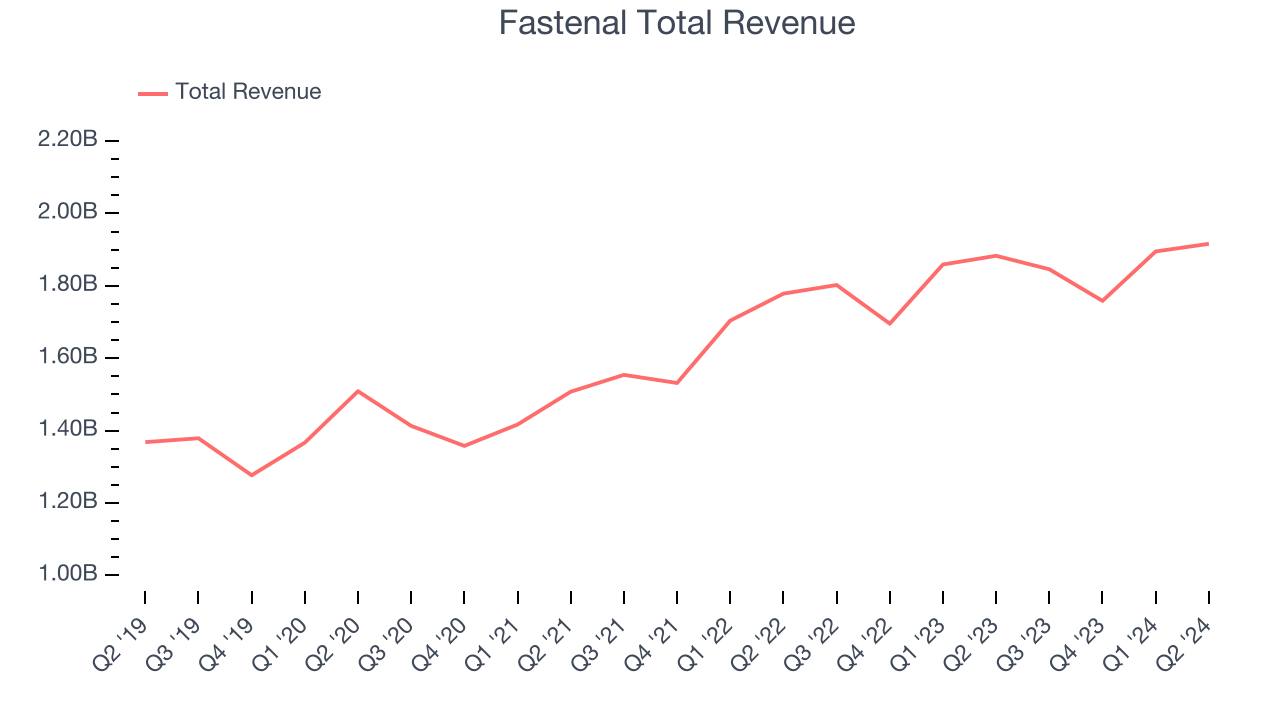
We at StockStory place the most emphasis on long-term growth, but within industrials, a half-decade historical view may miss cycles, industry trends, or a company capitalizing on catalysts such as a new contract win or a successful product line. Fastenal's recent history shows its demand slowed as its annualized revenue growth of 6.3% over the last two years is below its five-year trend.
We can dig further into the company's revenue dynamics by analyzing its sales volumes, which reached 119,306 in the latest quarter. Over the last two years, Fastenal's sales volumes averaged 10.6% year-on-year growth. Because this number is better than its revenue growth, we can see the company's average selling price decreased. 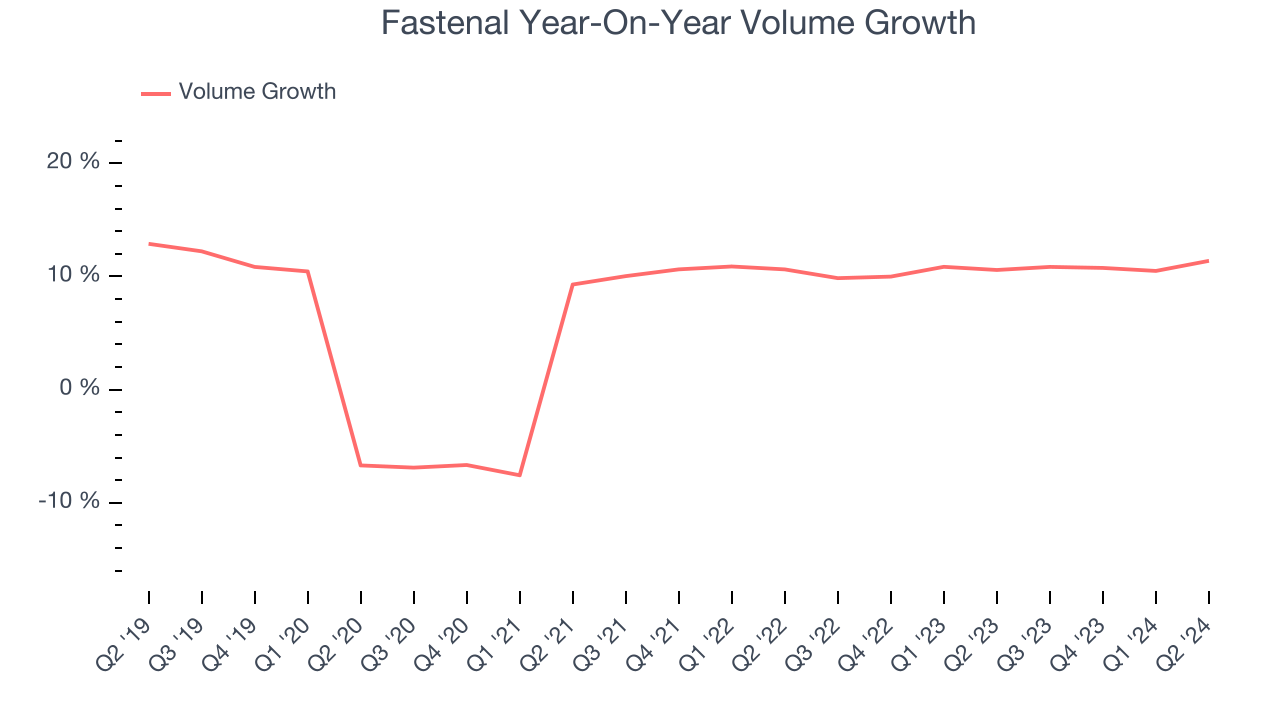
This quarter, Fastenal grew its revenue by 1.8% year on year, and its $1.92 billion of revenue was in line with Wall Street's estimates. Looking ahead, Wall Street expects sales to grow 4.9% over the next 12 months, an acceleration from this quarter.
Today’s young investors won’t have read the timeless lessons in Gorilla Game: Picking Winners In High Technology because it was written more than 20 years ago when Microsoft and Apple were first establishing their supremacy. But if we apply the same principles, then enterprise software stocks leveraging their own generative AI capabilities may well be the Gorillas of the future. So, in that spirit, we are excited to present our Special Free Report on a profitable, fast-growing enterprise software stock that is already riding the automation wave and looking to catch the generative AI next.
Operating Margin
Operating margin is an important measure of profitability. It’s the portion of revenue left after accounting for all core expenses–everything from the cost of goods sold to advertising and wages. Operating margin is also useful for comparing profitability across companies with different levels of debt and tax rates because it excludes interest and taxes.
Fastenal has been a well-oiled machine over the last five years. It demonstrated elite profitability for an industrials business, boasting an average operating margin of 20.5%. This isn't surprising as its high gross margin gives it a favorable starting point.
Analyzing the trend in its profitability, Fastenal's annual operating margin might have seen some fluctuations but has generally stayed the same over the last five years, highlighting the long-term consistency of its business.
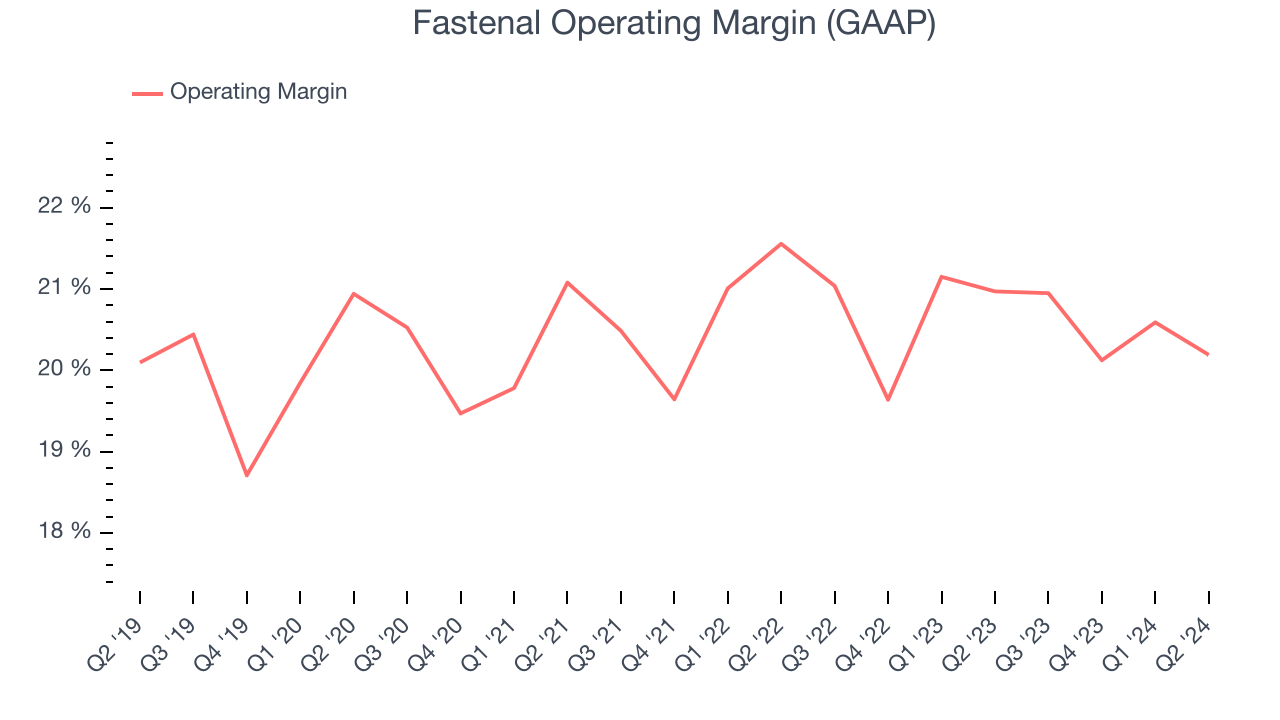
In Q2, Fastenal generated an operating profit margin of 20.2%, in line with the same quarter last year. This indicates the company's cost structure has recently been stable.
EPS
We track the long-term growth in earnings per share (EPS) for the same reason as long-term revenue growth. Compared to revenue, however, EPS highlights whether a company's growth was profitable.
Fastenal's EPS grew at a decent 8.5% compounded annual growth rate over the last five years, higher than its 7.4% annualized revenue growth. However, this alone doesn't tell us much about its day-to-day operations because its operating margin didn't expand.
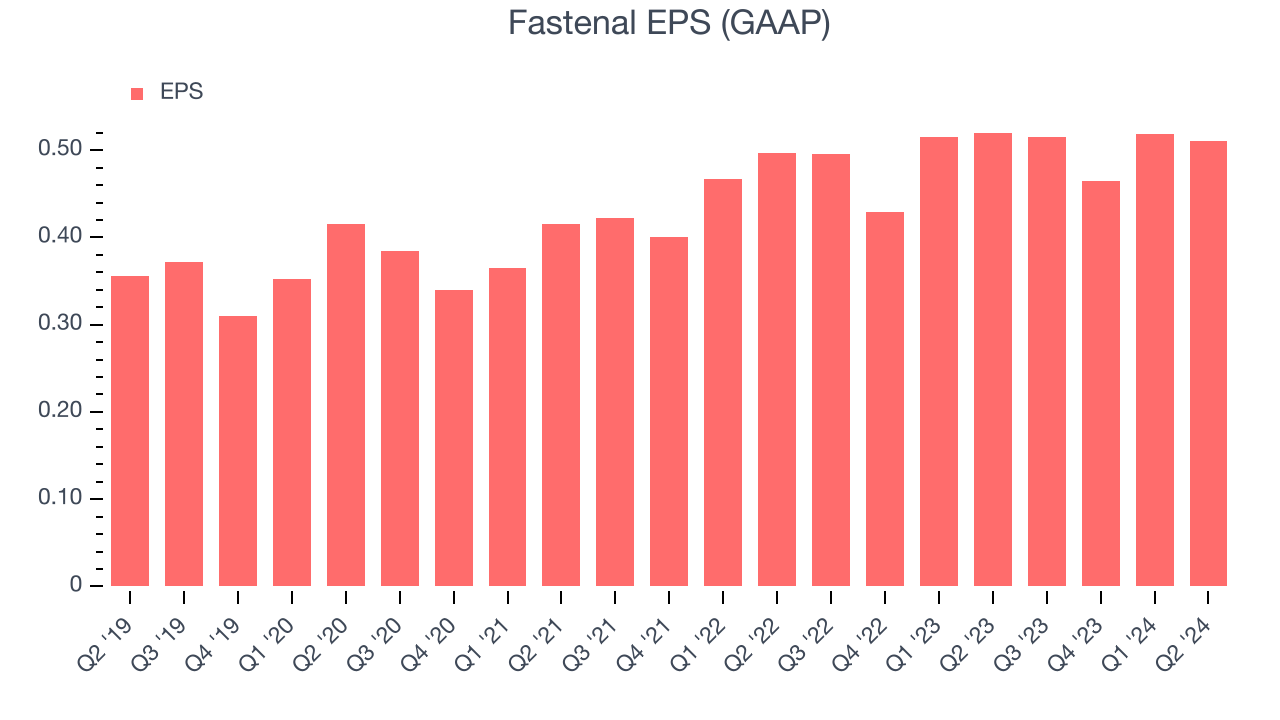
Like with revenue, we also analyze EPS over a shorter period to see if we are missing a change in the business. For Fastenal, its two-year annual EPS growth of 6% was lower than its five-year trend. We hope its growth can accelerate in the future.
In Q2, Fastenal reported EPS at $0.51, down from $0.52 in the same quarter last year. This print was close to analysts' estimates. Over the next 12 months, Wall Street expects Fastenal to grow its earnings. Analysts are projecting its EPS of $2.01 in the last year to climb by 3.5% to $2.08.
Key Takeaways from Fastenal's Q2 Results
Revenue beat by a bit and EPS was in line. While it wasn't the most exciting quarter, it shows that the company is squarely on track and performing as expected. Fastenal said "We experienced higher unit sales in the second quarter of 2024 primarily due to growth with larger customers and Onsite locations opened in the last two years." The stock traded up 1.4% to $65.09 immediately after reporting.
So should you invest in Fastenal right now? When making that decision, it's important to consider its valuation, business qualities, as well as what has happened in the latest quarter. We cover that in our actionable full research report which you can read here, it's free.