
Autonomous driving technology company Mobileye (NASDAQ:MBLY) announced better-than-expected revenue in Q3 CY2025, with sales up 3.7% year on year to $504 million. The company’s full-year revenue guidance of $1.87 billion at the midpoint came in 0.6% above analysts’ estimates. Its non-GAAP profit of $0.09 per share was in line with analysts’ consensus estimates.
Is now the time to buy Mobileye? Find out by accessing our full research report, it’s free for active Edge members.
Mobileye (MBLY) Q3 CY2025 Highlights:
- Revenue: $504 million vs analyst estimates of $481.8 million (3.7% year-on-year growth, 4.6% beat)
- Adjusted EPS: $0.09 vs analyst estimates of $0.09 (in line)
- Adjusted EBITDA: $92 million vs analyst estimates of $90.28 million (18.3% margin, 1.9% beat)
- Operating Margin: -21.6%, up from -578% in the same quarter last year
- Free Cash Flow Margin: 28.4%, up from 21.4% in the same quarter last year
- Market Capitalization: $8.5 billion
Company Overview
With its EyeQ chips installed in over 200 million vehicles worldwide, Mobileye (NASDAQ:MBLY) develops advanced driver assistance systems and autonomous driving technologies that help vehicles detect and respond to road conditions.
Revenue Growth
A company’s long-term sales performance can indicate its overall quality. Any business can put up a good quarter or two, but the best consistently grow over the long haul. Luckily, Mobileye’s sales grew at an incredible 18% compounded annual growth rate over the last five years. Its growth beat the average industrials company and shows its offerings resonate with customers.
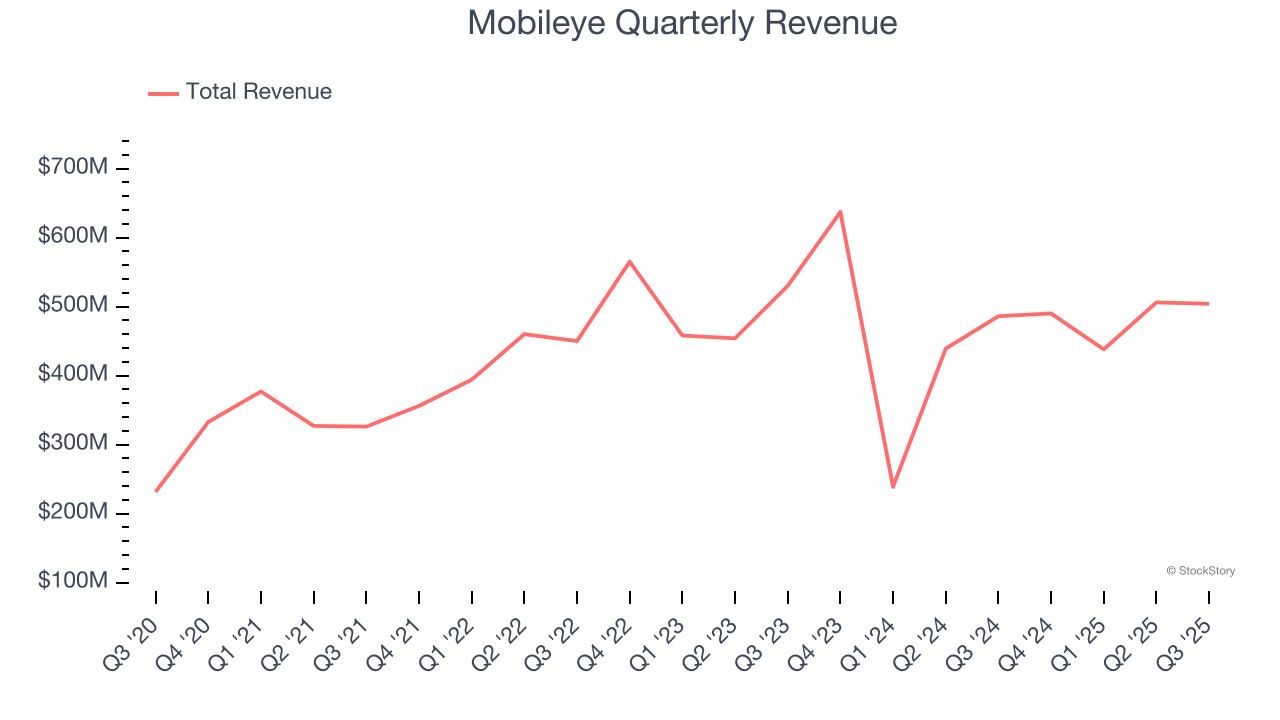
We at StockStory place the most emphasis on long-term growth, but within industrials, a half-decade historical view may miss cycles, industry trends, or a company capitalizing on catalysts such as a new contract win or a successful product line. Mobileye’s recent performance marks a sharp pivot from its five-year trend as its revenue has shown annualized declines of 1.7% over the last two years. 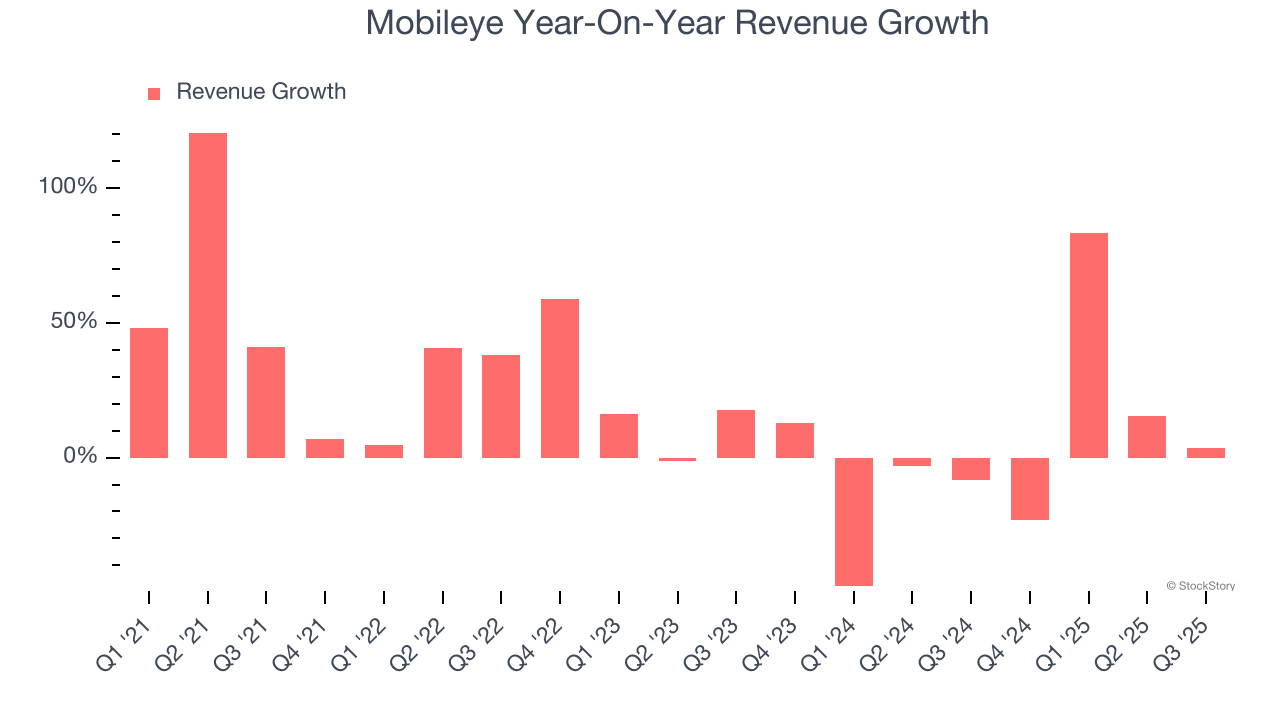
This quarter, Mobileye reported modest year-on-year revenue growth of 3.7% but beat Wall Street’s estimates by 4.6%.
Looking ahead, sell-side analysts expect revenue to decline by 1.9% over the next 12 months, similar to its two-year rate. This projection is underwhelming and suggests its newer products and services will not accelerate its top-line performance yet.
Software is eating the world and there is virtually no industry left that has been untouched by it. That drives increasing demand for tools helping software developers do their jobs, whether it be monitoring critical cloud infrastructure, integrating audio and video functionality, or ensuring smooth content streaming. Click here to access a free report on our 3 favorite stocks to play this generational megatrend.
Operating Margin
Mobileye’s high expenses have contributed to an average operating margin of negative 41.8% over the last five years. Unprofitable industrials companies require extra attention because they could get caught swimming naked when the tide goes out. It’s hard to trust that the business can endure a full cycle.
Looking at the trend in its profitability, Mobileye’s operating margin decreased by 18.2 percentage points over the last five years. This raises questions about the company’s expense base because its revenue growth should have given it leverage on its fixed costs, resulting in better economies of scale and profitability. Mobileye’s performance was poor no matter how you look at it - it shows that costs were rising and it couldn’t pass them onto its customers.
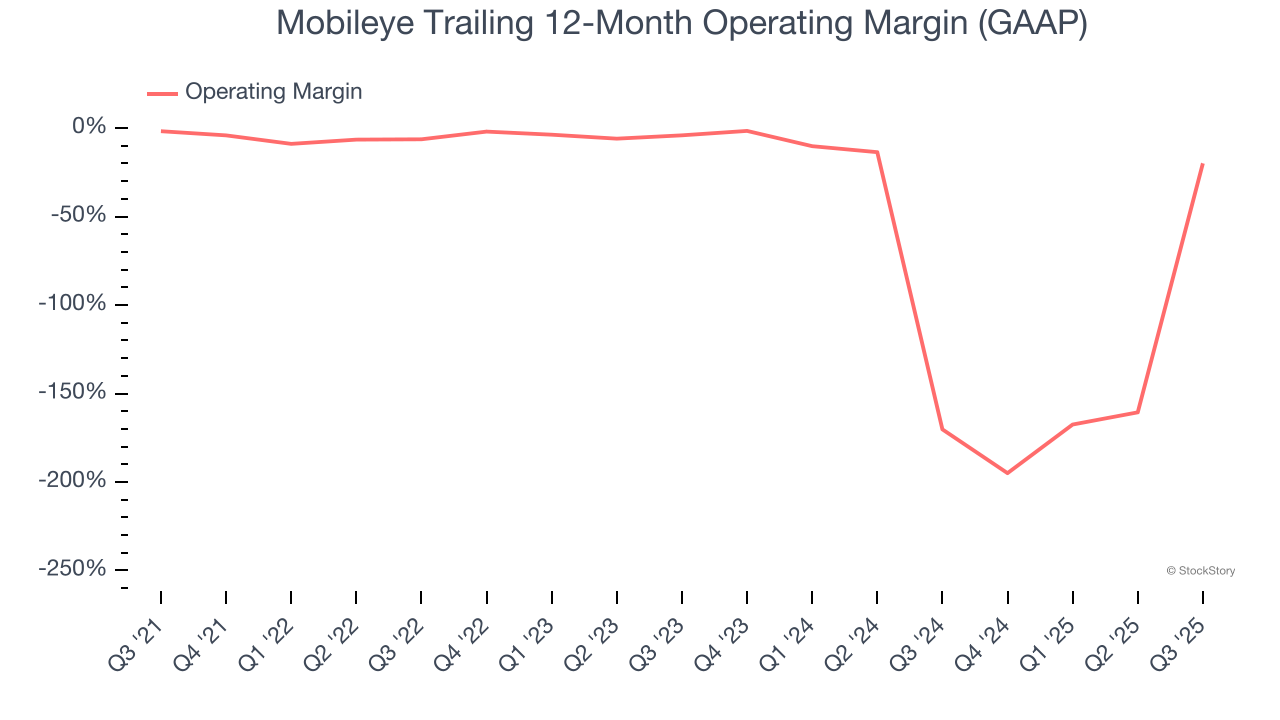
In Q3, Mobileye generated a negative 21.6% operating margin.
Cash Is King
Although earnings are undoubtedly valuable for assessing company performance, we believe cash is king because you can’t use accounting profits to pay the bills.
Mobileye has shown terrific cash profitability, putting it in an advantageous position to invest in new products, return capital to investors, and consolidate the market during industry downturns. The company’s free cash flow margin was among the best in the industrials sector, averaging 23% over the last five years. The divergence from its underwhelming operating margin stems from the add-back of non-cash charges like depreciation and stock-based compensation. GAAP operating profit expenses these line items, but free cash flow does not.
Taking a step back, we can see that Mobileye’s margin expanded by 2.2 percentage points during that time. This shows the company is heading in the right direction, and we can see it became a less capital-intensive business because its free cash flow profitability rose while its operating profitability fell.
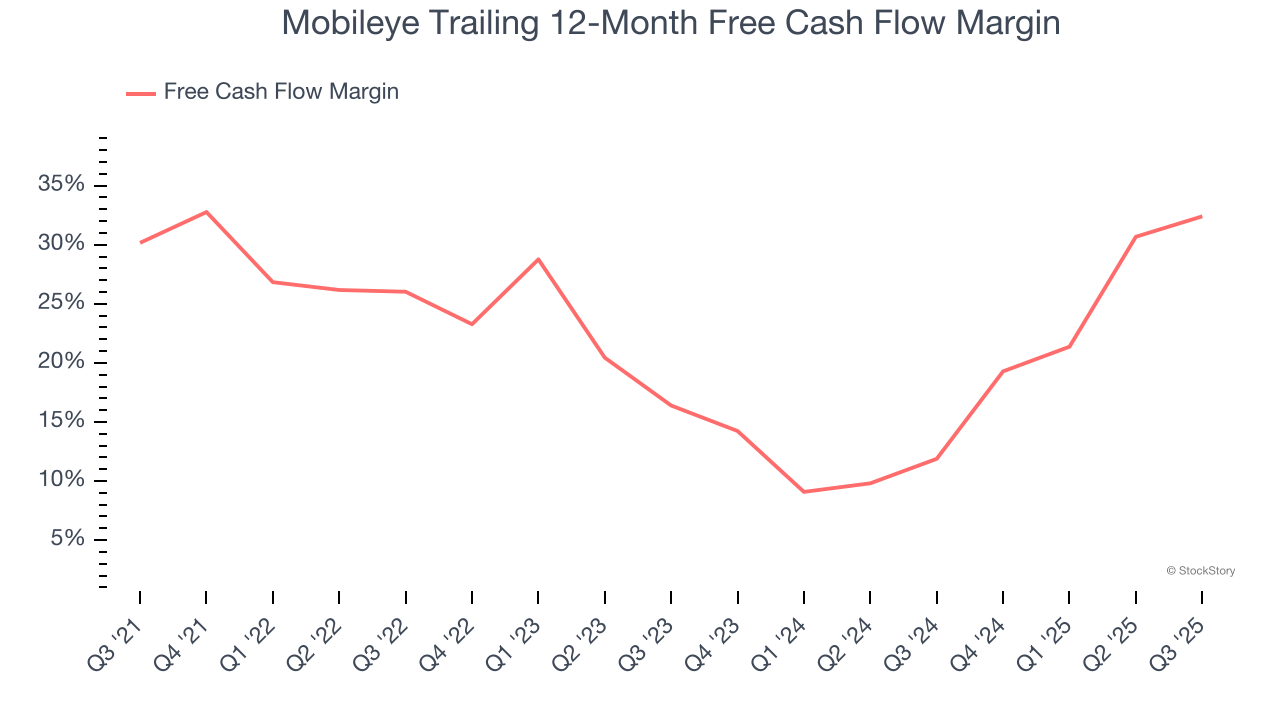
Mobileye’s free cash flow clocked in at $143 million in Q3, equivalent to a 28.4% margin. This result was good as its margin was 7 percentage points higher than in the same quarter last year, building on its favorable historical trend.
Key Takeaways from Mobileye’s Q3 Results
We were impressed by how significantly Mobileye blew past analysts’ revenue expectations this quarter. We were also glad its adjusted operating income outperformed Wall Street’s estimates. Overall, we think this was a decent quarter with some key metrics above expectations. The stock remained flat at $10.42 immediately after reporting.
Big picture, is Mobileye a buy here and now? The latest quarter does matter, but not nearly as much as longer-term fundamentals and valuation, when deciding if the stock is a buy. We cover that in our actionable full research report which you can read here, it’s free for active Edge members.