
Semiconductor photomask manufacturer Photronics (NASDAQ:PLAB) beat Wall Street’s revenue expectations in Q3 CY2025, but sales fell by 3.1% year on year to $215.8 million. On top of that, next quarter’s revenue guidance ($221 million at the midpoint) was surprisingly good and 6.7% above what analysts were expecting. Its non-GAAP profit of $0.60 per share was 34.8% above analysts’ consensus estimates.
Is now the time to buy Photronics? Find out by accessing our full research report, it’s free for active Edge members.
Photronics (PLAB) Q3 CY2025 Highlights:
- Revenue: $215.8 million vs analyst estimates of $204.5 million (3.1% year-on-year decline, 5.5% beat)
- Adjusted EPS: $0.60 vs analyst estimates of $0.45 (34.8% beat)
- Adjusted EBITDA: $73.86 million vs analyst estimates of $64.2 million (34.2% margin, 15.1% beat)
- Revenue Guidance for Q4 CY2025 is $221 million at the midpoint, above analyst estimates of $207 million
- Adjusted EPS guidance for Q4 CY2025 is $0.55 at the midpoint, above analyst estimates of $0.45
- Operating Margin: 24.1%, in line with the same quarter last year
- Free Cash Flow Margin: 9.4%, down from 11.3% in the same quarter last year
- Inventory Days Outstanding: 40, down from 41 in the previous quarter
- Market Capitalization: $1.52 billion
Commenting on the fourth-quarter performance, Chairman and CEO George Macricostas said, "Photronics delivered very good results in our fiscal fourth quarter achieving record high end revenue with particular strength in the United States. We continue to see positive forecasts from our customers in the U.S. validating our U.S. investment plans, while our Korea capability extension is also anticipated to help diversify our geographic revenue mix and increase our exposure to leading-edge chip designs in the future.”
Company Overview
Sporting a global footprint of facilities, Photronics (NASDAQ:PLAB) is a manufacturer of photomasks, templates used to transfer patterns onto semiconductor wafers.
Revenue Growth
Reviewing a company’s long-term sales performance reveals insights into its quality. Any business can experience short-term success, but top-performing ones enjoy sustained growth for years. Luckily, Photronics’s sales grew at a decent 6.9% compounded annual growth rate over the last five years. Its growth was slightly above the average semiconductor company and shows its offerings resonate with customers. Semiconductors are a cyclical industry, and long-term investors should be prepared for periods of high growth followed by periods of revenue contractions.
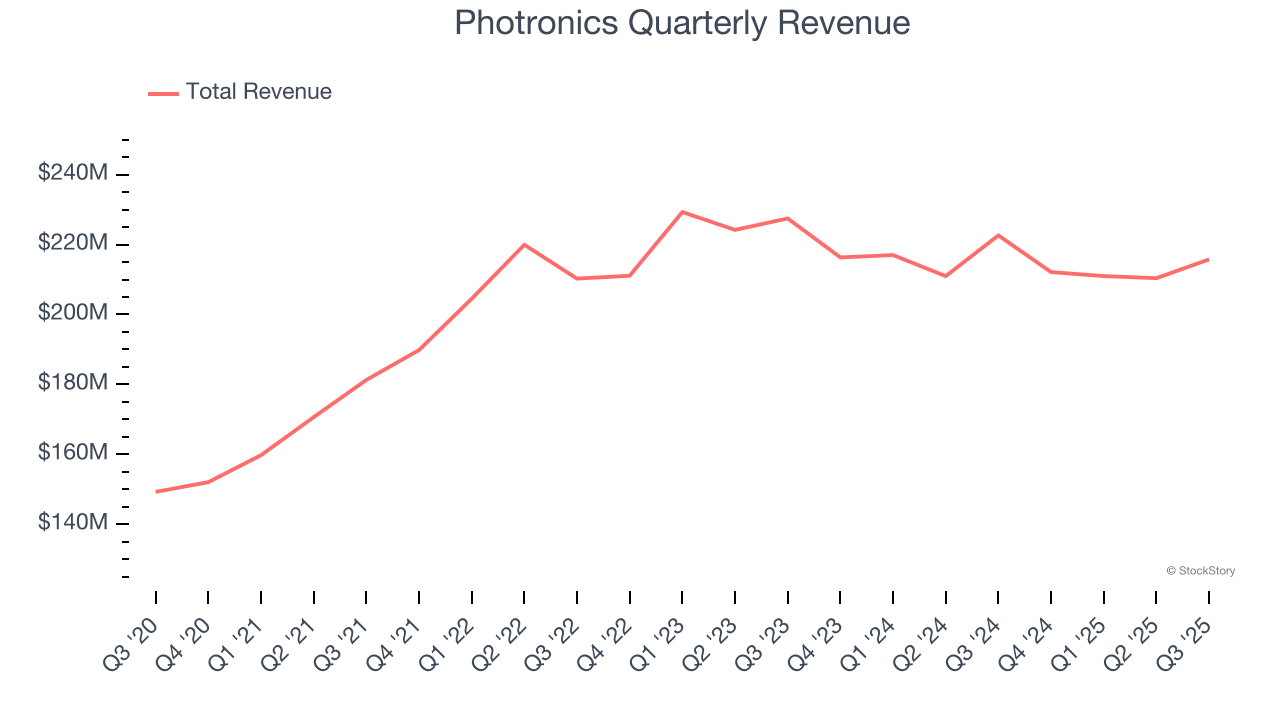
Long-term growth is the most important, but short-term results matter for semiconductors because the rapid pace of technological innovation (Moore's Law) could make yesterday's hit product obsolete today. Photronics’s recent performance marks a sharp pivot from its five-year trend as its revenue has shown annualized declines of 2.4% over the last two years. 
This quarter, Photronics’s revenue fell by 3.1% year on year to $215.8 million but beat Wall Street’s estimates by 5.5%. Despite the beat, the drop in sales could mean that the current downcycle is deepening. Company management is currently guiding for a 4.2% year-on-year increase in sales next quarter.
Looking further ahead, sell-side analysts expect revenue to grow 3.9% over the next 12 months. While this projection suggests its newer products and services will fuel better top-line performance, it is still below average for the sector.
Microsoft, Alphabet, Coca-Cola, Monster Beverage—all began as under-the-radar growth stories riding a massive trend. We’ve identified the next one: a profitable AI semiconductor play Wall Street is still overlooking. Go here for access to our full report.
Product Demand & Outstanding Inventory
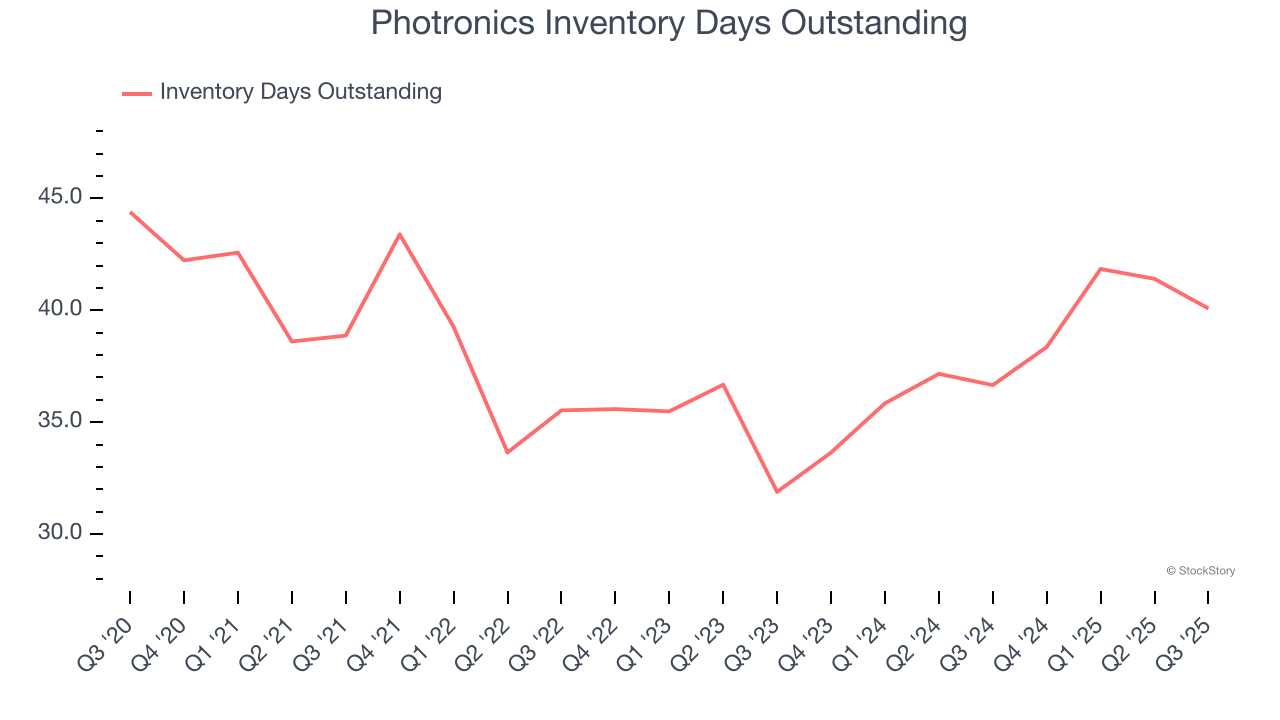
Days Inventory Outstanding (DIO) is an important metric for chipmakers, as it reflects a business’ capital intensity and the cyclical nature of semiconductor supply and demand. In a tight supply environment, inventories tend to be stable, allowing chipmakers to exert pricing power. Steadily increasing DIO can be a warning sign that demand is weak, and if inventories continue to rise, the company may have to downsize production.
This quarter, Photronics’s DIO came in at 40, which is 2 more days than its five-year average. These numbers suggest that despite the recent decrease, the company’s inventory levels are slightly above the long-term average.
Key Takeaways from Photronics’s Q3 Results
It was good to see Photronics beat analysts’ EPS expectations this quarter. We were also glad its revenue guidance for next quarter exceeded Wall Street’s estimates. Zooming out, we think this quarter featured some important positives. The stock traded up 11.5% to $28.65 immediately after reporting.
Indeed, Photronics had a rock-solid quarterly earnings result, but is this stock a good investment here? What happened in the latest quarter matters, but not as much as longer-term business quality and valuation, when deciding whether to invest in this stock. We cover that in our actionable full research report which you can read here, it’s free for active Edge members.