
Since July 2025, Purple has been in a holding pattern, posting a small return of 1.4% while floating around $0.73. The stock also fell short of the S&P 500’s 10.5% gain during that period.
Is now the time to buy Purple, or should you be careful about including it in your portfolio? See what our analysts have to say in our full research report, it’s free.
Why Do We Think Purple Will Underperform?
We don't have much confidence in Purple. Here are three reasons why PRPL doesn't excite us and a stock we'd rather own.
1. Revenue Spiraling Downwards
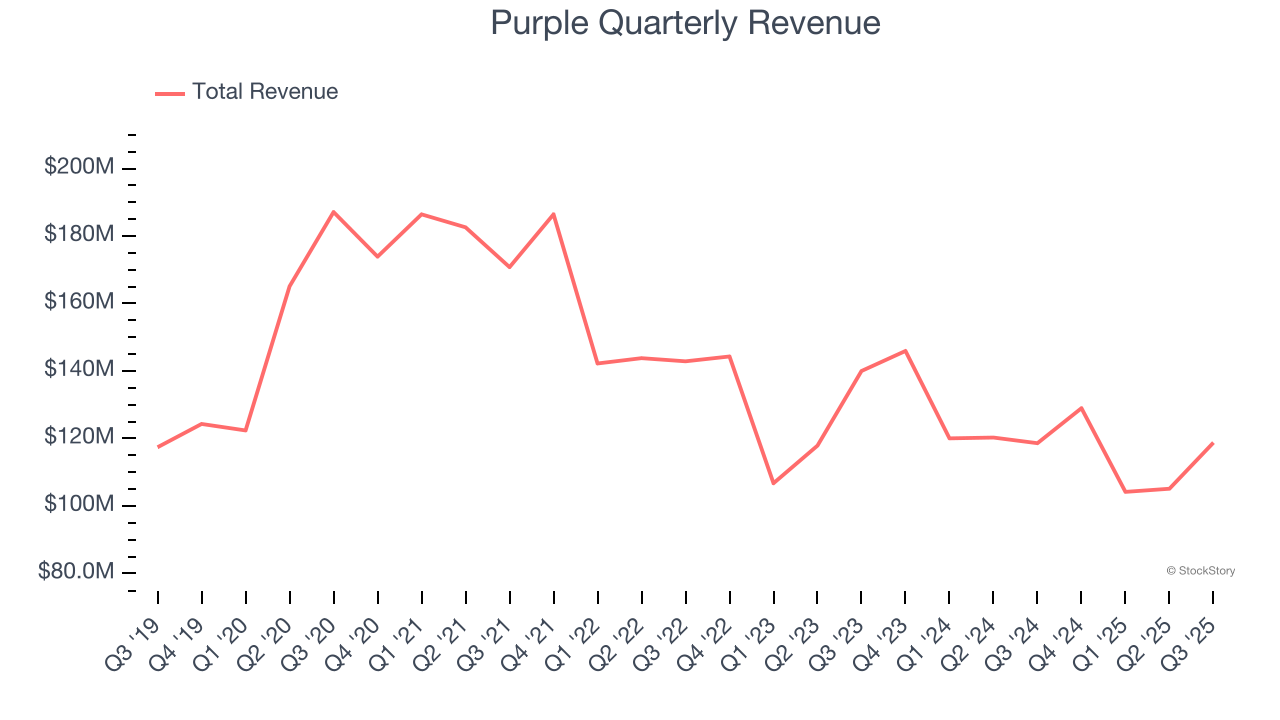
A company’s long-term performance is an indicator of its overall quality. Any business can put up a good quarter or two, but many enduring ones grow for years. Purple struggled to consistently generate demand over the last five years as its sales dropped at a 5.3% annual rate. This was below our standards and is a sign of poor business quality.
2. New Investments Fail to Bear Fruit as ROIC Declines
ROIC, or return on invested capital, is a metric showing how much operating profit a company generates relative to the money it has raised (debt and equity).
We like to invest in businesses with high returns, but the trend in a company’s ROIC is what often surprises the market and moves the stock price. Unfortunately, Purple’s ROIC has decreased significantly over the last few years. Paired with its already low returns, these declines suggest its profitable growth opportunities are few and far between.
3. Short Cash Runway Exposes Shareholders to Potential Dilution
As long-term investors, the risk we care about most is the permanent loss of capital, which can happen when a company goes bankrupt or raises money from a disadvantaged position. This is separate from short-term stock price volatility, something we are much less bothered by.
Purple burned through $28.43 million of cash over the last year, and its $224.3 million of debt exceeds the $32.36 million of cash on its balance sheet. This is a deal breaker for us because indebted loss-making companies spell trouble.
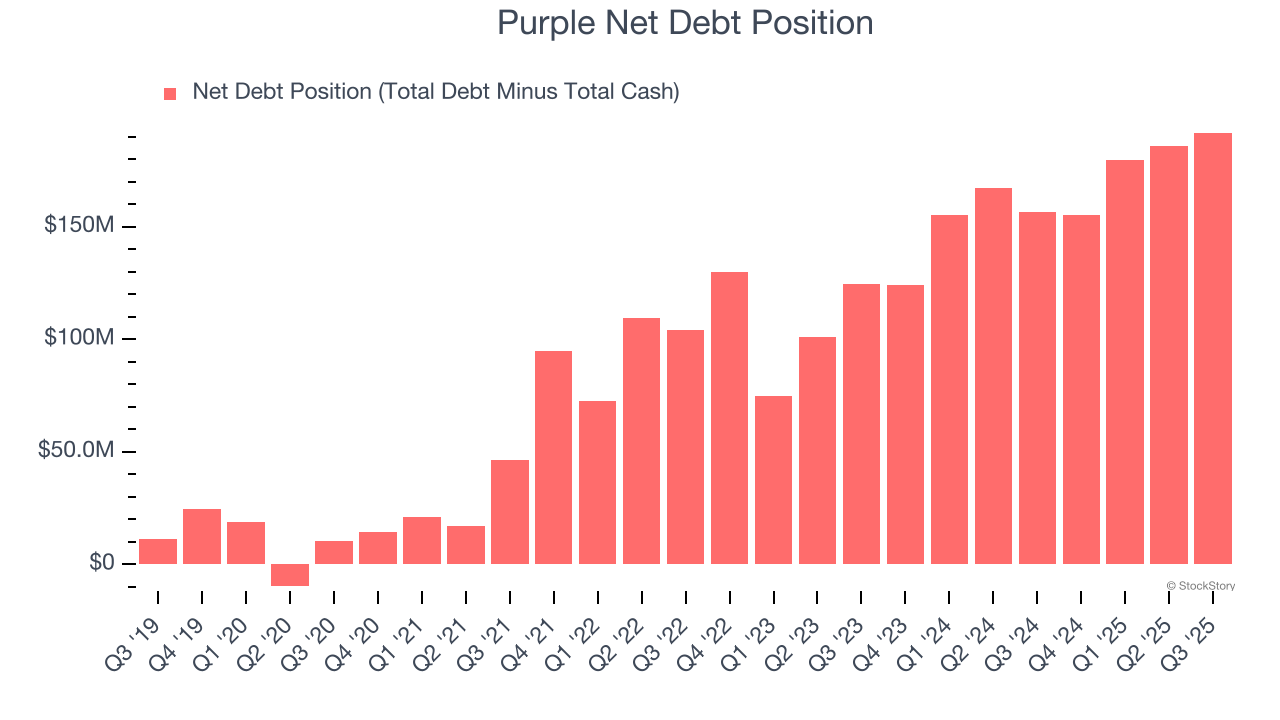
Unless the Purple’s fundamentals change quickly, it might find itself in a position where it must raise capital from investors to continue operating. Whether that would be favorable is unclear because dilution is a headwind for shareholder returns.
We remain cautious of Purple until it generates consistent free cash flow or any of its announced financing plans materialize on its balance sheet.
Final Judgment
We see the value of companies helping consumers, but in the case of Purple, we’re out. With its shares trailing the market in recent months, the stock trades at 17.4× forward EV-to-EBITDA (or $0.73 per share). At this valuation, there’s a lot of good news priced in - you can find more timely opportunities elsewhere. We’d recommend looking at one of Charlie Munger’s all-time favorite businesses.
High-Quality Stocks for All Market Conditions
Your portfolio can’t afford to be based on yesterday’s story. The risk in a handful of heavily crowded stocks is rising daily.
The names generating the next wave of massive growth are right here in our Top 9 Market-Beating Stocks. This is a curated list of our High Quality stocks that have generated a market-beating return of 244% over the last five years (as of June 30, 2025).
Stocks that have made our list include now familiar names such as Nvidia (+1,326% between June 2020 and June 2025) as well as under-the-radar businesses like the once-small-cap company Comfort Systems (+782% five-year return). Find your next big winner with StockStory today.