
Enterprise data capture company Zebra Technologies (NASDAQ:ZBRA) reported Q4 CY2025 results topping the market’s revenue expectations, with sales up 10.6% year on year to $1.48 billion. On top of that, next quarter’s revenue guidance ($1.48 billion at the midpoint) was surprisingly good and 3.2% above what analysts were expecting. Its non-GAAP profit of $4.33 per share was in line with analysts’ consensus estimates.
Is now the time to buy Zebra? Find out by accessing our full research report, it’s free.
Zebra (ZBRA) Q4 CY2025 Highlights:
- Revenue: $1.48 billion vs analyst estimates of $1.46 billion (10.6% year-on-year growth, 1.2% beat)
- Adjusted EPS: $4.33 vs analyst estimates of $4.33 (in line)
- Adjusted EBITDA: $326 million vs analyst estimates of $322.6 million (22.1% margin, 1.1% beat)
- Revenue Guidance for Q1 CY2026 is $1.48 billion at the midpoint, above analyst estimates of $1.43 billion
- Adjusted EPS guidance for the upcoming financial year 2026 is $18 at the midpoint, beating analyst estimates by 2.1%
- Operating Margin: 9.4%, down from 16.9% in the same quarter last year
- Free Cash Flow Margin: 22.2%, similar to the same quarter last year
- Organic Revenue rose 2.5% year on year (beat)
- Market Capitalization: $12.79 billion
“We delivered a strong finish to the year as our team continued to advance the strategic priorities that strengthen Zebra’s leadership in digitizing and automating workflows,” said Bill Burns, Chief Executive Officer, Zebra Technologies.
Company Overview
Taking its name from the black and white stripes of barcodes, Zebra Technologies (NASDAQ:ZBRA) provides barcode scanners, mobile computers, RFID systems, and other data capture technologies that help businesses track assets and optimize operations.
Revenue Growth
A company’s long-term sales performance can indicate its overall quality. Any business can experience short-term success, but top-performing ones enjoy sustained growth for years.
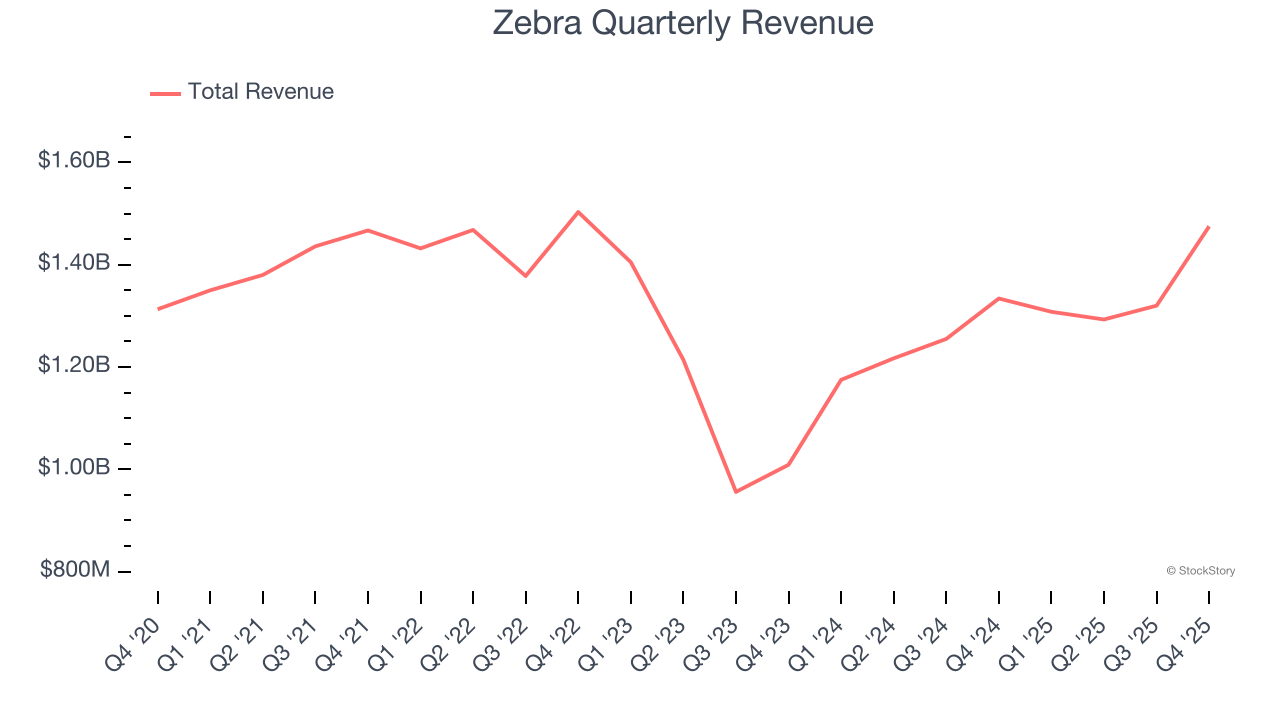
With $5.40 billion in revenue over the past 12 months, Zebra is one of the larger companies in the business services industry and benefits from a well-known brand that influences purchasing decisions. However, its scale is a double-edged sword because it’s challenging to maintain high growth rates when you’ve already captured a large portion of the addressable market. To expand meaningfully, Zebra likely needs to tweak its prices, innovate with new offerings, or enter new markets.
As you can see below, Zebra grew its sales at a tepid 3.9% compounded annual growth rate over the last five years. This shows it failed to generate demand in any major way and is a rough starting point for our analysis.
We at StockStory place the most emphasis on long-term growth, but within business services, a half-decade historical view may miss recent innovations or disruptive industry trends. Zebra’s annualized revenue growth of 8.5% over the last two years is above its five-year trend, suggesting its demand recently accelerated. 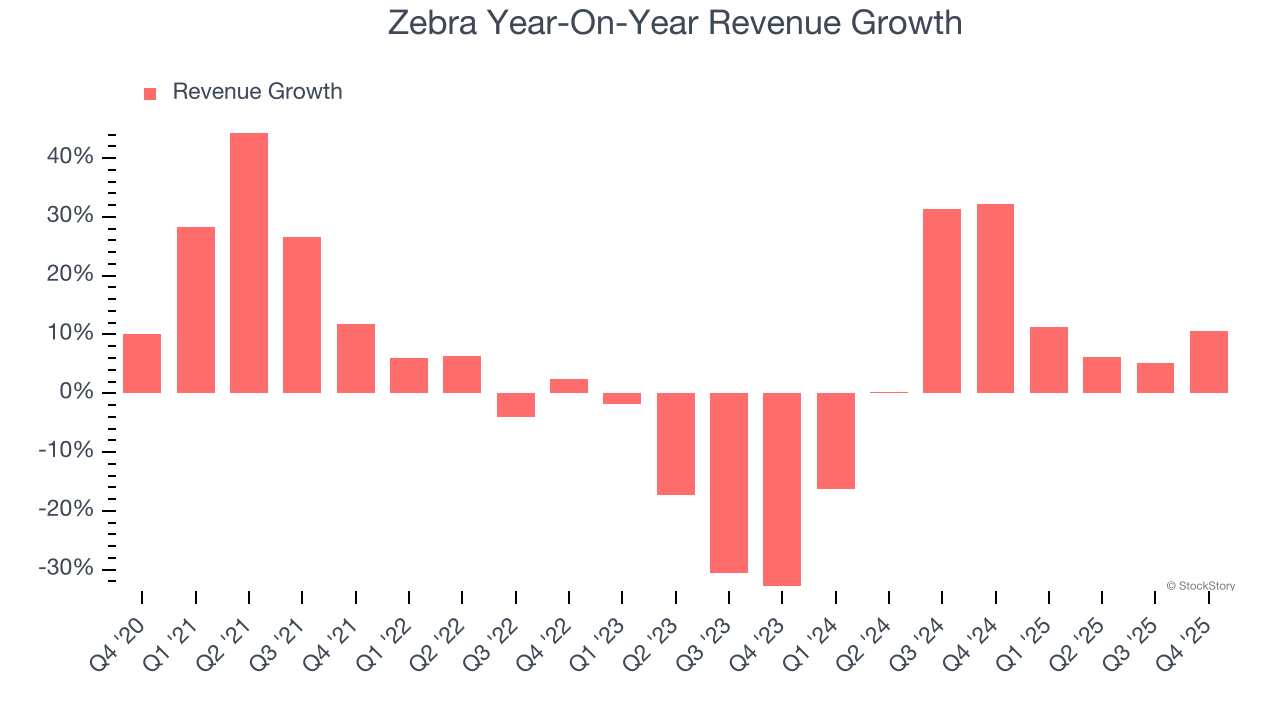
We can dig further into the company’s sales dynamics by analyzing its organic revenue, which strips out one-time events like acquisitions and currency fluctuations that don’t accurately reflect its fundamentals. Over the last two years, Zebra’s organic revenue averaged 8.8% year-on-year growth. Because this number aligns with its two-year revenue growth, we can see the company’s core operations (not acquisitions and divestitures) drove most of its results. 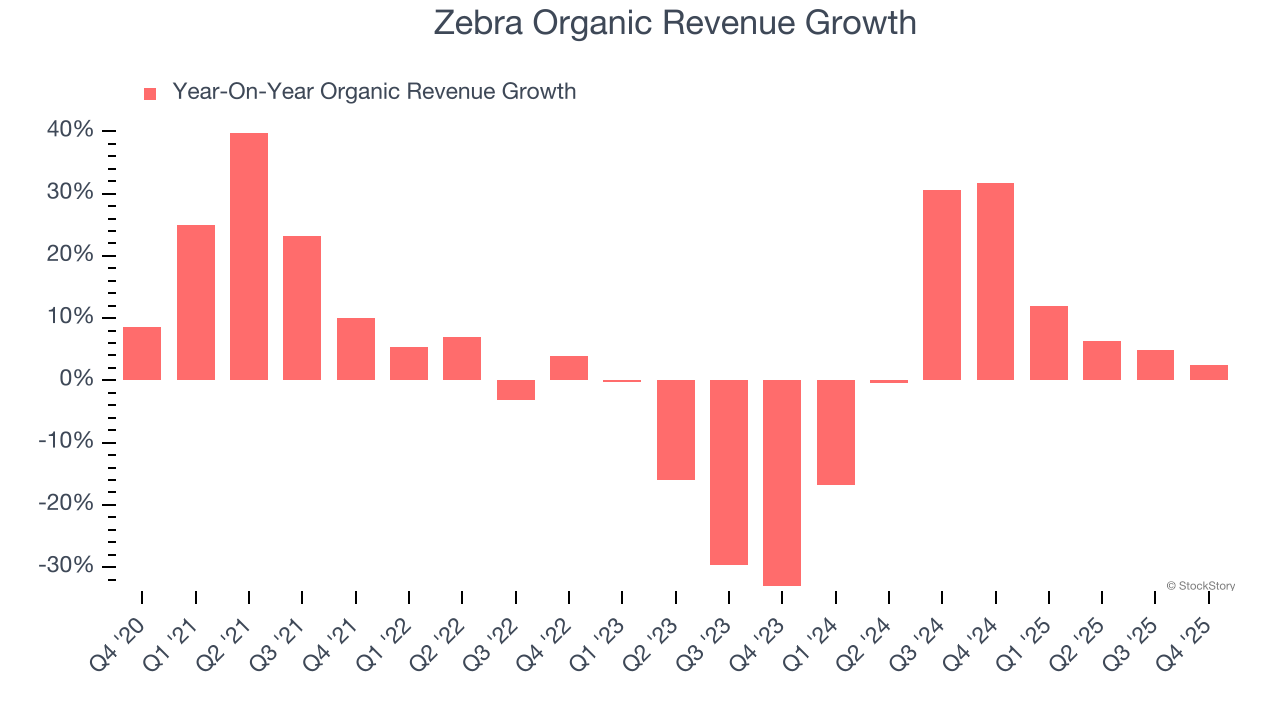
This quarter, Zebra reported year-on-year revenue growth of 10.6%, and its $1.48 billion of revenue exceeded Wall Street’s estimates by 1.2%. Company management is currently guiding for a 13% year-on-year increase in sales next quarter.
Looking further ahead, sell-side analysts expect revenue to grow 9.4% over the next 12 months, similar to its two-year rate. This projection is commendable and indicates the market is forecasting success for its products and services.
Microsoft, Alphabet, Coca-Cola, Monster Beverage—all began as under-the-radar growth stories riding a massive trend. We’ve identified the next one: a profitable AI semiconductor play Wall Street is still overlooking. Go here for access to our full report.
Operating Margin
Zebra has managed its cost base well over the last five years. It demonstrated solid profitability for a business services business, producing an average operating margin of 13%.
Looking at the trend in its profitability, Zebra’s operating margin decreased by 4.4 percentage points over the last five years. This raises questions about the company’s expense base because its revenue growth should have given it leverage on its fixed costs, resulting in better economies of scale and profitability.
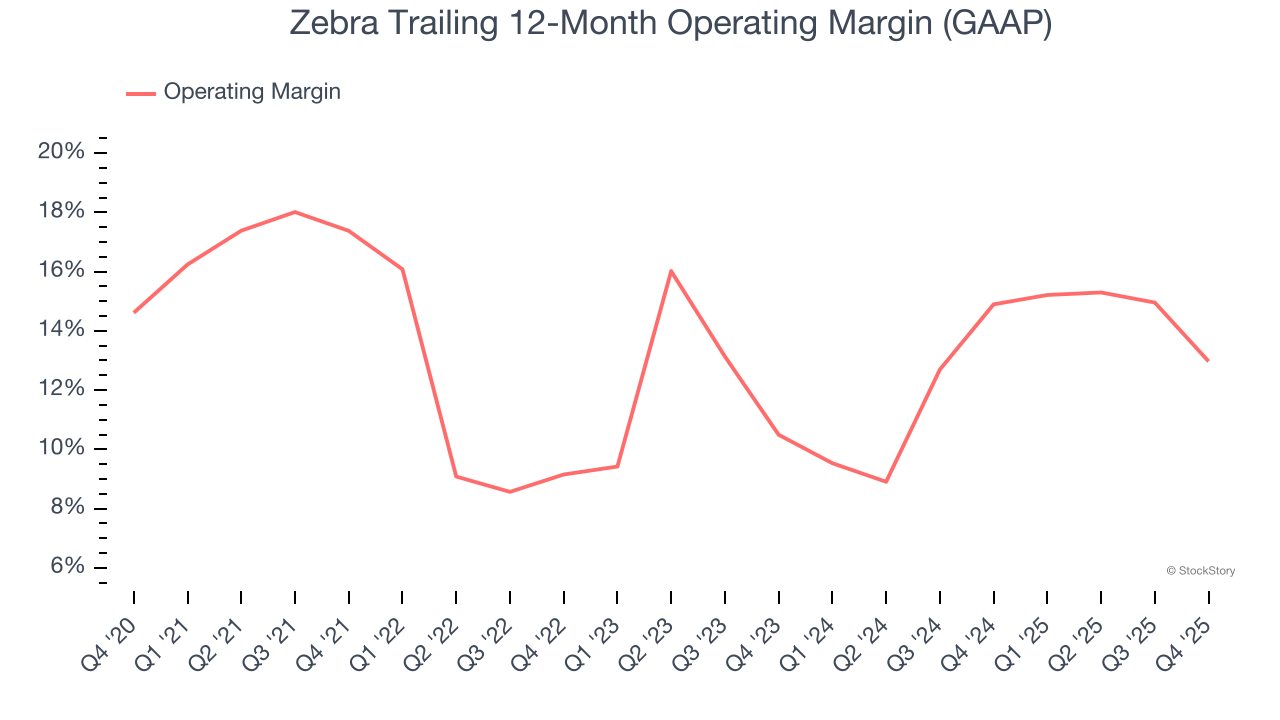
In Q4, Zebra generated an operating margin profit margin of 9.4%, down 7.4 percentage points year on year. This contraction shows it was less efficient because its expenses grew faster than its revenue.
Earnings Per Share
We track the long-term change in earnings per share (EPS) for the same reason as long-term revenue growth. Compared to revenue, however, EPS highlights whether a company’s growth is profitable.
Zebra’s unimpressive 4.3% annual EPS growth over the last five years aligns with its revenue performance. This tells us it maintained its per-share profitability as it expanded.
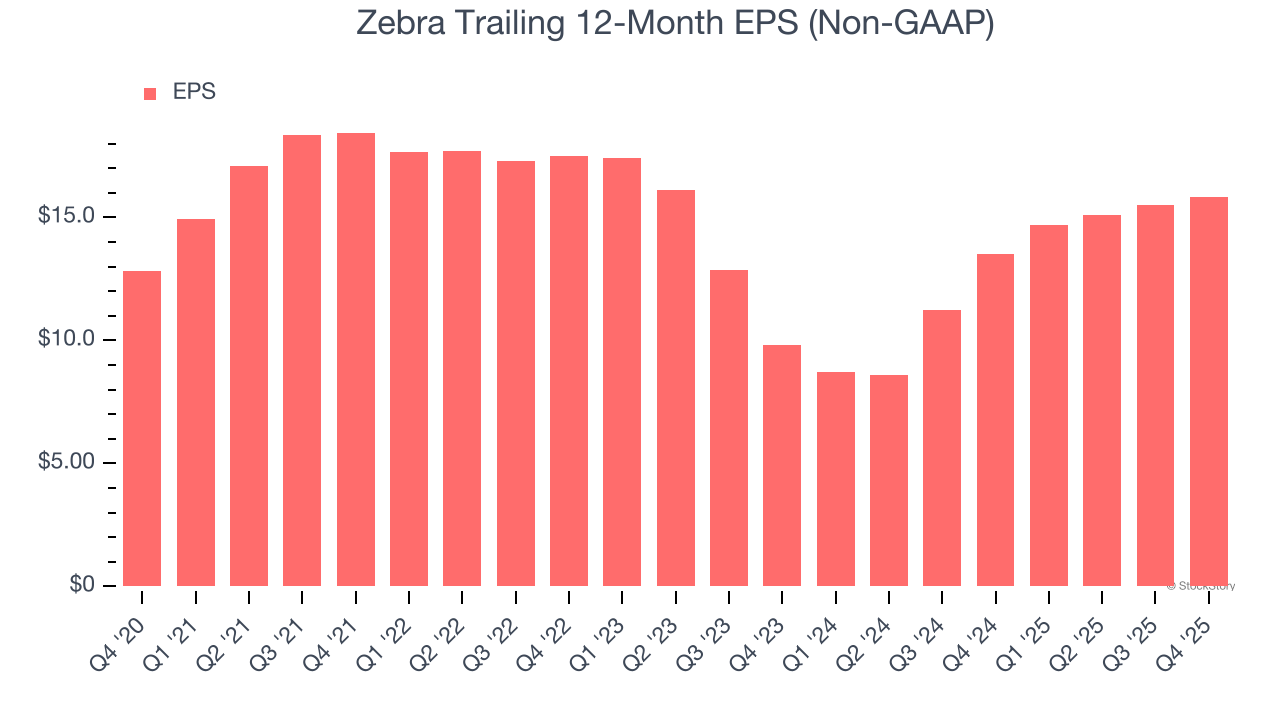
Like with revenue, we analyze EPS over a more recent period because it can provide insight into an emerging theme or development for the business.
Zebra’s two-year annual EPS growth of 27.1% was fantastic and topped its 8.5% two-year revenue growth.
We can take a deeper look into Zebra’s earnings quality to better understand the drivers of its performance. While we mentioned earlier that Zebra’s operating margin declined this quarter, a two-year view shows its margin has expandedwhile its share count has shrunk 2%. These are positive signs for shareholders because improving profitability and share buybacks turbocharge EPS growth relative to revenue growth. 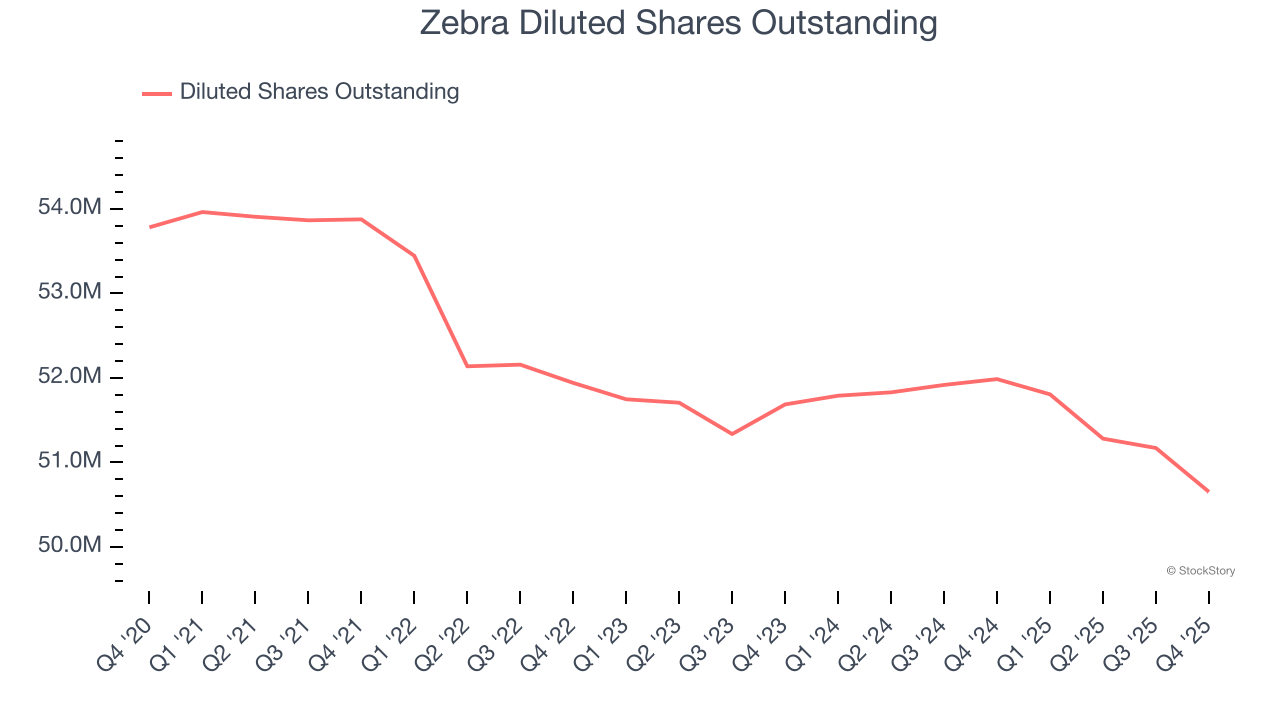
In Q4, Zebra reported adjusted EPS of $4.33, up from $4 in the same quarter last year. This print was close to analysts’ estimates. Over the next 12 months, Wall Street expects Zebra’s full-year EPS of $15.84 to grow 11.2%.
Key Takeaways from Zebra’s Q4 Results
We were impressed by Zebra’s optimistic revenue guidance for next quarter, which blew past analysts’ expectations. We were also happy its organic revenue narrowly outperformed Wall Street’s estimates. Overall, we think this was a solid quarter with some key areas of upside. The stock traded up 4.4% to $263.52 immediately following the results.
Zebra put up rock-solid earnings, but one quarter doesn’t necessarily make the stock a buy. Let’s see if this is a good investment. If you’re making that decision, you should consider the bigger picture of valuation, business qualities, as well as the latest earnings. We cover that in our actionable full research report which you can read here (it’s free).