
Atlantic Union Bankshares has had an impressive run over the past six months as its shares have beaten the S&P 500 by 13.8%. The stock now trades at $40.24, marking a 19.7% gain. This was partly due to its solid quarterly results, and the run-up might have investors contemplating their next move.
Is now the time to buy Atlantic Union Bankshares, or should you be careful about including it in your portfolio? Check out our in-depth research report to see what our analysts have to say, it’s free.
Why Is Atlantic Union Bankshares Not Exciting?
Despite the momentum, we're cautious about Atlantic Union Bankshares. Here are three reasons you should be careful with AUB and a stock we'd rather own.
1. EPS Barely Growing
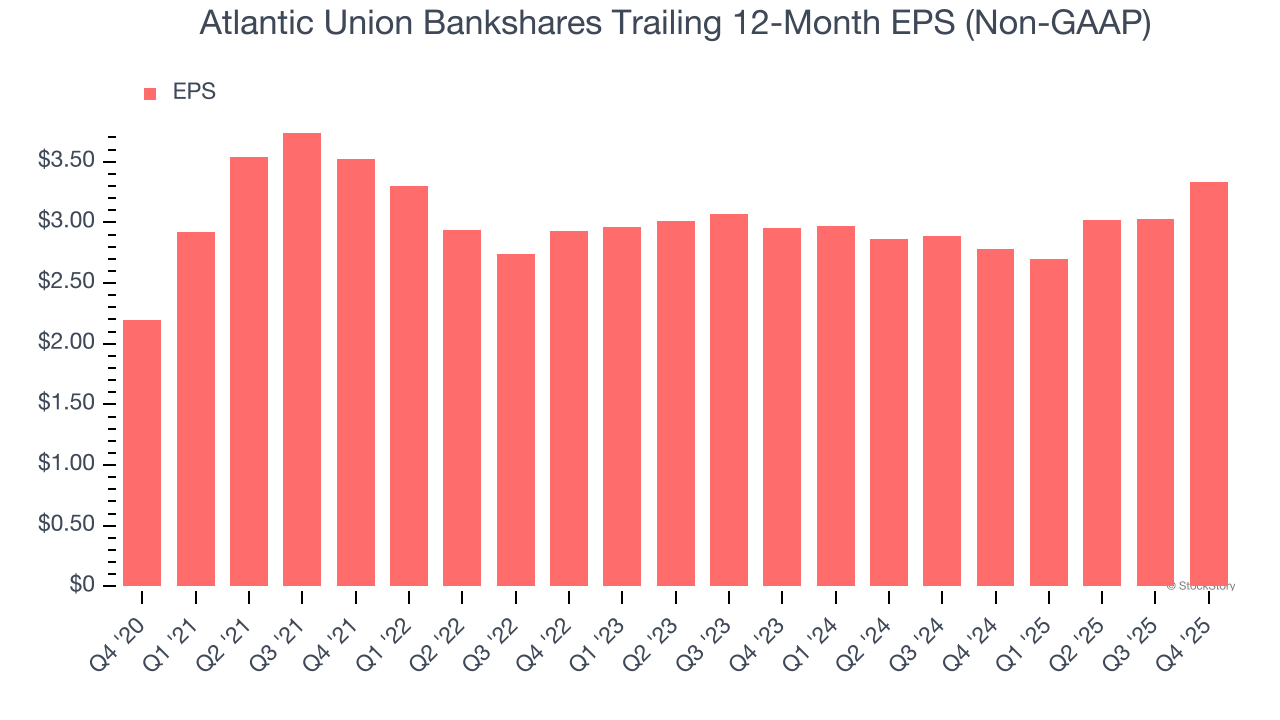
We track the long-term change in earnings per share (EPS) because it highlights whether a company’s growth is profitable.
Atlantic Union Bankshares’s EPS grew at an unimpressive 8.7% compounded annual growth rate over the last five years, lower than its 14.7% annualized revenue growth. This tells us the company became less profitable on a per-share basis as it expanded.
2. Declining TBVPS Reflects Erosion of Asset Value
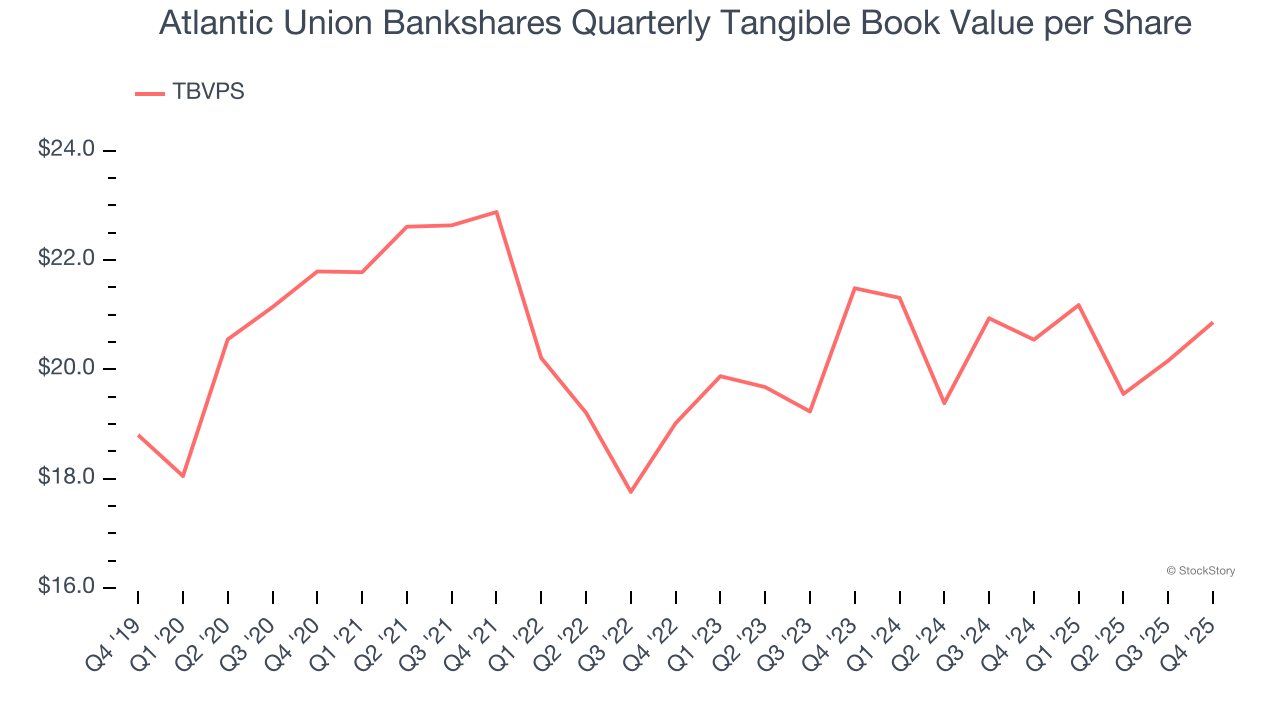
Tangible book value per share (TBVPS) serves as a key indicator of a bank’s financial strength, representing the hard assets available to shareholders after removing intangible assets that could evaporate during financial distress.
Disappointingly for investors, Atlantic Union Bankshares’s TBVPS declined at a 1.5% annual clip over the last two years.
Leverage is core to a financial firm’s business model (loans funded by deposits). To ensure economic stability and avoid a repeat of the 2008 GFC, regulators require certain levels of capital and liquidity, focusing on the Tier 1 capital ratio.
Tier 1 capital is the highest-quality capital that a firm holds, consisting primarily of common stock and retained earnings, but also physical gold. It serves as the primary cushion against losses and is the first line of defense in times of financial distress.
This capital is divided by risk-weighted assets to derive the Tier 1 capital ratio. Risk-weighted means that cash and US treasury securities are assigned little risk while unsecured consumer loans and equity investments get much higher risk weights, for example.
New regulation after the 2008 financial crisis requires that all firms must maintain a Tier 1 capital ratio greater than 4.5%. On top of this, there are additional buffers based on scale, risk profile, and other regulatory classifications, so that at the end of the day, firms generally must maintain a 7-10% ratio at minimum.
Over the last two years, Atlantic Union Bankshares has averaged a Tier 1 capital ratio of 9.9%, which is considered unsafe in the event of a black swan or if macro or market conditions suddenly deteriorate. For this reason alone, we will be crossing it off our shopping list.
Final Judgment
Atlantic Union Bankshares isn’t a terrible business, but it isn’t one of our picks. With its shares outperforming the market lately, the stock trades at 1.1× forward P/B (or $40.24 per share). While this valuation is fair, the upside isn’t great compared to the potential downside. We're pretty confident there are more exciting stocks to buy at the moment. Let us point you toward a fast-growing restaurant franchise with an A+ ranch dressing sauce.
Stocks We Like More Than Atlantic Union Bankshares
Your portfolio can’t afford to be based on yesterday’s story. The risk in a handful of heavily crowded stocks is rising daily.
The names generating the next wave of massive growth are right here in our Top 6 Stocks for this week. This is a curated list of our High Quality stocks that have generated a market-beating return of 244% over the last five years (as of June 30, 2025).
Stocks that have made our list include now familiar names such as Nvidia (+1,326% between June 2020 and June 2025) as well as under-the-radar businesses like the once-small-cap company Comfort Systems (+782% five-year return). Find your next big winner with StockStory today.