
Shareholders of DoubleVerify would probably like to forget the past six months even happened. The stock dropped 30.1% and now trades at $11.17. This was partly driven by its softer quarterly results and might have investors contemplating their next move.
Is there a buying opportunity in DoubleVerify, or does it present a risk to your portfolio? Get the full breakdown from our expert analysts, it’s free.
Why Is DoubleVerify Not Exciting?
Even though the stock has become cheaper, we're sitting this one out for now. Here are three reasons you should be careful with DV and a stock we'd rather own.
1. Projected Revenue Growth Is Slim
Forecasted revenues by Wall Street analysts signal a company’s potential. Predictions may not always be accurate, but accelerating growth typically boosts valuation multiples and stock prices while slowing growth does the opposite.
Over the next 12 months, sell-side analysts expect DoubleVerify’s revenue to rise by 9.3%, a deceleration versus its 26.9% annualized growth for the past five years. This projection is underwhelming and implies its products and services will face some demand challenges.
2. Long Payback Periods Delay Returns
The customer acquisition cost (CAC) payback period represents the months required to recover the cost of acquiring a new customer. Essentially, it’s the break-even point for sales and marketing investments. A shorter CAC payback period is ideal, as it implies better returns on investment and business scalability.
DoubleVerify’s recent customer acquisition efforts haven’t yielded returns as its CAC payback period was negative this quarter, meaning its incremental sales and marketing investments outpaced its revenue. The company’s inefficiency indicates it operates in a competitive market and must continue investing to grow.
3. Shrinking Operating Margin
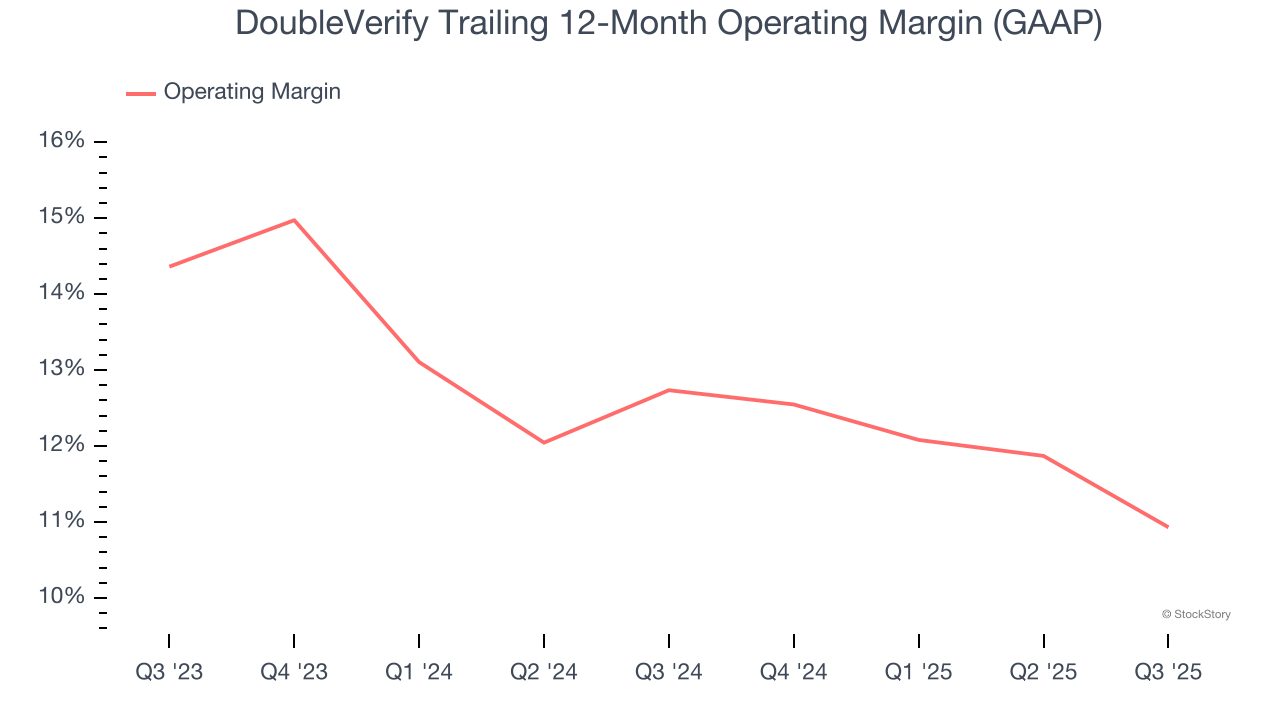
Many software businesses adjust their profits for stock-based compensation (SBC), but we prioritize GAAP operating margin because SBC is a real expense used to attract and retain engineering and sales talent. This metric shows how much revenue remains after accounting for all core expenses – everything from the cost of goods sold to sales and R&D.
Looking at the trend in its profitability, DoubleVerify’s operating margin decreased by 1.8 percentage points over the last two years. This raises questions about the company’s expense base because its revenue growth should have given it leverage on its fixed costs, resulting in better economies of scale and profitability. Its operating margin for the trailing 12 months was 10.9%.
Final Judgment
DoubleVerify’s business quality ultimately falls short of our standards. After the recent drawdown, the stock trades at 2.3× forward price-to-sales (or $11.17 per share). While this valuation is fair, the upside isn’t great compared to the potential downside. We're pretty confident there are superior stocks to buy right now. We’d suggest looking at one of our top digital advertising picks.
High-Quality Stocks for All Market Conditions
Check out the high-quality names we’ve flagged in our Top 5 Growth Stocks for this month. This is a curated list of our High Quality stocks that have generated a market-beating return of 244% over the last five years (as of June 30, 2025).
Stocks that have made our list include now familiar names such as Nvidia (+1,326% between June 2020 and June 2025) as well as under-the-radar businesses like the once-small-cap company Comfort Systems (+782% five-year return). Find your next big winner with StockStory today.