
Earnings results often indicate what direction a company will take in the months ahead. With Q3 behind us, let’s have a look at Jackson Financial (NYSE:JXN) and its peers.
Life insurance companies collect premiums from policyholders in exchange for providing a future death benefit or retirement income stream. Interest rates matter for the sector (and make it cyclical), with higher rates allowing insurers to reinvest their fixed-income portfolios at more attractive yields and vice versa. Additionally, favorable demographic shifts, such as an aging population, are driving strong demand for retirement products while AI and data analytics offer significant opportunities to improve underwriting accuracy and operational efficiency. Conversely, the industry faces headwinds from persistent competition from agile insurtechs that threaten traditional distribution models.
The 14 life insurance stocks we track reported a mixed Q3. As a group, revenues beat analysts’ consensus estimates by 3.8%.
Thankfully, share prices of the companies have been resilient as they are up 5.2% on average since the latest earnings results.
Jackson Financial (NYSE:JXN)
Spun off from British insurer Prudential plc in 2021 after more than 60 years as its U.S. subsidiary, Jackson Financial (NYSE:JXN) offers annuity products and retirement solutions that help Americans grow and protect their retirement savings and income.
Jackson Financial reported revenues of $1.44 billion, down 33.5% year on year. This print fell short of analysts’ expectations by 24.1%. Overall, it was a mixed quarter for the company with a beat of analysts’ EPS estimates but a significant miss of analysts’ revenue estimates.
Laura Prieskorn, President and Chief Executive Officer of Jackson, stated, “Our third quarter performance highlights the ongoing strength and momentum of our business as we advance toward our strategic goals. Retail annuity sales grew year over year, driven by our broad and innovative product portfolio, including record RILA sales and the successful launch of our Jackson Income Assurance℠ and Jackson Income Assurance℠ Advisory fixed index annuities. Our robust in-force book continued to deliver healthy free cash flow, generating $216 million in the quarter and nearly $1 billion over the past year. In addition, we returned $210 million to common shareholders, increased our estimated RBC ratio, and further enhanced our already substantial excess cash position at the holding company. Looking ahead, we believe we are well positioned to extend on this momentum through the remainder of 2025 and into 2026, continuing our commitment to helping Americans achieve financial security.”
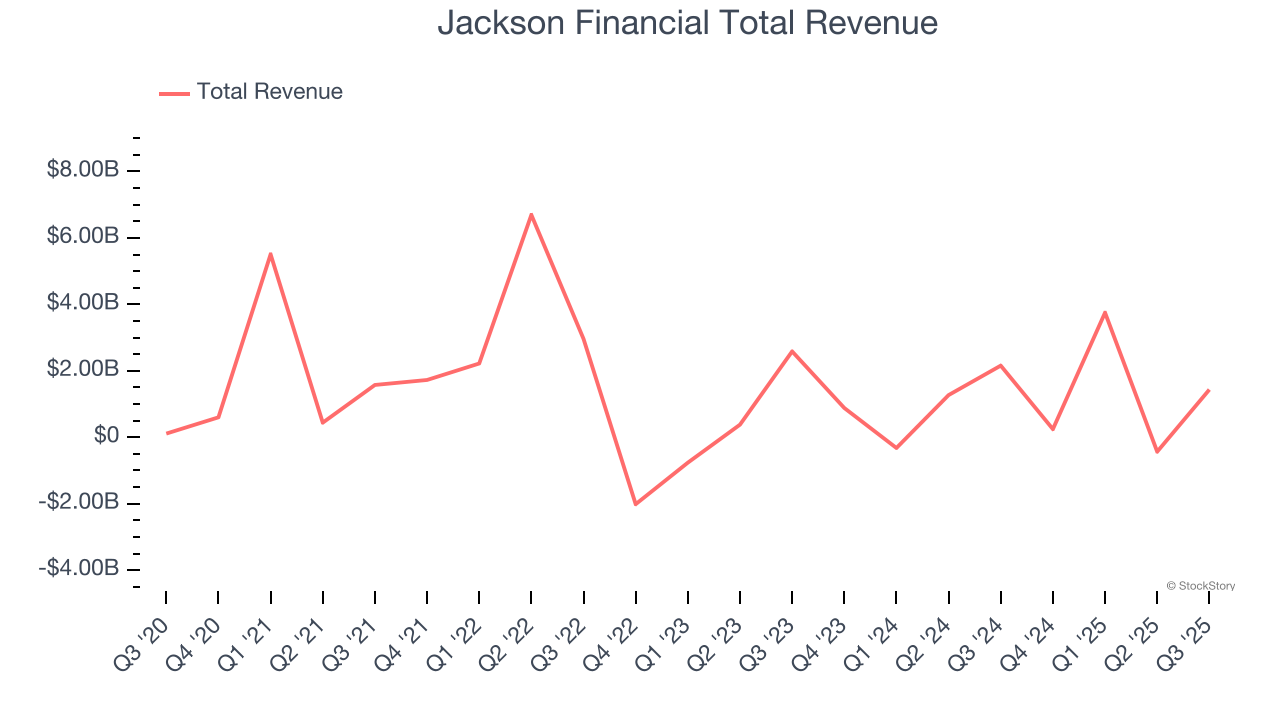
Jackson Financial delivered the weakest performance against analyst estimates and slowest revenue growth of the whole group. Interestingly, the stock is up 7.9% since reporting and currently trades at $108.45.
Is now the time to buy Jackson Financial? Access our full analysis of the earnings results here, it’s free for active Edge members.
Best Q3: Aflac (NYSE:AFL)
Known for its iconic duck mascot that has quacked "Aflac!" in commercials since 2000, Aflac (NYSE:AFL) provides supplemental health and life insurance policies that pay cash benefits directly to policyholders for expenses not covered by their primary insurance.
Aflac reported revenues of $4.41 billion, up 2.8% year on year, falling short of analysts’ expectations by 0.9%. However, the business still had a very strong quarter with a solid beat of analysts’ book value per share estimates and a beat of analysts’ EPS estimates.
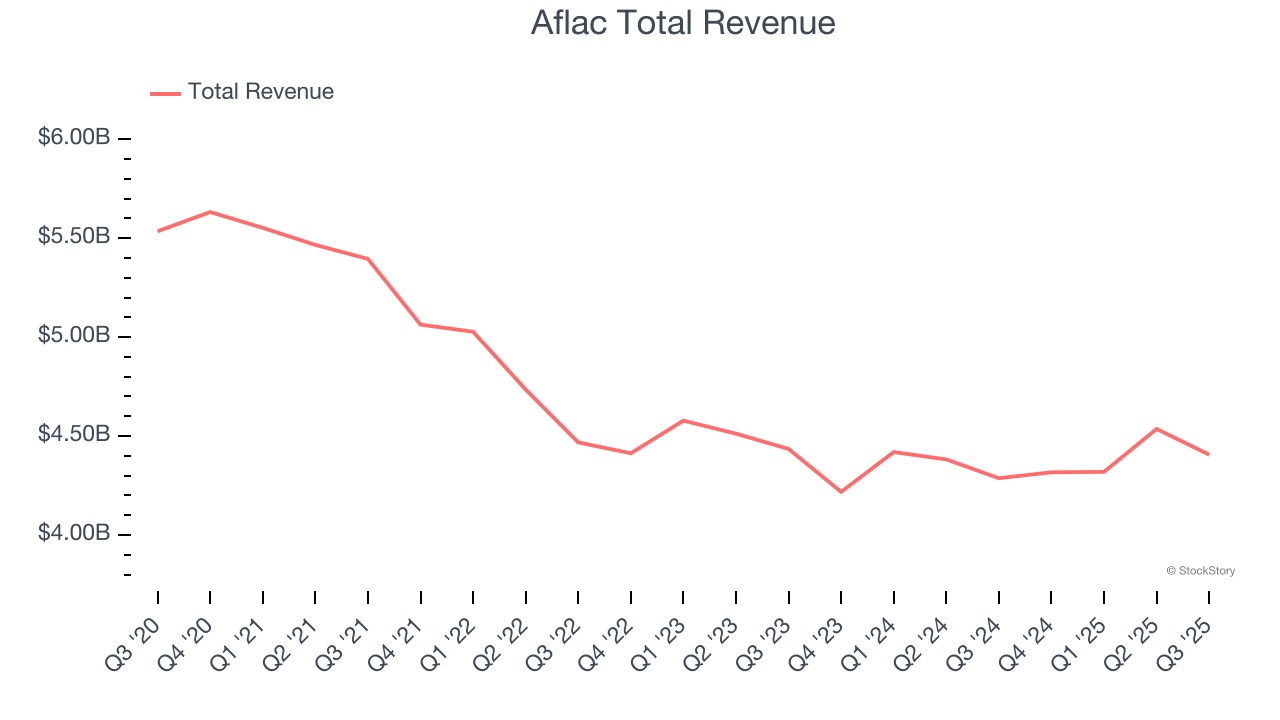
The market seems content with the results as the stock is up 1.6% since reporting. It currently trades at $110.52.
Is now the time to buy Aflac? Access our full analysis of the earnings results here, it’s free for active Edge members.
Weakest Q3: Brighthouse Financial (NASDAQ:BHF)
Spun off from MetLife in 2017 to focus specifically on retail financial products, Brighthouse Financial (NASDAQ:BHF) provides annuity contracts and life insurance products designed to help individuals protect wealth, generate income, and transfer assets.
Brighthouse Financial reported revenues of $2.17 billion, flat year on year, falling short of analysts’ expectations by 4%. It was a disappointing quarter as it posted a significant miss of analysts’ revenue estimates and a significant miss of analysts’ net premiums earned estimates.
As expected, the stock is down 1.3% since the results and currently trades at $64.87.
Read our full analysis of Brighthouse Financial’s results here.
Equitable Holdings (NYSE:EQH)
Tracing its roots back to 1859 as one of America's oldest financial institutions, Equitable Holdings (NYSE:EQH) provides retirement planning, asset management, and life insurance products through its two main franchises, Equitable and AllianceBernstein.
Equitable Holdings reported revenues of $3.74 billion, flat year on year. This print topped analysts’ expectations by 3.2%. More broadly, it was a slower quarter as it recorded a significant miss of analysts’ EPS estimates.
The stock is flat since reporting and currently trades at $48.76.
Read our full, actionable report on Equitable Holdings here, it’s free for active Edge members.
Lincoln Financial Group (NYSE:LNC)
Founded in 1905 by a group of Fort Wayne, Indiana businessmen who named the company after Abraham Lincoln, Lincoln National Corporation (NYSE:LNC) provides insurance, retirement plans, and wealth management products through its subsidiaries, operating under four main segments: Annuities, Life Insurance, Group Protection, and Retirement Plan Services.
Lincoln Financial Group reported revenues of $4.78 billion, up 3.8% year on year. This result came in 0.7% below analysts' expectations. Aside from that, it was a mixed quarter as it also produced a solid beat of analysts’ net premiums earned estimates but a significant miss of analysts’ book value per share estimates.
The stock is up 14.6% since reporting and currently trades at $45.87.
Read our full, actionable report on Lincoln Financial Group here, it’s free for active Edge members.
Market Update
The Fed’s interest rate hikes throughout 2022 and 2023 have successfully cooled post-pandemic inflation, bringing it closer to the 2% target. Inflationary pressures have eased without tipping the economy into a recession, suggesting a soft landing. This stability, paired with recent rate cuts (0.5% in September 2024 and 0.25% in November 2024), fueled a strong year for the stock market in 2024. The markets surged further after Donald Trump’s presidential victory in November, with major indices reaching record highs in the days following the election. Still, questions remain about the direction of economic policy, as potential tariffs and corporate tax changes add uncertainty for 2025.
Want to invest in winners with rock-solid fundamentals? Check out our Top 5 Quality Compounder Stocks and add them to your watchlist. These companies are poised for growth regardless of the political or macroeconomic climate.
StockStory’s analyst team — all seasoned professional investors — uses quantitative analysis and automation to deliver market-beating insights faster and with higher quality.