
Offshore banking group Butterfield Bank (NYSE:NTB) reported Q4 CY2025 results topping the market’s revenue expectations, with sales up 4.7% year on year to $159.1 million. Its non-GAAP profit of $1.54 per share was 5% above analysts’ consensus estimates.
Is now the time to buy Butterfield Bank? Find out by accessing our full research report, it’s free.
Butterfield Bank (NTB) Q4 CY2025 Highlights:
- Net Interest Income: $92.6 million vs analyst estimates of $90.97 million (73.6% year-on-year decline, 1.8% beat)
- Net Interest Margin: 2.7% vs analyst estimates of 2.7% (in line)
- Revenue: $159.1 million vs analyst estimates of $153.5 million (4.7% year-on-year growth, 3.6% beat)
- Efficiency Ratio: 57.2% vs analyst estimates of 58.6% (136.7 basis point beat)
- Adjusted EPS: $1.54 vs analyst estimates of $1.47 (5% beat)
- Tangible Book Value per Share: $26.41 vs analyst estimates of $25.83 (22% year-on-year growth, 2.2% beat)
- Market Capitalization: $2.15 billion
Michael Collins, Butterfield's Chairman and Chief Executive Officer, commented, “Throughout 2025 Butterfield delivered strong financial results supported by disciplined strategic execution. We achieved year-on-year net income growth, with core net income per diluted share increasing 17.4% compared to 2024. Our relationship-focused banking and private trust businesses increased non-interest income, while net interest income benefited from lower deposit costs and higher yielding asset redeployment. Butterfield remained focused on expense management, while completing a number of value-added projects that have advanced our technology platform.
Company Overview
Founded in 1784 as one of the oldest banks in the Western Hemisphere, Butterfield Bank (NYSE:NTB) provides banking, wealth management, and trust services to individuals and businesses in select offshore financial centers including Bermuda, Cayman Islands, and the Channel Islands.
Sales Growth
In general, banks make money from two primary sources. The first is net interest income, which is interest earned on loans, mortgages, and investments in securities minus interest paid out on deposits. The second source is non-interest income, which can come from bank account, credit card, wealth management, investing banking, and trading fees. Unfortunately, Butterfield Bank’s 3.9% annualized revenue growth over the last five years was sluggish. This fell short of our benchmark for the banking sector and is a rough starting point for our analysis.
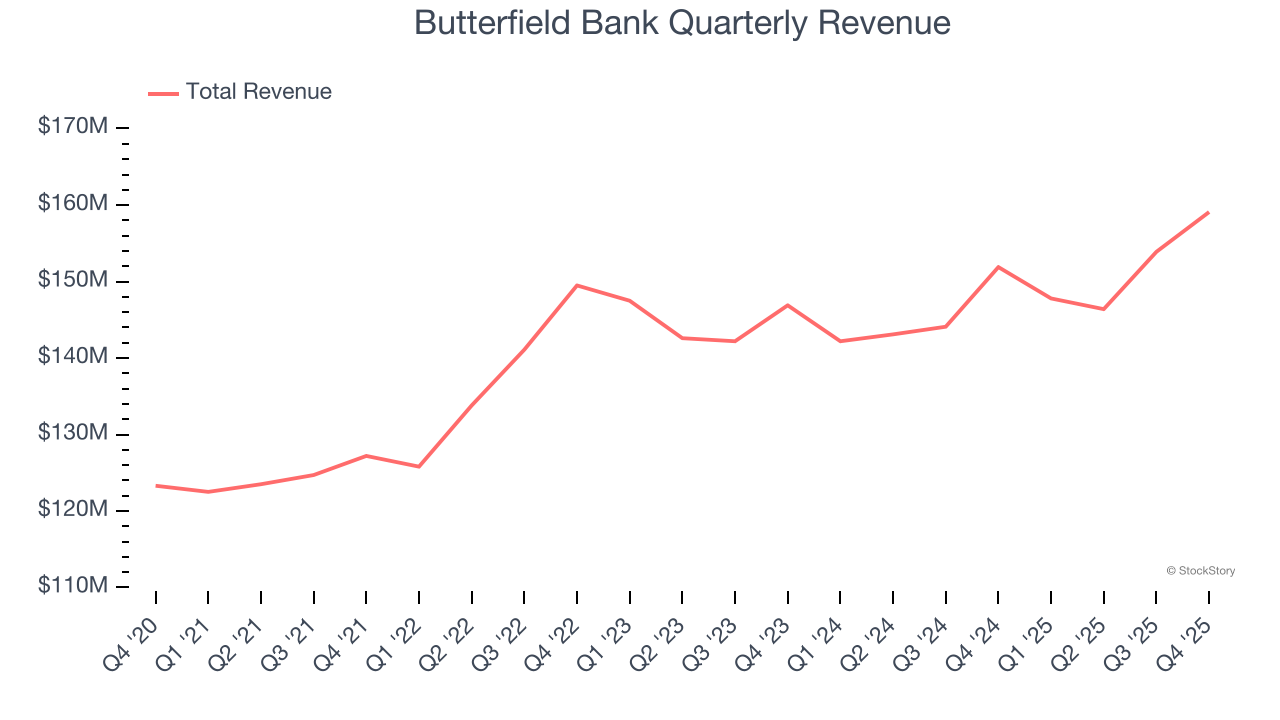
Long-term growth is the most important, but within financials, a half-decade historical view may miss recent interest rate changes and market returns. Butterfield Bank’s recent performance shows its demand has slowed as its annualized revenue growth of 2.4% over the last two years was below its five-year trend. 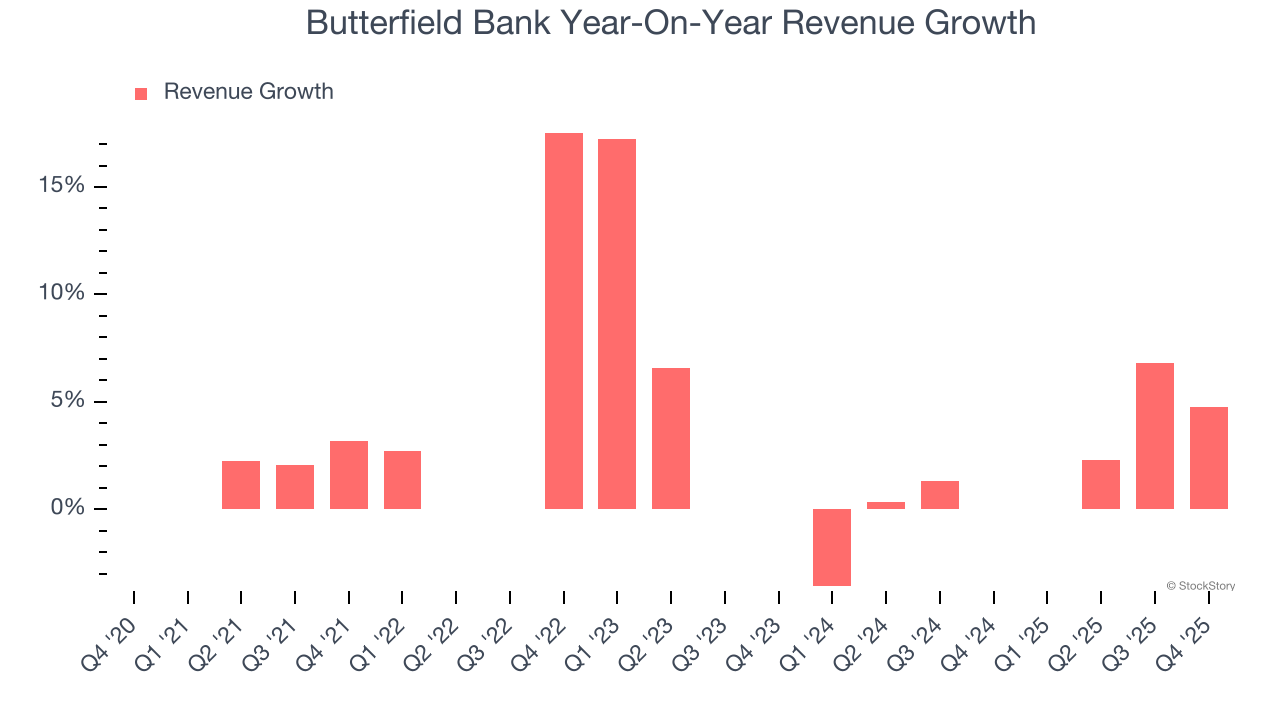 Note: Quarters not shown were determined to be outliers, impacted by outsized investment gains/losses that are not indicative of the recurring fundamentals of the business.
This quarter, Butterfield Bank reported modest year-on-year revenue growth of 4.7% but beat Wall Street’s estimates by 3.6%.
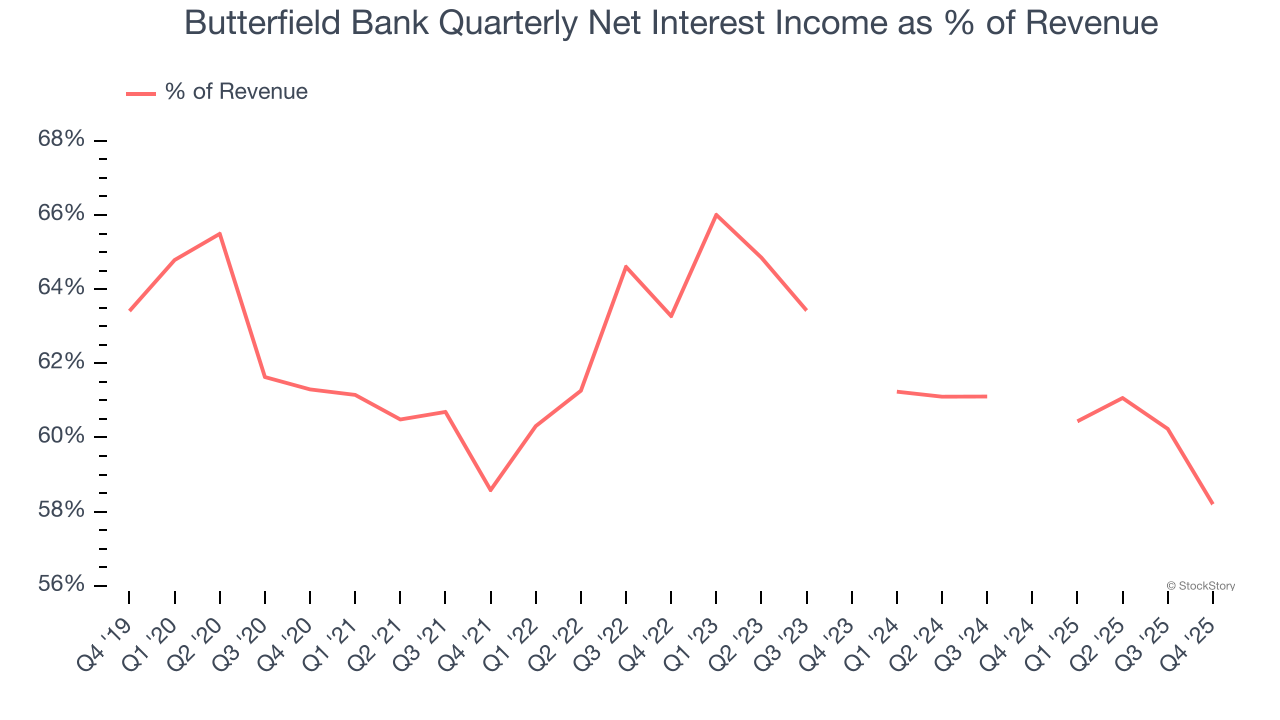
Net interest income made up 79.5% of the company’s total revenue during the last five years, meaning lending operations are Butterfield Bank’s largest source of revenue.
 Note: Quarters not shown were determined to be outliers, impacted by outsized investment gains/losses that are not indicative of the recurring fundamentals of the business.
Our experience and research show the market cares primarily about a bank’s net interest income growth as non-interest income is considered a lower-quality and non-recurring revenue source.
Microsoft, Alphabet, Coca-Cola, Monster Beverage—all began as under-the-radar growth stories riding a massive trend. We’ve identified the next one: a profitable AI semiconductor play Wall Street is still overlooking. Go here for access to our full report.
Tangible Book Value Per Share (TBVPS)
The balance sheet drives banking profitability since earnings flow from the spread between borrowing and lending rates. As such, valuations for these companies concentrate on capital strength and sustainable equity accumulation potential.
This explains why tangible book value per share (TBVPS) stands as the premier banking metric. TBVPS strips away questionable intangible assets, revealing concrete per-share net worth that investors can trust. EPS can become murky due to acquisition impacts or accounting flexibility around loan provisions, and TBVPS resists financial engineering manipulation.
Butterfield Bank’s TBVPS grew at an excellent 8.1% annual clip over the last five years. TBVPS growth has also accelerated recently, growing by 17.1% annually over the last two years from $19.25 to $26.41 per share.
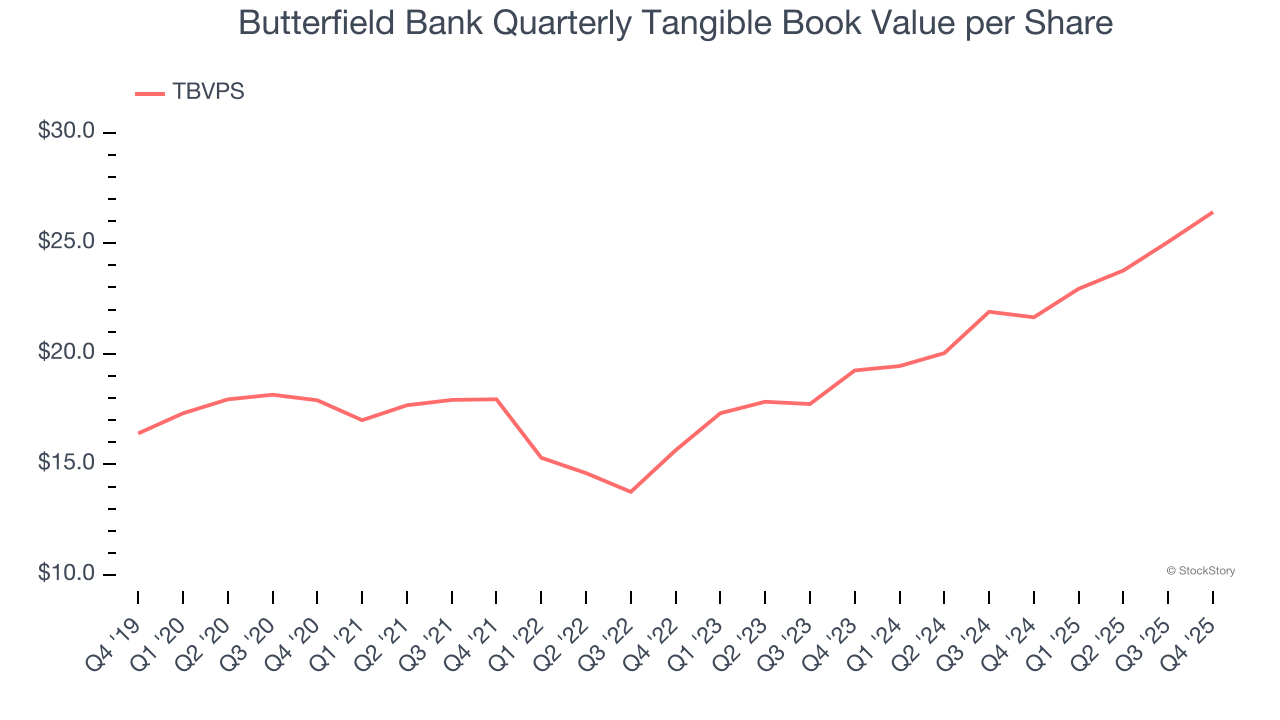
Over the next 12 months, Consensus estimates call for Butterfield Bank’s TBVPS to grow by 10.2% to $29.09, mediocre growth rate.
Key Takeaways from Butterfield Bank’s Q4 Results
We enjoyed seeing Butterfield Bank beat analysts’ revenue expectations this quarter. We were also happy its tangible book value per share outperformed Wall Street’s estimates. Overall, we think this was a solid quarter with some key areas of upside. The stock traded up 4.8% to $55.97 immediately following the results.
Butterfield Bank may have had a good quarter, but does that mean you should invest right now? If you’re making that decision, you should consider the bigger picture of valuation, business qualities, as well as the latest earnings. We cover that in our actionable full research report which you can read here (it’s free).