
Since January 2021, the S&P 500 has delivered a total return of 81.5%. But one standout stock has more than doubled the market - over the past five years, RTX has surged 175% to $191.97 per share. Its momentum hasn’t stopped as it’s also gained 32.5% in the last six months thanks to its solid quarterly results, beating the S&P by 21%.
Is now the time to buy RTX, or should you be careful about including it in your portfolio? Get the full stock story straight from our expert analysts, it’s free for active Edge members.
Why Is RTX Not Exciting?
We’re happy investors have made money, but we're sitting this one out for now. Here are three reasons you should be careful with RTX and a stock we'd rather own.
1. Projected Revenue Growth Is Slim
Forecasted revenues by Wall Street analysts signal a company’s potential. Predictions may not always be accurate, but accelerating growth typically boosts valuation multiples and stock prices while slowing growth does the opposite.
Over the next 12 months, sell-side analysts expect RTX’s revenue to rise by 5.2%, a deceleration versus its 7.6% annualized growth for the past five years. This projection is underwhelming and suggests its products and services will see some demand headwinds.
2. Weak Operating Margin Could Cause Trouble
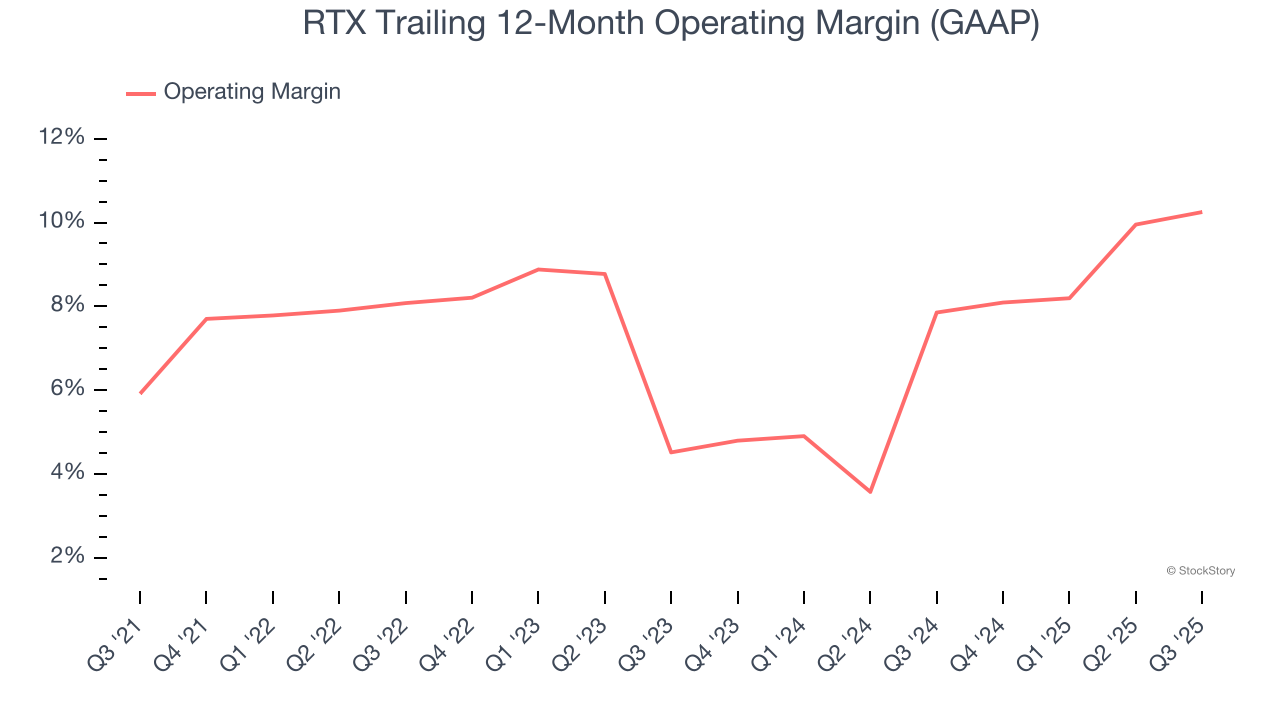
Operating margin is an important measure of profitability as it shows the portion of revenue left after accounting for all core expenses – everything from the cost of goods sold to advertising and wages. It’s also useful for comparing profitability across companies with different levels of debt and tax rates because it excludes interest and taxes.
RTX was profitable over the last five years but held back by its large cost base. Its average operating margin of 7.5% was weak for an industrials business.
3. Previous Growth Initiatives Haven’t Impressed
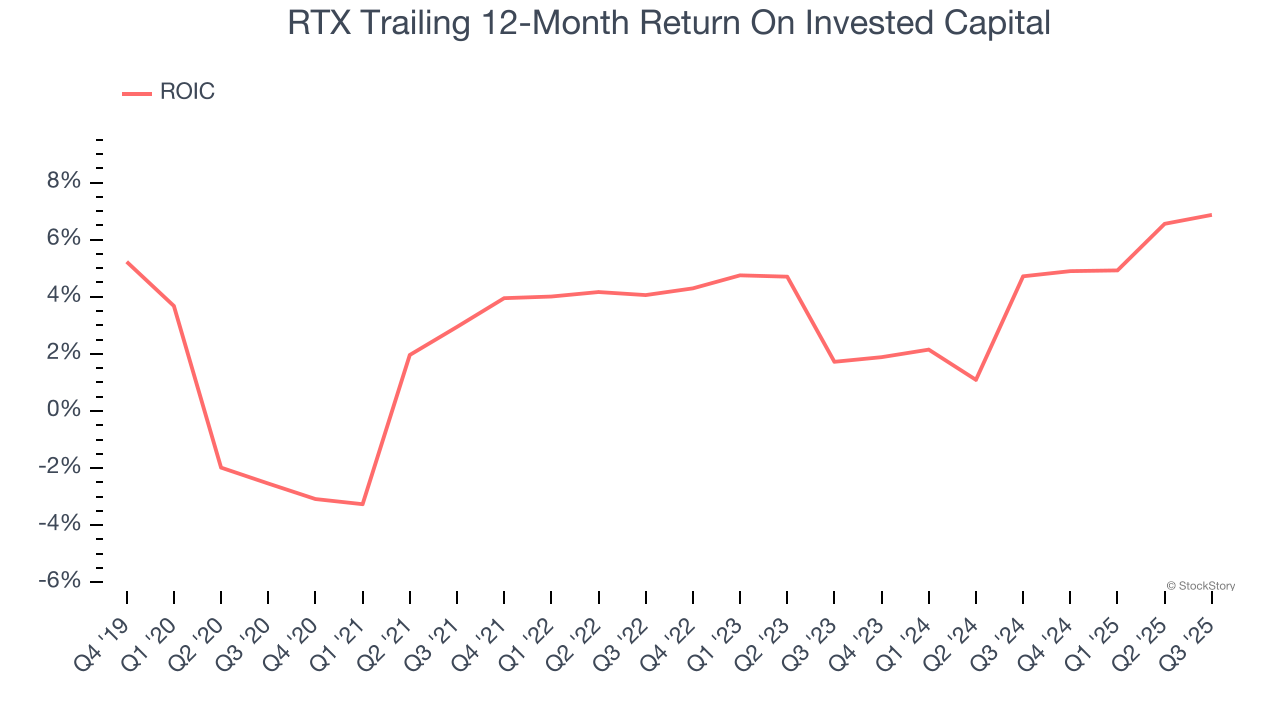
Growth gives us insight into a company’s long-term potential, but how capital-efficient was that growth? A company’s ROIC explains this by showing how much operating profit it makes compared to the money it has raised (debt and equity).
RTX historically did a mediocre job investing in profitable growth initiatives. Its five-year average ROIC was 4.1%, lower than the typical cost of capital (how much it costs to raise money) for industrials companies.
Final Judgment
RTX’s business quality ultimately falls short of our standards. With its shares beating the market recently, the stock trades at 29.7× forward P/E (or $191.97 per share). Investors with a higher risk tolerance might like the company, but we don’t really see a big opportunity at the moment. We're pretty confident there are more exciting stocks to buy at the moment. Let us point you toward one of our top digital advertising picks.
High-Quality Stocks for All Market Conditions
If your portfolio success hinges on just 4 stocks, your wealth is built on fragile ground. You have a small window to secure high-quality assets before the market widens and these prices disappear.
Don’t wait for the next volatility shock. Check out our Top 9 Market-Beating Stocks. This is a curated list of our High Quality stocks that have generated a market-beating return of 244% over the last five years (as of June 30, 2025).
Stocks that have made our list include now familiar names such as Nvidia (+1,326% between June 2020 and June 2025) as well as under-the-radar businesses like the once-small-cap company Comfort Systems (+782% five-year return). Find your next big winner with StockStory today.