
Wrapping up Q3 earnings, we look at the numbers and key takeaways for the regional banks stocks, including United Community Banks (NYSE:UCB) and its peers.
Regional banks, financial institutions operating within specific geographic areas, serve as intermediaries between local depositors and borrowers. They benefit from rising interest rates that improve net interest margins (the difference between loan yields and deposit costs), digital transformation reducing operational expenses, and local economic growth driving loan demand. However, these banks face headwinds from fintech competition, deposit outflows to higher-yielding alternatives, credit deterioration (increasing loan defaults) during economic slowdowns, and regulatory compliance costs. Recent concerns about regional bank stability following high-profile failures and significant commercial real estate exposure present additional challenges.
The 98 regional banks stocks we track reported a satisfactory Q3. As a group, revenues beat analysts’ consensus estimates by 1.3%.
Thankfully, share prices of the companies have been resilient as they are up 8.4% on average since the latest earnings results.
United Community Banks (NYSE:UCB)
Starting as a small community bank in 1950 and expanding through strategic acquisitions across the Southeast, United Community Banks (NYSE:UCB) is a regional bank holding company that provides financial services including loans, deposits, wealth management, and merchant services across the southeastern United States.
United Community Banks reported revenues of $277.9 million, up 13.2% year on year. This print exceeded analysts’ expectations by 2.6%. Overall, it was a satisfactory quarter for the company with an impressive beat of analysts’ revenue estimates but net interest income in line with analysts’ estimates.
Chairman and CEO Lynn Harton stated, “We are proud of our third quarter financial results. Our teams drove solid loan and deposit growth as well as healthy margin expansion. These actions resulted in meaningful improvement in our return on assets and return on tangible common equity. Tangible book value per share grew by $0.59 from the second quarter – an 11% annualized rate. Loans grew by $254 million, or 5.4% annualized, while customer deposits, excluding seasonal outflow of public funds, were up $137 million or 2.6% annualized. Non-interest bearing deposits, excluding public funds, grew at an annualized rate of 4.7%. Operating efficiency and operating leverage also both continued their improving trend.”
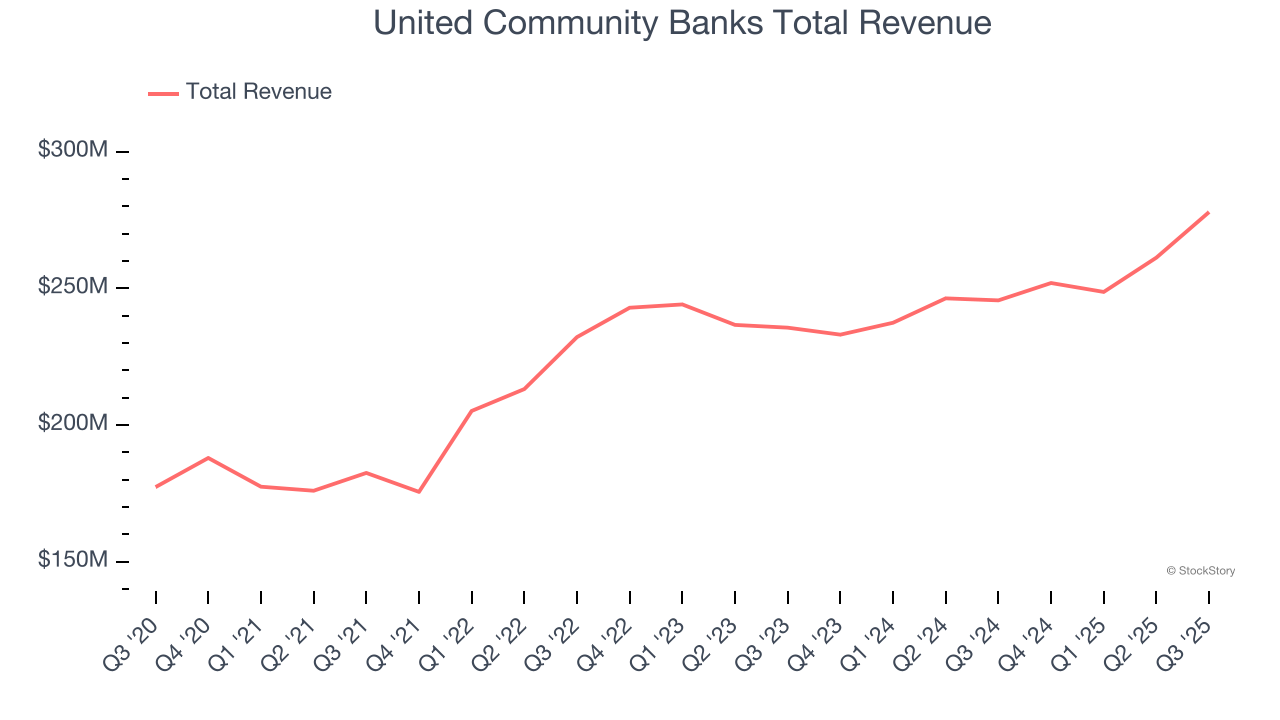
Interestingly, the stock is up 9.2% since reporting and currently trades at $33.
Is now the time to buy United Community Banks? Access our full analysis of the earnings results here, it’s free for active Edge members.
Best Q3: Customers Bancorp (NYSE:CUBI)
Originally founded with a "high-tech, high-touch" branch-light banking strategy, Customers Bancorp (NYSE:CUBI) is a bank holding company that provides commercial and consumer banking services through its Customers Bank subsidiary, with a focus on business lending and digital banking.
Customers Bancorp reported revenues of $231.8 million, up 38.3% year on year, outperforming analysts’ expectations by 6.9%. The business had a stunning quarter with a solid beat of analysts’ net interest income estimates and an impressive beat of analysts’ revenue estimates.
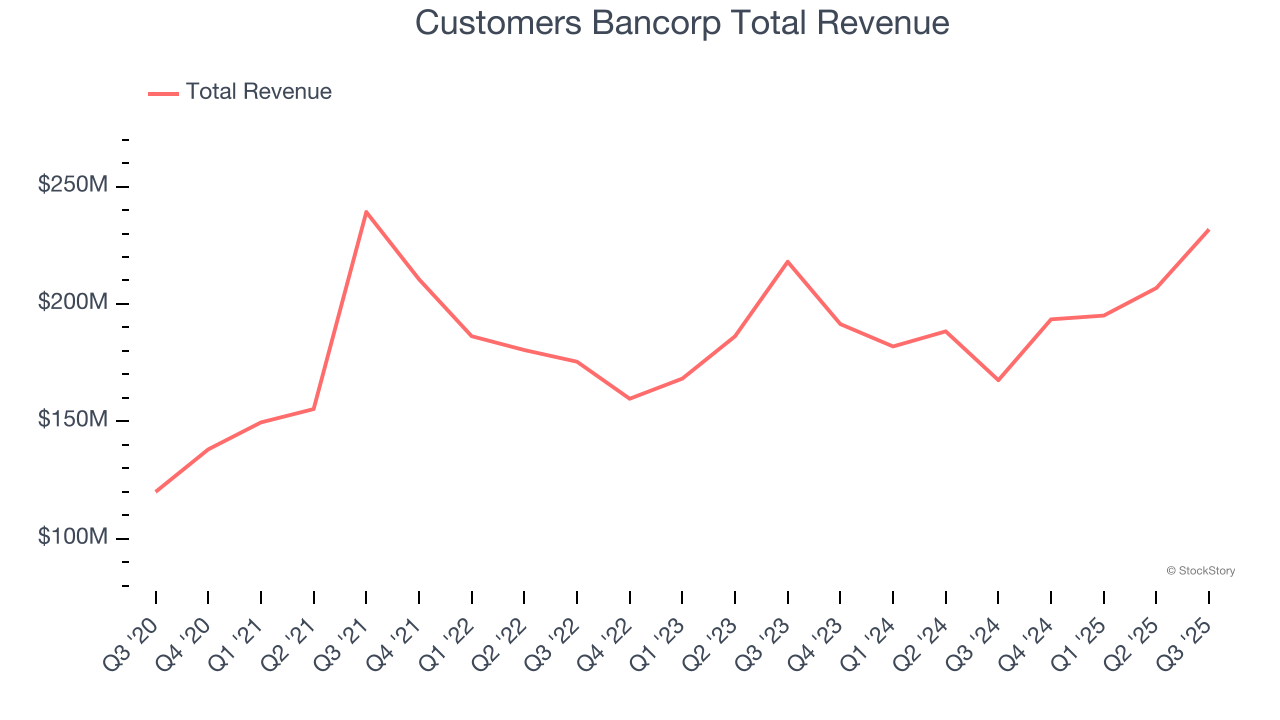
The market seems happy with the results as the stock is up 16.8% since reporting. It currently trades at $76.56.
Is now the time to buy Customers Bancorp? Access our full analysis of the earnings results here, it’s free for active Edge members.
Weakest Q3: The Bancorp (NASDAQ:TBBK)
Operating behind the scenes of many popular fintech apps and prepaid cards you might use daily, The Bancorp (NASDAQ:TBBK) is a bank holding company that specializes in providing banking services to fintech companies and offering specialty lending products.
The Bancorp reported revenues of $174.7 million, up 38.8% year on year, falling short of analysts’ expectations by 9.9%. It was a disappointing quarter as it posted a significant miss of analysts’ revenue estimates and a significant miss of analysts’ net interest income estimates.
The Bancorp delivered the weakest performance against analyst estimates in the group. As expected, the stock is down 9.6% since the results and currently trades at $69.82.
Read our full analysis of The Bancorp’s results here.
Live Oak Bancshares (NYSE:LOB)
Founded during the 2008 financial crisis with a vision to reimagine small business banking through technology, Live Oak Bancshares (NYSE:LOB) is a bank holding company that specializes in providing online banking services and SBA-guaranteed loans to small businesses across targeted industries nationwide.
Live Oak Bancshares reported revenues of $153.1 million, up 17% year on year. This number topped analysts’ expectations by 3%. Taking a step back, it was a mixed quarter as it also recorded an impressive beat of analysts’ revenue estimates but a significant miss of analysts’ EPS estimates.
The stock is up 1.6% since reporting and currently trades at $35.23.
Read our full, actionable report on Live Oak Bancshares here, it’s free for active Edge members.
Butterfield Bank (NYSE:NTB)
Founded in 1784 as one of the oldest banks in the Western Hemisphere, Butterfield Bank (NYSE:NTB) provides banking, wealth management, and trust services to individuals and businesses in select offshore financial centers including Bermuda, Cayman Islands, and the Channel Islands.
Butterfield Bank reported revenues of $153.9 million, up 6.8% year on year. This result beat analysts’ expectations by 3.9%. It was a very strong quarter as it also recorded a solid beat of analysts’ revenue estimates and a beat of analysts’ EPS estimates.
The stock is up 20.3% since reporting and currently trades at $50.53.
Read our full, actionable report on Butterfield Bank here, it’s free for active Edge members.
Market Update
The Fed’s interest rate hikes throughout 2022 and 2023 have successfully cooled post-pandemic inflation, bringing it closer to the 2% target. Inflationary pressures have eased without tipping the economy into a recession, suggesting a soft landing. This stability, paired with recent rate cuts (0.5% in September 2024 and 0.25% in November 2024), fueled a strong year for the stock market in 2024. The markets surged further after Donald Trump’s presidential victory in November, with major indices reaching record highs in the days following the election. Still, questions remain about the direction of economic policy, as potential tariffs and corporate tax changes add uncertainty for 2025.
Want to invest in winners with rock-solid fundamentals? Check out our 9 Best Market-Beating Stocks and add them to your watchlist. These companies are poised for growth regardless of the political or macroeconomic climate.
StockStory’s analyst team — all seasoned professional investors — uses quantitative analysis and automation to deliver market-beating insights faster and with higher quality.