Hormel Foods (HRL)
Hormel Foods keeps us up at night. Not only are its sales cratering but also its low returns on capital suggest it struggles to generate profits.― StockStory Analyst Team


1. News



2. Summary
Why We Think Hormel Foods Will Underperform
Best known for its SPAM brand, Hormel (NYSE:HRL) is a packaged foods company with products that span meat, poultry, shelf-stable foods, and spreads.
- Products fail to spark excitement with consumers, as seen in its flat sales over the last three years
- Easily substituted products (and therefore stiff competition) result in an inferior gross margin of 16.2% that must be offset through higher volumes
- Sales over the last three years were less profitable as its earnings per share fell by 8.8% annually while its revenue was flat
Hormel Foods is in the doghouse. We’re hunting for superior stocks elsewhere.
Why There Are Better Opportunities Than Hormel Foods



At $22.78 per share, Hormel Foods trades at 15x forward P/E. Hormel Foods’s valuation may seem like a bargain, especially when stacked up against other consumer staples companies. We remind you that you often get what you pay for, though.
We’d rather pay up for companies with elite fundamentals than get a bargain on weak ones. Cheap stocks can be value traps, and as their performance deteriorates, they will stay cheap or get even cheaper.
3. Hormel Foods (HRL) Research Report: Q4 CY2025 Update
Packaged foods company Hormel (NYSE:HRL) missed Wall Street’s revenue expectations in Q4 CY2025 as sales only rose 1.3% year on year to $3.03 billion. On the other hand, the company’s outlook for the full year was close to analysts’ estimates with revenue guided to $12.35 billion at the midpoint. Its non-GAAP profit of $0.34 per share was 6.1% above analysts’ consensus estimates.
Hormel Foods (HRL) Q4 CY2025 Highlights:
- Revenue: $3.03 billion vs analyst estimates of $3.07 billion (1.3% year-on-year growth, 1.5% miss)
- Adjusted EPS: $0.34 vs analyst estimates of $0.32 (6.1% beat)
- Adjusted EBITDA: $310.8 million vs analyst estimates of $308.1 million (10.3% margin, 0.9% beat)
- The company reconfirmed its revenue guidance for the full year of $12.35 billion at the midpoint
- Management reiterated its full-year Adjusted EPS guidance of $1.47 at the midpoint
- Operating Margin: 8%, in line with the same quarter last year
- Free Cash Flow Margin: 9.3%, up from 7.9% in the same quarter last year
- Sales Volumes fell 3.9% year on year, in line with the same quarter last year
- Market Capitalization: $13.92 billion
Company Overview
Best known for its SPAM brand, Hormel (NYSE:HRL) is a packaged foods company with products that span meat, poultry, shelf-stable foods, and spreads.
Established in 1891 by George A. Hormel, the company started as a meatpacking operation. Throughout its history, Hormel has grown its business and expanded its portfolio through organic development as well as through mergers and acquisitions. The 1936 acquisition of SPAM was transformative, as was the 2013 deal to bring Skippy peanut butter into the portfolio.
In addition to its namesake brand, SPAM, and Skippy, the company also boasts the Planters (nuts), Applegate Farms (meats), Jennie-O (meats), and Justin’s (spreads and snacks) brands. Hormel caters to low to middle-income households seeking convenience through trusted brands. The heads or caretakers of these households are usually busy and don’t have the time to cook meals or prepare snacks from scratch. The company’s products add convenience to everyday life, and they are often brands that customers have been eating since childhood.
Hormel products enjoy wide distribution. Supermarkets and grocery stores are the most common sellers of the company’s products, but consumers can also find brands such as SPAM and Skippy in mass merchandisers and discount retailers that carry food.
4. Shelf-Stable Food
As America industrialized and moved away from an agricultural economy, people faced more demands on their time. Packaged foods emerged as a solution offering convenience to the evolving American family, whether it be canned goods or snacks. Today, Americans seek brands that are high in quality, reliable, and reasonably priced. Furthermore, there's a growing emphasis on health-conscious and sustainable food options. Packaged food stocks are considered resilient investments. People always need to eat, so these companies can enjoy consistent demand as long as they stay on top of changing consumer preferences. The industry spans from multinational corporations to smaller specialized firms and is subject to food safety and labeling regulations.
Competitors in packaged food with a focus on meat include Kraft Heinz (NASDAQ:KHC), Tyson (NYSE:TSN), and Pilgrim’s Pride (NASDAQ:PPC).
5. Revenue Growth
Reviewing a company’s long-term sales performance reveals insights into its quality. Any business can put up a good quarter or two, but many enduring ones grow for years.
With $12.14 billion in revenue over the past 12 months, Hormel Foods is one of the larger consumer staples companies and benefits from a well-known brand that influences purchasing decisions. However, its scale is a double-edged sword because it’s harder to find incremental growth when your existing brands have penetrated most of the market. For Hormel Foods to boost its sales, it likely needs to adjust its prices, launch new offerings, or lean into foreign markets.
As you can see below, Hormel Foods struggled to increase demand as its $12.14 billion of sales for the trailing 12 months was close to its revenue three years ago. This is mainly because consumers bought less of its products - we’ll explore what this means in the "Volume Growth" section.
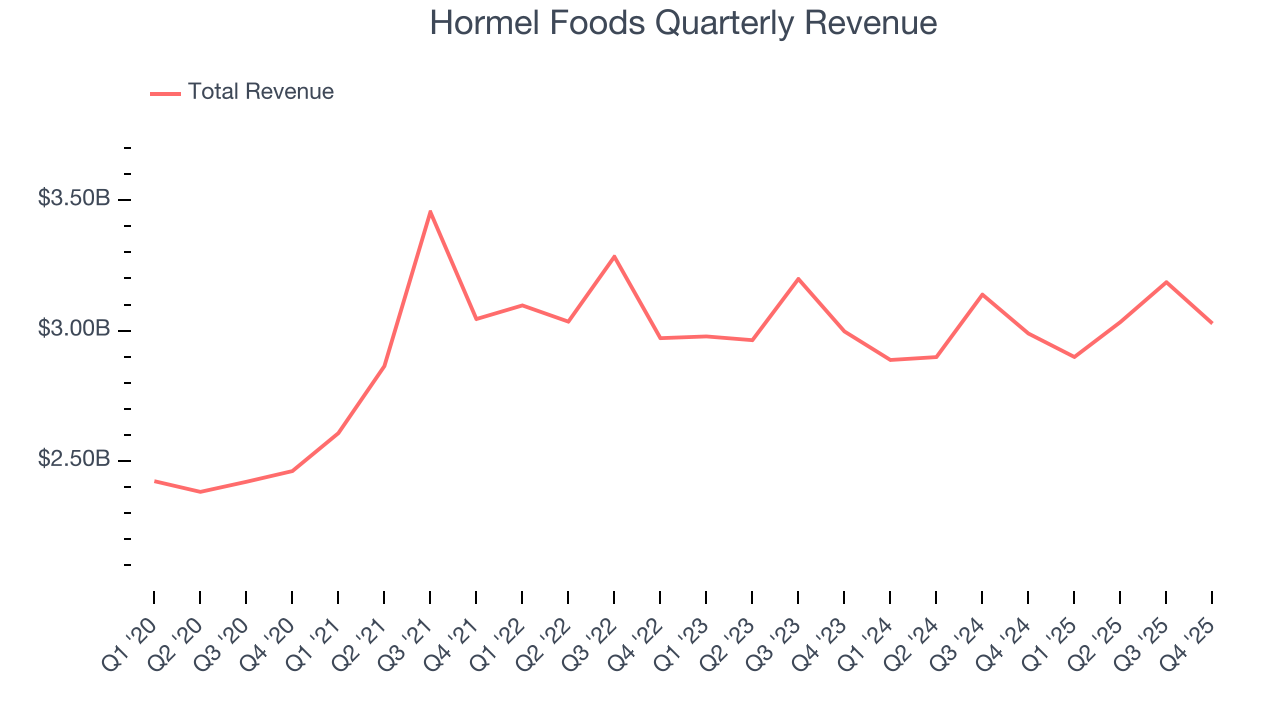
This quarter, Hormel Foods’s revenue grew by 1.3% year on year to $3.03 billion, falling short of Wall Street’s estimates.
Looking ahead, sell-side analysts expect revenue to grow 2.7% over the next 12 months. Although this projection indicates its newer products will spur better top-line performance, it is still below average for the sector.
6. Volume Growth
Revenue growth can be broken down into changes in price and volume (the number of units sold). While both are important, volume is the lifeblood of a successful staples business as there’s a ceiling to what consumers will pay for everyday goods; they can always trade down to non-branded products if the branded versions are too expensive.
Hormel Foods’s average quarterly sales volumes have shrunk by 3.4% over the last two years. This decrease isn’t ideal because the quantity demanded for consumer staples products is typically stable. 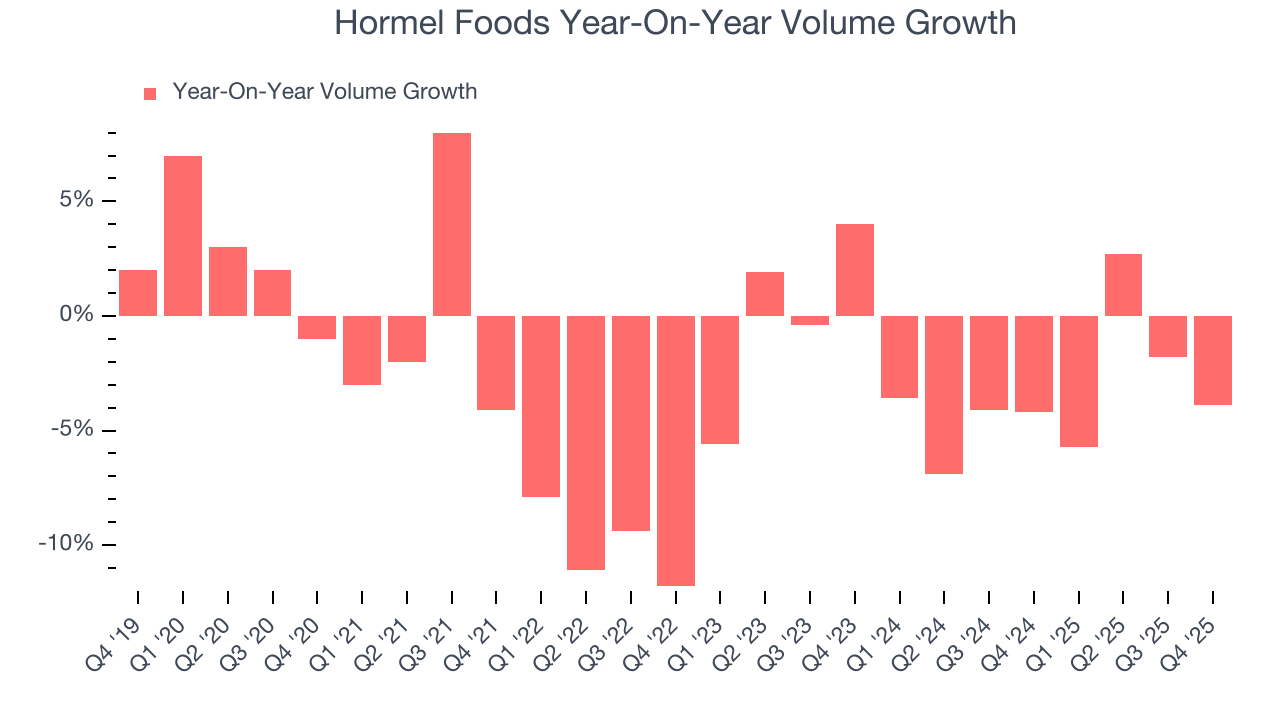
In Hormel Foods’s Q4 2026, sales volumes dropped 3.9% year on year. This result represents a further deceleration from its historical levels, showing the business is struggling to move its products.
7. Gross Margin & Pricing Power
Hormel Foods has bad unit economics for a consumer staples company, signaling it operates in a competitive market and lacks pricing power because its products can be substituted. As you can see below, it averaged a 16.2% gross margin over the last two years. That means Hormel Foods paid its suppliers a lot of money ($83.84 for every $100 in revenue) to run its business. 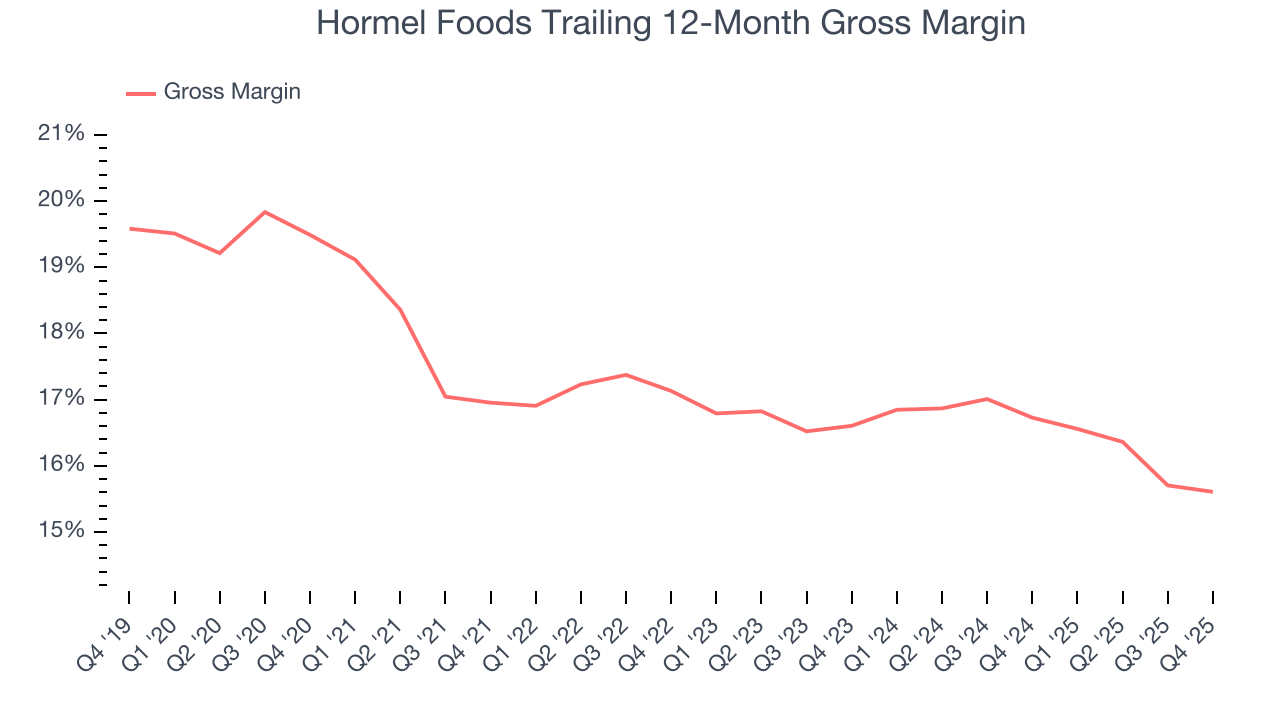
This quarter, Hormel Foods’s gross profit margin was 15.5%, in line with the same quarter last year. Zooming out, Hormel Foods’s full-year margin has been trending down over the past 12 months, decreasing by 1.1 percentage points. If this move continues, it could suggest a more competitive environment with some pressure to lower prices and higher input costs (such as raw materials and manufacturing expenses).
8. Operating Margin
Hormel Foods was profitable over the last two years but held back by its large cost base. Its average operating margin of 7.3% was weak for a consumer staples business. This result isn’t too surprising given its low gross margin as a starting point.
Analyzing the trend in its profitability, Hormel Foods’s operating margin decreased by 2.5 percentage points over the last year. Hormel Foods’s performance was poor no matter how you look at it - it shows that costs were rising and it couldn’t pass them onto its customers.
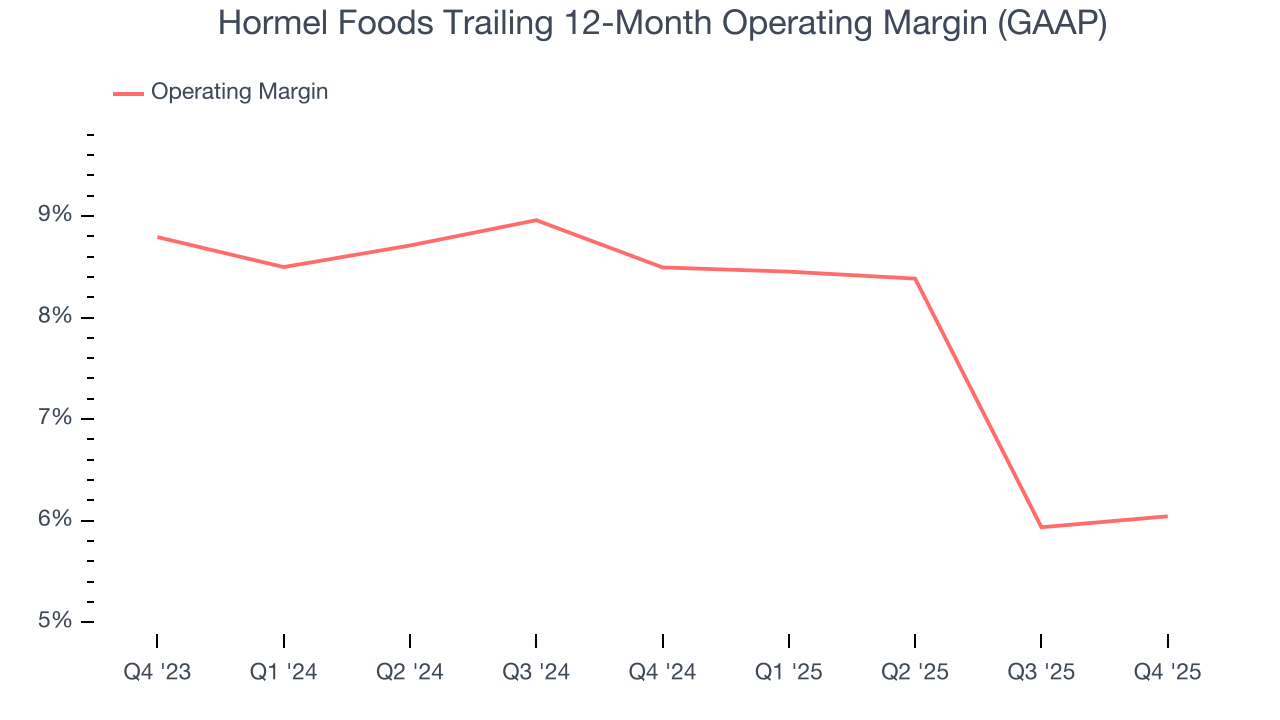
This quarter, Hormel Foods generated an operating margin profit margin of 8%, in line with the same quarter last year. This indicates the company’s cost structure has recently been stable.
9. Earnings Per Share
We track the long-term change in earnings per share (EPS) for the same reason as long-term revenue growth. Compared to revenue, however, EPS highlights whether a company’s growth is profitable.
Sadly for Hormel Foods, its EPS declined by 8.8% annually over the last three years while its revenue was flat. This tells us the company struggled because its fixed cost base made it difficult to adjust to choppy demand.
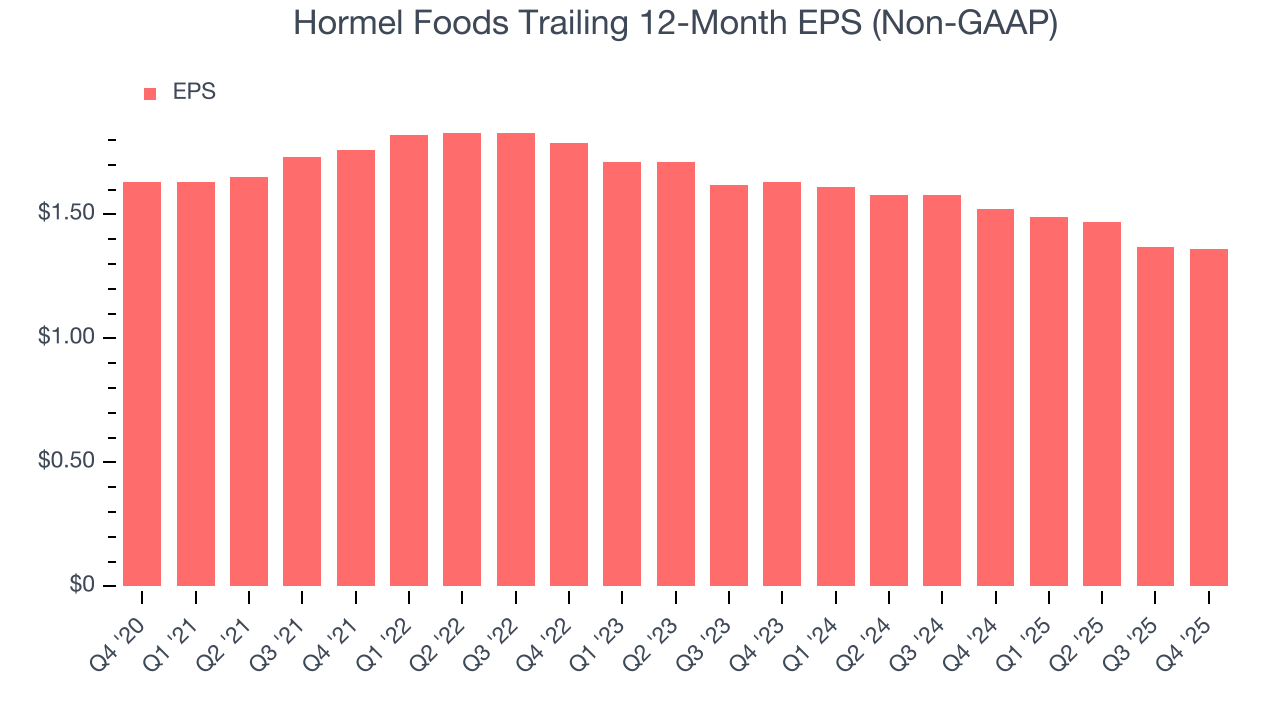
In Q4, Hormel Foods reported adjusted EPS of $0.34, in line with the same quarter last year. This print beat analysts’ estimates by 6.1%. Over the next 12 months, Wall Street expects Hormel Foods’s full-year EPS of $1.36 to grow 11.7%.
10. Cash Is King
If you’ve followed StockStory for a while, you know we emphasize free cash flow. Why, you ask? We believe that in the end, cash is king, and you can’t use accounting profits to pay the bills.
Hormel Foods has shown decent cash profitability, giving it some flexibility to reinvest or return capital to investors. The company’s free cash flow margin averaged 6.1% over the last two years, slightly better than the broader consumer staples sector.
Taking a step back, we can see that Hormel Foods’s margin dropped by 2.7 percentage points over the last year. Continued declines could signal it is in the middle of an investment cycle.
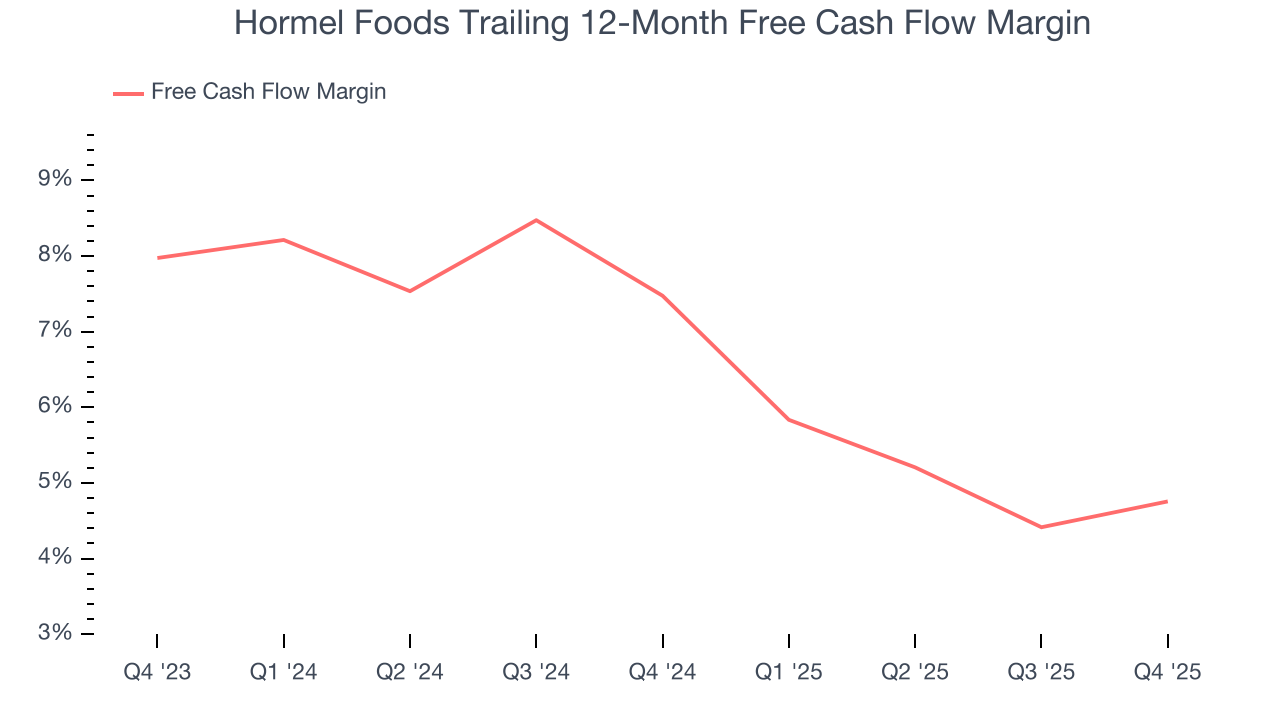
Hormel Foods’s free cash flow clocked in at $280.2 million in Q4, equivalent to a 9.3% margin. This result was good as its margin was 1.3 percentage points higher than in the same quarter last year, but we wouldn’t read too much into the short term because investment needs can be seasonal, leading to temporary swings. Long-term trends are more important.
11. Return on Invested Capital (ROIC)
EPS and free cash flow tell us whether a company was profitable while growing its revenue. But was it capital-efficient? A company’s ROIC explains this by showing how much operating profit it makes compared to the money it has raised (debt and equity).
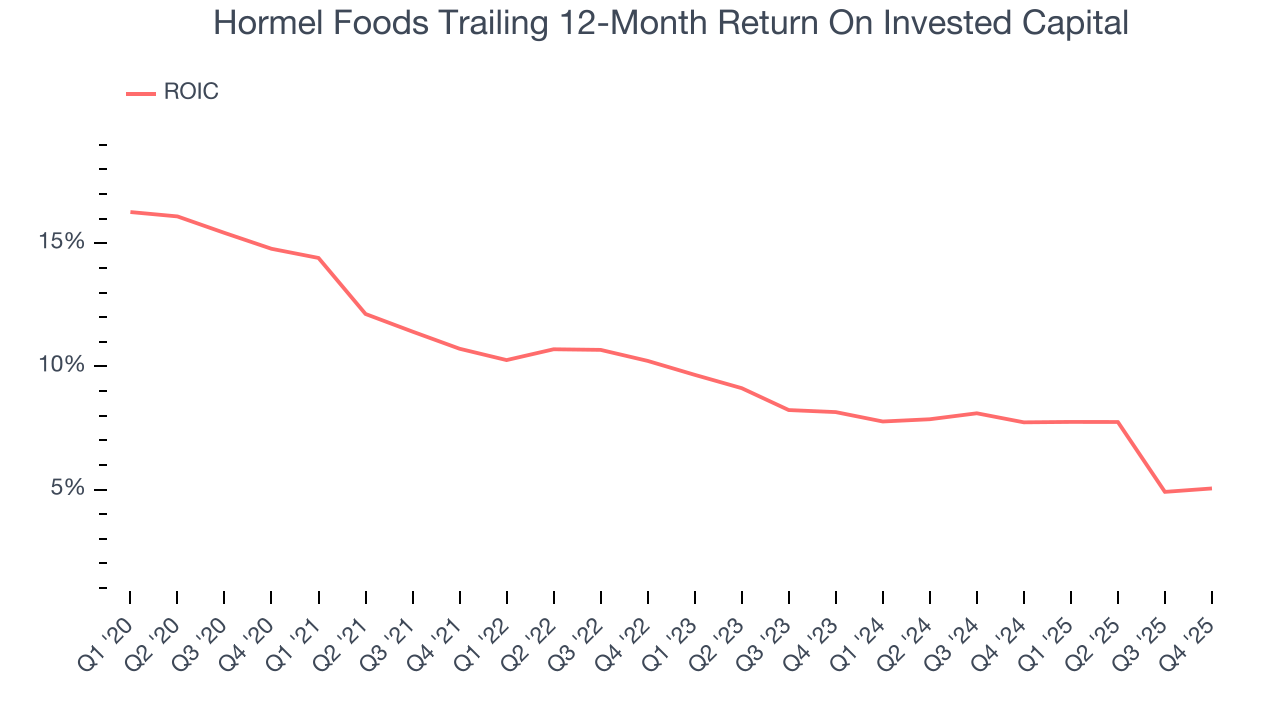
Hormel Foods historically did a mediocre job investing in profitable growth initiatives. Its five-year average ROIC was 8.4%, somewhat low compared to the best consumer staples companies that consistently pump out 20%+.
12. Balance Sheet Assessment
Hormel Foods reported $901.2 million of cash and $2.86 billion of debt on its balance sheet in the most recent quarter. As investors in high-quality companies, we primarily focus on two things: 1) that a company’s debt level isn’t too high and 2) that its interest payments are not excessively burdening the business.
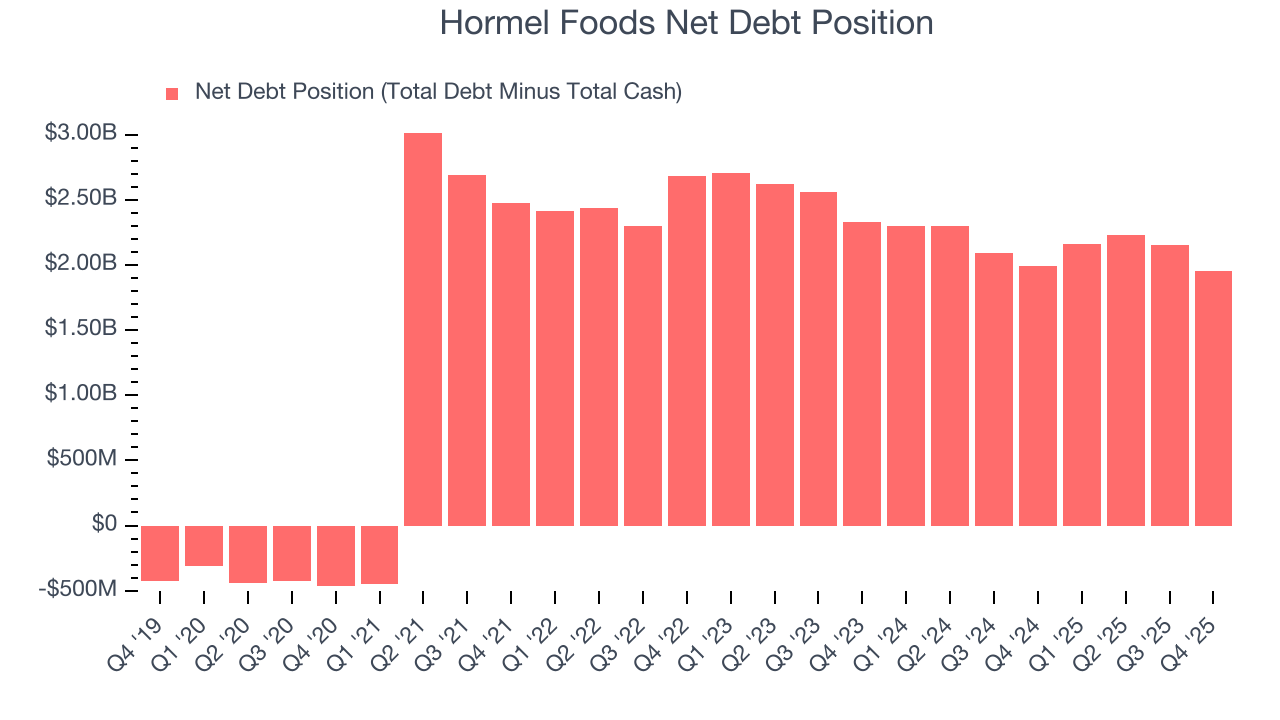
With $1.28 billion of EBITDA over the last 12 months, we view Hormel Foods’s 1.5× net-debt-to-EBITDA ratio as safe. We also see its $39.74 million of annual interest expenses as appropriate. The company’s profits give it plenty of breathing room, allowing it to continue investing in growth initiatives.
13. Key Takeaways from Hormel Foods’s Q4 Results
It was encouraging to see Hormel Foods beat analysts’ gross margin expectations this quarter. We were also glad its EPS outperformed Wall Street’s estimates. On the other hand, its revenue slightly missed. Overall, this was a softer quarter. The stock remained flat at $25.38 immediately following the results.
14. Is Now The Time To Buy Hormel Foods?
Updated: March 15, 2026 at 10:56 PM EDT
When considering an investment in Hormel Foods, investors should account for its valuation and business qualities as well as what’s happened in the latest quarter.
We see the value of companies helping consumers, but in the case of Hormel Foods, we’re out. To begin with, its revenue has declined over the last three years. While its favorable brand awareness gives it meaningful influence over consumers’ dining decisions, the downside is its gross margins make it more challenging to reach positive operating profits compared to other consumer staples businesses. On top of that, its declining EPS over the last three years makes it a less attractive asset to the public markets.
Hormel Foods’s P/E ratio based on the next 12 months is 15x. At this valuation, there’s a lot of good news priced in - we think other companies feature superior fundamentals at the moment.
Wall Street analysts have a consensus one-year price target of $27.63 on the company (compared to the current share price of $22.78).
Although the price target is bullish, readers should exercise caution because analysts tend to be overly optimistic. The firms they work for, often big banks, have relationships with companies that extend into fundraising, M&A advisory, and other rewarding business lines. As a result, they typically hesitate to say bad things for fear they will lose out. We at StockStory do not suffer from such conflicts of interest, so we’ll always tell it like it is.