
Marvell Technology (MRVL)
Marvell Technology is interesting. Its revenue is growing quickly while its profitability is rising, giving it multiple ways to win.― StockStory Analyst Team


1. News


2. Summary
Why Marvell Technology Is Interesting
Moving away from a low margin storage device management chips in one of the biggest semiconductor business model pivots of the past decade, Marvell Technology (NASDAQ: MRVL) is a fabless designer of special purpose data processing and networking chips used by data centers, communications carriers, enterprises, and autos.
- Impressive 22.5% annual revenue growth over the last five years indicates it’s winning market share this cycle
- Demand for the next 12 months is expected to accelerate above its two-year trend as Wall Street forecasts robust revenue growth of 32.1%
- On the flip side, its underwhelming -0.7% return on capital reflects management’s difficulties in finding profitable growth opportunities
Marvell Technology has some noteworthy aspects. If you like the story, the price seems fair.
Why Is Now The Time To Buy Marvell Technology?






Marvell Technology’s stock price of $87.75 implies a valuation ratio of 23x forward P/E. Marvell Technology’s multiple is lower than that of many semiconductor companies. Even so, we think it is justified for the top-line growth you get.
This could be a good time to invest if you think there are underappreciated aspects of the business.
3. Marvell Technology (MRVL) Research Report: Q4 CY2025 Update
Networking chips designer Marvell Technology (NASDAQ: MRVL) beat Wall Street’s revenue expectations in Q4 CY2025, with sales up 22.1% year on year to $2.22 billion. On top of that, next quarter’s revenue guidance ($2.4 billion at the midpoint) was surprisingly good and 5.2% above what analysts were expecting. Its non-GAAP profit of $0.80 per share was in line with analysts’ consensus estimates.
Marvell Technology (MRVL) Q4 CY2025 Highlights:
- Revenue: $2.22 billion vs analyst estimates of $2.21 billion (22.1% year-on-year growth, 0.5% beat)
- Adjusted EPS: $0.80 vs analyst estimates of $0.79 (in line)
- Adjusted EBITDA: $640.8 million vs analyst estimates of $872.7 million (28.9% margin, 26.6% miss)
- Revenue Guidance for Q1 CY2026 is $2.4 billion at the midpoint, above analyst estimates of $2.28 billion
- Adjusted EPS guidance for Q1 CY2026 is $0.79 at the midpoint, above analyst estimates of $0.74
- Operating Margin: 18.2%, up from 12.9% in the same quarter last year
- Free Cash Flow Margin: 11.7%, down from 24.4% in the same quarter last year
- Inventory Days Outstanding: 118, up from 92 in the previous quarter
- Market Capitalization: $68.03 billion
Company Overview
Moving away from a low margin storage device management chips in one of the biggest semiconductor business model pivots of the past decade, Marvell Technology (NASDAQ: MRVL) is a fabless designer of special purpose data processing and networking chips used by data centers, communications carriers, enterprises, and autos.
Marvell was founded in 1995 by Dr. Sehat Sutardja, his wife, and his brother, and for the first two decades was focused on chips used to run storage devices like disk drives and networking equipment like ethernet switches. It also supplied Wi-Fi chipsets used in mobile devices like the iPhone and Google’s Chromecast. In 2016, in the wake of an internal accounting investigation activist investor Starboard Value acquired a minority stake and ousted Dr. Sutardja and his wife, installing Matt Murphy as CEO.
Murphy quickly exited low margin businesses like the consumer hard drives and Wi-Fi chips and refocused R&D efforts to focus on the higher margin networking business. He made multiple transformative acquisitions: Cavium in 2018, Avera and Aquantia in 2019, and Inphi and Innovium in 2021. The result is a company with leading chipsets that enable data transfer – within and between datacenters, across 5G cellular networks, and throughout autos.
The chips used to power today’s cloud data centers are no longer just general purpose CPUs like we think of that run a PC, but there is also a range of chips that are customized for specific tasks like AI used to scan online videos or machine learning used to make ecommerce recommendations. Marvell specializes in these types of chipsets, known as customized ASICs. Marvell also increasingly competes with chip heavyweights Intel and Nvidia with its Octeon data processing units or “DPUs” which is an ARM-based CPU that offloads networking, storage, security, and other infrastructure workloads from the CPU in the server and accelerates them, saving CPU capacity for other tasks, like running applications.
Marvell’s peers and competitors include AMD (NASDAQ:AMD), Broadcom (NASDAQ:AVGO), Intel (NASDAQ:INTC), and Nvidia (NASDAQ: NDVA).
4. Analog Semiconductors
Longer manufacturing duration allows analog chip makers to generate greater efficiencies, leading to structurally higher gross margins than their fabless digital peers. The downside of vertical integration is that cyclicality can be more pronounced for analog chipmakers, as capacity utilization upsides work in reverse during down periods.
5. Revenue Growth
A company’s long-term performance is an indicator of its overall quality. Any business can have short-term success, but a top-tier one grows for years. Over the last five years, Marvell Technology grew its sales at an exceptional 22.5% compounded annual growth rate. Its growth beat the average semiconductor company and shows its offerings resonate with customers, a helpful starting point for our analysis. Semiconductors are a cyclical industry, and long-term investors should be prepared for periods of high growth followed by periods of revenue contractions.
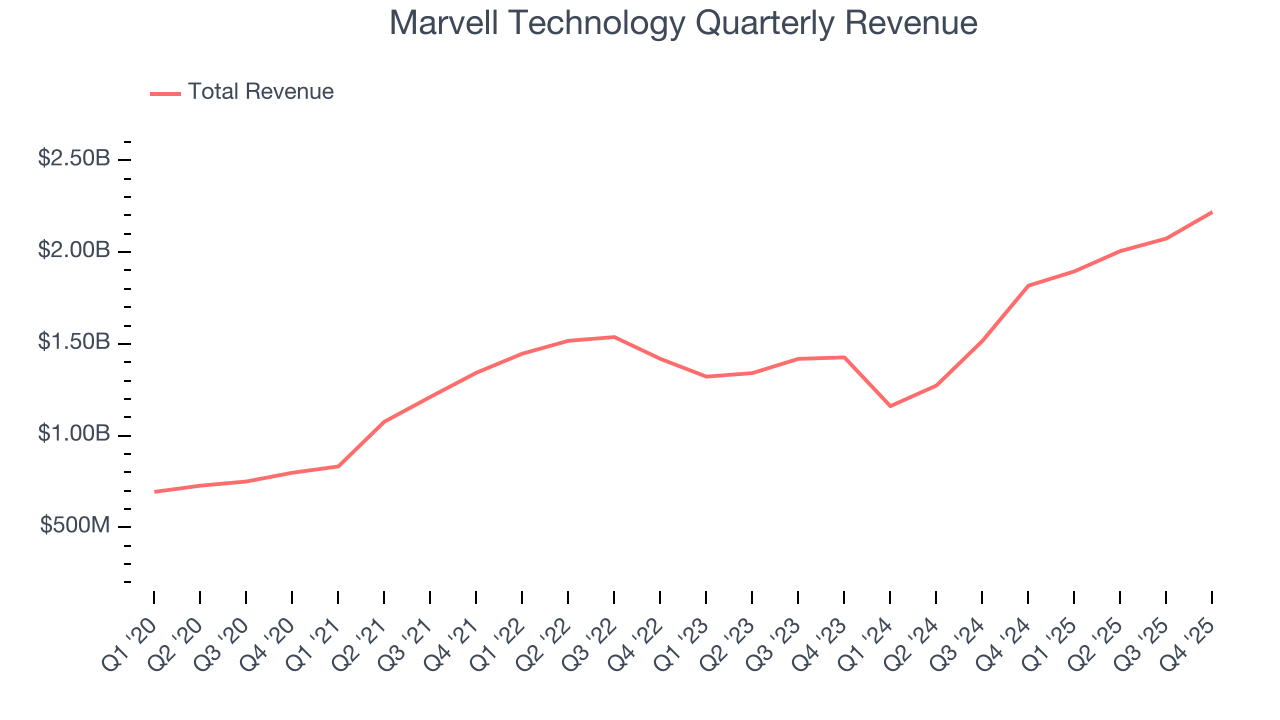
We at StockStory place the most emphasis on long-term growth, but within semiconductors, a half-decade historical view may miss new demand cycles or industry trends like AI. Marvell Technology’s annualized revenue growth of 22% over the last two years aligns with its five-year trend, suggesting its demand was predictably strong. 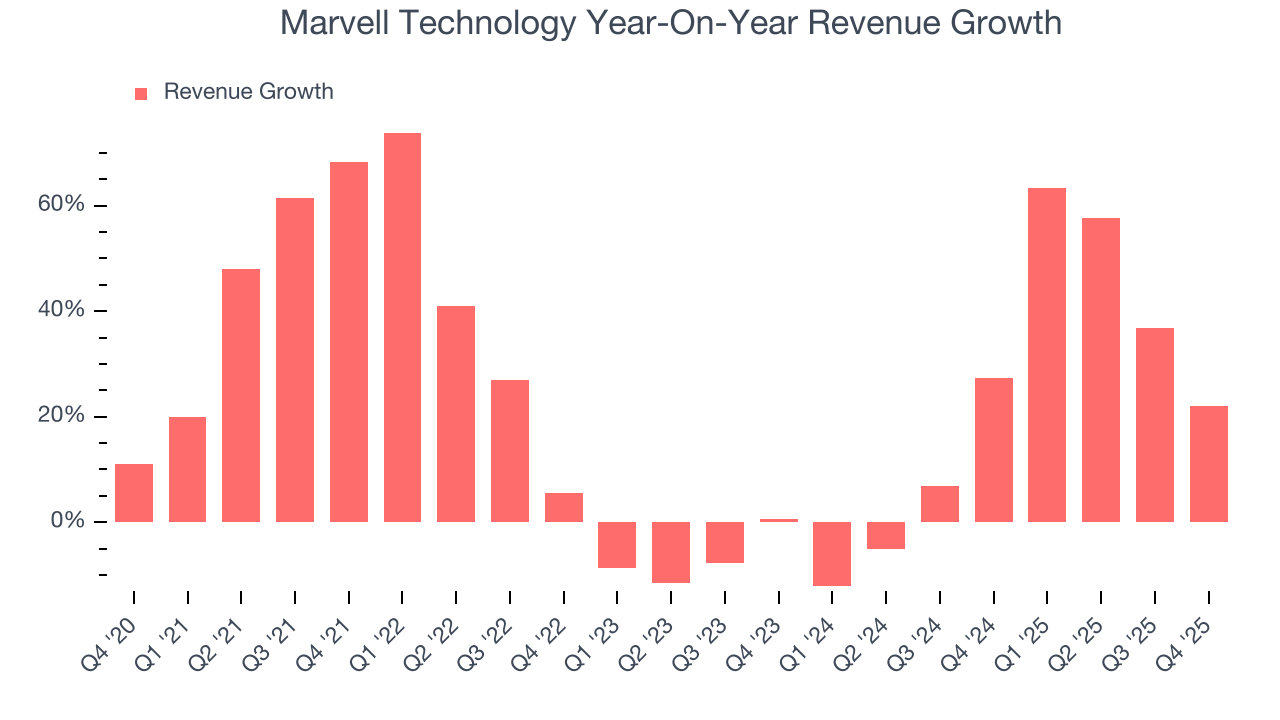
This quarter, Marvell Technology reported robust year-on-year revenue growth of 22.1%, and its $2.22 billion of revenue topped Wall Street estimates by 0.5%. Despite the beat, this was its third consecutive quarter of decelerating growth, pointing to a potential downturn in the semiconductor cycle. Company management is currently guiding for a 26.6% year-on-year increase in sales next quarter.
Looking further ahead, sell-side analysts expect revenue to grow 22% over the next 12 months, similar to its two-year rate. This projection is admirable and implies the market is forecasting success for its products and services.
6. Product Demand & Outstanding Inventory
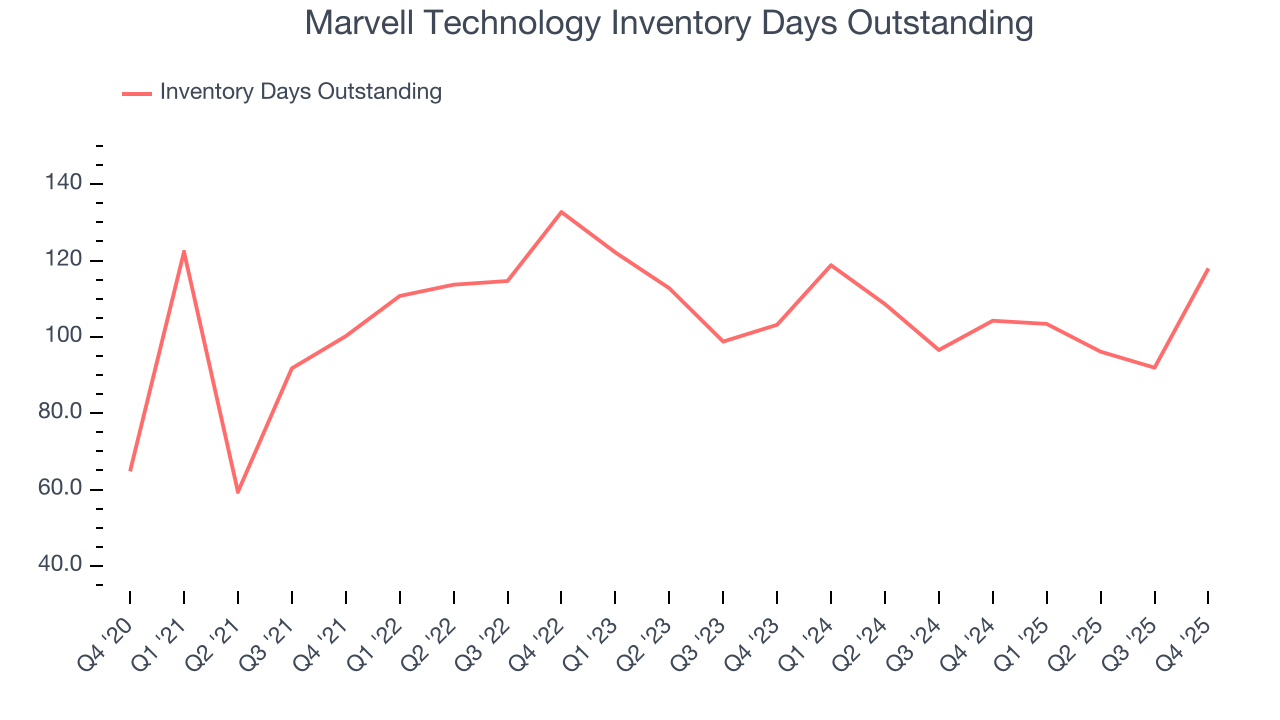
Days Inventory Outstanding (DIO) is an important metric for chipmakers, as it reflects a business’ capital intensity and the cyclical nature of semiconductor supply and demand. In a tight supply environment, inventories tend to be stable, allowing chipmakers to exert pricing power. Steadily increasing DIO can be a warning sign that demand is weak, and if inventories continue to rise, the company may have to downsize production.
This quarter, Marvell Technology’s DIO came in at 118, which is 12 days above its five-year average, suggesting that the company’s inventory has grown to higher levels than we’ve seen in the past.
7. Gross Margin & Pricing Power
In the semiconductor industry, a company’s gross profit margin is a critical metric to track because it sheds light on its pricing power, complexity of products, and ability to procure raw materials, equipment, and labor.
Marvell Technology’s unit economics are roughly in line with other semiconductor businesses, pointing to a lack of significant pricing pressure and the effectiveness of its products. As you can see below, it averaged a decent 49.6% gross margin over the last two years. That means for every $100 in revenue, roughly $49.57 was left to spend on selling, marketing, R&D, and general administrative overhead. 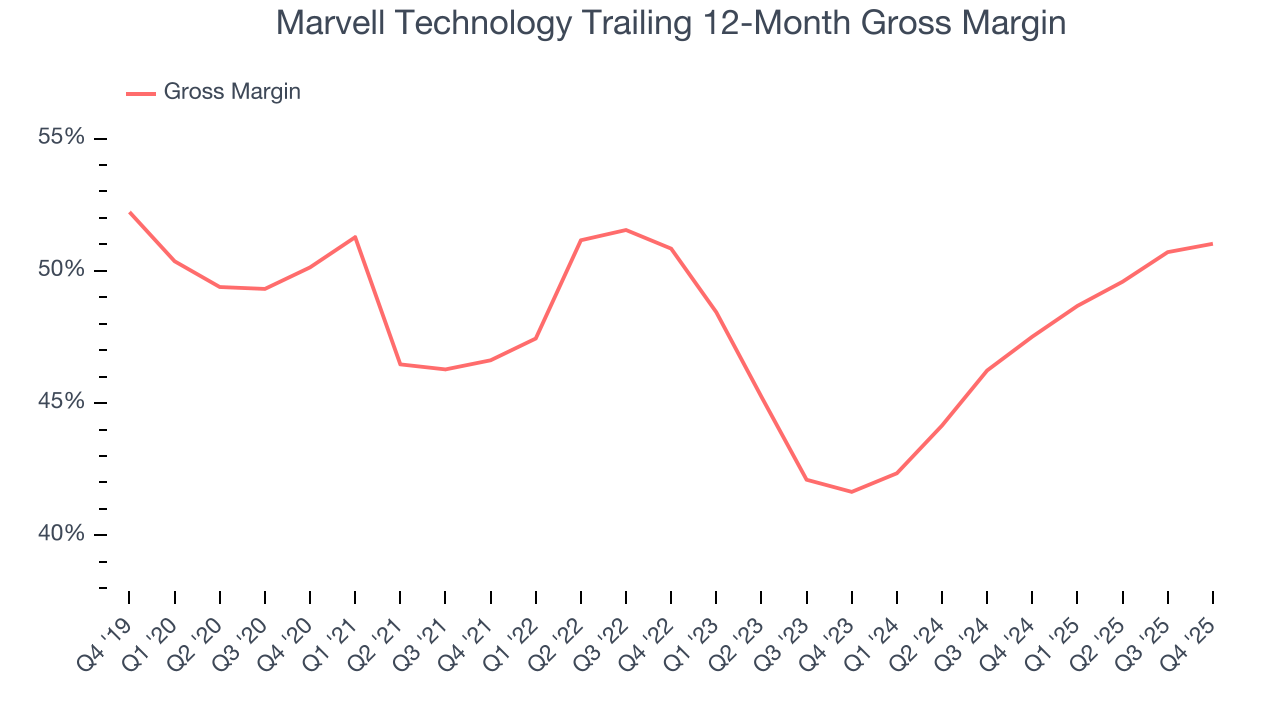
In Q4, Marvell Technology produced a 51.7% gross profit margin, up 1.2 percentage points year on year. Marvell Technology’s full-year margin has also been trending up over the past 12 months, increasing by 3.5 percentage points. If this move continues, it could suggest better unit economics due to more leverage from its growing sales on the fixed portion of its cost of goods sold (such as manufacturing expenses).
8. Operating Margin
Marvell Technology was profitable over the last two years but held back by its large cost base. Its average operating margin of 4.3% was weak for a semiconductor business.
On the plus side, Marvell Technology’s operating margin rose by 23.9 percentage points over the last five years, as its sales growth gave it immense operating leverage.
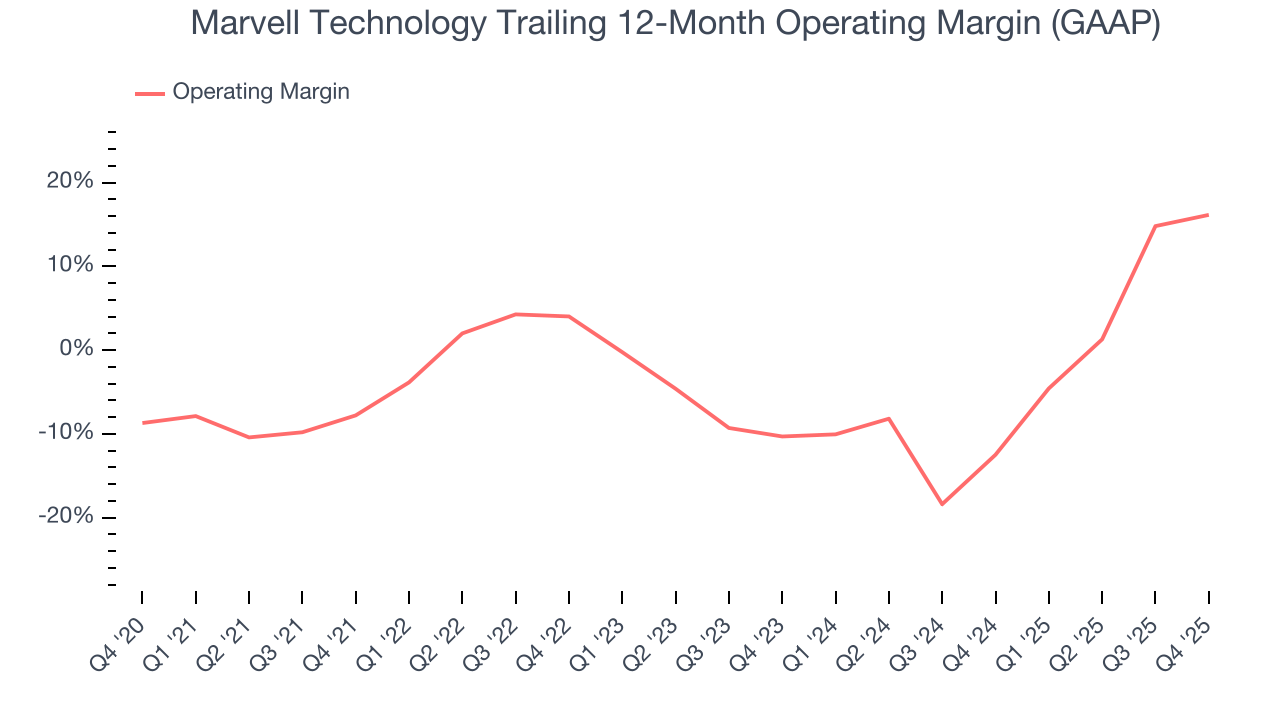
In Q4, Marvell Technology generated an operating margin profit margin of 18.2%, up 5.3 percentage points year on year. The increase was solid, and because its operating margin rose more than its gross margin, we can infer it was more efficient with expenses such as marketing, R&D, and administrative overhead.
9. Earnings Per Share
Revenue trends explain a company’s historical growth, but the long-term change in earnings per share (EPS) points to the profitability of that growth – for example, a company could inflate its sales through excessive spending on advertising and promotions.
Marvell Technology’s EPS grew at 25.1% compounded annual growth rate over the last five years, higher than its 22.5% annualized revenue growth. This tells us the company became more profitable on a per-share basis as it expanded.
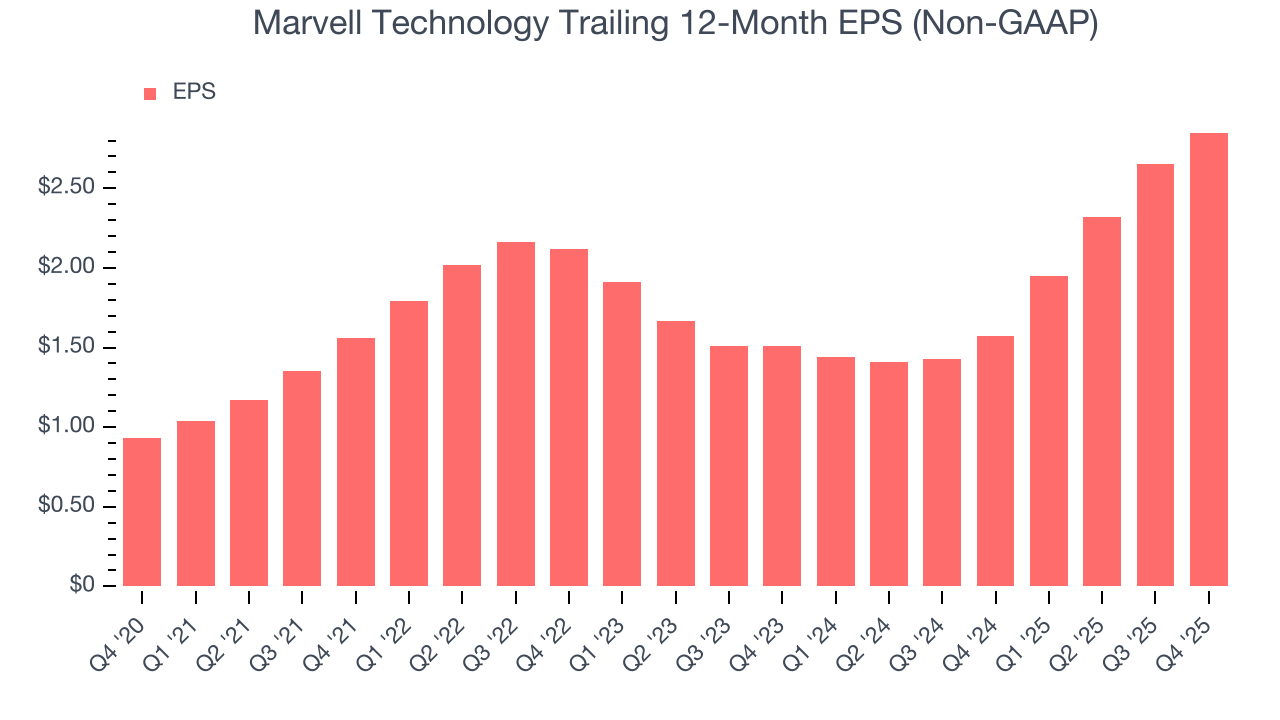
We can take a deeper look into Marvell Technology’s earnings to better understand the drivers of its performance. As we mentioned earlier, Marvell Technology’s operating margin expanded by 23.9 percentage points over the last five years. This was the most relevant factor (aside from the revenue impact) behind its higher earnings; interest expenses and taxes can also affect EPS but don’t tell us as much about a company’s fundamentals.
In Q4, Marvell Technology reported adjusted EPS of $0.80, up from $0.60 in the same quarter last year. This print beat analysts’ estimates by 1.1%. Over the next 12 months, Wall Street expects Marvell Technology’s full-year EPS of $2.85 to grow 19%.
10. Cash Is King
Free cash flow isn't a prominently featured metric in company financials and earnings releases, but we think it's telling because it accounts for all operating and capital expenses, making it tough to manipulate. Cash is king.
Marvell Technology has shown impressive cash profitability, and if maintainable, will be in a position to ride out cyclical downturns more easily while continuing to invest in new and existing products. The company’s free cash flow margin averaged 20% over the last two years, better than the broader semiconductor sector. Marvell Technology has shown impressive cash profitability relative to peers over the last two years, giving the company fewer opportunities to return capital to shareholders.
Taking a step back, we can see that Marvell Technology’s margin expanded by 2.5 percentage points over the last five years. This is encouraging because it gives the company more optionality.
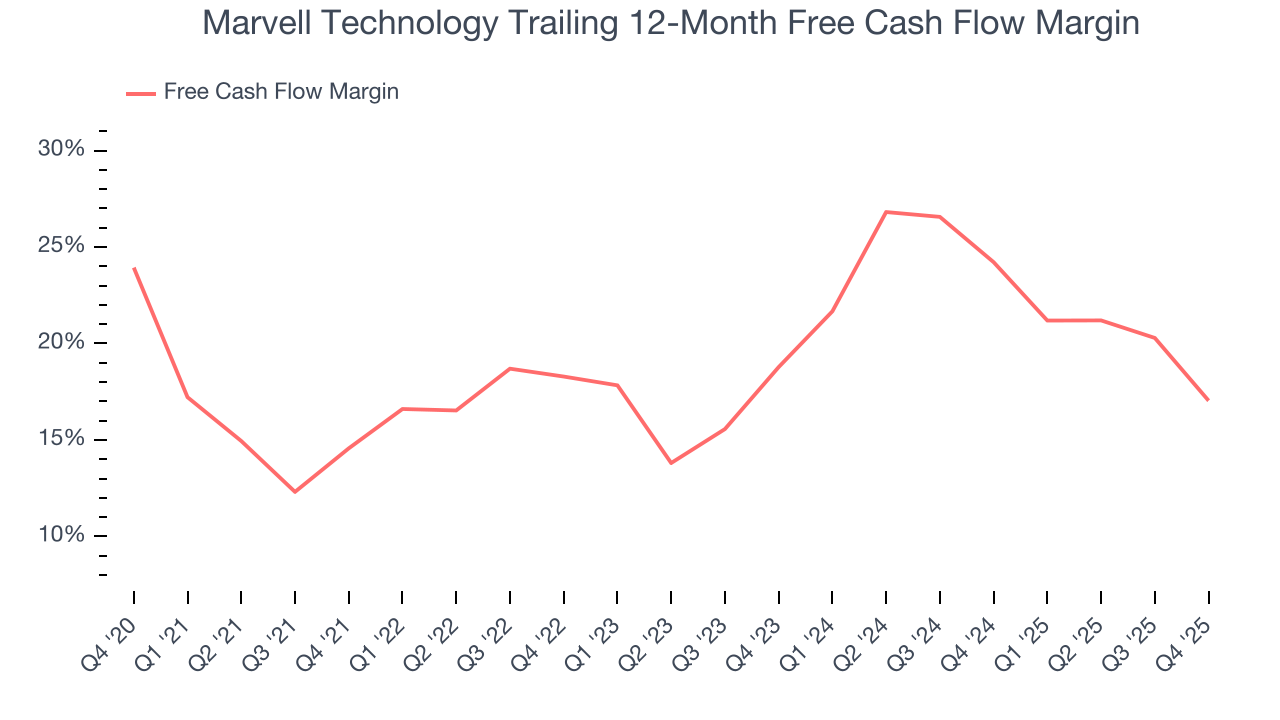
Marvell Technology’s free cash flow clocked in at $259.4 million in Q4, equivalent to a 11.7% margin. The company’s cash profitability regressed as it was 12.7 percentage points lower than in the same quarter last year, but we wouldn’t read too much into it because capital expenditures can be seasonal and companies often stockpile inventory in anticipation of higher demand, leading to quarter-to-quarter swings. Long-term trends carry greater meaning.
11. Return on Invested Capital (ROIC)
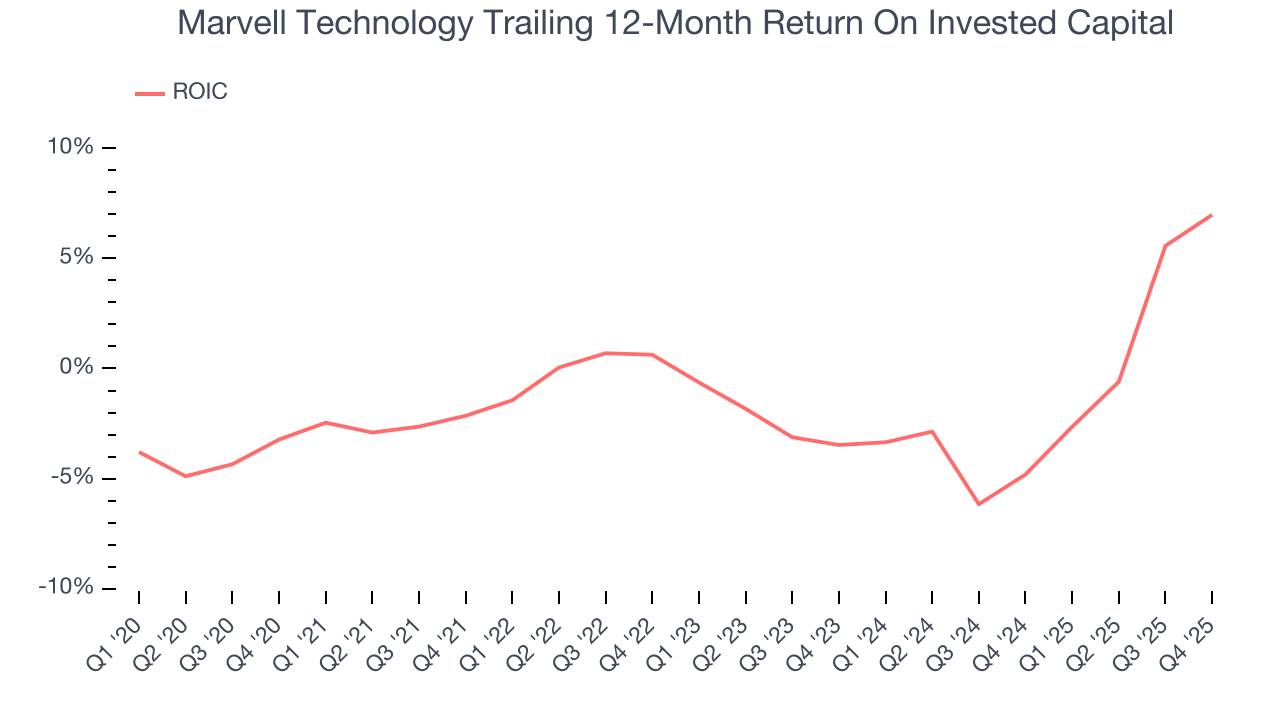
EPS and free cash flow tell us whether a company was profitable while growing its revenue. But was it capital-efficient? A company’s ROIC explains this by showing how much operating profit it makes compared to the money it has raised (debt and equity).
Although Marvell Technology has shown solid business quality lately, it struggled to grow profitably in the past. Its five-year average ROIC was negative 0.6%, meaning management lost money while trying to expand the business.
12. Balance Sheet Assessment
Marvell Technology reported $2.64 billion of cash and $4.47 billion of debt on its balance sheet in the most recent quarter. As investors in high-quality companies, we primarily focus on two things: 1) that a company’s debt level isn’t too high and 2) that its interest payments are not excessively burdening the business.
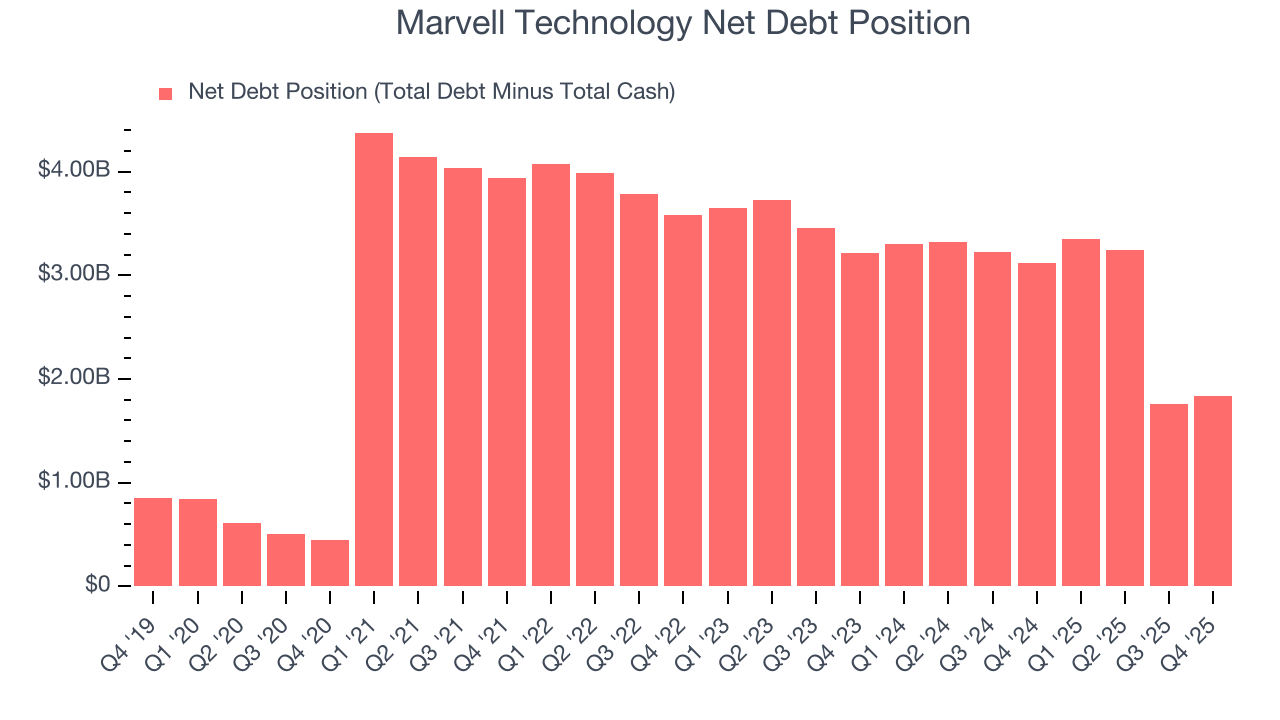
With $3.00 billion of EBITDA over the last 12 months, we view Marvell Technology’s 0.6× net-debt-to-EBITDA ratio as safe. We also see its $85.7 million of annual interest expenses as appropriate. The company’s profits give it plenty of breathing room, allowing it to continue investing in growth initiatives.
13. Key Takeaways from Marvell Technology’s Q4 Results
It was great to see Marvell Technology’s revenue guidance for next quarter top analysts’ expectations. We were also glad its EPS was in line with Wall Street’s estimates. On the other hand, its inventory levels materially increased. Overall, this print had some key positives. The stock traded up 10.1% to $83.77 immediately after reporting.
14. Is Now The Time To Buy Marvell Technology?
Updated: March 15, 2026 at 10:18 PM EDT
When considering an investment in Marvell Technology, investors should account for its valuation and business qualities as well as what’s happened in the latest quarter.
Marvell Technology is a fine business. First off, its revenue growth was exceptional over the last five years and is expected to accelerate over the next 12 months. And while its relatively low ROIC suggests management has struggled to find compelling investment opportunities, its expanding operating margin shows the business has become more efficient. On top of that, its spectacular EPS growth over the last five years shows its profits are trickling down to shareholders.
Marvell Technology’s P/E ratio based on the next 12 months is 23x. Looking at the semiconductor landscape right now, Marvell Technology trades at a pretty interesting price. If you believe in the company and its growth potential, now is an opportune time to buy shares.
Wall Street analysts have a consensus one-year price target of $120.28 on the company (compared to the current share price of $87.75), implying they see 37.1% upside in buying Marvell Technology in the short term.