
Paycom (PAYC)
We’re skeptical of Paycom. Its decelerating growth and falling profitability suggest it’s struggling to scale down costs as demand fades.― StockStory Analyst Team


1. News


2. Summary
Why We Think Paycom Will Underperform
Pioneering the concept of employees doing their own payroll with its "Beti" technology, Paycom (NYSE:PAYC) provides cloud-based human capital management software that helps businesses manage the entire employment lifecycle from recruitment to retirement.
- Costs have risen faster than its revenue over the last year, causing its operating margin to decline by 6 percentage points
- Estimated sales growth of 6.6% for the next 12 months implies demand will slow from its two-year trend
- A positive is that its software is difficult to replicate at scale and leads to a best-in-class gross margin of 87.2%
Paycom falls below our quality standards. We see more favorable opportunities in the market.
Why There Are Better Opportunities Than Paycom







At $125.72 per share, Paycom trades at 3.2x forward price-to-sales. Paycom’s valuation may seem like a great deal, but we think there are valid reasons why it’s so cheap.
Our advice is to pay up for elite businesses whose advantages are tailwinds to earnings growth. Don’t get sucked into lower-quality businesses just because they seem like bargains. These mediocre businesses often never achieve a higher multiple as hoped, a phenomenon known as a “value trap”.
3. Paycom (PAYC) Research Report: Q4 CY2025 Update
HR software provider Paycom (NYSE:PAYC) met Wall Street’s revenue expectations in Q4 CY2025, with sales up 10.2% year on year to $544.3 million. On the other hand, the company’s full-year revenue guidance of $2.19 billion at the midpoint came in 1.9% below analysts’ estimates. Its non-GAAP profit of $2.45 per share was in line with analysts’ consensus estimates.
Paycom (PAYC) Q4 CY2025 Highlights:
- Revenue: $544.3 million vs analyst estimates of $542.9 million (10.2% year-on-year growth, in line)
- Adjusted EPS: $2.45 vs analyst estimates of $2.45 (in line)
- Adjusted EBITDA: $236.3 million vs analyst estimates of $231.3 million (43.4% margin, 2.2% beat)
- EBITDA guidance for the upcoming financial year 2026 is $960 million at the midpoint, in line with analyst expectations
- Operating Margin: 28.9%, down from 30.1% in the same quarter last year
- Free Cash Flow Margin: 21.7%, up from 16.2% in the previous quarter
- Market Capitalization: $6.86 billion
Company Overview
Pioneering the concept of employees doing their own payroll with its "Beti" technology, Paycom (NYSE:PAYC) provides cloud-based human capital management software that helps businesses manage the entire employment lifecycle from recruitment to retirement.
Paycom's comprehensive platform is built around a core system of record that maintains all human capital data in a single database, eliminating the need for multiple software products and reducing compliance risks associated with maintaining separate systems. The software suite includes applications for talent acquisition, time and labor management, payroll processing, talent management, and HR administration.
What sets Paycom apart is its emphasis on employee self-service. Through the company's mobile app and web interface, employees can access pay information, request time off, submit expenses, clock in and out, complete learning modules, and even process their own payroll. This self-service approach shifts administrative tasks from HR departments to employees, creating efficiencies for organizations while giving employees more control over their information.
Paycom's revenue model is subscription-based, with clients paying monthly fees based on the number of employees and selected applications. While the company's core offering is payroll processing, clients typically adopt multiple applications from Paycom's suite. For example, a manufacturing company might use Paycom to manage employee scheduling across shifts, track time and attendance, process payroll, administer benefits, and provide required training—all through a single integrated system.
The company sells its solution directly through its own sales force across the United States, assigning dedicated specialists to each client for personalized support. Paycom targets organizations across all industries, with a historical focus on businesses with 50 to 10,000 employees, though it has expanded to serve larger enterprises as well.
4. HR Software
Modern HR software has two powerful benefits: cost savings and ease of use. For cost savings, businesses large and small much prefer the flexibility of cloud-based, web-browser-delivered software paid for on a subscription basis rather than the hassle and complexity of purchasing and managing on-premise enterprise software. On the usability side, the consumerization of business software creates seamless experiences whereby multiple standalone processes like payroll processing and compliance are aggregated into a single, easy-to-use platform.
Paycom competes with established payroll and HR solution providers like ADP, Paychex, UKG (Ultimate Kronos Group), Workday, and Ceridian Dayforce, as well as newer entrants like Paylocity, Paycor, and Rippling.
5. Revenue Growth
Reviewing a company’s long-term sales performance reveals insights into its quality. Any business can put up a good quarter or two, but many enduring ones grow for years. Thankfully, Paycom’s 19.5% annualized revenue growth over the last five years was decent. Its growth was slightly above the average software company and shows its offerings resonate with customers.
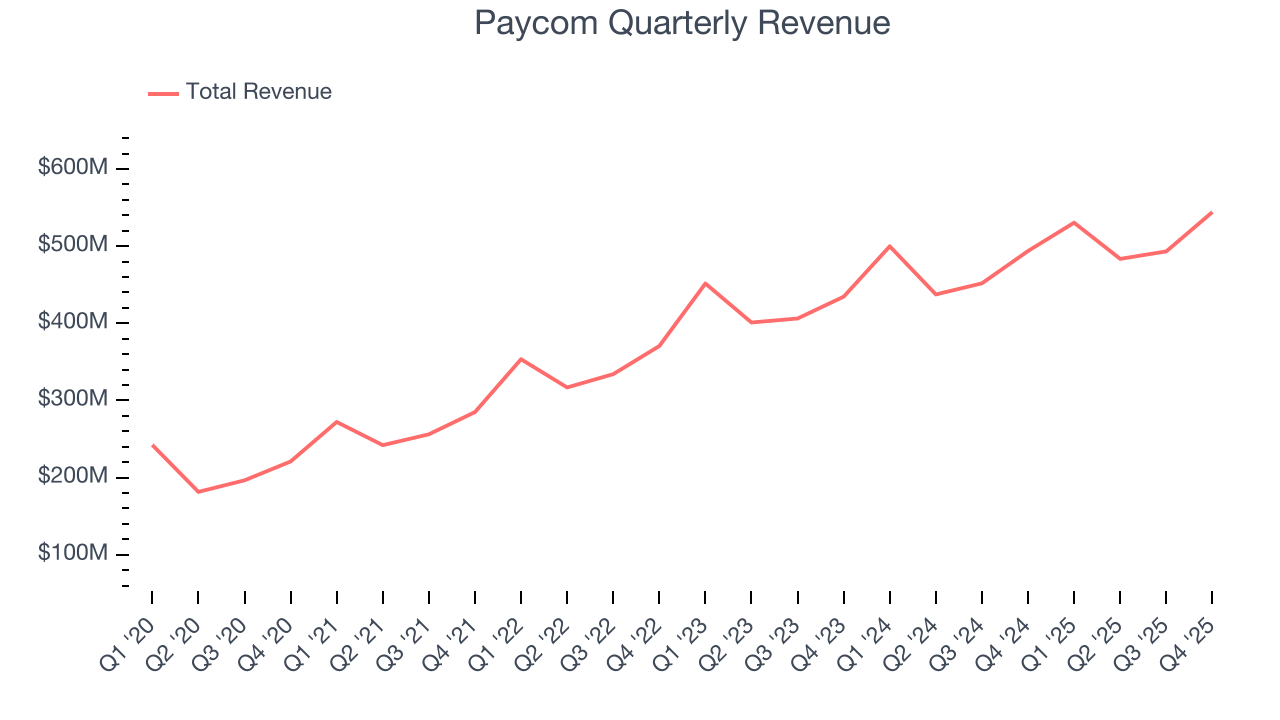
We at StockStory place the most emphasis on long-term growth, but within software, a half-decade historical view may miss recent innovations or disruptive industry trends. Paycom’s recent performance shows its demand has slowed as its annualized revenue growth of 10.1% over the last two years was below its five-year trend. We’re wary when companies in the sector see decelerations in revenue growth, as it could signal changing consumer tastes aided by low switching costs. 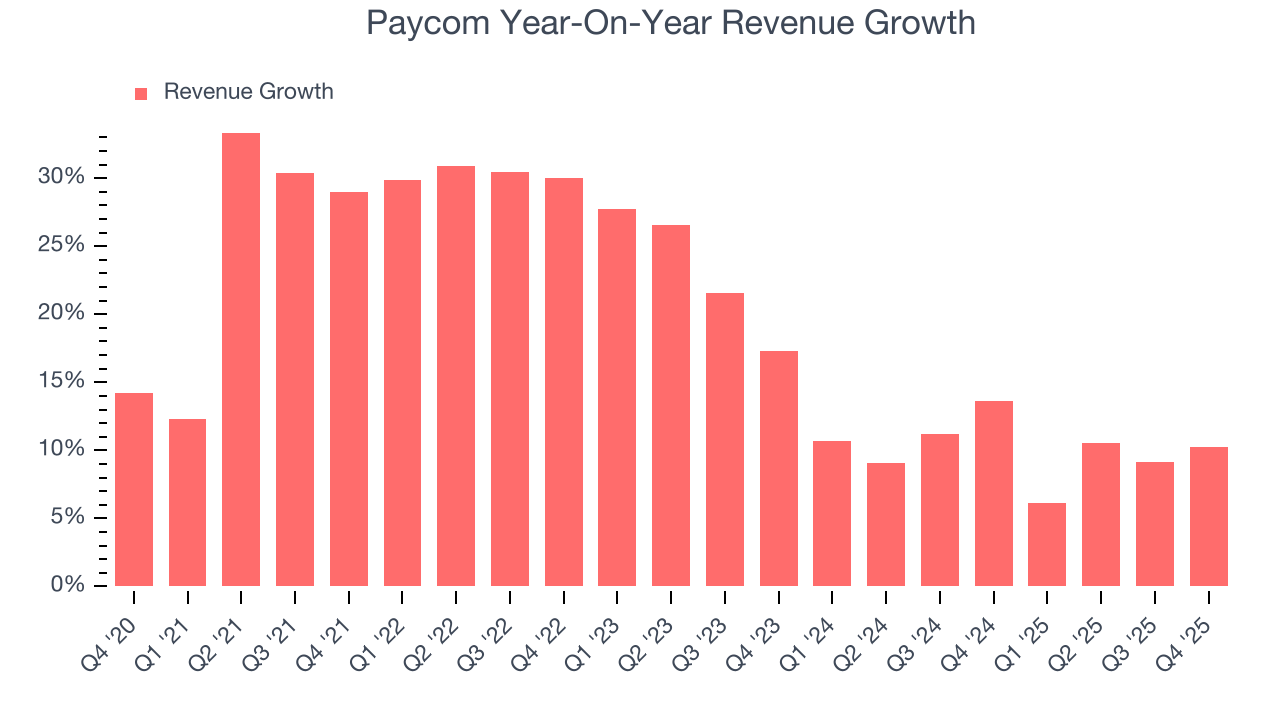
This quarter, Paycom’s year-on-year revenue growth was 10.2%, and its $544.3 million of revenue was in line with Wall Street’s estimates.
Looking ahead, sell-side analysts expect revenue to grow 8.7% over the next 12 months, similar to its two-year rate. This projection doesn't excite us and implies its products and services will see some demand headwinds.
6. Billings
Billings is a non-GAAP metric that is often called “cash revenue” because it shows how much money the company has collected from customers in a certain period. This is different from revenue, which must be recognized in pieces over the length of a contract.
Paycom’s billings came in at $543.4 million in Q4, and over the last four quarters, its growth was underwhelming as it averaged 8.5% year-on-year increases. This performance mirrored its total sales and suggests that increasing competition is causing challenges in acquiring/retaining customers. 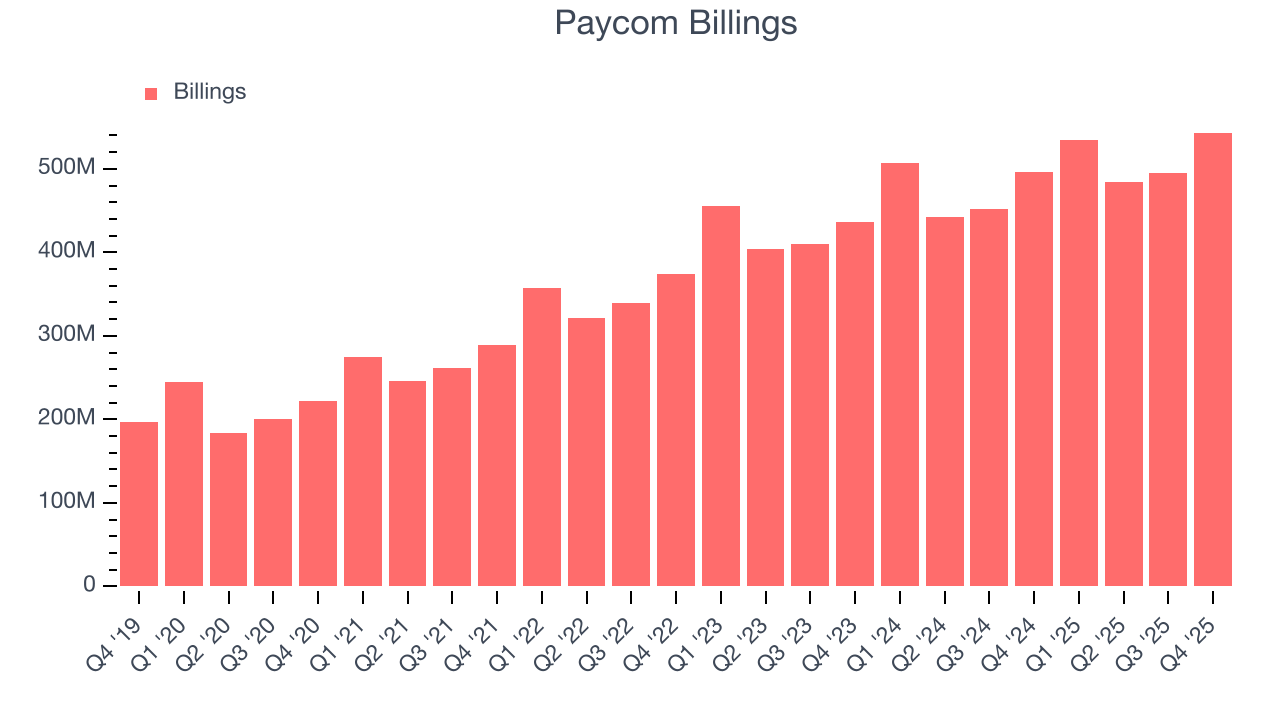
7. Customer Acquisition Efficiency
The customer acquisition cost (CAC) payback period measures the months a company needs to recoup the money spent on acquiring a new customer. This metric helps assess how quickly a business can break even on its sales and marketing investments.
Paycom is extremely efficient at acquiring new customers, and its CAC payback period checked in at 13 months this quarter. The company’s rapid recovery of its customer acquisition costs means it can attempt to spur growth by increasing its sales and marketing investments. 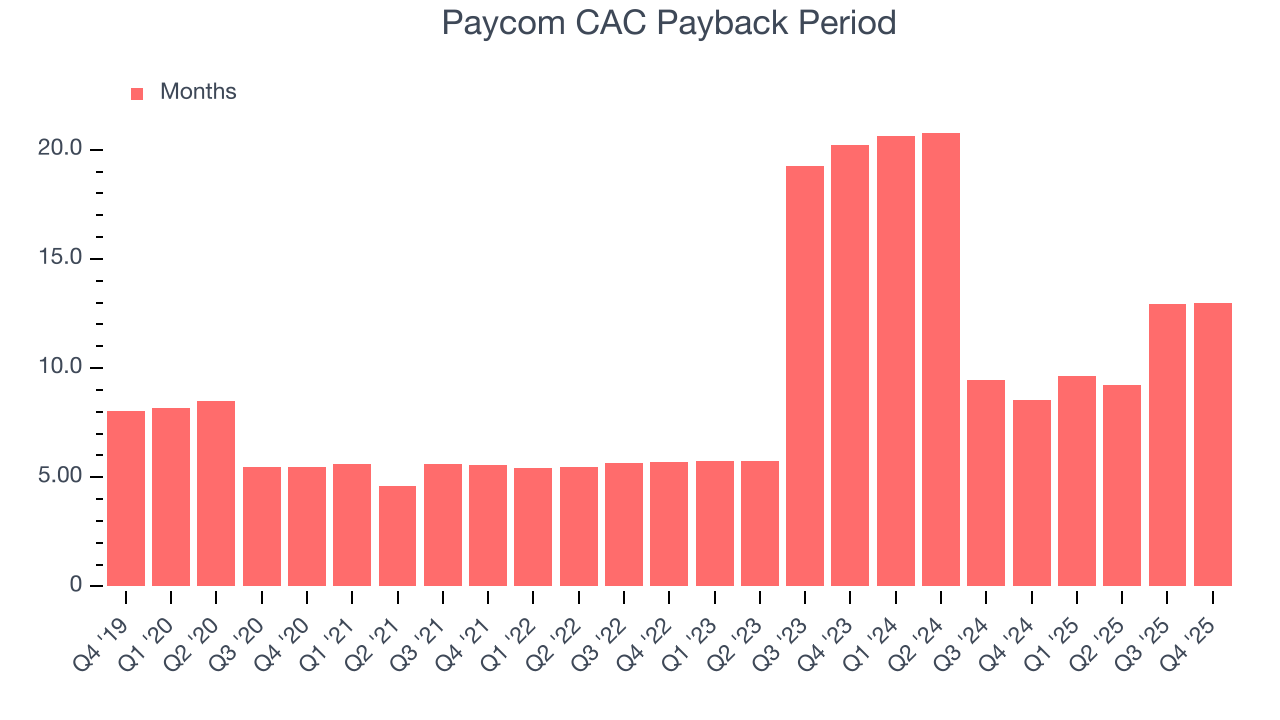
8. Gross Margin & Pricing Power
For software companies like Paycom, gross profit tells us how much money remains after paying for the base cost of products and services (typically servers, licenses, and certain personnel). These costs are usually low as a percentage of revenue, explaining why software is more lucrative than other sectors.
Paycom’s gross margin is one of the highest in the software sector, an output of its asset-lite business model and strong pricing power. It also enables the company to fund large investments in new products and sales during periods of rapid growth to achieve higher profits in the future. As you can see below, it averaged an elite 86% gross margin over the last year. Said differently, roughly $86.03 was left to spend on selling, marketing, and R&D for every $100 in revenue.
The market not only cares about gross margin levels but also how they change over time because expansion creates firepower for profitability and free cash generation. Paycom has seen gross margins decline by 0.8 percentage points over the last 2 year, which is slightly worse than average for software.
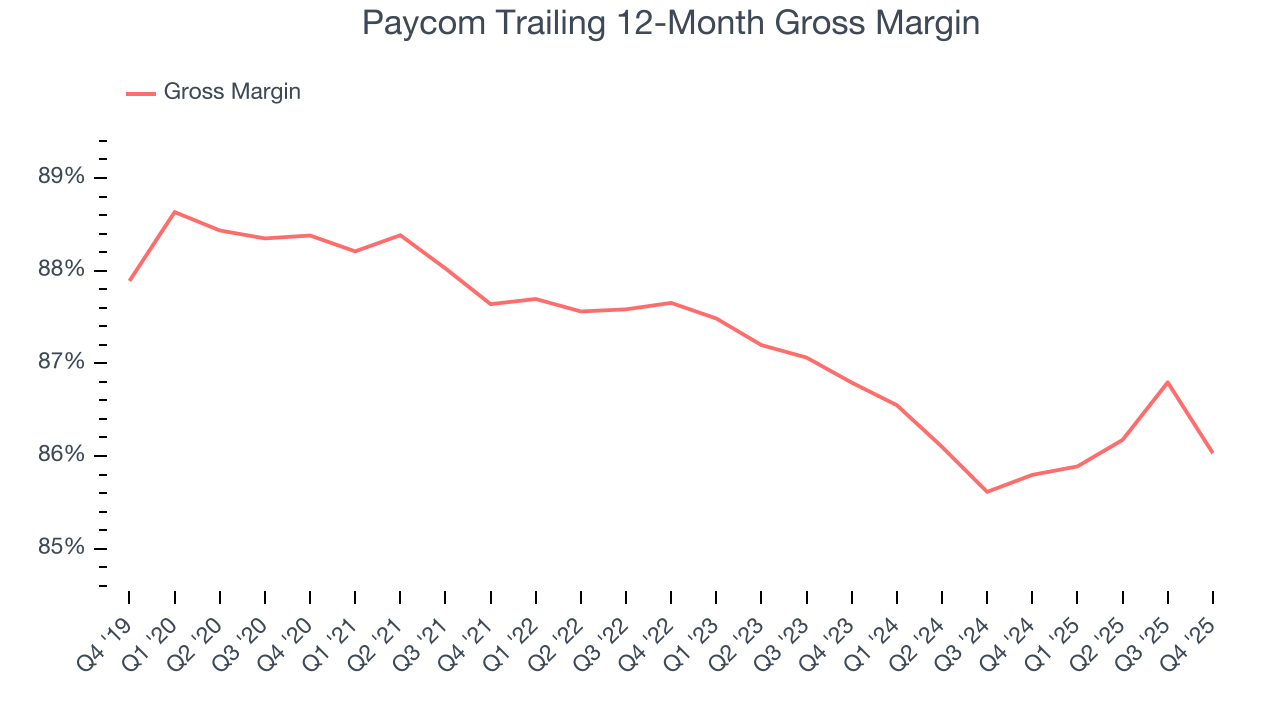
In Q4, Paycom produced a 83.9% gross profit margin , marking a 2.9 percentage point decrease from 86.7% in the same quarter last year. On a wider time horizon, the company’s full-year margin has remained steady over the past four quarters, suggesting its input costs have been stable and it isn’t under pressure to lower prices.
9. Operating Margin
Paycom has been a well-oiled machine over the last year. It demonstrated elite profitability for a software business, boasting an average operating margin of 27.6%. This result isn’t surprising as its high gross margin gives it a favorable starting point.
Analyzing the trend in its profitability, Paycom’s operating margin decreased by 6 percentage points over the last two years. This raises questions about the company’s expense base because its revenue growth should have given it leverage on its fixed costs, resulting in better economies of scale and profitability.
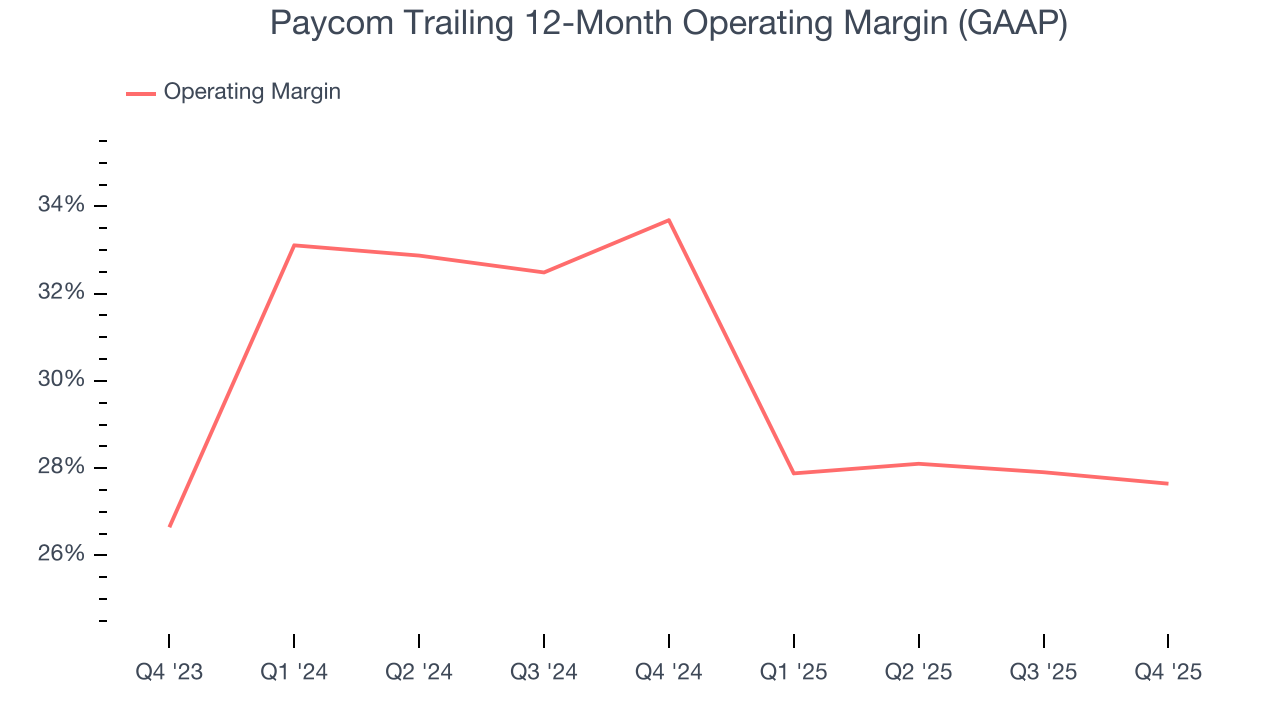
This quarter, Paycom generated an operating margin profit margin of 28.9%, down 1.2 percentage points year on year. Since Paycom’s gross margin decreased more than its operating margin, we can assume its recent inefficiencies were driven more by weaker leverage on its cost of sales rather than increased marketing, R&D, and administrative overhead expenses.
10. Cash Is King
Although earnings are undoubtedly valuable for assessing company performance, we believe cash is king because you can’t use accounting profits to pay the bills.
Paycom has shown impressive cash profitability, driven by its attractive business model and cost-effective customer acquisition strategy that give it the option to invest in new products and services rather than sales and marketing. The company’s free cash flow margin averaged 19.7% over the last year, better than the broader software sector.
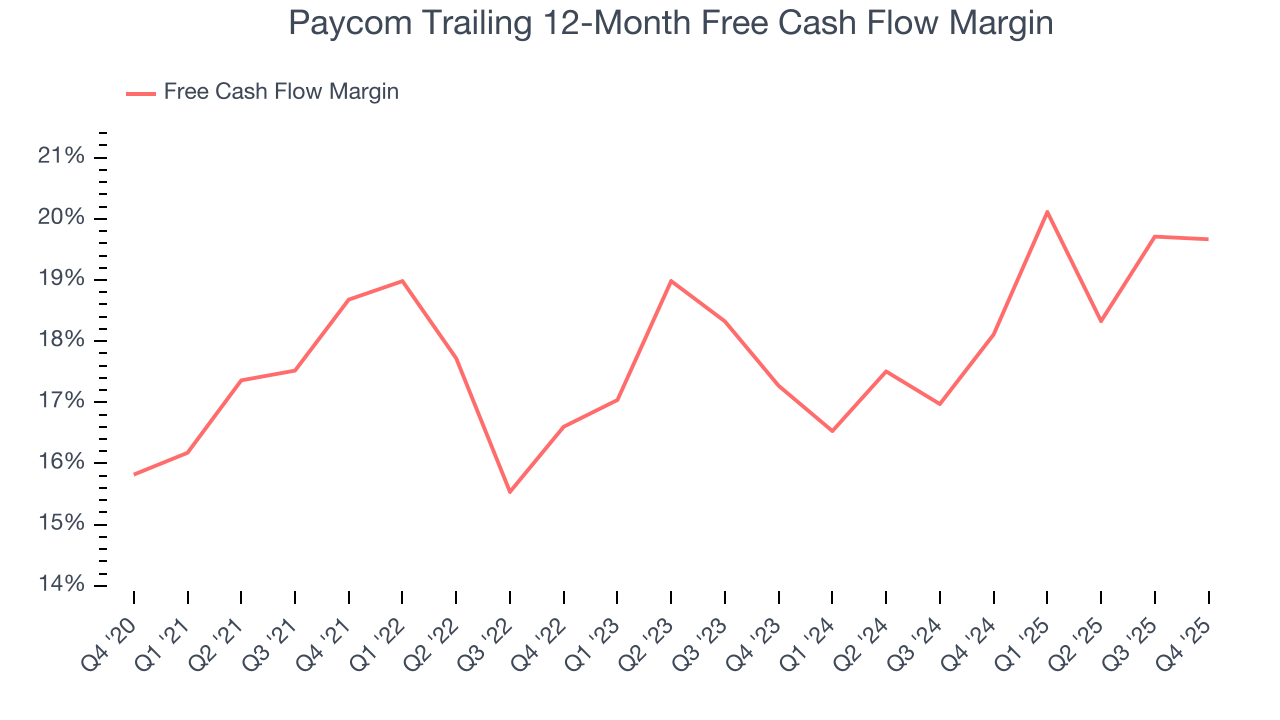
Paycom’s free cash flow clocked in at $118.1 million in Q4, equivalent to a 21.7% margin. This cash profitability was in line with the comparable period last year and above its one-year average.
Over the next year, analysts predict Paycom’s cash conversion will slightly improve. Their consensus estimates imply its free cash flow margin of 19.7% for the last 12 months will increase to 21.5%, giving it more flexibility for investments, share buybacks, and dividends.
11. Balance Sheet Assessment
Businesses that maintain a cash surplus face reduced bankruptcy risk.
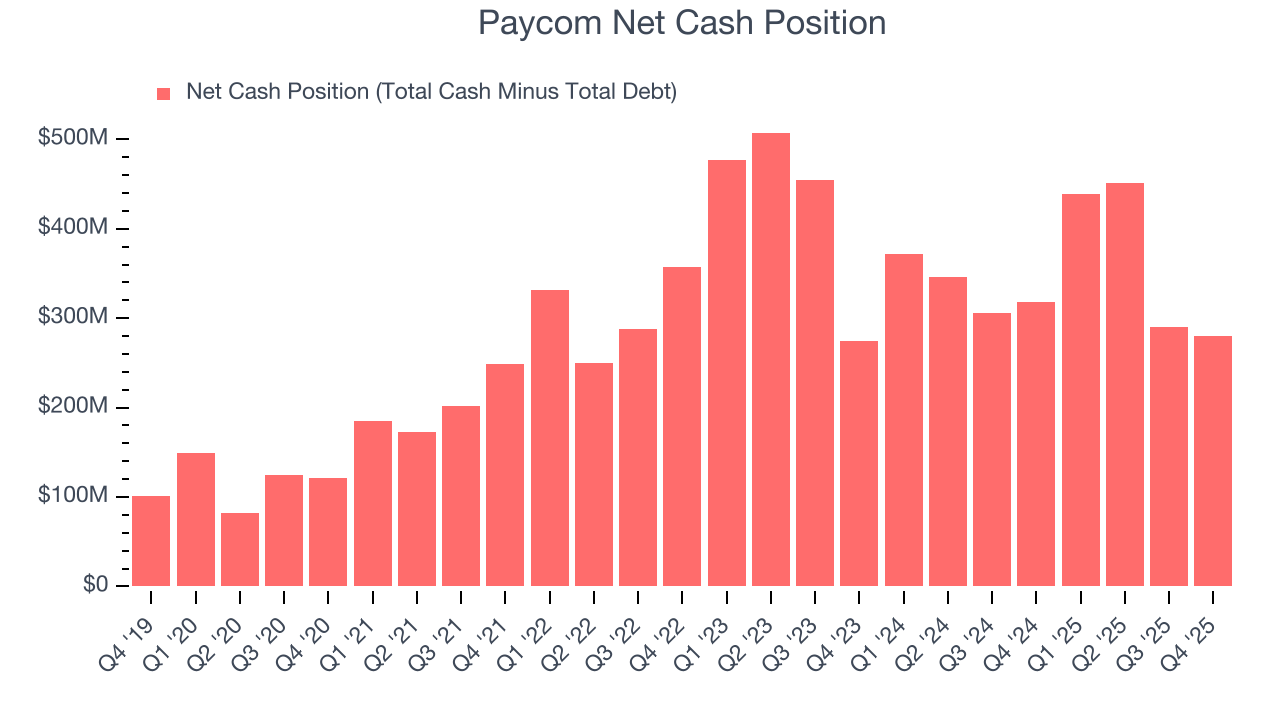
Paycom is a profitable, well-capitalized company with $370 million of cash and $90.3 million of debt on its balance sheet. This $279.7 million net cash position is 4.1% of its market cap and gives it the freedom to borrow money, return capital to shareholders, or invest in growth initiatives. Leverage is not an issue here.
12. Key Takeaways from Paycom’s Q4 Results
It was encouraging to see Paycom beat analysts’ EBITDA expectations this quarter. On the other hand, its full-year revenue guidance missed and its revenue guidance for next year suggests a slowdown in demand. Overall, this was a softer quarter. The stock traded down 7.9% to $109.26 immediately following the results.
13. Is Now The Time To Buy Paycom?
Updated: March 15, 2026 at 10:12 PM EDT
The latest quarterly earnings matters, sure, but we actually think longer-term fundamentals and valuation matter more. Investors should consider all these pieces before deciding whether or not to invest in Paycom.
Paycom isn’t a terrible business, but it doesn’t pass our bar. Although its revenue growth was solid over the last five years, it’s expected to deteriorate over the next 12 months and its declining operating margin shows it’s becoming less efficient at building and selling its software.
Paycom’s price-to-sales ratio based on the next 12 months is 3.2x. While this valuation is reasonable, we don’t really see a big opportunity at the moment. We're pretty confident there are more exciting stocks to buy at the moment.
Wall Street analysts have a consensus one-year price target of $152.94 on the company (compared to the current share price of $125.72).
Although the price target is bullish, readers should exercise caution because analysts tend to be overly optimistic. The firms they work for, often big banks, have relationships with companies that extend into fundraising, M&A advisory, and other rewarding business lines. As a result, they typically hesitate to say bad things for fear they will lose out. We at StockStory do not suffer from such conflicts of interest, so we’ll always tell it like it is.