
Pathward Financial (CASH)
Pathward Financial is an amazing business. Its excellent net interest margin demonstrates the strong performance of its loan book.― StockStory Analyst Team


1. News


2. Summary
Why We Like Pathward Financial
Formerly known as Meta Financial until its 2022 rebranding, Pathward Financial (NASDAQ:CASH) provides banking-as-a-service solutions and commercial finance products, enabling partners to offer financial services like prepaid cards, payment processing, and lending options.
- Performance over the past five years shows its incremental sales were extremely profitable, as its annual earnings per share growth of 25% outpaced its revenue gains
- Balance sheet strength has increased this cycle as its 11.6% annual tangible book value per share growth over the last five years was exceptional
- Differentiated product suite results in a Strong performance of its loan book is reflected in its High-yielding loan book and low cost of funds result in a best-in-class net interest margin of 7.2%
We have an affinity for Pathward Financial. The price seems reasonable in light of its quality, and we think now is a favorable time to invest in the stock.
Why Is Now The Time To Buy Pathward Financial?







Pathward Financial is trading at $90.38 per share, or 2.1x forward P/B. Sure, the valuation multiple seems high and could make for some share price rockiness. But given its fundamentals, we think the multiple is justified.
Entry price may seem important in the moment, but our work shows that time and again, long-term market outperformance is determined by business quality rather than getting an absolute bargain on a stock.
3. Pathward Financial (CASH) Research Report: Q4 CY2025 Update
Financial services company Pathward Financial (NASDAQ:CASH) missed Wall Street’s revenue expectations in Q4 CY2025, with sales flat year on year at $173.1 million. Its GAAP profit of $1.57 per share was 13.8% above analysts’ consensus estimates.
Pathward Financial (CASH) Q4 CY2025 Highlights:
- Net Interest Income: $119.3 million vs analyst estimates of $125.9 million (2.8% year-on-year growth, 5.2% miss)
- Net Interest Margin: 7% vs analyst estimates of 7.4% (46 basis point miss)
- Revenue: $173.1 million vs analyst estimates of $185.8 million (flat year on year, 6.8% miss)
- EPS (GAAP): $1.57 vs analyst estimates of $1.38 (13.8% beat)
- Tangible Book Value per Share: $24.54 vs analyst estimates of $24.90 (27.5% year-on-year growth, 1.4% miss)
- Market Capitalization: $1.71 billion
Company Overview
Formerly known as Meta Financial until its 2022 rebranding, Pathward Financial (NASDAQ:CASH) provides banking-as-a-service solutions and commercial finance products, enabling partners to offer financial services like prepaid cards, payment processing, and lending options.
Pathward operates through three main segments: Consumer, Commercial, and Corporate Services. The Consumer segment houses its Banking-as-a-Service (BaaS) business, which allows fintech companies and other partners to offer financial products without becoming banks themselves. Through this segment, Pathward powers payment processing, prepaid and debit card issuance, and consumer lending programs for its partners.
The Commercial segment focuses on providing specialized financing solutions to businesses through its Commercial Finance division. These include working capital loans secured by business assets, equipment financing through leases and loans, structured finance for small and mid-sized businesses, and insurance premium financing that helps companies spread the cost of their insurance policies over time.
Pathward has established itself as a significant player in several niche financial markets. It's one of the leading prepaid card issuers in the United States and sponsors approximately 60% of freestanding ATMs nationwide, enabling consumers to access funds at locations like malls, convenience stores, and small businesses. The company also has a substantial presence in tax-related financial services, offering refund advance loans and supporting over 30,000 independent tax offices.
Revenue is generated through interest income on loans and investments, as well as fees from its various financial services. For example, when a consumer uses a prepaid card issued through Pathward, the company earns interchange fees from merchants. Similarly, its tax services generate fees when taxpayers choose to receive their refunds through Pathward's temporary accounts.
4. Regional Banks
Regional banks, financial institutions operating within specific geographic areas, serve as intermediaries between local depositors and borrowers. They benefit from rising interest rates that improve net interest margins (the difference between loan yields and deposit costs), digital transformation reducing operational expenses, and local economic growth driving loan demand. However, these banks face headwinds from fintech competition, deposit outflows to higher-yielding alternatives, credit deterioration (increasing loan defaults) during economic slowdowns, and regulatory compliance costs. Recent concerns about regional bank stability following high-profile failures and significant commercial real estate exposure present additional challenges.
Pathward Financial competes with other banking-as-a-service providers like The Bancorp (NASDAQ:TBBK), Sutton Bank (private), and WebBank (private). In the commercial finance space, its competitors include regional banks, specialized lenders like Marlin Business Services (NASDAQ:MRLN), and larger financial institutions that offer similar lending products.
5. Sales Growth
Two primary revenue streams drive bank earnings. While net interest income, which is earned by charging higher rates on loans than paid on deposits, forms the foundation, fee-based services across banking, credit, wealth management, and trading operations provide additional income. Thankfully, Pathward Financial’s 11.5% annualized revenue growth over the last five years was decent. Its growth was slightly above the average banking company and shows its offerings resonate with customers.
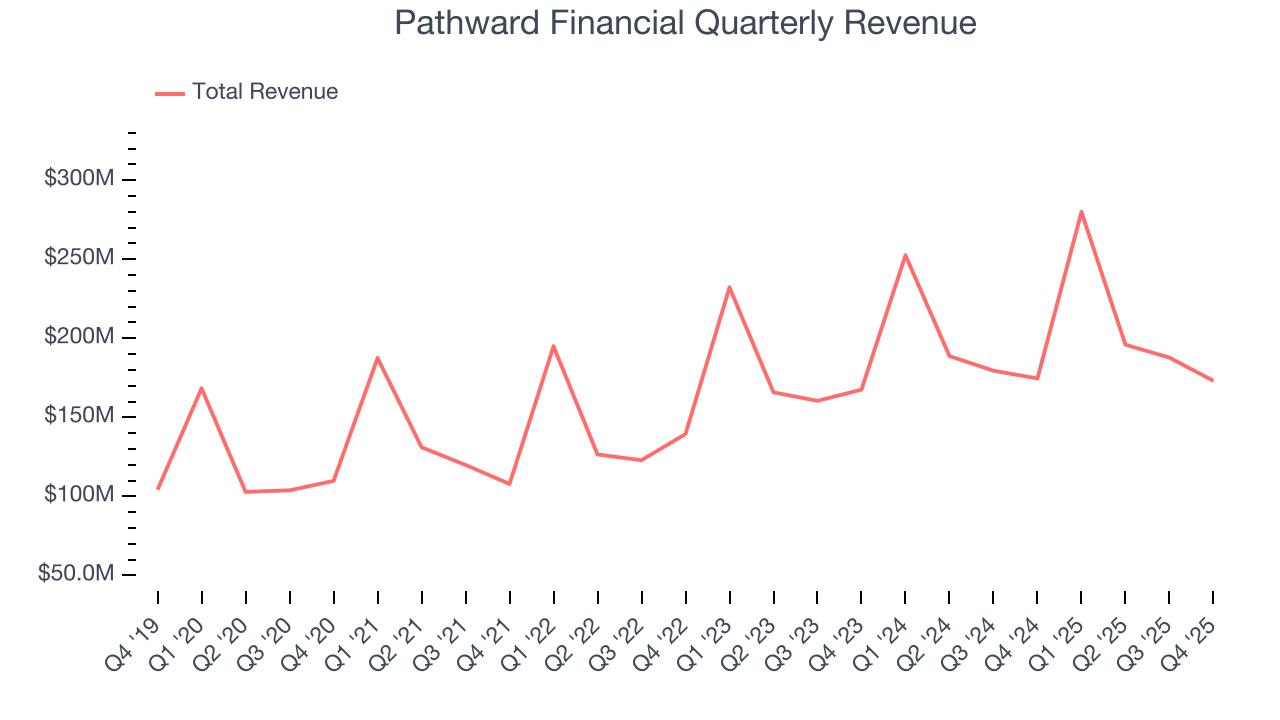
Long-term growth is the most important, but within financials, a half-decade historical view may miss recent interest rate changes and market returns. Pathward Financial’s recent performance shows its demand has slowed as its annualized revenue growth of 7.4% over the last two years was below its five-year trend. 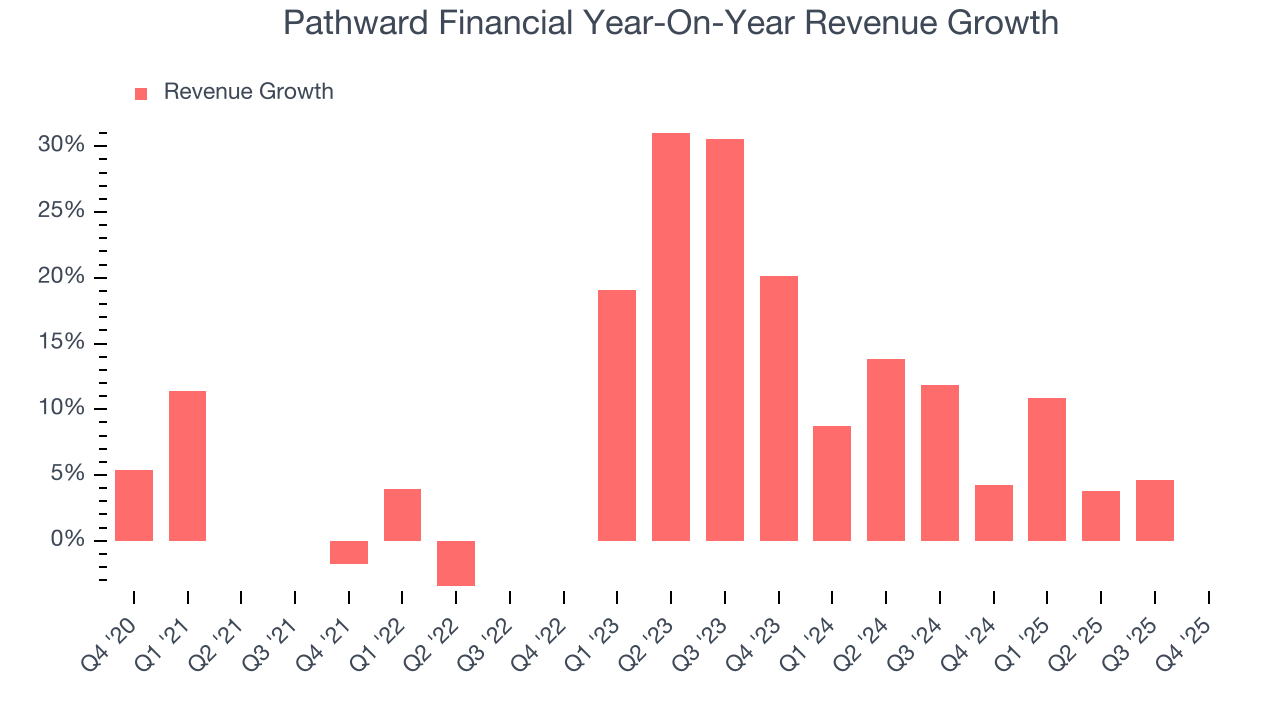 Note: Quarters not shown were determined to be outliers, impacted by outsized investment gains/losses that are not indicative of the recurring fundamentals of the business.
This quarter, Pathward Financial missed Wall Street’s estimates and reported a rather uninspiring 0.9% year-on-year revenue decline, generating $173.1 million of revenue.
Net interest income made up 57.8% of the company’s total revenue during the last five years, meaning Pathward Financial’s growth drivers strike a balance between lending and non-lending activities.
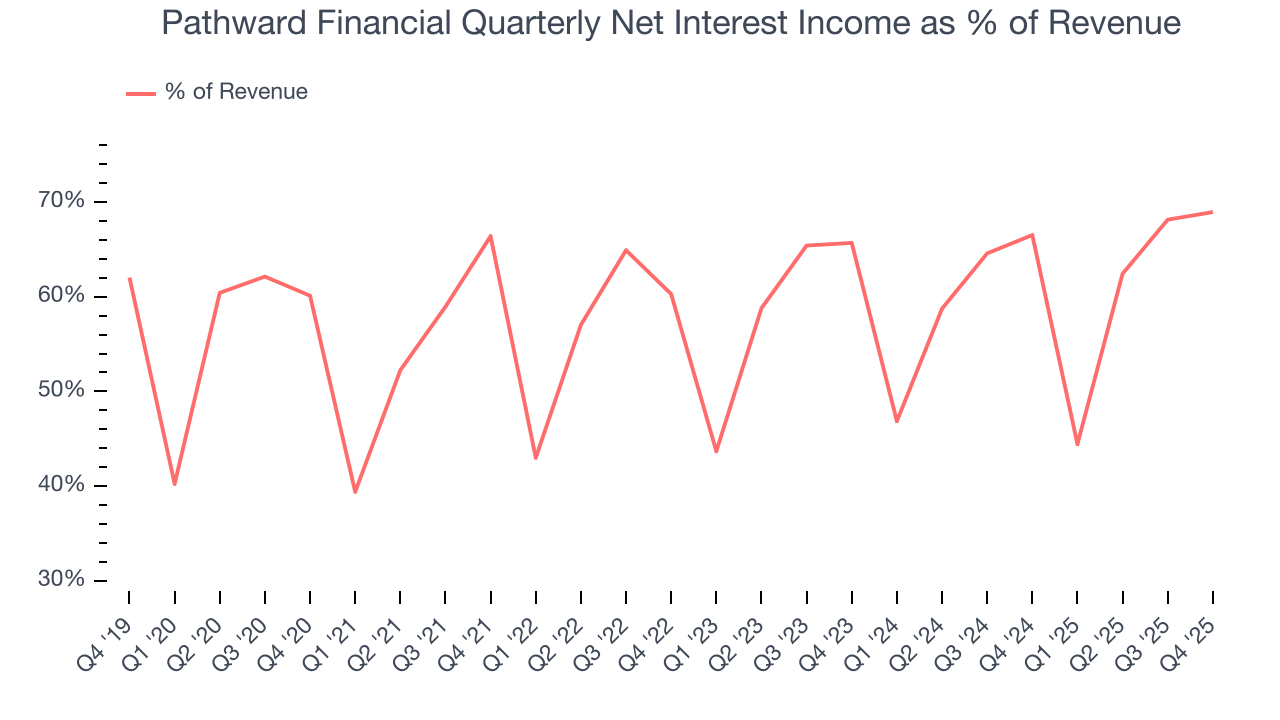
Markets consistently prioritize net interest income growth over fee-based revenue, recognizing its superior quality and recurring nature compared to the more unpredictable non-interest income streams.
6. Earnings Per Share
We track the long-term change in earnings per share (EPS) for the same reason as long-term revenue growth. Compared to revenue, however, EPS highlights whether a company’s growth is profitable.
Pathward Financial’s EPS grew at an astounding 20.7% compounded annual growth rate over the last five years, higher than its 11.5% annualized revenue growth. This tells us the company became more profitable on a per-share basis as it expanded.
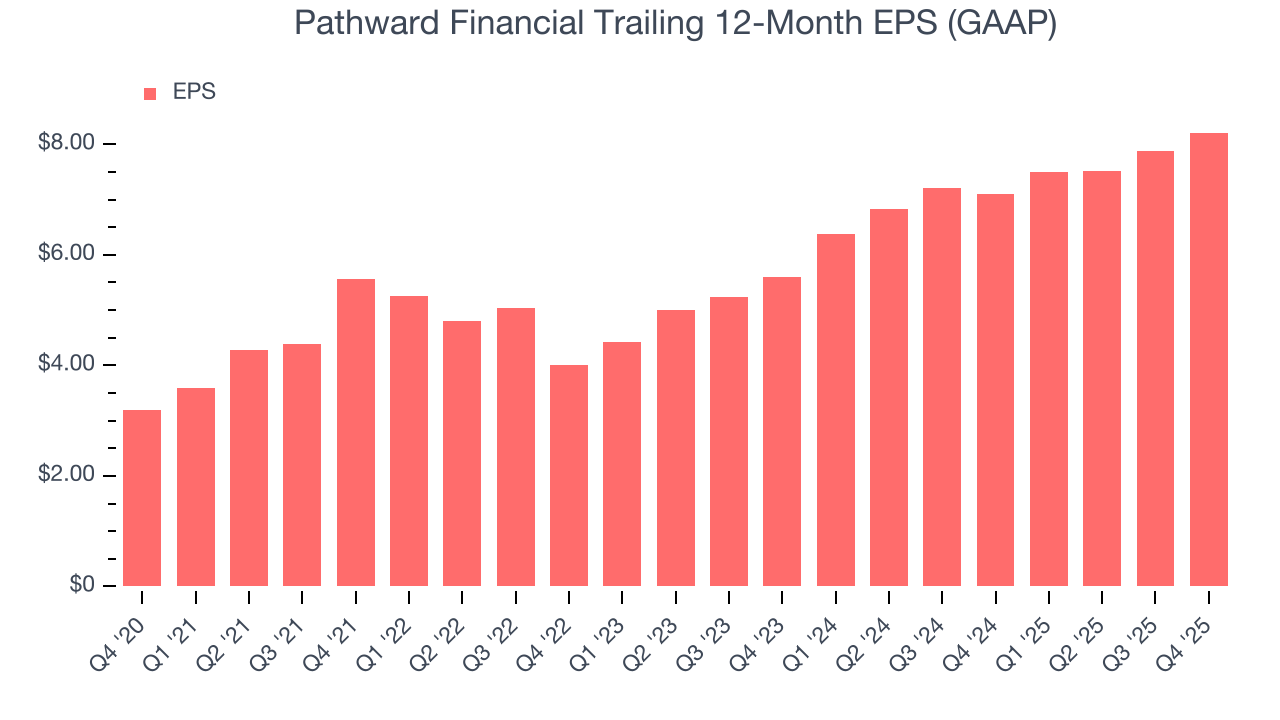
Like with revenue, we analyze EPS over a more recent period because it can provide insight into an emerging theme or development for the business.
For Pathward Financial, its two-year annual EPS growth of 21% is similar to its five-year trend, implying strong and stable earnings power.
In Q4, Pathward Financial reported EPS of $1.57, up from $1.23 in the same quarter last year. This print easily cleared analysts’ estimates, and shareholders should be content with the results. Over the next 12 months, Wall Street expects Pathward Financial’s full-year EPS of $8.21 to grow 7.1%.
7. Tangible Book Value Per Share (TBVPS)
Banks are balance sheet-driven businesses because they generate earnings primarily through borrowing and lending. They’re also valued based on their balance sheet strength and ability to compound book value (another name for shareholders’ equity) over time.
This explains why tangible book value per share (TBVPS) stands as the premier banking metric. TBVPS strips away questionable intangible assets, revealing concrete per-share net worth that investors can trust. On the other hand, EPS is often distorted by mergers and flexible loan loss accounting. TBVPS provides clearer performance insights.
Pathward Financial’s TBVPS grew at an incredible 11.6% annual clip over the last five years. TBVPS growth has also accelerated recently, growing by 26.2% annually over the last two years from $15.41 to $24.54 per share.
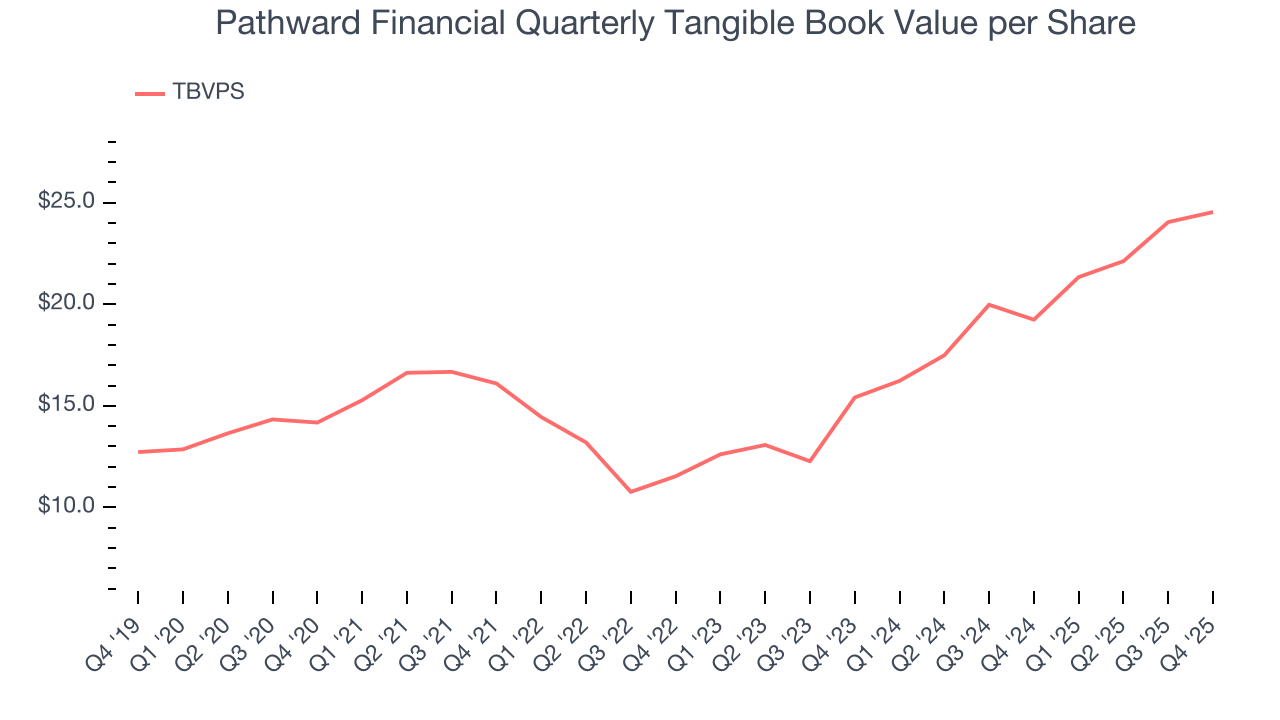
Over the next 12 months, Consensus estimates call for Pathward Financial’s TBVPS to grow by 23.1% to $30.20, elite growth rate.
8. Balance Sheet Assessment
Leverage is core to a financial firm’s business model (loans funded by deposits). To ensure economic stability and avoid a repeat of the 2008 GFC, regulators require certain levels of capital and liquidity, focusing on the Tier 1 capital ratio.
Tier 1 capital is the highest-quality capital that a firm holds, consisting primarily of common stock and retained earnings, but also physical gold. It serves as the primary cushion against losses and is the first line of defense in times of financial distress.
This capital is divided by risk-weighted assets to derive the Tier 1 capital ratio. Risk-weighted means that cash and US treasury securities are assigned little risk while unsecured consumer loans and equity investments get much higher risk weights, for example.
New regulation after the 2008 financial crisis requires that all firms must maintain a Tier 1 capital ratio greater than 4.5%. On top of this, there are additional buffers based on scale, risk profile, and other regulatory classifications, so that at the end of the day, firms generally must maintain a 7-10% ratio at minimum.
Over the last two years, Pathward Financial has averaged a Tier 1 capital ratio of 12.5%, which is considered safe and well capitalized in the event that macro or market conditions suddenly deteriorate.
9. Return on Equity
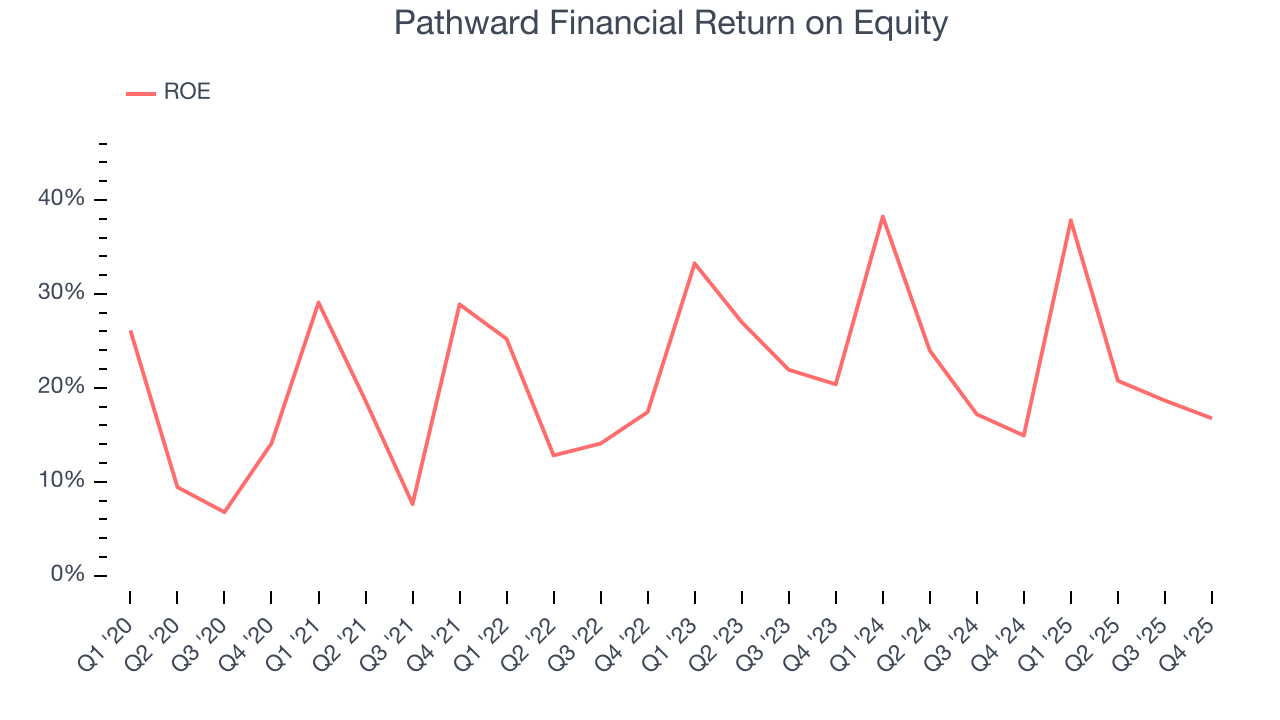
Return on equity, or ROE, tells us how much profit a company generates for each dollar of shareholder equity, a key funding source for banks. Over a long period, banks with high ROE tend to compound shareholder wealth faster through retained earnings, buybacks, and dividends.
Over the last five years, Pathward Financial has averaged an ROE of 22.2%, exceptional for a company operating in a sector where the average shakes out around 7.5% and those putting up 15%+ are greatly admired. This shows Pathward Financial has a strong competitive moat.
10. Key Takeaways from Pathward Financial’s Q4 Results
It was good to see Pathward Financial beat analysts’ EPS expectations this quarter. On the other hand, its revenue missed and its net interest income fell short of Wall Street’s estimates. Overall, this was a softer quarter. The stock remained flat at $79.90 immediately following the results.
11. Is Now The Time To Buy Pathward Financial?
Updated: March 19, 2026 at 12:28 AM EDT
Before making an investment decision, investors should account for Pathward Financial’s business fundamentals and valuation in addition to what happened in the latest quarter.
Pathward Financial is truly a cream-of-the-crop banking company. For starters, its revenue growth was good over the last five years. And while its estimated net interest income for the next 12 months are weak, its admirable net interest margin a wonderful starting point for the overall profitability of the business. On top of that, Pathward Financial’s astounding EPS growth over the last five years shows its profits are trickling down to shareholders.
Pathward Financial’s P/B ratio based on the next 12 months is 2.1x. You get what you pay for, and in this case, the higher valuation is warranted because Pathward Financial’s fundamentals clearly illustrate it’s a special business. We think the stock is attractive here.
Wall Street analysts have a consensus one-year price target of $103.50 on the company (compared to the current share price of $90.38), implying they see 14.5% upside in buying Pathward Financial in the short term.