
Entegris (ENTG)
We’re cautious of Entegris. Its weak returns on capital suggest it doesn’t generate sufficient profits, a sign of value destruction.― StockStory Analyst Team


1. News






2. Summary
Why We Think Entegris Will Underperform
With fabs representing the company’s largest customer type, Entegris (NASDAQ:ENTG) supplies products that purify, protect, and generally ensure the integrity of raw materials needed for advanced semiconductor manufacturing.
- Projected sales growth of 7.2% for the next 12 months suggests sluggish demand
- Poor free cash flow generation means it has few chances to reinvest for growth, repurchase shares, or distribute capital
- A consolation is that its 11.4% annual revenue growth over the last five years surpassed the sector average as its products resonated with customers
Entegris lacks the business quality we seek. Better stocks can be found in the market.
Why There Are Better Opportunities Than Entegris

Entegris is trading at $116.71 per share, or 36.1x forward P/E. This multiple is quite expensive for the quality you get.
We’d rather pay up for companies with elite fundamentals than get a decent price on a poor one. High-quality businesses often have more durable earnings power, helping us sleep well at night.
3. Entegris (ENTG) Research Report: Q4 CY2025 Update
Semiconductor materials supplier Entegris (NASDAQ:ENTG) reported Q4 CY2025 results topping the market’s revenue expectations, but sales fell by 3.1% year on year to $823.9 million. Guidance for next quarter’s revenue was optimistic at $805 million at the midpoint, 2.3% above analysts’ estimates. Its non-GAAP profit of $0.70 per share was 5.4% above analysts’ consensus estimates.
Entegris (ENTG) Q4 CY2025 Highlights:
- Revenue: $823.9 million vs analyst estimates of $812.4 million (3.1% year-on-year decline, 1.4% beat)
- Adjusted EPS: $0.70 vs analyst estimates of $0.66 (5.4% beat)
- Adjusted EBITDA: $228.1 million vs analyst estimates of $220.3 million (27.7% margin, 3.5% beat)
- Revenue Guidance for Q1 CY2026 is $805 million at the midpoint, above analyst estimates of $786.9 million
- Adjusted EPS guidance for Q1 CY2026 is $0.74 at the midpoint, above analyst estimates of $0.63
- Operating Margin: 12.7%, down from 17.7% in the same quarter last year
- Free Cash Flow Margin: 16.3%, up from 8.1% in the same quarter last year
- Inventory Days Outstanding: 126, down from 129 in the previous quarter
- Market Capitalization: $18.55 billion
Company Overview
With fabs representing the company’s largest customer type, Entegris (NASDAQ:ENTG) supplies products that purify, protect, and generally ensure the integrity of raw materials needed for advanced semiconductor manufacturing.
Entegris was founded in 1966 as Fluoroware, a company serving early microelectronics manufacturers. After merging with EMPAK in 1999 and rebranding itself Entegris, the company went public in 2000.
As chip performance advances, semiconductor manufacturing has involved increasing materials content per wafer and generally more process complexity due to smaller geometries, improved architectures, and new materials. These generally lead to ever-increasing requirements for materials purity, quality, and stability to optimize yields. Entegris provides filters, gas, and liquid delivery systems and specialty chemicals that are needed for advanced semiconductor manufacturing environments.
Entegris is organized into three segments to reflect its product portfolio and role in semiconductor manufacturing. The ‘Specialty Chemical and Engineered Materials’ segment offers products such as hazardous gasses and high-fidelity coatings. The ‘Microcontamination Control’ segment offers filters to ensure materials purity. The ‘Advanced Materials Handling’ segment offers technologies to safely and consistently transport materials and products throughout the manufacturing process.
Other competitors who provide materials and chemicals to semiconductor manufacturers include Pall Corporation (part of Danaher (NYSE:DHR)), Shin-Etsu Polymer (TYO:7970), Gemu Valves, and DuPont (NYSE:DD).
4. Revenue Growth
Examining a company’s long-term performance can provide clues about its quality. Any business can put up a good quarter or two, but many enduring ones grow for years. Thankfully, Entegris’s 11.4% annualized revenue growth over the last five years was solid. Its growth beat the average semiconductor company and shows its offerings resonate with customers. Semiconductors are a cyclical industry, and long-term investors should be prepared for periods of high growth followed by periods of revenue contractions.
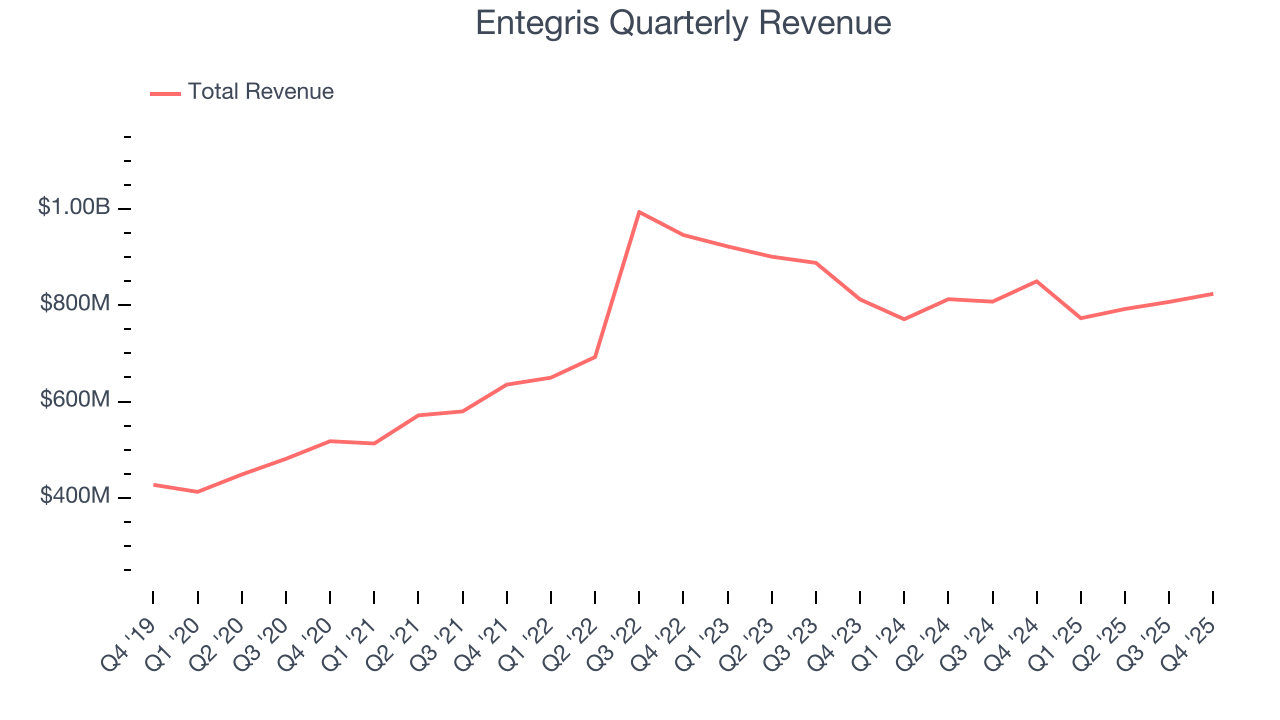
We at StockStory place the most emphasis on long-term growth, but within semiconductors, a half-decade historical view may miss new demand cycles or industry trends like AI. Entegris’s recent performance marks a sharp pivot from its five-year trend as its revenue has shown annualized declines of 4.8% over the last two years. 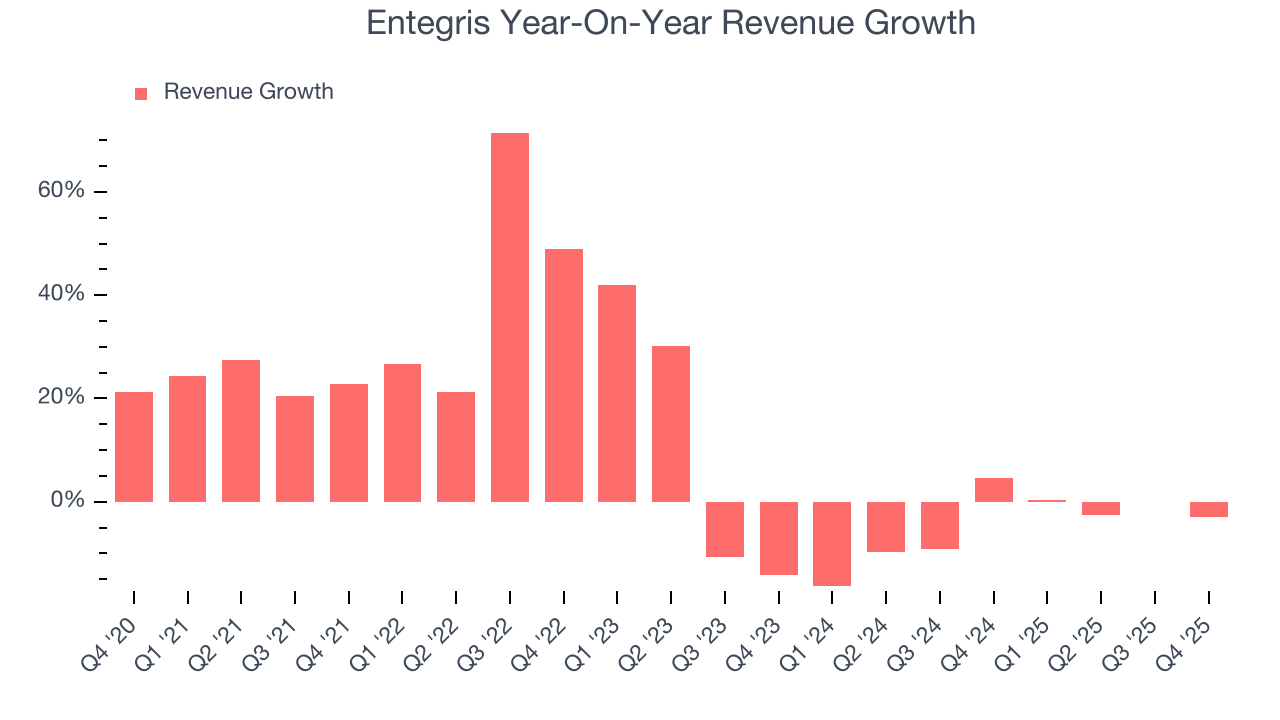
This quarter, Entegris’s revenue fell by 3.1% year on year to $823.9 million but beat Wall Street’s estimates by 1.4%. Despite the beat, the drop in sales could mean that the current downcycle is deepening. Company management is currently guiding for a 4.1% year-on-year increase in sales next quarter.
Looking further ahead, sell-side analysts expect revenue to grow 6% over the next 12 months. Although this projection indicates its newer products and services will spur better top-line performance, it is still below the sector average.
5. Product Demand & Outstanding Inventory
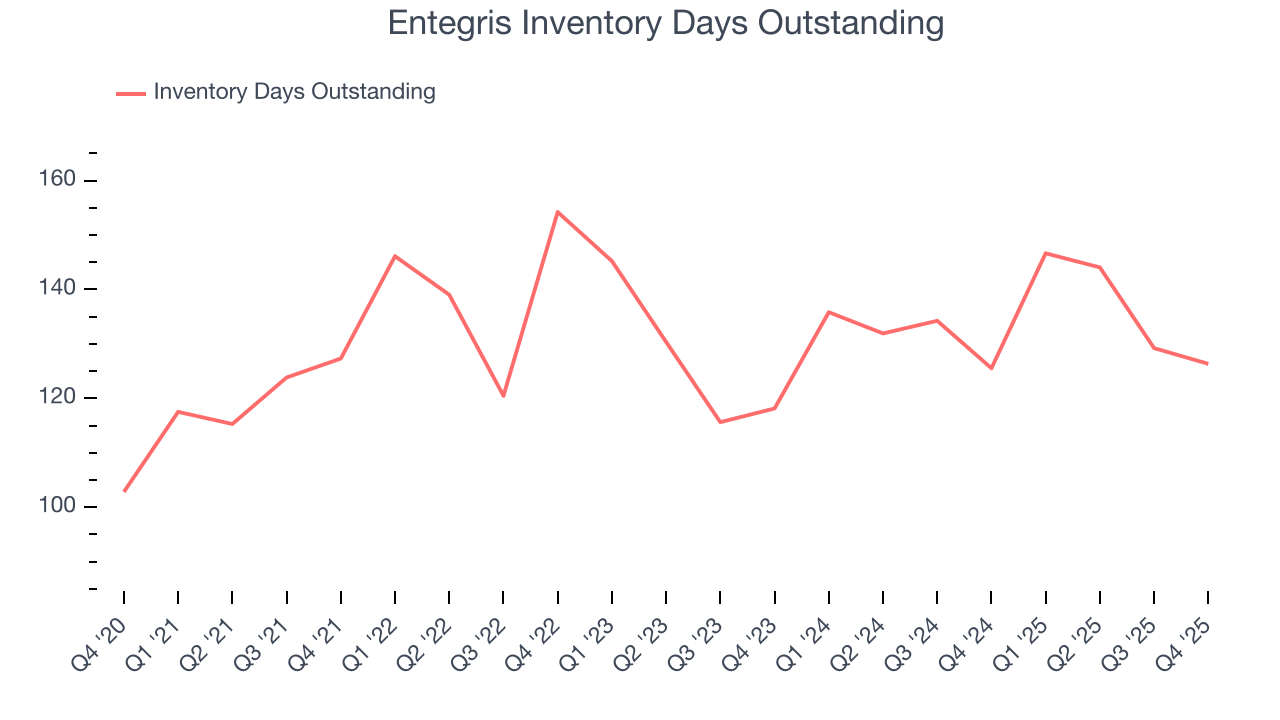
Days Inventory Outstanding (DIO) is an important metric for chipmakers, as it reflects a business’ capital intensity and the cyclical nature of semiconductor supply and demand. In a tight supply environment, inventories tend to be stable, allowing chipmakers to exert pricing power. Steadily increasing DIO can be a warning sign that demand is weak, and if inventories continue to rise, the company may have to downsize production.
This quarter, Entegris’s DIO came in at 126, which is 5 days below its five-year average. At the moment, these numbers show no indication of an excessive inventory buildup.
6. Gross Margin & Pricing Power
In the semiconductor industry, a company’s gross profit margin is a critical metric to track because it sheds light on its pricing power, complexity of products, and ability to procure raw materials, equipment, and labor.
Entegris’s gross margin is slightly below the average semiconductor company, indicating its products aren’t as mission-critical as its competitors. As you can see below, it averaged a 45.2% gross margin over the last two years. That means Entegris paid its suppliers a lot of money ($54.81 for every $100 in revenue) to run its business. 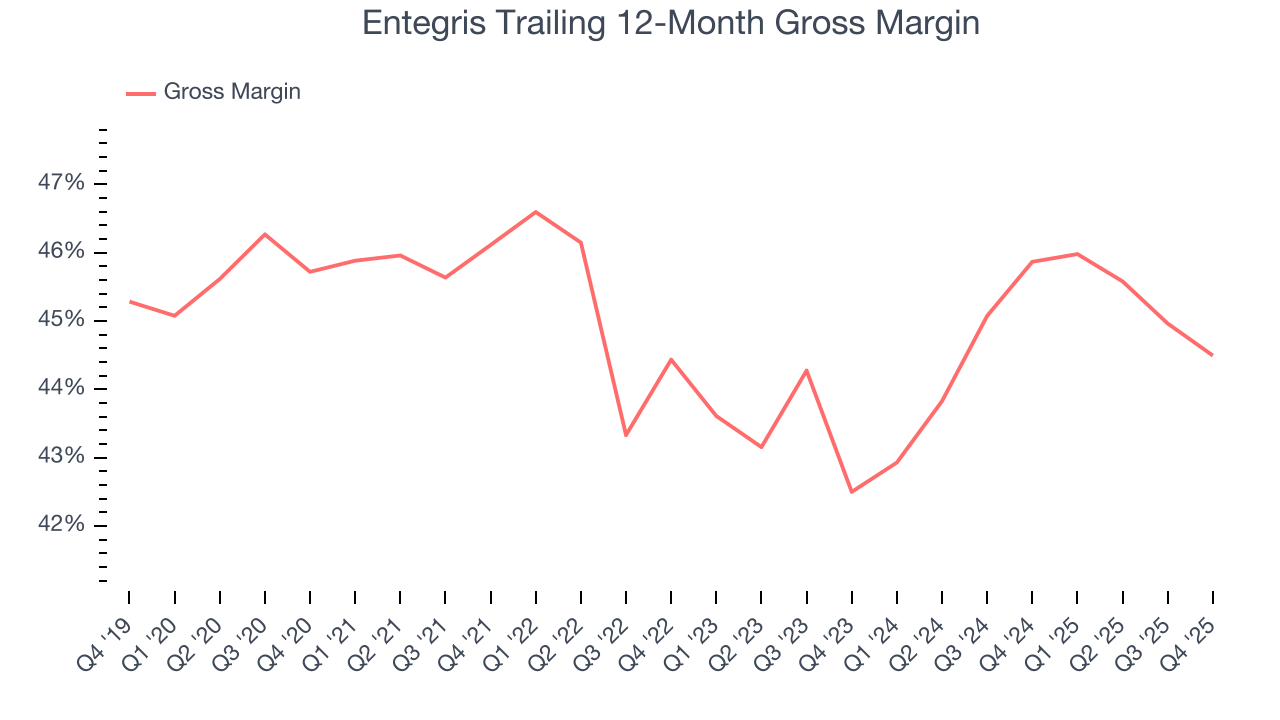
Entegris’s gross profit margin came in at 43.8% this quarter, marking a 1.8 percentage point decrease from 45.6% in the same quarter last year. Entegris’s full-year margin has also been trending down over the past 12 months, decreasing by 1.4 percentage points. If this move continues, it could suggest a more competitive environment with some pressure to lower prices and higher input costs (such as raw materials and manufacturing expenses).
7. Operating Margin
Operating margin is a key measure of profitability. Think of it as net income - the bottom line - excluding the impact of taxes and interest on debt, which are less connected to business fundamentals.
Entegris’s operating margin has been trending down over the last 12 months, but it still averaged 15.4% over the last two years, decent for a semiconductor business. This shows it generally does a decent job managing its expenses, and its solid historical revenue growth also suggests its margin dropped because it ramped up investments to capture market share. We’ll keep a close eye to see if this strategy pays off.
Analyzing the trend in its profitability, Entegris’s operating margin decreased by 9.7 percentage points over the last five years. This raises questions about the company’s expense base because its revenue growth should have given it leverage on its fixed costs, resulting in better economies of scale and profitability.
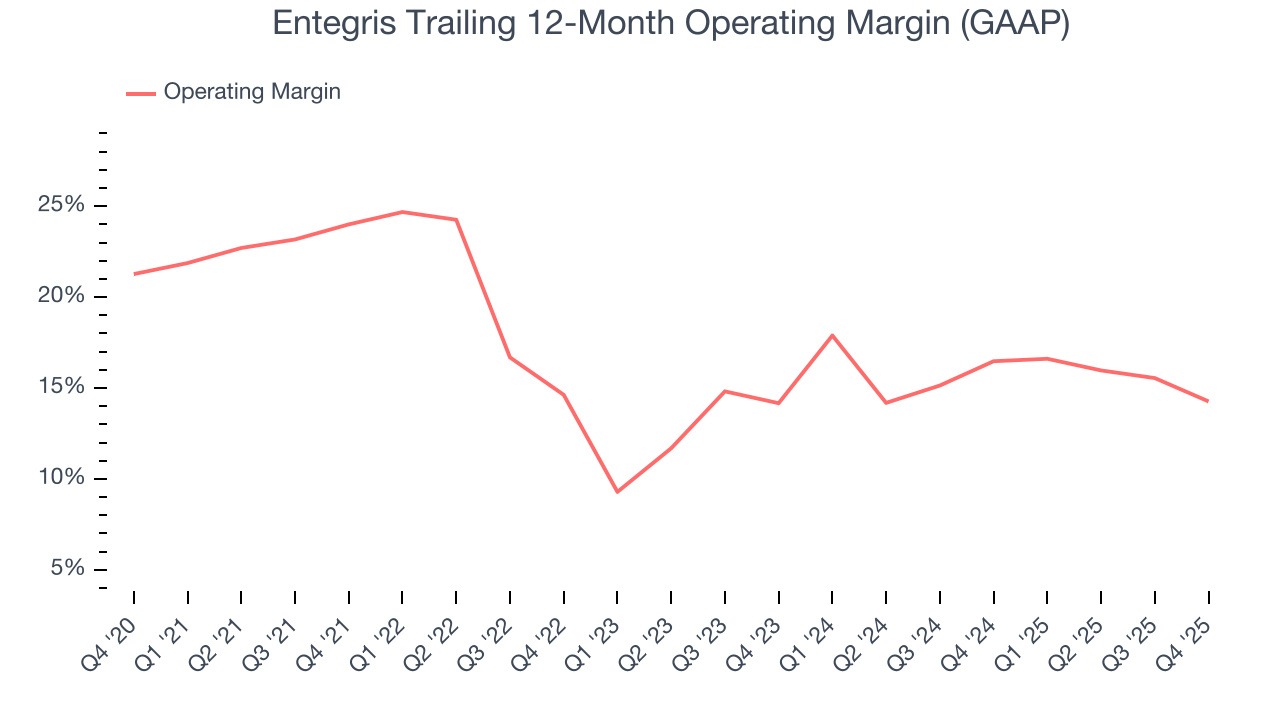
This quarter, Entegris generated an operating margin profit margin of 12.7%, down 4.9 percentage points year on year. Since Entegris’s operating margin decreased more than its gross margin, we can assume it was less efficient because expenses such as marketing, R&D, and administrative overhead increased.
8. Earnings Per Share
We track the long-term change in earnings per share (EPS) for the same reason as long-term revenue growth. Compared to revenue, however, EPS highlights whether a company’s growth is profitable.
Entegris’s EPS grew at an unimpressive 1.7% compounded annual growth rate over the last five years, lower than its 11.4% annualized revenue growth. This tells us the company became less profitable on a per-share basis as it expanded.
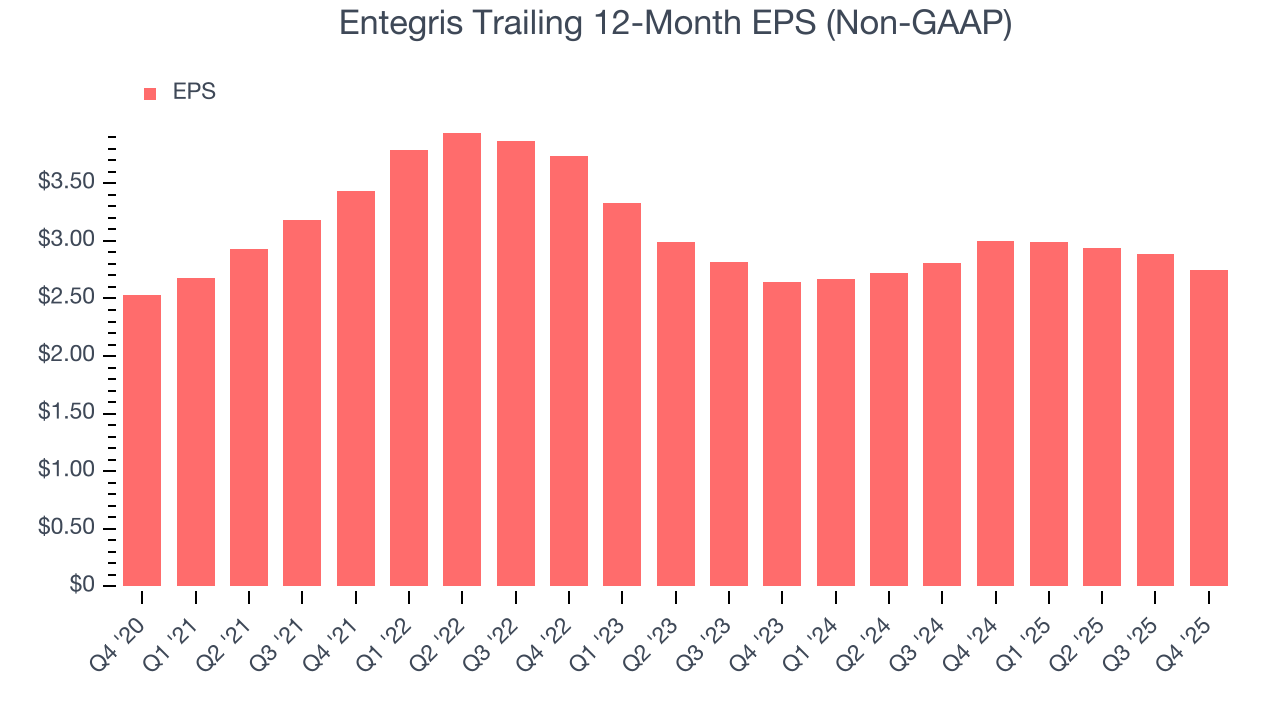
We can take a deeper look into Entegris’s earnings to better understand the drivers of its performance. As we mentioned earlier, Entegris’s operating margin declined by 9.7 percentage points over the last five years. Its share count also grew by 11.8%, meaning the company not only became less efficient with its operating expenses but also diluted its shareholders. 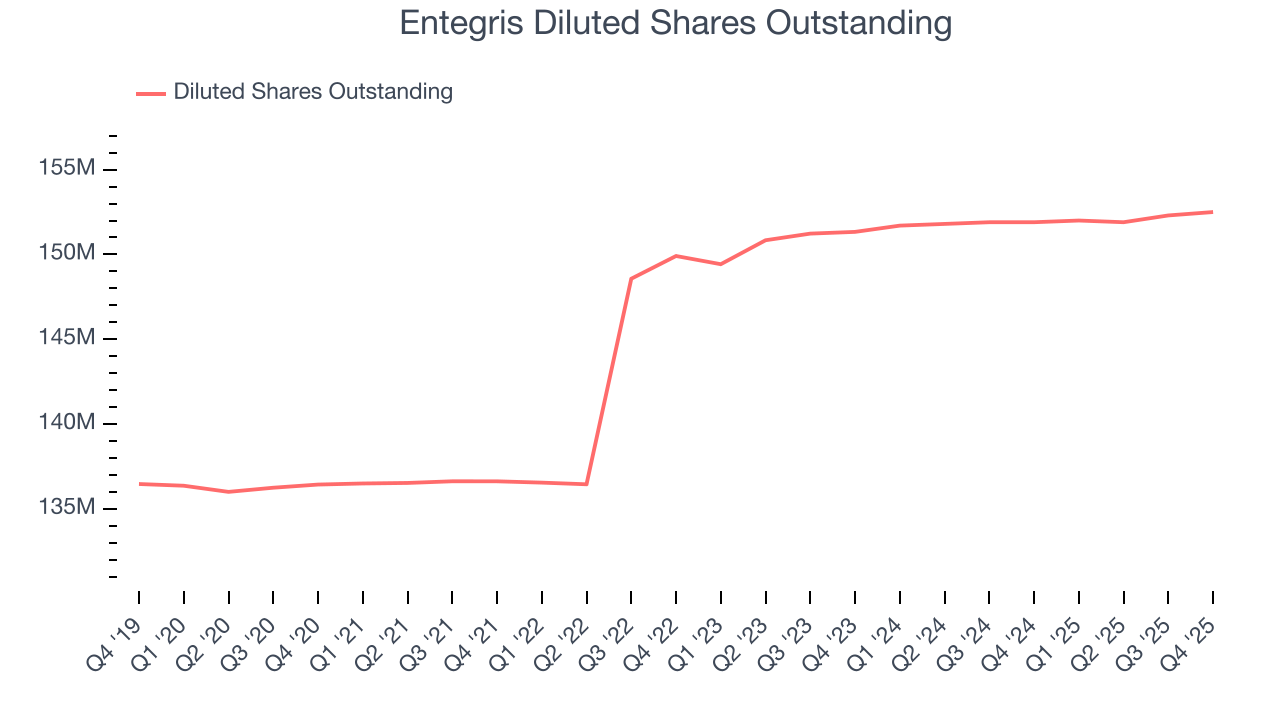
In Q4, Entegris reported adjusted EPS of $0.70, down from $0.84 in the same quarter last year. Despite falling year on year, this print beat analysts’ estimates by 5.4%. Over the next 12 months, Wall Street expects Entegris’s full-year EPS of $2.75 to grow 16.3%.
9. Cash Is King
Although earnings are undoubtedly valuable for assessing company performance, we believe cash is king because you can’t use accounting profits to pay the bills.
Entegris has shown weak cash profitability over the last two years, giving the company limited opportunities to return capital to shareholders. Its free cash flow margin averaged 11.1%, subpar for a semiconductor business.
Taking a step back, an encouraging sign is that Entegris’s margin expanded by 4.1 percentage points over the last five years. The company’s improvement shows it’s heading in the right direction, and we can see it became a less capital-intensive business because its free cash flow profitability rose while its operating profitability fell.
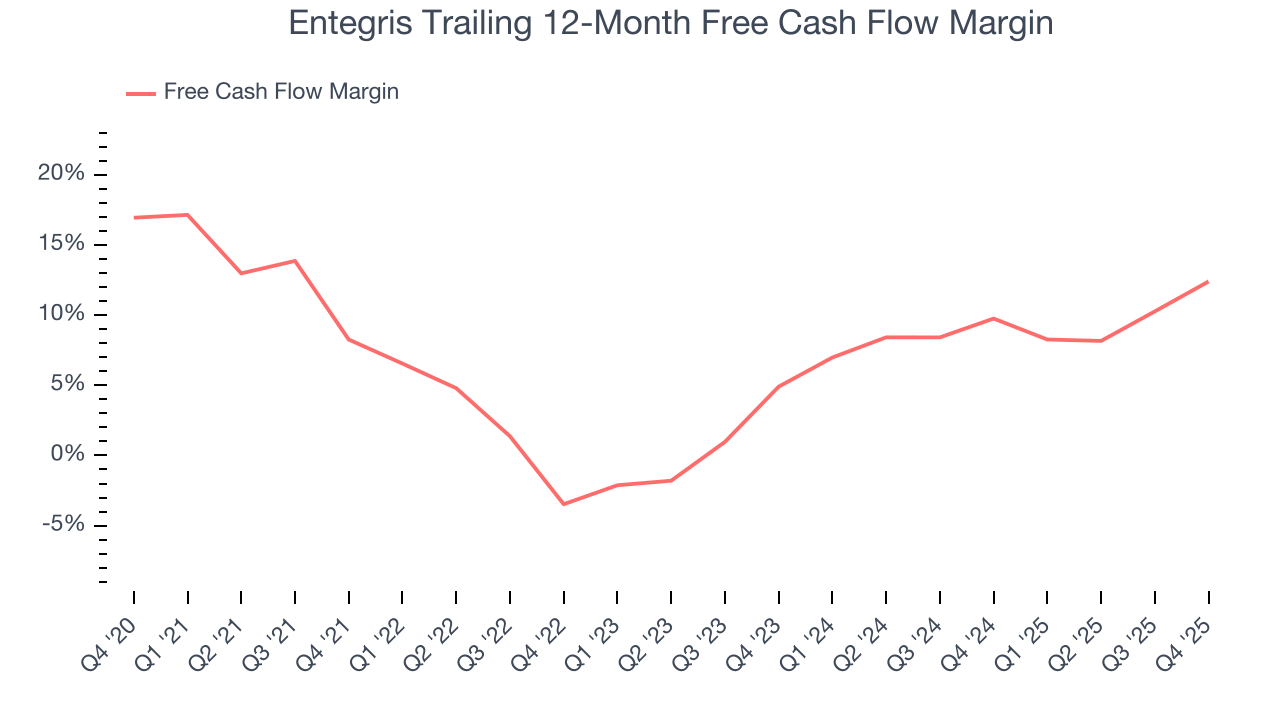
Entegris’s free cash flow clocked in at $134 million in Q4, equivalent to a 16.3% margin. This result was good as its margin was 8.2 percentage points higher than in the same quarter last year, building on its favorable historical trend.
10. Return on Invested Capital (ROIC)
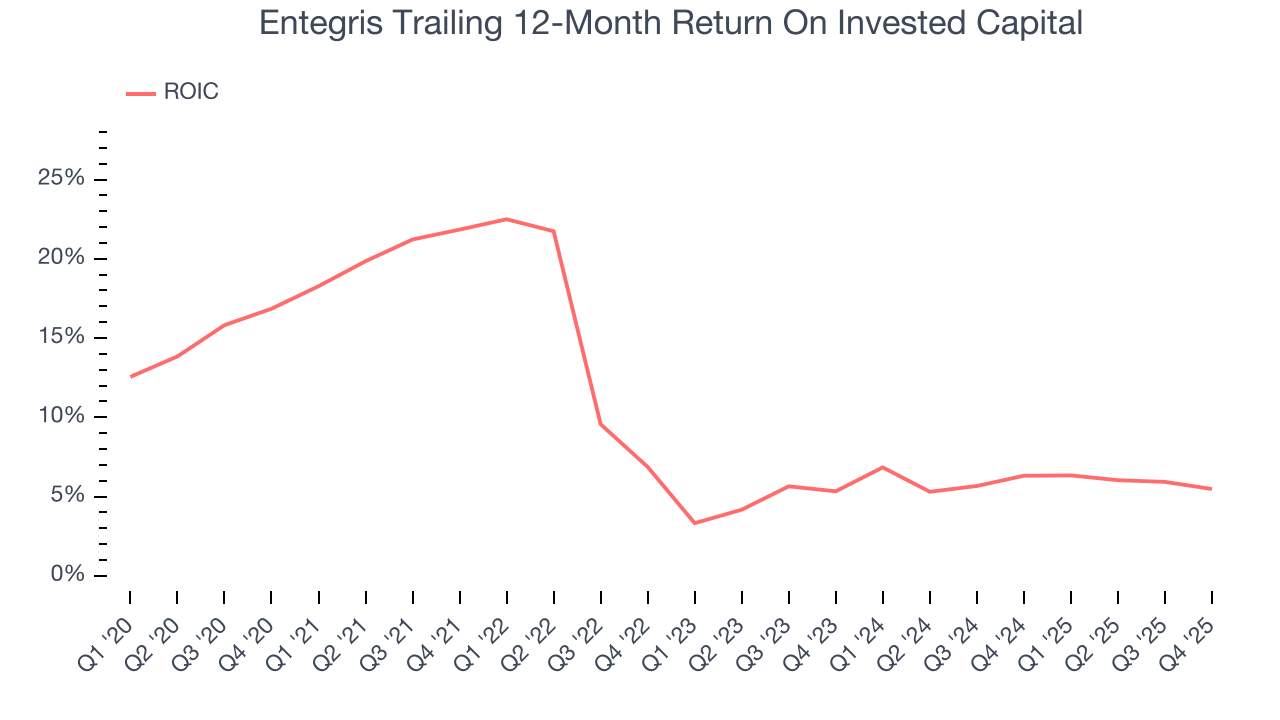
EPS and free cash flow tell us whether a company was profitable while growing its revenue. But was it capital-efficient? Enter ROIC, a metric showing how much operating profit a company generates relative to the money it has raised (debt and equity).
Entegris historically did a mediocre job investing in profitable growth initiatives. Its five-year average ROIC was 9.2%, somewhat low compared to the best semiconductor companies that consistently pump out 35%+.
11. Balance Sheet Assessment
Entegris reported $360.4 million of cash and $3.80 billion of debt on its balance sheet in the most recent quarter. As investors in high-quality companies, we primarily focus on two things: 1) that a company’s debt level isn’t too high and 2) that its interest payments are not excessively burdening the business.
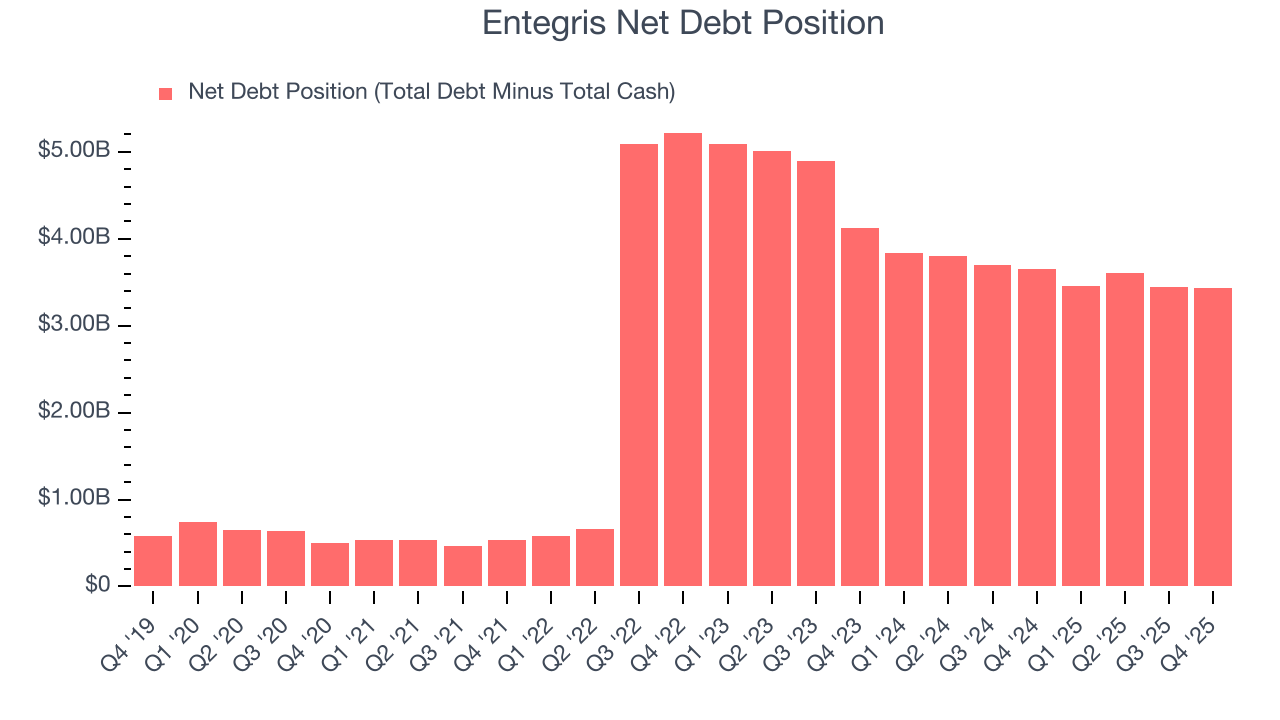
With $886.2 million of EBITDA over the last 12 months, we view Entegris’s 3.9× net-debt-to-EBITDA ratio as safe. We also see its $100.5 million of annual interest expenses as appropriate. The company’s profits give it plenty of breathing room, allowing it to continue investing in growth initiatives.
12. Key Takeaways from Entegris’s Q4 Results
It was good to see Entegris beat analysts’ EPS expectations this quarter. We were also glad its adjusted operating income outperformed Wall Street’s estimates. Overall, we think this was a solid quarter with some key areas of upside. The stock traded up 2.5% to $125.47 immediately after reporting.
13. Is Now The Time To Buy Entegris?
Updated: March 26, 2026 at 10:30 PM EDT
We think that the latest earnings result is only one piece of the bigger puzzle. If you’re deciding whether to own Entegris, you should also grasp the company’s longer-term business quality and valuation.
Entegris isn’t a terrible business, but it isn’t one of our picks. Although its revenue growth was solid over the last five years, it’s expected to deteriorate over the next 12 months and its low free cash flow margins give it little breathing room. And while the company’s rising cash profitability gives it more optionality, the downside is its mediocre ROIC lags the market and is a headwind for its stock price.
Entegris’s P/E ratio based on the next 12 months is 36.1x. This valuation tells us it’s a bit of a market darling with a lot of good news priced in - you can find more timely opportunities elsewhere.
Wall Street analysts have a consensus one-year price target of $141.40 on the company (compared to the current share price of $116.71).
Although the price target is bullish, readers should exercise caution because analysts tend to be overly optimistic. The firms they work for, often big banks, have relationships with companies that extend into fundraising, M&A advisory, and other rewarding business lines. As a result, they typically hesitate to say bad things for fear they will lose out. We at StockStory do not suffer from such conflicts of interest, so we’ll always tell it like it is.