
Heartland Express (HTLD)
Heartland Express faces an uphill battle. Its weak sales growth and low returns on capital show it struggled to generate demand and profits.― StockStory Analyst Team


1. News




2. Summary
Why We Think Heartland Express Will Underperform
Founded by the son of a trucker, Heartland Express (NASDAQ:HTLD) offers full-truckload deliveries across the United States and Mexico.
- Products and services are facing significant end-market challenges during this cycle as sales have declined by 18.3% annually over the last two years
- Incremental sales over the last five years were much less profitable as its earnings per share fell by 20.7% annually while its revenue grew
- Forecasted revenue decline of 11.7% for the upcoming 12 months implies demand will fall even further
Heartland Express’s quality doesn’t meet our hurdle. We believe there are better opportunities elsewhere.
Why There Are Better Opportunities Than Heartland Express





At $9.72 per share, Heartland Express trades at 6.8x forward EV-to-EBITDA. This certainly seems like a cheap stock, but we think there are valid reasons why it trades this way.
Cheap stocks can look like great bargains at first glance, but you often get what you pay for. These mediocre businesses often have less earnings power, meaning there is more reliance on a re-rating to generate good returns - an unlikely scenario for low-quality companies.
3. Heartland Express (HTLD) Research Report: Q4 CY2025 Update
Freight delivery company Heartland Express (NASDAQ:HTLD) missed Wall Street’s revenue expectations in Q4 CY2025, with sales falling 26.1% year on year to $179.4 million. Its non-GAAP loss of $0.06 per share was 25.3% above analysts’ consensus estimates.
Heartland Express (HTLD) Q4 CY2025 Highlights:
- Revenue: $179.4 million vs analyst estimates of $190.8 million (26.1% year-on-year decline, 6% miss)
- Adjusted EPS: -$0.06 vs analyst estimates of -$0.08 (25.3% beat)
- Adjusted EBITDA: $14.52 million vs analyst estimates of $36 million (8.1% margin, 59.7% miss)
- Operating Margin: -12.7%, down from 0.4% in the same quarter last year
- Market Capitalization: $834.1 million
Company Overview
Founded by the son of a trucker, Heartland Express (NASDAQ:HTLD) offers full-truckload deliveries across the United States and Mexico.
Heartland Express was founded in 1978 as a regional trucking company focusing on providing delivery services when the founder bought Scott’s Transportation of Swisher and renamed it. Over the years, it was able to expand its geographic reach and fleet by making various acquisitions. Specifically, the $525 million acquisition of Contract Freighters (CFI) in 2022 established its cross-border freight to and from Mexico.
Heartland Express offers full-truckload services across the United States and cross-border into Mexico using its fleet of trucks and trailers. For these deliveries, an entire truck or trailer is dedicated to a single customer’s shipment. This includes dry van services for standard cargo such as boxed goods and equipment, as well as refrigerated services for perishable items requiring temperature control during transport.
The company primarily focuses on short-to-medium distance (70% of its loads are less than 500 miles in length of haul) deliveries which allows the company to use a single driver rather than a team of drivers. It has been able to limit its delivery distance by building terminals across the country where drivers start and end trips.
Heartland Express engages in long-term contracts with its customers that typically span multiple years. These contracts specify particular routes or lanes where freight will be transported over a prolonged period. For example, a customer might contract the company to exclusively transport goods between two specific cities or along a designated highway route for a set duration. Deliveries are typically priced based on distance and the type of freight.
4. Ground Transportation
The growth of e-commerce and global trade continues to drive demand for shipping services, especially last-mile delivery, presenting opportunities for ground transportation companies. The industry continues to invest in data, analytics, and autonomous fleets to optimize efficiency and find the most cost-effective routes. Despite the essential services this industry provides, ground transportation companies are still at the whim of economic cycles. Consumer spending, for example, can greatly impact the demand for these companies’ offerings while fuel costs can influence profit margins.
Competitors offering similar products include Schneider (NYSE:SNDR), Werner (NASDAQ:WERN), and J.B. Hunt (NASDAQ:JBHT).
5. Revenue Growth
Reviewing a company’s long-term sales performance reveals insights into its quality. Any business can put up a good quarter or two, but the best consistently grow over the long haul. Regrettably, Heartland Express’s sales grew at a tepid 4.5% compounded annual growth rate over the last five years. This fell short of our benchmark for the industrials sector and is a poor baseline for our analysis.
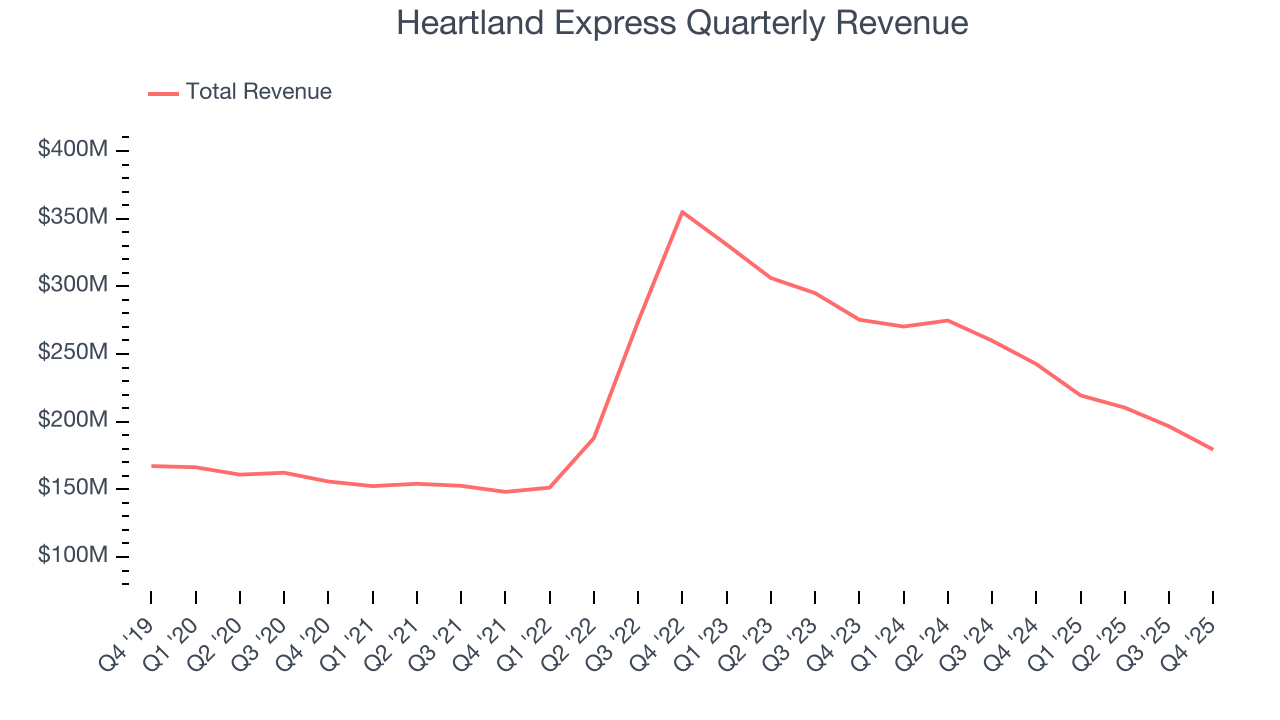
Long-term growth is the most important, but within industrials, a half-decade historical view may miss new industry trends or demand cycles. Heartland Express’s performance shows it grew in the past but relinquished its gains over the last two years, as its revenue fell by 18.3% annually. 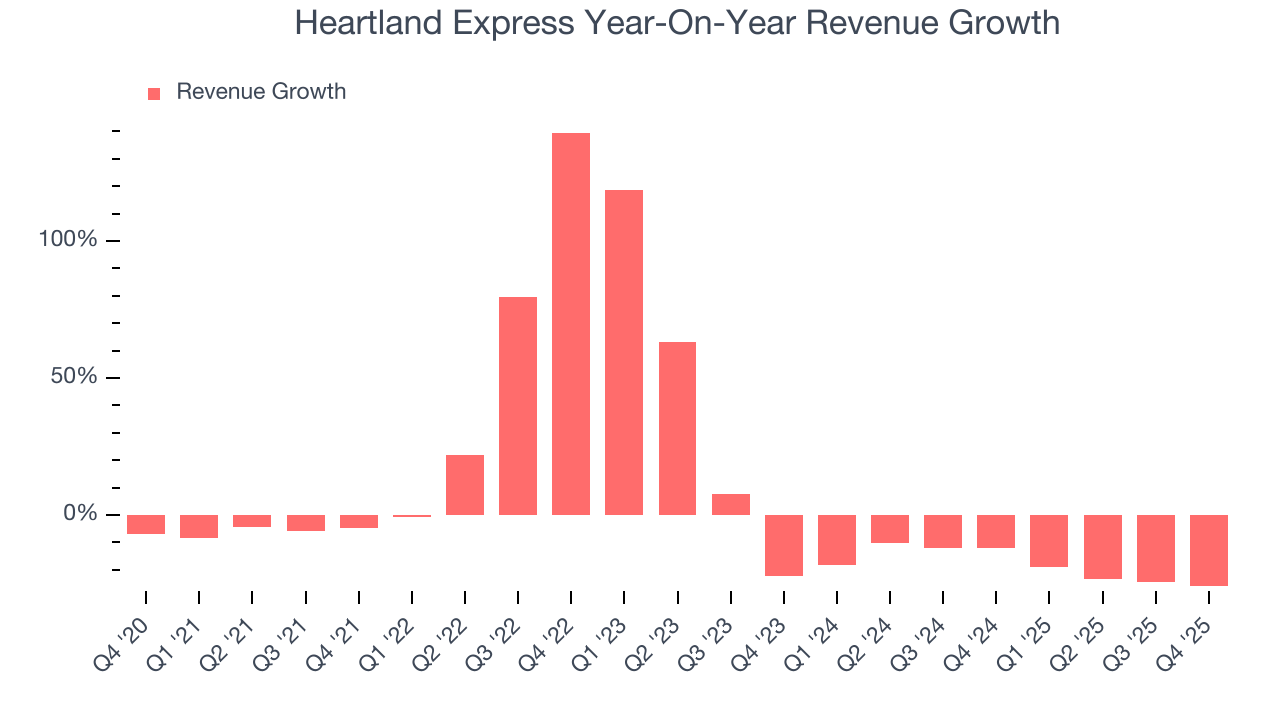
This quarter, Heartland Express missed Wall Street’s estimates and reported a rather uninspiring 26.1% year-on-year revenue decline, generating $179.4 million of revenue.
Looking ahead, sell-side analysts expect revenue to decline by 3.7% over the next 12 months. Although this projection is better than its two-year trend, it’s hard to get excited about a company that is struggling with demand.
6. Gross Margin & Pricing Power
Cost of sales for an industrials business is usually comprised of the direct labor, raw materials, and supplies needed to offer a product or service. These costs can be impacted by inflation and supply chain dynamics.
Heartland Express’s unit economics are better than the typical industrials business, signaling its products are somewhat differentiated through quality or brand.As you can see below, it averaged a decent 30% gross margin over the last five years. That means for every $100 in revenue, roughly $30.00 was left to spend on selling, marketing, R&D, and general administrative overhead. 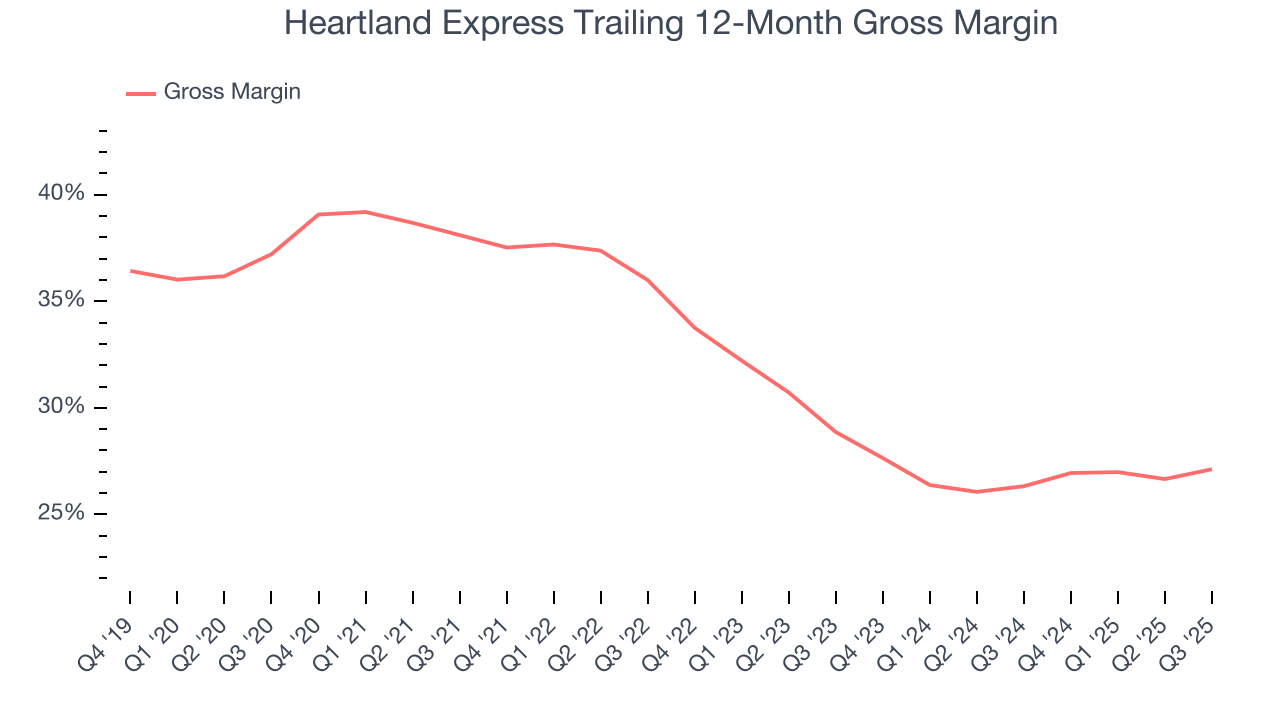
7. Operating Margin
Operating margin is an important measure of profitability as it shows the portion of revenue left after accounting for all core expenses – everything from the cost of goods sold to advertising and wages. It’s also useful for comparing profitability across companies with different levels of debt and tax rates because it excludes interest and taxes.
Heartland Express was profitable over the last five years but held back by its large cost base. Its average operating margin of 5.6% was weak for an industrials business.
Looking at the trend in its profitability, Heartland Express’s operating margin decreased by 24.5 percentage points over the last five years. This raises questions about the company’s expense base because its revenue growth should have given it leverage on its fixed costs, resulting in better economies of scale and profitability. Heartland Express’s performance was poor no matter how you look at it - it shows that costs were rising and it couldn’t pass them onto its customers.
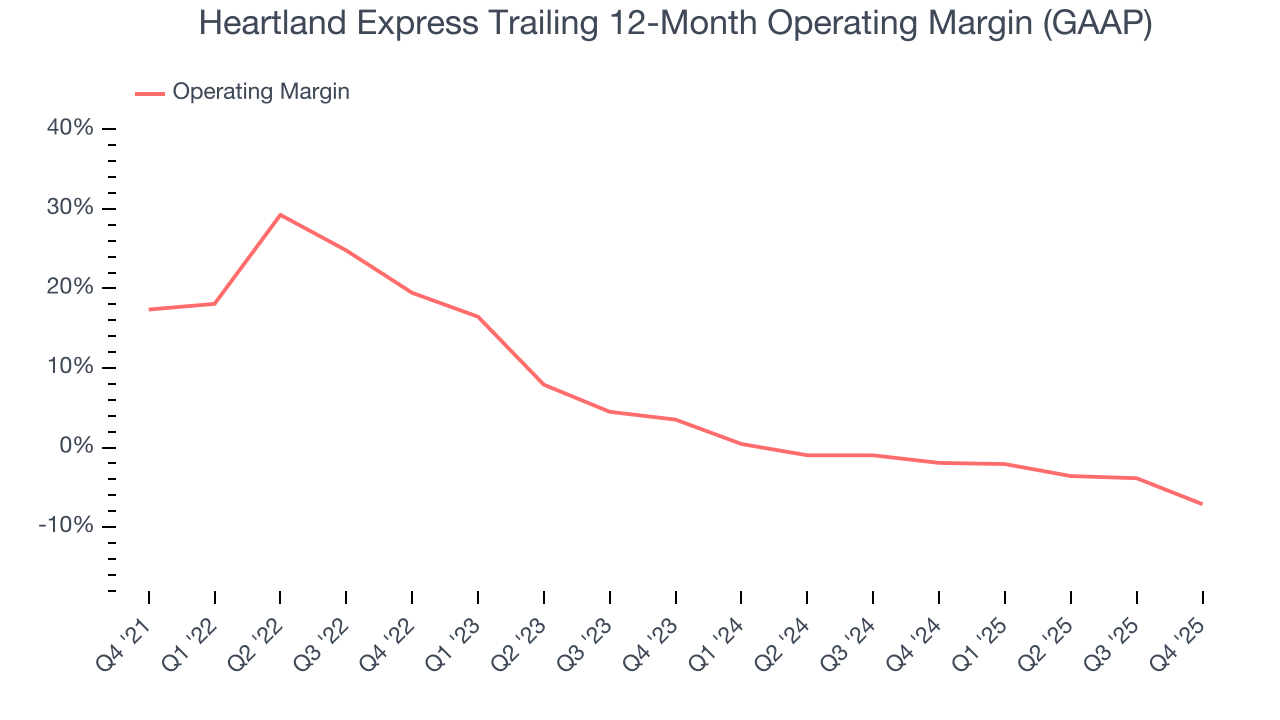
In Q4, Heartland Express generated an operating margin profit margin of negative 12.7%, down 13.2 percentage points year on year. The contraction shows it was less efficient because its expenses increased relative to its revenue.
8. Earnings Per Share
Revenue trends explain a company’s historical growth, but the long-term change in earnings per share (EPS) points to the profitability of that growth – for example, a company could inflate its sales through excessive spending on advertising and promotions.
Sadly for Heartland Express, its EPS declined by 20.7% annually over the last five years while its revenue grew by 4.5%. This tells us the company became less profitable on a per-share basis as it expanded due to non-fundamental factors such as interest expenses and taxes.
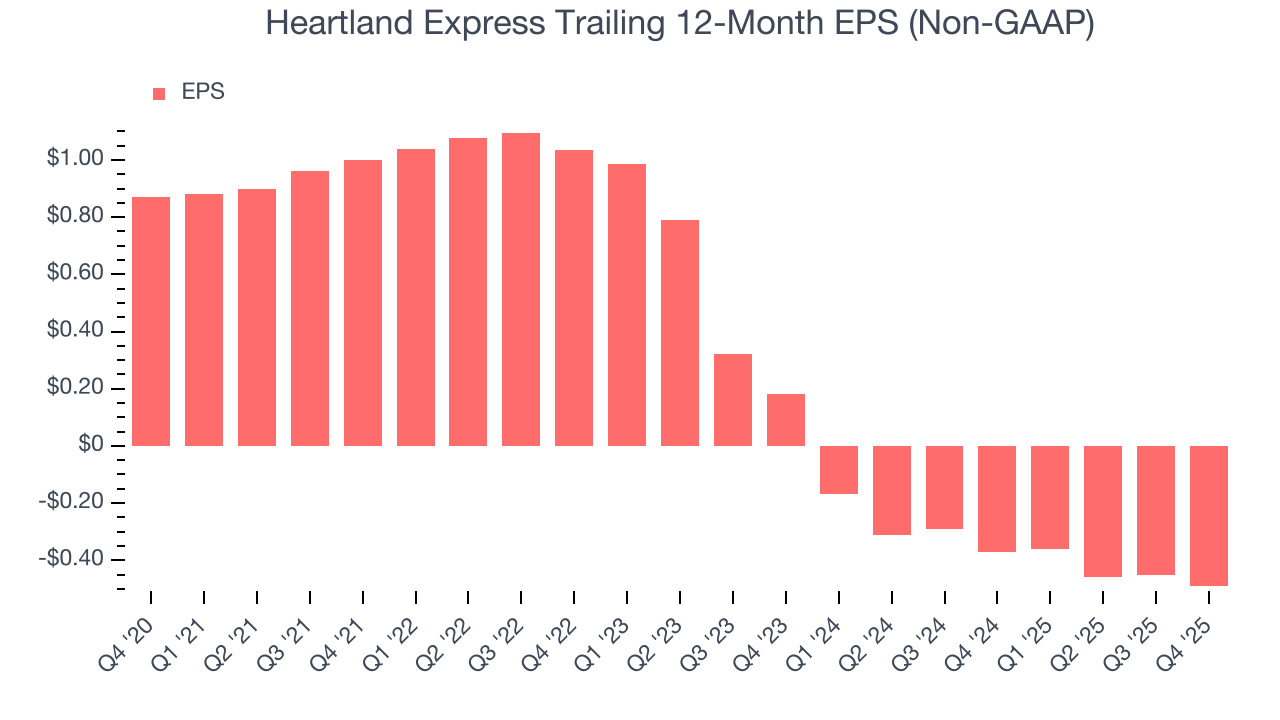
We can take a deeper look into Heartland Express’s earnings to better understand the drivers of its performance. As we mentioned earlier, Heartland Express’s operating margin declined by 24.5 percentage points over the last five years. This was the most relevant factor (aside from the revenue impact) behind its lower earnings; interest expenses and taxes can also affect EPS but don’t tell us as much about a company’s fundamentals.
Like with revenue, we analyze EPS over a shorter period to see if we are missing a change in the business.
For Heartland Express, its two-year annual EPS declines of 117% show it’s continued to underperform. These results were bad no matter how you slice the data.
In Q4, Heartland Express reported adjusted EPS of negative $0.06, down from negative $0.02 in the same quarter last year. Despite falling year on year, this print easily cleared analysts’ estimates. Over the next 12 months, Wall Street expects Heartland Express to improve its earnings losses. Analysts forecast its full-year EPS of negative $0.49 will advance to negative $0.14.
9. Cash Is King
Free cash flow isn't a prominently featured metric in company financials and earnings releases, but we think it's telling because it accounts for all operating and capital expenses, making it tough to manipulate. Cash is king.
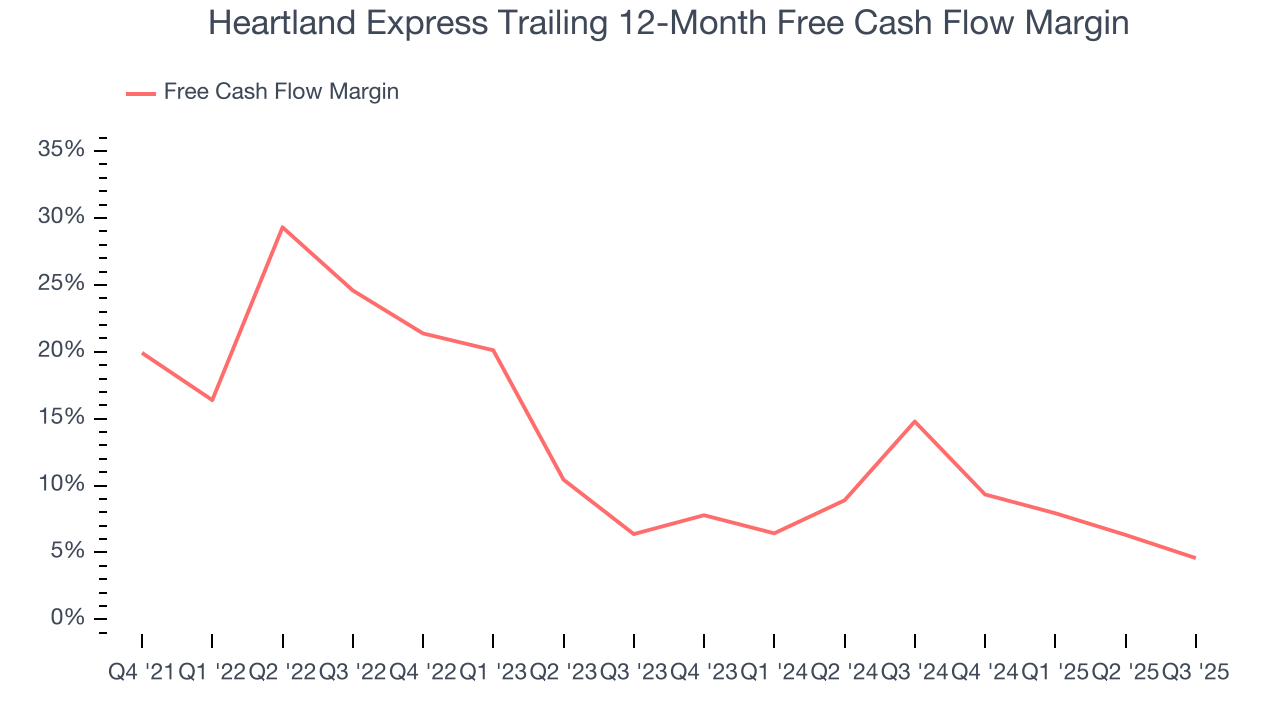
Heartland Express has shown robust cash profitability, enabling it to comfortably ride out cyclical downturns while investing in plenty of new offerings and returning capital to investors. The company’s free cash flow margin averaged 12.8% over the last five years, quite impressive for an industrials business. The divergence from its underwhelming operating margin stems from the add-back of non-cash charges like depreciation and stock-based compensation. GAAP operating profit expenses these line items, but free cash flow does not.
Taking a step back, we can see that Heartland Express’s margin dropped by 14 percentage points during that time. Continued declines could signal it is in the middle of an investment cycle.
10. Return on Invested Capital (ROIC)
EPS and free cash flow tell us whether a company was profitable while growing its revenue. But was it capital-efficient? Enter ROIC, a metric showing how much operating profit a company generates relative to the money it has raised (debt and equity).
Heartland Express historically did a mediocre job investing in profitable growth initiatives. Its five-year average ROIC was 5.2%, somewhat low compared to the best industrials companies that consistently pump out 20%+.
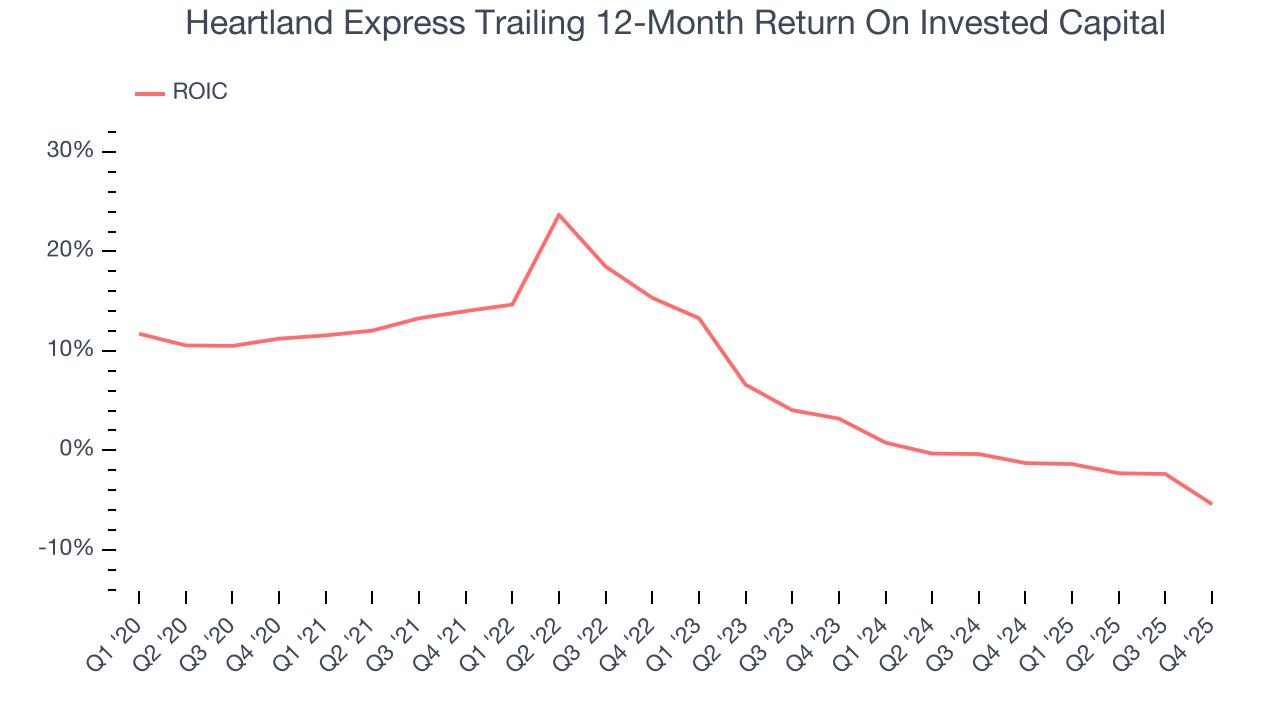
We like to invest in businesses with high returns, but the trend in a company’s ROIC is what often surprises the market and moves the stock price. Over the last few years, Heartland Express’s ROIC has unfortunately decreased significantly. Paired with its already low returns, these declines suggest its profitable growth opportunities are few and far between.
11. Balance Sheet Assessment
Heartland Express reported $18.48 million of cash and $161.4 million of debt on its balance sheet in the most recent quarter. As investors in high-quality companies, we primarily focus on two things: 1) that a company’s debt level isn’t too high and 2) that its interest payments are not excessively burdening the business.
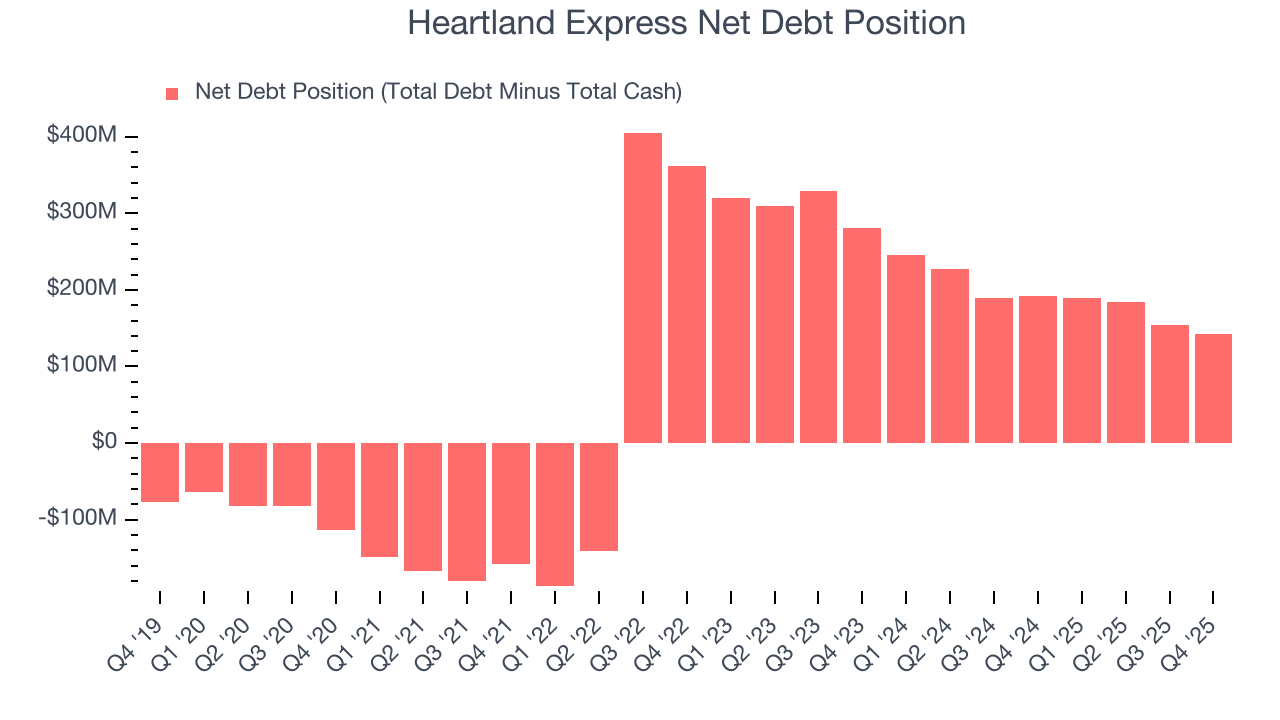
With $101.8 million of EBITDA over the last 12 months, we view Heartland Express’s 1.4× net-debt-to-EBITDA ratio as safe. We also see its $6.11 million of annual interest expenses as appropriate. The company’s profits give it plenty of breathing room, allowing it to continue investing in growth initiatives.
12. Key Takeaways from Heartland Express’s Q4 Results
It was good to see Heartland Express beat analysts’ EPS expectations this quarter. On the other hand, its revenue missed and its EBITDA fell short of Wall Street’s estimates. Overall, this quarter could have been better. The stock remained flat at $11.10 immediately following the results.
13. Is Now The Time To Buy Heartland Express?
Updated: March 20, 2026 at 11:57 PM EDT
Before investing in or passing on Heartland Express, we urge you to understand the company’s business quality (or lack thereof), valuation, and the latest quarterly results - in that order.
Heartland Express doesn’t pass our quality test. To begin with, its revenue growth was uninspiring over the last five years, and analysts expect its demand to deteriorate over the next 12 months. While its projected EPS for the next year implies the company’s fundamentals will improve, the downside is its diminishing returns show management's prior bets haven't worked out. On top of that, its declining EPS over the last five years makes it a less attractive asset to the public markets.
Heartland Express’s EV-to-EBITDA ratio based on the next 12 months is 6.8x. While this valuation is optically cheap, the potential downside is huge given its shaky fundamentals. There are more exciting stocks to buy at the moment.
Wall Street analysts have a consensus one-year price target of $10 on the company (compared to the current share price of $9.72).