
PENN Entertainment (PENN)
PENN Entertainment faces an uphill battle. Its sales have underperformed and its low returns on capital show it has few growth opportunities.― StockStory Analyst Team


1. News


2. Summary
Why We Think PENN Entertainment Will Underperform
Established in 1982, PENN Entertainment (NASDAQ:PENN) is a diversified American operator of casinos, sports betting, and entertainment venues.
- Lackluster 14.2% annual revenue growth over the last five years indicates the company is losing ground to competitors
- Responsiveness to unforeseen market trends is restricted due to its substandard operating margin profitability
- Cash-burning tendencies make us wonder if it can sustainably generate shareholder value
PENN Entertainment falls short of our expectations. We see more lucrative opportunities elsewhere.
Why There Are Better Opportunities Than PENN Entertainment






PENN Entertainment is trading at $14.22 per share, or 14.4x forward P/E. This multiple is lower than most consumer discretionary companies, but for good reason.
Cheap stocks can look like great bargains at first glance, but you often get what you pay for. These mediocre businesses often have less earnings power, meaning there is more reliance on a re-rating to generate good returns - an unlikely scenario for low-quality companies.
3. PENN Entertainment (PENN) Research Report: Q4 CY2025 Update
Casino, sports betting and entertainment operator PENN Entertainment (NASDAQ:PENN) announced better-than-expected revenue in Q4 CY2025, with sales up 8.2% year on year to $1.81 billion. Its non-GAAP profit of $0.07 per share was significantly above analysts’ consensus estimates.
PENN Entertainment (PENN) Q4 CY2025 Highlights:
- Revenue: $1.81 billion vs analyst estimates of $1.76 billion (8.2% year-on-year growth, 2.6% beat)
- Adjusted EPS: $0.07 vs analyst estimates of -$0.16 (significant beat)
- Operating Margin: -1%, down from 2.4% in the same quarter last year
- Free Cash Flow was -$190.4 million compared to -$118.1 million in the same quarter last year
- Market Capitalization: $1.67 billion
Company Overview
Established in 1982, PENN Entertainment (NASDAQ:PENN) is a diversified American operator of casinos, sports betting, and entertainment venues.
PENN Entertainment started as a small casino operator and has since expanded to include sports betting and entertainment venues.
Today, the company's services encompass casino gaming, sports betting, and diverse entertainment options across its properties. It has strategically embraced the surge in online sports betting, offering digital wagering alongside traditional in-person services. This approach not only caters to the classic casino-goer but also to a newer, tech-savvy audience. Beyond gaming, PENN Entertainment's venues provide a variety of dining and entertainment choices, addressing the demand for multifaceted leisure experiences.
The company's revenue streams are a blend of physical and online gaming operations, sports betting, and entertainment services.
4. Consumer Discretionary - Casino Operator
The Consumer Discretionary sector, by definition, is made up of companies selling non-essential goods and services. When economic conditions deteriorate or tastes shift, consumers can easily cut back or eliminate these purchases. For long-term investors with five-year holding periods, this creates a structural challenge: the sector is inherently hit-driven, with low switching costs and fickle customers. As a result, only a handful of companies can reliably grow demand and compound earnings over long periods, which is why our bar is high and High Quality ratings are rare.
Casino operators run gaming resorts and facilities that generate revenue from gambling, hospitality, food and beverage, and entertainment offerings. Tailwinds include pent-up travel demand, expansion into new jurisdictions legalizing gaming, and growing interest in integrated resort developments in Asia and the Middle East. However, the industry faces notable headwinds: heavy regulatory and licensing requirements limit operational flexibility, capital expenditure for property development and renovation is substantial, and revenue is highly sensitive to macroeconomic conditions and consumer confidence. Rising competition from online gambling platforms, regional saturation in mature markets, and geopolitical risks in key international jurisdictions add further uncertainty.
Competitors in the gaming and entertainment sector include Caesars Entertainment (NASDAQ:CZR), MGM Resorts (NYSE:MGM), and Boyd Gaming (NYSE:BYD).
5. Revenue Growth
A company’s long-term sales performance can indicate its overall quality. Any business can put up a good quarter or two, but the best consistently grow over the long haul. Over the last five years, PENN Entertainment grew its sales at a 14.2% annual rate. Though this growth is acceptable on an absolute basis, we need to see more than just topline growth for the consumer discretionary sector, which can display significant earnings volatility. This means our bar for the sector is particularly high, reflecting the non-essential and hit-driven nature of the products and services offered. Additionally, five-year CAGR starts around Covid, when revenue was depressed then rebounded.
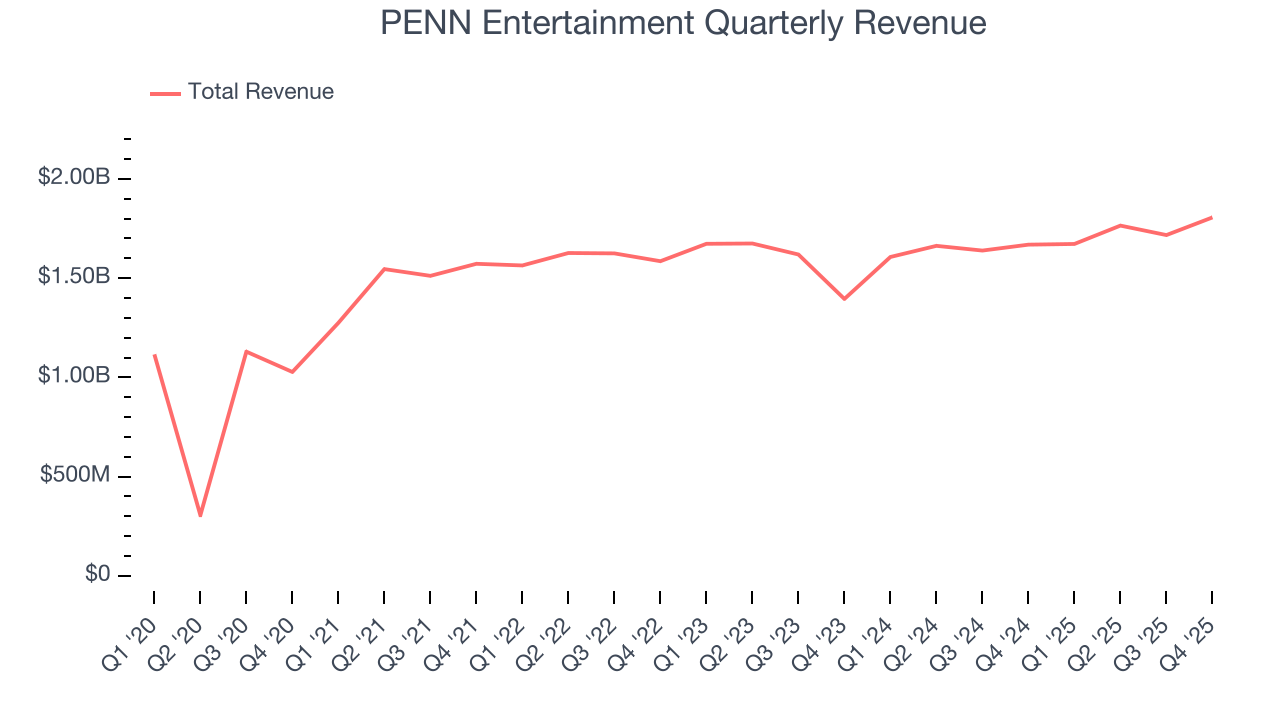
Long-term growth is the most important, but within consumer discretionary, product cycles are short and revenue can be hit-driven due to rapidly changing trends and consumer preferences. PENN Entertainment’s recent performance shows its demand has slowed as its annualized revenue growth of 4.6% over the last two years was below its five-year trend. We’re wary when companies in the sector see decelerations in revenue growth, as it could signal changing consumer tastes aided by low switching costs. Note that COVID hurt PENN Entertainment’s business in 2020 and part of 2021, and it bounced back in a big way thereafter. 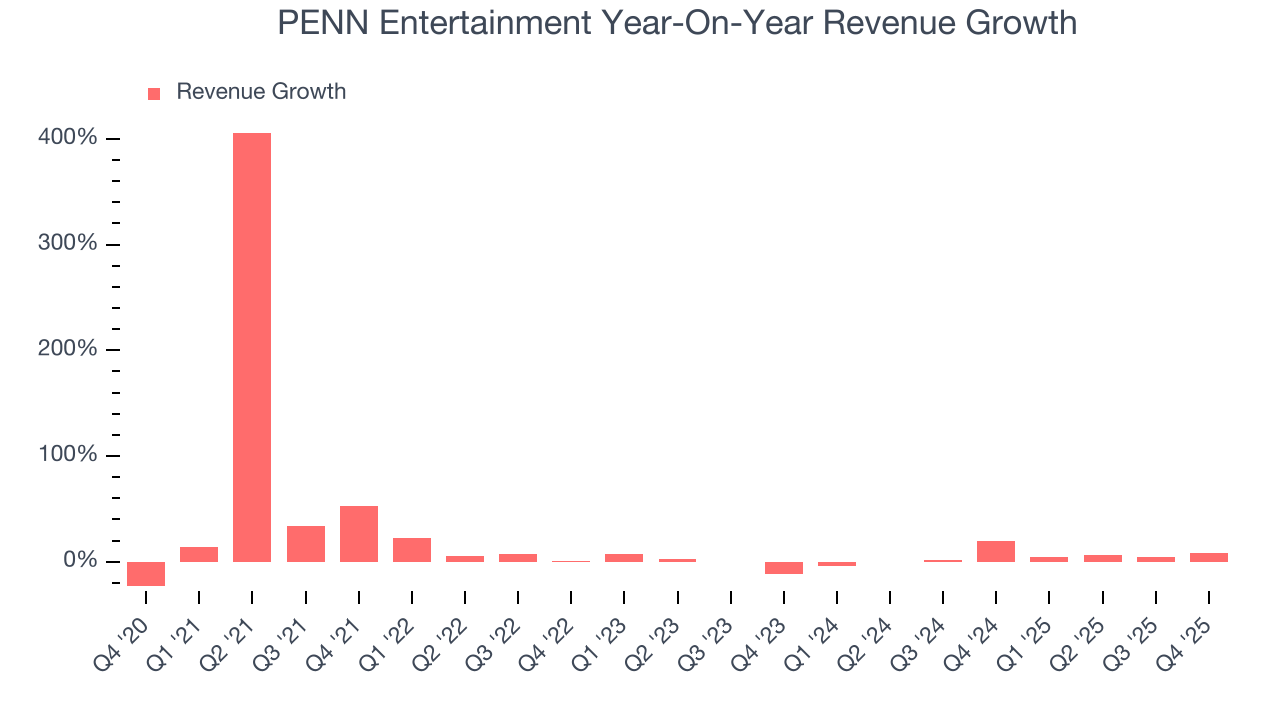
We can dig further into the company’s revenue dynamics by analyzing its most important segment, Northeast Region. Over the last two years, PENN Entertainment’s Northeast Region revenue (casinos, hotels) averaged 1.2% year-on-year growth. This segment has lagged the company’s overall sales. 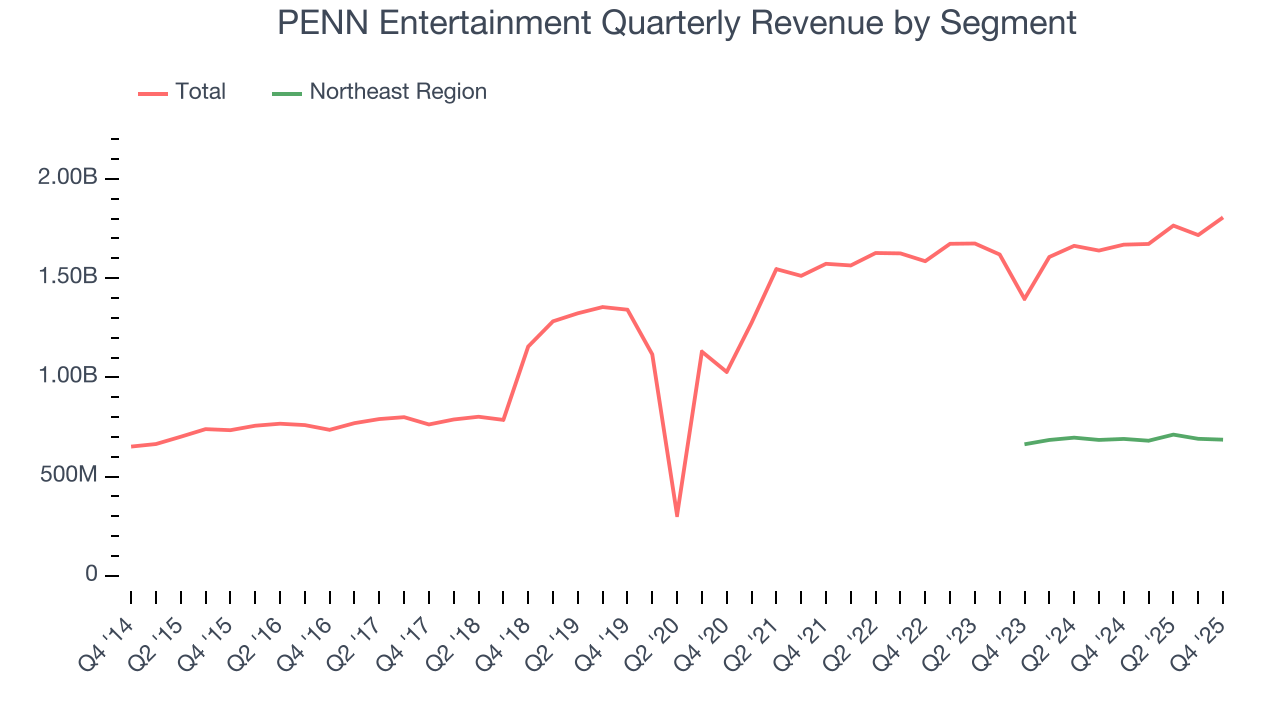
This quarter, PENN Entertainment reported year-on-year revenue growth of 8.2%, and its $1.81 billion of revenue exceeded Wall Street’s estimates by 2.6%.
Looking ahead, sell-side analysts expect revenue to grow 1.8% over the next 12 months, a slight deceleration versus the last two years. This projection doesn't excite us and indicates its products and services will see some demand headwinds.
6. Operating Margin
PENN Entertainment’s operating margin might fluctuated slightly over the last 12 months but has remained more or less the same, averaging 2.4% over the last two years. This profitability was inadequate for a consumer discretionary business and caused by its suboptimal cost structure.
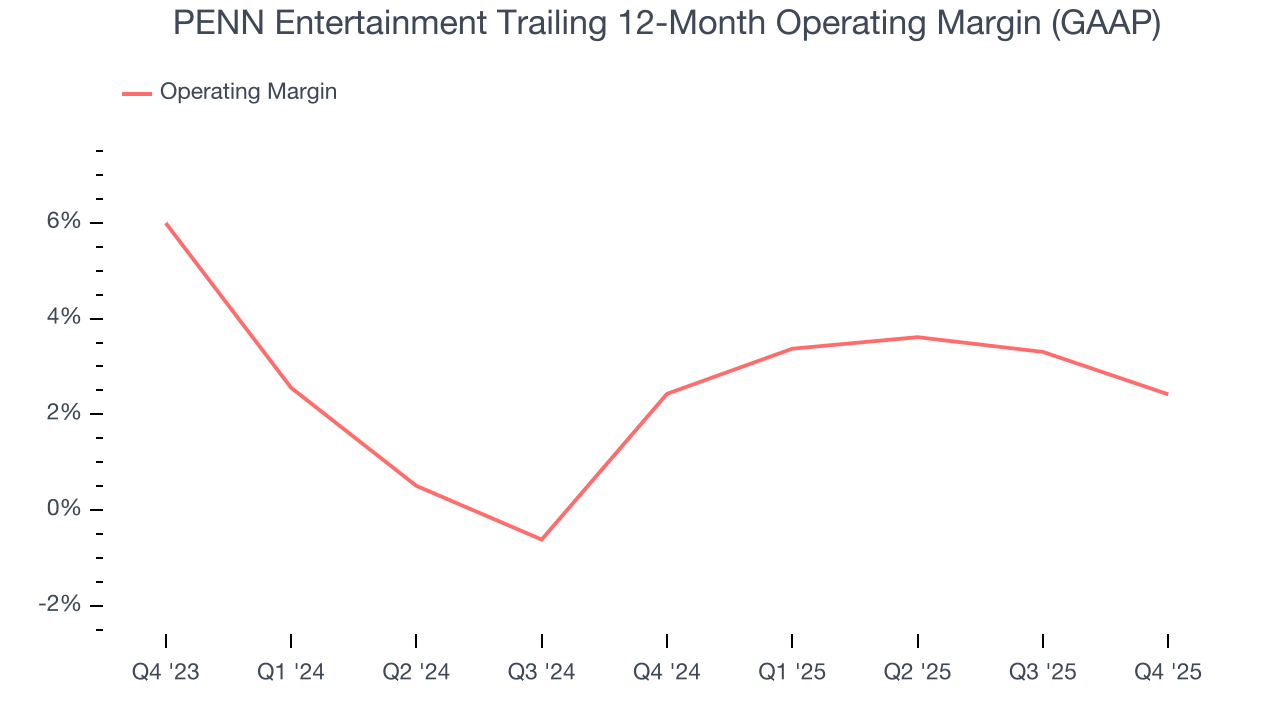
This quarter, PENN Entertainment’s breakeven margin was -1%, down 3.3 percentage points year on year. This contraction shows it was less efficient because its expenses grew faster than its revenue.
7. Earnings Per Share
Revenue trends explain a company’s historical growth, but the long-term change in earnings per share (EPS) points to the profitability of that growth – for example, a company could inflate its sales through excessive spending on advertising and promotions.
Although PENN Entertainment’s full-year earnings are still negative, it reduced its losses and improved its EPS by 23% annually over the last five years. The next few quarters will be critical for assessing its long-term profitability.
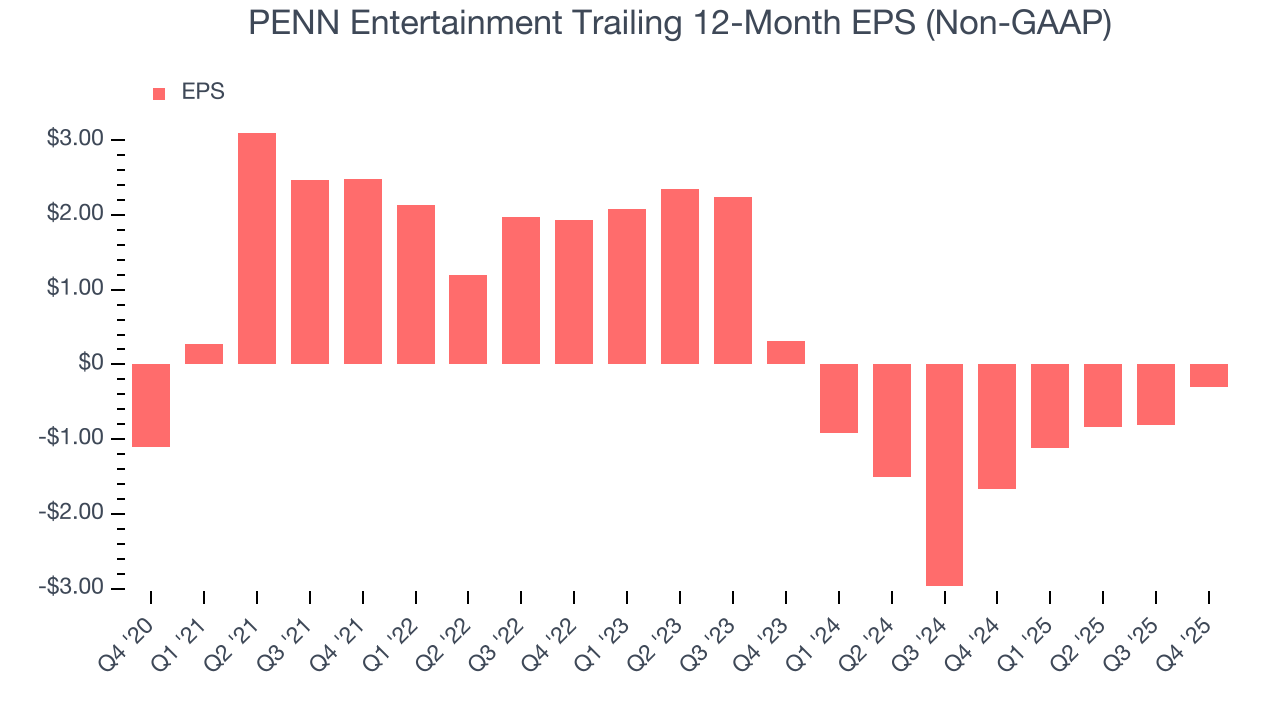
In Q4, PENN Entertainment reported adjusted EPS of $0.07, up from negative $0.44 in the same quarter last year. This print easily cleared analysts’ estimates, and shareholders should be content with the results. Over the next 12 months, Wall Street is optimistic. Analysts forecast PENN Entertainment’s full-year EPS of negative $0.30 will flip to positive $0.77.
8. Cash Is King
Free cash flow isn't a prominently featured metric in company financials and earnings releases, but we think it's telling because it accounts for all operating and capital expenses, making it tough to manipulate. Cash is king.
Over the last two years, PENN Entertainment’s demanding reinvestments to stay relevant have drained its resources, putting it in a pinch and limiting its ability to return capital to investors. Its free cash flow margin averaged negative 2.7%, meaning it lit $2.73 of cash on fire for every $100 in revenue.
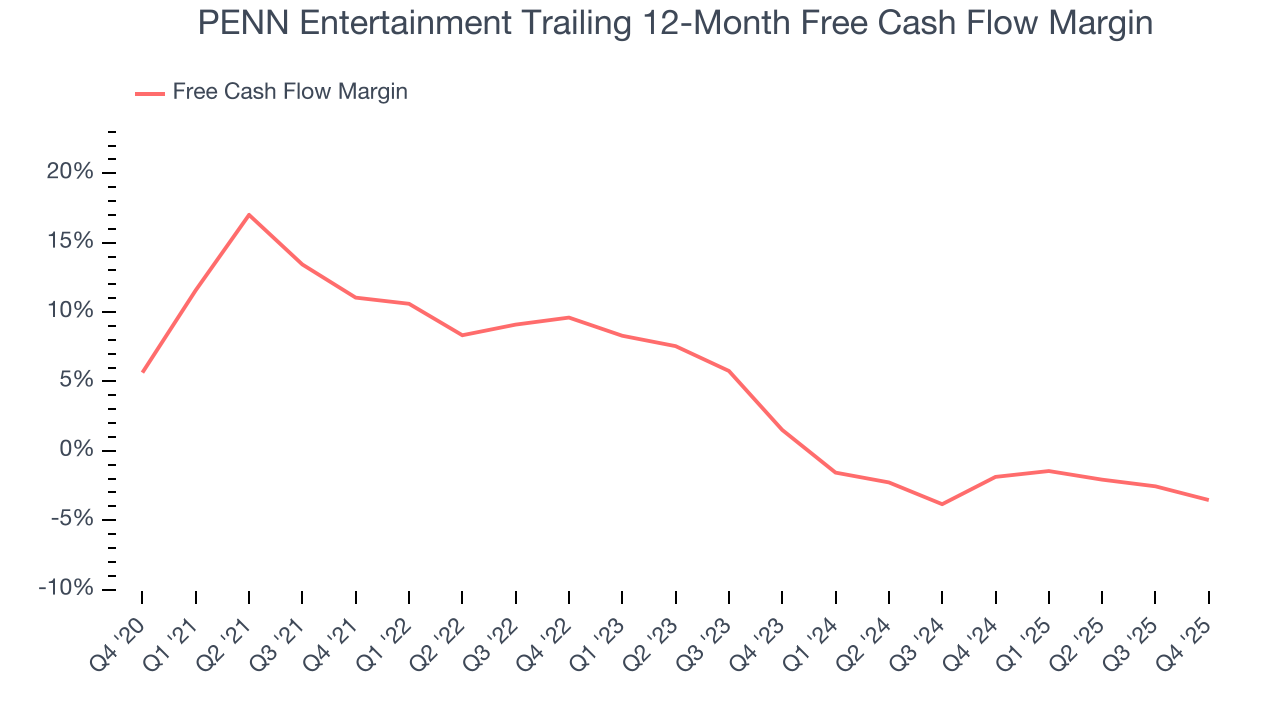
PENN Entertainment burned through $190.4 million of cash in Q4, equivalent to a negative 10.5% margin. The company’s cash burn increased from $118.1 million of lost cash in the same quarter last year.
Looking forward, analysts predict PENN Entertainment will generate cash on a full-year basis. Their consensus estimates imply its free cash flow margin of negative 3.5% for the last 12 months will increase to positive 2.6%, giving it more optionality.
9. Return on Invested Capital (ROIC)
EPS and free cash flow tell us whether a company was profitable while growing its revenue. But was it capital-efficient? A company’s ROIC explains this by showing how much operating profit it makes compared to the money it has raised (debt and equity).
PENN Entertainment historically did a mediocre job investing in profitable growth initiatives. Its five-year average ROIC was 12.7%, somewhat low compared to the best consumer discretionary companies that consistently pump out 25%+.
We like to invest in businesses with high returns, but the trend in a company’s ROIC is what often surprises the market and moves the stock price. Unfortunately, PENN Entertainment’s ROIC has decreased significantly over the last few years. Paired with its already low returns, these declines suggest its profitable growth opportunities are few and far between.
10. Balance Sheet Assessment
PENN Entertainment reported $686.6 million of cash and $2.90 billion of debt on its balance sheet in the most recent quarter. As investors in high-quality companies, we primarily focus on two things: 1) that a company’s debt level isn’t too high and 2) that its interest payments are not excessively burdening the business.
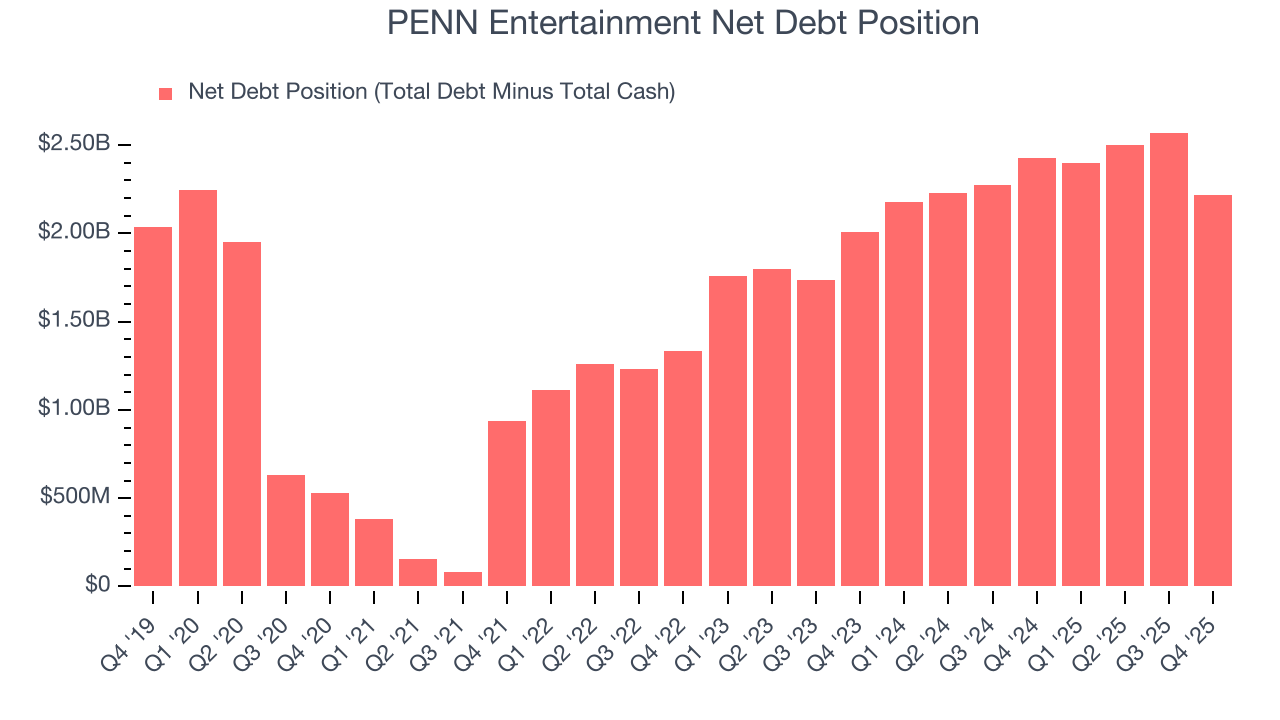
With $830.1 million of EBITDA over the last 12 months, we view PENN Entertainment’s 2.7× net-debt-to-EBITDA ratio as safe. We also see its $398.3 million of annual interest expenses as appropriate. The company’s profits give it plenty of breathing room, allowing it to continue investing in growth initiatives.
11. Key Takeaways from PENN Entertainment’s Q4 Results
It was good to see PENN Entertainment beat analysts’ EPS expectations this quarter. We were also happy its revenue outperformed Wall Street’s estimates. On the other hand, its EBITDA missed. Overall, this print had some key positives. The stock traded up 6.5% to $13.35 immediately following the results.
12. Is Now The Time To Buy PENN Entertainment?
Updated: March 19, 2026 at 10:43 PM EDT
When considering an investment in PENN Entertainment, investors should account for its valuation and business qualities as well as what’s happened in the latest quarter.
We cheer for all companies serving everyday consumers, but in the case of PENN Entertainment, we’ll be cheering from the sidelines. While its projected EPS for the next year implies the company’s fundamentals will improve, the downside is its relatively low ROIC suggests management has struggled to find compelling investment opportunities. On top of that, its cash burn raises the question of whether it can sustainably maintain growth.
PENN Entertainment’s P/E ratio based on the next 12 months is 14.4x. While this valuation is fair, the upside isn’t great compared to the potential downside. There are better investments elsewhere.
Wall Street analysts have a consensus one-year price target of $19.11 on the company (compared to the current share price of $14.22).
Although the price target is bullish, readers should exercise caution because analysts tend to be overly optimistic. The firms they work for, often big banks, have relationships with companies that extend into fundraising, M&A advisory, and other rewarding business lines. As a result, they typically hesitate to say bad things for fear they will lose out. We at StockStory do not suffer from such conflicts of interest, so we’ll always tell it like it is.