Take-Two (TTWO)
Take-Two doesn’t excite us. It not only burned cash historically but also has been less efficient lately. No need to stick around here.― StockStory Analyst Team


1. News






2. Summary
Why Take-Two Is Not Exciting
Best known for its Grand Theft Auto and NBA 2K franchises, Take Two (NASDAQ:TTWO) is one of the world’s largest video game publishers.
- Historically negative EPS raises concerns for risk-averse investors and makes its earnings potential harder to gauge
- Cash burn makes us question whether it can achieve sustainable long-term growth
- On the plus side, its successful business model is illustrated by its impressive EBITDA margin
Take-Two’s quality doesn’t meet our bar. We see more favorable opportunities in the market.
Why There Are Better Opportunities Than Take-Two
At $246.00 per share, Take-Two trades at 47.3x forward EV/EBITDA. The current multiple is quite expensive, especially for the fundamentals of the business.
We prefer to invest in similarly-priced but higher-quality companies with superior earnings growth.
3. Take-Two (TTWO) Research Report: Q3 CY2025 Update
Video game publisher Take Two (NASDAQ:TTWO) reported Q3 CY2025 results beating Wall Street’s revenue expectations, with sales up 20.3% year on year to $1.77 billion. On top of that, next quarter’s revenue guidance ($1.60 billion at the midpoint) was surprisingly good and 6.7% above what analysts were expecting. Its GAAP loss of $0.73 per share was 17.1% below analysts’ consensus estimates.
Take-Two (TTWO) Q3 CY2025 Highlights:
- Grand Theft Auto VI release date is set for November 19, 2026
- Revenue: $1.77 billion vs analyst estimates of $1.71 billion (20.3% year-on-year growth, 3.8% beat)
- EPS (GAAP): -$0.73 vs analyst expectations of -$0.62 (17.1% miss)
- Adjusted EBITDA: $116.7 million vs analyst estimates of $288 million (6.6% margin, 59.5% miss)
- The company lifted its revenue guidance for the full year to $6.43 billion at the midpoint from $6.15 billion, a 4.6% increase
- EPS (GAAP) guidance for the full year is -$2.08 at the midpoint, roughly in line with what analysts were expecting
- EBITDA guidance for the full year is $608 million at the midpoint, below analyst estimates of $910.2 million
- Operating Margin: -5.5%, up from -20.1% in the same quarter last year
- Free Cash Flow was $96.5 million, up from -$69.8 million in the previous quarter
- Market Capitalization: $47 billion
Company Overview
Best known for its Grand Theft Auto and NBA 2K franchises, Take Two (NASDAQ:TTWO) is one of the world’s largest video game publishers.
Take Two develops video games for consoles, PCs, and mobile devices through its five main development studios: Rockstar Games, 2K, Private Division, Social Point, and Playdots. Take Two’s games range across multiple genres, from first person shooter, action, role-playing, strategy, sports and family/casual entertainment. It also employs a range of business models; Take Two sells full premium games along with free to play games with in game purchase, and subscription style content.
Unlike rivals EA and Activision, whose businesses are built on big releases of annualized content like Madden or Call of Duty, some of Take Two’s biggest franchises are released less frequently, with the company often taking years to develop new versions. Its biggest franchise, Grand Theft Auto’s last release was September 2013, while the October 2018 release of Red Dead Redemption II was in development for 8 years. Its NBA 2K series is its only major title with an annual release. The company also has a collection of mid-tier franchises that have more regular releases such as Bioshock, Borderlands, Mafia, and Sid Meier’s Civilization.
4. Video Gaming
Since videogames were invented in the 1970s, they have gradually taken more share of entertainment time. Ubiquitous mobile devices have powered a surge in “snackable” games that can be played on the go. Over time, games have developed more social engagement features where friends can play games together over the internet. The business models of games publishers have become less volatile due to digitization of distribution, in game monetization, and like Hollywood, an increasing dependence on surefire hit franchises. Covid driven lockdowns accelerated adoption and usage of videogames – a trend that has not slowed.
Take Two competes with other large video game companies such as Electronic Arts (NASDAQ:EA), Roblox (NYSE:RBLX), and Nintendo (TSE:7974).
5. Revenue Growth
A company’s long-term performance is an indicator of its overall quality. Any business can experience short-term success, but top-performing ones enjoy sustained growth for years. Over the last three years, Take-Two grew its sales at a decent 13.9% compounded annual growth rate. Its growth was slightly above the average consumer internet company and shows its offerings resonate with customers.
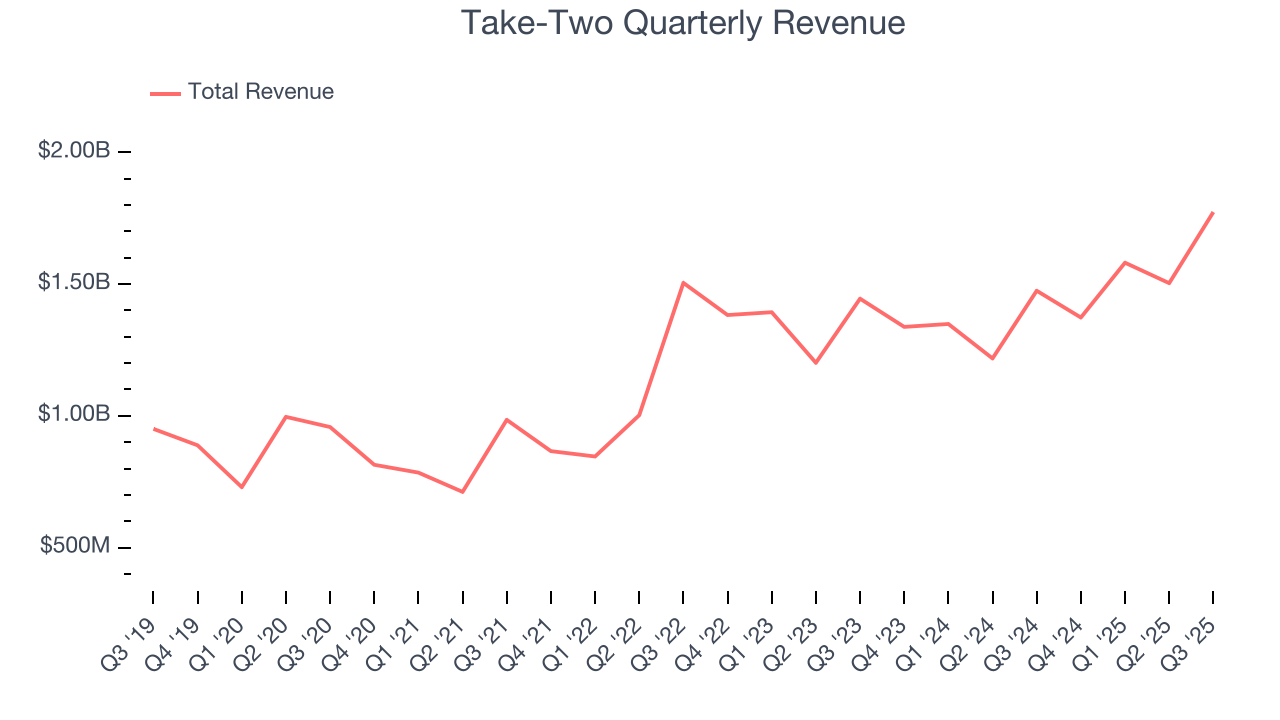
This quarter, Take-Two reported robust year-on-year revenue growth of 20.3%, and its $1.77 billion of revenue topped Wall Street estimates by 3.8%. Company management is currently guiding for a 16.1% year-on-year increase in sales next quarter.
Looking further ahead, sell-side analysts expect revenue to grow 37.2% over the next 12 months, an acceleration versus the last three years. This projection is eye-popping and implies its newer products and services will fuel better top-line performance.
6. Gross Margin & Pricing Power
A company’s gross profit margin has a significant impact on its ability to exert pricing power, develop new products, and invest in marketing. These factors can determine the winner in a competitive market.
For gaming businesses like Take-Two, gross profit tells us how much money the company gets to keep after covering the base cost of its products and services, which typically include royalties to sports leagues or celebrities featured in games, fees paid to Alphabet or Apple for games downloaded in their digital app stores, and data center hosting expenses associated with delivering games over the internet.
Take-Two’s gross margin is ahead of the broader industry and points to its solid unit economics, competitive products and services, and lack of meaningful pricing pressure. As you can see below, it averaged an impressive 64.6% gross margin over the last two years. Said differently, Take-Two paid its providers $35.44 for every $100 in revenue. 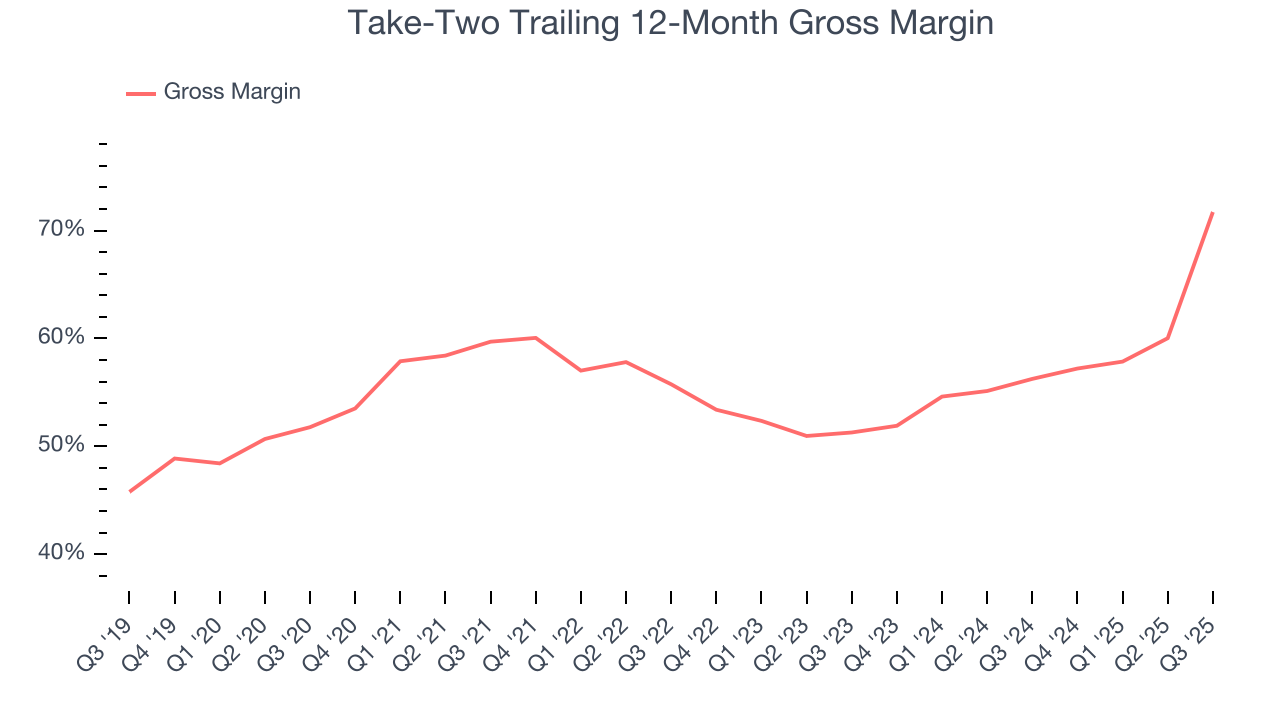
This quarter, Take-Two’s gross profit margin was 99.8%, up 41.4 percentage points year on year. Take-Two’s full-year margin has also been trending up over the past 12 months, increasing by 15.5 percentage points. If this move continues, it could suggest a less competitive environment where the company has better pricing power and leverage from its growing sales on the fixed portion of its cost of goods sold (such as servers).
7. User Acquisition Efficiency
Consumer internet businesses like Take-Two grow from a combination of product virality, paid advertisement, and incentives (unlike enterprise software products, which are often sold by dedicated sales teams).
Take-Two does a decent job acquiring new users, spending 41.2% of its gross profit on sales and marketing expenses over the last year. This decent efficiency indicates relatively solid competitive positioning, giving Take-Two the freedom to invest its resources into new growth initiatives.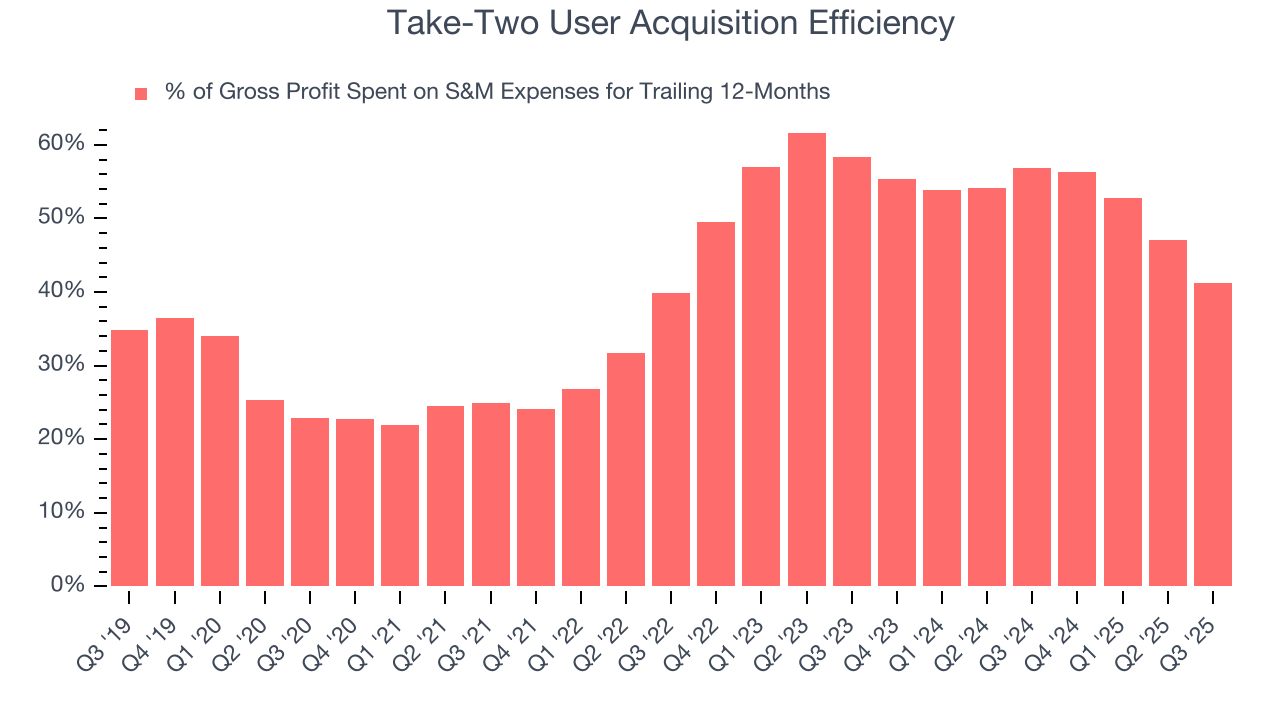
8. EBITDA
Take-Two has been an efficient company over the last two years. It was one of the more profitable businesses in the consumer internet sector, boasting an average EBITDA margin of 12.1%. This result isn’t too surprising as its gross margin gives it a favorable starting point.
Analyzing the trend in its profitability, Take-Two’s EBITDA margin decreased by 6.9 percentage points over the last few years. This raises questions about the company’s expense base because its revenue growth should have given it leverage on its fixed costs, resulting in better economies of scale and profitability.
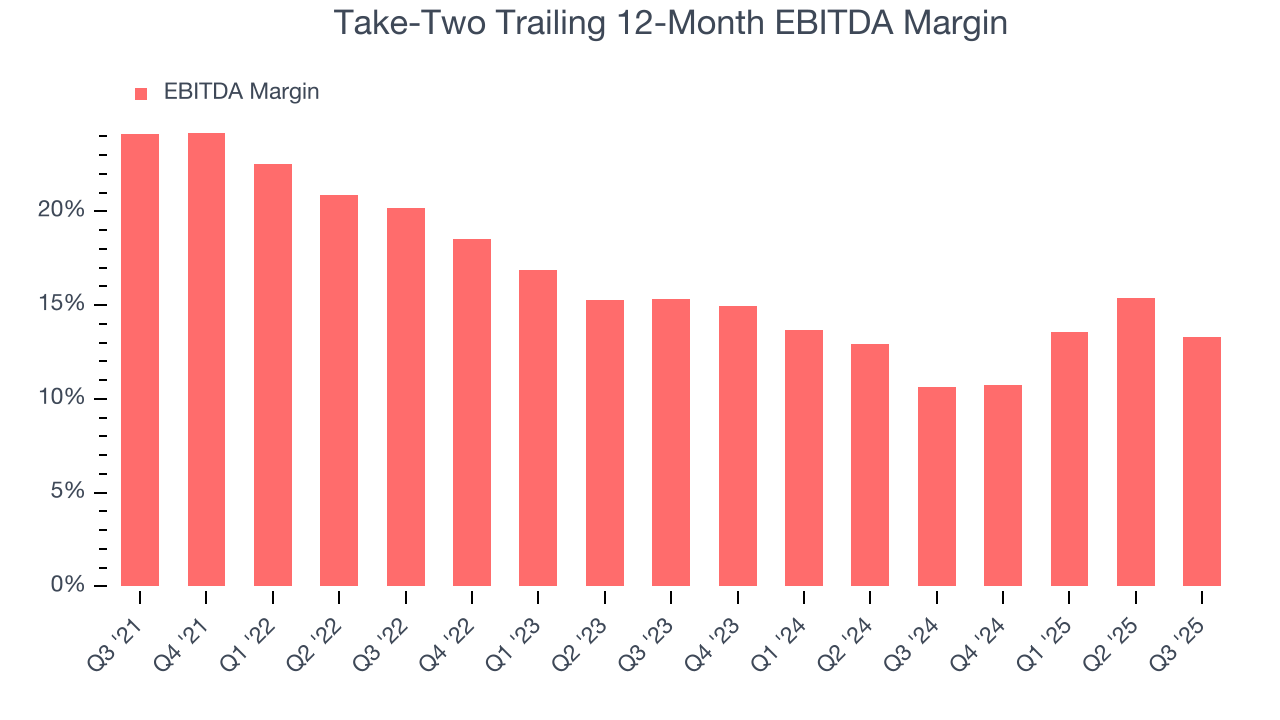
This quarter, Take-Two generated an EBITDA margin profit margin of 6.6%, down 7 percentage points year on year. Conversely, its revenue and gross margin actually rose, so we can assume it was less efficient because its operating expenses like marketing, R&D, and administrative overhead grew faster than its revenue.
9. Earnings Per Share
Revenue trends explain a company’s historical growth, but the change in earnings per share (EPS) points to the profitability of that growth – for example, a company could inflate its sales through excessive spending on advertising and promotions.
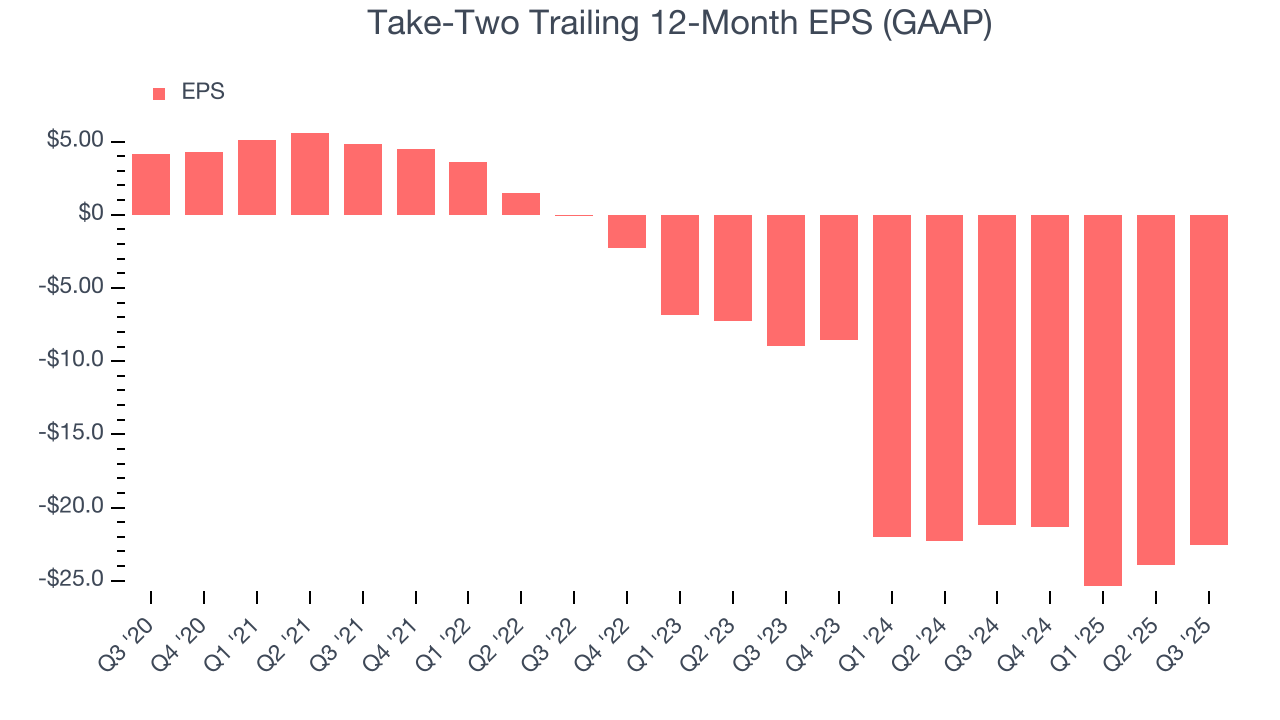
In Q3, Take-Two reported EPS of negative $0.73, up from negative $2.08 in the same quarter last year. Despite growing year on year, this print missed analysts’ estimates. Over the next 12 months, Wall Street is optimistic. Analysts forecast Take-Two’s full-year EPS of negative $22.59 will flip to positive $2.47.
10. Cash Is King
Free cash flow isn't a prominently featured metric in company financials and earnings releases, but we think it's telling because it accounts for all operating and capital expenses, making it tough to manipulate. Cash is king.
While Take-Two posted positive free cash flow this quarter, the broader story hasn’t been so clean. Take-Two’s demanding reinvestments have consumed many resources over the last two years, contributing to an average free cash flow margin of negative 3.1%. This means it lit $3.06 of cash on fire for every $100 in revenue. This is a stark contrast from its EBITDA margin, and its investments (i.e., stocking inventory, building new facilities) are the primary culprit.
Taking a step back, an encouraging sign is that Take-Two’s margin expanded by 3.7 percentage points over the last few years. The company’s improvement and free cash flow generation this quarter show it’s heading in the right direction, and continued increases could help it achieve long-term cash profitability.
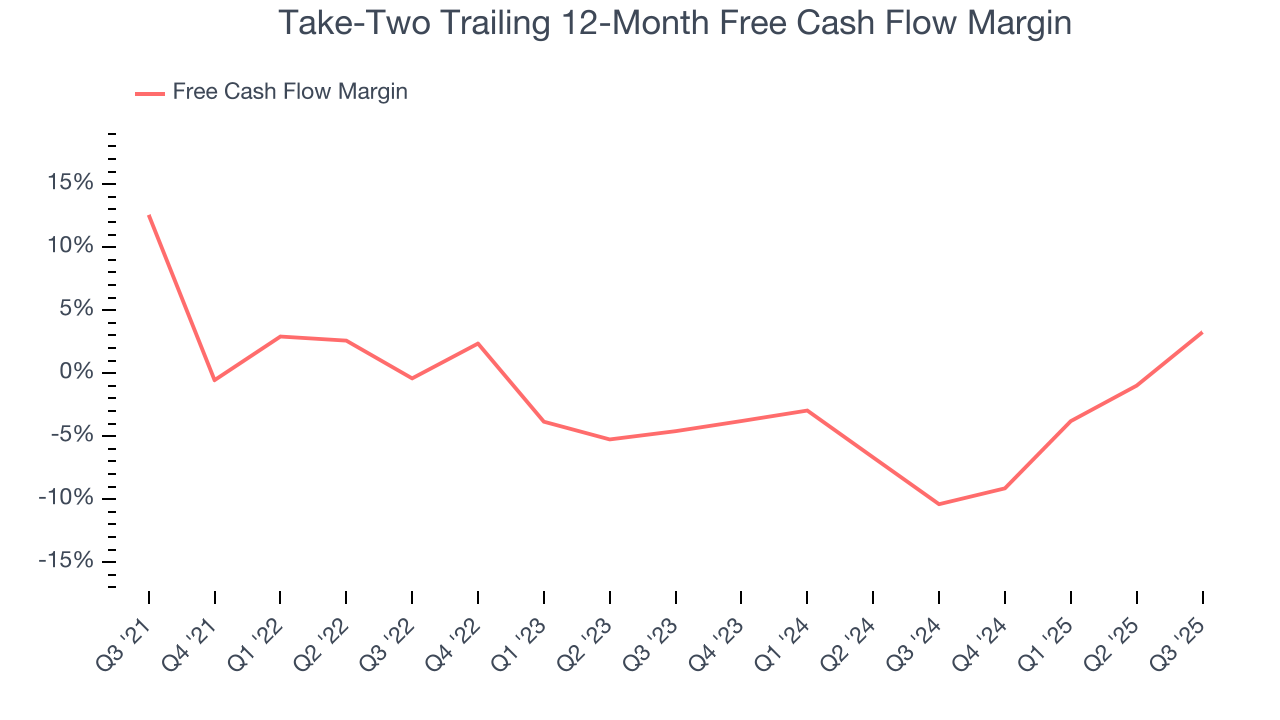
Take-Two’s free cash flow clocked in at $96.5 million in Q3, equivalent to a 5.4% margin. Its cash flow turned positive after being negative in the same quarter last year, marking a potential inflection point.
11. Balance Sheet Assessment
Take-Two reported $1.87 billion of cash and $3.51 billion of debt on its balance sheet in the most recent quarter. As investors in high-quality companies, we primarily focus on two things: 1) that a company’s debt level isn’t too high and 2) that its interest payments are not excessively burdening the business.
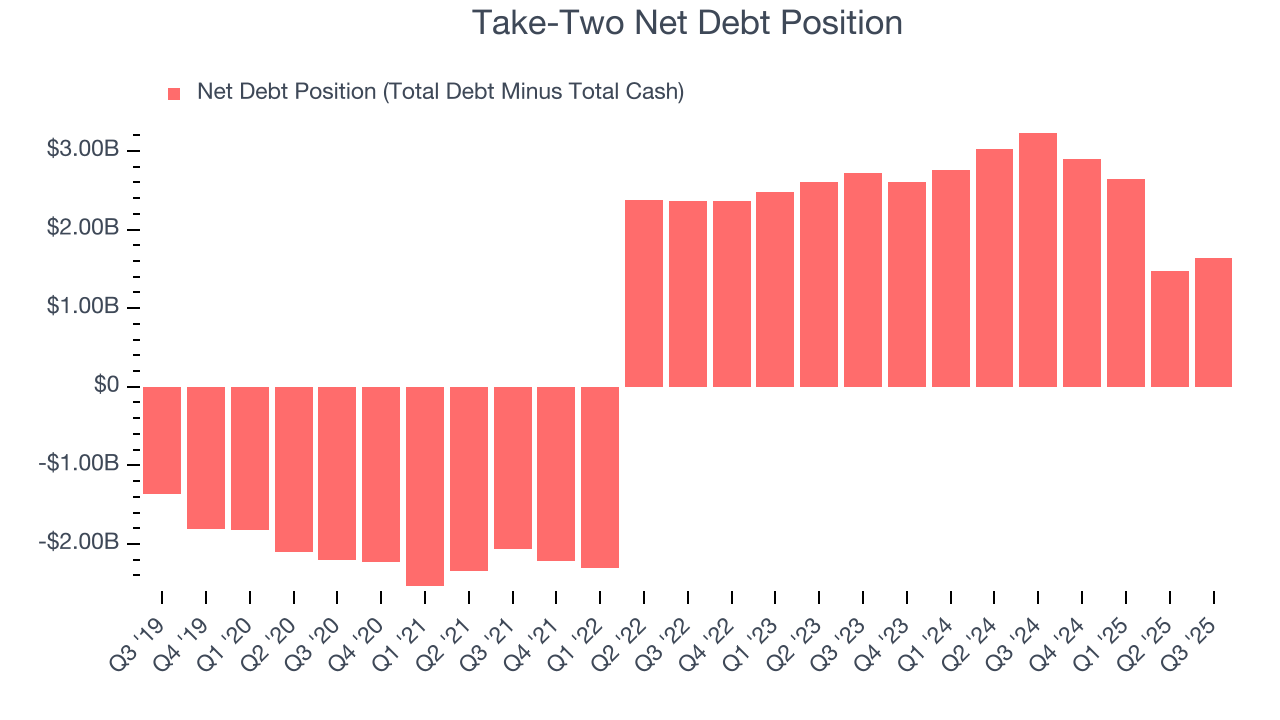
With $827.9 million of EBITDA over the last 12 months, we view Take-Two’s 2.0× net-debt-to-EBITDA ratio as safe. We also see its $52.3 million of annual interest expenses as appropriate. The company’s profits give it plenty of breathing room, allowing it to continue investing in growth initiatives.
12. Key Takeaways from Take-Two’s Q3 Results
It was great to see Take-Two beat analysts' revenue expectations and raise its full-year revenue guidance. On the other hand, its EPS and EBITDA missed significantly, and its full-year EBITDA guidance fell well short of Wall Street’s estimates. Overall, this print was mixed. Investors were likely hoping for stronger profitability, and shares traded down 6.9% to $235.60 immediately following the results.
13. Is Now The Time To Buy Take-Two?
Updated: January 24, 2026 at 9:17 PM EST
We think that the latest earnings result is only one piece of the bigger puzzle. If you’re deciding whether to own Take-Two, you should also grasp the company’s longer-term business quality and valuation.
Take-Two isn’t a terrible business, but it isn’t one of our picks. Although its revenue growth was good over the last three years, it’s expected to deteriorate over the next 12 months and its declining EPS over the last three years makes it a less attractive asset to the public markets. And while the company’s projected EPS for the next year implies the company’s fundamentals will improve, the downside is its cash burn raises the question of whether it can sustainably maintain growth.
Take-Two’s EV/EBITDA ratio based on the next 12 months is 47.3x. At this valuation, there’s a lot of good news priced in - you can find more timely opportunities elsewhere.
Wall Street analysts have a consensus one-year price target of $277.95 on the company (compared to the current share price of $246.00).