


1. News
2. Summary
Why We Like Ares
With roots in the leveraged finance group of Apollo Management, Ares Management (NYSE:ARES) is an alternative investment firm that manages private equity, credit, real estate, and infrastructure assets for institutional and high-net-worth clients.
- Fee-related earnings increased by 32.6% annually over the last five years as it refined its cost structure
- Annual revenue growth of 21.4% over the past five years was outstanding, reflecting market share gains this cycle
- Earnings per share grew by 20.7% annually over the last five years and easily exceeded the peer group average
We’re fond of companies like Ares. The valuation seems reasonable based on its quality, and we think now is a favorable time to buy the stock.
Why Is Now The Time To Buy Ares?




At $131.60 per share, Ares trades at 20x forward P/E. While this multiple is higher than most financials companies, we think the valuation is fair given its quality characteristics.
By definition, where you buy a stock impacts returns. But according to our work on the topic, business quality is a much bigger determinant of market outperformance over the long term compared to entry price.
3. Ares (ARES) Research Report: Q4 CY2025 Update
Alternative asset manager Ares Management (NYSE:ARES) missed Wall Street’s revenue expectations in Q4 CY2025, but sales rose 22% year on year to $1.5 billion. Its non-GAAP profit of $1.45 per share was 14% below analysts’ consensus estimates.
Ares (ARES) Q4 CY2025 Highlights:
- Assets Under Management: $622.5 billion vs analyst estimates of $618.2 billion (28.5% year-on-year growth, 0.7% beat)
- Management Fees: $991.1 million vs analyst estimates of $995 million (27% year-on-year growth, in line)
- Revenue: $1.5 billion vs analyst estimates of $1.64 billion (22% year-on-year growth, 8% miss)
- Fee-Related Earnings: $527.7 million vs analyst estimates of $515.7 million (2.3% beat)
- Adjusted EPS: $1.45 vs analyst expectations of $1.69 (14% miss)
- Market Capitalization: $30.24 billion
Company Overview
With roots in the leveraged finance group of Apollo Management, Ares Management (NYSE:ARES) is an alternative investment firm that manages private equity, credit, real estate, and infrastructure assets for institutional and high-net-worth clients.
Ares operates through four primary investment strategies: Credit, Private Equity, Real Estate, and Strategic Initiatives. The Credit Group, the largest segment, invests in various debt instruments across the capital structure, from senior secured loans to high-yield bonds and distressed securities. The Private Equity Group focuses on controlling stakes in middle-market companies, particularly in sectors like healthcare, services, and consumer products. The Real Estate Group invests in commercial properties and mortgage debt, while Strategic Initiatives encompasses infrastructure investments and other emerging strategies.
The firm's clients include pension funds, sovereign wealth funds, insurance companies, foundations, endowments, and wealthy individuals seeking investment returns that often exceed those available in public markets. For example, a state pension fund might allocate capital to Ares to manage within a private credit fund that provides direct loans to middle-market companies unable to secure traditional bank financing.
Ares generates revenue primarily through management fees, which are calculated as a percentage of assets under management, and performance-based fees (carried interest), which are earned when investments exceed predetermined return thresholds. The firm also benefits from investment income on its own capital invested alongside clients.
The company has expanded its global footprint through both organic growth and strategic acquisitions, including the purchase of Black Creek Group to enhance its real estate capabilities and SSG Capital to strengthen its position in Asian credit markets. Ares operates offices across North America, Europe, Asia, and Australia, allowing it to source investment opportunities and deploy capital worldwide.
4. Asset Management
Asset management firms oversee investment portfolios for institutions and individuals. The industry benefits from the growing global wealth pool, retirement savings needs, and expansion into alternative investments (private equity, real estate, etc.). However, firms face significant pressure from the shift to lower-cost passive investment products, regulatory requirements for fee transparency, and increasing technology costs to stay competitive in portfolio management and client service.
Ares Management competes with other alternative asset managers including Blackstone (NYSE:BX), KKR (NYSE:KKR), Apollo Global Management (NYSE:APO), The Carlyle Group (NASDAQ:CG), and Brookfield Asset Management (NYSE:BAM).
5. Revenue Growth
A company’s long-term sales performance can indicate its overall quality. Any business can experience short-term success, but top-performing ones enjoy sustained growth for years. Over the last five years, Ares grew its revenue at an excellent 21.3% compounded annual growth rate. Its growth surpassed the average financials company and shows its offerings resonate with customers, a great starting point for our analysis.
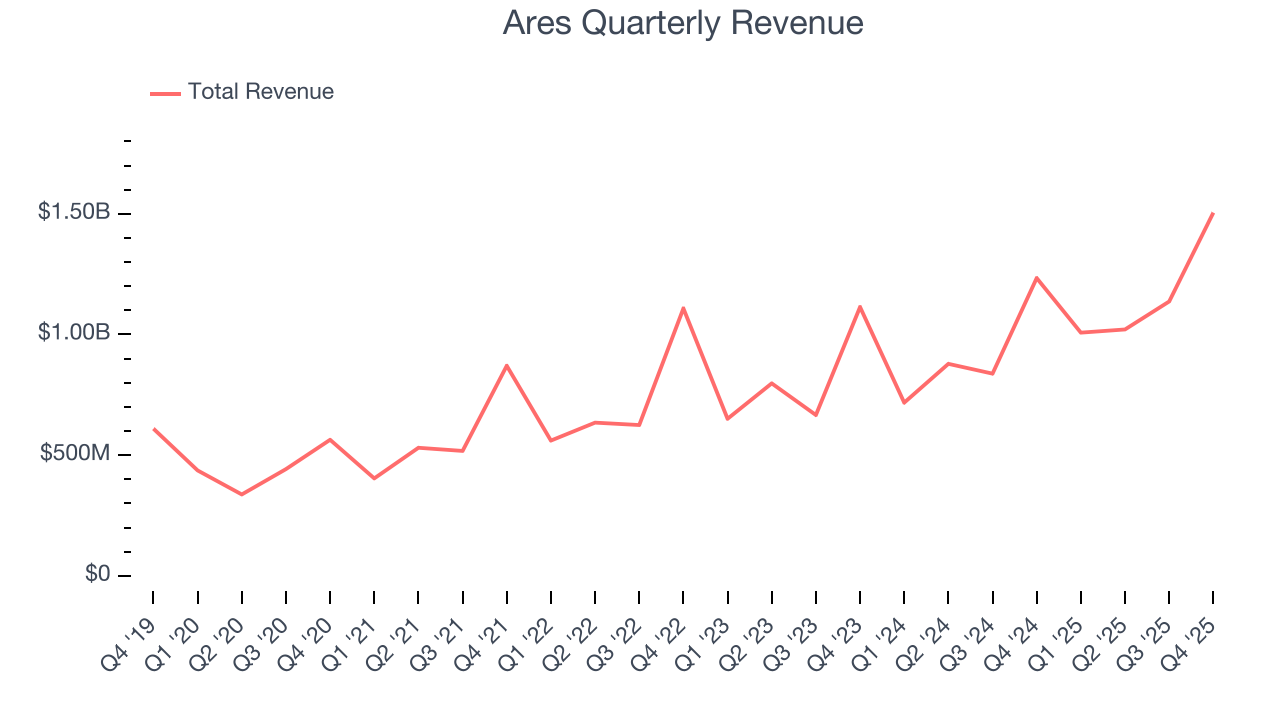
We at StockStory place the most emphasis on long-term growth, but within financials, a half-decade historical view may miss recent interest rate changes, market returns, and industry trends. Ares’s annualized revenue growth of 20.3% over the last two years is below its five-year trend, but we still think the results suggest healthy demand. 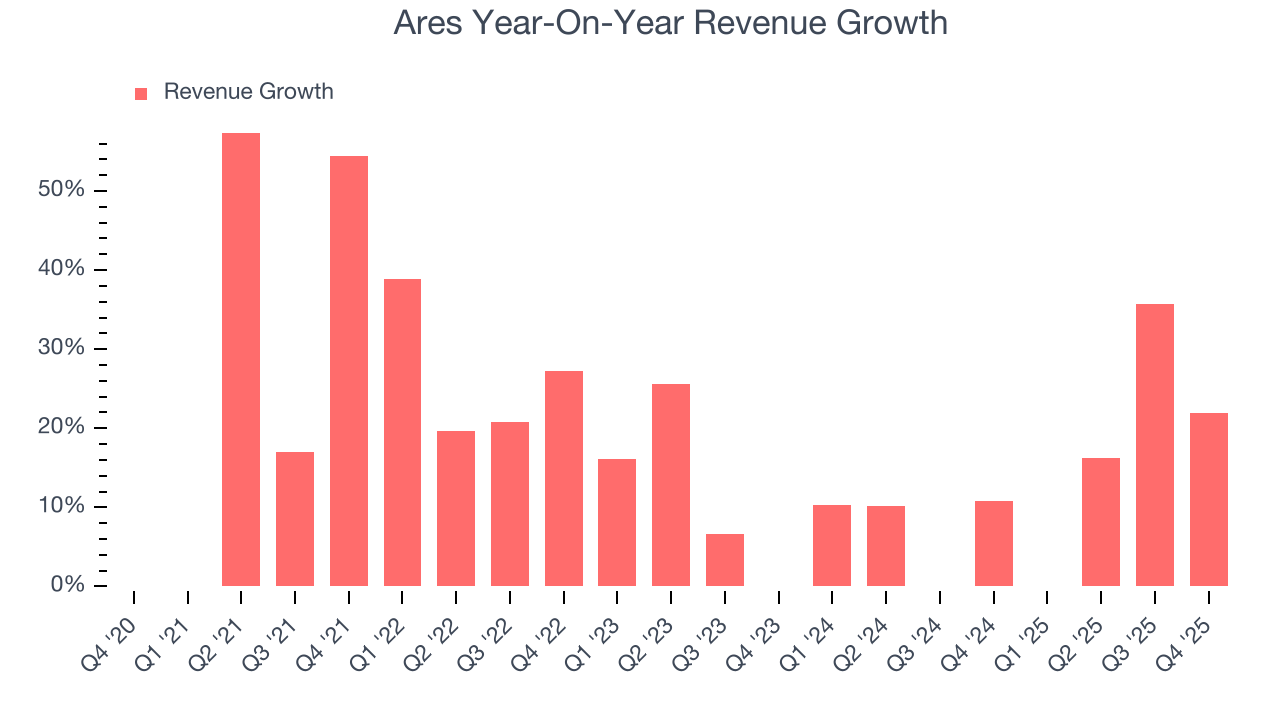 Note: Quarters not shown were determined to be outliers, impacted by outsized investment gains/losses that are not indicative of the recurring fundamentals of the business.
This quarter, Ares generated an excellent 22% year-on-year revenue growth rate, but its $1.5 billion of revenue fell short of Wall Street’s high expectations.
6. Assets Under Management (AUM)
Assets Under Management (AUM) encompasses all client funds under a firm's investment management umbrella. The recurring fee structure on these assets provides consistent revenue generation, offering financial stability even during periods of poor investment returns, though sustained underperformance can impact future asset flows.
Ares’s AUM has grown at an annual rate of 27.9% over the last five years, much better than the broader financials industry and faster than its total revenue. When analyzing Ares’s AUM over the last two years, we can see that growth decelerated to 22.7% annually. Fundraising or short-term investment performance were net contributors for the company over this shorter period since assets grew faster than total revenue. But again, we put less weight on asset growth given how lumpy and cyclical it can be.
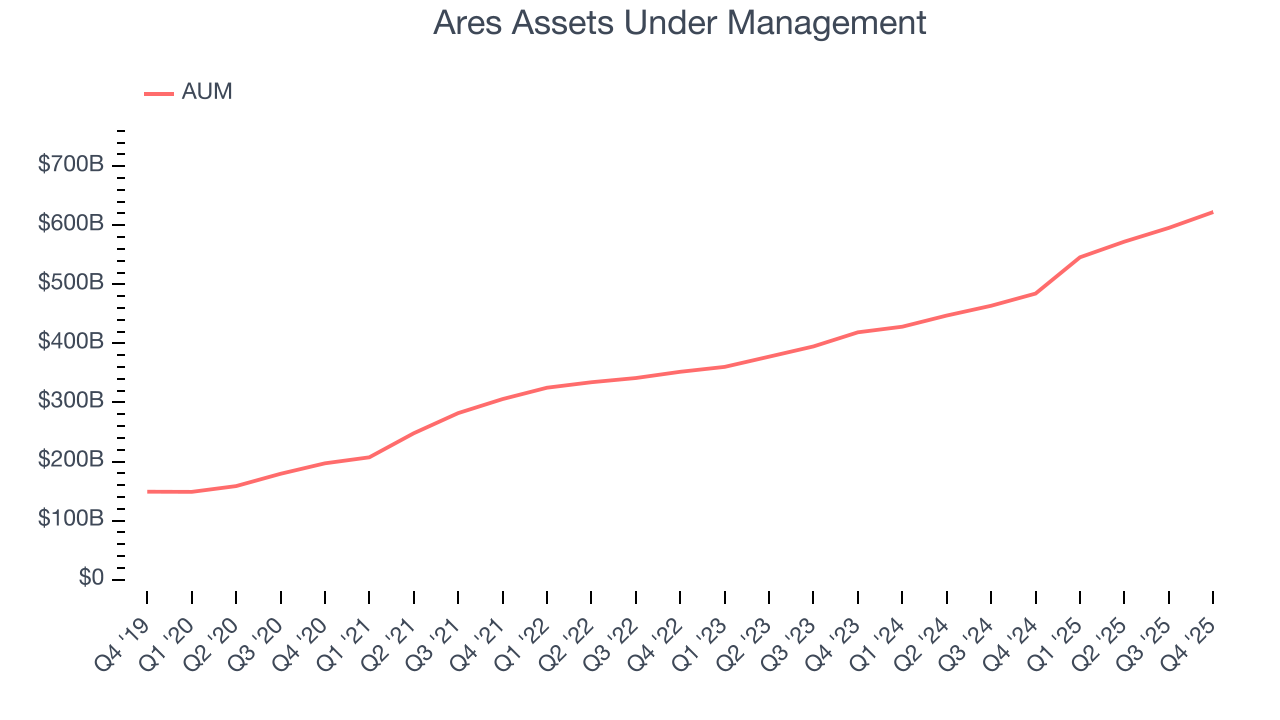
In Q4, Ares’s AUM was $622.5 billion, beating analysts’ expectations by 0.7%. This print was 28.5% higher than the same quarter last year.
7. Management Fees
Management fees represent the core revenue stream for investment firms, calculated as a percentage of assets under management. These fees provide steady income regardless of investment performance.
Over the past five years, Ares’s management fees grew by a terrific 25.4% per year but lagged its 27.9% annual growth in AUM, suggesting the firm reduced its average fees across its family of funds. A two-year view reveals that growth decelerated to 19.7% annualized, but this was still an acceptable result.
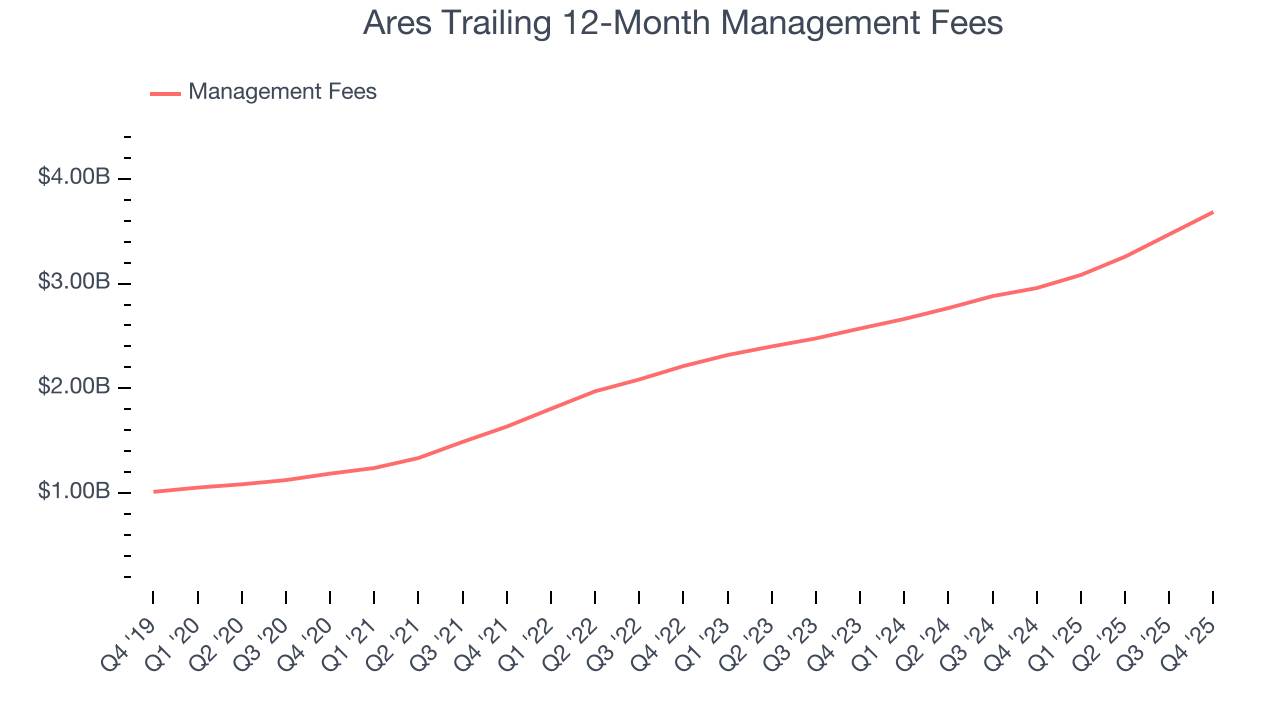
Ares’s management fees punched in at $993.7 million in Q4, in line with Consensus estimates. Wall Street opinions aside, management fees grew by 27.3% year on year.
8. Fee-Related Earnings
Assessing topline trends is important, but the profitability of this growth matters for the bottom line. For asset managers, we look at fee-related earnings, which is profits generated from the core fee-based business, excluding more volatile components like performance fees (carry) and investment income. This is essentially the recurring profits of the business.
Ares’s five-year annual fee-related earnings growth of 32.6% was elite and topped its 25.4% five-year management fee growth. Roughly speaking, this means Ares became more efficient in its core operations.
As you’ve seen throughout this report, we supplement with a two-year look because a five-year view may miss recent changes in the business. Over this period, Ares’s fee-related earnings grew by an exceptional 23.5% annually, faster than its growth in management fees. This data implies that the change in AUM-related revenue outpaced the operating expenses associated with managing that AUM.
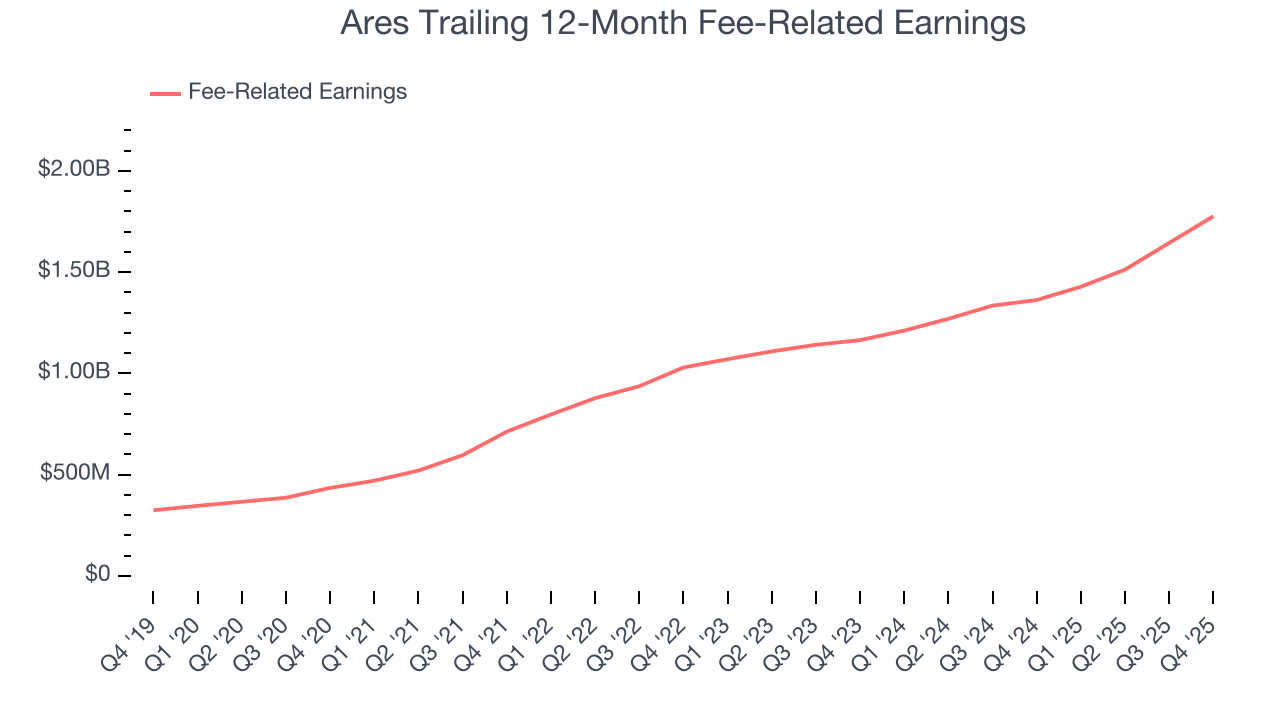
In Q4, Ares’s fee-related earnings were $527.7 million, beating analysts’ expectations by 2.3%. These results represent 33.2% year-on-year growth.
9. Adjusted Net Earnings per Share (ANI per Share)
Asset managers report ANI per share, which stands for adjusted net income per share. Make no mistake, this is essentially just the adjusted EPS that many other companies across various industries report.
This metric filters out the noise of investment mark-to-market changes and one-time charges to show true operational performance. The per-share calculation also captures the effect of capital allocation decisions like buybacks or new share offerings on shareholder value.
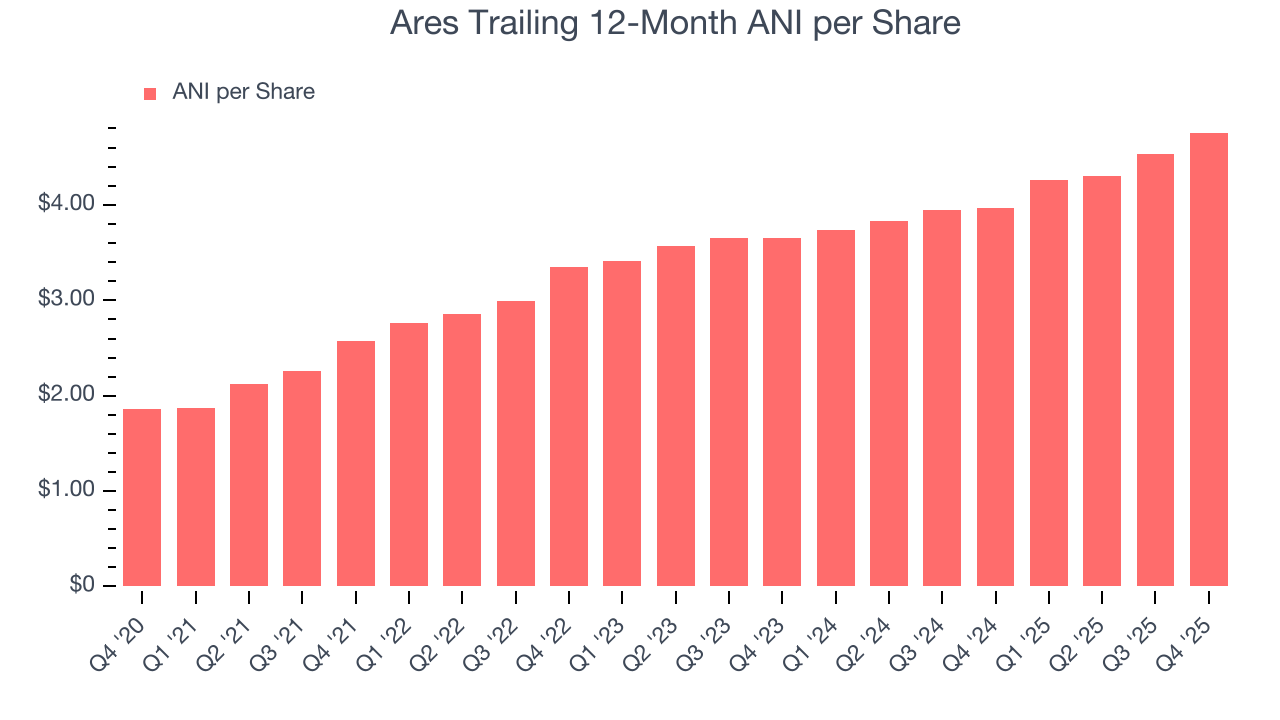
Ares’s 20.7% annualized ANI per share growth over the past five years was spectacular but underperformed its 32.6% fee-related earnings growth. It also diluted shareholders across this stretch, a headwind for its results. 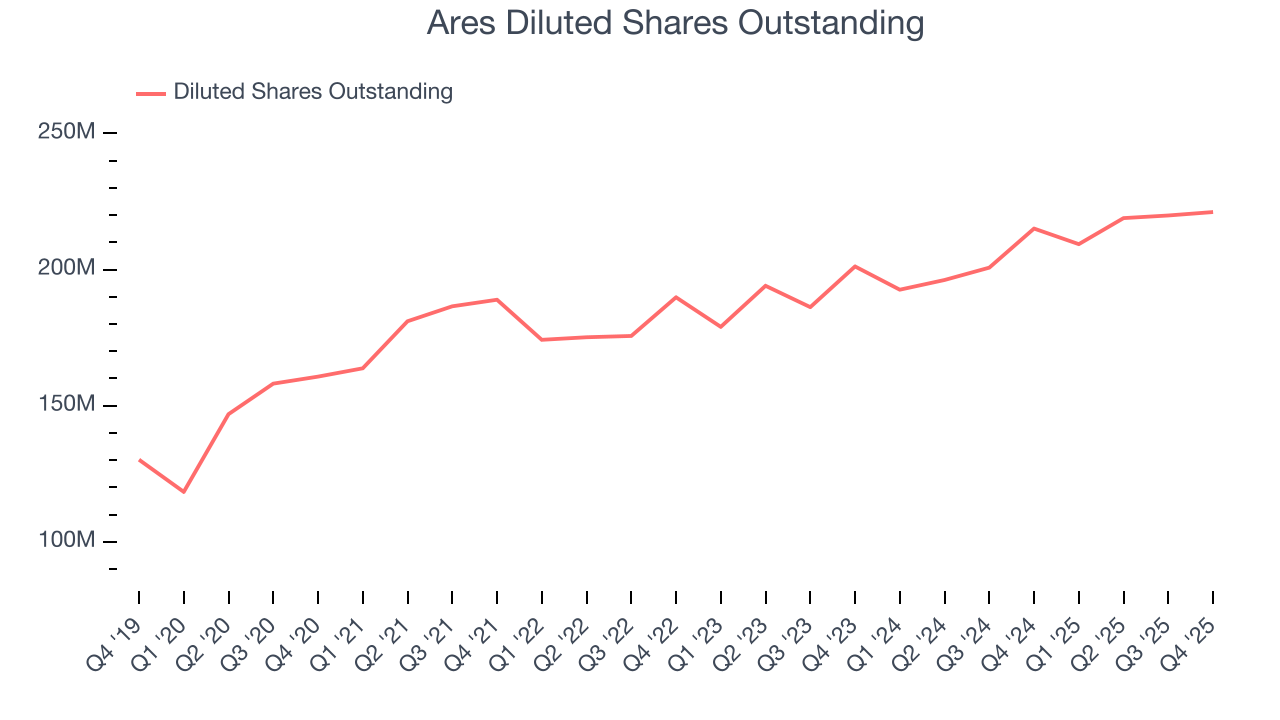
On a two-year basis, Ares’s annualized ANI per share growth decelerated to 14.2%. While this performance was good on an absolute level, it lagged its fee-related earnings growth over the same period. We note the company continued diluting shareholders during this timeframe, suppressing its ANI per share.
In Q4, Ares reported ANI per share of $1.45, up from $1.23 in the same quarter last year. Despite growing year on year, this print missed analysts’ estimates, but we care more about long-term ANI per share growth than short-term movements.
10. A Word on Book Value and ROE
You may wonder when we will analyze book value and return on equity (ROE) since Ares is a financials company. We pay less attention to these metrics for asset managers because they are not great measures of business quality.
Asset managers are fee-based, capital light firms that manage client capital rather than their own, so they are not balance sheet businesses. Additionally, book value fails to capture the value of brands, investment track records, and other intangibles, thus understating intrinsic value, while ROE can look artificially high due to the relatively smaller bases of equity capital needed to operate the business compared to banks and insurers.
11. Balance Sheet Assessment
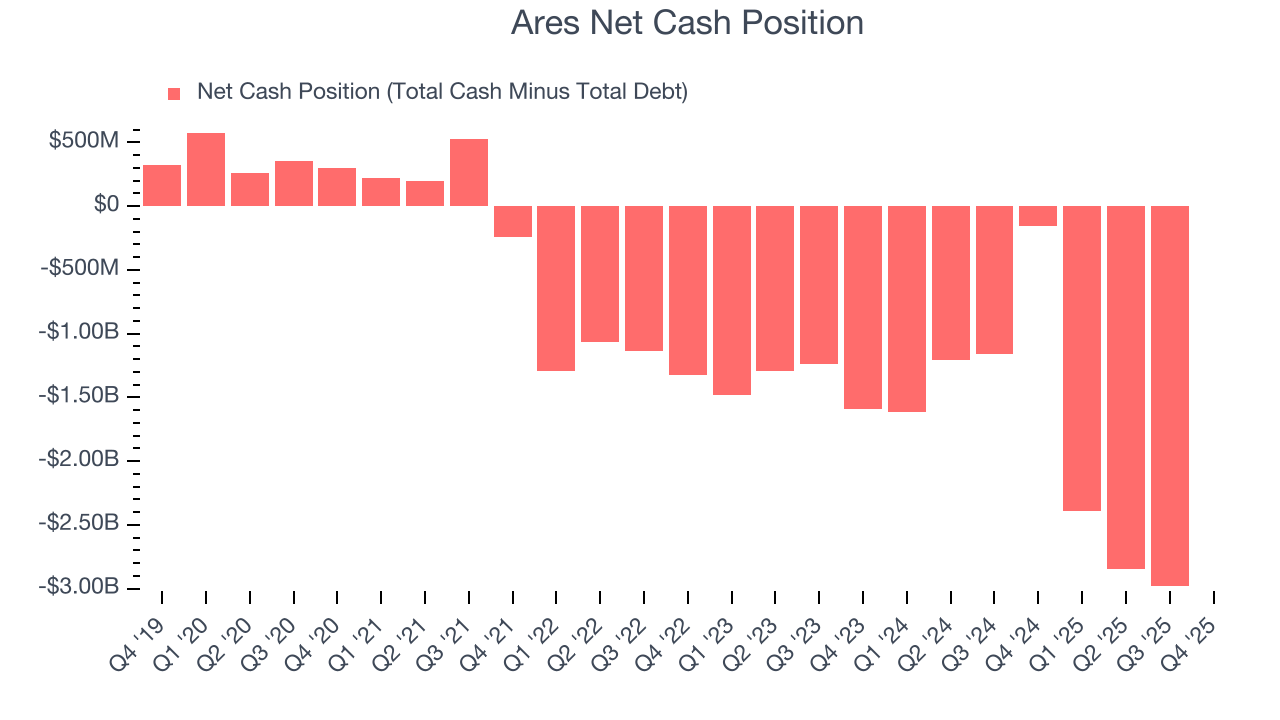
Ares reported $0 of cash and $0 of debt on its balance sheet in the most recent quarter.
Given the company has no debt, leverage is not an issue here.
12. Key Takeaways from Ares’s Q4 Results
It was encouraging to see Ares beat analysts’ fee-related earnings expectations this quarter. We were also happy its AUM narrowly outperformed Wall Street’s estimates. On the other hand, its revenue missed and its EPS fell short of Wall Street’s estimates. Overall, this was a softer quarter. The stock traded down 2.9% to $133.25 immediately following the results.
13. Is Now The Time To Buy Ares?
Updated: February 8, 2026 at 11:30 PM EST
The latest quarterly earnings matters, sure, but we actually think longer-term fundamentals and valuation matter more. Investors should consider all these pieces before deciding whether or not to invest in Ares.
There is a lot to like about Ares. For starters, its revenue growth was impressive over the last five years and is expected to accelerate over the next 12 months. On top of that, its expanding fee-related earnings shows the asset management business is generating more profits, and its AUM growth was exceptional over the last five years.
Ares’s P/E ratio based on the next 12 months is 18.7x. Scanning the financials landscape today, Ares’s fundamentals clearly illustrate that it’s an elite business, and we like it at this price.
Wall Street analysts have a consensus one-year price target of $185.31 on the company (compared to the current share price of $130.92), implying they see 41.5% upside in buying Ares in the short term.