
CAVA (CAVA)
We’re skeptical of CAVA. Its negative returns on capital raise questions about its ability to allocate resources and generate profits.― StockStory Analyst Team


1. News





2. Summary
Why CAVA Is Not Exciting
Starting from a single Washington, D.C. location, CAVA (NYSE:CAVA) operates a fast-casual restaurant chain offering customizable Mediterranean-inspired dishes.
- Negative returns on capital show management lost money while trying to expand the business
- Earnings per share have dipped by 15.6% annually over the past two years, which is concerning because stock prices follow EPS over the long term
- A bright spot is that its annual revenue growth of 24% over the past four years was outstanding, reflecting market share gains
CAVA doesn’t meet our quality criteria. There are more appealing investments to be made.
Why There Are Better Opportunities Than CAVA


CAVA is trading at $66.25 per share, or 119x forward P/E. We consider this valuation aggressive considering the business fundamentals.
There are stocks out there featuring similar valuation multiples with better fundamentals. We prefer to invest in those.
3. CAVA (CAVA) Research Report: Q3 CY2025 Update
Mediterranean fast-casual restaurant chain CAVA (NYSE:CAVA) met Wall Streets revenue expectations in Q3 CY2025, with sales up 19.9% year on year to $292.2 million. Its non-GAAP profit of $0.12 per share was in line with analysts’ consensus estimates.
CAVA (CAVA) Q3 CY2025 Highlights:
- Revenue: $292.2 million vs analyst estimates of $292 million (19.9% year-on-year growth, in line)
- Adjusted EPS: $0.12 vs analyst estimates of $0.13 (in line)
- Adjusted EBITDA: $40.04 million vs analyst estimates of $40.54 million (13.7% margin, 1.2% miss)
- Lowered full-year guidance same-store sales growth
- EBITDA guidance for the full year is $150 million at the midpoint, below analyst estimates of $156.1 million
- Operating Margin: 5.9%, in line with the same quarter last year
- Locations: 415 at quarter end, up from 363 in the same quarter last year
- Same-Store Sales rose 1.9% year on year (18.1% in the same quarter last year)
- Market Capitalization: $6.1 billion
Company Overview
Starting from a single Washington, D.C. location, CAVA (NYSE:CAVA) operates a fast-casual restaurant chain offering customizable Mediterranean-inspired dishes.
The company was founded by a group of friends with a desire to bring modern Mediterranean flavors to a broader audience. Starting as a local restaurant, CAVA built its reputation on a build-your-own concept that lets customers choose from a variety of fresh proteins, toppings, and sauces.
CAVA’s restaurants typically feature an open, assembly line-style setup, inviting guests to watch their meals come to life as they move down the line. To reach even more consumers, the brand has expanded beyond its own stores, offering dips and spreads through grocery channels, and further strengthening its presence through the acquisition of Zoës Kitchen. This acquisition helped CAVA break into new markets and scale its operations by converting former Zoës Kitchen sites into new CAVA locations.
In today’s digital age, CAVA provides online ordering and delivery options through its website and mobile app, streamlining the process with real-time tracking and exclusive promotions.
4. Modern Fast Food
Modern fast food is a relatively newer category representing a middle ground between traditional fast food and sit-down restaurants. These establishments feature an expanded menu selection priced above traditional fast food options, often incorporating fresher and cleaner ingredients to serve customers prioritizing quality. These eateries are capitalizing on the perception that your drive-through burger and fries joint is detrimental to your health because of inferior ingredients.
Competitors offering similar menus and service models include Chipotle (NYSE:CMG), Sweetgreen (NYSE:SG), and Noodles & Company (NASDAQ:NDLS).
5. Revenue Growth
Examining a company’s long-term performance can provide clues about its quality. Any business can put up a good quarter or two, but many enduring ones grow for years.
With $1.13 billion in revenue over the past 12 months, CAVA is a mid-sized restaurant chain, which sometimes brings disadvantages compared to larger competitors benefiting from better brand awareness and economies of scale. On the bright side, it can still flex high growth rates because it’s working from a smaller revenue base.
As you can see below, CAVA’s sales grew at an incredible 24% compounded annual growth rate over the last four years (we compare to 2019 to normalize for COVID-19 impacts) as it opened new restaurants and increased sales at existing, established dining locations.
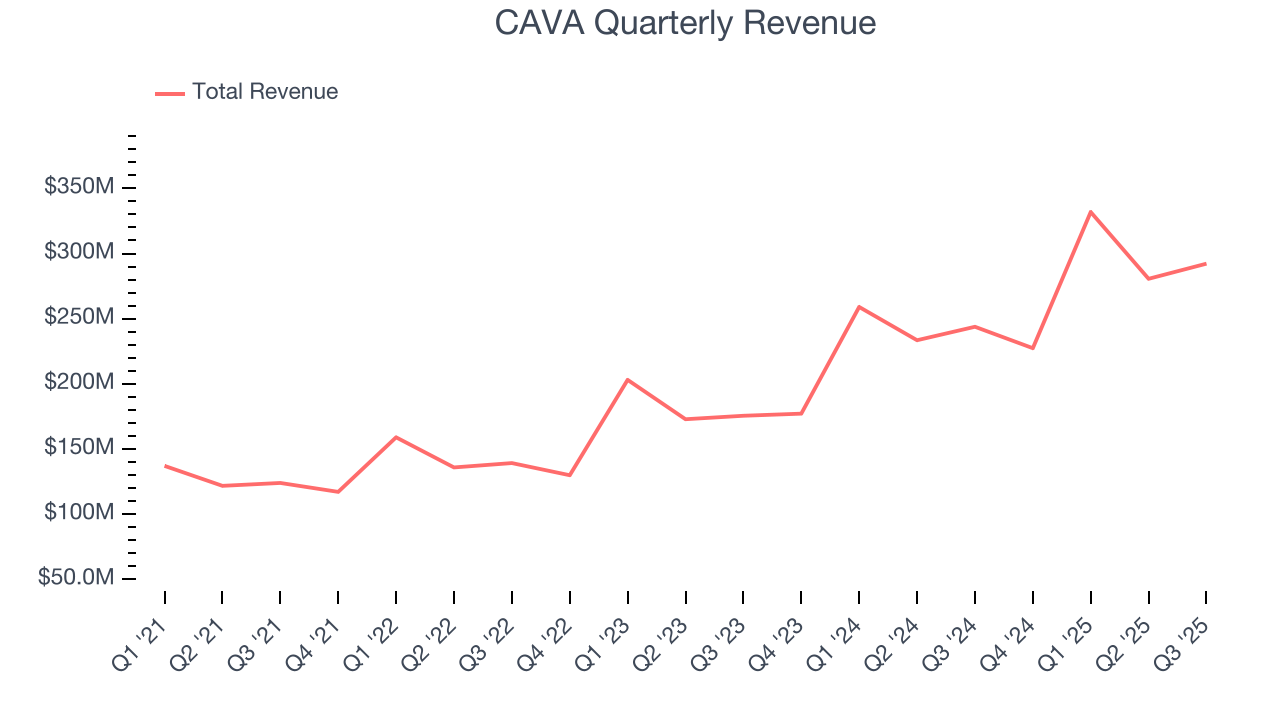
This quarter, CAVA’s year-on-year revenue growth was 19.9%, and its $292.2 million of revenue was in line with Wall Street’s estimates.
Looking ahead, sell-side analysts expect revenue to grow 21.7% over the next 12 months, a slight deceleration versus the last four years. Despite the slowdown, this projection is noteworthy and implies the market is baking in success for its menu offerings.
6. Restaurant Performance
Number of Restaurants
A restaurant chain’s total number of dining locations influences how much it can sell and how quickly revenue can grow.
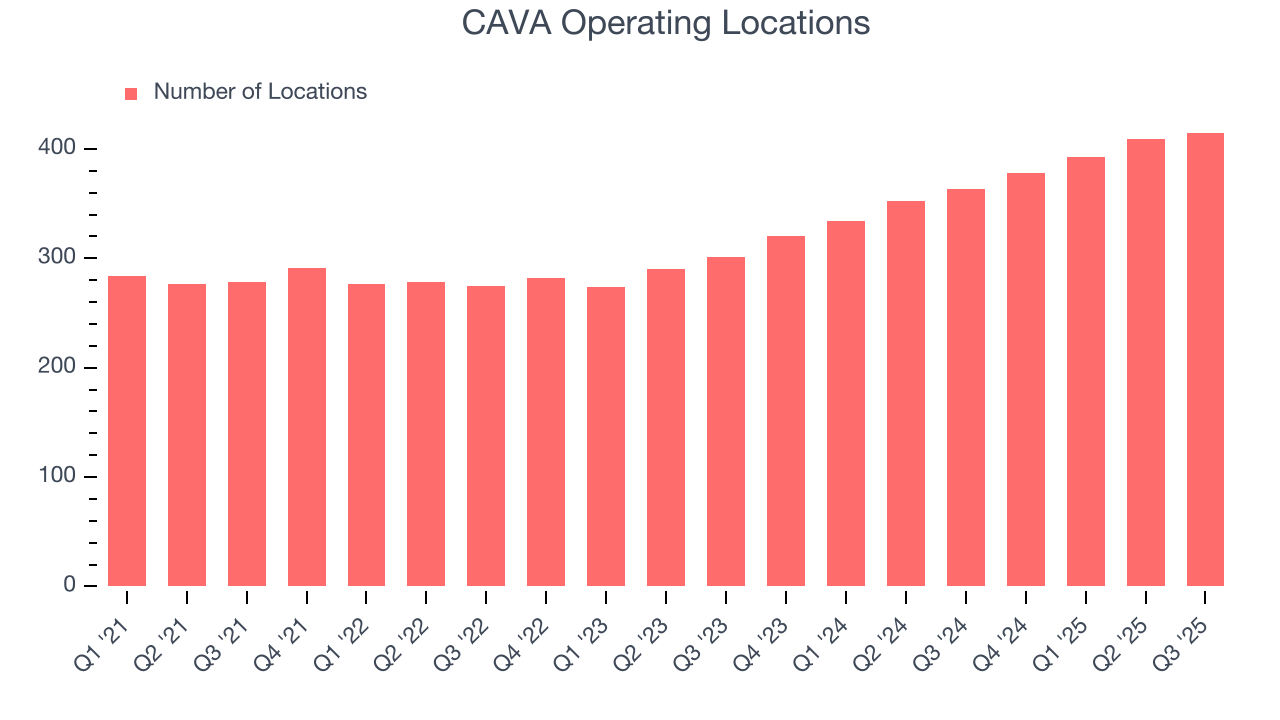
CAVA operated 415 locations in the latest quarter. It has opened new restaurants at a rapid clip over the last two years, averaging 18% annual growth, much faster than the broader restaurant sector. This gives it a chance to become a large, scaled business over time.
When a chain opens new restaurants, it usually means it’s investing for growth because there’s healthy demand for its meals and there are markets where its concepts have few or no locations.
Same-Store Sales
The change in a company's restaurant base only tells one side of the story. The other is the performance of its existing locations, which informs management teams whether they should expand or downsize their physical footprints. Same-store sales gives us insight into this topic because it measures organic growth at restaurants open for at least a year.
CAVA has been one of the most successful restaurant chains over the last two years thanks to skyrocketing demand within its existing dining locations. On average, the company has posted exceptional year-on-year same-store sales growth of 10.3%. This performance along with its meaningful buildout of new restaurants suggest it’s playing some aggressive offense.
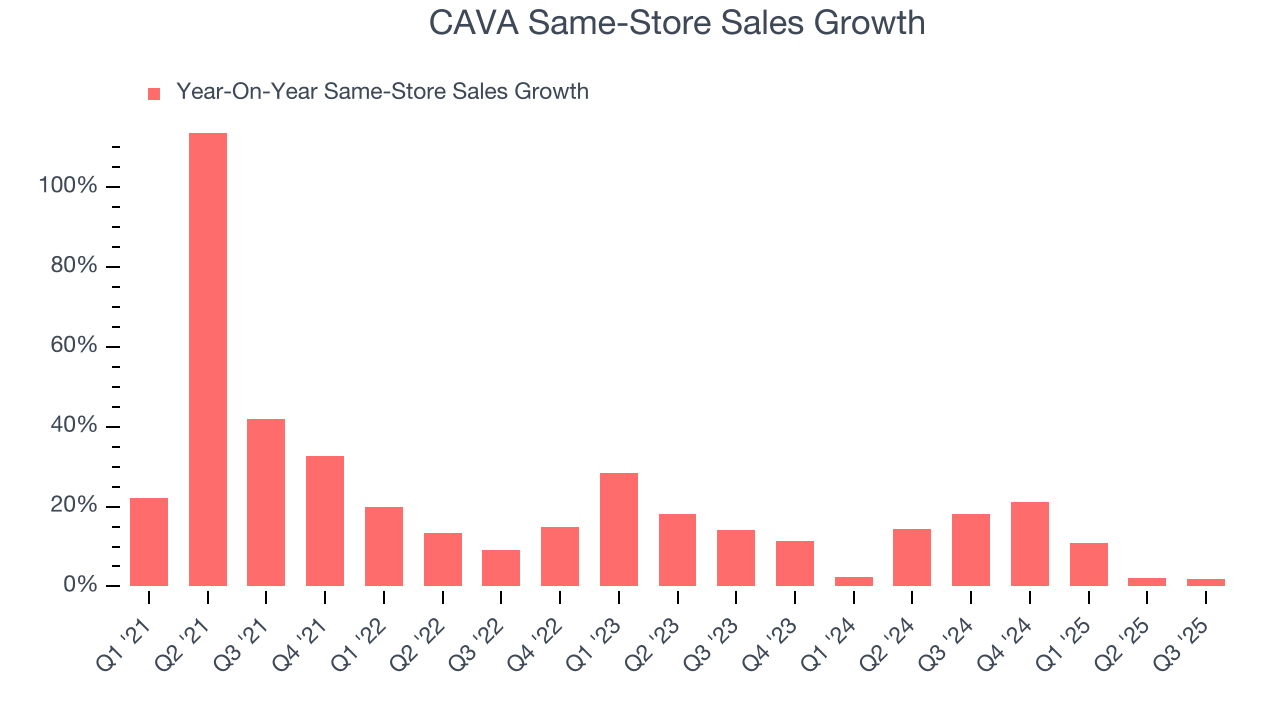
In the latest quarter, CAVA’s same-store sales rose 1.9% year on year. This was a meaningful deceleration from its historical levels. We’ll be watching closely to see if CAVA can reaccelerate growth.
7. Gross Margin & Pricing Power
We prefer higher gross margins because they not only make it easier to generate more operating profits but also indicate pricing power and differentiation, whether it be the dining experience or quality and taste of food.
CAVA has great unit economics for a restaurant company, giving it ample room to invest in areas such as marketing and talent to grow its brand. As you can see below, it averaged an excellent 37.6% gross margin over the last two years. That means CAVA only paid its suppliers $62.40 for every $100 in revenue. 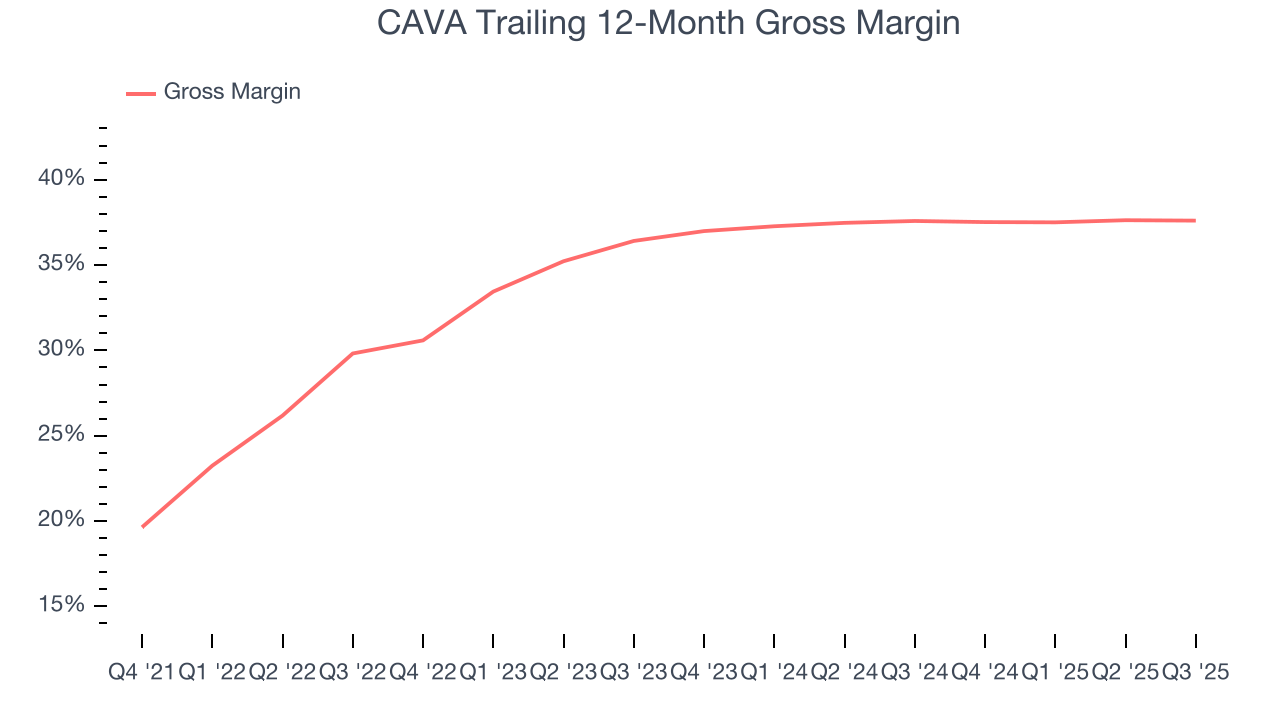
CAVA’s gross profit margin came in at 37.8% this quarter, in line with the same quarter last year. Zooming out, the company’s full-year margin has remained steady over the past 12 months, suggesting its input costs (such as ingredients and transportation expenses) have been stable and it isn’t under pressure to lower prices.
8. Operating Margin
CAVA’s operating margin might fluctuated slightly over the last 12 months but has generally stayed the same, averaging 4.6% over the last two years. This profitability was lousy for a restaurant business and caused by its suboptimal cost structure.
Analyzing the trend in its profitability, CAVA’s operating margin might fluctuated slightly but has generally stayed the same over the last year. This raises questions about the company’s expense base because its revenue growth should have given it leverage on its fixed costs, resulting in better economies of scale and profitability.
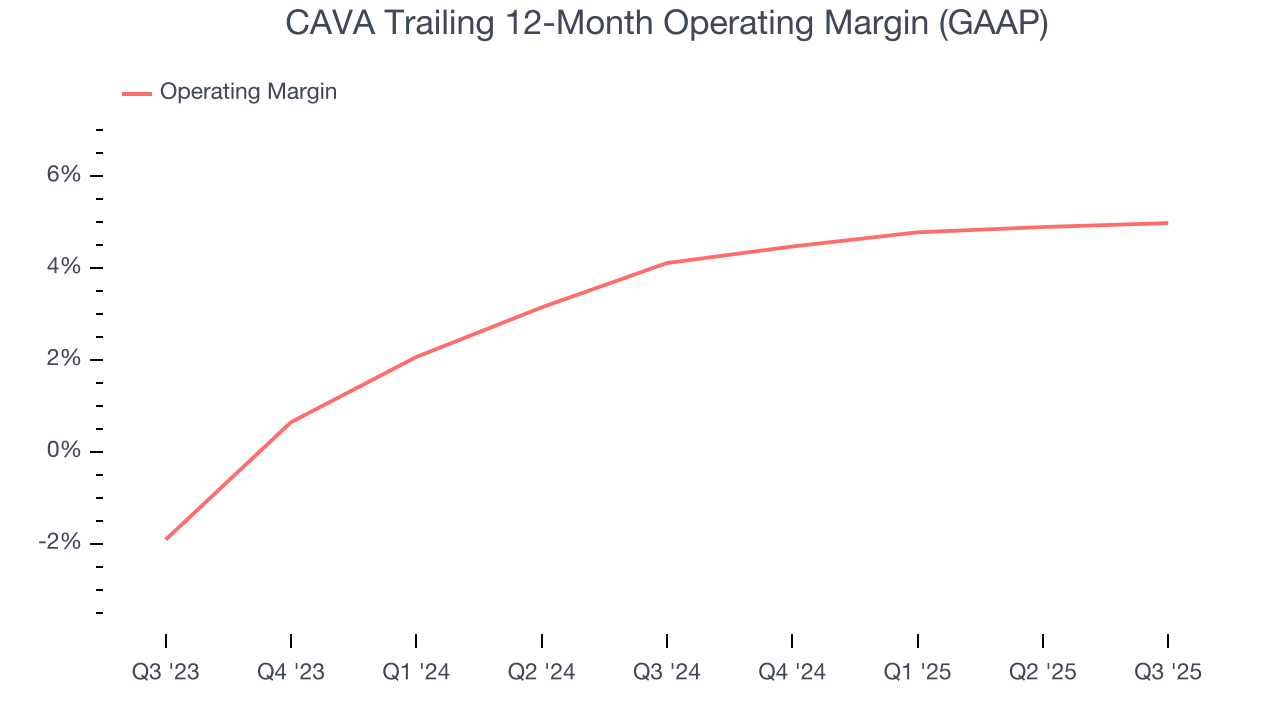
This quarter, CAVA generated an operating margin profit margin of 5.9%, in line with the same quarter last year. This indicates the company’s cost structure has recently been stable.
9. Earnings Per Share
We track the change in earnings per share (EPS) for the same reason as long-term revenue growth. Compared to revenue, however, EPS highlights whether a company’s growth is profitable.
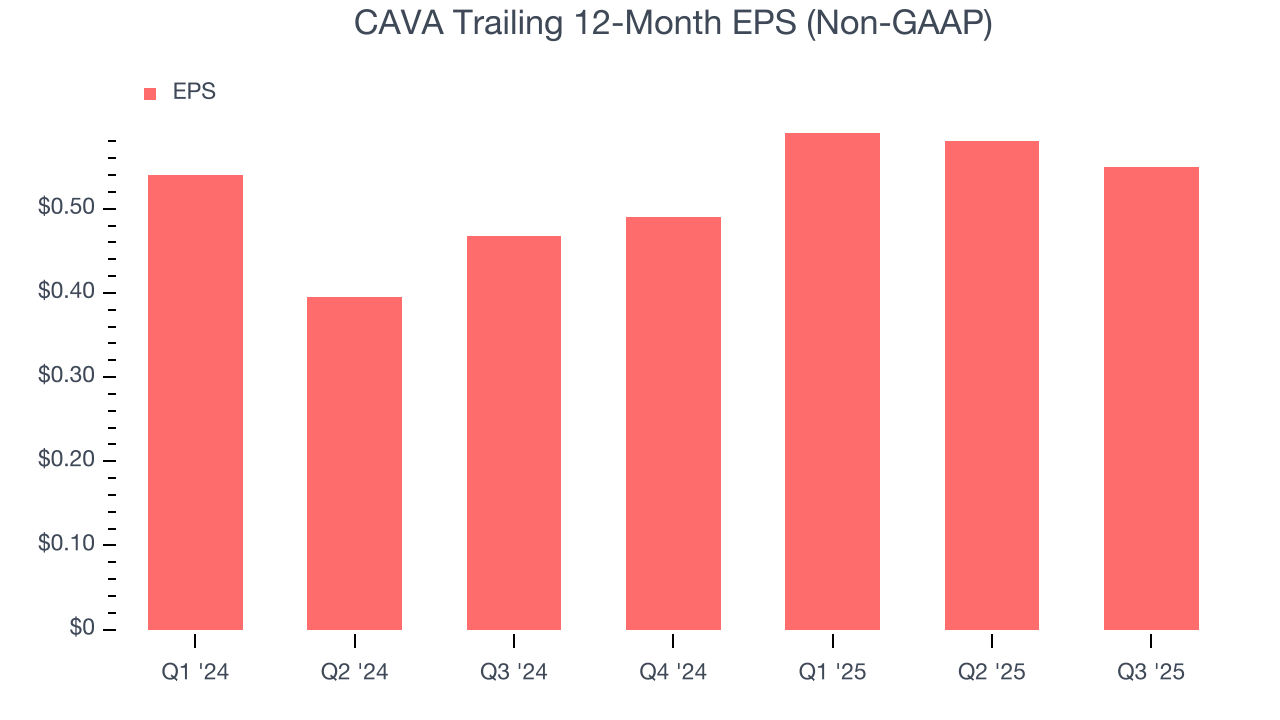
In Q3, CAVA reported adjusted EPS of $0.12, down from $0.15 in the same quarter last year. This print missed analysts’ estimates. Over the next 12 months, Wall Street expects CAVA’s full-year EPS of $0.55 to grow 17.8%.
10. Cash Is King
If you’ve followed StockStory for a while, you know we emphasize free cash flow. Why, you ask? We believe that in the end, cash is king, and you can’t use accounting profits to pay the bills.
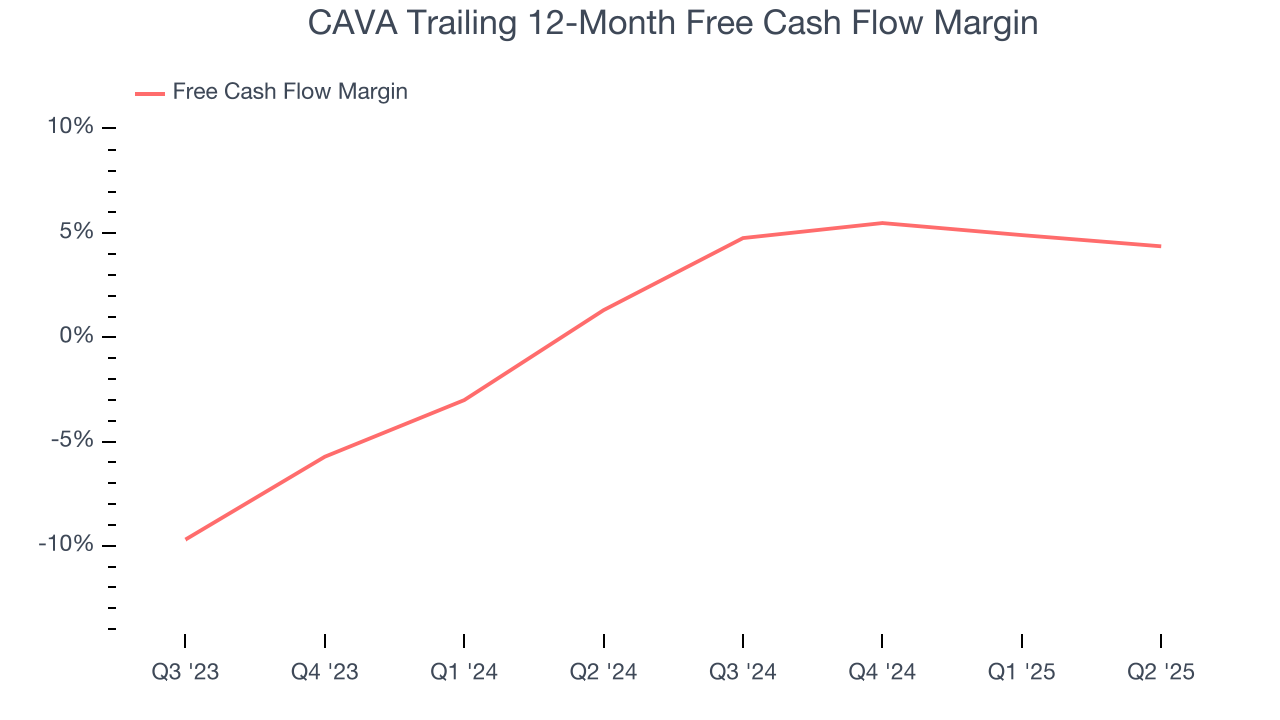
CAVA has shown decent cash profitability, giving it some flexibility to reinvest or return capital to investors. The company’s free cash flow margin averaged 3.9% over the last two years, slightly better than the broader restaurant sector.
11. Return on Invested Capital (ROIC)
EPS and free cash flow tell us whether a company was profitable while growing its revenue. But was it capital-efficient? A company’s ROIC explains this by showing how much operating profit it makes compared to the money it has raised (debt and equity).
Although CAVA has shown solid business quality lately, it struggled to grow profitably in the past. Its five-year average ROIC was negative 5.3%, meaning management lost money while trying to expand the business.
12. Balance Sheet Assessment
CAVA reported $284.6 million of cash and $433.8 million of debt on its balance sheet in the most recent quarter. As investors in high-quality companies, we primarily focus on two things: 1) that a company’s debt level isn’t too high and 2) that its interest payments are not excessively burdening the business.
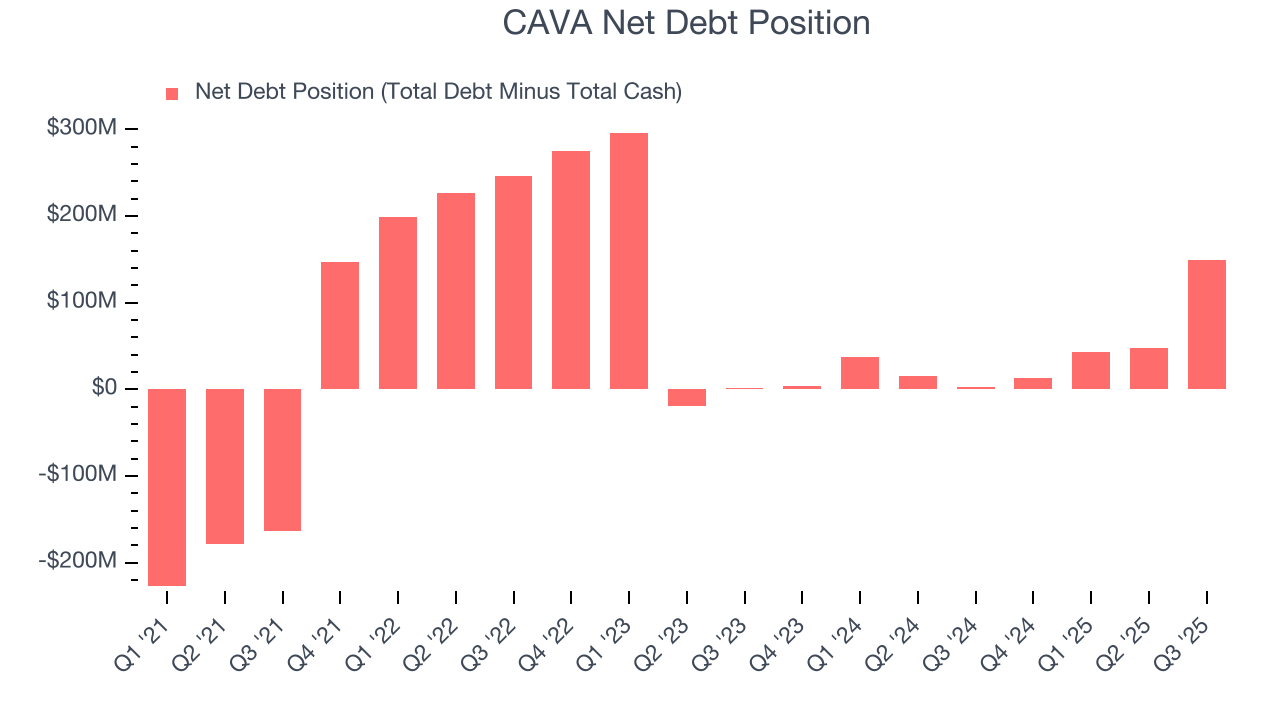
With $152.1 million of EBITDA over the last 12 months, we view CAVA’s 1.0× net-debt-to-EBITDA ratio as safe. We also see its $15.42 million of annual interest expenses as appropriate. The company’s profits give it plenty of breathing room, allowing it to continue investing in growth initiatives.
13. Key Takeaways from CAVA’s Q3 Results
We struggled to find many positives in these results. CAVA's same-store sales fell slightly short of Wall Street’s estimates. Its full-year same-store sales growth was lowered, reflecting dampened topline expectations. The company's full-year EBITDA guidance also missed. Overall, this was a softer quarter. The stock traded down 4.2% to $49.50 immediately following the results.
14. Is Now The Time To Buy CAVA?
Updated: January 24, 2026 at 9:44 PM EST
Are you wondering whether to buy CAVA or pass? We urge investors to not only consider the latest earnings results but also longer-term business quality and valuation as well.
CAVA isn’t a terrible business, but it doesn’t pass our quality test. Although its revenue growth was exceptional over the last four years, it’s expected to deteriorate over the next 12 months and its declining EPS over the last two years makes it a less attractive asset to the public markets. And while the company’s marvelous same-store sales growth is on another level, the downside is its relatively low ROIC suggests management has struggled to find compelling investment opportunities.
CAVA’s P/E ratio based on the next 12 months is 119x. This valuation tells us it’s a bit of a market darling with a lot of good news priced in - we think there are better stocks to buy right now.
Wall Street analysts have a consensus one-year price target of $71.85 on the company (compared to the current share price of $66.25).