
Frost Bank (CFR)
Frost Bank doesn’t excite us. Its sluggish sales growth shows demand is soft, a worrisome sign for investors in high-quality stocks.― StockStory Analyst Team


1. News






2. Summary
Why We Think Frost Bank Will Underperform
Tracing its roots back to 1868 when it was founded during Texas's post-Civil War reconstruction era, Cullen/Frost Bankers (NYSE:CFR) operates Frost Bank, a Texas-based financial institution providing commercial and consumer banking, wealth management, and insurance services.
- Projected tangible book value per share decline of 4.1% for the next 12 months points to tough credit quality challenges ahead
- Sales trends were unexciting over the last five years as its 8.5% annual growth was below the typical banking company
- A silver lining is that its stellar return on equity showcases management’s ability to surface highly profitable business ventures
Frost Bank’s quality is insufficient. There are superior opportunities elsewhere.
Why There Are Better Opportunities Than Frost Bank








Frost Bank’s stock price of $126.95 implies a valuation ratio of 1.8x forward P/B. Not only does Frost Bank trade at a premium to companies in the banking space, but this multiple is also high for its top-line growth.
There are stocks out there featuring similar valuation multiples with better fundamentals. We prefer to invest in those.
3. Frost Bank (CFR) Research Report: Q3 CY2025 Update
Texas-based financial institution Cullen/Frost Bankers (NYSE:CFR) reported Q3 CY2025 results beating Wall Street’s revenue expectations, with sales up 13.8% year on year to $589.3 million. Its GAAP profit of $2.67 per share was 11.7% above analysts’ consensus estimates.
Frost Bank (CFR) Q3 CY2025 Highlights:
- Net Interest Income: $463.7 million vs analyst estimates of $452.1 million (14.7% year-on-year growth, 2.6% beat)
- Net Interest Margin: 3.7% vs analyst estimates of 3.7% (2.6 basis point miss)
- Revenue: $589.3 million vs analyst estimates of $553.4 million (13.8% year-on-year growth, 6.5% beat)
- EPS (GAAP): $2.67 vs analyst estimates of $2.39 (11.7% beat)
- Tangible Book Value per Share: $67.64 vs analyst estimates of $55.77 (8.4% year-on-year growth, 21.3% beat)
- Market Capitalization: $7.81 billion
Company Overview
Tracing its roots back to 1868 when it was founded during Texas's post-Civil War reconstruction era, Cullen/Frost Bankers (NYSE:CFR) operates Frost Bank, a Texas-based financial institution providing commercial and consumer banking, wealth management, and insurance services.
Cullen/Frost operates through a community-based model with regional management teams and advisory boards comprised of local business leaders who help tailor services to specific market needs. This local approach is complemented by centralized support in key areas, allowing the bank to offer sophisticated financial products typically associated with larger institutions.
The company's operations are divided into two main segments: Banking and Frost Wealth Advisors. The Banking segment encompasses both commercial and consumer services. For businesses, Cullen/Frost provides financing for industrial and commercial properties, equipment, inventories, and acquisitions, along with treasury management services. A business client might use Cullen/Frost for a multi-million dollar loan to expand operations while also utilizing the bank's cash management tools to optimize daily financial operations.
For individual customers, the bank offers standard retail banking products including checking and savings accounts, mortgages, home equity loans, and personal installment loans. The Frost Wealth Advisors segment delivers trust services, investment management, retirement planning, and securities brokerage services.
Cullen/Frost also maintains specialized divisions including international banking services (primarily for customers dealing with businesses in Mexico), correspondent banking for other financial institutions, and capital markets services for fixed-income institutional investors. The company generates revenue through interest on loans, service fees, and investment income, with its primary market concentrated across major metropolitan areas in Texas including Austin, Dallas, Fort Worth, Houston, and San Antonio.
4. Regional Banks
Regional banks, financial institutions operating within specific geographic areas, serve as intermediaries between local depositors and borrowers. They benefit from rising interest rates that improve net interest margins (the difference between loan yields and deposit costs), digital transformation reducing operational expenses, and local economic growth driving loan demand. However, these banks face headwinds from fintech competition, deposit outflows to higher-yielding alternatives, credit deterioration (increasing loan defaults) during economic slowdowns, and regulatory compliance costs. Recent concerns about regional bank stability following high-profile failures and significant commercial real estate exposure present additional challenges.
Cullen/Frost Bankers competes with other regional banks operating in Texas such as Prosperity Bancshares (NYSE:PB), Texas Capital Bancshares (NASDAQ:TCBI), and Comerica (NYSE:CMA), as well as national banks with significant Texas presence including JPMorgan Chase (NYSE:JPM), Bank of America (NYSE:BAC), and Wells Fargo (NYSE:WFC).
5. Sales Growth
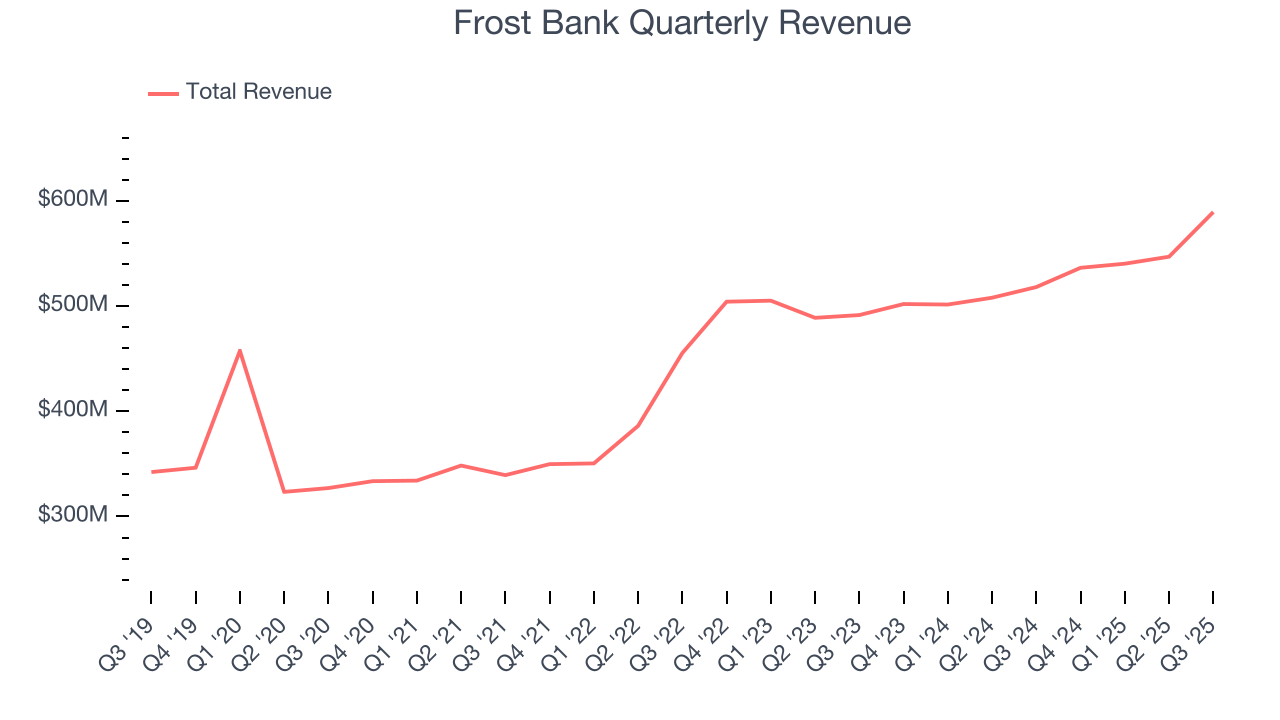
From lending activities to service fees, most banks build their revenue model around two income sources. Interest rate spreads between loans and deposits create the first stream, with the second coming from charges on everything from basic bank accounts to complex investment banking transactions. Thankfully, Frost Bank’s 8.8% annualized revenue growth over the last five years was solid. Its growth beat the average banking company and shows its offerings resonate with customers, a helpful starting point for our analysis.
Long-term growth is the most important, but within financials, a half-decade historical view may miss recent interest rate changes and market returns. Frost Bank’s annualized revenue growth of 5.5% over the last two years is below its five-year trend, but we still think the results were respectable. 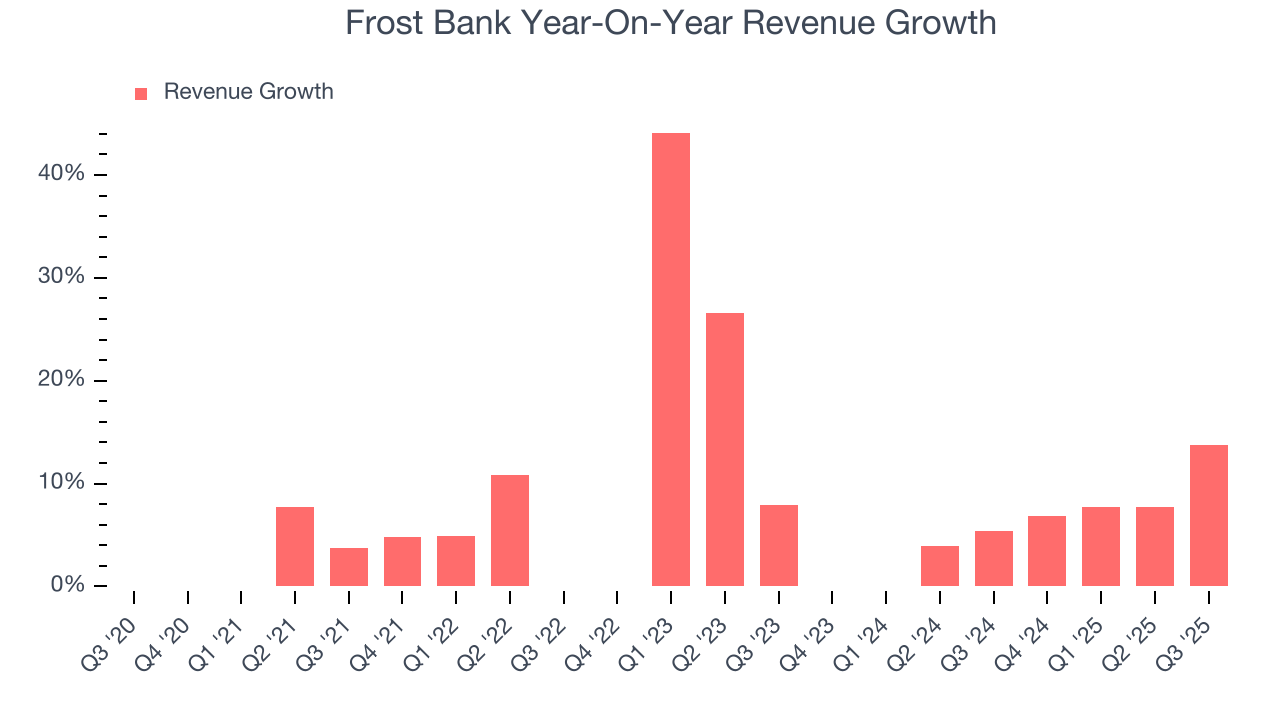 Note: Quarters not shown were determined to be outliers, impacted by outsized investment gains/losses that are not indicative of the recurring fundamentals of the business.
This quarter, Frost Bank reported year-on-year revenue growth of 13.8%, and its $589.3 million of revenue exceeded Wall Street’s estimates by 6.5%.
Net interest income made up 76.3% of the company’s total revenue during the last five years, meaning lending operations are Frost Bank’s largest source of revenue.
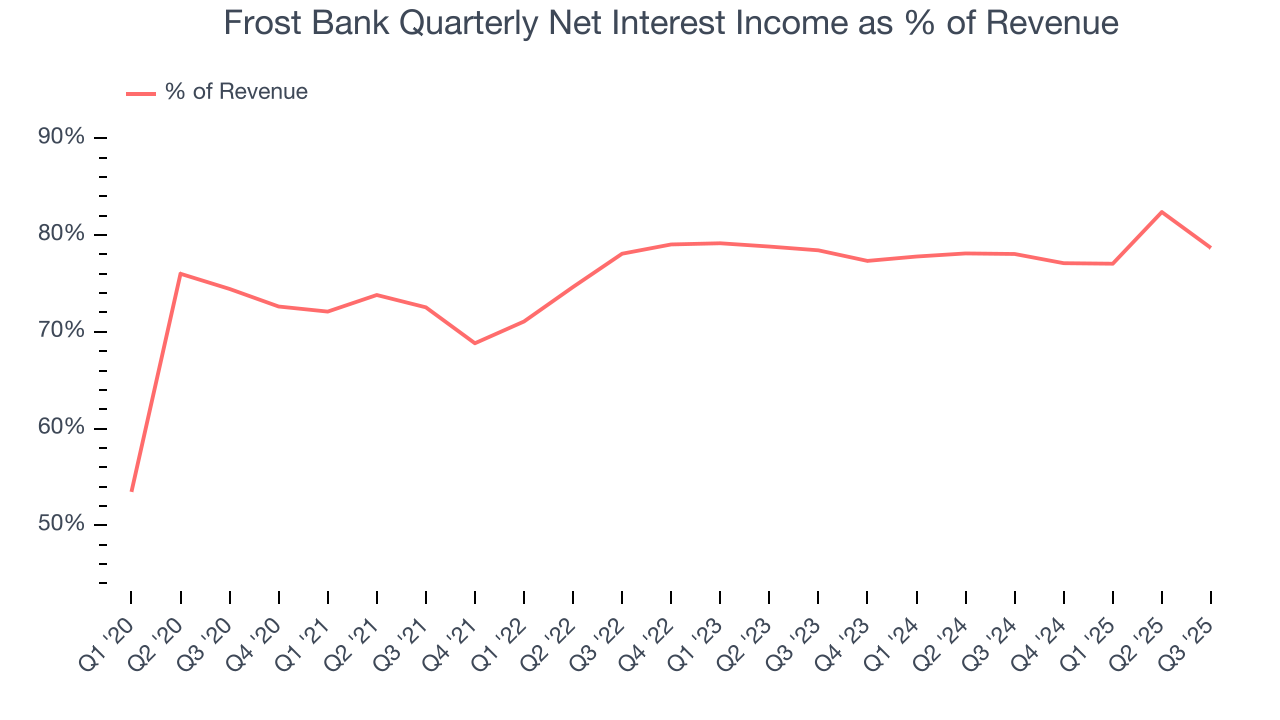
Markets consistently prioritize net interest income growth over fee-based revenue, recognizing its superior quality and recurring nature compared to the more unpredictable non-interest income streams.
6. Earnings Per Share
Revenue trends explain a company’s historical growth, but the long-term change in earnings per share (EPS) points to the profitability of that growth – for example, a company could inflate its sales through excessive spending on advertising and promotions.
Frost Bank’s EPS grew at an astounding 12.8% compounded annual growth rate over the last five years, higher than its 8.8% annualized revenue growth. However, we take this with a grain of salt because its efficiency ratio didn’t improve and it didn’t repurchase its shares, meaning the delta came from factors we consider non-core or less sustainable over the long term.
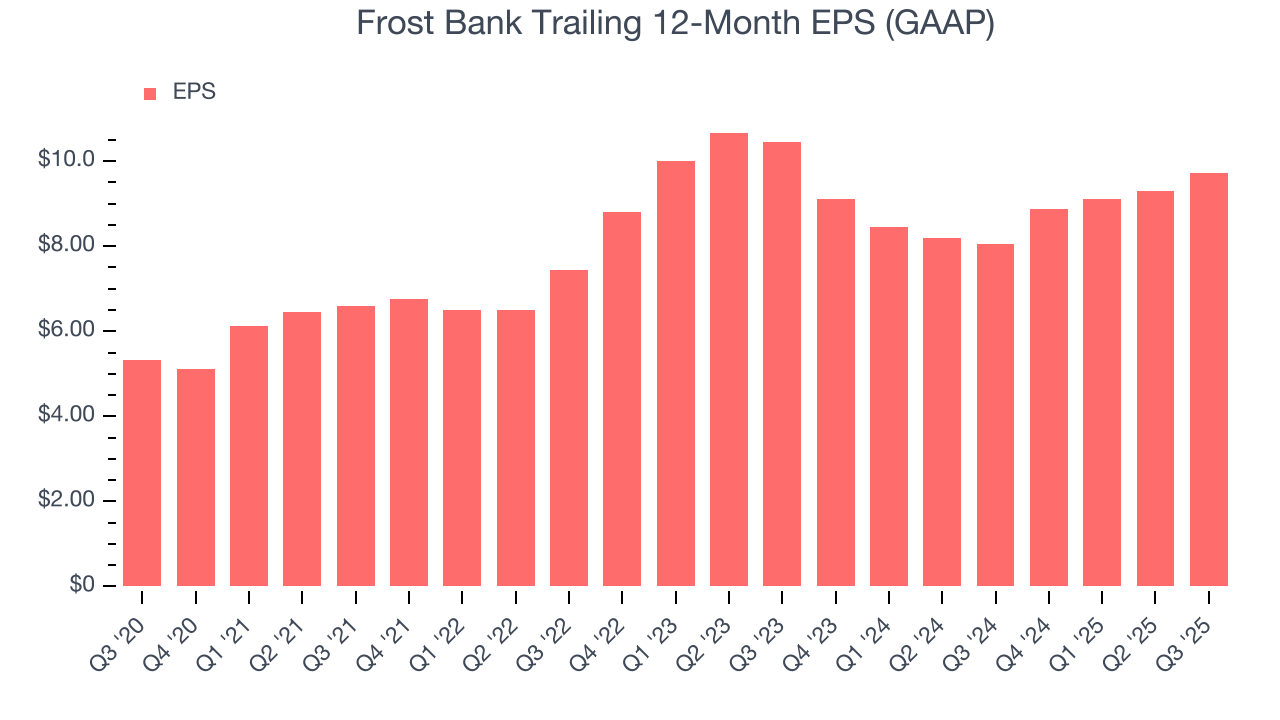
Like with revenue, we analyze EPS over a more recent period because it can provide insight into an emerging theme or development for the business.
For Frost Bank, its two-year annual EPS declines of 3.6% mark a reversal from its (seemingly) healthy five-year trend. These shorter-term results weren’t ideal, but given it was successful in other measures of financial health, we’re hopeful Frost Bank can return to earnings growth in the future.
In Q3, Frost Bank reported EPS of $2.67, up from $2.24 in the same quarter last year. This print easily cleared analysts’ estimates, and shareholders should be content with the results. Over the next 12 months, Wall Street expects Frost Bank’s full-year EPS of $9.72 to shrink by 2%.
7. Tangible Book Value Per Share (TBVPS)
Banks profit by intermediating between depositors and borrowers, making them fundamentally balance sheet-driven enterprises. Market participants emphasize balance sheet quality and sustained book value growth when evaluating these institutions.
When analyzing banks, tangible book value per share (TBVPS) takes precedence over many other metrics. This measure isolates genuine per-share value by removing intangible assets of debatable liquidation worth. EPS can become murky due to acquisition impacts or accounting flexibility around loan provisions, and TBVPS resists financial engineering manipulation.
Frost Bank’s TBVPS grew at a mediocre 4.4% annual clip over the last five years. However, TBVPS growth has accelerated recently, growing by 23.2% annually over the last two years from $44.59 to $67.64 per share.
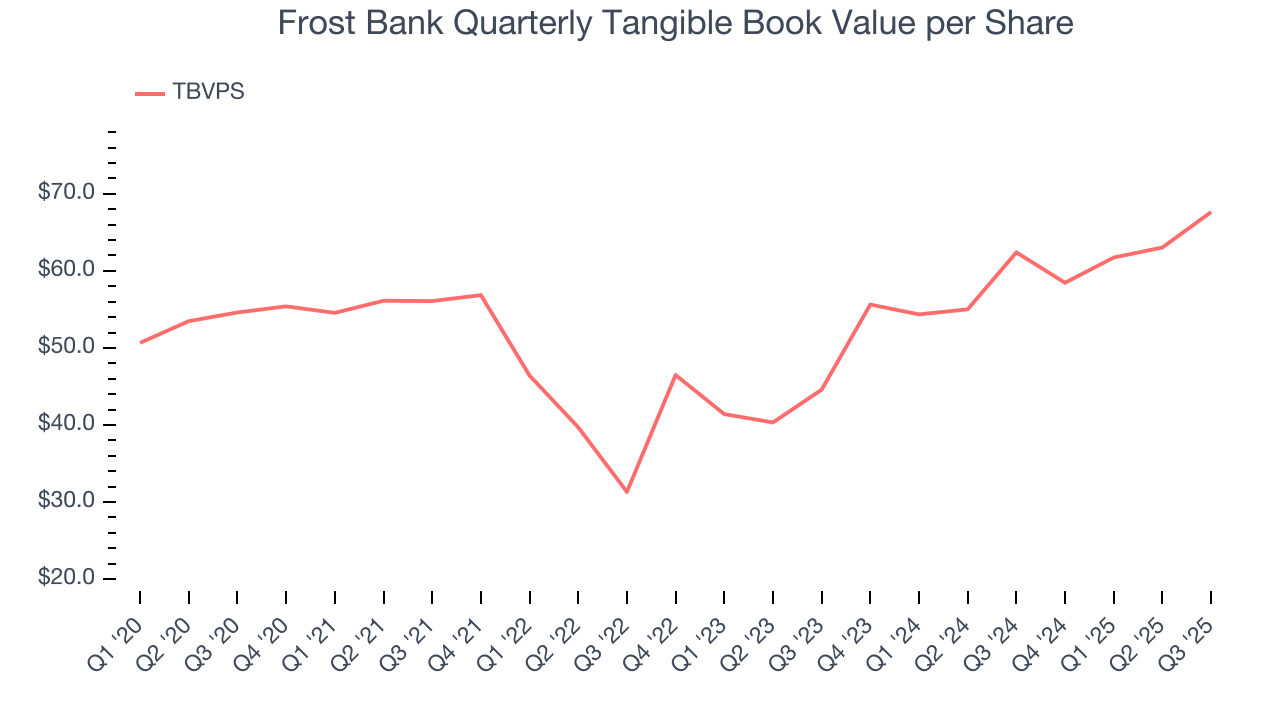
Over the next 12 months, Consensus estimates call for Frost Bank’s TBVPS to shrink by 9.8% to $61.03, a sour projection.
8. Balance Sheet Assessment
Leverage is core to a financial firm’s business model (loans funded by deposits). To ensure economic stability and avoid a repeat of the 2008 GFC, regulators require certain levels of capital and liquidity, focusing on the Tier 1 capital ratio.
Tier 1 capital is the highest-quality capital that a firm holds, consisting primarily of common stock and retained earnings, but also physical gold. It serves as the primary cushion against losses and is the first line of defense in times of financial distress.
This capital is divided by risk-weighted assets to derive the Tier 1 capital ratio. Risk-weighted means that cash and US treasury securities are assigned little risk while unsecured consumer loans and equity investments get much higher risk weights, for example.
New regulation after the 2008 financial crisis requires that all firms must maintain a Tier 1 capital ratio greater than 4.5%. On top of this, there are additional buffers based on scale, risk profile, and other regulatory classifications, so that at the end of the day, firms generally must maintain a 7-10% ratio at minimum.
Over the last two years, Frost Bank has averaged a Tier 1 capital ratio of 13.6%, which is considered safe and well capitalized in the event that macro or market conditions suddenly deteriorate.
9. Return on Equity
Return on equity, or ROE, quantifies bank profitability relative to shareholder equity - an essential capital source for these institutions. Over extended periods, superior ROE performance drives faster shareholder wealth compounding through reinvestment, share repurchases, and dividend growth.
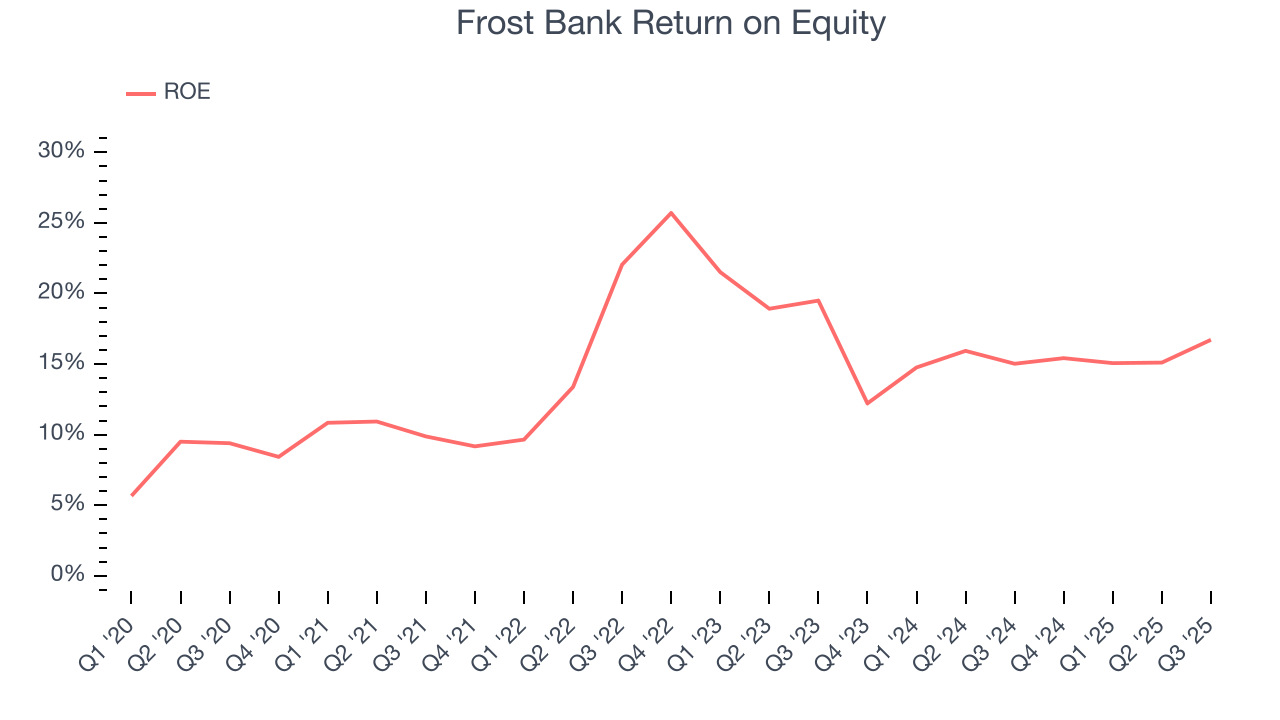
Over the last five years, Frost Bank has averaged an ROE of 15%, exceptional for a company operating in a sector where the average shakes out around 7.5% and those putting up 15%+ are greatly admired. This shows Frost Bank has a strong competitive moat.
10. Key Takeaways from Frost Bank’s Q3 Results
We were impressed by how significantly Frost Bank blew past analysts’ revenue expectations this quarter. We were also excited its tangible book value per share outperformed Wall Street’s estimates by a wide margin. Zooming out, we think this was a solid print. The stock traded up 1.1% to $122.85 immediately after reporting.
11. Is Now The Time To Buy Frost Bank?
Updated: December 4, 2025 at 11:13 PM EST
Before making an investment decision, investors should account for Frost Bank’s business fundamentals and valuation in addition to what happened in the latest quarter.
Frost Bank isn’t a terrible business, but it doesn’t pass our quality test. To begin with, its revenue growth was mediocre over the last five years, and analysts expect its demand to deteriorate over the next 12 months. And while its expanding net interest margin shows its loan book is becoming more profitable, the downside is its estimated sales for the next 12 months are weak. On top of that, its projected EPS for the next year is lacking.
Frost Bank’s P/B ratio based on the next 12 months is 1.8x. Investors with a higher risk tolerance might like the company, but we think the potential downside is too great. We're fairly confident there are better stocks to buy right now.
Wall Street analysts have a consensus one-year price target of $137.60 on the company (compared to the current share price of $127.17).