Centene (CNC)
We’re skeptical of Centene. Its poor sales growth shows demand is soft and its negative returns on capital suggest it destroyed value.― StockStory Analyst Team


1. News




2. Summary
Why We Think Centene Will Underperform
Serving nearly 1 in 15 Americans through its government healthcare programs, Centene (NYSE:CNC) is a healthcare company that manages government-sponsored health insurance programs like Medicaid and Medicare for low-income and complex-needs populations.
- Earnings per share fell by 16.3% annually over the last five years while its revenue grew, showing its incremental sales were much less profitable
- Push for growth has led to negative returns on capital, signaling value destruction, and its decreasing returns suggest its historical profit centers are aging
- The good news is that its massive revenue base of $194.8 billion gives it meaningful leverage when negotiating reimbursement rates
Centene doesn’t meet our quality standards. There are better opportunities in the market.
Why There Are Better Opportunities Than Centene








Centene’s stock price of $31.76 implies a valuation ratio of 10.7x forward P/E. Centene’s valuation may seem like a bargain, especially when stacked up against other healthcare companies. We remind you that you often get what you pay for, though.
We’d rather pay up for companies with elite fundamentals than get a bargain on weak ones. Cheap stocks can be value traps, and as their performance deteriorates, they will stay cheap or get even cheaper.
3. Centene (CNC) Research Report: Q4 CY2025 Update
Health coverage company Centene (NYSE:CNC) announced better-than-expected revenue in Q4 CY2025, with sales up 21.9% year on year to $49.73 billion. On the other hand, the company’s full-year revenue guidance of $188.5 billion at the midpoint came in 2.1% below analysts’ estimates. Its non-GAAP loss of $1.19 per share was 2.5% above analysts’ consensus estimates.
Centene (CNC) Q4 CY2025 Highlights:
- Revenue: $49.73 billion vs analyst estimates of $48.26 billion (21.9% year-on-year growth, 3% beat)
- Adjusted EPS: -$1.19 vs analyst estimates of -$1.22 (2.5% beat)
- Adjusted EBITDA: -$1.53 billion (-3.1% margin, 408% year-on-year decline)
- Adjusted EPS guidance for the upcoming financial year 2026 is $3 at the midpoint, in line with analyst estimates
- Operating Margin: -3.5%, down from 0.4% in the same quarter last year
- Free Cash Flow was $224 million, up from -$741 million in the same quarter last year
- Customers: 27.63 million, down from 27.97 million in the previous quarter
- Market Capitalization: $19.62 billion
Company Overview
Serving nearly 1 in 15 Americans through its government healthcare programs, Centene (NYSE:CNC) is a healthcare company that manages government-sponsored health insurance programs like Medicaid and Medicare for low-income and complex-needs populations.
Centene operates through four main segments: Medicaid, Medicare, Commercial, and Other. As the largest Medicaid insurer in the country, Centene serves over 14 million Medicaid recipients across 30 states, providing coverage for various populations including low-income families, individuals with disabilities, and children. The company also serves 1.3 million Medicare Advantage members and 4.6 million Medicare Part D prescription drug plan members.
In the commercial space, Centene has established itself as the largest Health Insurance Marketplace carrier under its Ambetter Health brand, serving 3.9 million members across 28 states. These marketplace plans provide subsidized coverage options for individuals without access to employer-sponsored insurance.
The company's business model revolves around contracting with federal and state governments to provide managed care services. When a state Medicaid agency or the federal Medicare program pays Centene a fixed monthly premium per member, the company then works to coordinate care efficiently through its provider networks. A typical Centene member might visit a primary care physician in the company's network for preventive care, with Centene covering the cost while also providing care management services to ensure appropriate utilization.
Centene's approach emphasizes local delivery of healthcare services, with teams embedded in the communities they serve. This local focus allows the company to build relationships with community providers and tailor programs to specific population needs. For example, a Centene care manager might coordinate services for a dual-eligible Medicare-Medicaid member who requires both medical care and long-term support services.
Beyond insurance administration, Centene offers specialty services including pharmacy benefit management through AcariaHealth, behavioral health services through Magellan Health, and vision and dental benefits through Envolve Benefit Options. The company also operates clinical healthcare services in certain markets, providing direct patient care through community medical groups.
4. Health Insurance Providers
Upfront premiums collected by health insurers lead to reliable revenue, but profitability ultimately depends on accurate risk assessments and the ability to control medical costs. Health insurers are also highly sensitive to regulatory changes and economic conditions such as unemployment. Going forward, the industry faces tailwinds from an aging population, increasing demand for personalized healthcare services, and advancements in data analytics to improve cost management. However, continued regulatory scrutiny on pricing practices, the potential for government-led reforms such as expanded public healthcare options, and inflation in medical costs could add volatility to margins. One big debate among investors is the long-term impact of AI and whether it will help underwriting, fraud detection, and claims processing or whether it may wade into ethical grey areas like reinforcing biases and widening disparities in medical care.
Centene's main competitors in the government-sponsored healthcare space include UnitedHealth Group's (NYSE: UNH) Optum division, Elevance Health (NYSE: ELV) formerly known as Anthem, Humana (NYSE: HUM), Molina Healthcare (NYSE: MOH), and CVS Health's (NYSE: CVS) Aetna division.
5. Economies of Scale
Larger companies benefit from economies of scale, where fixed costs like infrastructure, technology, and administration are spread over a higher volume of goods or services, reducing the cost per unit. Scale can also lead to bargaining power with suppliers, greater brand recognition, and more investment firepower. A virtuous cycle can ensue if a scaled company plays its cards right.
With $194.8 billion in revenue over the past 12 months, Centene is one of the most scaled enterprises in healthcare. This is particularly important because health insurance providers companies are volume-driven businesses due to their low margins.
6. Revenue Growth
Examining a company’s long-term performance can provide clues about its quality. Any business can put up a good quarter or two, but many enduring ones grow for years. Luckily, Centene’s sales grew at a decent 11.9% compounded annual growth rate over the last five years. Its growth was slightly above the average healthcare company and shows its offerings resonate with customers.
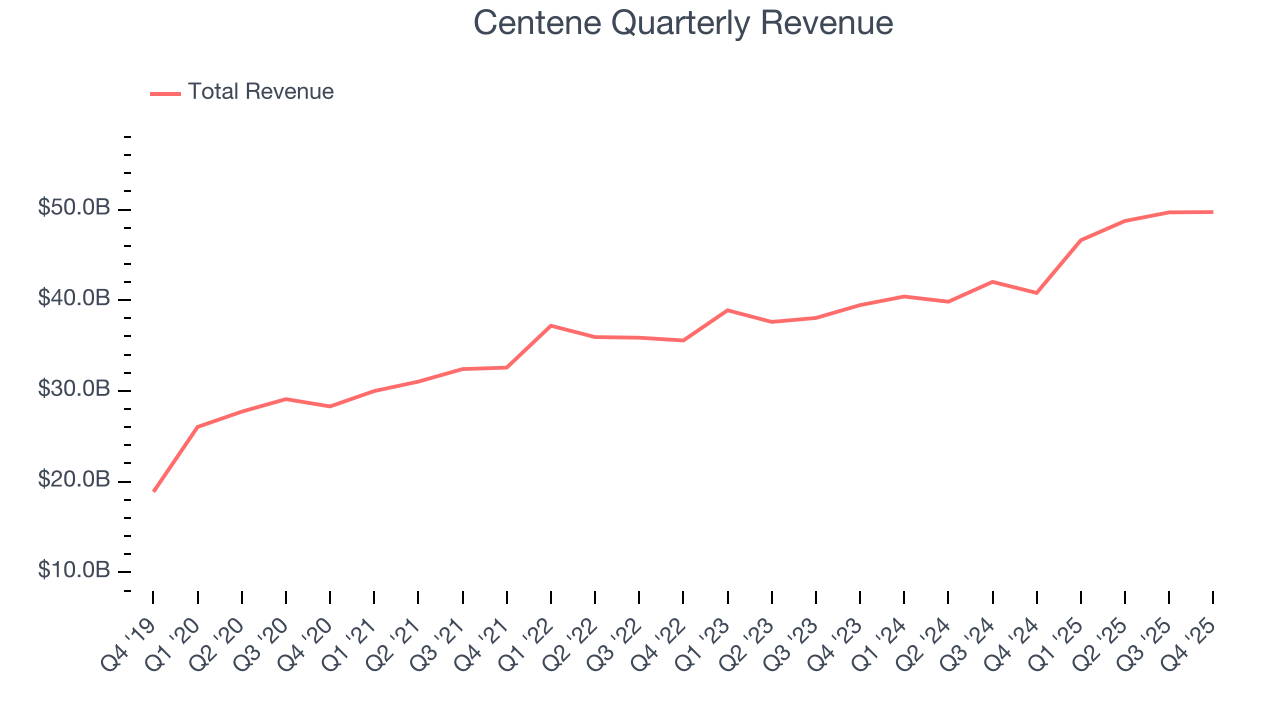
We at StockStory place the most emphasis on long-term growth, but within healthcare, a half-decade historical view may miss recent innovations or disruptive industry trends. Centene’s annualized revenue growth of 12.5% over the last two years aligns with its five-year trend, suggesting its demand was stable. 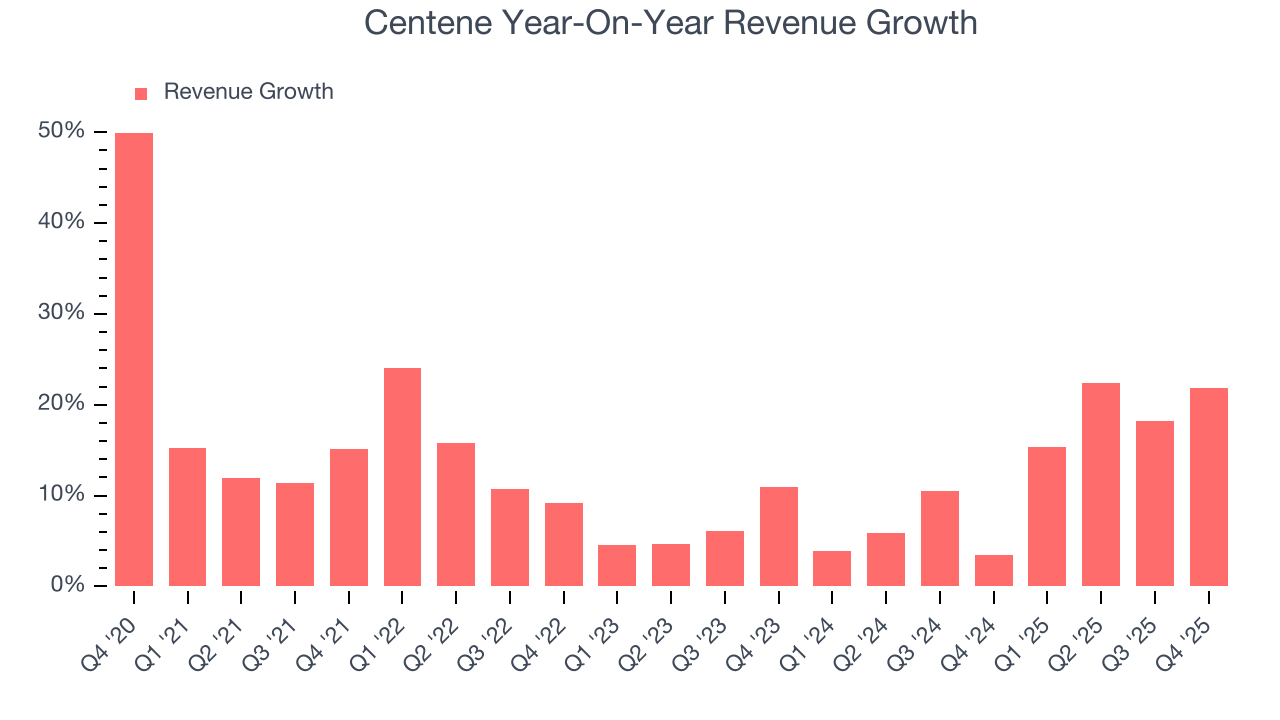
We can dig further into the company’s revenue dynamics by analyzing its number of customers, which reached 27.63 million in the latest quarter. Over the last two years, Centene neither added nor lost customers. Because this number is lower than its revenue growth, we can see the average customer spent more money each year on the company’s products and services. 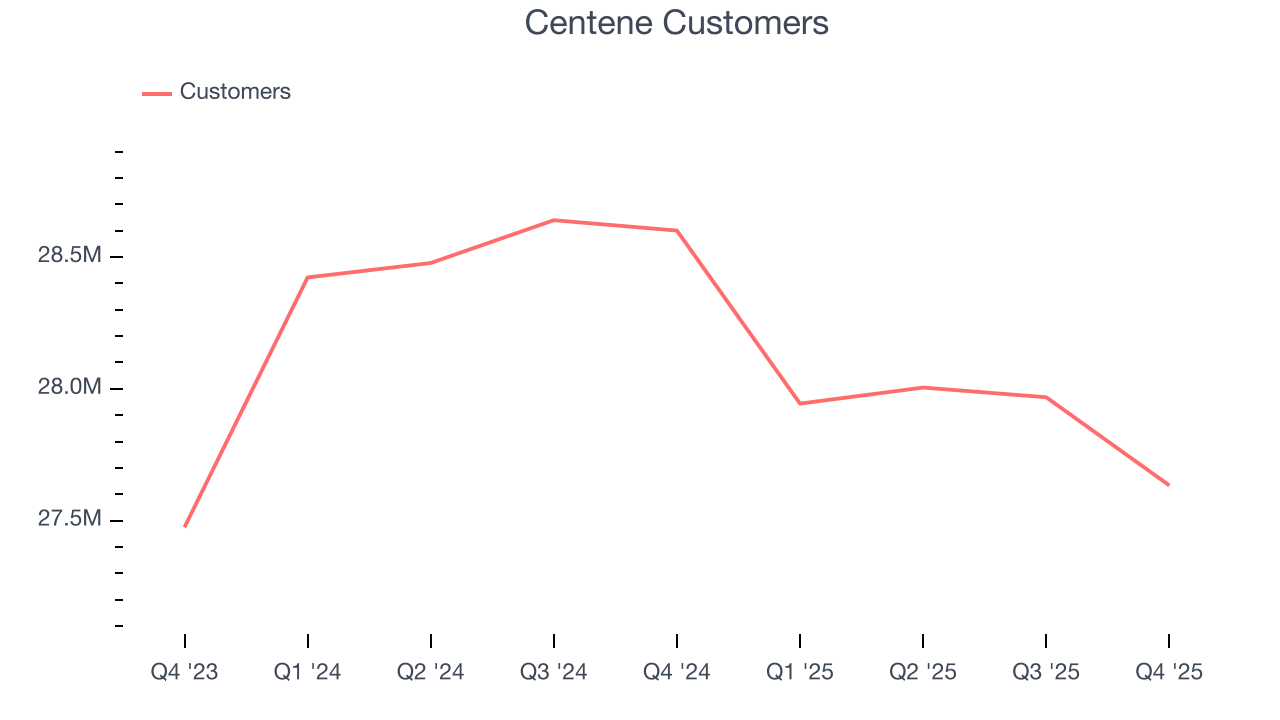
This quarter, Centene reported robust year-on-year revenue growth of 21.9%, and its $49.73 billion of revenue topped Wall Street estimates by 3%.
Looking ahead, sell-side analysts expect revenue to remain flat over the next 12 months, a deceleration versus the last two years. This projection is underwhelming and suggests its products and services will see some demand headwinds.
7. Operating Margin
Centene was roughly breakeven when averaging the last five years of quarterly operating profits, lousy for a healthcare business.
Looking at the trend in its profitability, Centene’s operating margin decreased by 5.3 percentage points over the last five years. The company’s two-year trajectory also shows it failed to get its profitability back to the peak as its margin fell by 5.8 percentage points. This performance was poor no matter how you look at it - it shows its expenses were rising and it couldn’t pass those costs onto its customers.
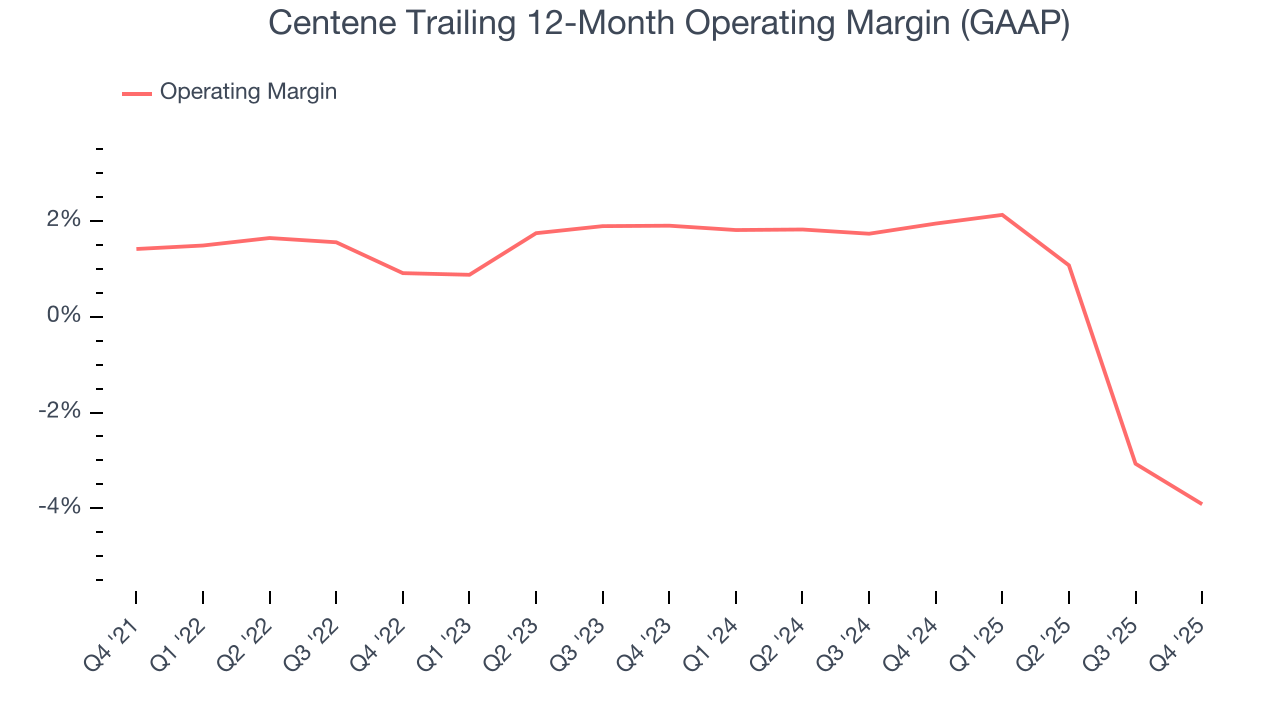
This quarter, Centene generated an operating margin profit margin of negative 3.5%, down 3.9 percentage points year on year. This contraction shows it was less efficient because its expenses grew faster than its revenue.
8. Earnings Per Share
We track the long-term change in earnings per share (EPS) for the same reason as long-term revenue growth. Compared to revenue, however, EPS highlights whether a company’s growth is profitable.
Sadly for Centene, its EPS declined by 16.3% annually over the last five years while its revenue grew by 11.9%. This tells us the company became less profitable on a per-share basis as it expanded due to non-fundamental factors such as interest expenses and taxes.
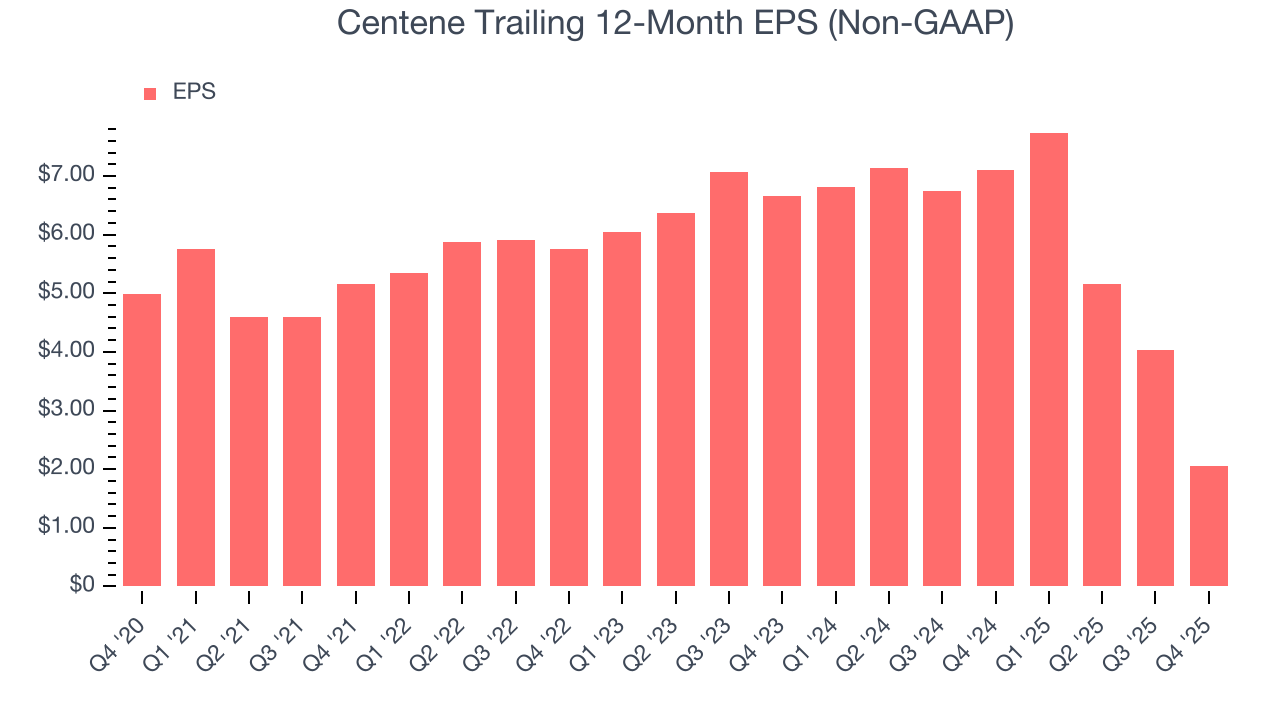
We can take a deeper look into Centene’s earnings to better understand the drivers of its performance. As we mentioned earlier, Centene’s operating margin declined by 5.3 percentage points over the last five years. This was the most relevant factor (aside from the revenue impact) behind its lower earnings; interest expenses and taxes can also affect EPS but don’t tell us as much about a company’s fundamentals.
In Q4, Centene reported adjusted EPS of negative $1.19, down from $0.80 in the same quarter last year. Despite falling year on year, this print beat analysts’ estimates by 2.5%. Over the next 12 months, Wall Street expects Centene’s full-year EPS of $2.05 to grow 55.4%.
9. Cash Is King
If you’ve followed StockStory for a while, you know we emphasize free cash flow. Why, you ask? We believe that in the end, cash is king, and you can’t use accounting profits to pay the bills.
Centene has shown mediocre cash profitability over the last five years, giving the company limited opportunities to return capital to shareholders. Its free cash flow margin averaged 2.5%, subpar for a healthcare business.
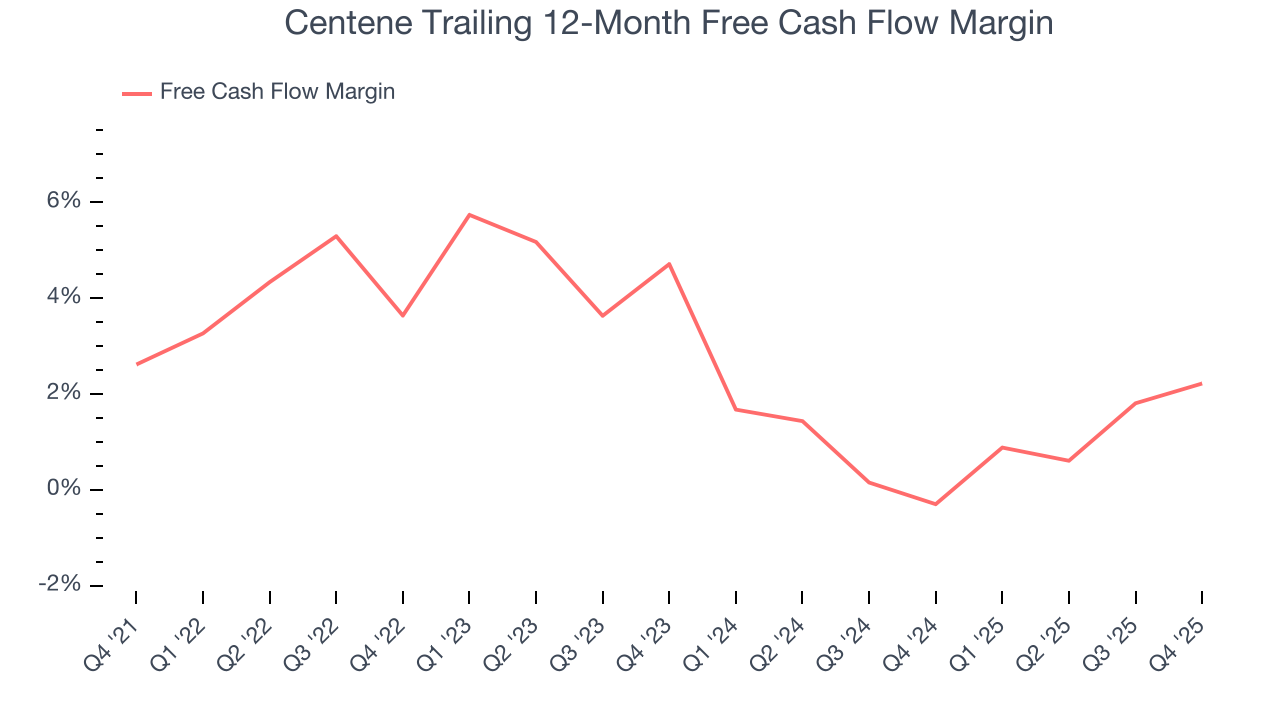
Centene broke even from a free cash flow perspective in Q4. This result was good as its margin was 2.3 percentage points higher than in the same quarter last year, but we wouldn’t read too much into the short term because investment needs can be seasonal, leading to temporary swings. Long-term trends carry greater meaning.
10. Return on Invested Capital (ROIC)
EPS and free cash flow tell us whether a company was profitable while growing its revenue. But was it capital-efficient? Enter ROIC, a metric showing how much operating profit a company generates relative to the money it has raised (debt and equity).
Centene’s five-year average ROIC was negative 3.1%, meaning management lost money while trying to expand the business. Its returns were among the worst in the healthcare sector.
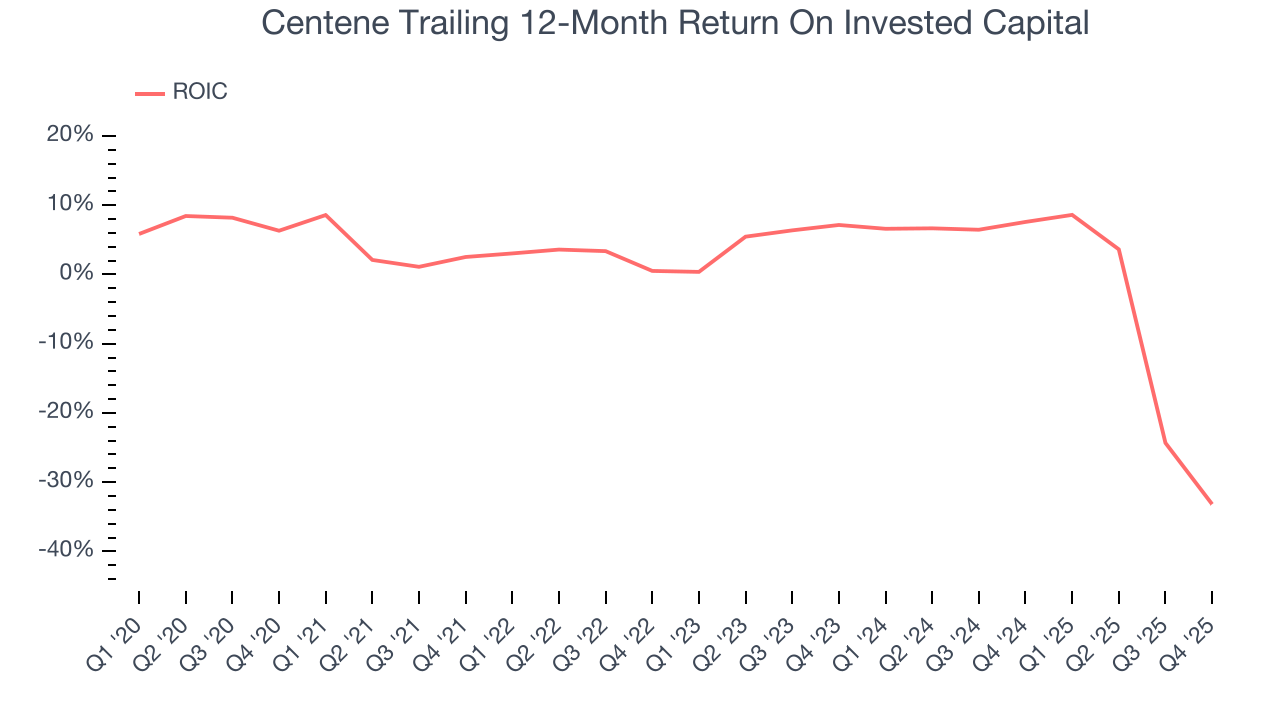
We like to invest in businesses with high returns, but the trend in a company’s ROIC is what often surprises the market and moves the stock price. Over the last few years, Centene’s ROIC has unfortunately decreased significantly. Paired with its already low returns, these declines suggest its profitable growth opportunities are few and far between.
11. Balance Sheet Assessment
Businesses that maintain a cash surplus face reduced bankruptcy risk.
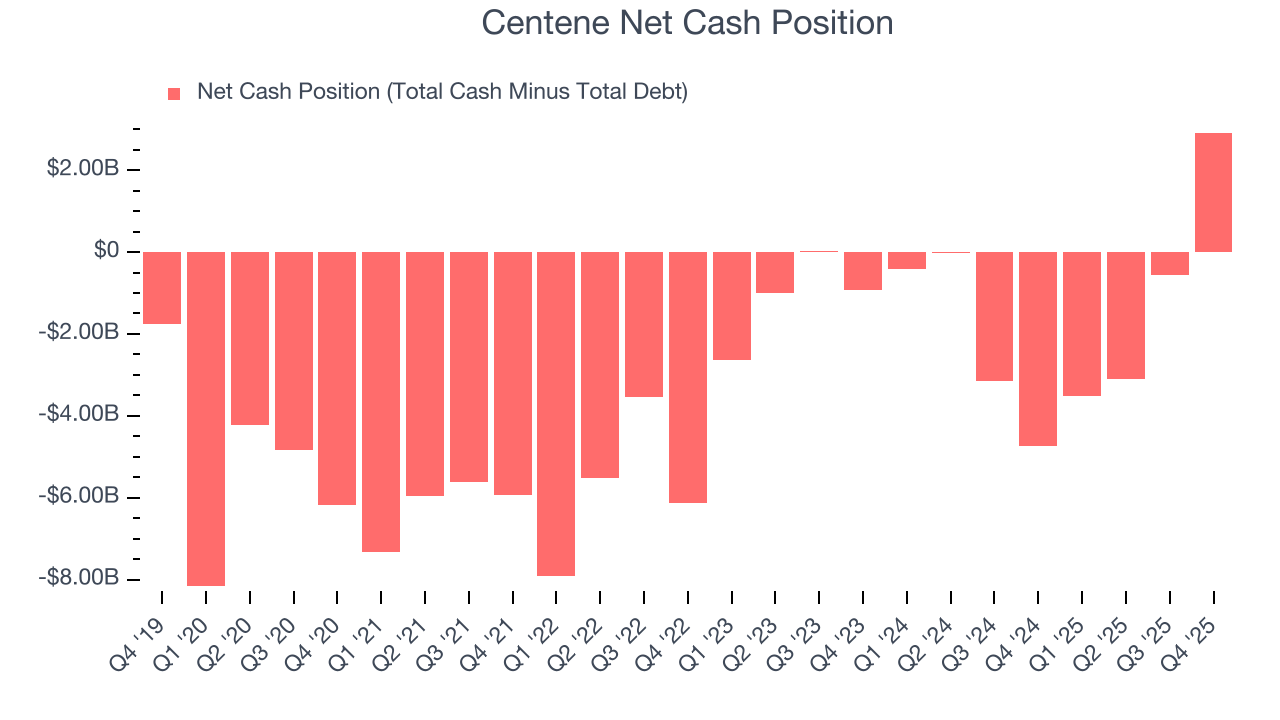
Centene is a well-capitalized company with $20.32 billion of cash and $17.4 billion of debt on its balance sheet. This $2.92 billion net cash position is 14.9% of its market cap and gives it the freedom to borrow money, return capital to shareholders, or invest in growth initiatives. Leverage is not an issue here.
12. Key Takeaways from Centene’s Q4 Results
We enjoyed seeing Centene beat analysts’ revenue expectations this quarter. On the other hand, its full-year revenue guidance missed. Overall, this was a softer quarter. The stock traded down 2.2% to $39.05 immediately after reporting.
13. Is Now The Time To Buy Centene?
Updated: March 29, 2026 at 11:46 PM EDT
When considering an investment in Centene, investors should account for its valuation and business qualities as well as what’s happened in the latest quarter.
Centene isn’t a terrible business, but it isn’t one of our picks. Although its revenue growth was good over the last five years, it’s expected to deteriorate over the next 12 months and its declining EPS over the last five years makes it a less attractive asset to the public markets. And while the company’s scale gives it meaningful leverage when negotiating reimbursement rates, the downside is its diminishing returns show management's prior bets haven't worked out.
Centene’s P/E ratio based on the next 12 months is 11.2x. This valuation multiple is fair, but we don’t have much faith in the company. We're fairly confident there are better stocks to buy right now.
Wall Street analysts have a consensus one-year price target of $43.18 on the company (compared to the current share price of $31.94).
Although the price target is bullish, readers should exercise caution because analysts tend to be overly optimistic. The firms they work for, often big banks, have relationships with companies that extend into fundraising, M&A advisory, and other rewarding business lines. As a result, they typically hesitate to say bad things for fear they will lose out. We at StockStory do not suffer from such conflicts of interest, so we’ll always tell it like it is.