
Curtiss-Wright (CW)
Curtiss-Wright is a compelling stock. It not only produces robust profits but also has improved its margins, showing its quality is rising.― StockStory Analyst Team


1. News







2. Summary
Why We Like Curtiss-Wright
Formed from a merger of 12 companies, Curtiss-Wright (NYSE:CW) provides a range of products and services to the aerospace, industrial, electronic, and maritime industries.
- Additional sales over the last two years increased its profitability as the 18.8% annual growth in its earnings per share outpaced its revenue
- Successful business model is illustrated by its impressive operating margin, and it turbocharged its profits by achieving some fixed cost leverage
- Impressive free cash flow profitability enables the company to fund new investments or reward investors with share buybacks/dividends, and its improved cash conversion implies it’s becoming a less capital-intensive business
Curtiss-Wright is a standout company. No coincidence the stock is up 468% over the last five years.
Is Now The Time To Buy Curtiss-Wright?








At $679.02 per share, Curtiss-Wright trades at 46.7x forward P/E. There are high expectations given this pricey multiple; we can’t deny that.
If you love the business, we suggest making it a small position as the long-term outlook is bright. Be aware that Curtiss-Wright’s premium valuation could result in choppy short-term stock performance.
3. Curtiss-Wright (CW) Research Report: Q4 CY2025 Update
Aerospace and defense company Curtiss-Wright (NYSE:CW) reported revenue ahead of Wall Street’s expectations in Q4 CY2025, with sales up 14.9% year on year to $947 million. The company’s full-year revenue guidance of $3.74 billion at the midpoint came in 1.2% above analysts’ estimates. Its non-GAAP profit of $3.79 per share was 2.8% above analysts’ consensus estimates.
Curtiss-Wright (CW) Q4 CY2025 Highlights:
- Revenue: $947 million vs analyst estimates of $890.4 million (14.9% year-on-year growth, 6.4% beat)
- Adjusted EPS: $3.79 vs analyst estimates of $3.69 (2.8% beat)
- Adjusted EPS guidance for the upcoming financial year 2026 is $14.93 at the midpoint, beating analyst estimates by 2.1%
- Operating Margin: 19.2%, in line with the same quarter last year
- Free Cash Flow Margin: 33.3%, similar to the same quarter last year
- Market Capitalization: $23.8 billion
Company Overview
Formed from a merger of 12 companies, Curtiss-Wright (NYSE:CW) provides a range of products and services to the aerospace, industrial, electronic, and maritime industries.
Curtiss-Wright was formed in 1929 through the merger of companies founded by Glenn Curtiss, the father of naval aviation, and the Wright brothers, who are credited with building the world’s first successful airplane. It initially focused on aircraft manufacturing and has since diversified into various products including electronic systems and flow control technologies.
Today, Curtiss-Wright offers specialized products and services across the aerospace, defense, and power industries. The company produces everything from power management electronics and aircraft sensors to advanced surface treatments that improve the durability of metal parts. Specifically, in defense, Curtiss-Wright provides vital technologies such as embedded computing systems, flight testing instruments, and communication solutions while in the naval and energy sectors it supplies equipment like naval propulsion systems and coolant pumps for nuclear reactors.
Curtiss-Wright primarily goes to market through a global network of direct sales forces and independent representatives. Revenue is largely generated from the sale of engineered components, systems, and services, and a significant portion comes from long-term contracts with government and defense entities as well as commercial agreements within the power generation and naval sectors.
In addition to outright sales, Curtiss-Wright benefits from aftermarket revenue sources such as maintenance, repair, and overhaul services, and the supply of replacement parts. These services are crucial for ensuring the operational continuity and efficiency of customer equipment, thus creating a consistent demand and revenue stream.
The financial performance of Curtiss-Wright is closely linked to governmental defense spending, the health of the aerospace industry, and the global demand for energy, particularly nuclear power. These factors directly affect the company’s sales volumes and the development of new projects within its key market segments.
4. Aerospace
Aerospace companies often possess technical expertise and have made significant capital investments to produce complex products. It is an industry where innovation is important, and lately, emissions and automation are in focus, so companies that boast advances in these areas can take market share. On the other hand, demand for aerospace products can ebb and flow with economic cycles and geopolitical tensions, which can be particularly painful for companies with high fixed costs.
Curtiss-Wright’s peers and competitors include Lockheed Martin (NYSE:LMT), General Electrics (NYSE:GE), and Honeywell International (NASDAQ:HON)
5. Revenue Growth
A company’s long-term sales performance can indicate its overall quality. Any business can experience short-term success, but top-performing ones enjoy sustained growth for years. Thankfully, Curtiss-Wright’s 8.8% annualized revenue growth over the last five years was decent. Its growth was slightly above the average industrials company and shows its offerings resonate with customers.
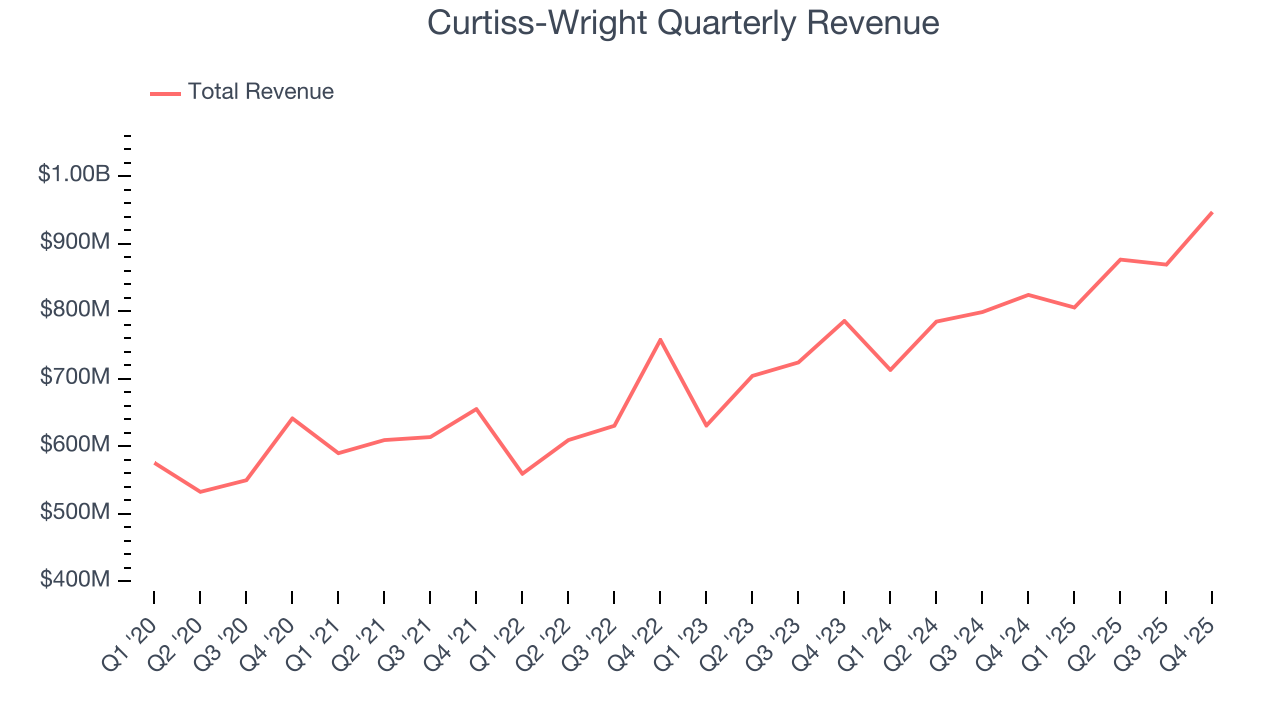
Long-term growth is the most important, but within industrials, a half-decade historical view may miss new industry trends or demand cycles. Curtiss-Wright’s annualized revenue growth of 10.9% over the last two years is above its five-year trend, suggesting its demand recently accelerated. 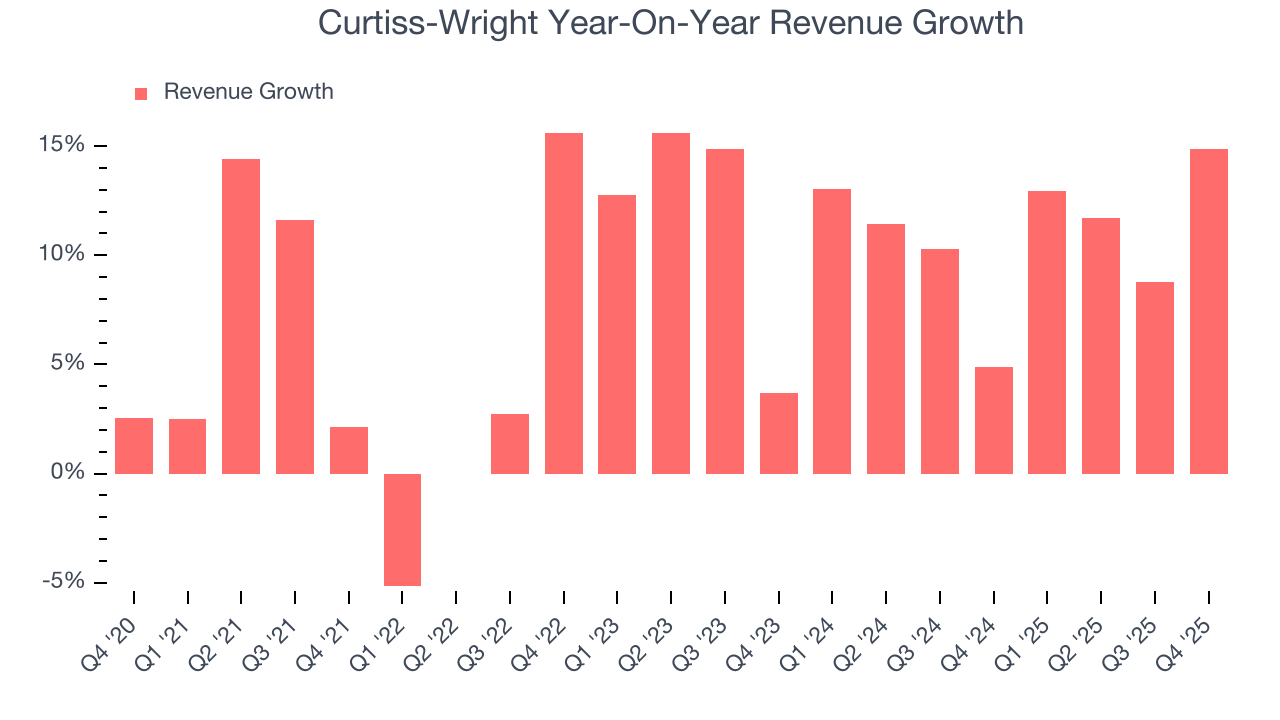
We can dig further into the company’s revenue dynamics by analyzing its most important segments, Product and Services, which are 85.8% and 14.2% of revenue. Over the last two years, Curtiss-Wright’s Product revenue (aerospace & defense technology) averaged 11.8% year-on-year growth while its Services revenue (testing, maintenance, consulting) averaged 7.1% growth. 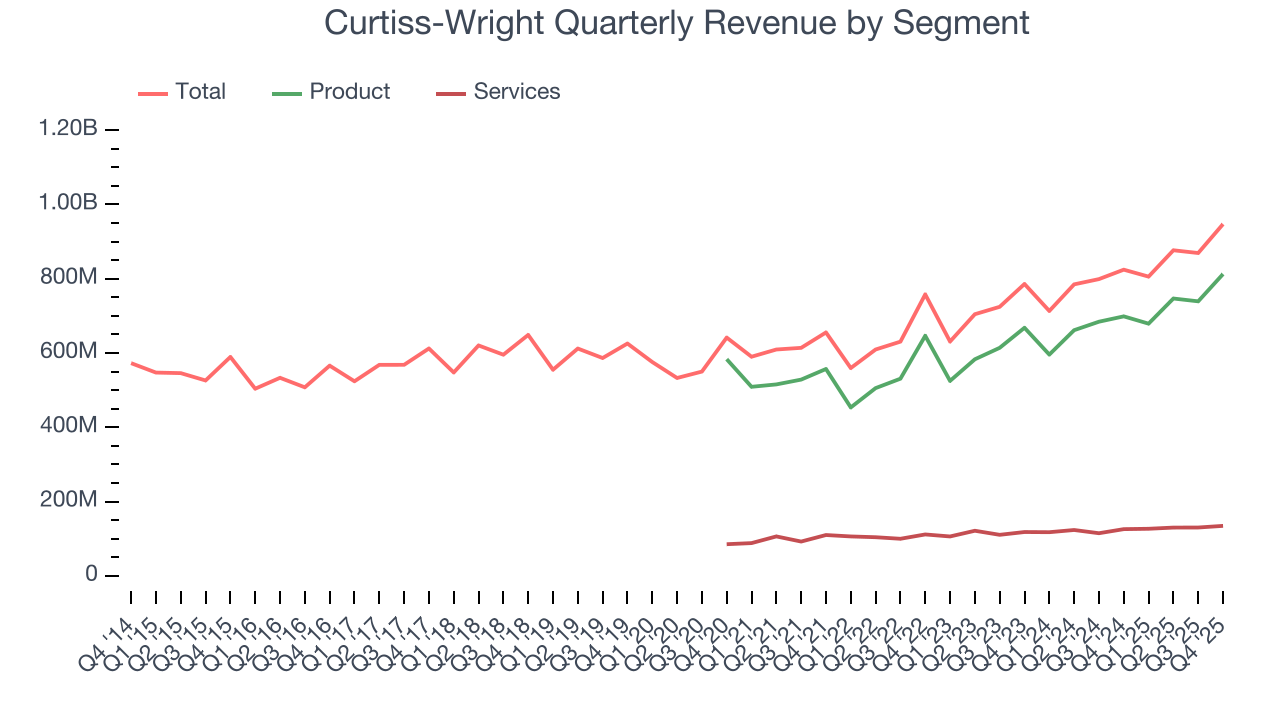
This quarter, Curtiss-Wright reported year-on-year revenue growth of 14.9%, and its $947 million of revenue exceeded Wall Street’s estimates by 6.4%.
Looking ahead, sell-side analysts expect revenue to grow 5.7% over the next 12 months, a deceleration versus the last two years. This projection doesn't excite us and indicates its products and services will see some demand headwinds. At least the company is tracking well in other measures of financial health.
6. Operating Margin
Curtiss-Wright has been a well-oiled machine over the last five years. It demonstrated elite profitability for an industrials business, boasting an average operating margin of 16.9%.
Looking at the trend in its profitability, Curtiss-Wright’s operating margin rose by 2.6 percentage points over the last five years, as its sales growth gave it operating leverage.
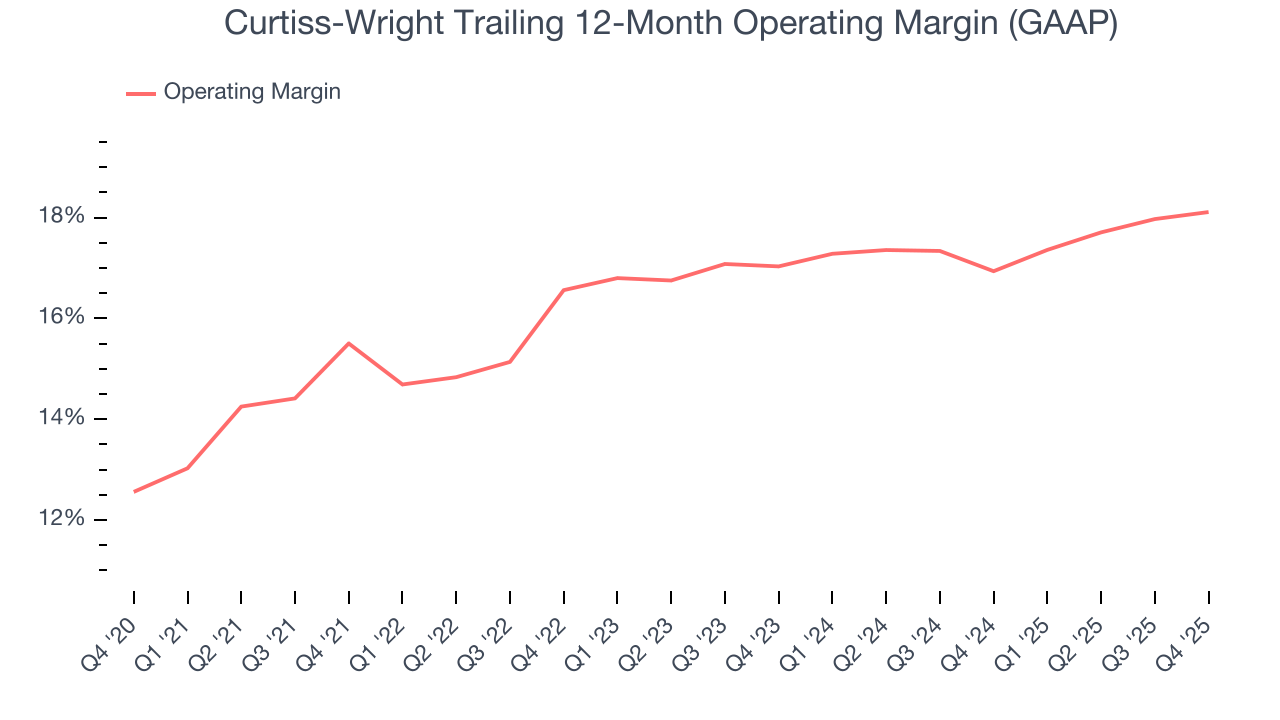
In Q4, Curtiss-Wright generated an operating margin profit margin of 19.2%, in line with the same quarter last year. This indicates the company’s overall cost structure has been relatively stable.
7. Earnings Per Share
Revenue trends explain a company’s historical growth, but the long-term change in earnings per share (EPS) points to the profitability of that growth – for example, a company could inflate its sales through excessive spending on advertising and promotions.
Curtiss-Wright’s EPS grew at a remarkable 14% compounded annual growth rate over the last five years, higher than its 8.8% annualized revenue growth. This tells us the company became more profitable on a per-share basis as it expanded.
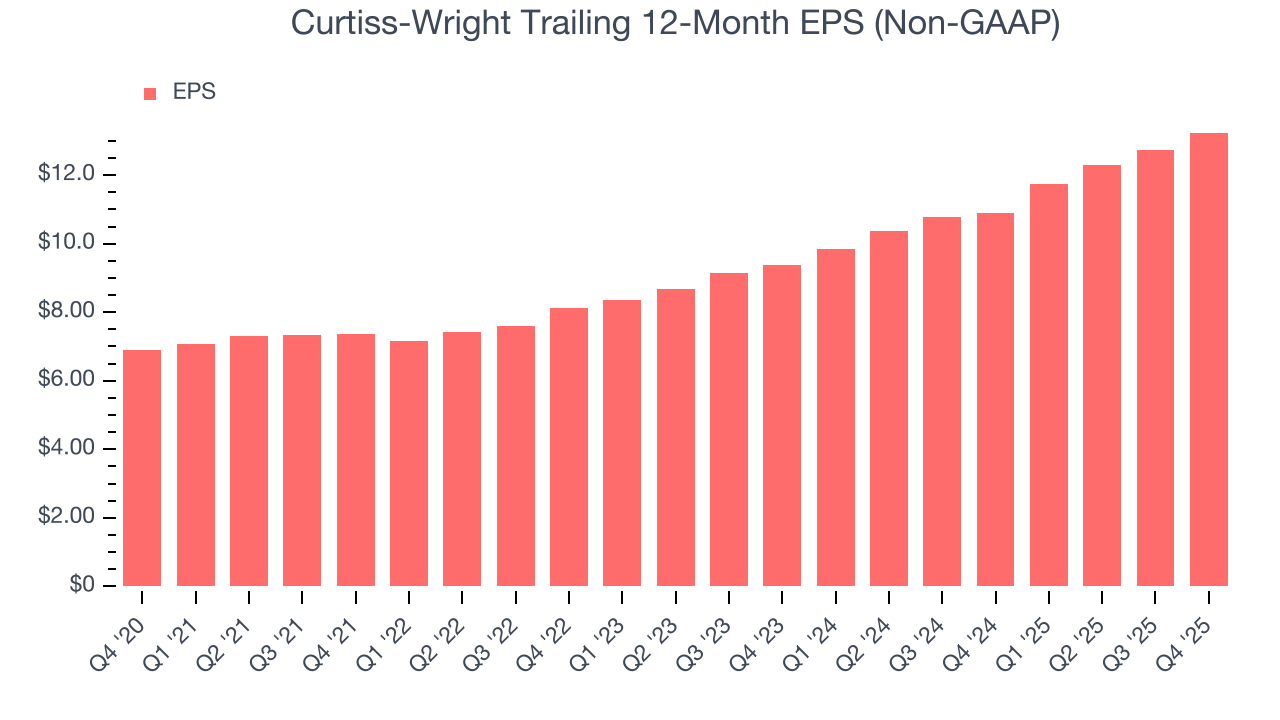
Diving into the nuances of Curtiss-Wright’s earnings can give us a better understanding of its performance. As we mentioned earlier, Curtiss-Wright’s operating margin was flat this quarter but expanded by 2.6 percentage points over the last five years. On top of that, its share count shrank by 10.3%. These are positive signs for shareholders because improving profitability and share buybacks turbocharge EPS growth relative to revenue growth. 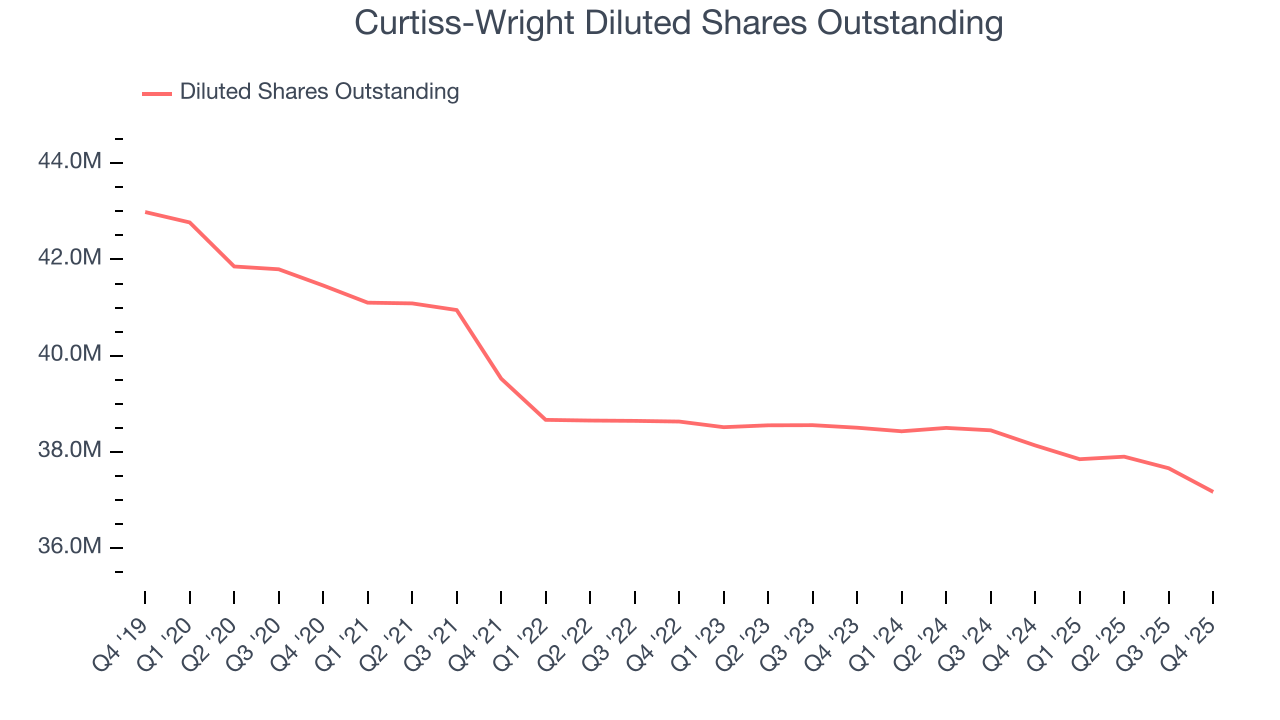
Like with revenue, we analyze EPS over a more recent period because it can provide insight into an emerging theme or development for the business.
For Curtiss-Wright, its two-year annual EPS growth of 18.8% was higher than its five-year trend. We love it when earnings growth accelerates, especially when it accelerates off an already high base.
In Q4, Curtiss-Wright reported adjusted EPS of $3.79, up from $3.27 in the same quarter last year. This print beat analysts’ estimates by 2.8%. Over the next 12 months, Wall Street expects Curtiss-Wright’s full-year EPS of $13.24 to grow 9.7%.
8. Cash Is King
Although earnings are undoubtedly valuable for assessing company performance, we believe cash is king because you can’t use accounting profits to pay the bills.
Curtiss-Wright has shown terrific cash profitability, putting it in an advantageous position to invest in new products, return capital to investors, and consolidate the market during industry downturns. The company’s free cash flow margin was among the best in the industrials sector, averaging 14.1% over the last five years.
Taking a step back, we can see that Curtiss-Wright’s margin expanded by 1.8 percentage points during that time. This is encouraging because it gives the company more optionality.
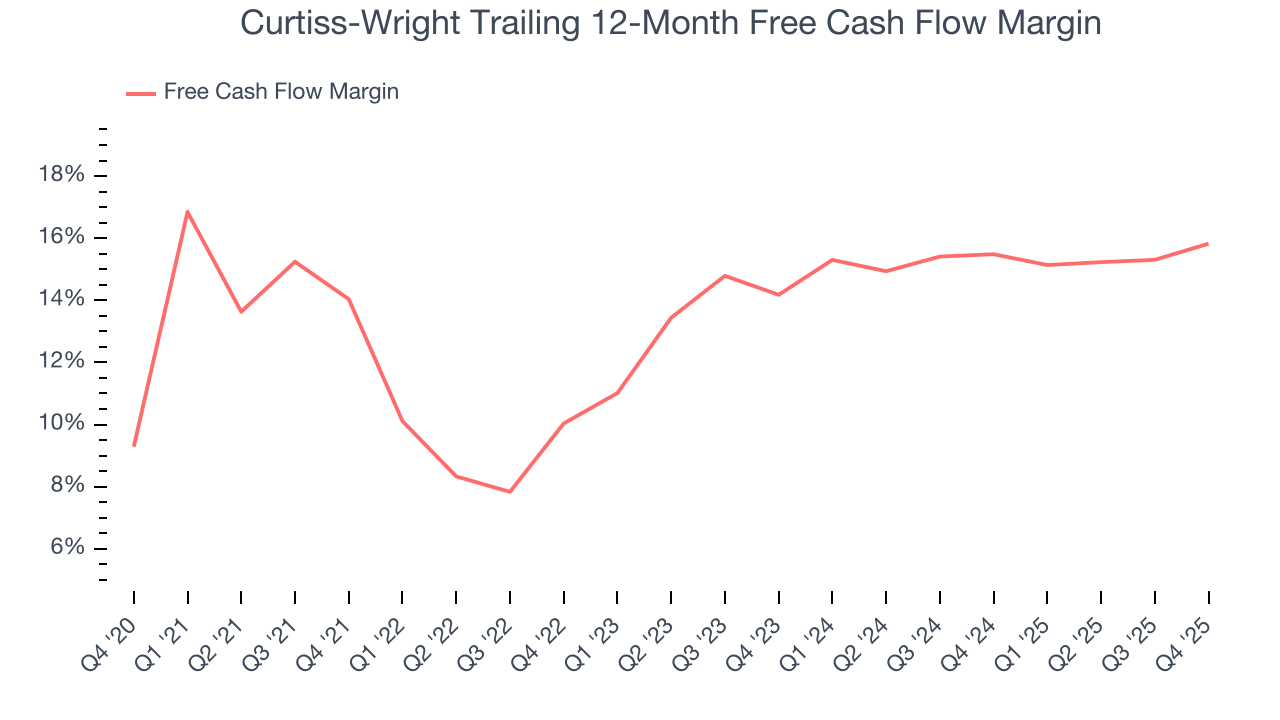
Curtiss-Wright’s free cash flow clocked in at $315 million in Q4, equivalent to a 33.3% margin. This cash profitability was in line with the comparable period last year and above its five-year average.
9. Return on Invested Capital (ROIC)
EPS and free cash flow tell us whether a company was profitable while growing its revenue. But was it capital-efficient? Enter ROIC, a metric showing how much operating profit a company generates relative to the money it has raised (debt and equity).
Curtiss-Wright’s five-year average ROIC was 12.8%, higher than most industrials businesses. This illustrates its management team’s ability to invest in profitable growth opportunities and generate value for shareholders.
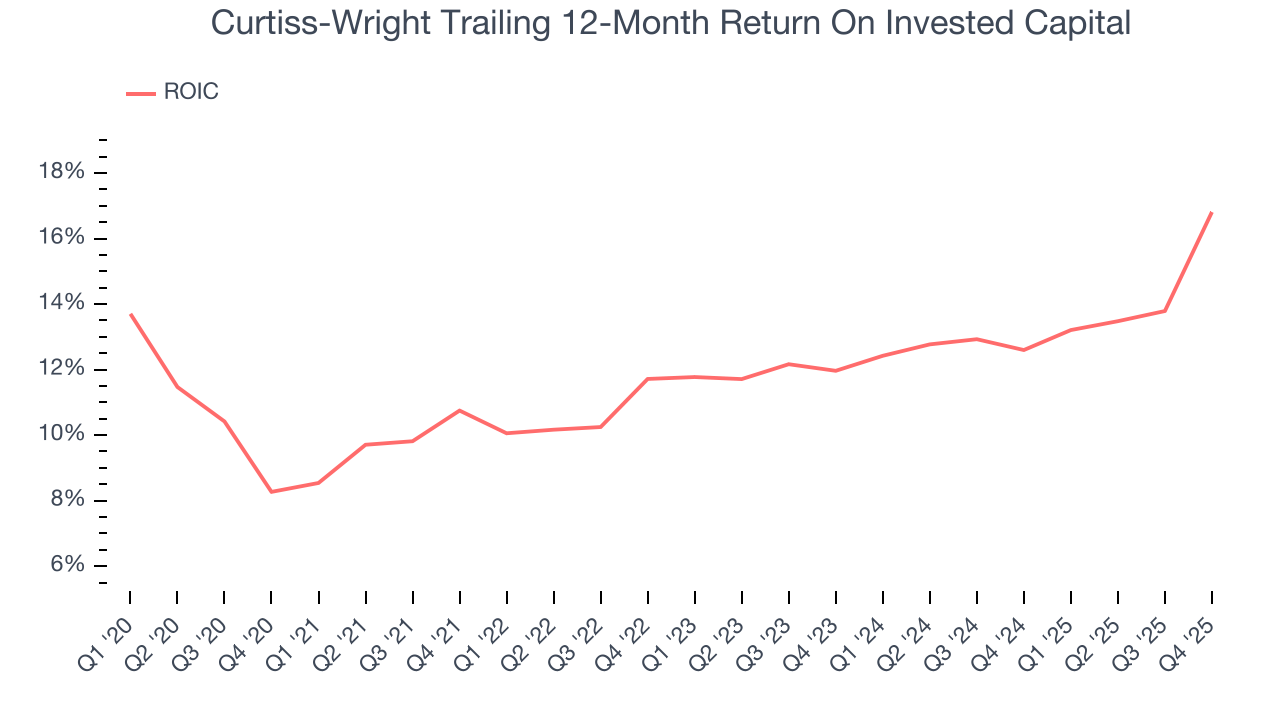
We like to invest in businesses with high returns, but the trend in a company’s ROIC is what often surprises the market and moves the stock price. On average, Curtiss-Wright’s ROIC increased by 3.5 percentage points annually each year over the last few years. This is a great sign when paired with its already strong returns. It could suggest its competitive advantage or profitable growth opportunities are expanding.
10. Balance Sheet Assessment
Curtiss-Wright reported $371.3 million of cash and $957.9 million of debt on its balance sheet in the most recent quarter. As investors in high-quality companies, we primarily focus on two things: 1) that a company’s debt level isn’t too high and 2) that its interest payments are not excessively burdening the business.
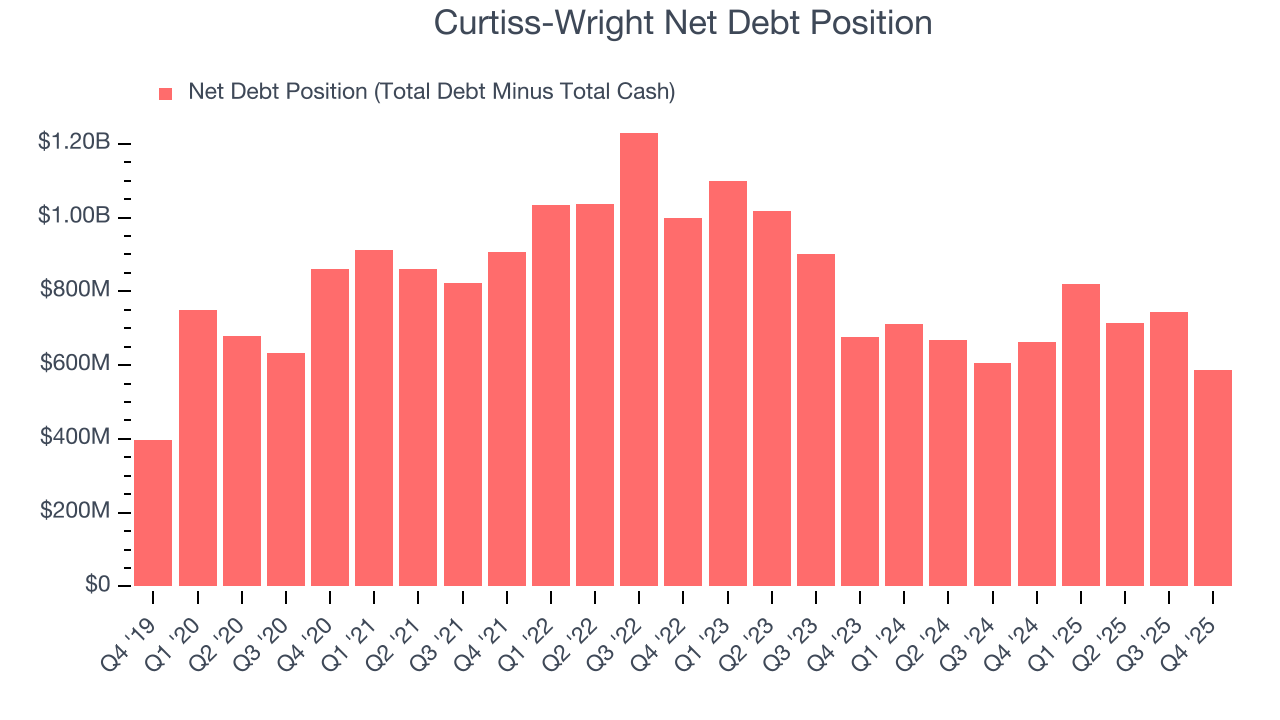
With $775.8 million of EBITDA over the last 12 months, we view Curtiss-Wright’s 0.8× net-debt-to-EBITDA ratio as safe. We also see its $43.15 million of annual interest expenses as appropriate. The company’s profits give it plenty of breathing room, allowing it to continue investing in growth initiatives.
11. Key Takeaways from Curtiss-Wright’s Q4 Results
We were impressed by how significantly Curtiss-Wright blew past analysts’ revenue expectations this quarter. We were also glad its full-year EPS guidance exceeded Wall Street’s estimates. Zooming out, we think this quarter featured some important positives. The stock traded up 3.1% to $654.50 immediately after reporting.
12. Is Now The Time To Buy Curtiss-Wright?
Updated: March 26, 2026 at 11:25 PM EDT
Before making an investment decision, investors should account for Curtiss-Wright’s business fundamentals and valuation in addition to what happened in the latest quarter.
There are multiple reasons why we think Curtiss-Wright is an amazing business. First of all, the company’s revenue growth was good over the last five years. On top of that, its impressive operating margins show it has a highly efficient business model, and its powerful free cash flow generation enables it to stay ahead of the competition through consistent reinvestment of profits.
Curtiss-Wright’s P/E ratio based on the next 12 months is 46.7x. There’s no doubt it’s a bit of a market darling given the lofty multiple, but we don’t mind owning a high-quality business, even if it’s expensive. Investments like this should be held patiently for at least three to five years as they benefit from the power of long-term compounding, which more than makes up for any short-term price volatility that comes with high valuations.
Wall Street analysts have a consensus one-year price target of $711.43 on the company (compared to the current share price of $679.02).