
FedEx (FDX)
FedEx is up against the odds. Its sales have underperformed and its low returns on capital show it has few growth opportunities.― StockStory Analyst Team


1. News


2. Summary
Why We Think FedEx Will Underperform
Sporting one of the largest air cargo fleets in the world, FedEx (NYSE:FDX) is a global provider of parcel and cargo delivery services.
- The company has faced growth challenges as its 1.2% annual revenue increases over the last two years fell short of other industrials companies
- Low free cash flow margin gives it little breathing room, constraining its ability to self-fund growth or return capital to shareholders
- Demand will likely be soft over the next 12 months as Wall Street’s estimates imply tepid growth of 5.2%
FedEx doesn’t live up to our standards. There are superior opportunities elsewhere.
Why There Are Better Opportunities Than FedEx







FedEx’s stock price of $348.65 implies a valuation ratio of 17.8x forward P/E. FedEx’s multiple may seem like a great deal among industrials peers, but we think there are valid reasons why it’s this cheap.
Cheap stocks can look like great bargains at first glance, but you often get what you pay for. These mediocre businesses often have less earnings power, meaning there is more reliance on a re-rating to generate good returns - an unlikely scenario for low-quality companies.
3. FedEx (FDX) Research Report: Q1 CY2026 Update
Parcel and cargo delivery company FedEx (NYSE:FDX) reported revenue ahead of Wall Street’s expectations in Q1 CY2026, with sales up 8.3% year on year to $24 billion. Its non-GAAP profit of $5.25 per share was 27% above analysts’ consensus estimates.
FedEx (FDX) Q1 CY2026 Highlights:
- Revenue: $24 billion vs analyst estimates of $23.51 billion (8.3% year-on-year growth, 2.1% beat)
- Adjusted EPS: $5.25 vs analyst estimates of $4.13 (27% beat)
- Adjusted EBITDA: $2.46 billion vs analyst estimates of $2.47 billion (10.3% margin, in line)
- Management raised its full-year Adjusted EPS guidance to $19.70 at the midpoint, a 7.1% increase
- Operating Margin: 5.6%, in line with the same quarter last year
- Free Cash Flow Margin: 4.3%, up from 3.1% in the same quarter last year
- Market Capitalization: $82.23 billion
Company Overview
Sporting one of the largest air cargo fleets in the world, FedEx (NYSE:FDX) is a global provider of parcel and cargo delivery services.
FedEx was founded in 1962 by Fred Smith after he devised a business idea for delivering packages at his Yale economics class. Despite facing challenges in being profitable early on, the company overcame its hurdles and has evolved into one of the largest logistics companies today. Specifically, much of the company’s growth has been fueled by acquisitions of companies such as TNT Express, an express delivery company it acquired for €4.4 billion in 2016 to expand its presence in Europe.
Today, FedEx provides pickup and delivery services for anything ranging from mail to large cargo. The company executes these services by leveraging its retail locations as drop-off/pick-up points and its network of distribution centers, ships, planes, and trucks to fulfill orders.
Its express offerings connect markets that generate more than 99% of the world’s gross domestic product through door-to-door. The company has implemented Network 2.0, a program to improve profitability by improving efficiency with which it picks up, transports, and delivers packages. Network 2.0 improves delivery routes and uses new technology to move packages faster and cheaper.
The company reaches its customers through its online platform and various brick-and-mortar locations where customers can access printing and shipping services. FedEx engages in contracts with businesses and offers volume discounts dependent on volume and frequency, incentivizing long-term partnerships. It offers several shipping speed options that vary in price.
4. Air Freight and Logistics
The growth of e-commerce and global trade continues to drive demand for expedited shipping services, presenting opportunities for air freight companies. The industry continues to invest in advanced technologies such as automated sorting systems and real-time tracking solutions to enhance operational efficiency. Despite the advantages of speed and global reach, air freight and logistics companies are still at the whim of economic cycles. Consumer spending, for example, can greatly impact the demand for these companies’ offerings while fuel costs can influence profit margins.
Competitors offering similar products include UPS (NYSE:UPS), GXO (NYSE:GXO), and Amazon (NASDAQ:AMZN).
5. Revenue Growth
A company’s long-term sales performance can indicate its overall quality. Even a bad business can shine for one or two quarters, but a top-tier one grows for years. Over the last five years, FedEx grew its sales at a sluggish 3.1% compounded annual growth rate. This was below our standard for the industrials sector and is a rough starting point for our analysis.
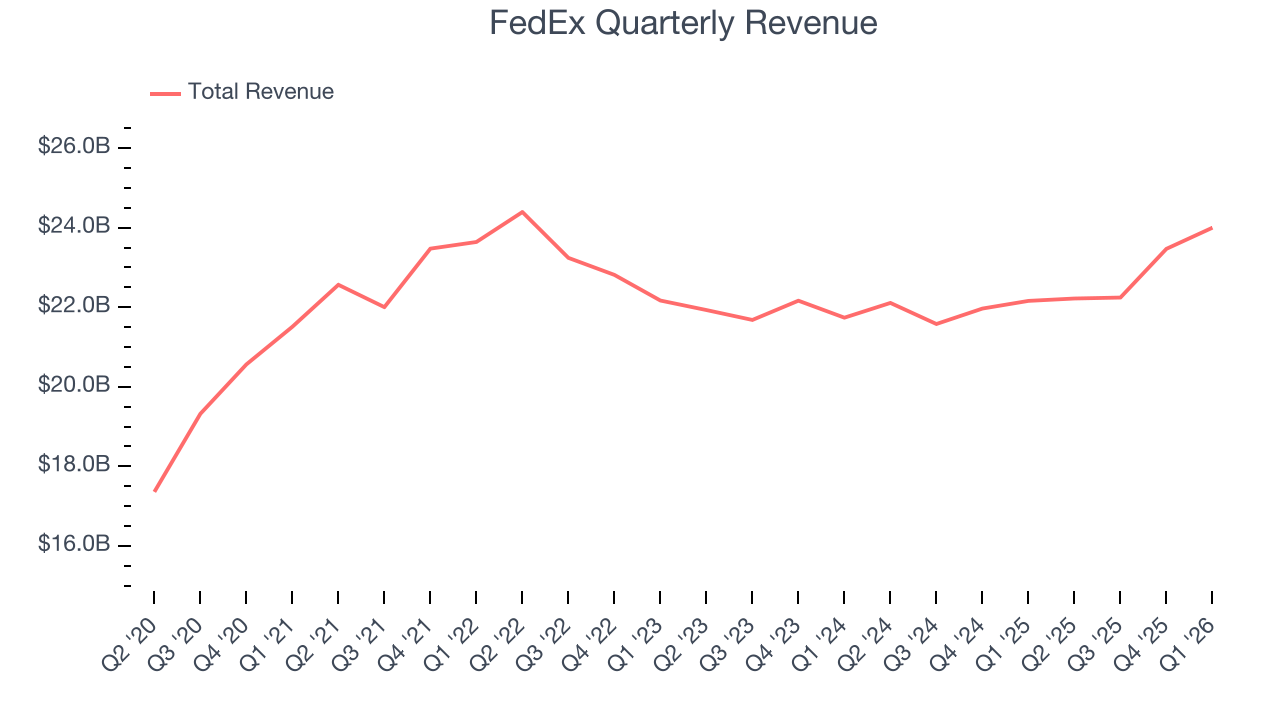
Long-term growth is the most important, but within industrials, a half-decade historical view may miss new industry trends or demand cycles. FedEx’s annualized revenue growth of 2.5% over the last two years aligns with its five-year trend, suggesting its demand was consistently weak. 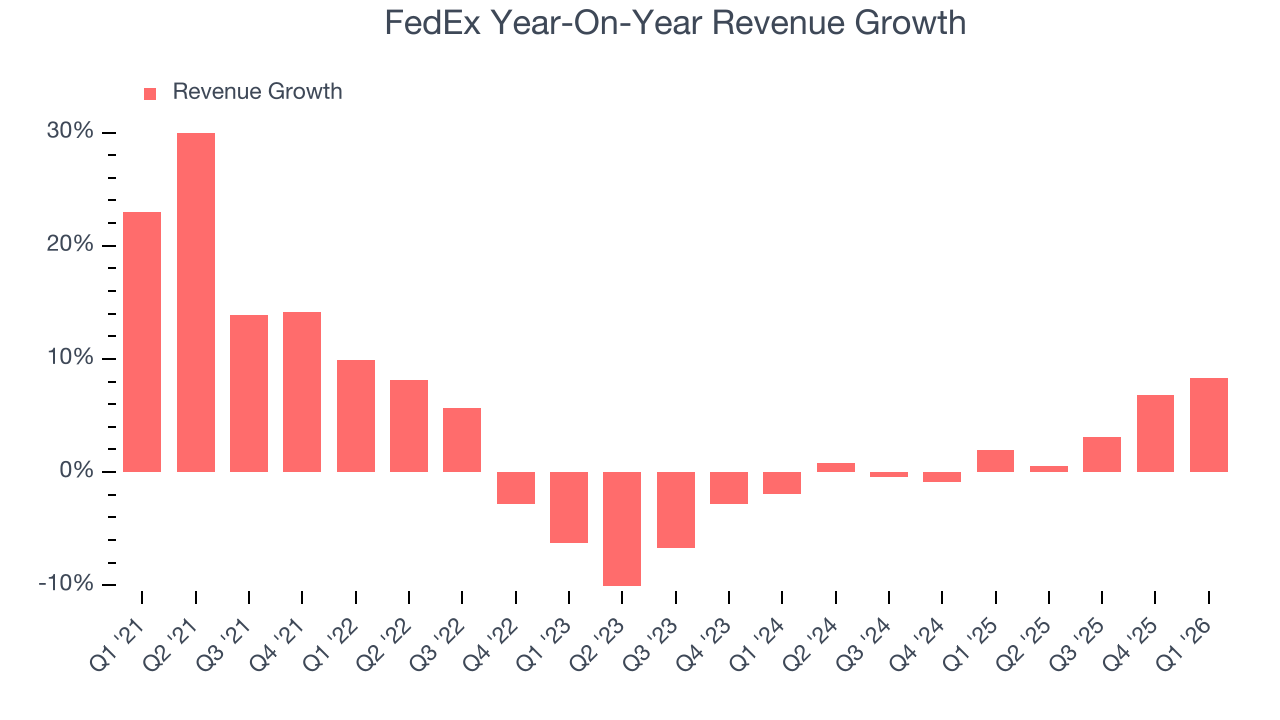
This quarter, FedEx reported year-on-year revenue growth of 8.3%, and its $24 billion of revenue exceeded Wall Street’s estimates by 2.1%.
Looking ahead, sell-side analysts expect revenue to grow 4.1% over the next 12 months. While this projection indicates its newer products and services will fuel better top-line performance, it is still below the sector average.
6. Gross Margin & Pricing Power
FedEx’s gross margin is slightly below the average industrials company, giving it less room to invest in areas such as research and development. As you can see below, it averaged a 27.1% gross margin over the last five years. Said differently, FedEx had to pay a chunky $72.88 to its suppliers for every $100 in revenue. 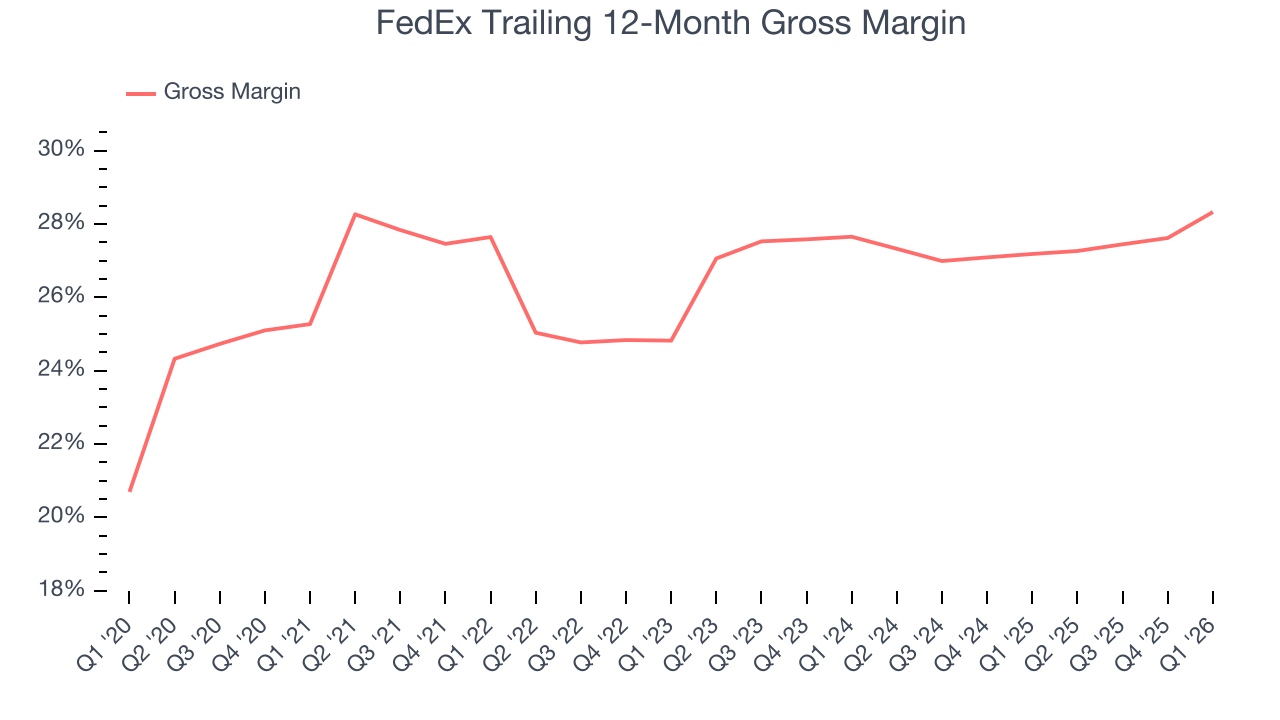
In Q1, FedEx produced a 29.2% gross profit margin, up 2.8 percentage points year on year. FedEx’s full-year margin has also been trending up over the past 12 months, increasing by 1.1 percentage points. If this move continues, it could suggest better unit economics due to more leverage from its growing sales on the fixed portion of its cost of goods sold (such as manufacturing expenses).
7. Operating Margin
Operating margin is a key measure of profitability. Think of it as net income - the bottom line - excluding the impact of taxes and interest on debt, which are less connected to business fundamentals.
FedEx’s operating margin has generally stayed the same over the last 12 months, averaging 6.1% over the last five years. This profitability was paltry for an industrials business and caused by its suboptimal cost structureand low gross margin.
Analyzing the trend in its profitability, FedEx’s operating margin might fluctuated slightly but has generally stayed the same over the last five years. This raises questions about the company’s expense base because its revenue growth should have given it leverage on its fixed costs, resulting in better economies of scale and profitability.
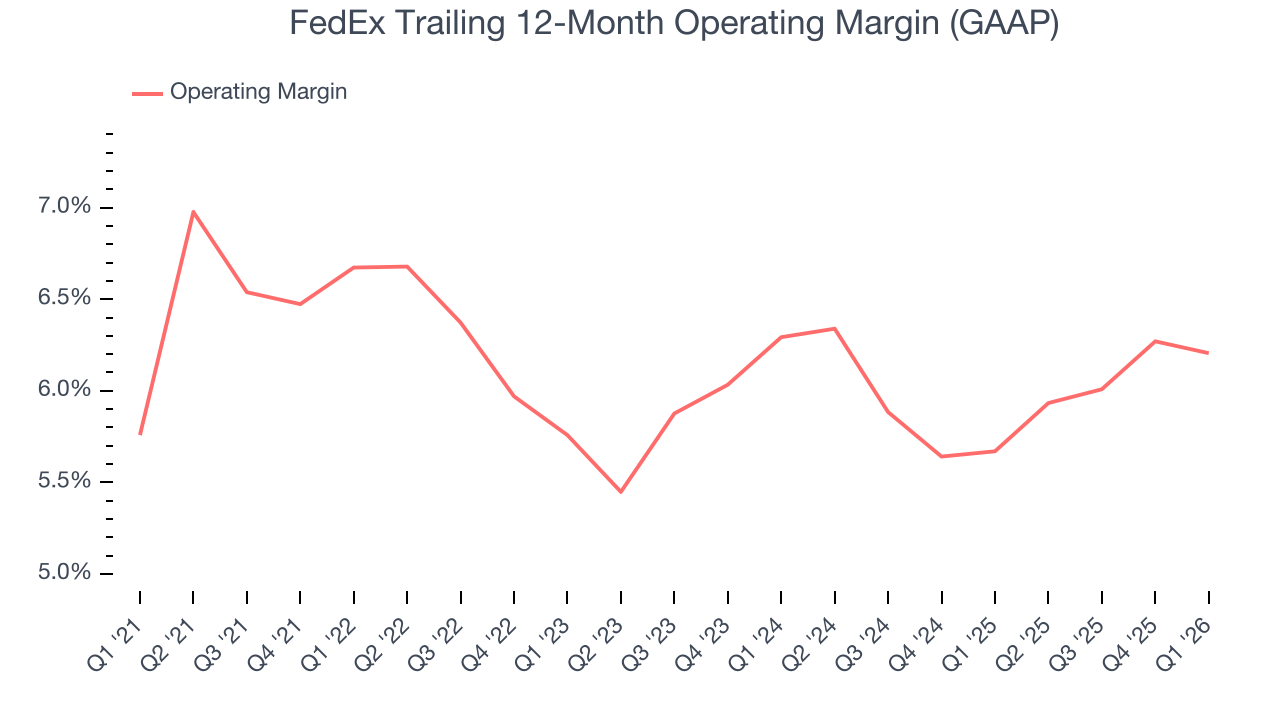
This quarter, FedEx generated an operating margin profit margin of 5.6%, in line with the same quarter last year. This indicates the company’s cost structure has recently been stable.
8. Earnings Per Share
We track the long-term change in earnings per share (EPS) for the same reason as long-term revenue growth. Compared to revenue, however, EPS highlights whether a company’s growth is profitable.
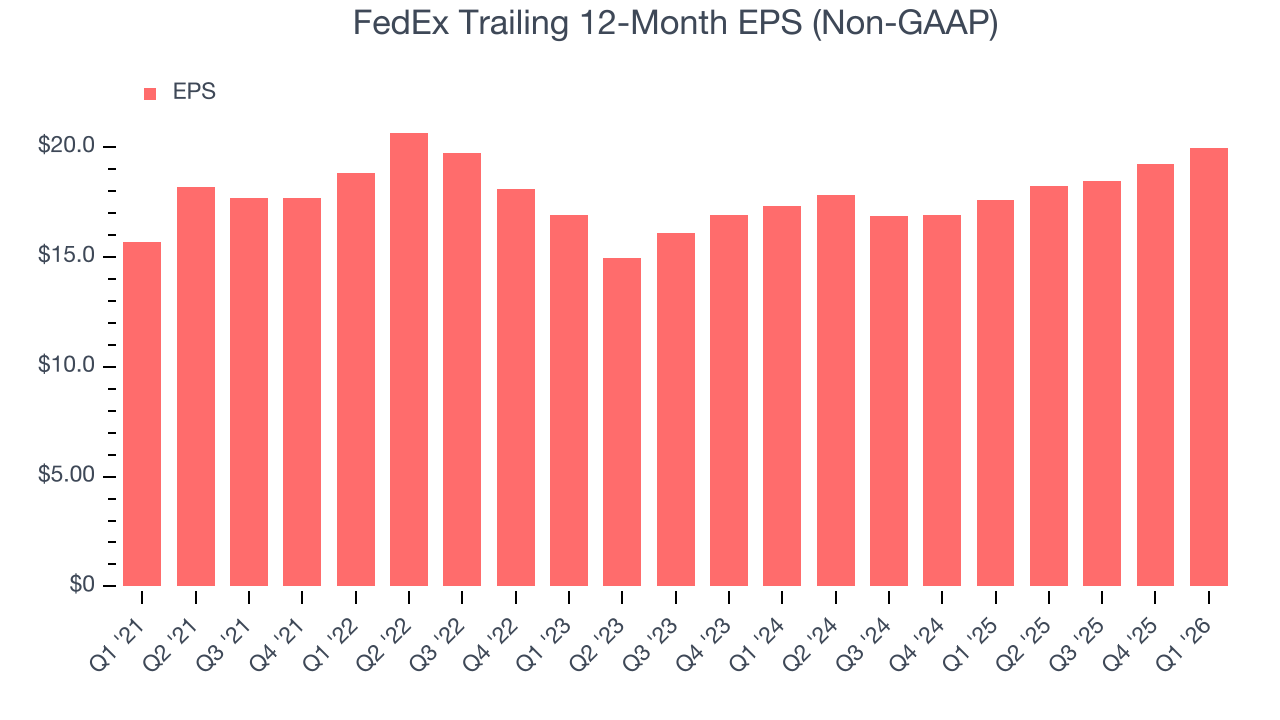
FedEx’s unimpressive 4.9% annual EPS growth over the last five years aligns with its revenue performance. This tells us it maintained its per-share profitability as it expanded.
Like with revenue, we analyze EPS over a more recent period because it can provide insight into an emerging theme or development for the business.
Although it wasn’t great, FedEx’s two-year annual EPS growth of 7.3% topped its 2.5% two-year revenue growth.
Diving into the nuances of FedEx’s earnings can give us a better understanding of its performance. A two-year view shows that FedEx has repurchased its stock, shrinking its share count by 4.4%. This tells us its EPS outperformed its revenue not because of increased operational efficiency but financial engineering, as buybacks boost per share earnings. 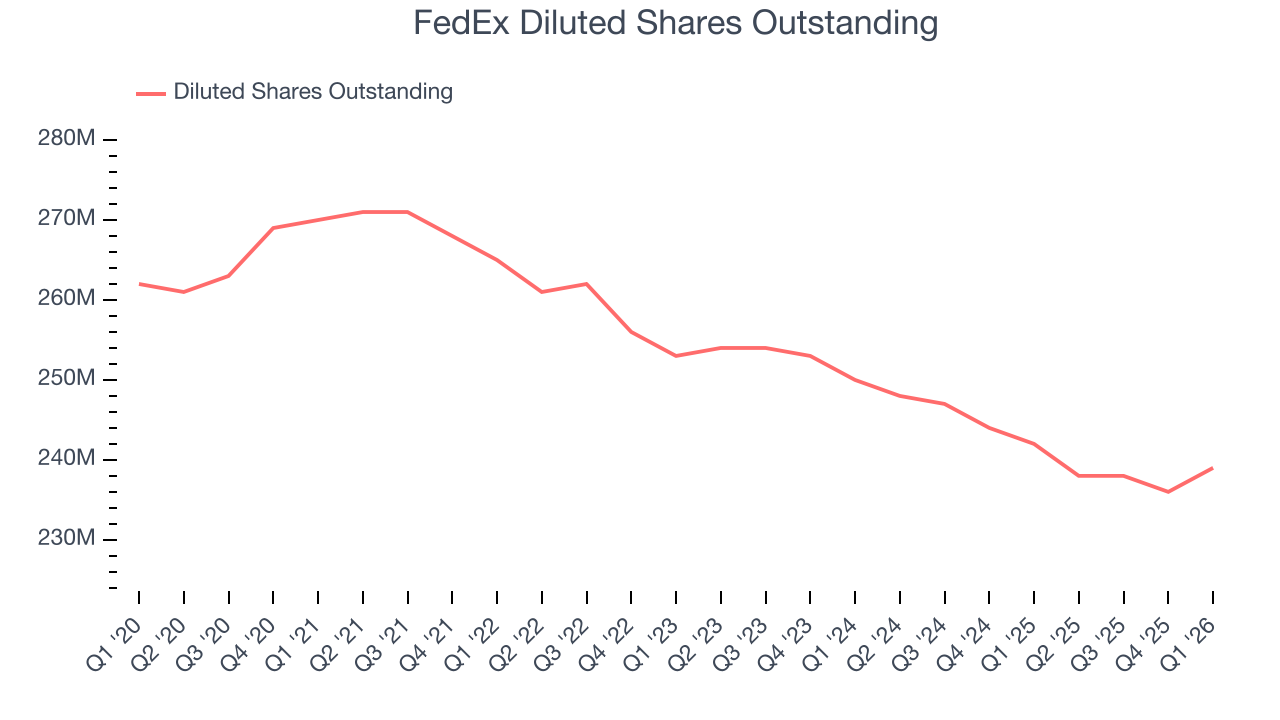
In Q1, FedEx reported adjusted EPS of $5.25, up from $4.51 in the same quarter last year. This print easily cleared analysts’ estimates, and shareholders should be content with the results. Over the next 12 months, Wall Street expects FedEx’s full-year EPS of $19.97 to grow 4.5%.
9. Cash Is King
Free cash flow isn't a prominently featured metric in company financials and earnings releases, but we think it's telling because it accounts for all operating and capital expenses, making it tough to manipulate. Cash is king.
FedEx has shown poor cash profitability relative to peers over the last five years, giving the company fewer opportunities to return capital to shareholders. Its free cash flow margin averaged 2.4%, below what we’d expect for an industrials business.
Taking a step back, an encouraging sign is that FedEx’s margin expanded by 1.3 percentage points during that time. The company’s improvement shows it’s heading in the right direction, and we can see it became a less capital-intensive business because its free cash flow profitability rose while its operating profitability was flat.
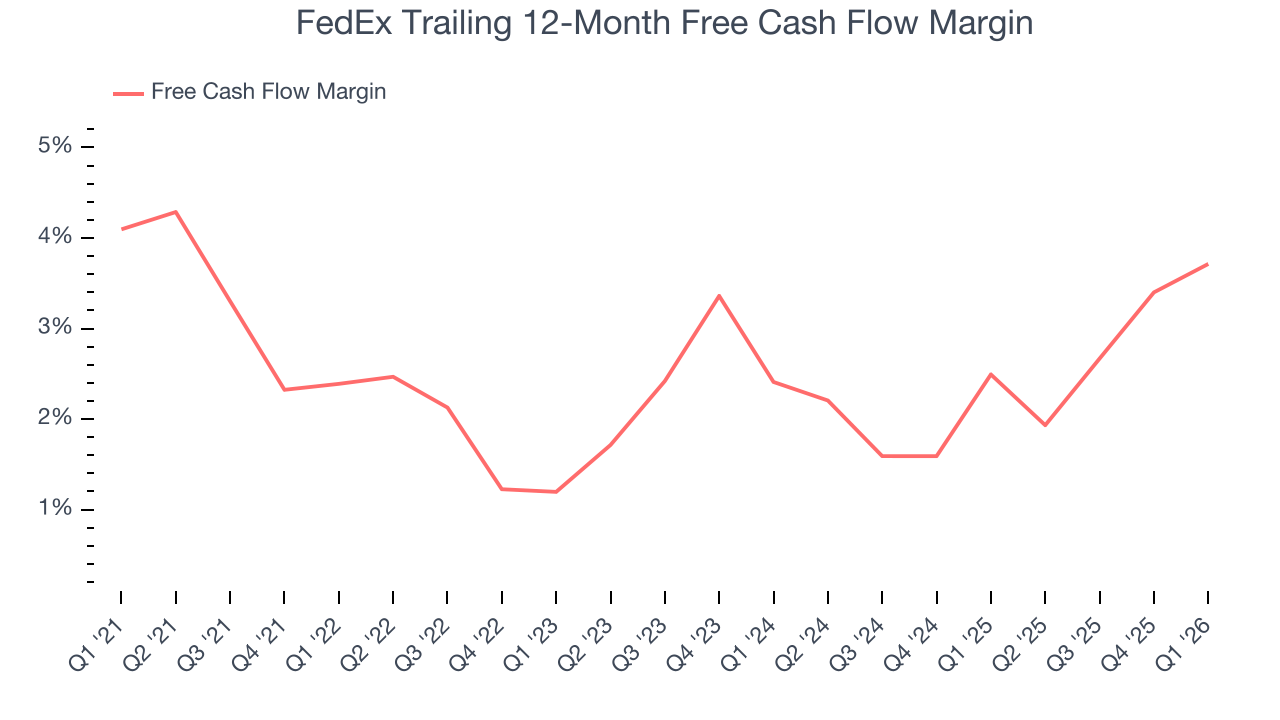
FedEx’s free cash flow clocked in at $1.04 billion in Q1, equivalent to a 4.3% margin. This result was good as its margin was 1.2 percentage points higher than in the same quarter last year, building on its favorable historical trend.
10. Return on Invested Capital (ROIC)
EPS and free cash flow tell us whether a company was profitable while growing its revenue. But was it capital-efficient? Enter ROIC, a metric showing how much operating profit a company generates relative to the money it has raised (debt and equity).
FedEx historically did a mediocre job investing in profitable growth initiatives. Its five-year average ROIC was 8.7%, somewhat low compared to the best industrials companies that consistently pump out 20%+.
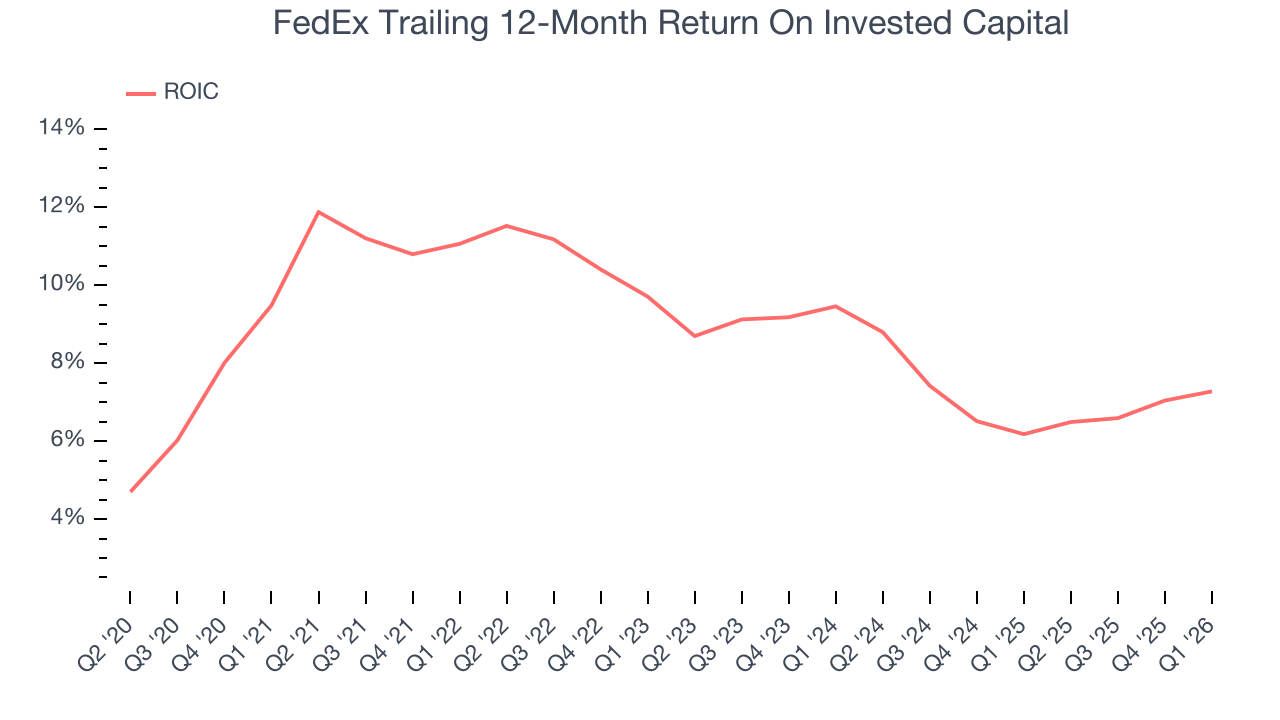
We like to invest in businesses with high returns, but the trend in a company’s ROIC is what often surprises the market and moves the stock price. Over the last few years, FedEx’s ROIC averaged 3.7 percentage point decreases each year. Paired with its already low returns, these declines suggest its profitable growth opportunities are few and far between.
11. Balance Sheet Assessment
FedEx reported $11.69 billion of cash and $42.02 billion of debt on its balance sheet in the most recent quarter. As investors in high-quality companies, we primarily focus on two things: 1) that a company’s debt level isn’t too high and 2) that its interest payments are not excessively burdening the business.
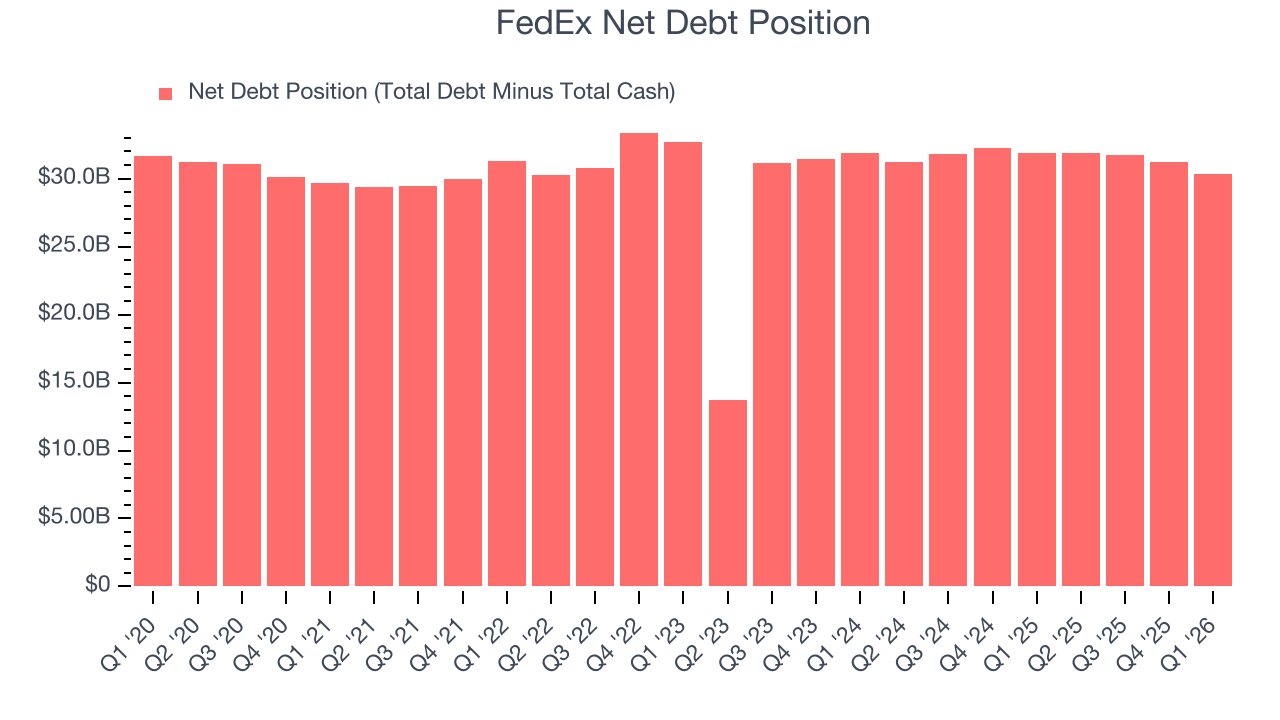
With $10.6 billion of EBITDA over the last 12 months, we view FedEx’s 2.9× net-debt-to-EBITDA ratio as safe. We also see its $516 million of annual interest expenses as appropriate. The company’s profits give it plenty of breathing room, allowing it to continue investing in growth initiatives.
12. Key Takeaways from FedEx’s Q1 Results
It was good to see FedEx beat analysts’ EPS expectations this quarter. We were also glad its full-year EPS guidance trumped Wall Street’s estimates. Zooming out, we think this was a good print with some key areas of upside. The stock traded up 3.8% to $369.71 immediately following the results.
13. Is Now The Time To Buy FedEx?
The latest quarterly earnings matters, sure, but we actually think longer-term fundamentals and valuation matter more. Investors should consider all these pieces before deciding whether or not to invest in FedEx.
FedEx doesn’t pass our quality test. First off, its revenue growth was weak over the last five years. On top of that, FedEx’s diminishing returns show management's prior bets haven't worked out, and its low free cash flow margins give it little breathing room.
FedEx’s P/E ratio based on the next 12 months is 17.1x. This valuation is reasonable, but the company’s shaky fundamentals present too much downside risk. There are better investments elsewhere.
Wall Street analysts have a consensus one-year price target of $384.96 on the company (compared to the current share price of $369.71).