
Federated Hermes (FHI)
Federated Hermes is intriguing. Its superb 25.3% ROE illustrates its skill in making high-return investments.― StockStory Analyst Team


1. News


2. Summary
Why Federated Hermes Is Interesting
With roots dating back to 1955 and a pioneering role in money market funds, Federated Hermes (NYSE:FHI) is an investment management firm that offers a wide range of funds and strategies for institutional and individual investors.
- ROE punches in at 25.3%, illustrating management’s expertise in identifying profitable investments
- One risk is its annual revenue growth of 4.5% over the last five years was below our standards for the financials sector
Federated Hermes has some noteworthy aspects. If you like the story, the valuation looks reasonable.
Why Is Now The Time To Buy Federated Hermes?




Federated Hermes is trading at $56.02 per share, or 11.1x forward P/E. The current valuation is below that of most financials companies, but this isn’t a bargain. Instead, the price is appropriate for the quality you get.
If you think the market is undervaluing the company, now could be a good time to build a position.
3. Federated Hermes (FHI) Research Report: Q4 CY2025 Update
Investment management firm Federated Hermes (NYSE:FHI) reported Q4 CY2025 results beating Wall Street’s revenue expectations, with sales up 13.7% year on year to $482.8 million. Its GAAP profit of $1.39 per share was 14% above analysts’ consensus estimates.
Federated Hermes (FHI) Q4 CY2025 Highlights:
- Revenue: $482.8 million vs analyst estimates of $472.3 million (13.7% year-on-year growth, 2.2% beat)
- Pre-tax Profit: $140.3 million (29.1% margin)
- EPS (GAAP): $1.39 vs analyst estimates of $1.22 (14% beat)
- Market Capitalization: $3.91 billion
Company Overview
With roots dating back to 1955 and a pioneering role in money market funds, Federated Hermes (NYSE:FHI) is an investment management firm that offers a wide range of funds and strategies for institutional and individual investors.
Federated Hermes manages assets across equity, fixed-income, alternative/private markets, multi-asset, and liquidity management strategies. The company is particularly known for its money market funds, which provide investors with relatively stable, liquid investments for cash management. These funds are used by corporations, government entities, and financial institutions to park short-term cash while earning modest returns.
The firm serves a diverse client base that includes banks, broker-dealers, wealth managers, retirement plans, public entities, corporations, insurance companies, foundations, and individual investors. Clients turn to Federated Hermes to access professional investment management, diversification, and expertise in navigating financial markets.
For example, a corporate treasurer might use Federated Hermes' money market funds to manage the company's cash reserves, while a pension fund might invest in the firm's equity or fixed-income strategies to meet long-term obligations to retirees. Meanwhile, individual investors can access the company's mutual funds through their financial advisors or retirement plans.
Federated Hermes generates revenue primarily through management fees based on assets under management. The company expanded its global presence and strengthened its environmental, social, and governance (ESG) capabilities through its acquisition of a majority stake in UK-based Hermes Investment Management in 2018, fully completing the acquisition in 2020. The firm operates globally with offices across North America, Europe, and parts of Asia, allowing it to serve clients worldwide while providing insights into regional market dynamics.
4. Custody Bank
Custody banks safeguard financial assets and provide services like settlement, accounting, and regulatory compliance for institutional investors. Growth opportunities stem from increasing global assets under custody, demand for data analytics, and blockchain technology adoption for settlement efficiency. Challenges include fee pressure from large clients, substantial technology investment requirements, and competition from both traditional players and fintech firms entering the space.
Federated Hermes competes with other asset management firms including BlackRock (NYSE:BLK), Vanguard, Fidelity Investments, T. Rowe Price (NASDAQ:TROW), Franklin Templeton (NYSE:BEN), and Invesco (NYSE:IVZ).
5. Revenue Growth
Examining a company’s long-term performance can provide clues about its quality. Any business can have short-term success, but a top-tier one grows for years. Over the last five years, Federated Hermes grew its revenue at a sluggish 4.5% compounded annual growth rate. This wasn’t a great result compared to the rest of the financials sector, but there are still things to like about Federated Hermes.
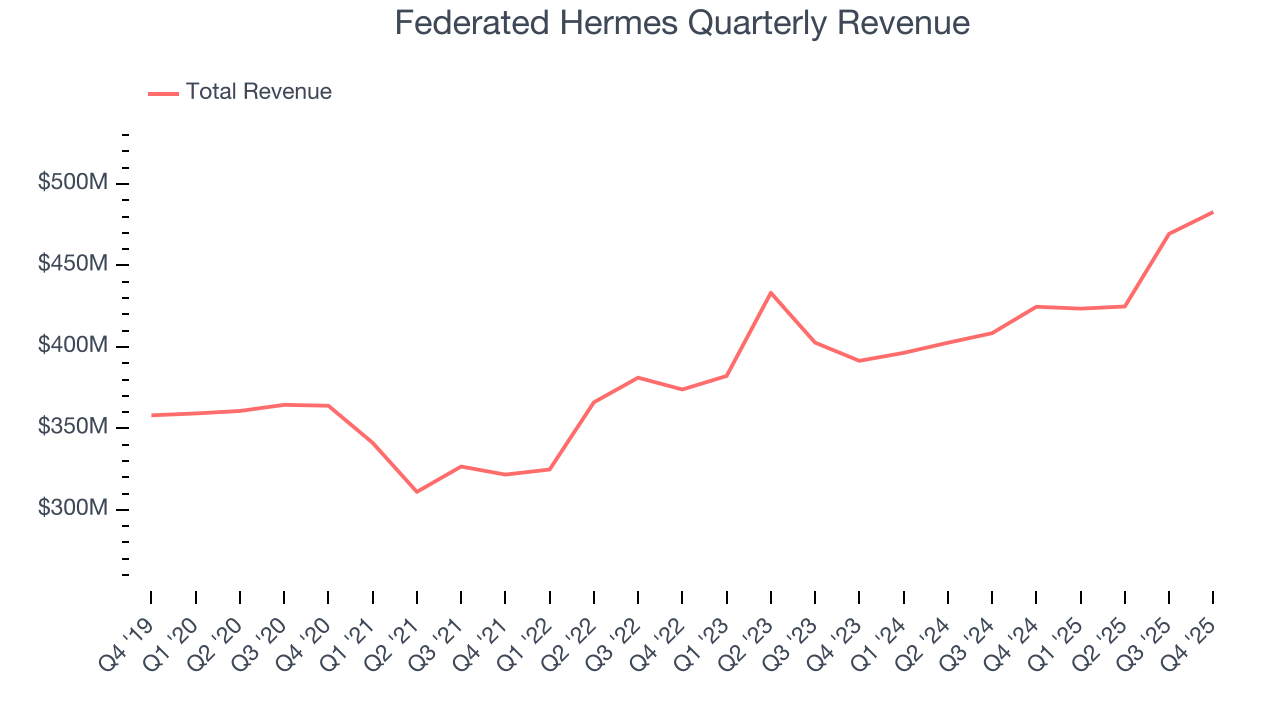
Long-term growth is the most important, but within financials, a half-decade historical view may miss recent interest rate changes and market returns. Federated Hermes’s annualized revenue growth of 5.8% over the last two years is above its five-year trend, but we were still disappointed by the results. 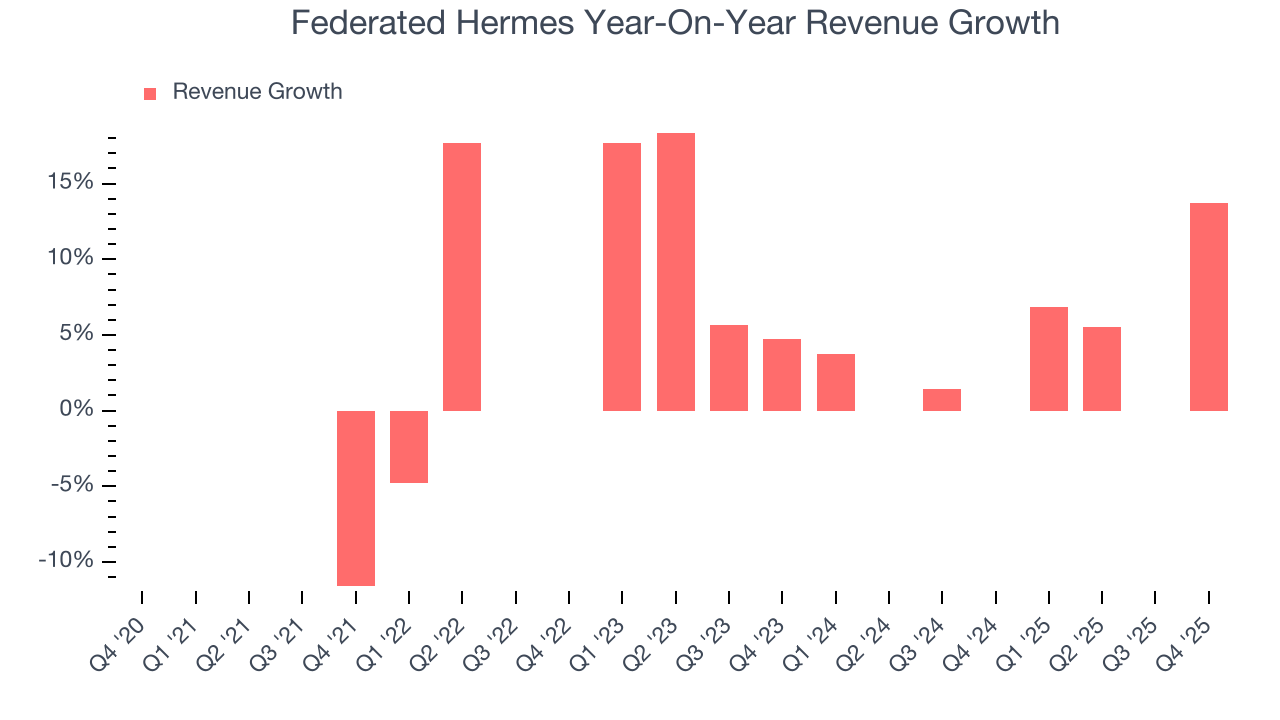 Note: Quarters not shown were determined to be outliers, impacted by outsized investment gains/losses that are not indicative of the recurring fundamentals of the business.
This quarter, Federated Hermes reported year-on-year revenue growth of 13.7%, and its $482.8 million of revenue exceeded Wall Street’s estimates by 2.2%.
6. Assets Under Management (AUM)
Assets Under Management (AUM) represents the total value of investments that a financial institution manages for its clients. These assets generate steady income through management fees, creating predictable revenue streams that remain stable so long as clients remain invested with the firm.
Federated Hermes’s AUM has grown at an annual rate of 5.6% over the last five years, worse than the broader financials industry but faster than its total revenue. When analyzing Federated Hermes’s AUM over the last two years, we can see that growth accelerated to 6.1% annually. This performance aligned with its total revenue.
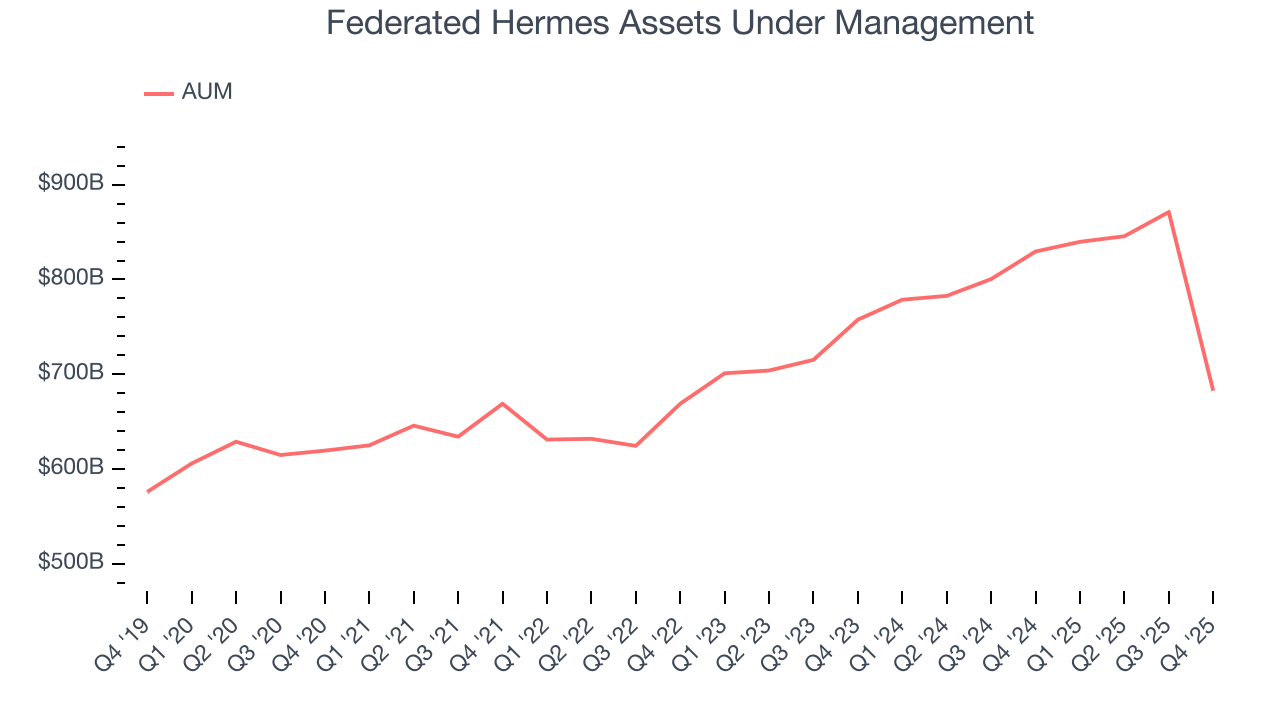
Federated Hermes’s AUM punched in at $682.6 billion this quarter, falling 23.8% short of analysts’ expectations. This print was 17.7% lower than the same quarter last year.
7. Pre-Tax Profit Margin
Revenue growth is one major determinant of business quality, and the efficiency of operations is another. For Custody Bank companies, we look at pre-tax profit rather than the operating margin that defines sectors such as consumer, tech, and industrials.
The pre-tax profit margin includes interest because it's central to how financial institutions generate revenue and manage costs. Tax considerations are excluded since they represent government policy rather than operational performance, giving investors a clearer view of business fundamentals.
Over the last five years, Federated Hermes’s pre-tax profit margin couldn’t build momentum, hanging around 30.4%. Luckily, it seems the company has recently taken steps to address its expense base as its pre-tax profit margin expanded by 4.9 percentage points on a two-year basis.
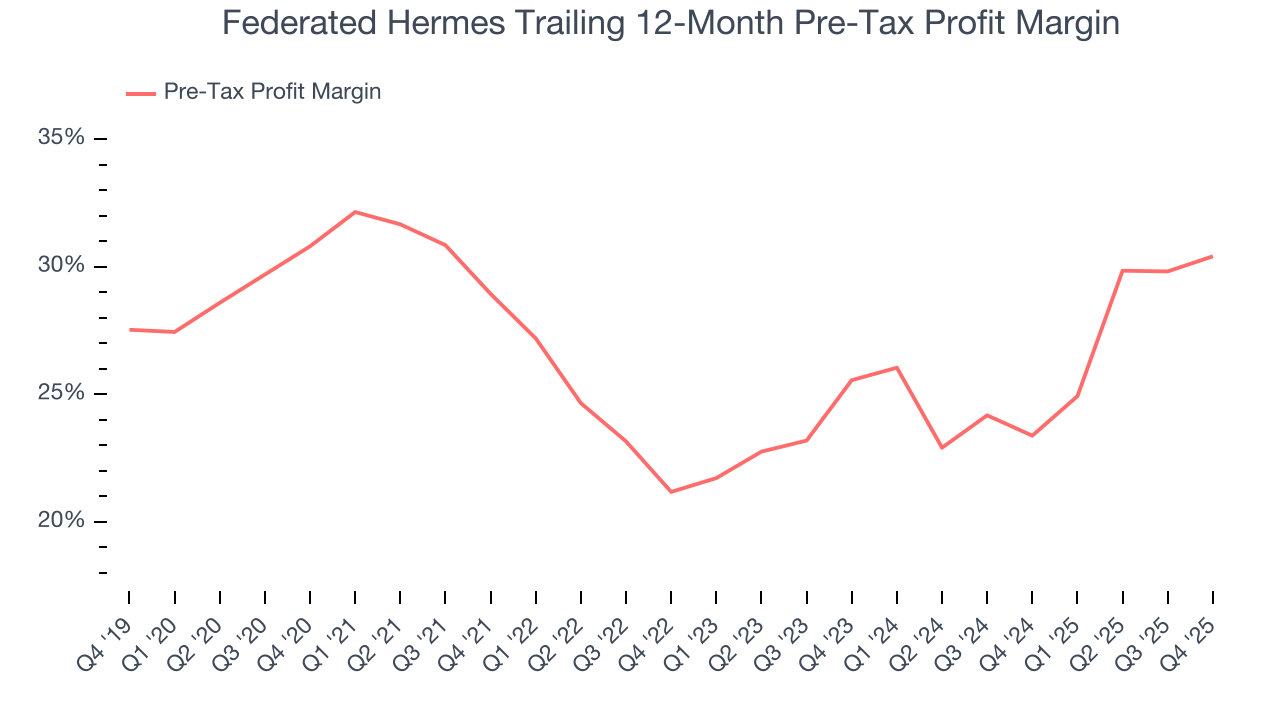
In Q4, Federated Hermes’s pre-tax profit margin was 29.1%. This result was 2.6 percentage points better than the same quarter last year.
8. Earnings Per Share
We track the long-term change in earnings per share (EPS) for the same reason as long-term revenue growth. Compared to revenue, however, EPS highlights whether a company’s growth is profitable.
Federated Hermes’s EPS grew at an unimpressive 9.9% compounded annual growth rate over the last five years. This performance was better than its flat revenue but doesn’t tell us much about its business quality because its pre-tax profit margin didn’t improve.
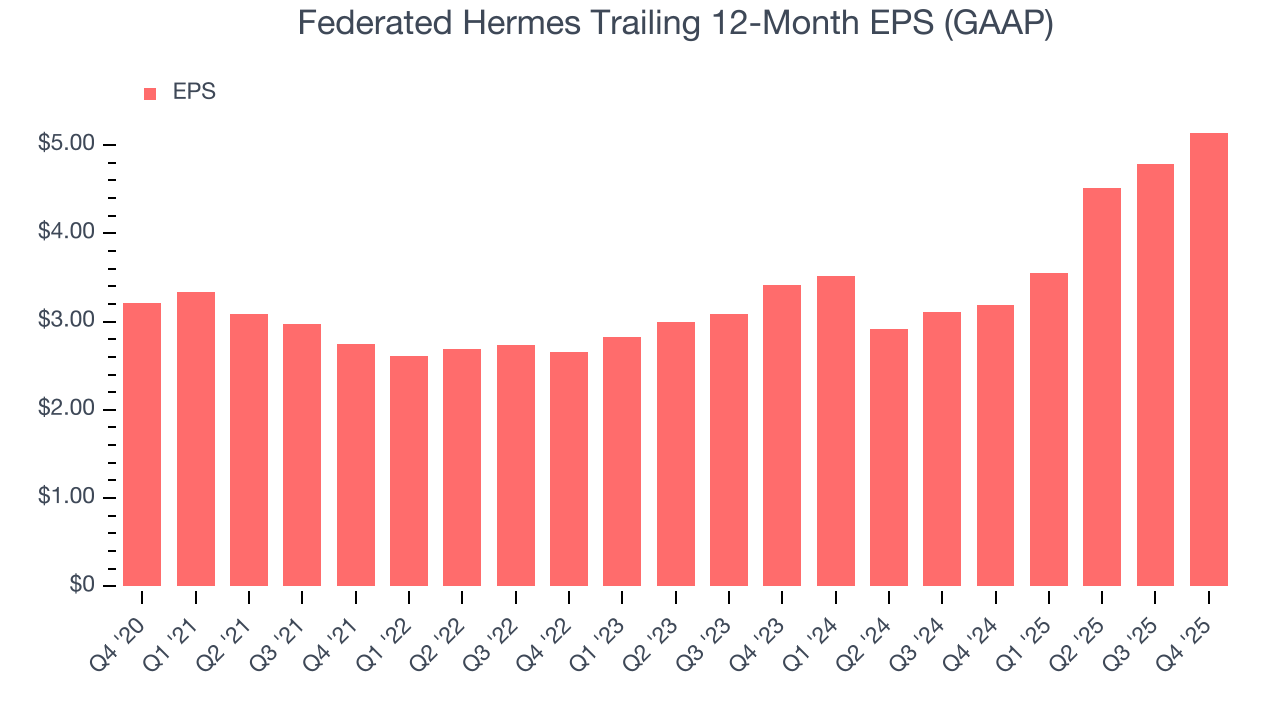
Like with revenue, we analyze EPS over a shorter period to see if we are missing a change in the business.
For Federated Hermes, its two-year annual EPS growth of 22.8% was higher than its five-year trend. This acceleration made it one of the faster-growing financials companies in recent history.
In Q4, Federated Hermes reported EPS of $1.39, up from $1.04 in the same quarter last year. This print easily cleared analysts’ estimates, and shareholders should be content with the results. Over the next 12 months, Wall Street expects Federated Hermes’s full-year EPS of $5.14 to shrink by 2.4%.
9. Return on Equity
Return on equity, or ROE, tells us how much profit a company generates for each dollar of shareholder equity, a key funding source for banks. Over a long period, banks with high ROE tend to compound shareholder wealth faster through retained earnings, buybacks, and dividends.
Over the last five years, Federated Hermes has averaged an ROE of 24.8%, exceptional for a company operating in a sector where the average shakes out around 10% and those putting up 25%+ are greatly admired. This shows Federated Hermes has a strong competitive moat.
10. Balance Sheet Assessment
The debt-to-equity ratio is a widely used measure to assess a company's balance sheet health. A higher ratio means that a business aggressively financed its growth with debt. This can result in higher earnings (if the borrowed funds are invested profitably) but also increases risk.
If debt levels are too high, there could be difficulties in meeting obligations, especially during economic downturns or periods of rising interest rates if the debt has variable-rate payments.
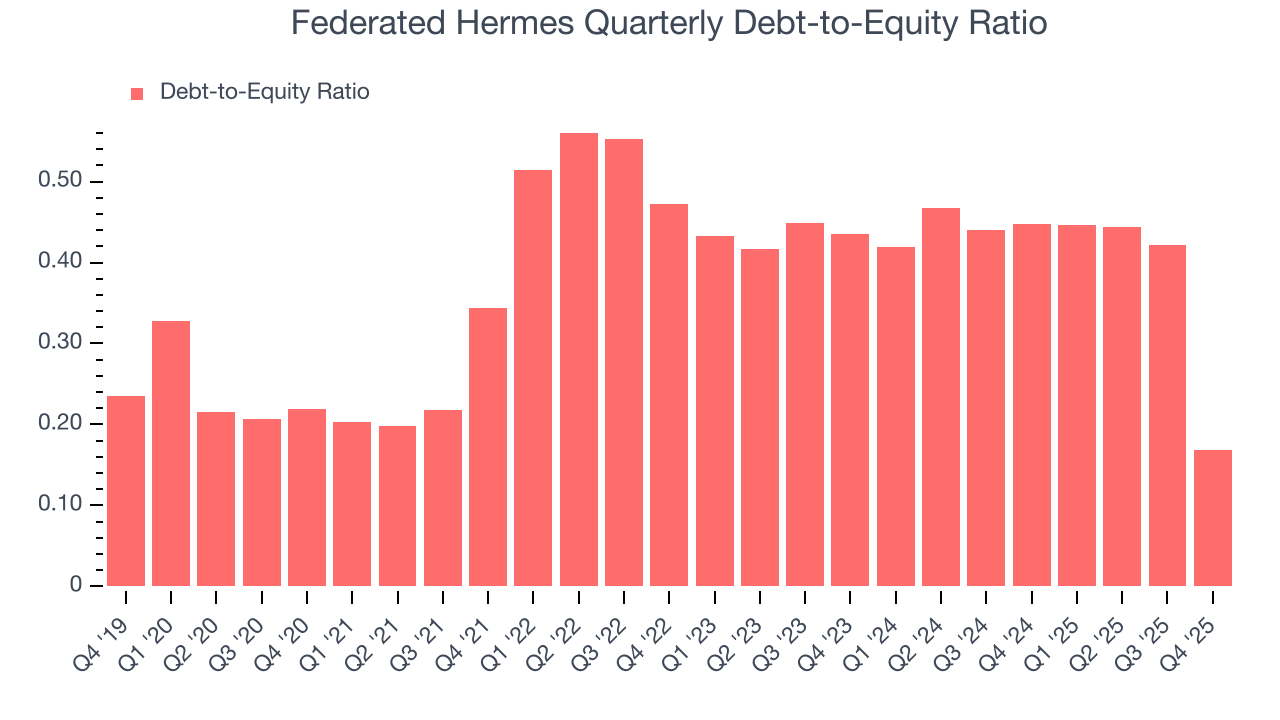
Federated Hermes currently has $348.4 million of debt and $2.07 billion of shareholder's equity on its balance sheet, and over the past four quarters, has averaged a debt-to-equity ratio of 0.4×. We think this is safe and raises no red flags. In general, we’re comfortable with any ratio below 3.5× for a financials business.
11. Key Takeaways from Federated Hermes’s Q4 Results
It was good to see Federated Hermes beat analysts’ EPS expectations this quarter. We were also happy its revenue outperformed Wall Street’s estimates. Overall, we think this was a solid quarter with some key areas of upside. The stock traded up 2.8% to $54.60 immediately following the results.
12. Is Now The Time To Buy Federated Hermes?
Updated: March 29, 2026 at 12:44 AM EDT
When considering an investment in Federated Hermes, investors should account for its valuation and business qualities as well as what’s happened in the latest quarter.
Federated Hermes is a fine business. Although its revenue growth was uninspiring over the last five years, its growth over the next 12 months is expected to be higher. And while Federated Hermes’s pre-tax profit margin didn’t move over the last five years, its stellar ROE suggests it has been a well-run company historically.
Federated Hermes’s P/E ratio based on the next 12 months is 11.1x. When scanning the financials space, Federated Hermes trades at a fair valuation. For those confident in the business and its management team, this is a good time to invest.
Wall Street analysts have a consensus one-year price target of $55.57 on the company (compared to the current share price of $56.02).