
Flutter Entertainment (FLUT)
We wouldn’t recommend Flutter Entertainment. Its poor sales growth shows demand is soft and its negative returns on capital suggest it destroyed value.― StockStory Analyst Team


1. News
2. Summary
Why We Think Flutter Entertainment Will Underperform
With its digital fingerprints on nearly every aspect of global gambling, from the Super Bowl bettor to the online poker aficionado, Flutter Entertainment (NASDAQ:FLUT) operates a portfolio of leading online sports betting and gaming brands including FanDuel, PokerStars, Paddy Power, and Sky Betting & Gaming.
- Annual sales growth of 17.9% over the last two years lagged behind its consumer discretionary peers as its large revenue base made it difficult to generate incremental demand
- Operating margin falls short of the industry average, and the smaller profit dollars make it harder to react to unexpected market developments
- Lacking free cash flow limits its freedom to invest in growth initiatives, execute share buybacks, or pay dividends
Flutter Entertainment is skating on thin ice. There’s a wealth of better opportunities.
Why There Are Better Opportunities Than Flutter Entertainment








At $114.40 per share, Flutter Entertainment trades at 13.3x forward P/E. This multiple is lower than most consumer discretionary companies, but for good reason.
It’s better to pay up for high-quality businesses with higher long-term earnings potential rather than to buy lower-quality stocks because they appear cheap. These challenged businesses often don’t re-rate, a phenomenon known as a “value trap”.
3. Flutter Entertainment (FLUT) Research Report: Q4 CY2025 Update
Global online betting powerhouse Flutter Entertainment (NASDAQ:FLUT) fell short of the market’s revenue expectations in Q4 CY2025, but sales rose 24.9% year on year to $4.74 billion. Its GAAP loss of $0.05 per share was significantly below analysts’ consensus estimates.
Flutter Entertainment (FLUT) Q4 CY2025 Highlights:
- Revenue: $4.74 billion vs analyst estimates of $4.97 billion (24.9% year-on-year growth, 4.6% miss)
- EPS (GAAP): -$0.05 vs analyst estimates of $0.76 (significant miss)
- Adjusted EBITDA: $832 million vs analyst estimates of $892.8 million (17.6% margin, 6.8% miss)
- Operating Margin: 5.4%, down from 7.4% in the same quarter last year
- Free Cash Flow Margin: 2.9%, down from 12.1% in the same quarter last year
- Market Capitalization: $21 billion
Company Overview
With its digital fingerprints on nearly every aspect of global gambling, from the Super Bowl bettor to the online poker aficionado, Flutter Entertainment (NASDAQ:FLUT) operates a portfolio of leading online sports betting and gaming brands including FanDuel, PokerStars, Paddy Power, and Sky Betting & Gaming.
Flutter organizes its business across four geographic segments: U.S., UK & Ireland, Australia, and International, with 91% of revenue generated online. The company offers three core product categories: sportsbook (56% of revenue), where customers bet on sporting events at fixed odds; iGaming (40%), which includes casino games, poker, and lottery products; and other offerings (4%) like betting exchanges and daily fantasy sports.
In the crucial U.S. market, Flutter's FanDuel has established itself as a market leader, operating in 23 states for sports betting and 5 states for online casino. FanDuel has secured partnerships with major sports leagues including the NBA, NFL, MLB, and NHL, enhancing its brand visibility and customer acquisition.
Internationally, Flutter's portfolio includes country-specific powerhouses like Sportsbet in Australia, Paddy Power in Ireland and the UK, and Sisal in Italy. The company typically enters markets through local licensing arrangements, partnerships with land-based casinos, or via multi-jurisdictional licenses from regulatory hubs like Malta.
Flutter's technology platform allows customers to seamlessly move between betting products. For instance, a FanDuel sportsbook user in states where iGaming is permitted can access casino games directly within the sportsbook app. This cross-selling approach increases customer lifetime value while reducing acquisition costs, as a sports bettor placing wagers on Sunday football might also try blackjack or roulette during halftime.
4. Consumer Discretionary - Casino Operator
The Consumer Discretionary sector, by definition, is made up of companies selling non-essential goods and services. When economic conditions deteriorate or tastes shift, consumers can easily cut back or eliminate these purchases. For long-term investors with five-year holding periods, this creates a structural challenge: the sector is inherently hit-driven, with low switching costs and fickle customers. As a result, only a handful of companies can reliably grow demand and compound earnings over long periods, which is why our bar is high and High Quality ratings are rare.
Casino operators run gaming resorts and facilities that generate revenue from gambling, hospitality, food and beverage, and entertainment offerings. Tailwinds include pent-up travel demand, expansion into new jurisdictions legalizing gaming, and growing interest in integrated resort developments in Asia and the Middle East. However, the industry faces notable headwinds: heavy regulatory and licensing requirements limit operational flexibility, capital expenditure for property development and renovation is substantial, and revenue is highly sensitive to macroeconomic conditions and consumer confidence. Rising competition from online gambling platforms, regional saturation in mature markets, and geopolitical risks in key international jurisdictions add further uncertainty.
Flutter Entertainment competes with other global gambling companies including DraftKings (NASDAQ:DKNG), MGM Resorts International's BetMGM (NYSE:MGM), Entain (OTCMKTS:GMVHY), Caesars Entertainment (NASDAQ:CZR), and privately-held Bet365.
5. Revenue Growth
A company’s long-term sales performance can indicate its overall quality. Any business can experience short-term success, but top-performing ones enjoy sustained growth for years. Over the last five years, Flutter Entertainment grew its sales at a 30% annual rate. Though this growth is acceptable on an absolute basis, we need to see more than just topline growth for the consumer discretionary sector, which can display significant earnings volatility. This means our bar for the sector is particularly high, reflecting the non-essential and hit-driven nature of the products and services offered. Additionally, five-year CAGR starts around Covid, when revenue was depressed then rebounded.
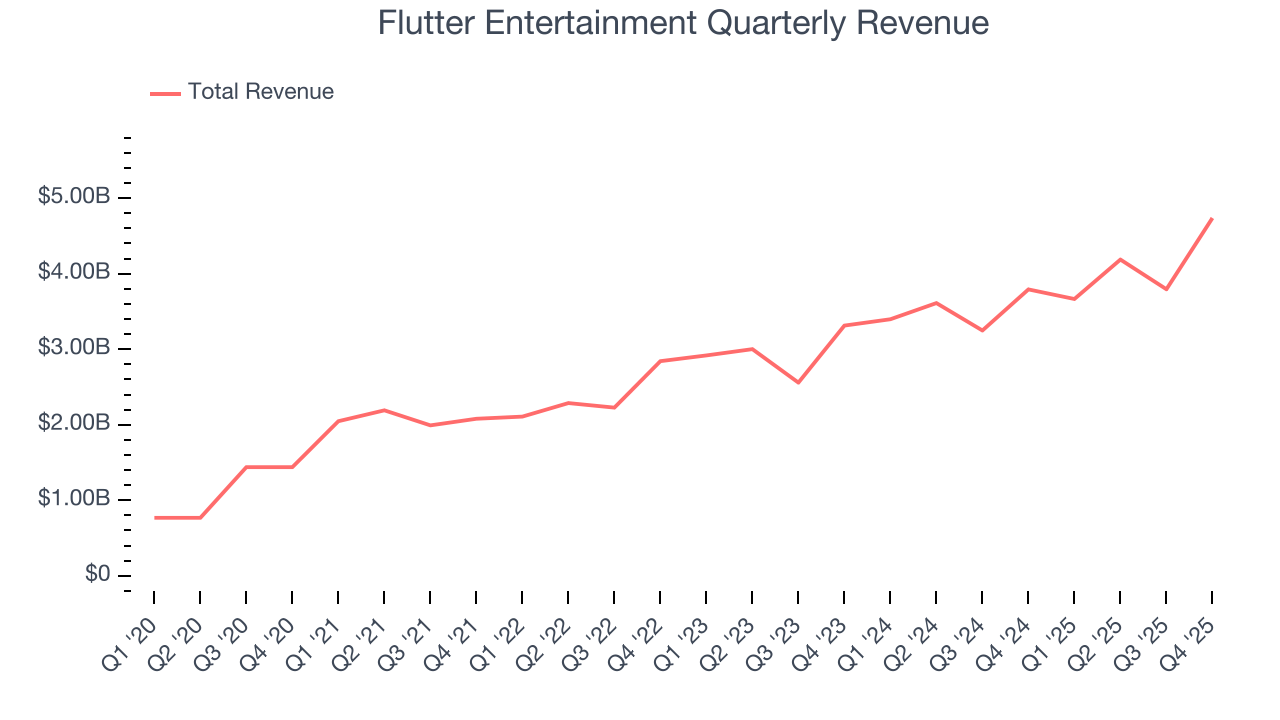
Long-term growth is the most important, but within consumer discretionary, product cycles are short and revenue can be hit-driven due to rapidly changing trends and consumer preferences. Flutter Entertainment’s recent performance shows its demand has slowed as its annualized revenue growth of 17.9% over the last two years was below its five-year trend. We’re wary when companies in the sector see decelerations in revenue growth, as it could signal changing consumer tastes aided by low switching costs. Note that COVID hurt Flutter Entertainment’s business in 2020 and part of 2021, and it bounced back in a big way thereafter. 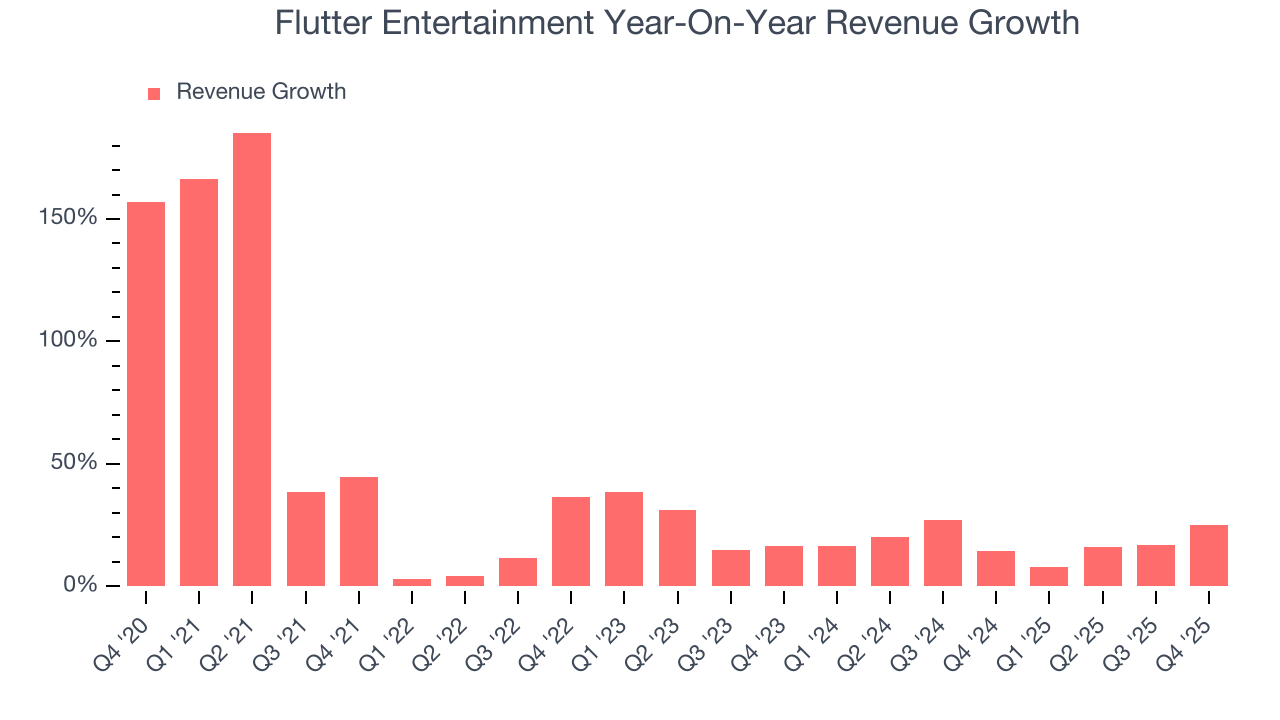
This quarter, Flutter Entertainment generated an excellent 24.9% year-on-year revenue growth rate, but its $4.74 billion of revenue fell short of Wall Street’s high expectations.
Looking ahead, sell-side analysts expect revenue to grow 16.8% over the next 12 months, similar to its two-year rate. We still think its growth trajectory is attractive given its scale and implies the market is baking in success for its products and services.
6. Operating Margin
Flutter Entertainment’s operating margin has shrunk over the last 12 months and averaged 3% over the last two years. The company’s profitability was mediocre for a consumer discretionary business and shows it couldn’t pass its higher operating expenses onto its customers.
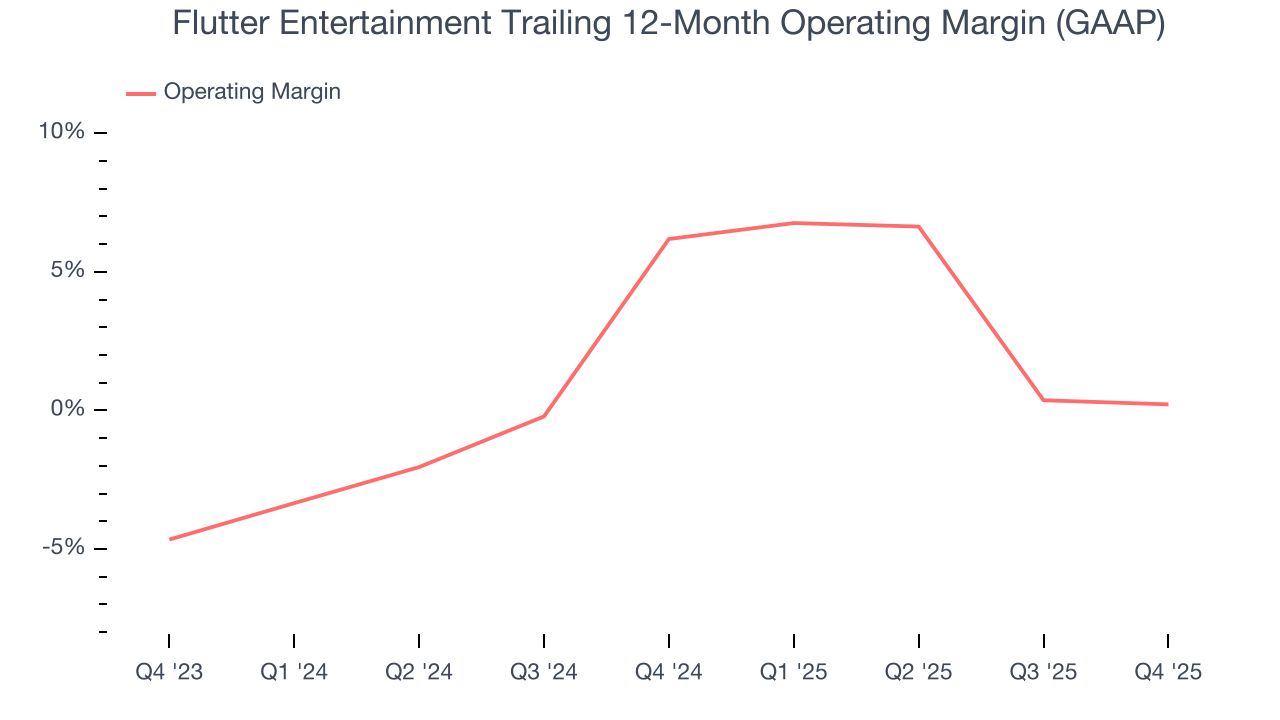
This quarter, Flutter Entertainment generated an operating margin profit margin of 5.4%, down 1.9 percentage points year on year. This reduction is quite minuscule and indicates the company’s overall cost structure has been relatively stable.
7. Earnings Per Share
Revenue trends explain a company’s historical growth, but the long-term change in earnings per share (EPS) points to the profitability of that growth – for example, a company could inflate its sales through excessive spending on advertising and promotions.
Although Flutter Entertainment’s full-year earnings are still negative, it reduced its losses and improved its EPS by 21.3% annually over the last four years. The next few quarters will be critical for assessing its long-term profitability.
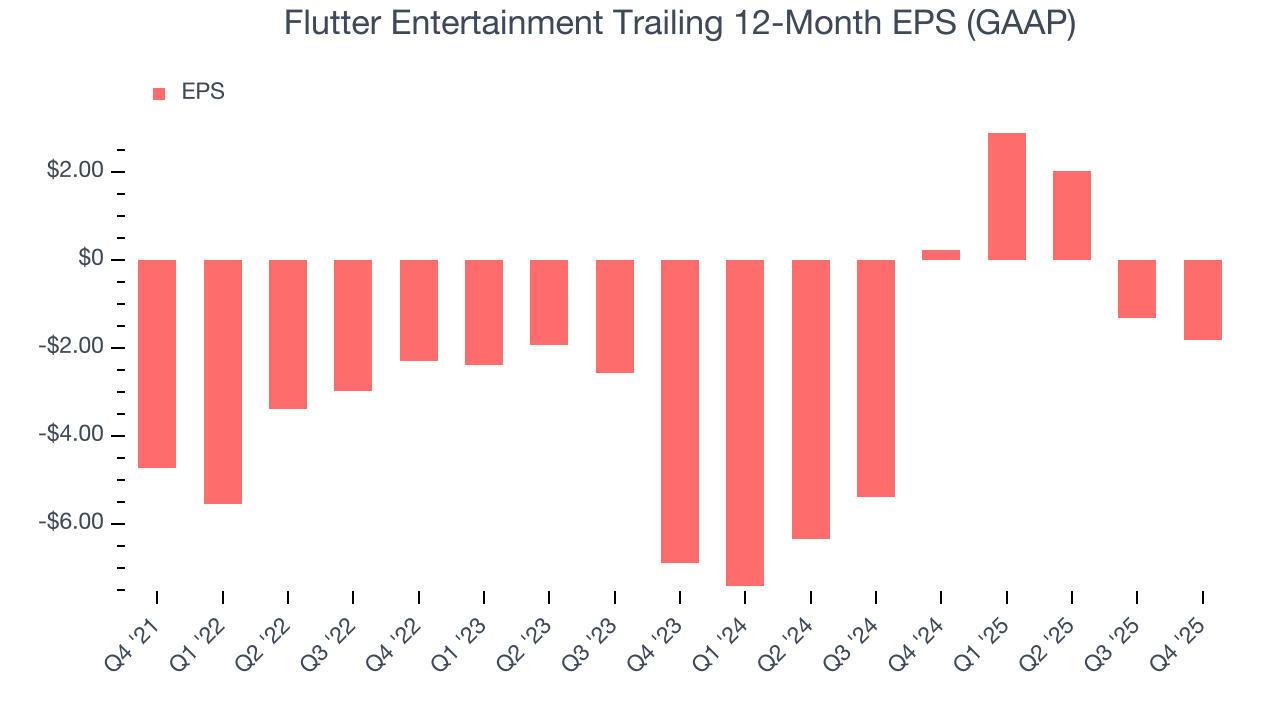
In Q4, Flutter Entertainment reported EPS of negative $0.05, down from $0.45 in the same quarter last year. This print missed analysts’ estimates. Over the next 12 months, Wall Street is optimistic. Analysts forecast Flutter Entertainment’s full-year EPS of negative $1.81 will flip to positive $4.52.
8. Cash Is King
Although earnings are undoubtedly valuable for assessing company performance, we believe cash is king because you can’t use accounting profits to pay the bills.
Flutter Entertainment has shown poor cash profitability over the last two years, giving the company limited opportunities to return capital to shareholders. Its free cash flow margin averaged 5.2%, lousy for a consumer discretionary business.
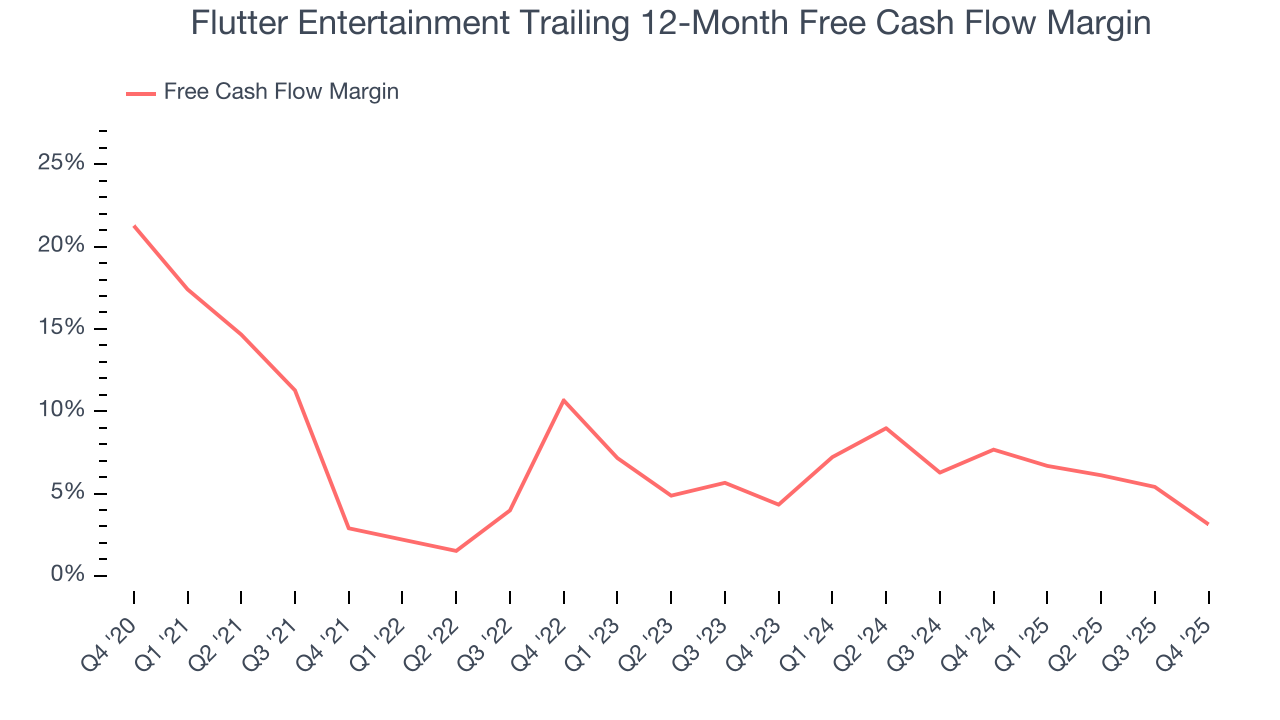
Flutter Entertainment’s free cash flow clocked in at $138 million in Q4, equivalent to a 2.9% margin. The company’s cash profitability regressed as it was 9.2 percentage points lower than in the same quarter last year, prompting us to pay closer attention. Short-term fluctuations typically aren’t a big deal because investment needs can be seasonal, but we’ll be watching to see if the trend extrapolates into future quarters.
Over the next year, analysts predict Flutter Entertainment’s cash conversion will improve. Their consensus estimates imply its free cash flow margin of 3.1% for the last 12 months will increase to 7.5%, it options for capital deployment (investments, share buybacks, etc.).
9. Return on Invested Capital (ROIC)
EPS and free cash flow tell us whether a company was profitable while growing its revenue. But was it capital-efficient? A company’s ROIC explains this by showing how much operating profit it makes compared to the money it has raised (debt and equity).
Flutter Entertainment’s five-year average ROIC was negative 1.8%, meaning management lost money while trying to expand the business. Its returns were among the worst in the consumer discretionary sector.
We like to invest in businesses with high returns, but the trend in a company’s ROIC is what often surprises the market and moves the stock price. Fortunately, Flutter Entertainment’s has increased over the last few years. This is a good sign, and we hope the company can continue improving.
10. Balance Sheet Assessment
Flutter Entertainment reported $1.9 billion of cash and $12.87 billion of debt on its balance sheet in the most recent quarter. As investors in high-quality companies, we primarily focus on two things: 1) that a company’s debt level isn’t too high and 2) that its interest payments are not excessively burdening the business.
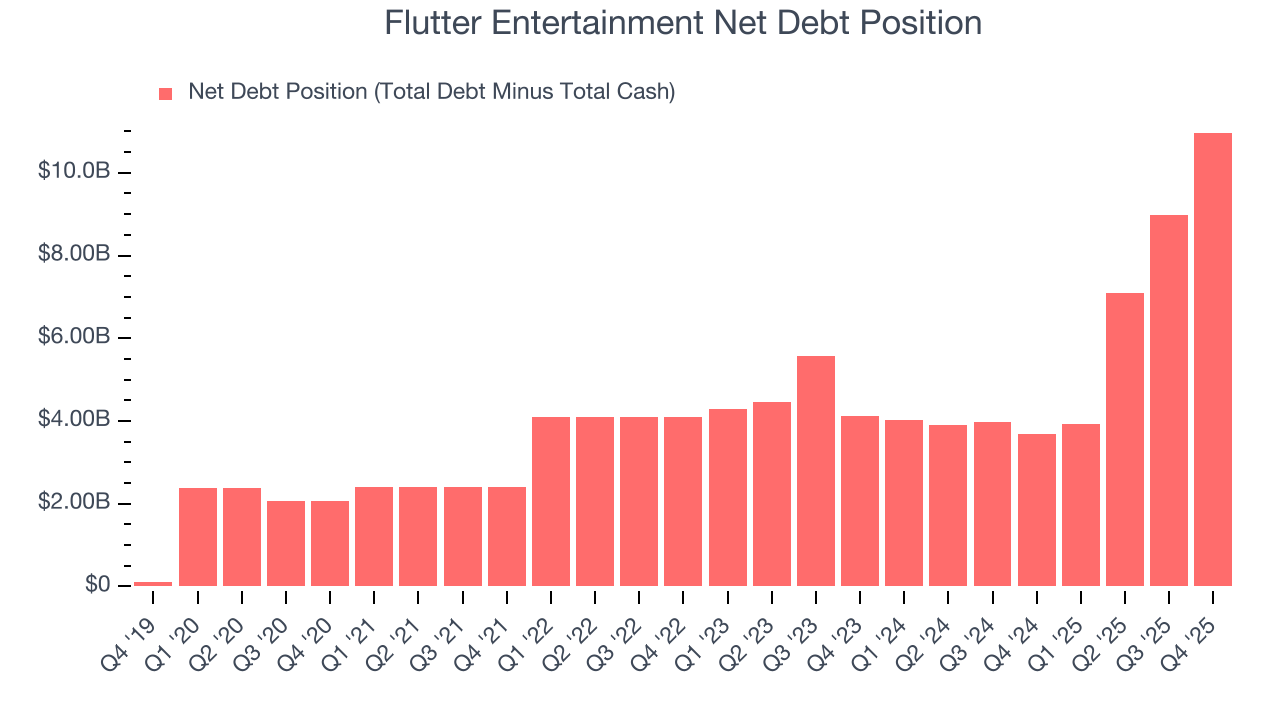
With $2.85 billion of EBITDA over the last 12 months, we view Flutter Entertainment’s 3.9× net-debt-to-EBITDA ratio as safe. We also see its $515 million of annual interest expenses as appropriate. The company’s profits give it plenty of breathing room, allowing it to continue investing in growth initiatives.
11. Key Takeaways from Flutter Entertainment’s Q4 Results
We struggled to find many positives in these results. Its revenue missed and its EPS fell short of Wall Street’s estimates. Overall, this quarter could have been better. The stock traded down 9.2% to $111.70 immediately following the results.
12. Is Now The Time To Buy Flutter Entertainment?
Updated: February 27, 2026 at 12:40 AM EST
The latest quarterly earnings matters, sure, but we actually think longer-term fundamentals and valuation matter more. Investors should consider all these pieces before deciding whether or not to invest in Flutter Entertainment.
Flutter Entertainment doesn’t pass our quality test. While its projected EPS for the next year implies the company’s fundamentals will improve, the downside is its relatively low ROIC suggests management has struggled to find compelling investment opportunities. On top of that, its low free cash flow margins give it little breathing room.
Flutter Entertainment’s P/E ratio based on the next 12 months is 13.3x. This valuation multiple is fair, but we don’t have much confidence in the company. There are more exciting stocks to buy at the moment.
Wall Street analysts have a consensus one-year price target of $269.56 on the company (compared to the current share price of $114.40).
Although the price target is bullish, readers should exercise caution because analysts tend to be overly optimistic. The firms they work for, often big banks, have relationships with companies that extend into fundraising, M&A advisory, and other rewarding business lines. As a result, they typically hesitate to say bad things for fear they will lose out. We at StockStory do not suffer from such conflicts of interest, so we’ll always tell it like it is.