
Humana (HUM)
Humana is an exciting business. Its estimated revenue growth for the next 12 months is great.― StockStory Analyst Team


1. News






2. Summary
Why We Like Humana
With over 80% of its revenue derived from federal government contracts, Humana (NYSE:HUM) provides health insurance plans and healthcare services to approximately 17 million members, with a strong focus on Medicare Advantage plans for seniors.
- Market share is on track to rise over the next 12 months as its 25.1% projected revenue growth implies demand will accelerate from its two-year trend
- ROIC punches in at 33.1%, illustrating management’s expertise in identifying profitable investments
- Enormous revenue base of $129.8 billion gives it leverage over plan holders and advantageous reimbursement terms with healthcare providers
We’re fond of companies like Humana. The price seems reasonable when considering its quality, so this might be an opportune time to buy some shares.
Why Is Now The Time To Buy Humana?







At $168.71 per share, Humana trades at 18.9x forward P/E. Looking at the healthcare space, we think the valuation is fair - potentially even too low - for the business quality.
Entry price matters far less than business fundamentals if you’re investing for a multi-year period. But if you can get a bargain price it’s certainly icing on the cake.
3. Humana (HUM) Research Report: Q4 CY2025 Update
Health insurance company Humana (NYSE:HUM) reported Q4 CY2025 results exceeding the market’s revenue expectations, with sales up 11.4% year on year to $32.52 billion. Its GAAP loss of $6.61 per share was 62.2% below analysts’ consensus estimates.
Humana (HUM) Q4 CY2025 Highlights:
- Revenue: $32.52 billion vs analyst estimates of $32.06 billion (11.4% year-on-year growth, 1.4% beat)
- EPS (GAAP): -$6.61 vs analyst expectations of -$4.08 (62.2% miss)
- Expects full-year 2026 EPS to be at least $9 per share, compared with analysts' estimate of $11.92 per share
- Adjusted EBITDA: $1.50 billion (4.6% margin)
- Operating Margin: 4.1%, up from -1.9% in the same quarter last year
- Free Cash Flow was -$1.85 billion compared to -$675 million in the same quarter last year
- Customers: 15 million, up from 14.99 million in the previous quarter
- Market Capitalization: $21.81 billion
Company Overview
With over 80% of its revenue derived from federal government contracts, Humana (NYSE:HUM) provides health insurance plans and healthcare services to approximately 17 million members, with a strong focus on Medicare Advantage plans for seniors.
Humana operates through two main segments: Insurance and CenterWell. The Insurance segment offers various Medicare products, including Medicare Advantage plans, stand-alone prescription drug plans, and Medicare Supplement policies. It also provides Medicaid plans through state-based contracts in multiple states and specialty insurance products like dental and vision coverage.
The company's Medicare Advantage plans typically offer enhanced benefits beyond traditional Medicare, such as reduced cost sharing, prescription drug coverage, care coordination, and wellness programs. As of 2023, Humana served approximately 5.4 million individual Medicare Advantage members across all 50 states, making it one of the largest providers in this market.
CenterWell, Humana's second segment, represents the company's healthcare services operations. This includes CenterWell Pharmacy (mail-order and specialty pharmacy services), CenterWell Senior Primary Care (senior-focused medical centers), and CenterWell Home Health (home healthcare services). Through these services, Humana delivers an integrated care model that aims to improve health outcomes while controlling costs.
For example, a 75-year-old Medicare Advantage member might visit a CenterWell Senior Primary Care center for regular checkups, receive medications through CenterWell Pharmacy, and recover from surgery with the help of CenterWell Home Health nurses—all coordinated through Humana's care management programs.
Humana employs various provider payment models, including value-based care arrangements where healthcare providers share financial risk for patient outcomes. These arrangements covered approximately 2.2 million members as of 2023, representing about 13% of Humana's total medical membership.
The company markets its products through multiple channels, including television, direct mail, telemarketing, and a sales force of approximately 1,000 representatives. It also partners with independent brokers and agents to sell Medicare and specialty products, and has a marketing arrangement with Walmart for its Medicare prescription drug plans.
4. Health Insurance Providers
Upfront premiums collected by health insurers lead to reliable revenue, but profitability ultimately depends on accurate risk assessments and the ability to control medical costs. Health insurers are also highly sensitive to regulatory changes and economic conditions such as unemployment. Going forward, the industry faces tailwinds from an aging population, increasing demand for personalized healthcare services, and advancements in data analytics to improve cost management. However, continued regulatory scrutiny on pricing practices, the potential for government-led reforms such as expanded public healthcare options, and inflation in medical costs could add volatility to margins. One big debate among investors is the long-term impact of AI and whether it will help underwriting, fraud detection, and claims processing or whether it may wade into ethical grey areas like reinforcing biases and widening disparities in medical care.
Humana's main competitors include UnitedHealth Group (NYSE: UNH), CVS Health's Aetna (NYSE: CVS), Cigna Group (NYSE: CI), Elevance Health (formerly Anthem) (NYSE: ELV), and Centene Corporation (NYSE: CNC). In the Medicare Advantage space specifically, UnitedHealth's UnitedHealthcare and CVS Health's Aetna are Humana's strongest competitors.
5. Economies of Scale
Larger companies benefit from economies of scale, where fixed costs like infrastructure, technology, and administration are spread over a higher volume of goods or services, reducing the cost per unit. Scale can also lead to bargaining power with suppliers, greater brand recognition, and more investment firepower. A virtuous cycle can ensue if a scaled company plays its cards right.
With $129.7 billion in revenue over the past 12 months, Humana is one of the most scaled enterprises in healthcare. This is particularly important because health insurance providers companies are volume-driven businesses due to their low margins.
6. Revenue Growth
Reviewing a company’s long-term sales performance reveals insights into its quality. Any business can experience short-term success, but top-performing ones enjoy sustained growth for years. Thankfully, Humana’s 11.2% annualized revenue growth over the last five years was decent. Its growth was slightly above the average healthcare company and shows its offerings resonate with customers.
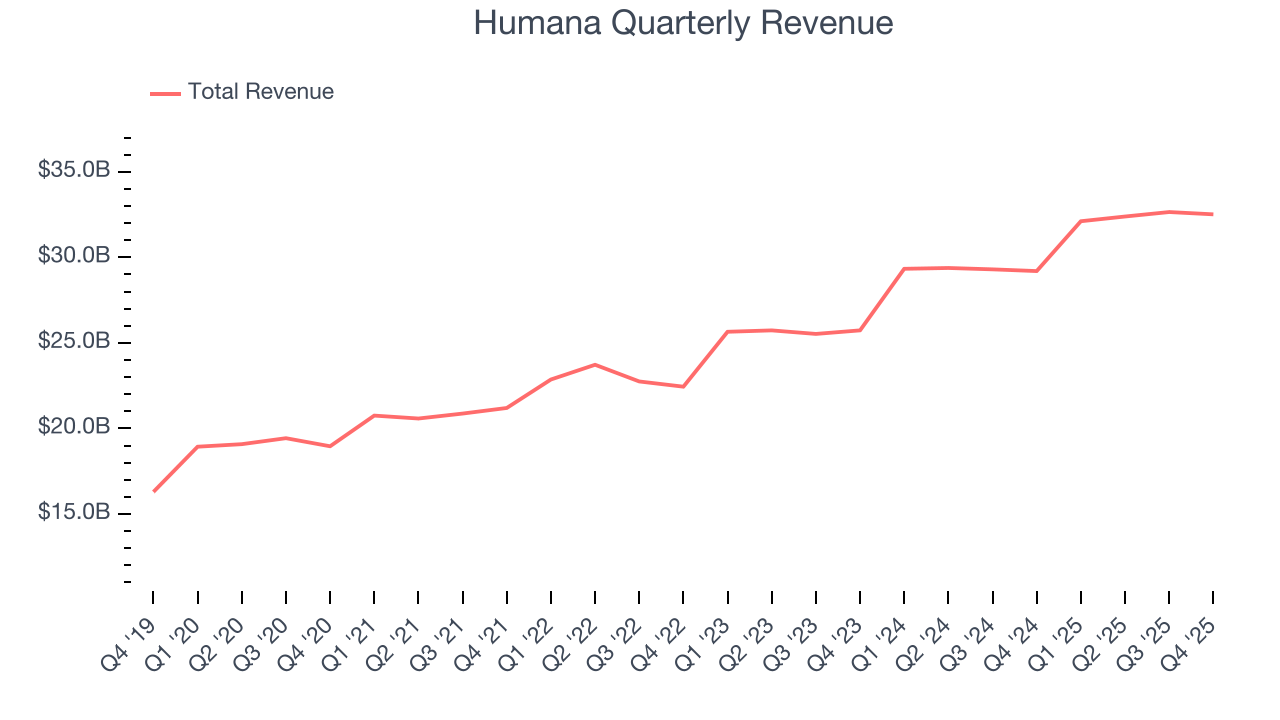
We at StockStory place the most emphasis on long-term growth, but within healthcare, a half-decade historical view may miss recent innovations or disruptive industry trends. Humana’s annualized revenue growth of 12.4% over the last two years is above its five-year trend, suggesting its demand recently accelerated. 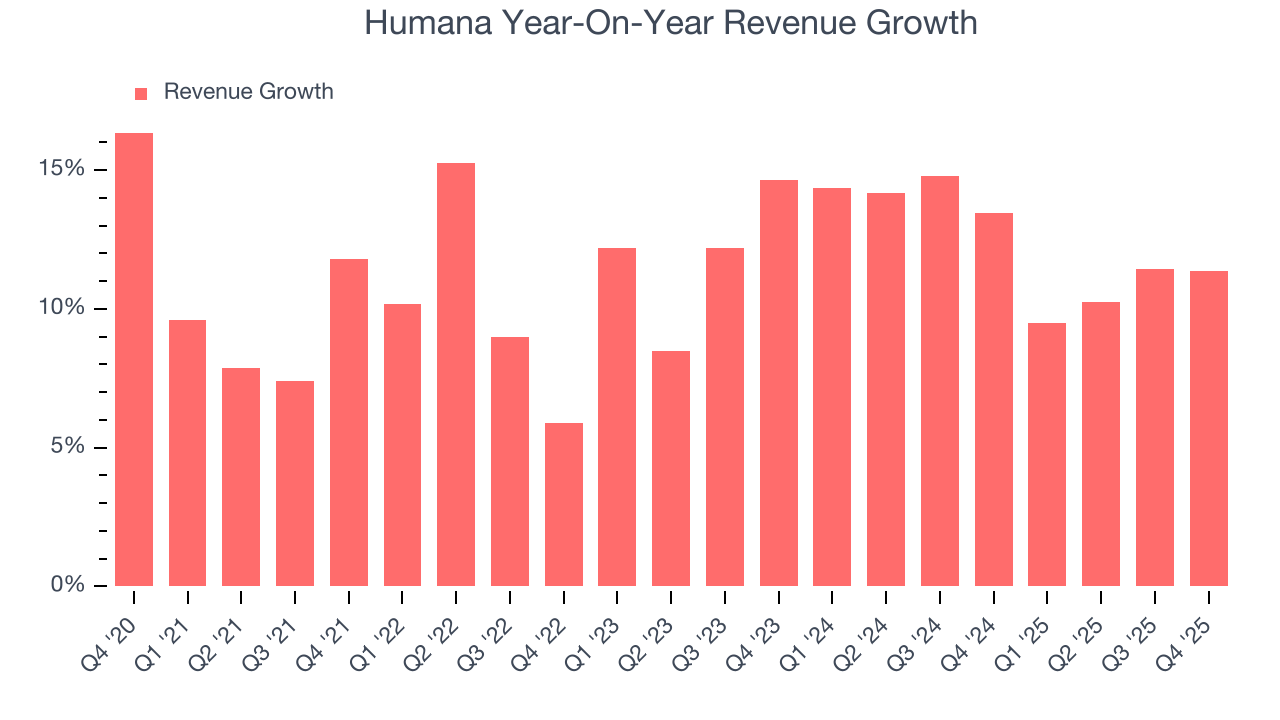
We can dig further into the company’s revenue dynamics by analyzing its number of customers, which reached 15 million in the latest quarter. Over the last two years, Humana’s customer base averaged 8.3% year-on-year declines. Because this number is lower than its revenue growth, we can see the average customer spent more money each year on the company’s products and services. 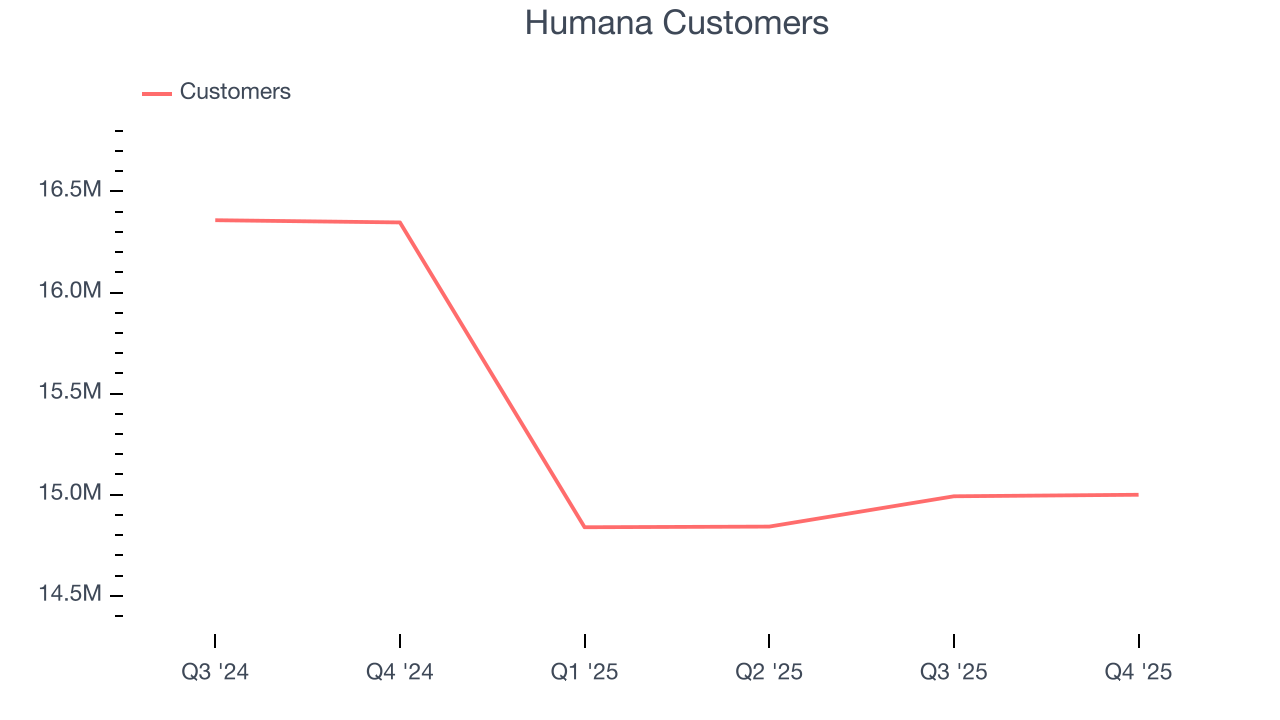
This quarter, Humana reported year-on-year revenue growth of 11.4%, and its $32.52 billion of revenue exceeded Wall Street’s estimates by 1.4%.
Looking ahead, sell-side analysts expect revenue to grow 12.6% over the next 12 months, similar to its two-year rate. This projection is particularly noteworthy for a company of its scale and implies the market is baking in success for its products and services.
7. Operating Margin
Operating margin is a key measure of profitability. Think of it as net income - the bottom line - excluding the impact of taxes and interest on debt, which are less connected to business fundamentals.
Humana’s operating margin has risen over the last 12 months and averaged 3.5% over the last five years. Although its profitability is still paltry, we can see its decent revenue growth is giving it operating leverage as it scales. This gives it a shot at higher long-term profits if it can keep expanding.
Analyzing the trend in its profitability, Humana’s operating margin might fluctuated slightly but has generally stayed the same over the last five years. This raises questions about the company’s expense base because its revenue growth should have given it leverage on its fixed costs, resulting in better economies of scale and profitability.
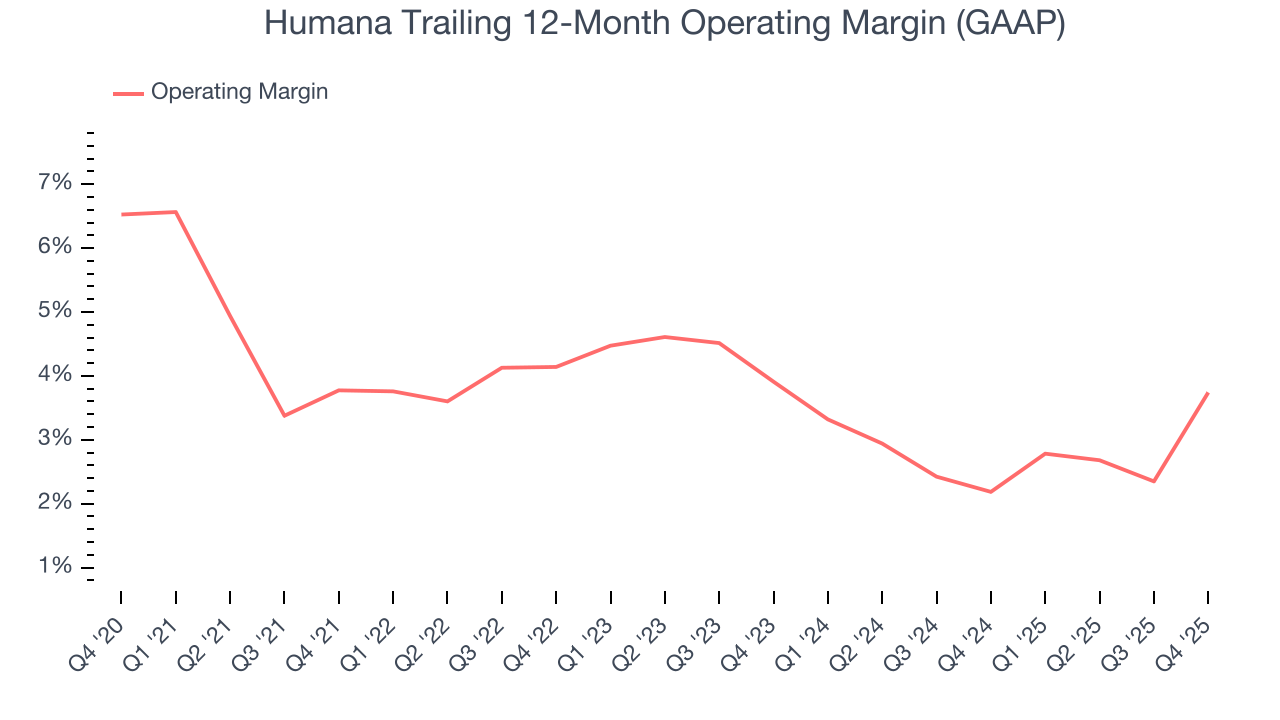
This quarter, Humana generated an operating margin profit margin of 4.1%, up 6 percentage points year on year. This increase was a welcome development and shows it was more efficient.
8. Earnings Per Share
We track the long-term change in earnings per share (EPS) for the same reason as long-term revenue growth. Compared to revenue, however, EPS highlights whether a company’s growth is profitable.
Sadly for Humana, its EPS declined by 17.3% annually over the last five years while its revenue grew by 11.2%. We can see the difference stemmed from higher interest expenses or taxes as the company actually improved its operating margin and repurchased its shares during this time.
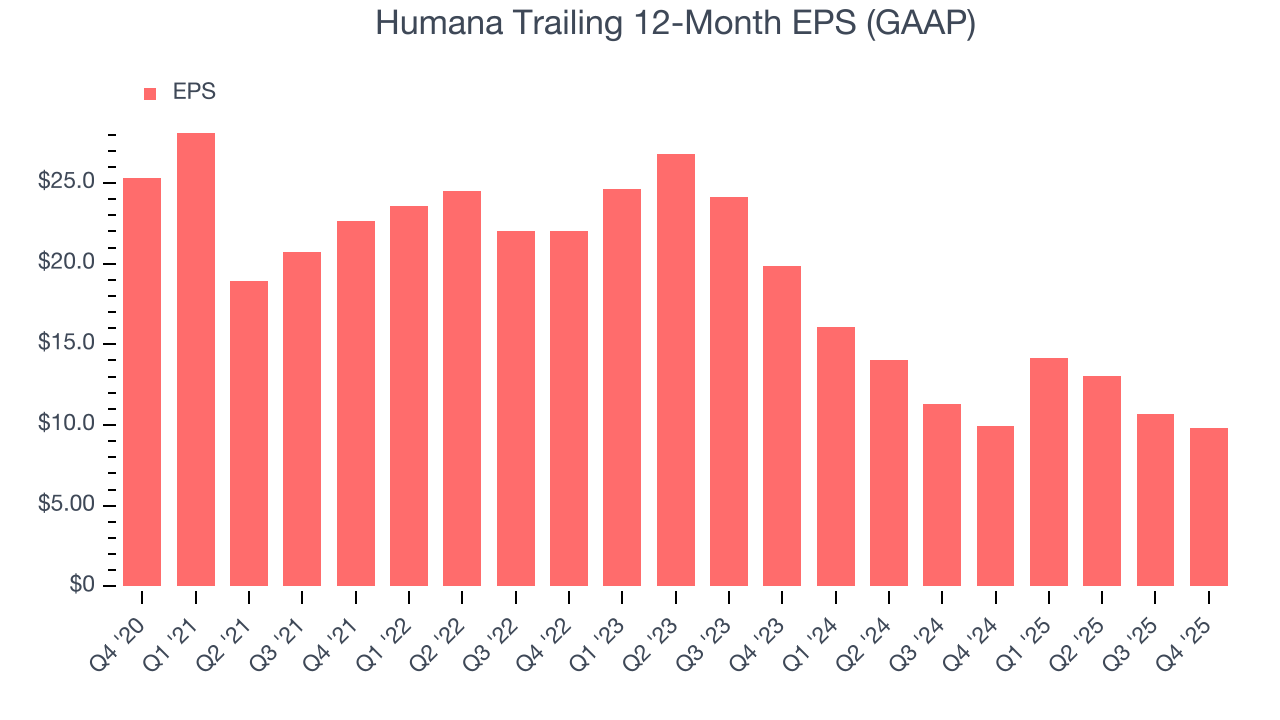
In Q4, Humana reported EPS of negative $6.61, down from negative $5.75 in the same quarter last year. This print missed analysts’ estimates. Over the next 12 months, Wall Street expects Humana’s full-year EPS of $9.80 to grow 23.1%.
9. Cash Is King
Although earnings are undoubtedly valuable for assessing company performance, we believe cash is king because you can’t use accounting profits to pay the bills.
Humana has shown mediocre cash profitability over the last five years, giving the company limited opportunities to return capital to shareholders. Its free cash flow margin averaged 2%, subpar for a healthcare business.
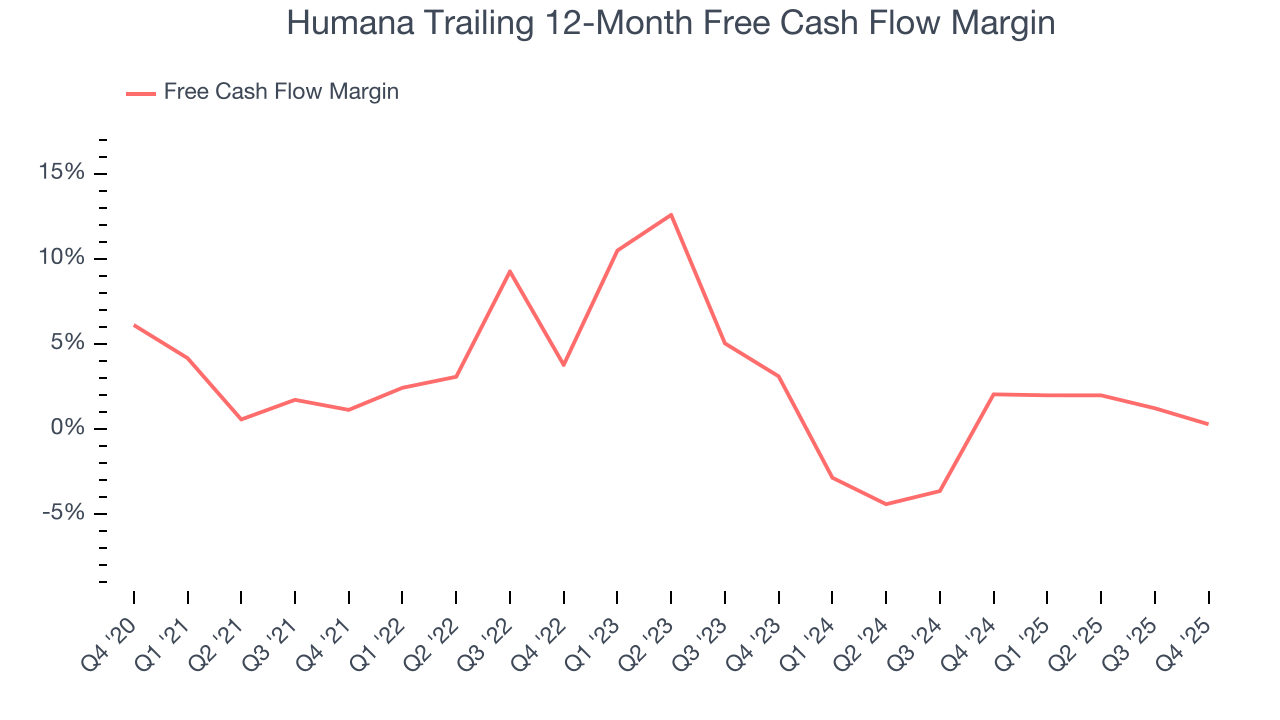
Humana burned through $1.85 billion of cash in Q4, equivalent to a negative 5.7% margin. The company’s cash burn increased from $675 million of lost cash in the same quarter last year. These numbers deviate from its longer-term margin, but we wouldn’t read too much into the short term because investment needs can be seasonal, leading to temporary swings.
10. Return on Invested Capital (ROIC)
EPS and free cash flow tell us whether a company was profitable while growing its revenue. But was it capital-efficient? A company’s ROIC explains this by showing how much operating profit it makes compared to the money it has raised (debt and equity).
Humana’s five-year average ROIC was 39.4%, placing it among the best healthcare companies. This illustrates its management team’s ability to invest in highly profitable ventures and produce tangible results for shareholders.
We like to invest in businesses with high returns, but the trend in a company’s ROIC is what often surprises the market and moves the stock price. Over the last few years, Humana’s ROIC averaged 1.9 percentage point decreases each year. Only time will tell if its new bets can bear fruit and potentially reverse the trend.
11. Balance Sheet Assessment
Humana reported $4.2 billion of cash and $12.98 billion of debt on its balance sheet in the most recent quarter. As investors in high-quality companies, we primarily focus on two things: 1) that a company’s debt level isn’t too high and 2) that its interest payments are not excessively burdening the business.
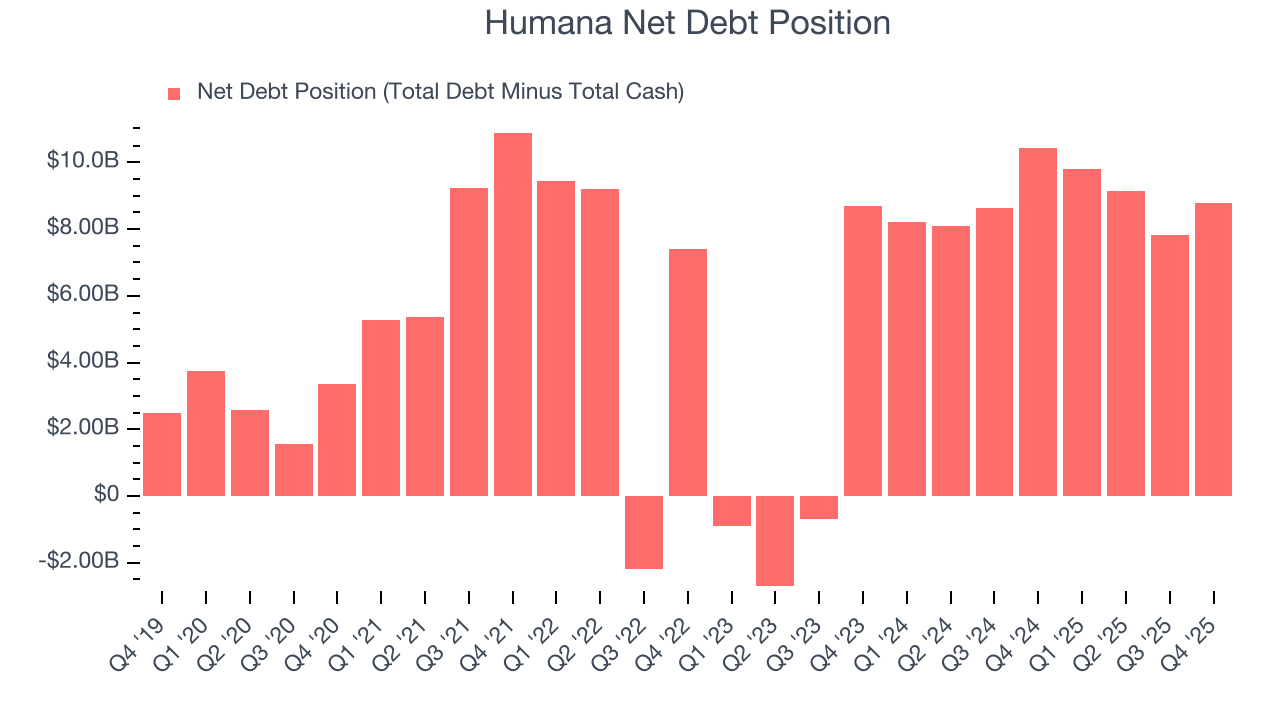
With $4.09 billion of EBITDA over the last 12 months, we view Humana’s 2.1× net-debt-to-EBITDA ratio as safe. We also see its $631 million of annual interest expenses as appropriate. The company’s profits give it plenty of breathing room, allowing it to continue investing in growth initiatives.
12. Key Takeaways from Humana’s Q4 Results
It was good to see Humana narrowly top analysts’ revenue expectations this quarter. On the other hand, its EPS missed. EPS guidance for the full year also came in well below Wall Street's estimate as lower quality ratings for its Medicare Advantage plans for older adults present a major headwind for the company. Overall, this was a weaker quarter. The stock traded down 8.1% to $166.67 immediately following the results.
13. Is Now The Time To Buy Humana?
Updated: March 29, 2026 at 12:21 AM EDT
The latest quarterly earnings matters, sure, but we actually think longer-term fundamentals and valuation matter more. Investors should consider all these pieces before deciding whether or not to invest in Humana.
There is a lot to like about Humana. For starters, its revenue growth was good over the last five years and is expected to accelerate over the next 12 months. And while its diminishing returns show management's recent bets still have yet to bear fruit, its scale gives it meaningful leverage when negotiating reimbursement rates. On top of that, Humana’s stellar ROIC suggests it has been a well-run company historically.
Humana’s P/E ratio based on the next 12 months is 18.9x. Scanning the healthcare space today, Humana’s fundamentals really stand out, and we like it at this price.
Wall Street analysts have a consensus one-year price target of $212.17 on the company (compared to the current share price of $168.71), implying they see 25.8% upside in buying Humana in the short term.