
MarineMax (HZO)
We wouldn’t buy MarineMax. Its low returns on capital and plummeting sales suggest it struggles to generate demand and profits, a red flag.― StockStory Analyst Team


1. News
2. Summary
Why We Think MarineMax Will Underperform
Appropriately headquartered in Clearwater, Florida, MarineMax (NYSE:HZO) sells boats, yachts, and other marine products.
- Recent store closures and weak same-store sales point to soft demand and an operational restructuring
- Smaller revenue base of $2.31 billion means it hasn’t achieved the economies of scale that some industry juggernauts enjoy
- 10× net-debt-to-EBITDA ratio shows it’s overleveraged and increases the probability of shareholder dilution if things turn unexpectedly
MarineMax is in the penalty box. We’re on the lookout for more interesting opportunities.
Why There Are Better Opportunities Than MarineMax






At $26.84 per share, MarineMax trades at 38.7x forward P/E. This multiple is high given its weaker fundamentals.
Paying up for elite businesses with strong earnings potential is better than investing in lower-quality companies with shaky fundamentals. That’s how you avoid big downside over the long term.
3. MarineMax (HZO) Research Report: Q4 CY2025 Update
Boat and marine products retailer MarineMax (NYSE:HZO) reported Q4 CY2025 results exceeding the market’s revenue expectations, with sales up 7.8% year on year to $505.2 million. Its non-GAAP loss of $0.21 per share was significantly below analysts’ consensus estimates.
MarineMax (HZO) Q4 CY2025 Highlights:
- Revenue: $505.2 million vs analyst estimates of $482.8 million (7.8% year-on-year growth, 4.6% beat)
- Adjusted EPS: -$0.21 vs analyst estimates of -$0.08 (significant miss)
- Adjusted EBITDA: $15.54 million vs analyst estimates of $22.12 million (3.1% margin, 29.7% miss)
- Management reiterated its full-year Adjusted EPS guidance of $0.68 at the midpoint
- EBITDA guidance for the full year is $117.5 million at the midpoint, below analyst estimates of $119 million
- Operating Margin: 1%, down from 8.3% in the same quarter last year
- Locations: 70 at quarter end, down from 70.7 in the same quarter last year
- Same-Store Sales rose 10% year on year (-11% in the same quarter last year)
- Market Capitalization: $587.4 million
Company Overview
Appropriately headquartered in Clearwater, Florida, MarineMax (NYSE:HZO) sells boats, yachts, and other marine products.
The company’s product offering includes boats from many prestigious manufacturers such as Sea Ray, Boston Whaler, Azimut, and Galeon. In addition, MarineMax provides services such as financing, insurance, maintenance, and repair to make it a one-stop shop for recreational boating.
The core customer is an affluent individual or family who's interested in marine activities and has the proximity or access to water to use the company’s products. These customers are looking for high-quality products that offer some combination of luxury and performance. They also often demand personalized support and assistance through the life of their boats or yachts.
The average MarineMax store is around 30,000 square feet and typically located in prime waterfront locations such as marinas and harbors. The layout of stores is open and spacious, with ample room for display. MarineMax launched its e-commerce platform in 2018, and the platform allows customers to browse–including virtual tours and video consultations–and purchase products online. Customers can also access financing and insurance services through the website.
4. Boat & Marine Retailer
Retailers that sell boats and marine products sell products, sure, but they also sell an image and lifestyle to an often wealthier customer. Unlike a car–which many use daily to get to/from work and to run personal and family errands–a boat or yacht is certainly a discretionary, luxury, nice-to-have purchase. While there is online competition, especially for research and discovery, the boat and yacht market is still very brick-and-mortar based given the magnitude of the purchase and the logistical costs associated with moving these products over long distances.
Competitors offering recreational marine products include OneWater Marine (NASDAQ:ONEW), Yamaha Motor Co. (TSE:7272), and Brunswick Corp (NYSE:BC).
5. Revenue Growth
A company’s long-term sales performance can indicate its overall quality. Any business can put up a good quarter or two, but many enduring ones grow for years.
With $2.35 billion in revenue over the past 12 months, MarineMax is a small retailer, which sometimes brings disadvantages compared to larger competitors benefiting from economies of scale and negotiating leverage with suppliers.
As you can see below, MarineMax struggled to increase demand as its $2.35 billion of sales for the trailing 12 months was close to its revenue three years ago. This was mainly because it closed stores.
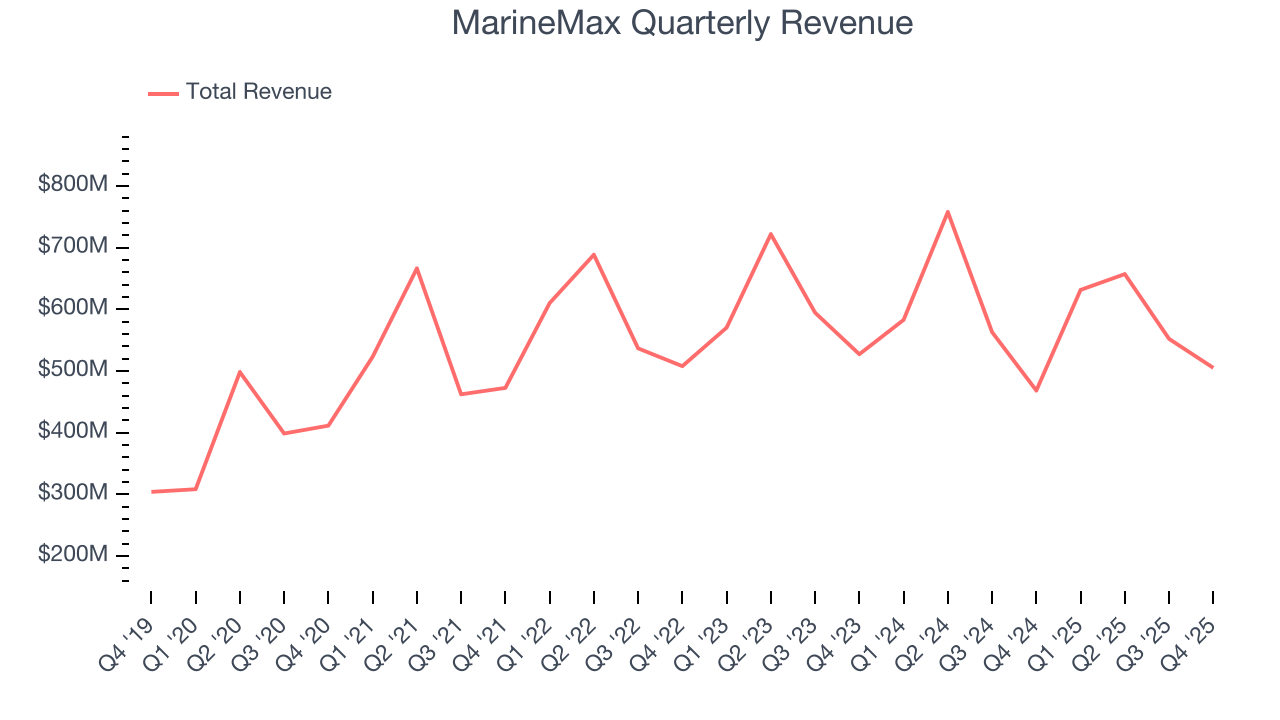
This quarter, MarineMax reported year-on-year revenue growth of 7.8%, and its $505.2 million of revenue exceeded Wall Street’s estimates by 4.6%.
Looking ahead, sell-side analysts expect revenue to remain flat over the next 12 months. This projection doesn't excite us and indicates its newer products will not lead to better top-line performance yet.
6. Store Performance
Number of Stores
A retailer’s store count often determines how much revenue it can generate.
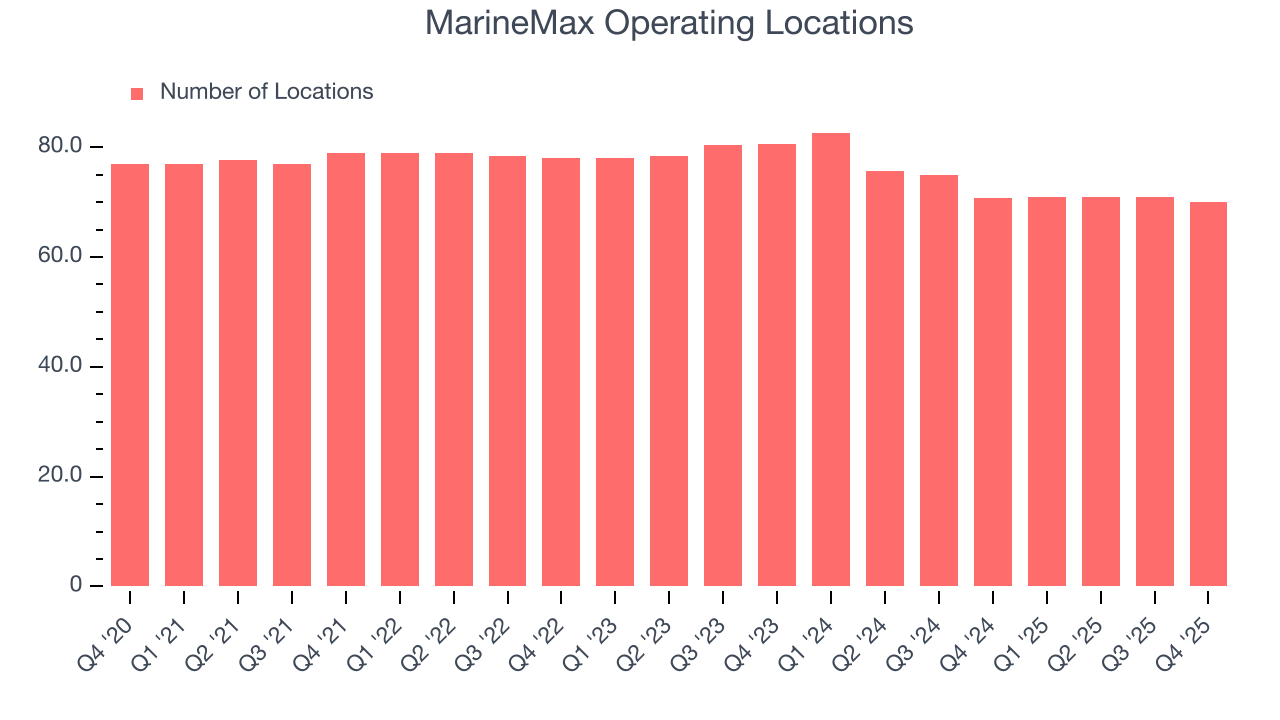
MarineMax operated 70 locations in the latest quarter. Over the last two years, the company has generally closed its stores, averaging 5.4% annual declines.
When a retailer shutters stores, it usually means that brick-and-mortar demand is less than supply, and it is responding by closing underperforming locations to improve profitability.
Same-Store Sales
A company's store base only paints one part of the picture. When demand is high, it makes sense to open more. But when demand is low, it’s prudent to close some locations and use the money in other ways. Same-store sales gives us insight into this topic because it measures organic growth for a retailer's e-commerce platform and brick-and-mortar shops that have existed for at least a year.
MarineMax’s demand within its existing locations has barely increased over the last two years as its same-store sales were flat. This performance isn’t ideal, and MarineMax is attempting to boost same-store sales by closing stores (fewer locations sometimes lead to higher same-store sales).
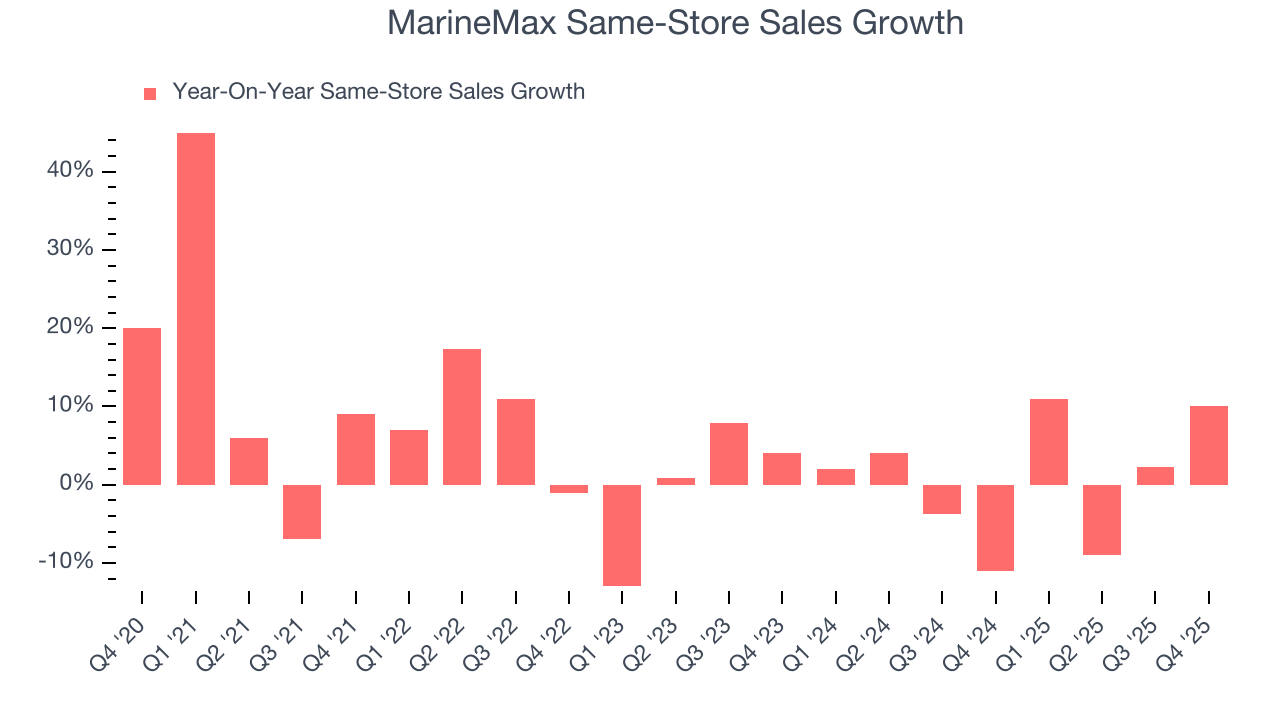
In the latest quarter, MarineMax’s same-store sales rose 10% year on year. This growth was an acceleration from its historical levels, which is always an encouraging sign.
7. Gross Margin & Pricing Power
We prefer higher gross margins because they not only make it easier to generate more operating profits but also indicate product differentiation, negotiating leverage, and pricing power.
MarineMax has bad unit economics for a retailer, signaling it operates in a competitive market and lacks pricing power because its inventory is sold in many places. As you can see below, it averaged a 32.6% gross margin over the last two years. That means MarineMax paid its suppliers a lot of money ($67.44 for every $100 in revenue) to run its business. 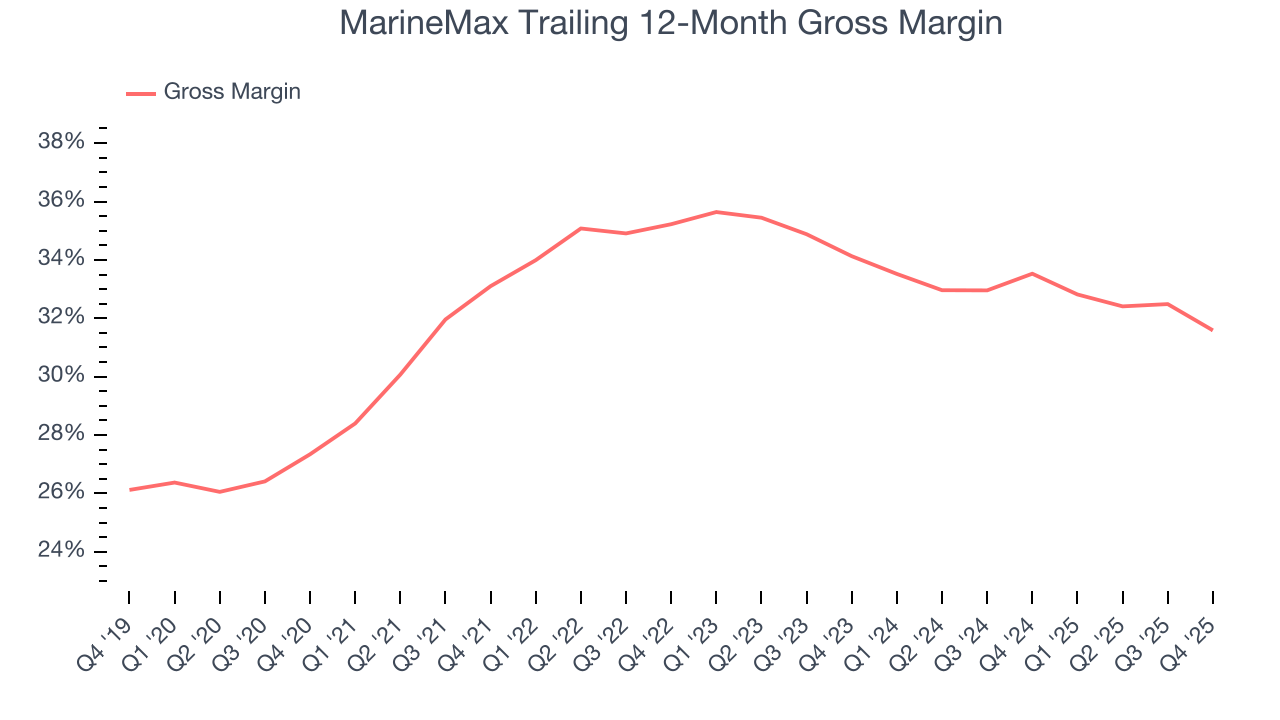
MarineMax produced a 31.8% gross profit margin in Q4, marking a 4.5 percentage point decrease from 36.2% in the same quarter last year. MarineMax’s full-year margin has also been trending down over the past 12 months, decreasing by 1.9 percentage points. If this move continues, it could suggest a more competitive environment with some pressure to discount products and higher input costs (such as labor and freight expenses to transport goods).
8. Operating Margin
Operating margin is an important measure of profitability for retailers as it accounts for all expenses necessary to run a store, including wages, inventory, rent, advertising, and other administrative costs.
MarineMax was profitable over the last two years but held back by its large cost base. Its average operating margin of 3.1% was weak for a consumer retail business. This result isn’t too surprising given its low gross margin as a starting point.
Looking at the trend in its profitability, MarineMax’s operating margin decreased by 6.2 percentage points over the last year. MarineMax’s performance was poor no matter how you look at it - it shows that costs were rising and it couldn’t pass them onto its customers.
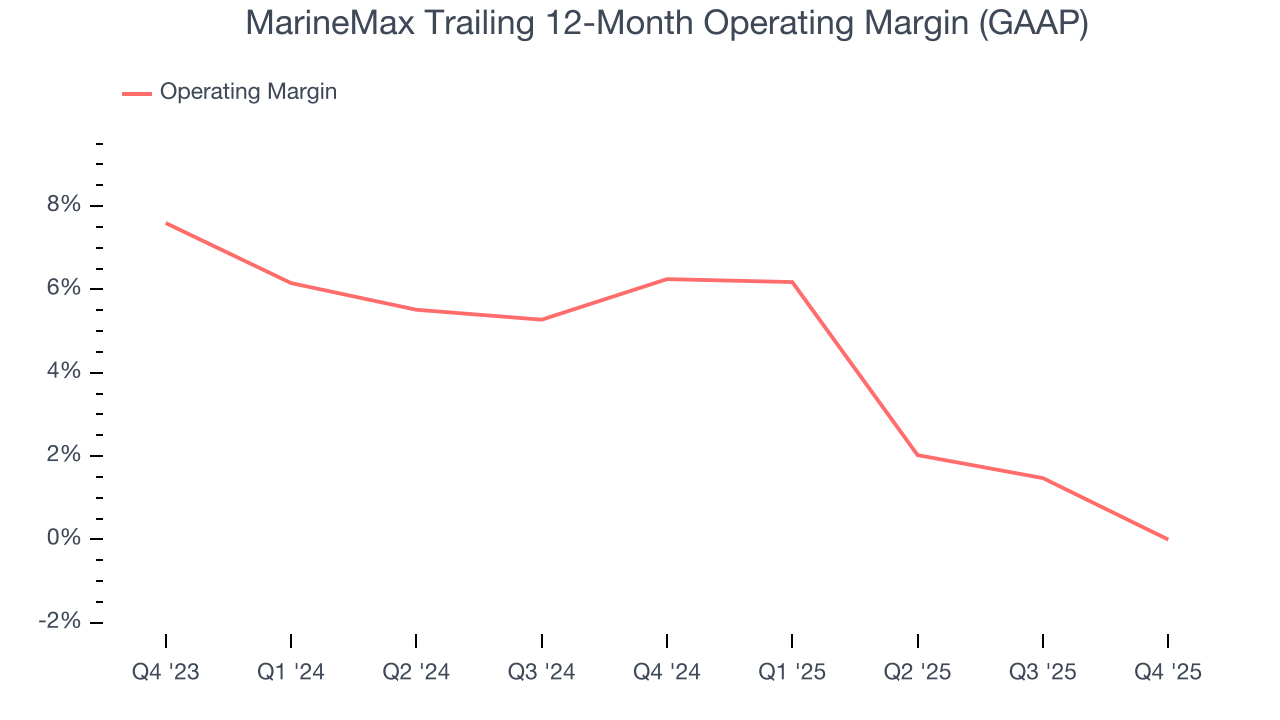
This quarter, MarineMax’s breakeven margin was down 7.3 percentage points year on year. Since MarineMax’s operating margin decreased more than its gross margin, we can assume it was less efficient because expenses such as marketing, and administrative overhead increased.
9. Cash Is King
Although earnings are undoubtedly valuable for assessing company performance, we believe cash is king because you can’t use accounting profits to pay the bills.
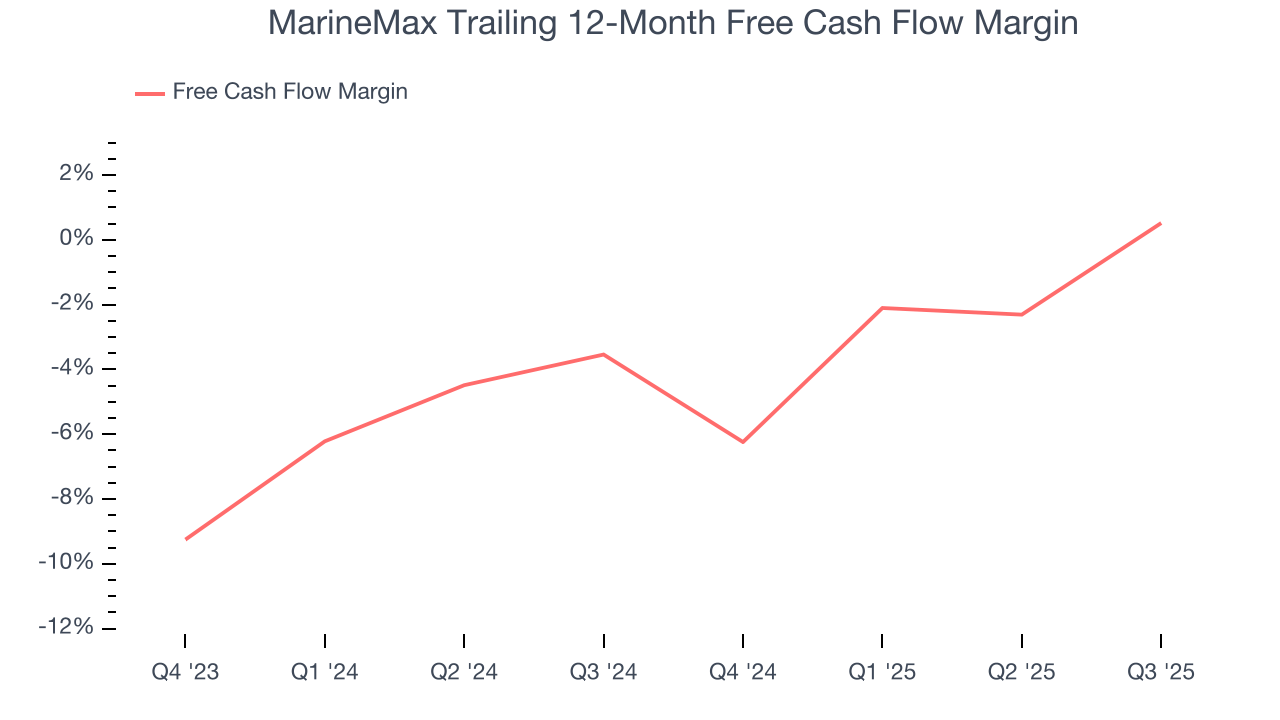
MarineMax broke even from a free cash flow perspective over the last two years, giving the company limited opportunities to return capital to shareholders.
10. Return on Invested Capital (ROIC)
EPS and free cash flow tell us whether a company was profitable while growing its revenue. But was it capital-efficient? A company’s ROIC explains this by showing how much operating profit it makes compared to the money it has raised (debt and equity).
MarineMax historically did a mediocre job investing in profitable growth initiatives. Its five-year average ROIC was 12.6%, somewhat low compared to the best consumer retail companies that consistently pump out 25%+.
11. Balance Sheet Risk
As long-term investors, the risk we care about most is the permanent loss of capital, which can happen when a company goes bankrupt or raises money from a disadvantaged position. This is separate from short-term stock price volatility, something we are much less bothered by.
MarineMax’s $1.22 billion of debt exceeds the $164.6 million of cash on its balance sheet. Furthermore, its 11× net-debt-to-EBITDA ratio (based on its EBITDA of $99.28 million over the last 12 months) shows the company is overleveraged.
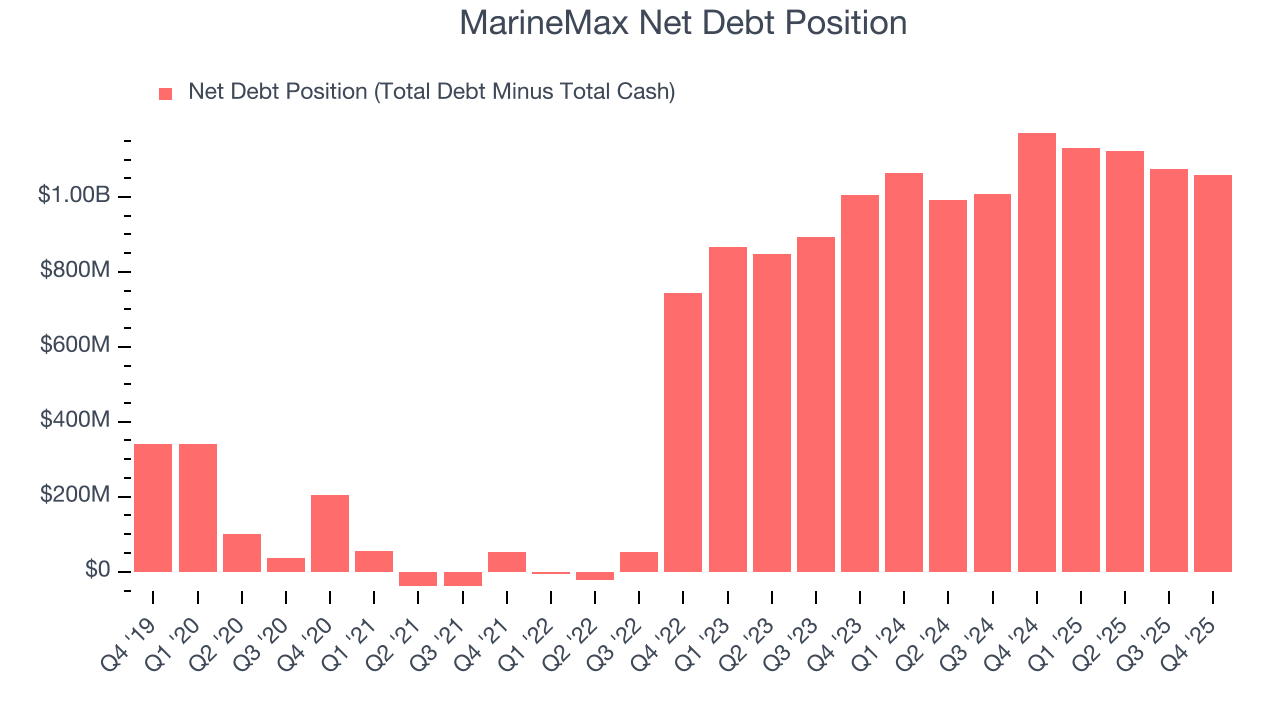
At this level of debt, incremental borrowing becomes increasingly expensive and credit agencies could downgrade the company’s rating if profitability falls. MarineMax could also be backed into a corner if the market turns unexpectedly – a situation we seek to avoid as investors in high-quality companies.
We hope MarineMax can improve its balance sheet and remain cautious until it increases its profitability or pays down its debt.
12. Key Takeaways from MarineMax’s Q4 Results
We were impressed by how significantly MarineMax blew past analysts’ revenue expectations this quarter. On the other hand, its EBITDA missed and its gross margin fell short of Wall Street’s estimates. Looking ahead, EBITDA guidance for the full year also missed. Overall, this was a weaker quarter. The stock remained flat at $26.84 immediately after reporting.
13. Is Now The Time To Buy MarineMax?
Updated: January 29, 2026 at 7:44 AM EST
A common mistake we notice when investors are deciding whether to buy a stock or not is that they simply look at the latest earnings results. Business quality and valuation matter more, so we urge you to understand these dynamics as well.
MarineMax doesn’t pass our quality test. First off, its revenue growth was weak over the last three years, and analysts don’t see anything changing over the next 12 months. And while its projected EPS for the next year implies the company’s fundamentals will improve, the downside is its declining EPS over the last three years makes it a less attractive asset to the public markets. On top of that, its declining physical locations suggests its demand is falling.
MarineMax’s P/E ratio based on the next 12 months is 30.2x. This valuation tells us a lot of optimism is priced in - we think there are better opportunities elsewhere.
Wall Street analysts have a consensus one-year price target of $30.71 on the company (compared to the current share price of $26.84).