
Leidos (LDOS)
Leidos is a sound business. Its surging backlog proves it has a healthy sales pipeline.― StockStory Analyst Team


1. News


2. Summary
Why Leidos Is Interesting
Formed through the split of IT services company SAIC, Leidos (NYSE:LDOS) offers technology and engineering solutions such as military training systems for the defense, civil, and health markets.
- Sales pipeline is in good shape as its backlog averaged 20.2% growth over the past two years
- Additional sales over the last five years increased its profitability as the 15.5% annual growth in its earnings per share outpaced its revenue
- On the other hand, its estimated sales growth of 3.6% for the next 12 months implies demand will slow from its two-year trend
Leidos has some noteworthy aspects. If you like the story, the price looks fair.
Why Is Now The Time To Buy Leidos?




Leidos is trading at $163.32 per share, or 13.7x forward P/E. Many industrials companies feature higher valuation multiples than Leidos. Regardless, we think Leidos’s current price is appropriate given the quality you get.
If you think the market is undervaluing the company, now could be a good time to build a position.
3. Leidos (LDOS) Research Report: Q4 CY2025 Update
Defense contractor Leidos (NYSE:LDOS) missed Wall Street’s revenue expectations in Q4 CY2025, with sales falling 3.6% year on year to $4.21 billion. The company’s full-year revenue guidance of $17.7 billion at the midpoint came in 1.1% below analysts’ estimates. Its non-GAAP profit of $2.76 per share was 5.9% above analysts’ consensus estimates.
Leidos (LDOS) Q4 CY2025 Highlights:
- Revenue: $4.21 billion vs analyst estimates of $4.31 billion (3.6% year-on-year decline, 2.5% miss)
- Adjusted EPS: $2.76 vs analyst estimates of $2.61 (5.9% beat)
- Adjusted EBITDA: $556 million vs analyst estimates of $538.5 million (13.2% margin, 3.2% beat)
- Adjusted EPS guidance for the upcoming financial year 2026 is $12.25 at the midpoint, in line with analyst estimates
- Operating Margin: 11.2%, up from 9.6% in the same quarter last year
- Free Cash Flow Margin: 10.7%, up from 4.9% in the same quarter last year
- Backlog: $49 billion at quarter end, up 12.5% year on year
- Market Capitalization: $22.54 billion
Company Overview
Formed through the split of IT services company SAIC, Leidos (NYSE:LDOS) offers technology and engineering solutions such as military training systems for the defense, civil, and health markets.
Formed through the split of IT services company SAIC, Leidos (NYSE:LDOS) offers technology and engineering solutions such as military training systems for the defense, civil, and health markets.
Leidos became a separate entity from SAIC in 2013. As a combined company,the higher-margin technology business (Leidos) was limited in what it could bid on because of conflicts of interest from the IT and technical services side of the business (SAIC). The separation was meant to address these hindrances.
Today, the company specializes in services, including cybersecurity, analytics, systems engineering, and environmental science. For instance, Leidos works on big problems such as modernizing IT systems for government agencies and developing advanced health analytics to improve patient care. Given its experience in defense and intelligence, the company offers some products straight out of spy movies such as retractable cameras for reconnaissance and devices to detect materials needed to make nuclear weapons.
Leidos operates on a contract-based revenue model, engaging primarily with the federal government, as well as state, local, and international governments. There are commercial customers in the mix as well. The company typically goes to market with fixed-price and cost-plus contracts (client pays the expenses plus a portion that is profit to the provider), facilitating a mix of one-time projects and longer-term services that generate recurring revenue.
4. Defense Contractors
Defense contractors typically require technical expertise and government clearance. Companies in this sector can also enjoy long-term contracts with government bodies, leading to more predictable revenues. Combined, these factors create high barriers to entry and can lead to limited competition. Lately, geopolitical tensions–whether it be Russia’s invasion of Ukraine or China’s aggression towards Taiwan–highlight the need for defense spending. On the other hand, demand for these products can ebb and flow with defense budgets and even who is president, as different administrations can have vastly different ideas of how to allocate federal funds.
Leidos competes with other major defense and government contractors including Booz Allen Hamilton (NYSE:BAH), Northrop Grumman (NYSE:NOC), Lockheed Martin (NYSE:LMT), General Dynamics (NYSE:GD), and SAIC (NYSE:SAIC). In the healthcare and IT sectors, competitors include Accenture Federal Services, IBM (NYSE:IBM), and Peraton.
5. Revenue Growth
A company’s long-term performance is an indicator of its overall quality. Even a bad business can shine for one or two quarters, but a top-tier one grows for years. Unfortunately, Leidos’s 6.9% annualized revenue growth over the last five years was mediocre. This wasn’t a great result compared to the rest of the industrials sector, but there are still things to like about Leidos.
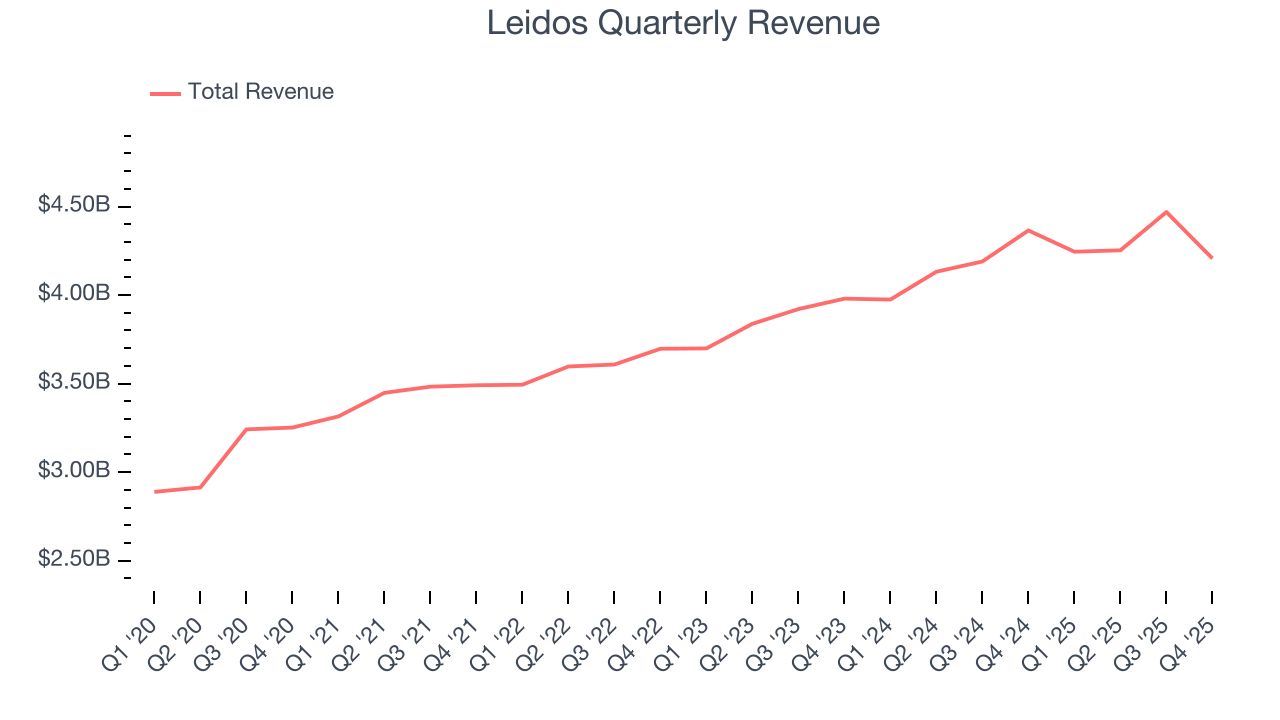
Long-term growth is the most important, but within industrials, a half-decade historical view may miss new industry trends or demand cycles. Leidos’s recent performance shows its demand has slowed as its annualized revenue growth of 5.5% over the last two years was below its five-year trend. We’re wary when companies in the sector see decelerations in revenue growth, as it could signal changing consumer tastes aided by low switching costs. 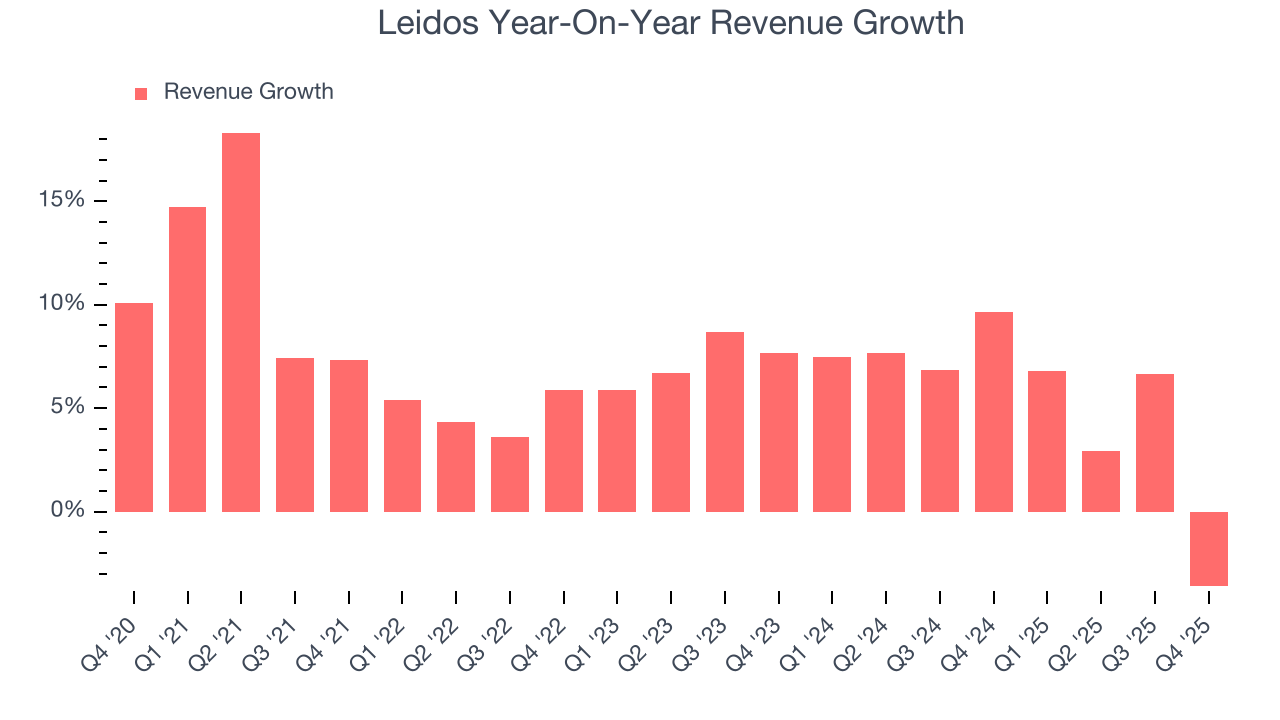
We can better understand the company’s revenue dynamics by analyzing its backlog, or the value of its outstanding orders that have not yet been executed or delivered. Leidos’s backlog reached $49 billion in the latest quarter and averaged 20.2% year-on-year growth over the last two years. Because this number is better than its revenue growth, we can see the company accumulated more orders than it could fulfill and deferred revenue to the future. This could imply elevated demand for Leidos’s products and services but raises concerns about capacity constraints. 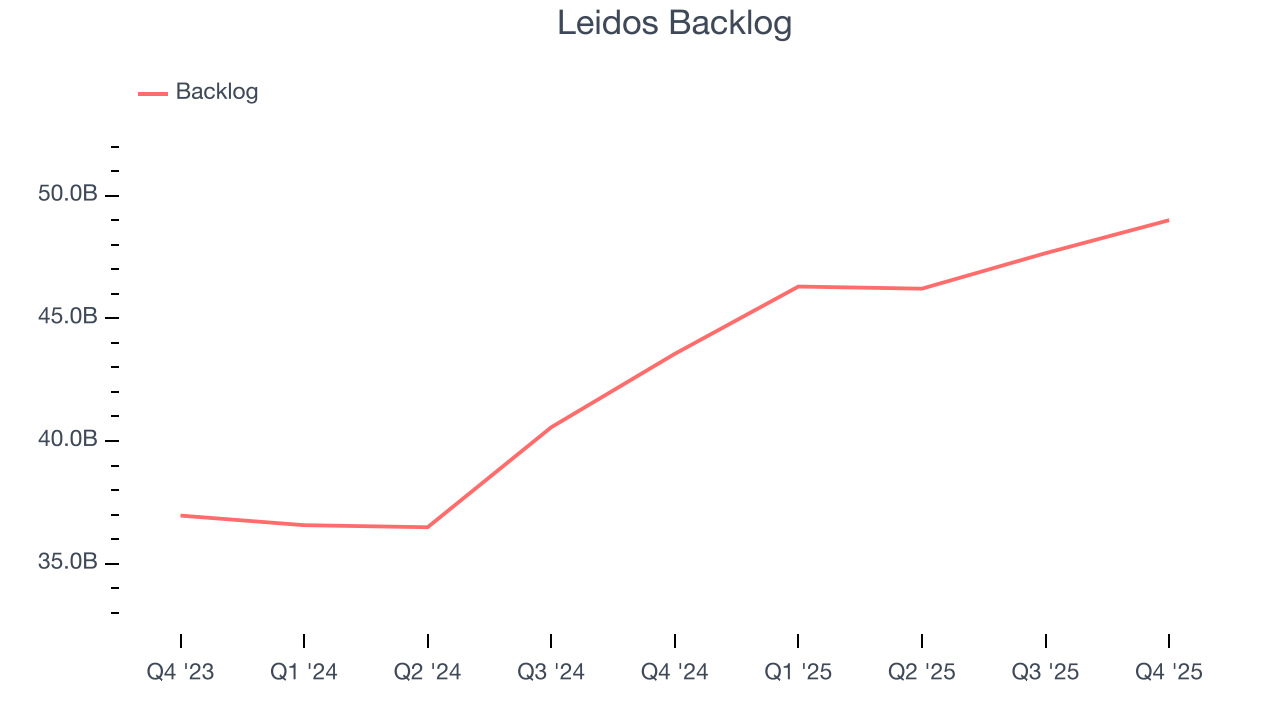
This quarter, Leidos missed Wall Street’s estimates and reported a rather uninspiring 3.6% year-on-year revenue decline, generating $4.21 billion of revenue.
Looking ahead, sell-side analysts expect revenue to grow 4.4% over the next 12 months, similar to its two-year rate. This projection doesn't excite us and suggests its products and services will face some demand challenges. At least the company is tracking well in other measures of financial health.
6. Operating Margin
Operating margin is a key measure of profitability. Think of it as net income - the bottom line - excluding the impact of taxes and interest on debt, which are less connected to business fundamentals.
Leidos has done a decent job managing its cost base over the last five years. The company has produced an average operating margin of 8.8%, higher than the broader industrials sector.
Looking at the trend in its profitability, Leidos’s operating margin rose by 3.9 percentage points over the last five years, as its sales growth gave it operating leverage.
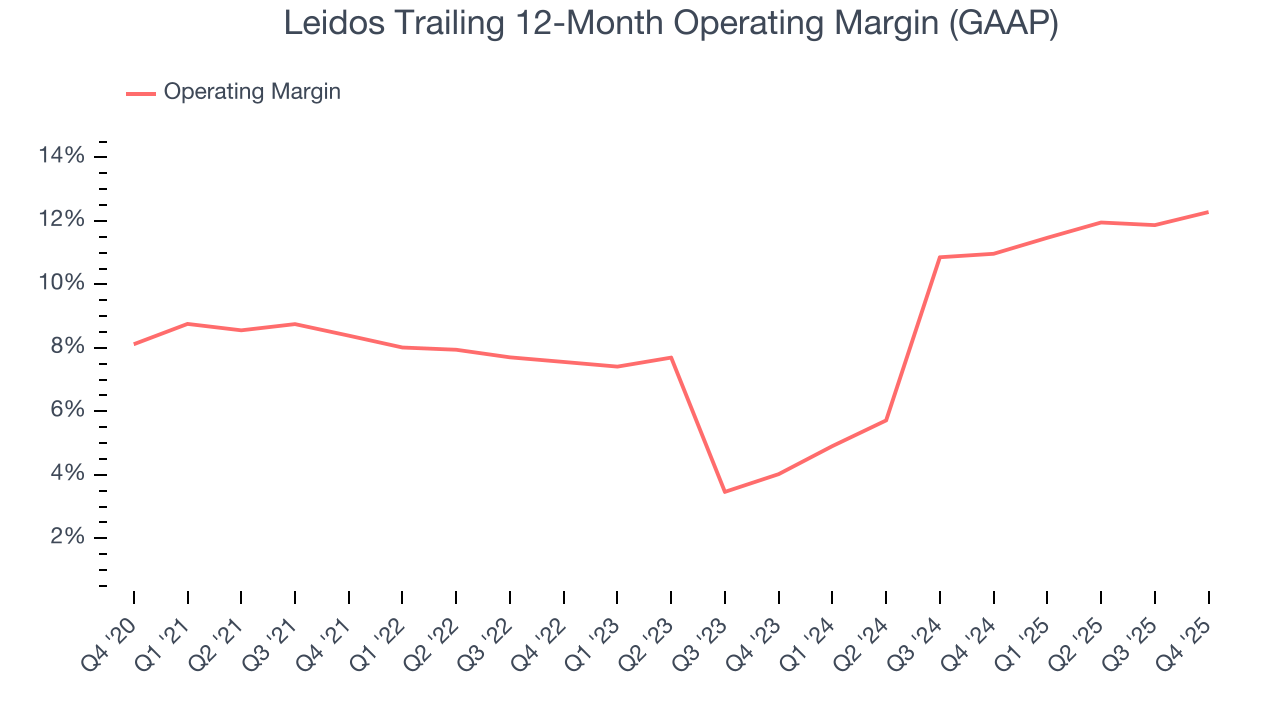
This quarter, Leidos generated an operating margin profit margin of 11.2%, up 1.6 percentage points year on year. This increase was a welcome development, especially since its revenue fell, showing it was more efficient because it scaled down its expenses.
7. Earnings Per Share
We track the long-term change in earnings per share (EPS) for the same reason as long-term revenue growth. Compared to revenue, however, EPS highlights whether a company’s growth is profitable.
Leidos’s EPS grew at a spectacular 15.5% compounded annual growth rate over the last five years, higher than its 6.9% annualized revenue growth. This tells us the company became more profitable on a per-share basis as it expanded.
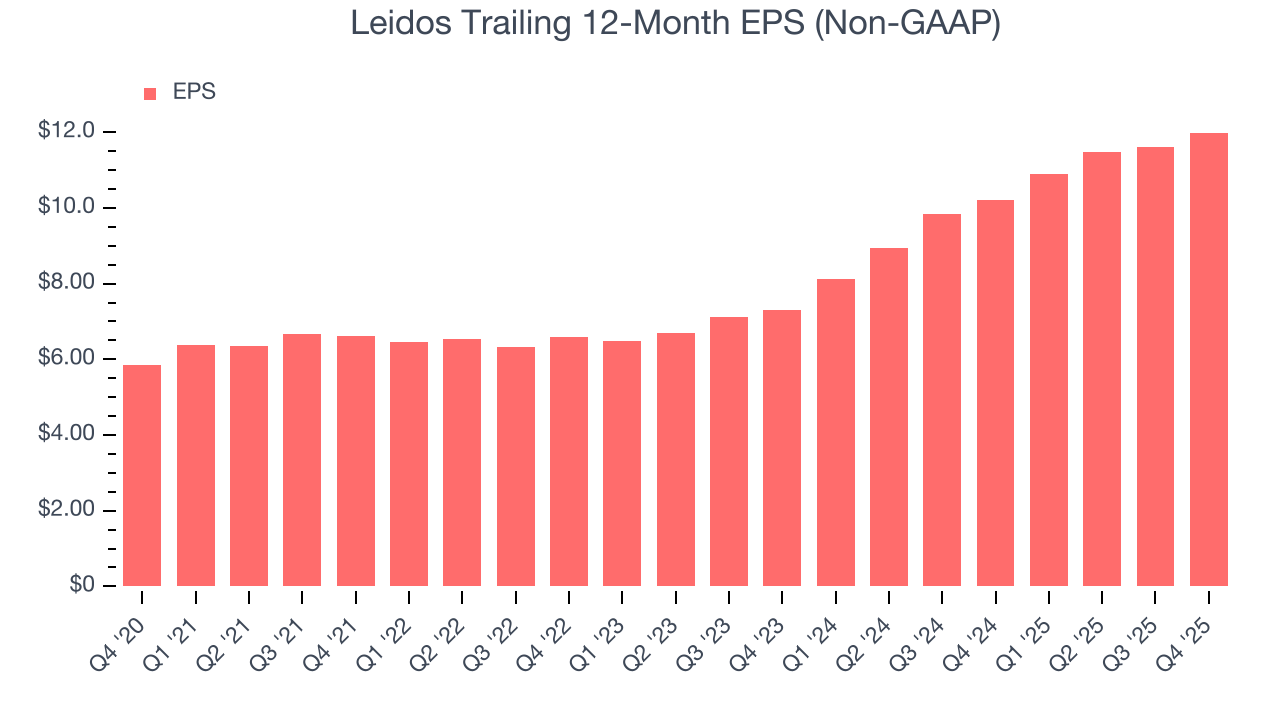
We can take a deeper look into Leidos’s earnings quality to better understand the drivers of its performance. As we mentioned earlier, Leidos’s operating margin expanded by 3.9 percentage points over the last five years. On top of that, its share count shrank by 10.4%. These are positive signs for shareholders because improving profitability and share buybacks turbocharge EPS growth relative to revenue growth. 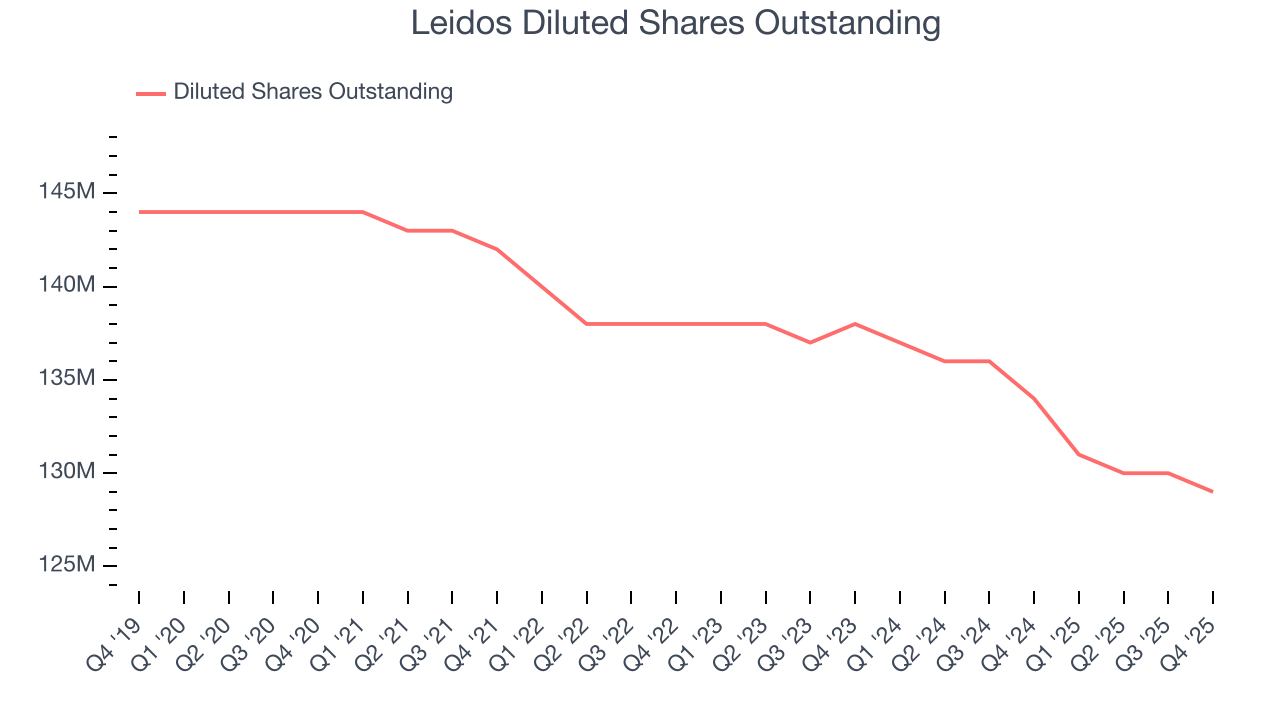
Like with revenue, we analyze EPS over a shorter period to see if we are missing a change in the business.
For Leidos, its two-year annual EPS growth of 28.2% was higher than its five-year trend. We love it when earnings growth accelerates, especially when it accelerates off an already high base.
In Q4, Leidos reported adjusted EPS of $2.76, up from $2.37 in the same quarter last year. This print beat analysts’ estimates by 5.9%. Over the next 12 months, Wall Street expects Leidos’s full-year EPS of $11.99 to grow 1.6%.
8. Cash Is King
If you’ve followed StockStory for a while, you know we emphasize free cash flow. Why, you ask? We believe that in the end, cash is king, and you can’t use accounting profits to pay the bills.
Leidos has shown decent cash profitability, giving it some flexibility to reinvest or return capital to investors. The company’s free cash flow margin averaged 7.3% over the last five years, slightly better than the broader industrials sector.
Taking a step back, we can see that Leidos’s margin expanded by 2.7 percentage points during that time. This is encouraging because it gives the company more optionality.
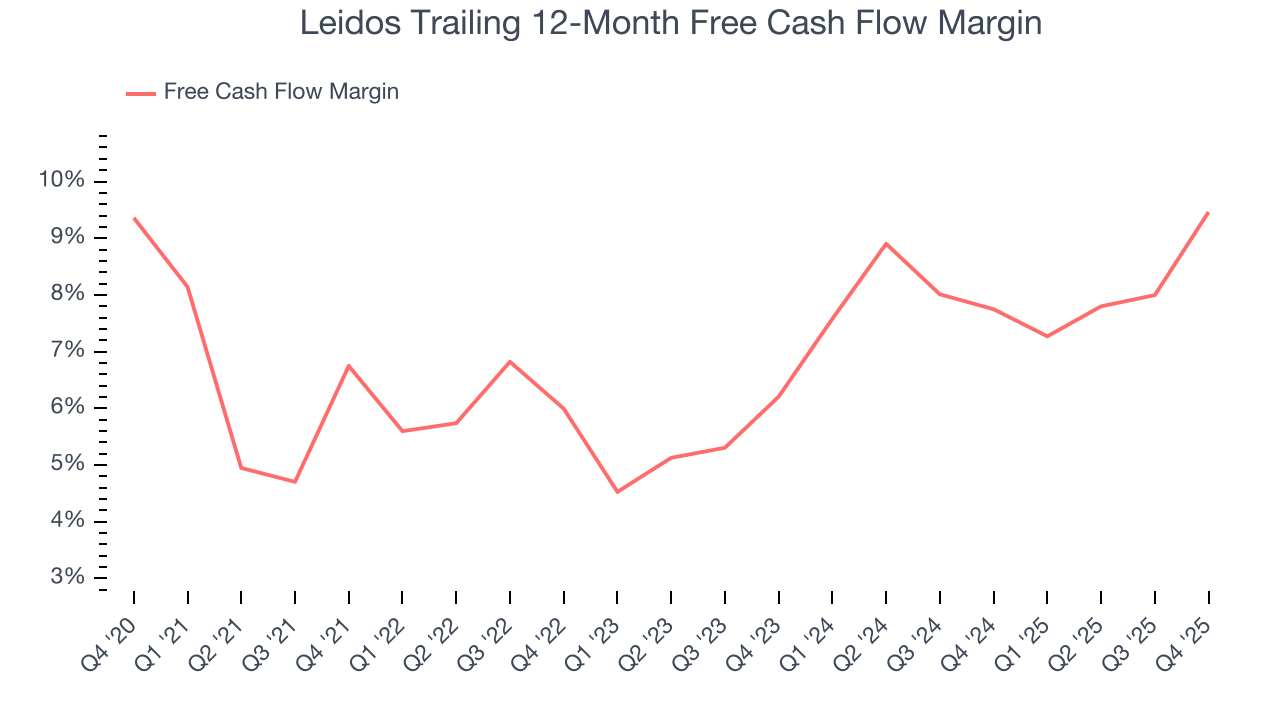
Leidos’s free cash flow clocked in at $452 million in Q4, equivalent to a 10.7% margin. This result was good as its margin was 5.9 percentage points higher than in the same quarter last year, building on its favorable historical trend.
9. Return on Invested Capital (ROIC)
EPS and free cash flow tell us whether a company was profitable while growing its revenue. But was it capital-efficient? Enter ROIC, a metric showing how much operating profit a company generates relative to the money it has raised (debt and equity).
Leidos’s management team makes decent investment decisions and generates value for shareholders. Its five-year average ROIC was 11.9%, slightly better than typical industrials business.
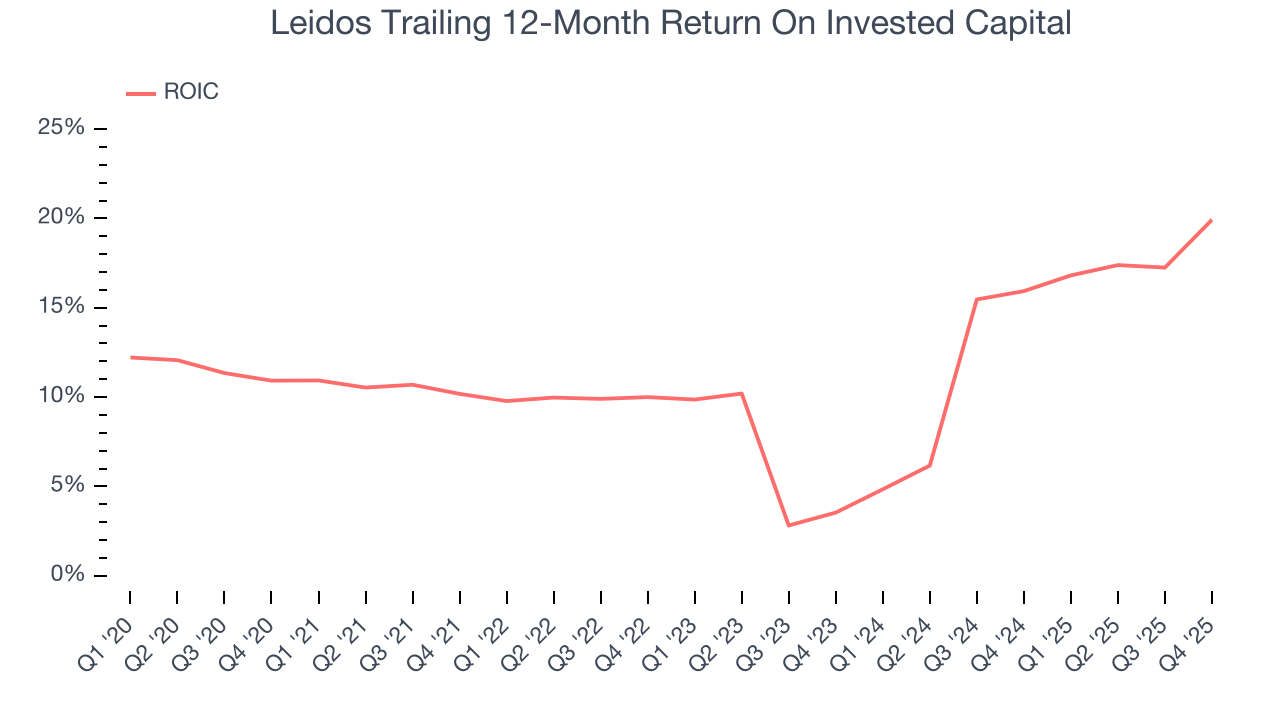
We like to invest in businesses with high returns, but the trend in a company’s ROIC is what often surprises the market and moves the stock price. Leidos’s ROIC has increased over the last few years. This is a great sign when paired with its already strong returns. It could suggest its competitive advantage or profitable growth opportunities are expanding.
10. Balance Sheet Assessment
Leidos reported $1.11 billion of cash and $5.24 billion of debt on its balance sheet in the most recent quarter. As investors in high-quality companies, we primarily focus on two things: 1) that a company’s debt level isn’t too high and 2) that its interest payments are not excessively burdening the business.
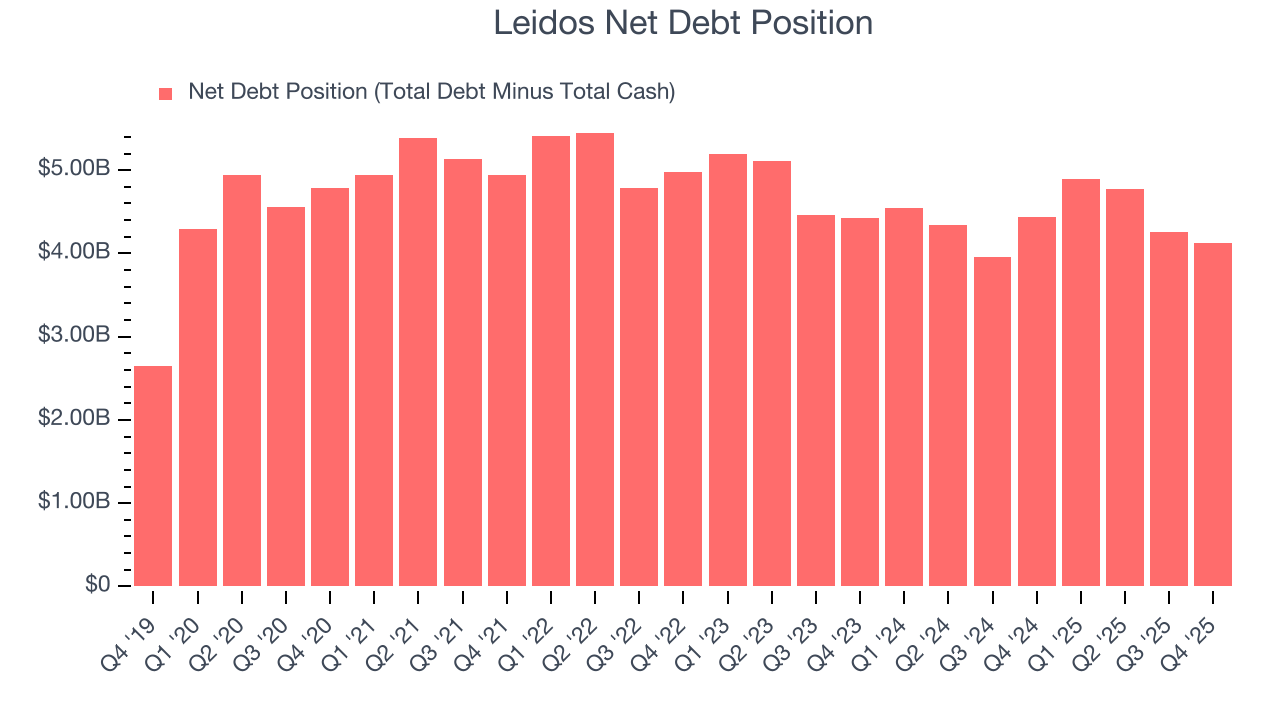
With $2.42 billion of EBITDA over the last 12 months, we view Leidos’s 1.7× net-debt-to-EBITDA ratio as safe. We also see its $203 million of annual interest expenses as appropriate. The company’s profits give it plenty of breathing room, allowing it to continue investing in growth initiatives.
11. Key Takeaways from Leidos’s Q4 Results
It was encouraging to see Leidos beat analysts’ EBITDA expectations this quarter. We were also glad its EPS outperformed Wall Street’s estimates. On the other hand, its revenue missed and its full-year revenue guidance fell slightly short of Wall Street’s estimates. Overall, this was a weaker quarter. The stock traded down 2.4% to $172.14 immediately after reporting.
12. Is Now The Time To Buy Leidos?
Updated: March 23, 2026 at 11:31 PM EDT
Before deciding whether to buy Leidos or pass, we urge investors to consider business quality, valuation, and the latest quarterly results.
In our opinion, Leidos is a good company. Although its revenue growth was mediocre over the last five years and analysts expect growth to slow over the next 12 months, its backlog growth has been marvelous. And while its projected EPS for the next year is lacking, its spectacular EPS growth over the last five years shows its profits are trickling down to shareholders.
Leidos’s P/E ratio based on the next 12 months is 13.7x. Looking at the industrials space right now, Leidos trades at a compelling valuation. For those confident in the business and its management team, this is a good time to invest.
Wall Street analysts have a consensus one-year price target of $212.46 on the company (compared to the current share price of $163.32), implying they see 30.1% upside in buying Leidos in the short term.