
Molina Healthcare (MOH)
Molina Healthcare catches our eye. Its scale gives it meaningful leverage when negotiating reimbursement rates.― StockStory Analyst Team


1. News






2. Summary
Why Molina Healthcare Is Interesting
Founded in 1980 as a provider for underserved communities in Southern California, Molina Healthcare (NYSE:MOH) provides managed healthcare services primarily to low-income individuals through Medicaid, Medicare, and Marketplace insurance programs across 21 states.
- Scale advantages are evident in its $44.55 billion revenue base, which provides operating leverage when demand is strong
- Market share has increased this cycle as its 19.3% annual revenue growth over the last five years was exceptional
- A drawback is its adjusted operating margin falls short of the industry average, and the smaller profit dollars make it harder to react to unexpected market developments
Molina Healthcare almost passes our quality test. If you believe in the company, the valuation seems reasonable.
Why Is Now The Time To Buy Molina Healthcare?








Molina Healthcare is trading at $196.44 per share, or 17.2x forward P/E. This multiple is lower than the broader healthcare space, and we think it’s fair given the revenue growth.
This could be a good time to invest if you think there are underappreciated aspects of the business.
3. Molina Healthcare (MOH) Research Report: Q3 CY2025 Update
Healthcare insurance company Molina Healthcare (NYSE:MOH) beat Wall Street’s revenue expectations in Q3 CY2025, with sales up 11% year on year to $11.48 billion. The company expects the full year’s revenue to be around $44.5 billion, close to analysts’ estimates. Its non-GAAP profit of $1.84 per share was 52.7% below analysts’ consensus estimates.
Molina Healthcare (MOH) Q3 CY2025 Highlights:
- Revenue: $11.48 billion vs analyst estimates of $10.96 billion (11% year-on-year growth, 4.7% beat)
- Adjusted EPS: $1.84 vs analyst expectations of $3.89 (52.7% miss)
- Adjusted EBITDA: $179 million vs analyst estimates of $346.7 million (1.6% margin, 48.4% miss)
- The company lifted its revenue guidance for the full year to $44.5 billion at the midpoint from $44 billion, a 1.1% increase
- Management lowered its full-year Adjusted EPS guidance to $14 at the midpoint, a 26.3% decrease
- Operating Margin: 1.2%, down from 4.5% in the same quarter last year
- Free Cash Flow was -$163 million, down from $838 million in the same quarter last year
- Customers: 5.63 million, down from 5.75 million in the previous quarter
- Market Capitalization: $10.67 billion
Company Overview
Founded in 1980 as a provider for underserved communities in Southern California, Molina Healthcare (NYSE:MOH) provides managed healthcare services primarily to low-income individuals through Medicaid, Medicare, and Marketplace insurance programs across 21 states.
Molina operates as a pure-play government-sponsored healthcare business with four main segments: Medicaid, Medicare, Marketplace, and a smaller segment offering long-term services consulting. The company serves approximately 5.5 million members, with Medicaid representing about 79% of its premium revenue.
In the Medicaid segment, Molina participates in various programs including Temporary Assistance for Needy Families (TANF), Aged, Blind or Disabled (ABD) coverage, Children's Health Insurance Program (CHIP), Medicaid Expansion, and Long Term Services and Supports (LTSS). The company contracts with state agencies, typically for three to five-year terms.
For Medicare, Molina offers Medicare Advantage plans with prescription drug coverage (MAPD) and several specialized programs for dual-eligible individuals who qualify for both Medicare and Medicaid. These include Dual Eligible Special Needs Plans (D-SNP) and more integrated options that coordinate care between the two programs.
In the Marketplace segment, established under the Affordable Care Act, Molina offers plans in most states where it operates Medicaid programs. This strategy allows members to maintain their providers when transitioning between Medicaid and Marketplace coverage.
Molina contracts with a network of healthcare providers including physicians, hospitals, and pharmacies. The company pays providers through various methods including capitation (fixed monthly payments per member) and fee-for-service arrangements. To manage medical costs, Molina emphasizes preventive care and appropriate utilization of specialty and hospital services.
The company employs various medical management strategies including utilization management, population health programs, and pharmacy management. These approaches help identify at-risk members, customize interventions, and promote cost-effective care while addressing physical health, behavioral health, and social determinants of health.
4. Health Insurance Providers
Upfront premiums collected by health insurers lead to reliable revenue, but profitability ultimately depends on accurate risk assessments and the ability to control medical costs. Health insurers are also highly sensitive to regulatory changes and economic conditions such as unemployment. Going forward, the industry faces tailwinds from an aging population, increasing demand for personalized healthcare services, and advancements in data analytics to improve cost management. However, continued regulatory scrutiny on pricing practices, the potential for government-led reforms such as expanded public healthcare options, and inflation in medical costs could add volatility to margins. One big debate among investors is the long-term impact of AI and whether it will help underwriting, fraud detection, and claims processing or whether it may wade into ethical grey areas like reinforcing biases and widening disparities in medical care.
Molina Healthcare's primary competitors in the Medicaid managed care space include Centene Corporation, CVS Health Corporation, Elevance Health (formerly Anthem), UnitedHealth Group, and various large not-for-profit healthcare organizations. In the Marketplace segment, Centene Corporation is Molina's main competitor for low-income members.
5. Economies of Scale
Larger companies benefit from economies of scale, where fixed costs like infrastructure, technology, and administration are spread over a higher volume of goods or services, reducing the cost per unit. Scale can also lead to bargaining power with suppliers, greater brand recognition, and more investment firepower. A virtuous cycle can ensue if a scaled company plays its cards right.
With $44.55 billion in revenue over the past 12 months, Molina Healthcare boasts impressive economies of scale. It may not be as large as heavyweights such as UnitedHealth Group and The Cigna Group from a topline perspective, but its heft is still an important advantage in a healthcare industry that is heavily regulated, complex, and resource-intensive.
6. Revenue Growth
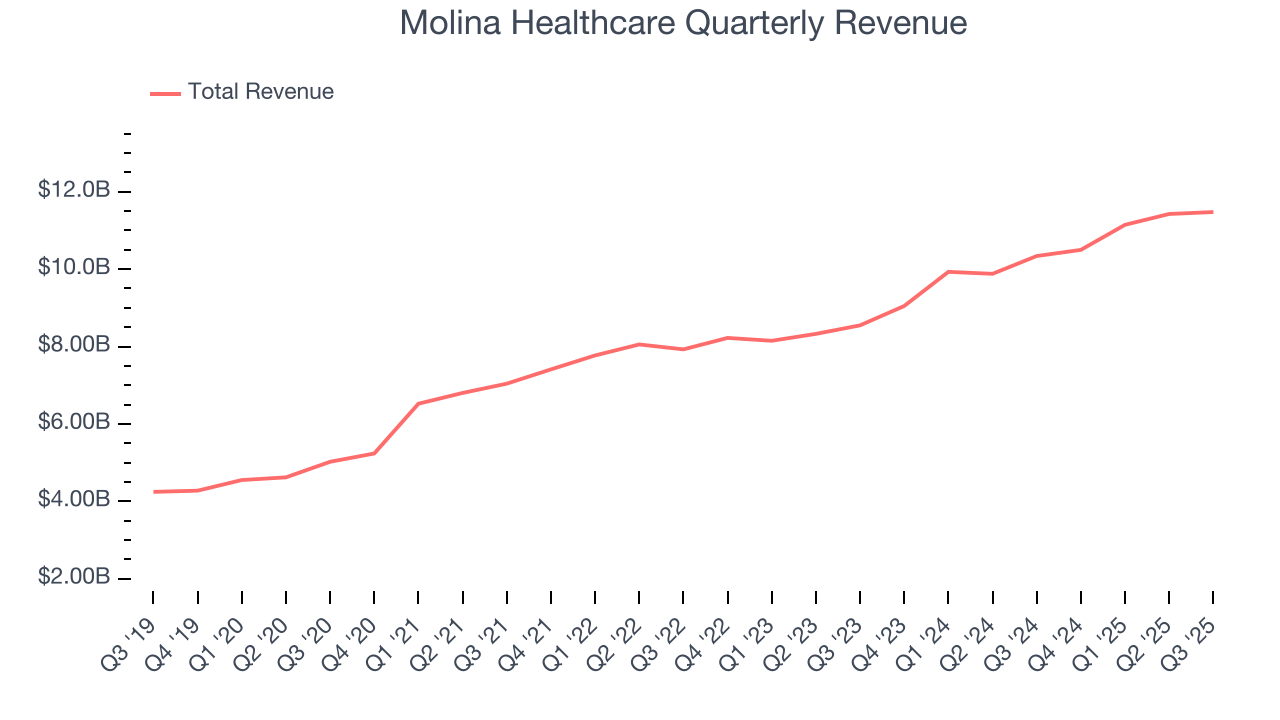
A company’s long-term performance is an indicator of its overall quality. Any business can put up a good quarter or two, but the best consistently grow over the long haul. Over the last five years, Molina Healthcare grew its sales at an impressive 19.3% compounded annual growth rate. Its growth beat the average healthcare company and shows its offerings resonate with customers, a helpful starting point for our analysis.
Long-term growth is the most important, but within healthcare, a half-decade historical view may miss new innovations or demand cycles. Molina Healthcare’s annualized revenue growth of 15.8% over the last two years is below its five-year trend, but we still think the results suggest healthy demand. 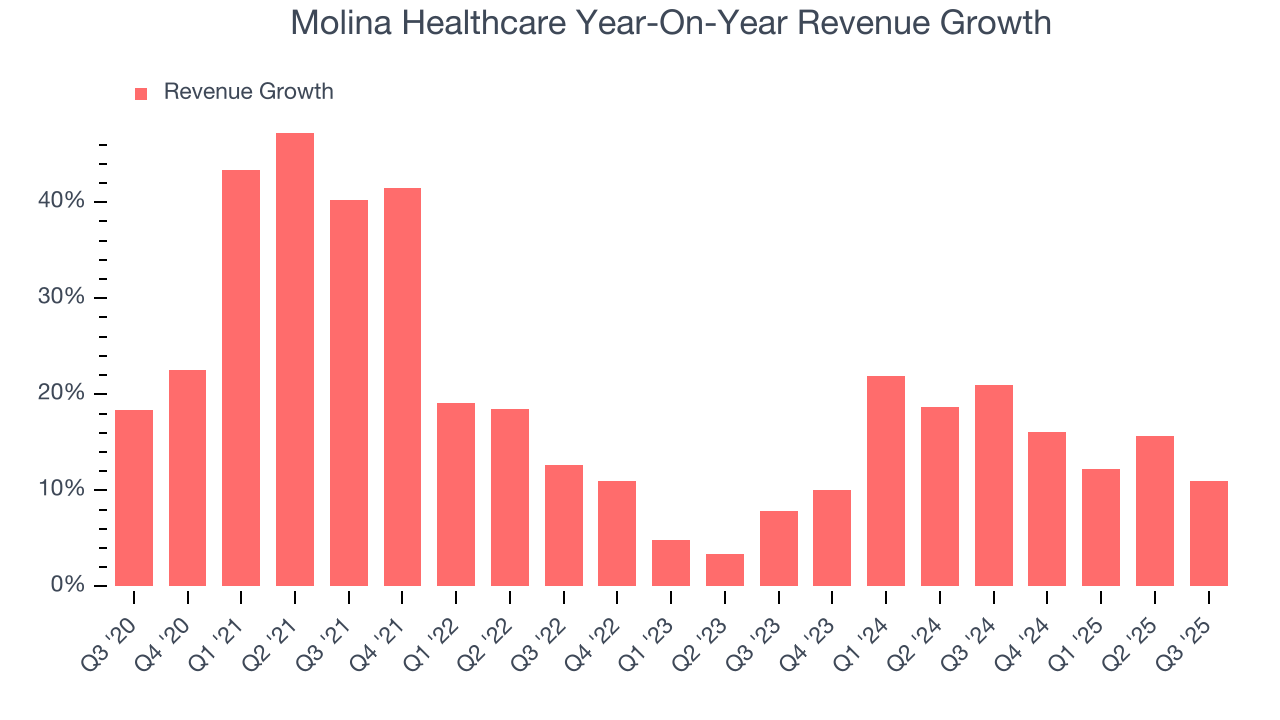
We can better understand the company’s revenue dynamics by analyzing its number of customers, which reached 5.63 million in the latest quarter. Over the last two years, Molina Healthcare’s customer base averaged 4.2% year-on-year growth. Because this number is lower than its revenue growth, we can see the average customer spent more money each year on the company’s products and services. 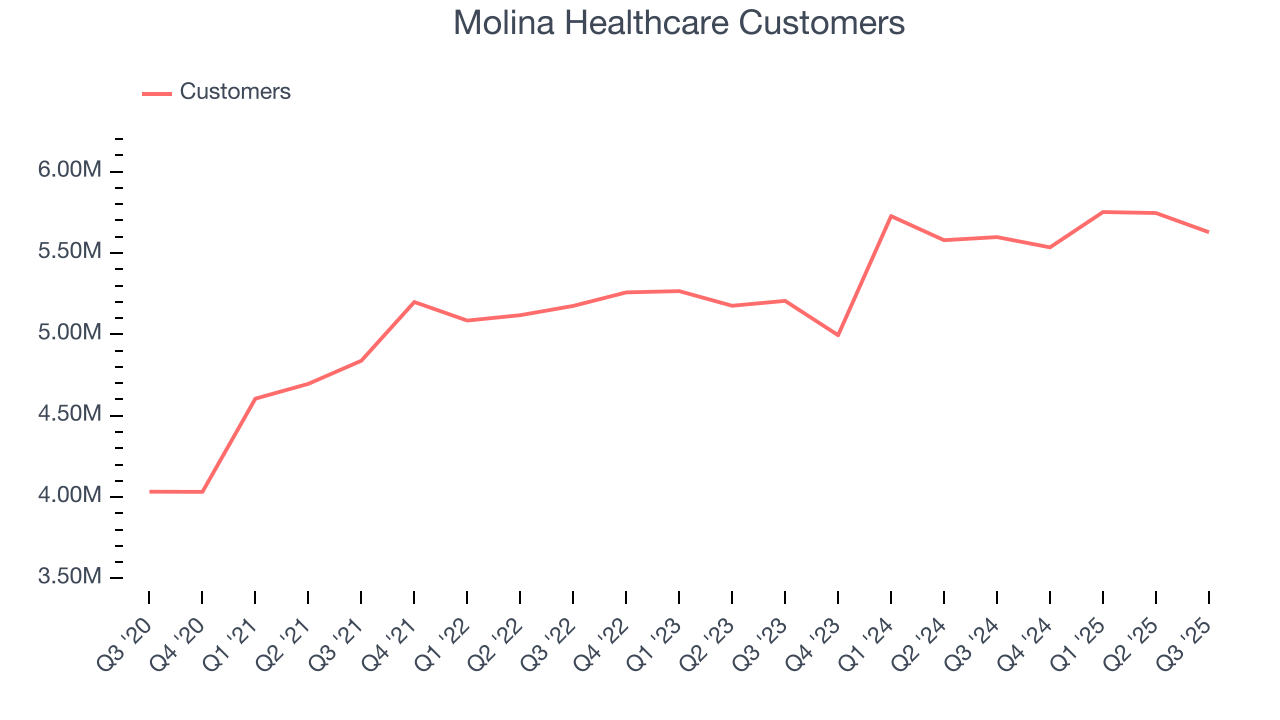
This quarter, Molina Healthcare reported year-on-year revenue growth of 11%, and its $11.48 billion of revenue exceeded Wall Street’s estimates by 4.7%.
Looking ahead, sell-side analysts expect revenue to grow 5% over the next 12 months, a deceleration versus the last two years. We still think its growth trajectory is satisfactory given its scale and implies the market is baking in success for its products and services.
7. Operating Margin
Molina Healthcare’s operating margin might fluctuated slightly over the last 12 months but has generally stayed the same, averaging 3.7% over the last five years. This profitability was paltry for a healthcare business and caused by its suboptimal cost structure.
Analyzing the trend in its profitability, Molina Healthcare’s operating margin of 3% for the trailing 12 months may be around the same as five years ago, but it has decreased by 1.1 percentage points over the last two years. Still, we’re optimistic that Molina Healthcare can correct course and expand its profitability on a longer-term horizon due to its business quality.
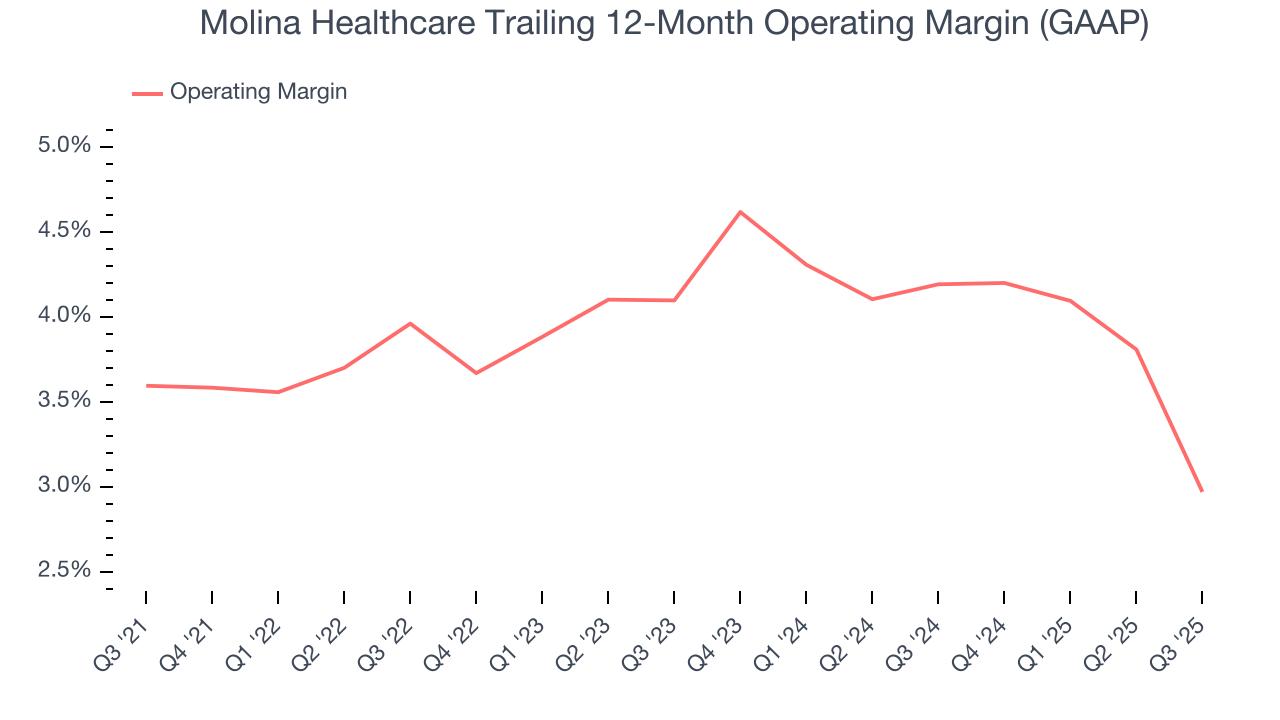
This quarter, Molina Healthcare generated an operating margin profit margin of 1.2%, down 3.3 percentage points year on year. This contraction shows it was less efficient because its expenses grew faster than its revenue.
8. Earnings Per Share
We track the long-term change in earnings per share (EPS) for the same reason as long-term revenue growth. Compared to revenue, however, EPS highlights whether a company’s growth is profitable.
Molina Healthcare’s EPS grew at a decent 5.8% compounded annual growth rate over the last five years. However, this performance was lower than its 19.3% annualized revenue growth, telling us the company became less profitable on a per-share basis as it expanded due to non-fundamental factors such as interest expenses and taxes.
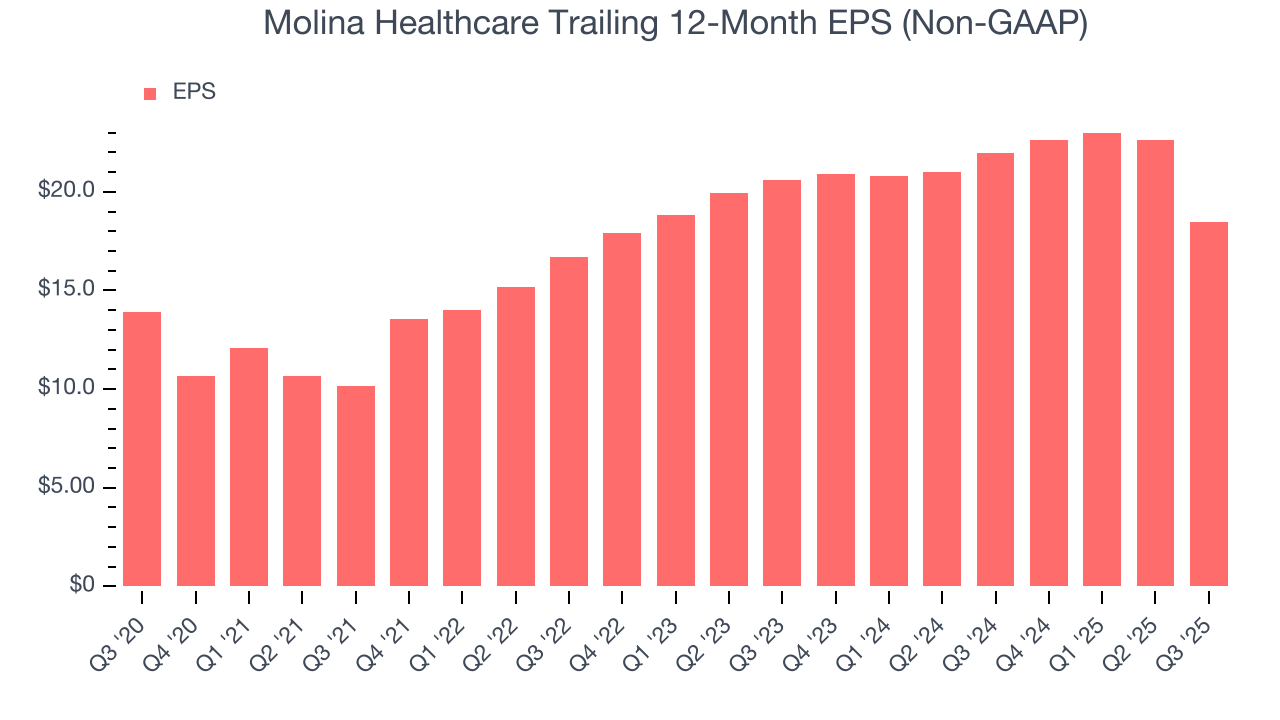
In Q3, Molina Healthcare reported adjusted EPS of $1.84, down from $6.01 in the same quarter last year. This print missed analysts’ estimates, but we care more about long-term adjusted EPS growth than short-term movements. Over the next 12 months, Wall Street expects Molina Healthcare’s full-year EPS of $18.45 to grow 1.2%.
9. Cash Is King
Free cash flow isn't a prominently featured metric in company financials and earnings releases, but we think it's telling because it accounts for all operating and capital expenses, making it tough to manipulate. Cash is king.
Molina Healthcare has shown mediocre cash profitability over the last five years, giving the company limited opportunities to return capital to shareholders. Its free cash flow margin averaged 3.3%, subpar for a healthcare business.
Taking a step back, we can see that Molina Healthcare’s margin dropped by 12.1 percentage points during that time. If the trend continues, it could signal it’s in the middle of a big investment cycle.
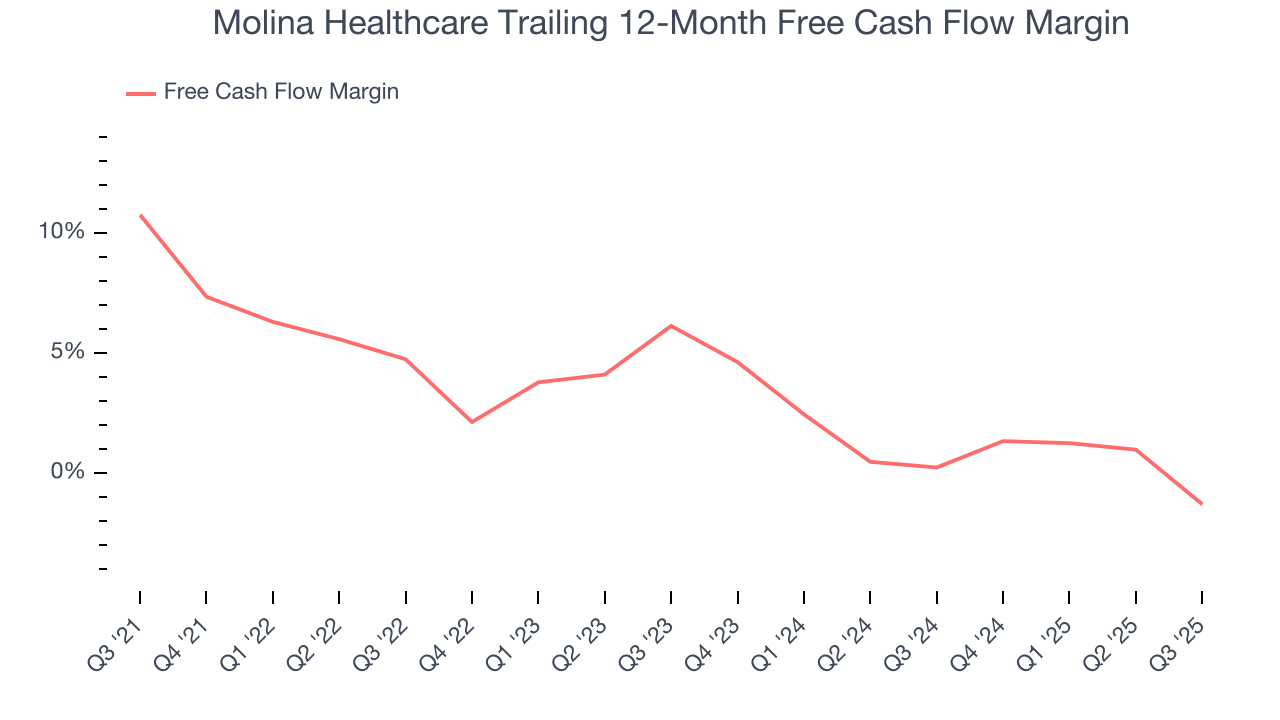
Molina Healthcare burned through $163 million of cash in Q3, equivalent to a negative 1.4% margin. The company’s cash flow turned negative after being positive in the same quarter last year, which isn’t ideal considering its longer-term trend.
10. Balance Sheet Assessment
One of the best ways to mitigate bankruptcy risk is to hold more cash than debt.
Molina Healthcare is a well-capitalized company with $8.45 billion of cash and $3.85 billion of debt on its balance sheet. This $4.60 billion net cash position is 43.1% of its market cap and gives it the freedom to borrow money, return capital to shareholders, or invest in growth initiatives. Leverage is not an issue here.
11. Key Takeaways from Molina Healthcare’s Q3 Results
We enjoyed seeing Molina Healthcare beat analysts’ revenue expectations this quarter. On the other hand, its full-year EPS guidance missed and its EPS guidance for next quarter fell short of Wall Street’s estimates. Overall, this was a weaker quarter. The stock traded down 17.9% to $159.88 immediately after reporting.
12. Is Now The Time To Buy Molina Healthcare?
Updated: January 21, 2026 at 10:51 PM EST
Before deciding whether to buy Molina Healthcare or pass, we urge investors to consider business quality, valuation, and the latest quarterly results.
There’s plenty to admire about Molina Healthcare. First off, its revenue growth was impressive over the last five years. And while its cash profitability fell over the last five years, its scale gives it meaningful leverage when negotiating reimbursement rates.
Molina Healthcare’s P/E ratio based on the next 12 months is 16.3x. Looking at the healthcare landscape right now, Molina Healthcare trades at a pretty interesting price. If you believe in the company and its growth potential, now is an opportune time to buy shares.
Wall Street analysts have a consensus one-year price target of $185.38 on the company (compared to the current share price of $192.73).