
Ridgepost Capital (RPC)
We’re skeptical of Ridgepost Capital. Its poor returns on capital indicate it barely generated any profits, a must for high-quality companies.― StockStory Analyst Team


1. News


2. Summary
Why Ridgepost Capital Is Not Exciting
Operating as a bridge between institutional investors and hard-to-access private market opportunities, Ridgepost Capital (NYSE:RPC) is an alternative asset management firm that provides access to private equity, venture capital, impact investing, and private credit opportunities in the middle and lower middle markets.
- Underwhelming 4.1% return on equity reflects management’s difficulties in finding profitable growth opportunities
- The good news is that its annual revenue growth of 34.6% over the past five years was outstanding, reflecting market share gains this cycle
Ridgepost Capital is in the doghouse. We’d search for superior opportunities elsewhere.
Why There Are Better Opportunities Than Ridgepost Capital








Ridgepost Capital’s stock price of $8.50 implies a valuation ratio of 11x forward P/E. Ridgepost Capital’s multiple may seem like a great deal among financials peers, but we think there are valid reasons why it’s this cheap.
It’s better to pay up for high-quality businesses with higher long-term earnings potential rather than to buy lower-quality stocks because they appear cheap. These challenged businesses often don’t re-rate, a phenomenon known as a “value trap”.
3. Ridgepost Capital (RPC) Research Report: Q4 CY2025 Update
Private markets investment firm Ridgepost Capital (NYSE:RPC) reported Q4 CY2025 results exceeding the market’s revenue expectations, but sales fell by 4.7% year on year to $81.05 million. Its non-GAAP profit of $0.26 per share was 8.3% above analysts’ consensus estimates.
Ridgepost Capital (RPC) Q4 CY2025 Highlights:
- Assets Under Management: $29.4 billion vs analyst estimates of $29.88 billion (14.5% year-on-year growth, 1.6% miss)
- Revenue: $81.05 million vs analyst estimates of $80.63 million (4.7% year-on-year decline, 0.5% beat)
- Pre-tax Profit: $17.78 million (21.9% margin)
- Adjusted EPS: $0.26 vs analyst estimates of $0.24 (8.3% beat)
- Market Capitalization: $935.1 million
Company Overview
Operating as a bridge between institutional investors and hard-to-access private market opportunities, Ridgepost Capital (NYSE:RPC) is an alternative asset management firm that provides access to private equity, venture capital, impact investing, and private credit opportunities in the middle and lower middle markets.
Ridgepost Capital focuses on middle and lower-middle market investments, primarily in North America, where it has built extensive networks with fund managers and companies. The firm structures its business around four main solutions: Private Equity, Venture Capital, Impact Investing, and Private Credit, each operating under established brands within their specialized markets.
For institutional clients like pension funds and endowments, Ridgepost Capital offers various investment vehicles including primary investment funds (both commingled and separate accounts), direct investments, co-investments, and secondary market opportunities. This flexibility allows investors to tailor their private market exposure according to their specific needs and objectives.
A university endowment, for example, might engage Ridgepost Capital to access a portfolio of venture capital funds that would be difficult to invest in directly due to high minimum investment requirements or closed status to new investors. Similarly, a pension fund might use P10's services to co-invest alongside experienced private equity managers in middle-market companies.
Ridgepost Capital's business model generates revenue primarily through management fees based on committed or invested capital, with typical investment commitments spanning 10-15 years. The company differentiates itself through proprietary databases containing information on thousands of investment firms, funds, and private companies, which it leverages for due diligence and investment selection. This data-driven approach, combined with decades of relationship-building in private markets, forms the foundation of P10's value proposition to investors seeking specialized expertise in alternative investments.
4. Custody Bank
Custody banks safeguard financial assets and provide services like settlement, accounting, and regulatory compliance for institutional investors. Growth opportunities stem from increasing global assets under custody, demand for data analytics, and blockchain technology adoption for settlement efficiency. Challenges include fee pressure from large clients, substantial technology investment requirements, and competition from both traditional players and fintech firms entering the space.
Ridgepost Capital competes with other alternative asset managers and private market solutions providers such as Hamilton Lane (NASDAQ:HLNE), StepStone Group (NASDAQ:STEP), and Blackstone's Strategic Partners (NYSE:BX), as well as with the direct investment platforms of large institutional investors.
5. Revenue Growth
Examining a company’s long-term performance can provide clues about its quality. Any business can put up a good quarter or two, but many enduring ones grow for years. Thankfully, Ridgepost Capital’s 34.6% annualized revenue growth over the last five years was incredible. Its growth beat the average financials company and shows its offerings resonate with customers.
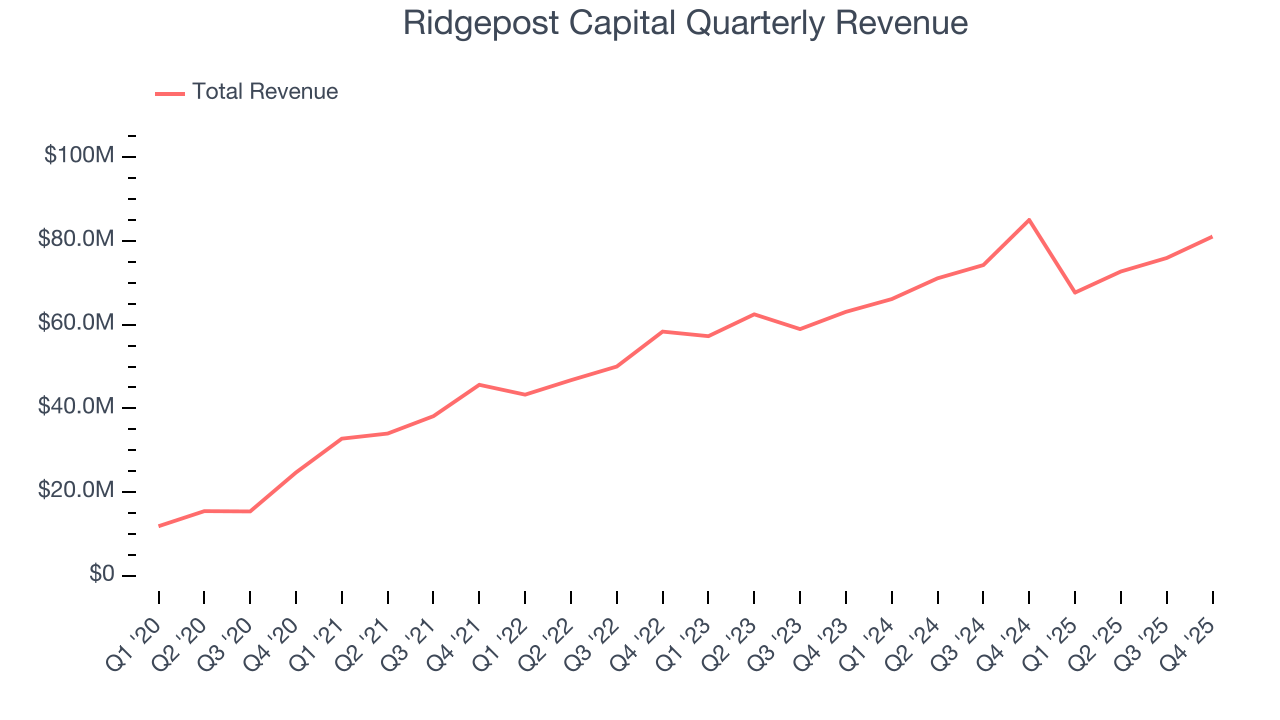
Long-term growth is the most important, but within financials, a half-decade historical view may miss recent interest rate changes and market returns. Ridgepost Capital’s annualized revenue growth of 10.9% over the last two years is below its five-year trend, but we still think the results were respectable. 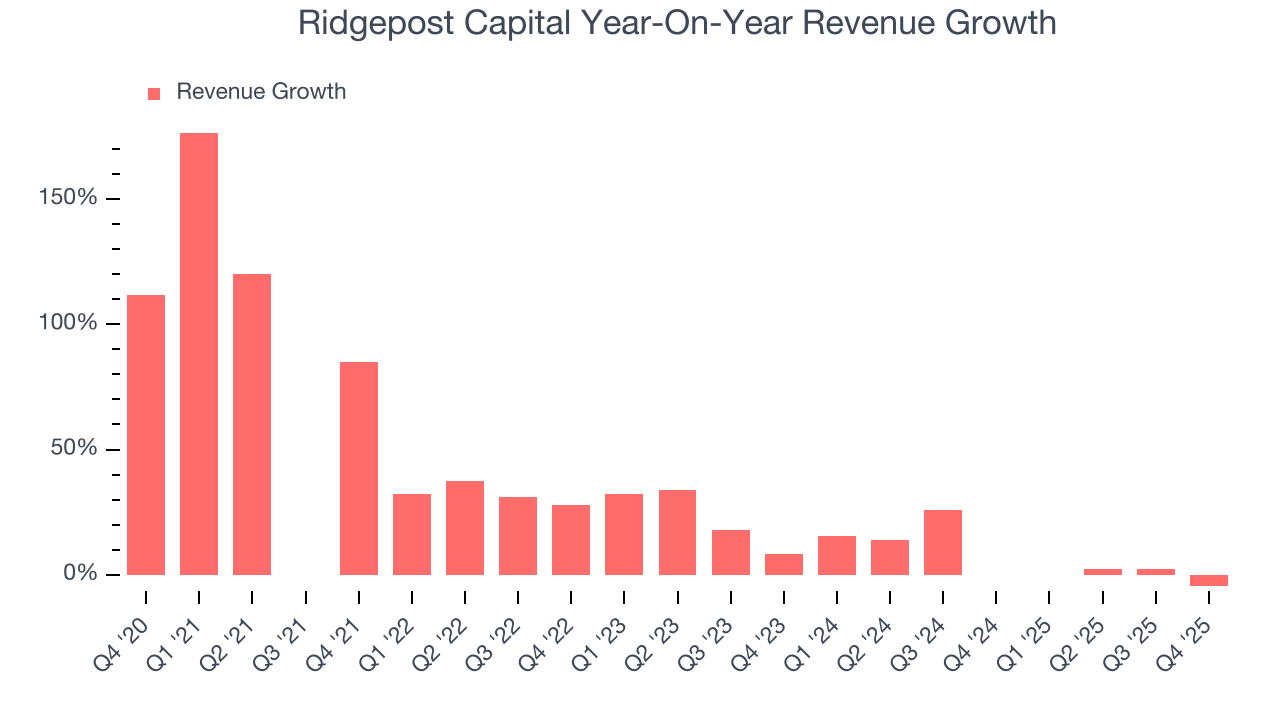 Note: Quarters not shown were determined to be outliers, impacted by outsized investment gains/losses that are not indicative of the recurring fundamentals of the business.
This quarter, Ridgepost Capital’s revenue fell by 4.7% year on year to $81.05 million but beat Wall Street’s estimates by 0.5%.
6. Assets Under Management (AUM)
Assets Under Management (AUM) encompasses all client funds under a firm's investment management umbrella. The recurring fee structure on these assets provides consistent revenue generation, offering financial stability even during periods of poor investment returns, though sustained underperformance can impact future asset flows.
Ridgepost Capital’s AUM has grown at an annual rate of 17% over the last four years, better than the broader financials industry. When analyzing Ridgepost Capital’s AUM over the last two years, we can see that growth decelerated to 12.6% annually. Fundraising or short-term investment performance were net contributors for the company over this shorter period since assets grew faster than total revenue. But again, we put less weight on asset growth given how lumpy and cyclical it can be.
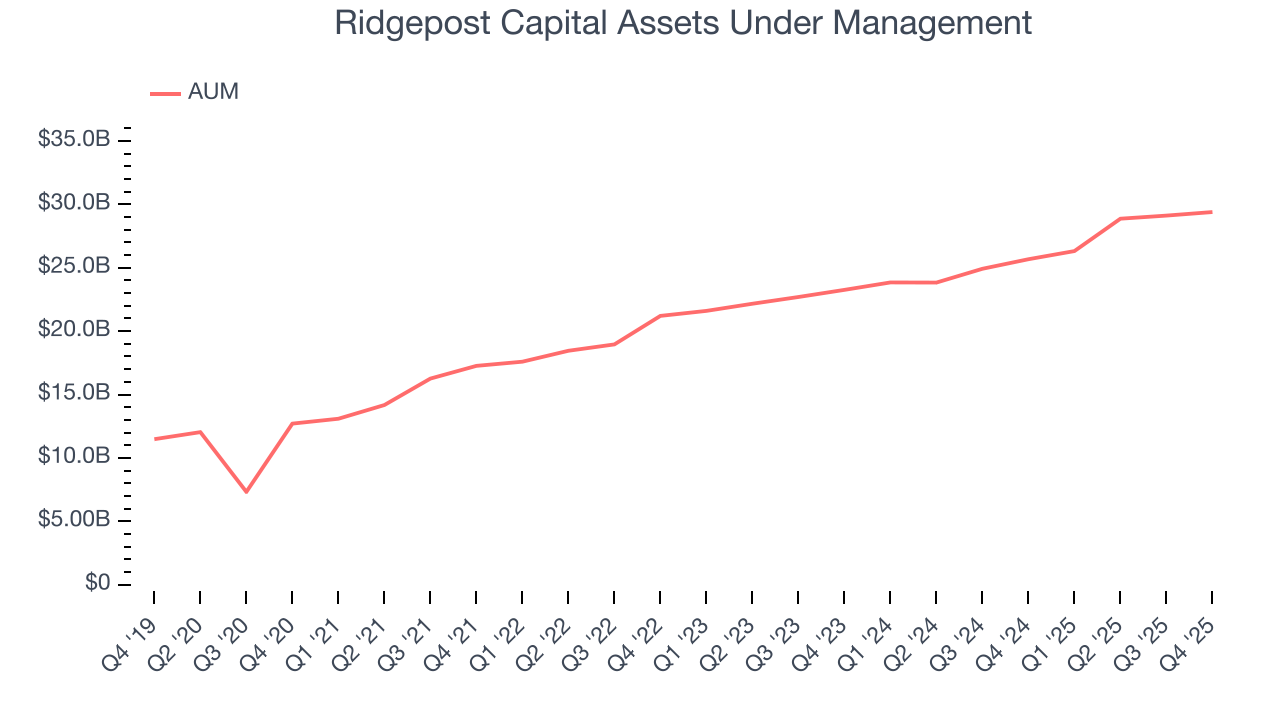
Ridgepost Capital’s AUM punched in at $29.4 billion this quarter, falling 1.6% short of analysts’ expectations. This print was 14.5% higher than the same quarter last year.
7. Pre-Tax Profit Margin
Revenue growth is one major determinant of business quality, and the efficiency of operations is another. For Custody Bank companies, we look at pre-tax profit rather than the operating margin that defines sectors such as consumer, tech, and industrials.
Financials companies manage interest-bearing assets and liabilities, making the interest income and expenses included in pre-tax profit essential to their profit calculation. Taxes, being external factors beyond management control, are appropriately excluded from this alternative margin measure.
Over the last five years, Ridgepost Capital’s pre-tax profit margin has fallen by 15.2 percentage points, going from 2.5% to 10.9%. It has also expanded by 12.2 percentage points on a two-year basis, showing its expenses have consistently grown at a slower rate than revenue. This typically signals prudent management.
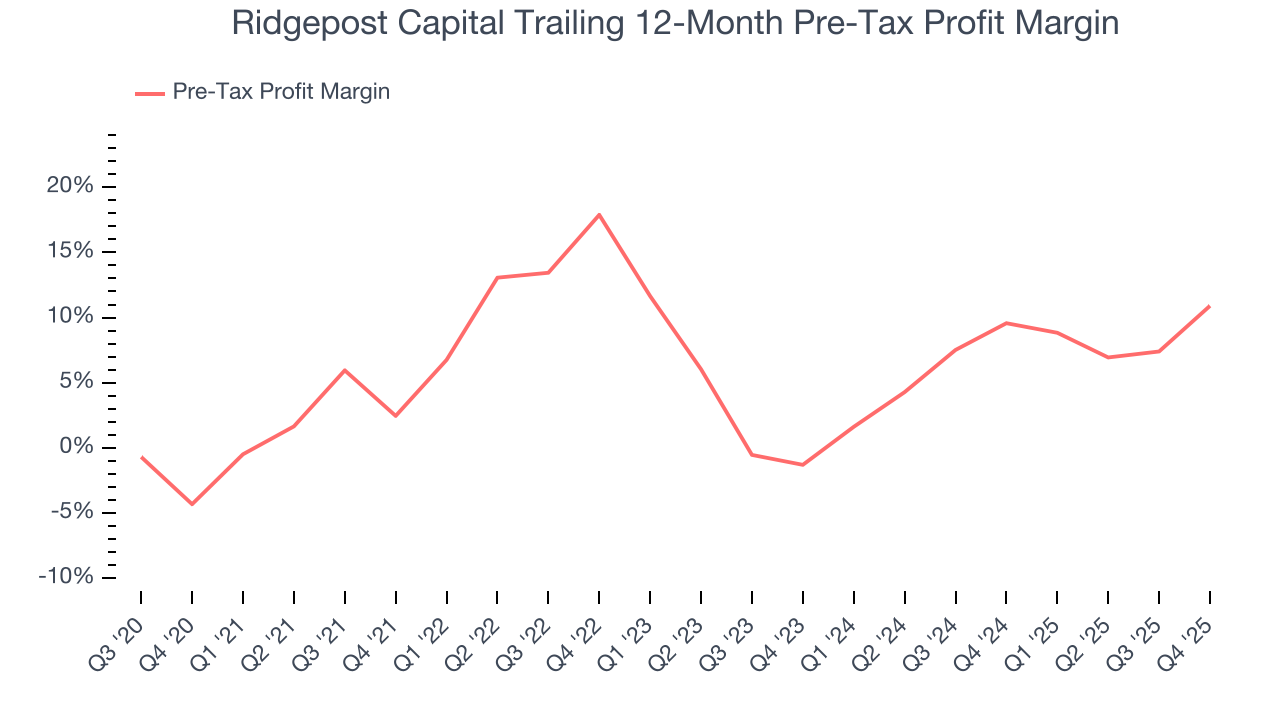
In Q4, Ridgepost Capital’s pre-tax profit margin was 21.9%. This result was 12.9 percentage points better than the same quarter last year.
8. Earnings Per Share
We track the long-term change in earnings per share (EPS) for the same reason as long-term revenue growth. Compared to revenue, however, EPS highlights whether a company’s growth is profitable.
Ridgepost Capital’s full-year EPS grew at a spectacular 22.8% compounded annual growth rate over the last four years, better than the broader financials sector.
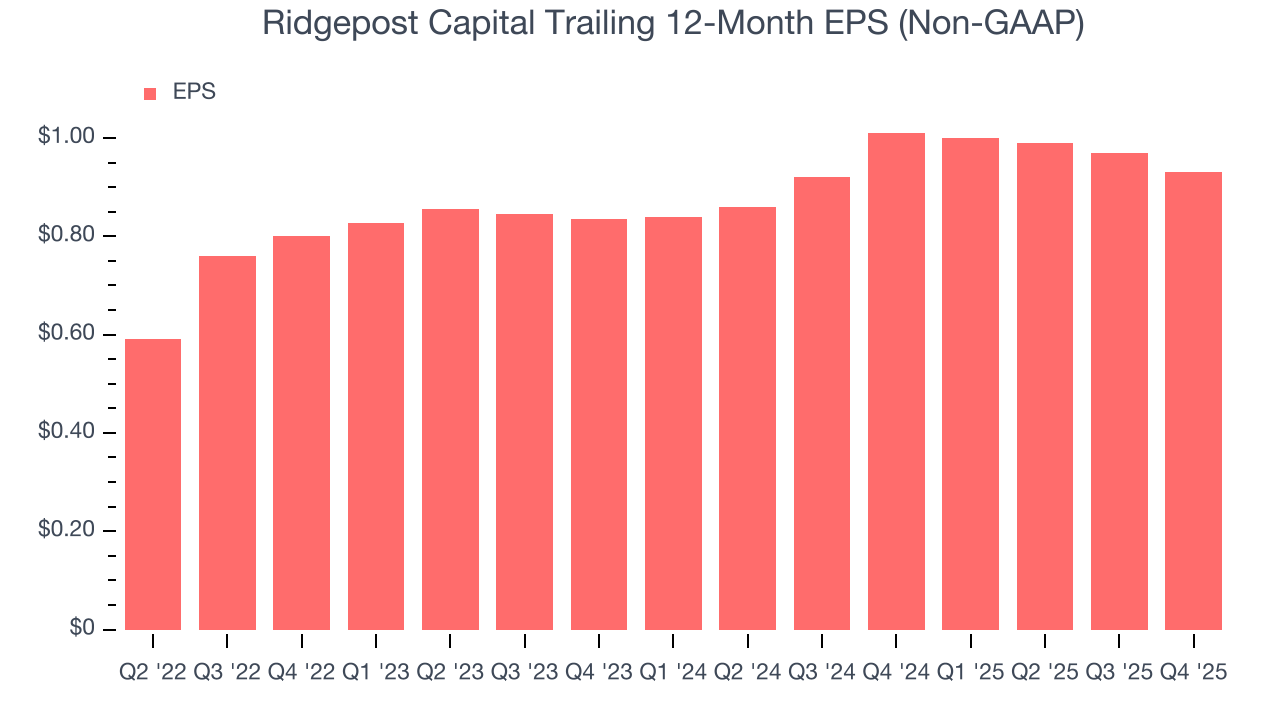
Like with revenue, we analyze EPS over a more recent period because it can provide insight into an emerging theme or development for the business.
Ridgepost Capital’s EPS grew at an unimpressive 5.5% compounded annual growth rate over the last two years, lower than its 10.9% annualized revenue growth. This tells us the company became less profitable on a per-share basis as it expanded.
In Q4, Ridgepost Capital reported adjusted EPS of $0.26, down from $0.30 in the same quarter last year. Despite falling year on year, this print beat analysts’ estimates by 8.3%. Over the next 12 months, Wall Street expects Ridgepost Capital’s full-year EPS of $0.93 to grow 3.8%.
9. Return on Equity
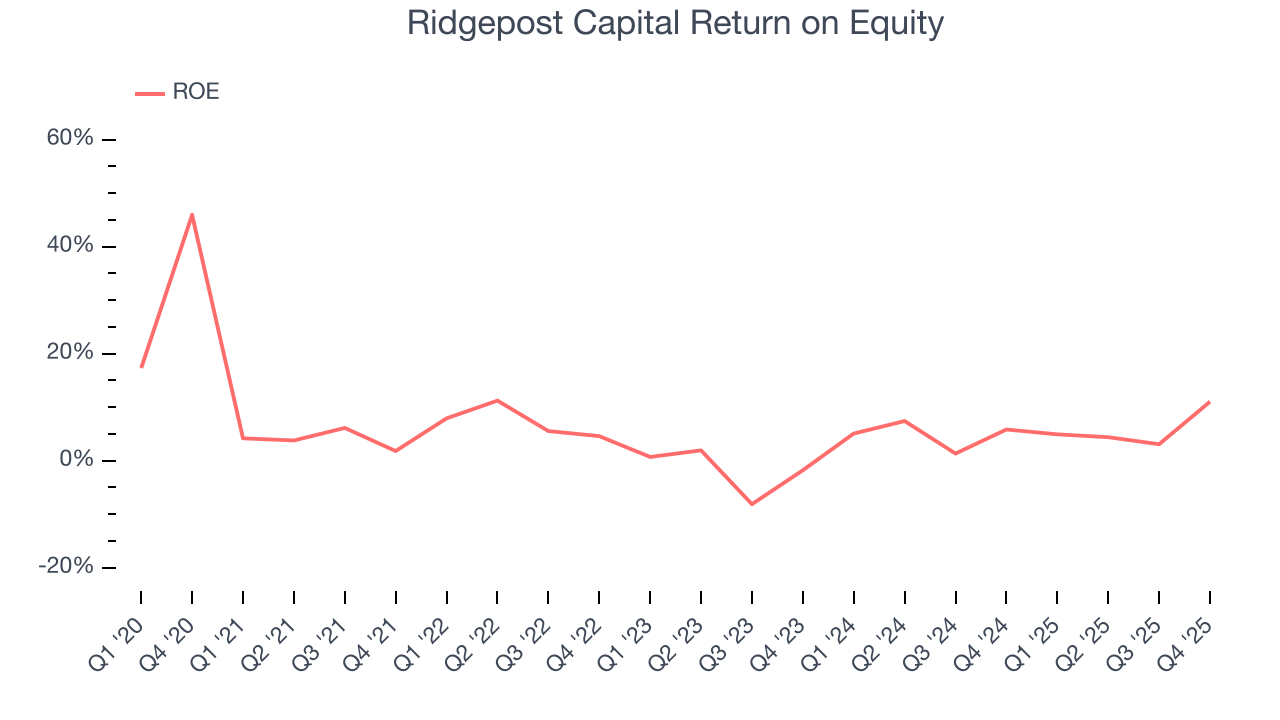
Return on equity (ROE) measures how effectively banks generate profit from each dollar of shareholder equity - a critical funding source. High-ROE institutions typically compound shareholder wealth faster over time through retained earnings, share repurchases, and dividend payments.
Over the last five years, Ridgepost Capital has averaged an ROE of 4.1%, uninspiring for a company operating in a sector where the average shakes out around 10%.
10. Balance Sheet Assessment
The debt-to-equity ratio is a widely used measure to assess a company's balance sheet health. A higher ratio means that a business aggressively financed its growth with debt. This can result in higher earnings (if the borrowed funds are invested profitably) but also increases risk.
If debt levels are too high, there could be difficulties in meeting obligations, especially during economic downturns or periods of rising interest rates if the debt has variable-rate payments.
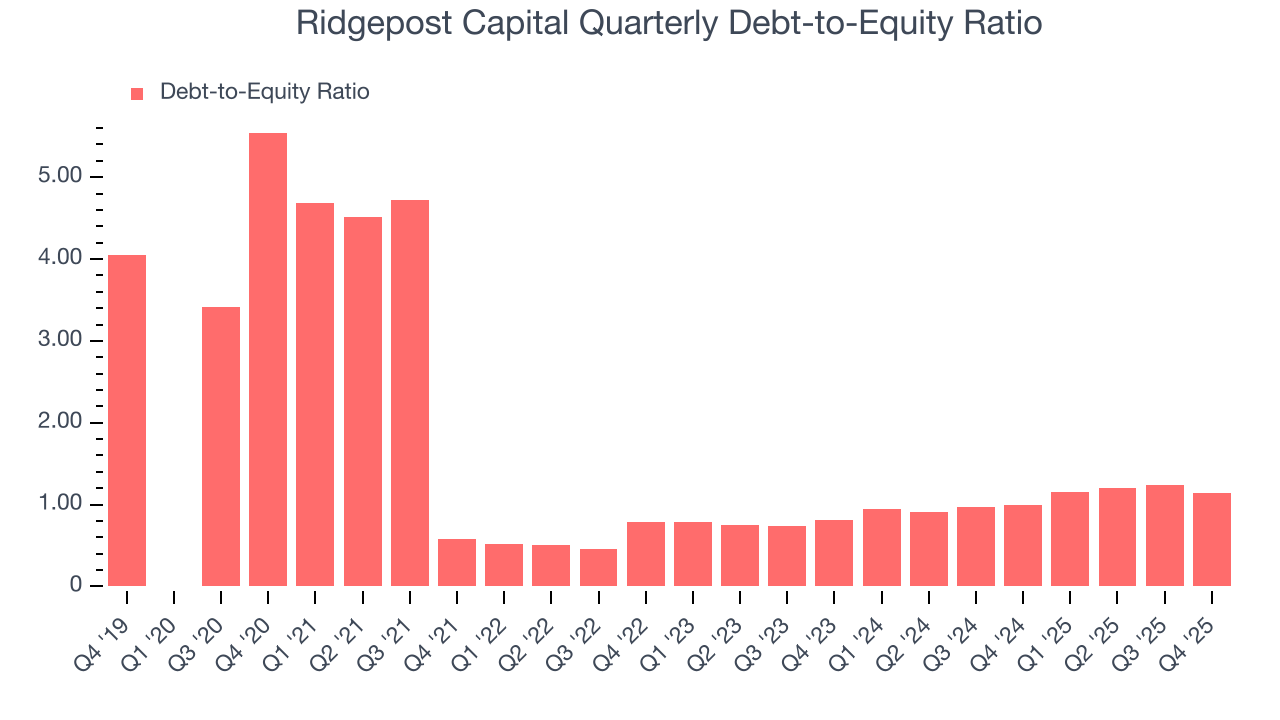
Ridgepost Capital currently has $402.9 million of debt and $351.4 million of shareholder's equity on its balance sheet, and over the past four quarters, has averaged a debt-to-equity ratio of 1.2×. We think this is safe and raises no red flags. In general, we’re comfortable with any ratio below 3.5× for a financials business.
11. Key Takeaways from Ridgepost Capital’s Q4 Results
It was good to see Ridgepost Capital beat analysts’ EPS expectations this quarter. On the other hand, its AUM missed. Overall, this print had some key positives. The stock remained flat at $8.50 immediately after reporting.
12. Is Now The Time To Buy Ridgepost Capital?
Updated: February 12, 2026 at 11:36 PM EST
A common mistake we notice when investors are deciding whether to buy a stock or not is that they simply look at the latest earnings results. Business quality and valuation matter more, so we urge you to understand these dynamics as well.
Ridgepost Capital isn’t a terrible business, but it isn’t one of our picks. Although its revenue growth was exceptional over the last five years, it’s expected to deteriorate over the next 12 months and its relatively low ROE suggests management has struggled to find compelling investment opportunities.
Ridgepost Capital’s P/E ratio based on the next 12 months is 11x. While this valuation is fair, the upside isn’t great compared to the potential downside. We're pretty confident there are superior stocks to buy right now.
Wall Street analysts have a consensus one-year price target of $16.13 on the company (compared to the current share price of $8.50).
Although the price target is bullish, readers should exercise caution because analysts tend to be overly optimistic. The firms they work for, often big banks, have relationships with companies that extend into fundraising, M&A advisory, and other rewarding business lines. As a result, they typically hesitate to say bad things for fear they will lose out. We at StockStory do not suffer from such conflicts of interest, so we’ll always tell it like it is.