
Revvity (RVTY)
Revvity is in for a bumpy ride. Its low returns on capital and plummeting sales suggest it struggles to generate demand and profits, a red flag.― StockStory Analyst Team


1. News


2. Summary
Why We Think Revvity Will Underperform
Formerly known as PerkinElmer until its rebranding in 2023, Revvity (NYSE:RVTY) provides health science technologies and services that support the complete workflow from discovery to development and diagnosis to cure.
- Earnings per share have dipped by 3.4% annually over the past five years, which is concerning because stock prices follow EPS over the long term
- Annual sales declines of 2.7% for the past five years show its products and services struggled to connect with the market during this cycle
- Organic sales performance over the past two years indicates the company may need to make strategic adjustments or rely on M&A to catalyze faster growth
Revvity is in the penalty box. We’d rather invest in businesses with stronger moats.
Why There Are Better Opportunities Than Revvity







Revvity is trading at $108.79 per share, or 20.5x forward P/E. This multiple is high given its weaker fundamentals.
It’s better to pay up for high-quality businesses with strong long-term earnings potential rather than to buy lower-quality companies with open questions and big downside risks.
3. Revvity (RVTY) Research Report: Q3 CY2025 Update
Life sciences company Revvity (NYSE:RVTY) met Wall Street’s revenue expectations in Q3 CY2025, with sales up 2.2% year on year to $698.9 million. The company’s outlook for the full year was close to analysts’ estimates with revenue guided to $2.86 billion at the midpoint. Its non-GAAP profit of $1.18 per share was 3.6% above analysts’ consensus estimates.
Revvity (RVTY) Q3 CY2025 Highlights:
- Revenue: $698.9 million vs analyst estimates of $700.7 million (2.2% year-on-year growth, in line)
- Adjusted EPS: $1.18 vs analyst estimates of $1.14 (3.6% beat)
- The company reconfirmed its revenue guidance for the full year of $2.86 billion at the midpoint
- Management raised its full-year Adjusted EPS guidance to $4.95 at the midpoint, a 1% increase
- Operating Margin: 11.7%, down from 14.3% in the same quarter last year
- Free Cash Flow Margin: 17.2%, down from 18.4% in the same quarter last year
- Organic Revenue rose 1% year on year vs analyst estimates of 1.1% growth (5.4 basis point miss)
- Market Capitalization: $11.48 billion
Company Overview
Formerly known as PerkinElmer until its rebranding in 2023, Revvity (NYSE:RVTY) provides health science technologies and services that support the complete workflow from discovery to development and diagnosis to cure.
Revvity operates through two main segments: Life Sciences and Diagnostics. The Life Sciences segment offers a comprehensive portfolio of technologies that help researchers better understand diseases and develop treatments. These include radiometric detection solutions, high-content screening systems, reagents for microscopy and imaging, multimode plate readers, and a wide range of assay technologies. These tools enable scientists to visualize cellular behaviors, analyze proteins, and accelerate drug discovery research.
The Diagnostics segment focuses on reproductive health, immunodiagnostics, emerging market diagnostics, and applied genomics. Revvity provides screening products for genetic disorders from pregnancy through early childhood, as well as infectious disease testing. Its prenatal screening platforms help detect conditions like Down syndrome, while its newborn screening technologies identify metabolic disorders from just a drop of blood. The company also offers automated systems for processing immunoassays and molecular diagnostic tests.
A pharmaceutical researcher might use Revvity's Opera Phenix Plus system to screen potential drug compounds against complex cellular models, while a hospital laboratory might employ its DELFIA Xpress platform to conduct prenatal screening tests. In both cases, Revvity's technologies help healthcare professionals make critical decisions that impact patient outcomes.
Revvity markets its products and services in more than 160 countries through specialized sales forces and distributors. Its customers include pharmaceutical and biotechnology companies, laboratories, academic and research institutions, public health authorities, private healthcare organizations, doctors, and government agencies. Many customers use Revvity's products to develop, test, and manufacture their own products.
The company's strategy focuses on developing innovative products in high-growth markets, strengthening its position through both internal research and strategic acquisitions, and driving operational excellence. In 2023, Revvity completed the sale of its Applied, Food and Enterprise Services businesses to focus on its core health science operations.
4. Research Tools & Consumables
The life sciences subsector specializing in research tools and consumables enables scientific discoveries across academia, biotechnology, and pharmaceuticals. These firms supply a wide range of essential laboratory products, ensuring a recurring revenue stream through repeat purchases and replenishment. Their business models benefit from strong customer loyalty, a diversified product portfolio, and exposure to both the research and clinical markets. However, challenges include high R&D investment to maintain technological leadership, pricing pressures from budget-conscious institutions, and vulnerability to fluctuations in research funding cycles. Looking ahead, this subsector stands to benefit from tailwinds such as growing demand for tools supporting emerging fields like synthetic biology and personalized medicine. There is also a rise in automation and AI-driven solutions in laboratories that could create new opportunities to sell tools and consumables. Nevertheless, headwinds exist. These companies tend to be at the mercy of supply chain disruptions and sensitivity to macroeconomic conditions that impact funding for research initiatives.
Revvity competes with other life sciences and diagnostics companies including Thermo Fisher Scientific (NYSE: TMO), Danaher Corporation (NYSE: DHR), Agilent Technologies (NYSE: A), Bio-Rad Laboratories (NYSE: BIO), and Illumina (NASDAQ: ILMN).
5. Economies of Scale
Larger companies benefit from economies of scale, where fixed costs like infrastructure, technology, and administration are spread over a higher volume of goods or services, reducing the cost per unit. Scale can also lead to bargaining power with suppliers, greater brand recognition, and more investment firepower. A virtuous cycle can ensue if a scaled company plays its cards right.
With $2.81 billion in revenue over the past 12 months, Revvity has decent scale. This is important as it gives the company more leverage in a heavily regulated, competitive environment that is complex and resource-intensive.
6. Revenue Growth
A company’s long-term sales performance can indicate its overall quality. Any business can have short-term success, but a top-tier one grows for years. Revvity’s demand was weak over the last five years as its sales fell at a 2.7% annual rate. This wasn’t a great result and is a sign of poor business quality.
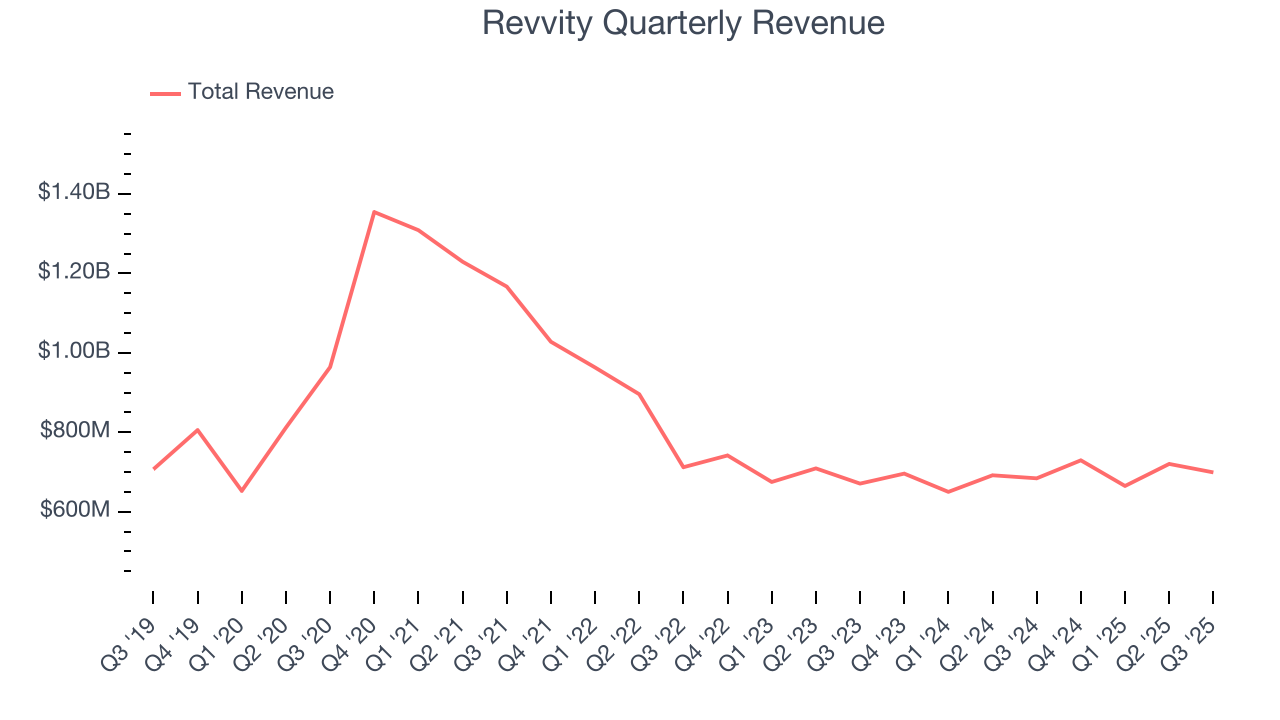
Long-term growth is the most important, but within healthcare, a half-decade historical view may miss new innovations or demand cycles. Revvity’s revenue over the last two years was flat, sugggesting its demand was weak but stabilized after its initial drop. 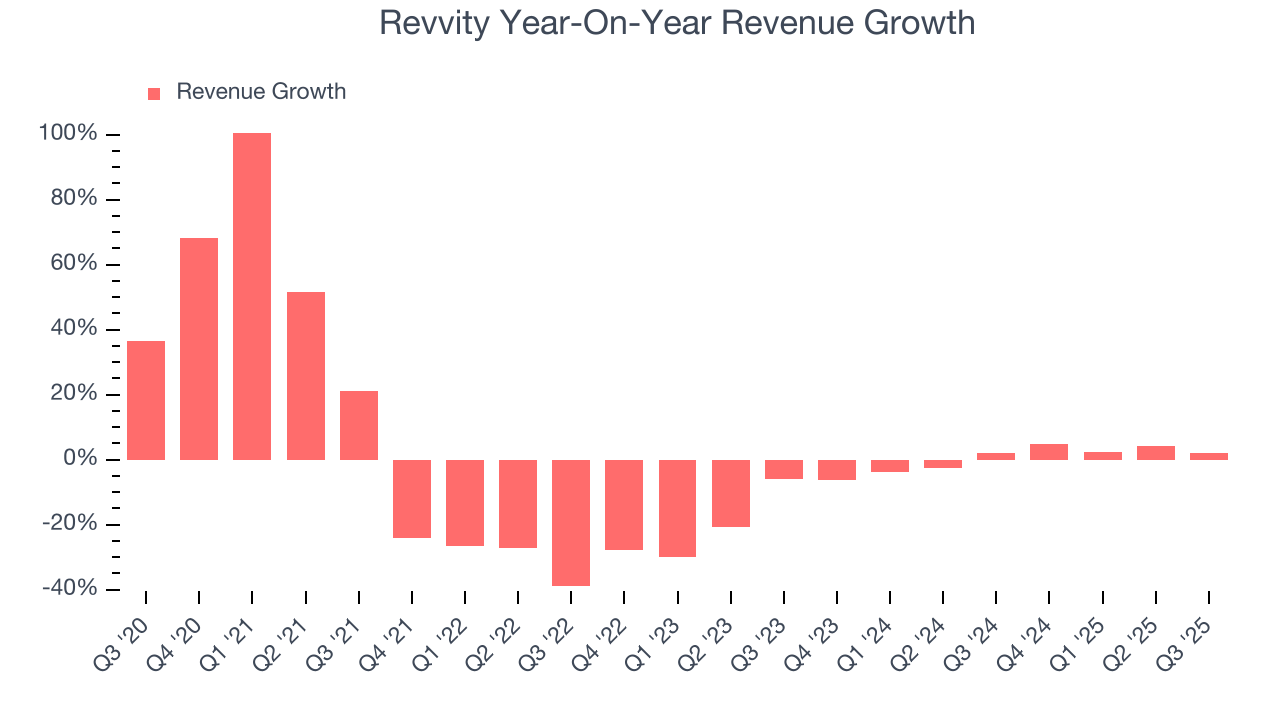
We can dig further into the company’s sales dynamics by analyzing its organic revenue, which strips out one-time events like acquisitions and currency fluctuations that don’t accurately reflect its fundamentals. Over the last two years, Revvity’s organic revenue was flat. Because this number aligns with its two-year revenue growth, we can see the company’s core operations (not acquisitions and divestitures) drove most of its results. 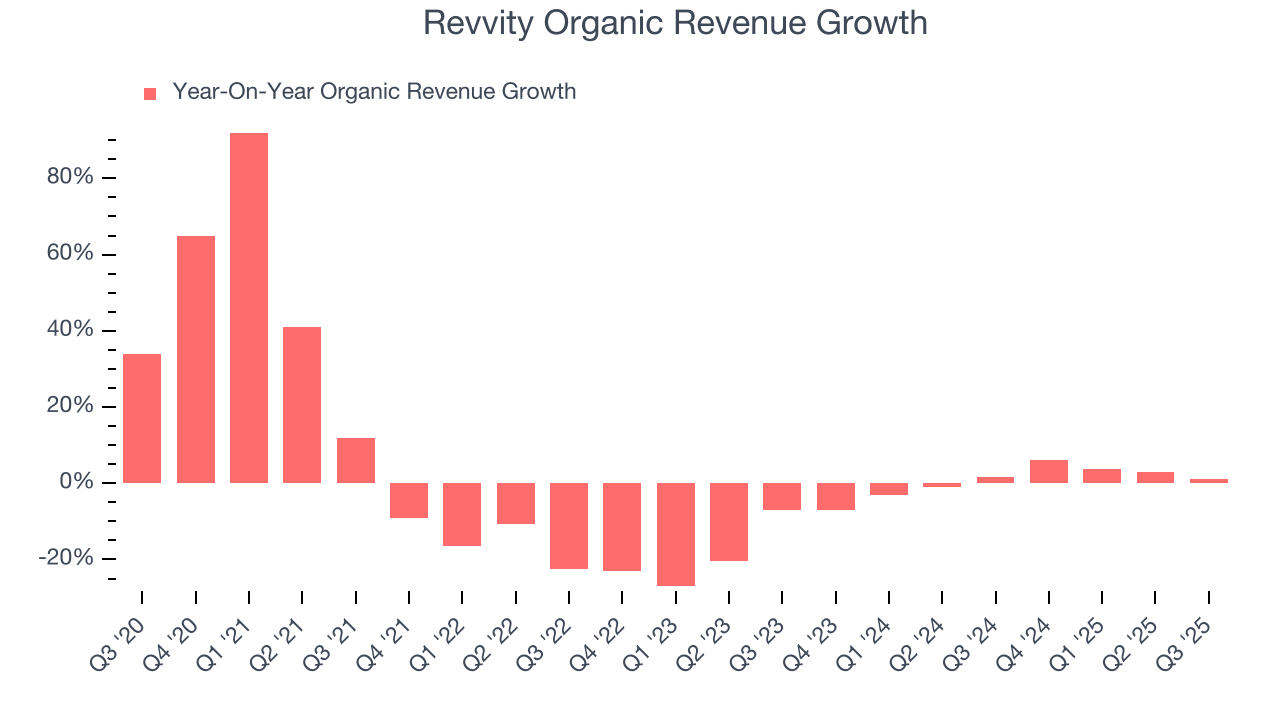
This quarter, Revvity grew its revenue by 2.2% year on year, and its $698.9 million of revenue was in line with Wall Street’s estimates.
Looking ahead, sell-side analysts expect revenue to grow 3.4% over the next 12 months. Although this projection indicates its newer products and services will catalyze better top-line performance, it is still below average for the sector.
7. Operating Margin
Operating margin is one of the best measures of profitability because it tells us how much money a company takes home after subtracting all core expenses, like marketing and R&D.
Revvity has been an efficient company over the last five years. It was one of the more profitable businesses in the healthcare sector, boasting an average operating margin of 20.5%.
Analyzing the trend in its profitability, Revvity’s operating margin decreased by 17.4 percentage points over the last five years. Even though its historical margin was healthy, shareholders will want to see Revvity become more profitable in the future.
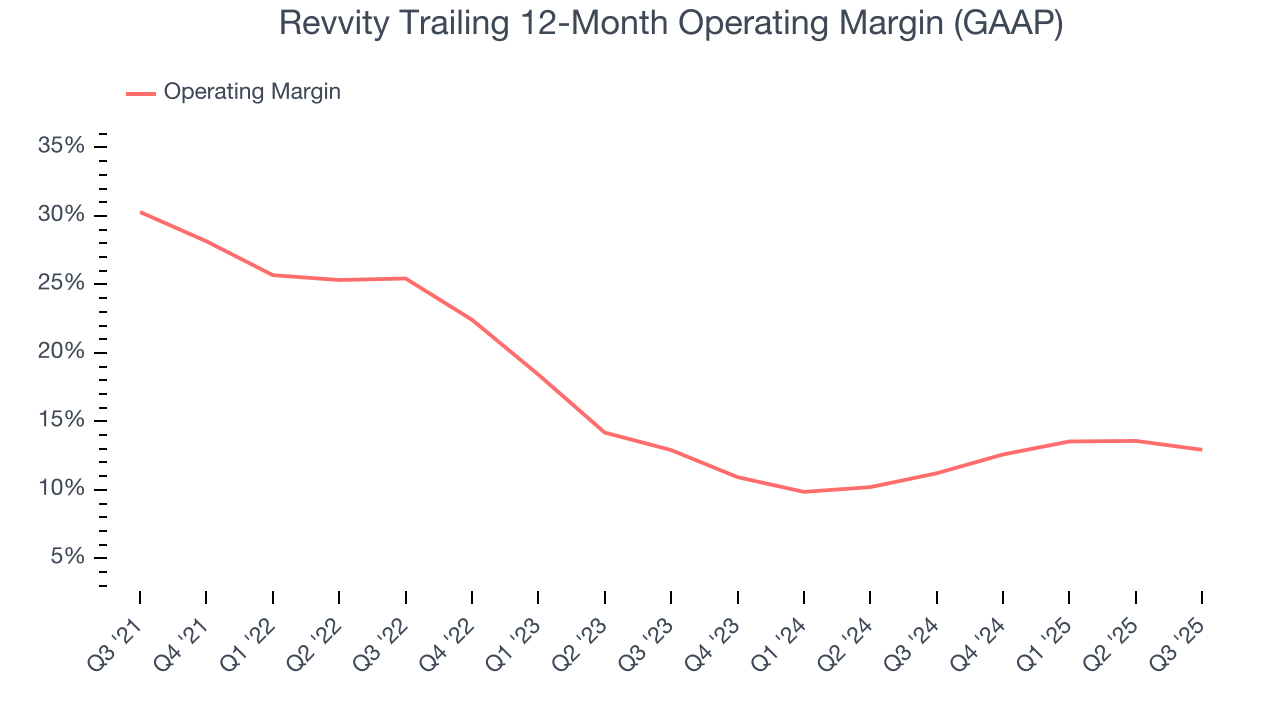
This quarter, Revvity generated an operating margin profit margin of 11.7%, down 2.6 percentage points year on year. This contraction shows it was less efficient because its expenses grew faster than its revenue.
8. Earnings Per Share
We track the long-term change in earnings per share (EPS) for the same reason as long-term revenue growth. Compared to revenue, however, EPS highlights whether a company’s growth is profitable.
Sadly for Revvity, its EPS and revenue declined by 3.4% and 2.7% annually over the last five years. We tend to steer our readers away from companies with falling revenue and EPS, where diminishing earnings could imply changing secular trends and preferences. If the tide turns unexpectedly, Revvity’s low margin of safety could leave its stock price susceptible to large downswings.
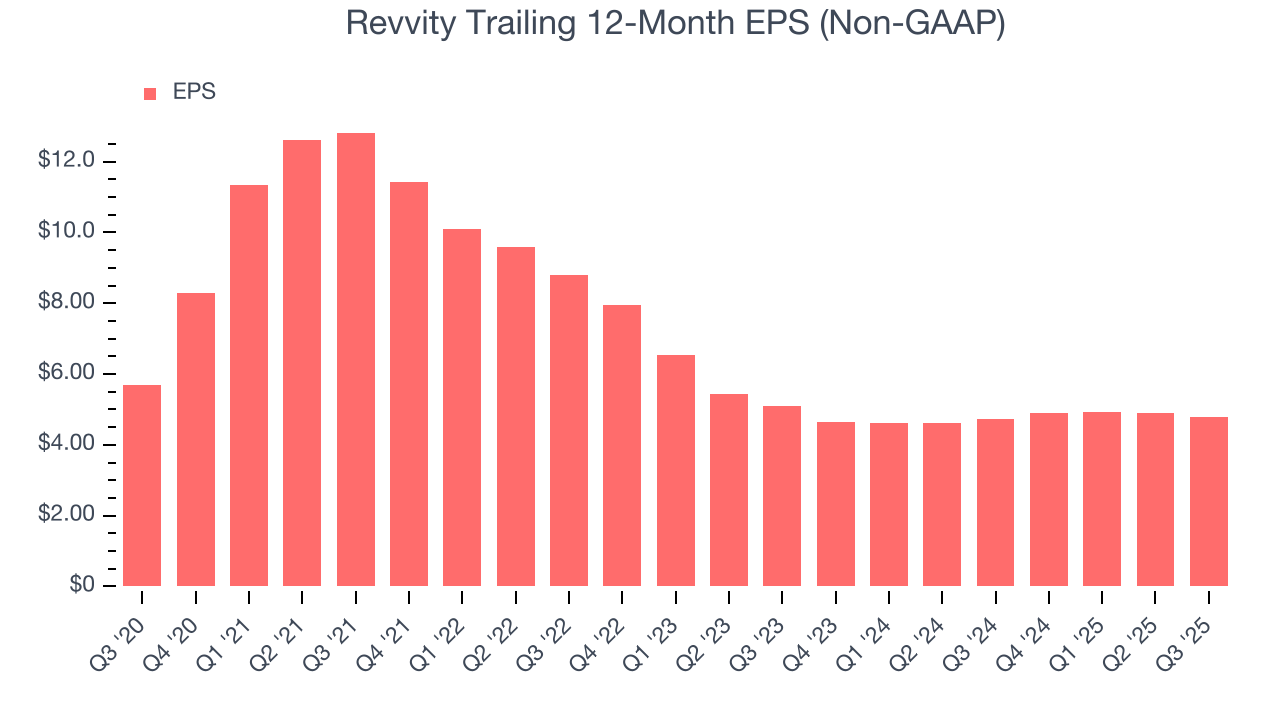
In Q3, Revvity reported adjusted EPS of $1.18, down from $1.28 in the same quarter last year. Despite falling year on year, this print beat analysts’ estimates by 3.6%. Over the next 12 months, Wall Street expects Revvity’s full-year EPS of $4.79 to grow 10.6%.
9. Cash Is King
Although earnings are undoubtedly valuable for assessing company performance, we believe cash is king because you can’t use accounting profits to pay the bills.
Revvity has shown robust cash profitability, giving it an edge over its competitors and the ability to reinvest or return capital to investors. The company’s free cash flow margin averaged 19.2% over the last five years, quite impressive for a healthcare business.
Taking a step back, we can see that Revvity’s margin dropped by 11.2 percentage points during that time. Continued declines could signal it is in the middle of an investment cycle.
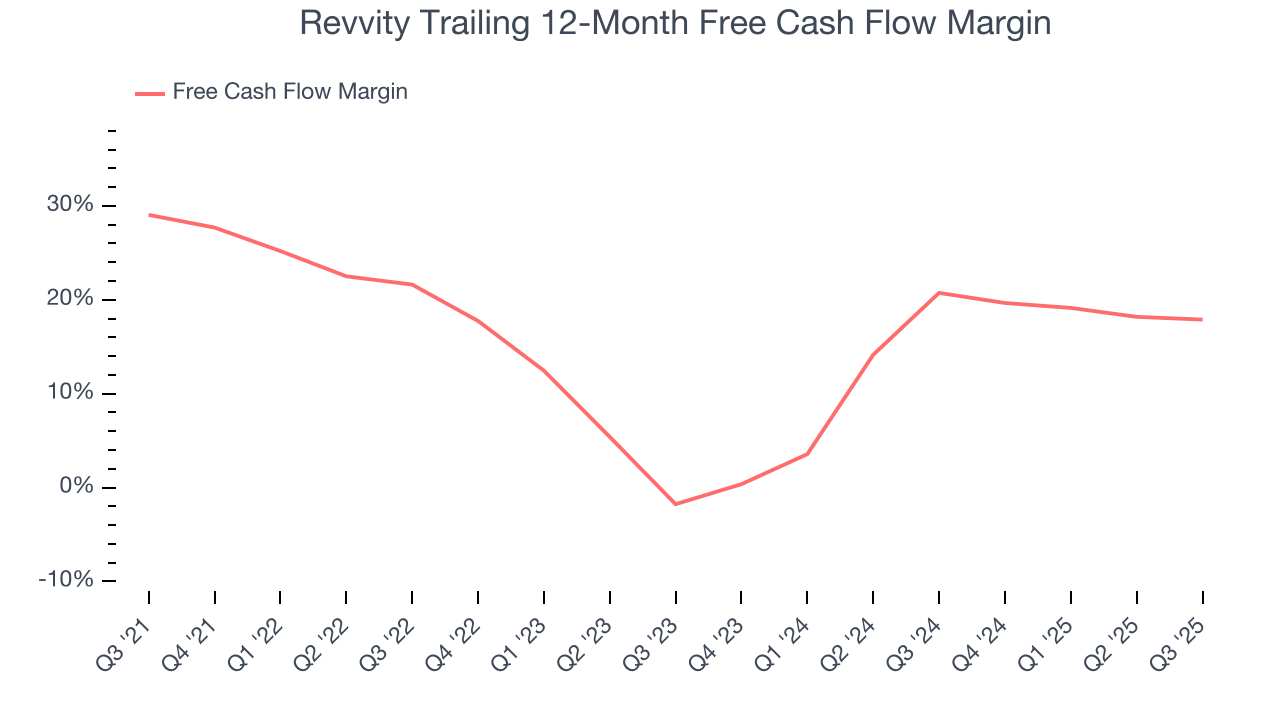
Revvity’s free cash flow clocked in at $120 million in Q3, equivalent to a 17.2% margin. The company’s cash profitability regressed as it was 1.2 percentage points lower than in the same quarter last year, suggesting its historical struggles have dragged on.
10. Return on Invested Capital (ROIC)
EPS and free cash flow tell us whether a company was profitable while growing its revenue. But was it capital-efficient? Enter ROIC, a metric showing how much operating profit a company generates relative to the money it has raised (debt and equity).
Revvity historically did a mediocre job investing in profitable growth initiatives. Its five-year average ROIC was 5.8%, somewhat low compared to the best healthcare companies that consistently pump out 20%+.
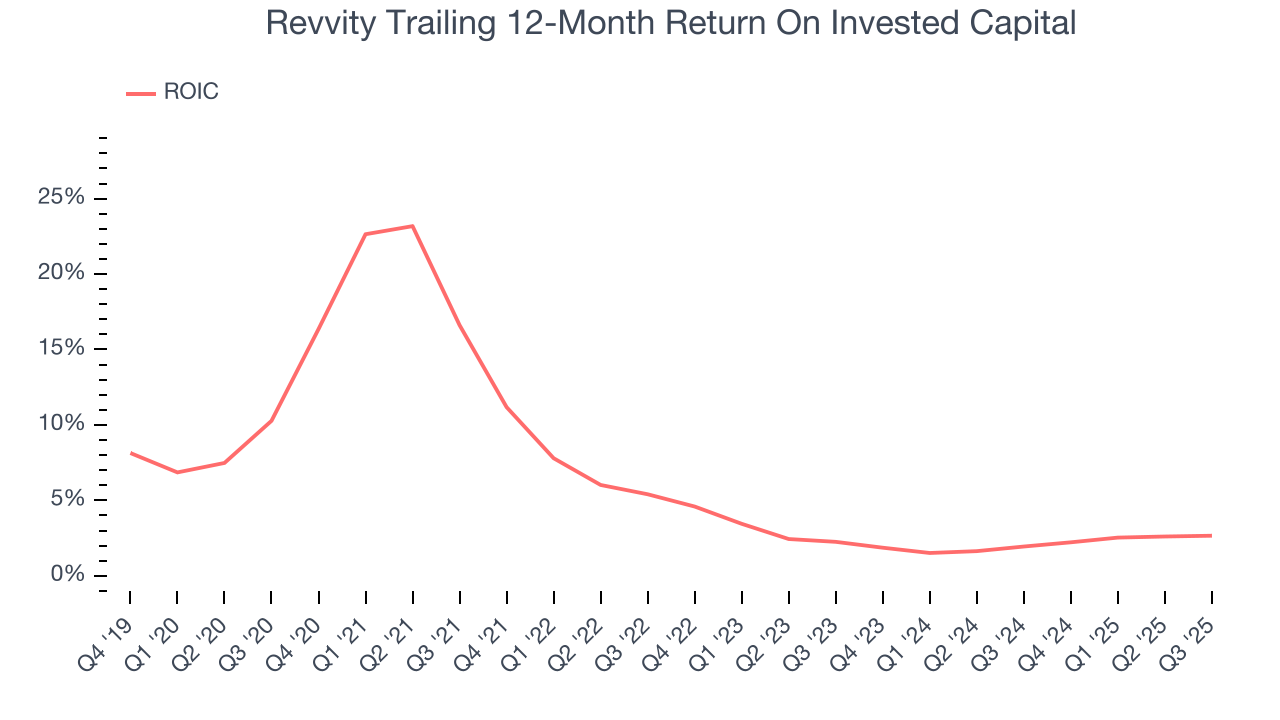
We like to invest in businesses with high returns, but the trend in a company’s ROIC is what often surprises the market and moves the stock price. Over the last few years, Revvity’s ROIC has unfortunately decreased. Paired with its already low returns, these declines suggest its profitable growth opportunities are few and far between.
11. Balance Sheet Assessment
Revvity reported $931.4 million of cash and $3.37 billion of debt on its balance sheet in the most recent quarter. As investors in high-quality companies, we primarily focus on two things: 1) that a company’s debt level isn’t too high and 2) that its interest payments are not excessively burdening the business.
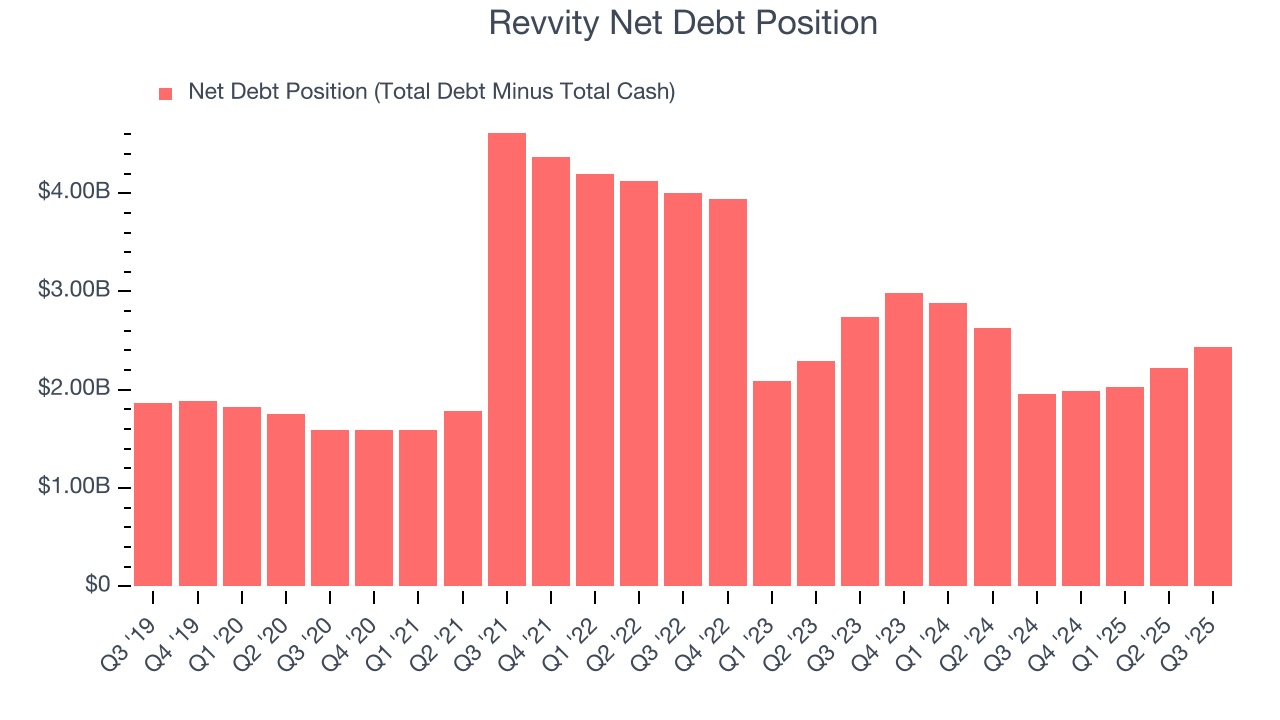
With $1.08 billion of EBITDA over the last 12 months, we view Revvity’s 2.3× net-debt-to-EBITDA ratio as safe. We also see its $24.58 million of annual interest expenses as appropriate. The company’s profits give it plenty of breathing room, allowing it to continue investing in growth initiatives.
12. Key Takeaways from Revvity’s Q3 Results
It was encouraging to see Revvity beat analysts’ full-year EPS guidance expectations this quarter. We were also glad its EPS outperformed Wall Street’s estimates. On the other hand, its revenue was just in line. Zooming out, we still think this was a decent quarter. The stock traded up 1.5% to $100.39 immediately following the results.
13. Is Now The Time To Buy Revvity?
Updated: January 30, 2026 at 11:05 PM EST
Before deciding whether to buy Revvity or pass, we urge investors to consider business quality, valuation, and the latest quarterly results.
We see the value of companies making people healthier, but in the case of Revvity, we’re out. To begin with, its revenue has declined over the last five years. And while its impressive operating margins show it has a highly efficient business model, the downside is its declining EPS over the last five years makes it a less attractive asset to the public markets. On top of that, its declining adjusted operating margin shows the business has become less efficient.
Revvity’s P/E ratio based on the next 12 months is 20.5x. This valuation tells us it’s a bit of a market darling with a lot of good news priced in - we think other companies feature superior fundamentals at the moment.
Wall Street analysts have a consensus one-year price target of $116.19 on the company (compared to the current share price of $108.79).