
Tyson Foods (TSN)
Tyson Foods is in for a bumpy ride. Its low returns on capital and plummeting sales suggest it struggles to generate demand and profits, a red flag.― StockStory Analyst Team


1. News




2. Summary
Why We Think Tyson Foods Will Underperform
Started as a simple trucking business, Tyson Foods (NYSE:TSN) is one of the world’s largest producers of chicken, beef, and pork.
- Commoditized products, bad unit economics, and high competition are reflected in its low gross margin of 7.2%
- Sales over the last three years were less profitable as its earnings per share fell by 22.1% annually while its revenue was flat
- Products fail to spark excitement with consumers, as seen in its flat sales over the last three years
Tyson Foods is skating on thin ice. We’d search for superior opportunities elsewhere.
Why There Are Better Opportunities Than Tyson Foods







At $64.38 per share, Tyson Foods trades at 16.8x forward P/E. This multiple is cheaper than most consumer staples peers, but we think this is justified.
Cheap stocks can look like a great deal at first glance, but they can be value traps. They often have less earnings power, meaning there is more reliance on a re-rating to generate good returns - an unlikely scenario for low-quality companies.
3. Tyson Foods (TSN) Research Report: Q3 CY2025 Update
Meat company Tyson Foods (NYSE:TSN) fell short of the markets revenue expectations in Q3 CY2025 as sales rose 2.2% year on year to $13.86 billion. Its non-GAAP profit of $1.15 per share was 37.8% above analysts’ consensus estimates.
Tyson Foods (TSN) Q3 CY2025 Highlights:
- Revenue: $13.86 billion vs analyst estimates of $14.01 billion (2.2% year-on-year growth, 1.1% miss)
- Adjusted EPS: $1.15 vs analyst estimates of $0.83 (37.8% beat)
- Operating Margin: 1.1%, down from 3.9% in the same quarter last year
- Free Cash Flow Margin: 8.5%, up from 2.7% in the same quarter last year
- Sales Volumes fell 1.6% year on year (0.5% in the same quarter last year)
- Market Capitalization: $18.74 billion
Company Overview
Started as a simple trucking business, Tyson Foods (NYSE:TSN) is one of the world’s largest producers of chicken, beef, and pork.
These humble beginnings can be traced to 1935 when John W. Tyson started his company in Springdale, Arkansas. Over time, this trucking business focused on delivering chickens. During the surge in food demand in the 1940s due to World War II, Tyson began investing in his own chicken hatcheries and feed mills. From there, vertical integration was adopted, where the company controlled every stage of poultry production from hatching to feed to processing.
Today, Tyson Foods is not just a chicken producer–it’s a diversified protein powerhouse that extends beyond meat into prepared foods and alternative protein sources. Among their most recognizable brands are Tyson, Jimmy Dean, Hillshire Farm, and Ball Park (hot dogs).
The Tyson Foods core customer is broad but can generally be understood as someone who shops for the household. This person is seeking convenient meal solutions–whether that’s chicken or beef from a trusted source that can be quickly tossed into a pan or a pre-made meal that just needs to be heated up. However, customers also include large-scale buyers such as restaurants and food service companies in need of bulk protein.
Tyson products are widely distributed in supermarkets, club stores, and special grocery stores. Restaurant and food service customers can procure their meats and prepared foods directly from Tyson, with discounts available for larger orders.
4. Perishable Food
The perishable food industry is diverse, encompassing large-scale producers and distributors to specialty and artisanal brands. These companies sell produce, dairy products, meats, and baked goods and have become integral to serving modern American consumers who prioritize freshness, quality, and nutritional value. Investing in perishable food stocks presents both opportunities and challenges. While the perishable nature of products can introduce risks related to supply chain management and shelf life, it also creates a constant demand driven by the necessity for fresh food. Companies that can efficiently manage inventory, distribution, and quality control are well-positioned to thrive in this competitive market. Navigating the perishable food industry requires adherence to strict food safety standards, regulations, and labeling requirements.
Competitors in protein and packaged foods include Pilgrim’s Pride (NASDAQ:PPC) and private companies Perdue Farms, Sanderson Farms, and Koch Foods.
5. Revenue Growth
A company’s long-term performance is an indicator of its overall quality. Even a bad business can shine for one or two quarters, but a top-tier one grows for years.
With $54.44 billion in revenue over the past 12 months, Tyson Foods is one of the most widely recognized consumer staples companies. Its influence over consumers gives it negotiating leverage with distributors, enabling it to pick and choose where it sells its products (a luxury many don’t have). However, its scale is a double-edged sword because it’s harder to find incremental growth when your existing brands have penetrated most of the market. To accelerate sales, Tyson Foods likely needs to optimize its pricing or lean into new products and international expansion.
As you can see below, Tyson Foods struggled to increase demand as its $54.44 billion of sales for the trailing 12 months was close to its revenue three years ago. This shows demand was soft, a poor baseline for our analysis.
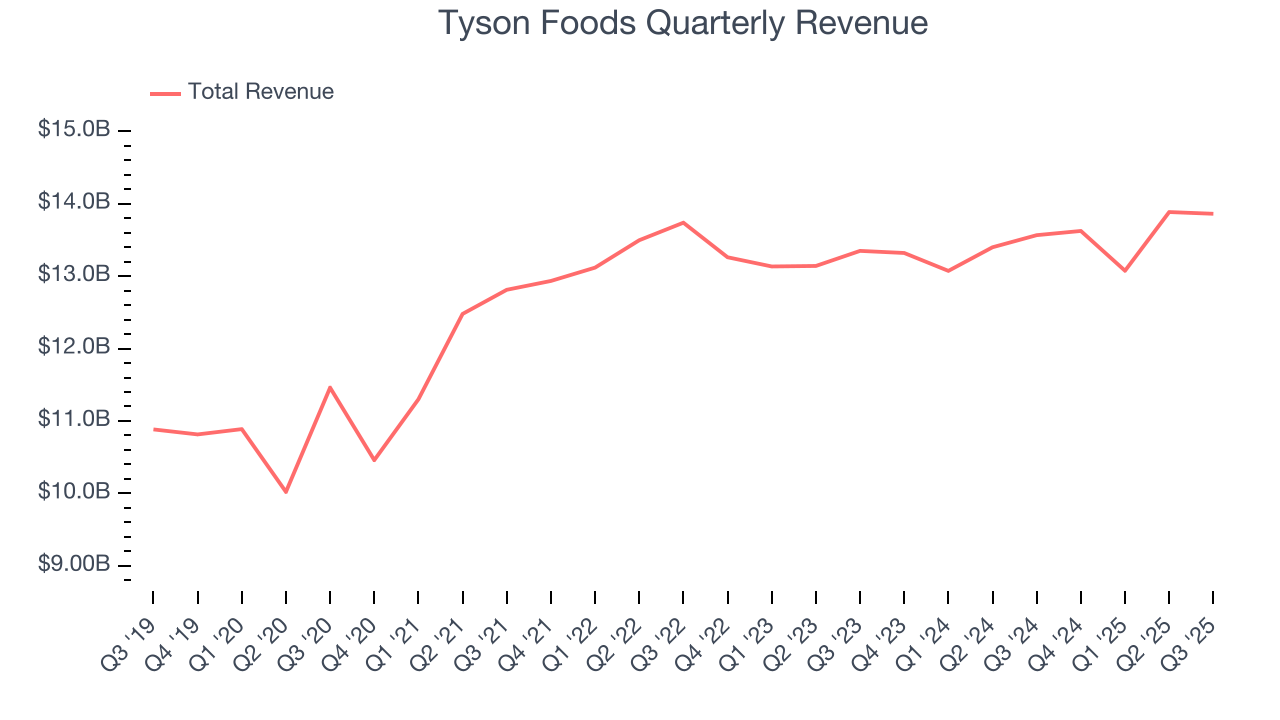
This quarter, Tyson Foods’s revenue grew by 2.2% year on year to $13.86 billion, falling short of Wall Street’s estimates.
Looking ahead, sell-side analysts expect revenue to grow 2.2% over the next 12 months. While this projection indicates its newer products will catalyze better top-line performance, it is still below average for the sector.
6. Volume Growth
Revenue growth can be broken down into changes in price and volume (the number of units sold). While both are important, volume is the lifeblood of a successful staples business as there’s a ceiling to what consumers will pay for everyday goods; they can always trade down to non-branded products if the branded versions are too expensive.
Tyson Foods’s quarterly sales volumes have, on average, stayed about the same over the last two years. This stability is normal because the quantity demanded for consumer staples products typically doesn’t see much volatility. 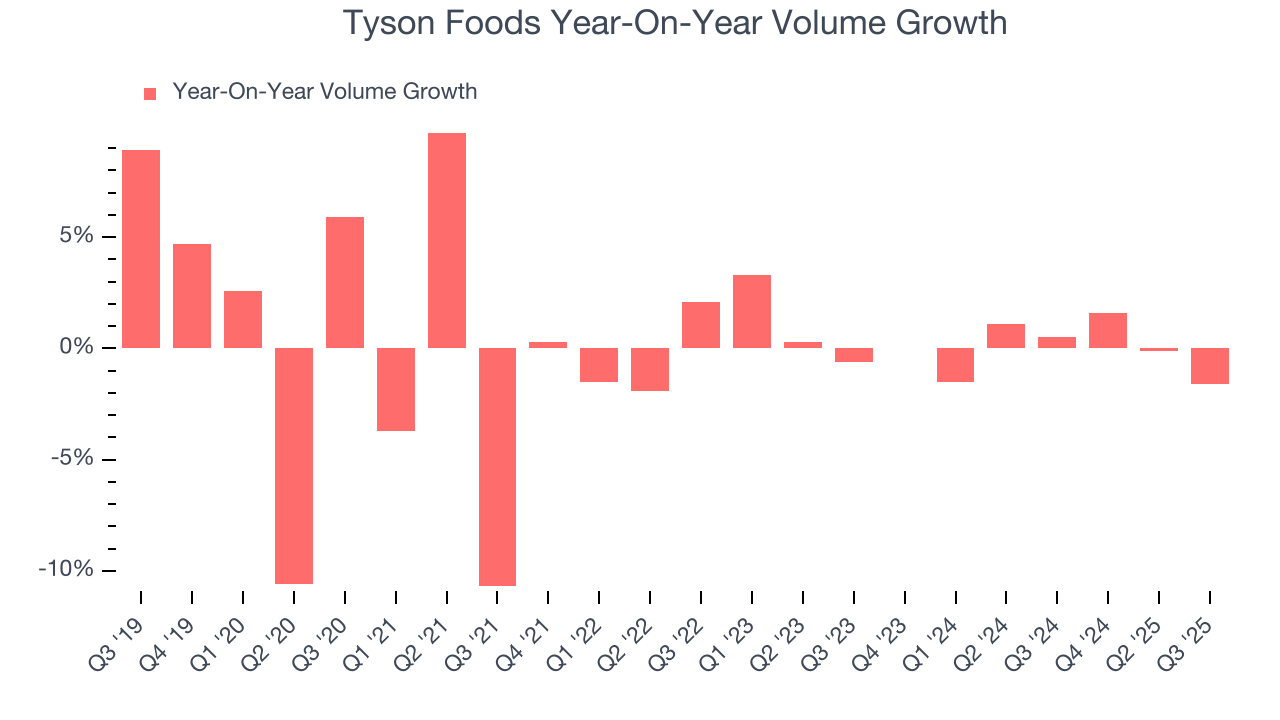
In Tyson Foods’s Q3 2025, sales volumes dropped 1.6% year on year.
7. Gross Margin & Pricing Power
Tyson Foods has bad unit economics for a consumer staples company, signaling it operates in a competitive market and lacks pricing power because its products can be substituted. As you can see below, it averaged a 7.4% gross margin over the last two years. That means Tyson Foods paid its suppliers a lot of money ($92.64 for every $100 in revenue) to run its business. 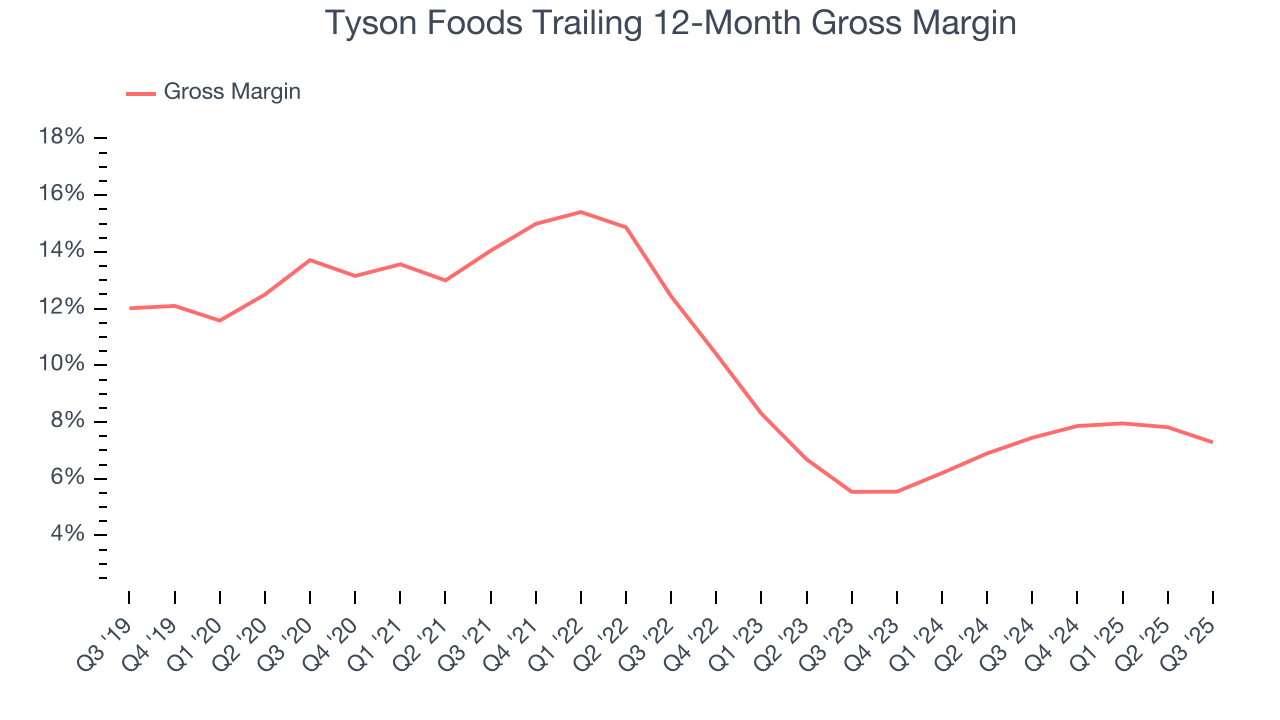
Tyson Foods produced a 5.2% gross profit margin in Q3, marking a 2.1 percentage point decrease from 7.3% in the same quarter last year. On a wider time horizon, the company’s full-year margin has remained steady over the past four quarters, suggesting its input costs (such as raw materials and manufacturing expenses) have been stable and it isn’t under pressure to lower prices.
8. Operating Margin
Operating margin is a key profitability metric because it accounts for all expenses enabling a business to operate smoothly, including marketing and advertising, IT systems, wages, and other administrative costs.
Tyson Foods’s operating margin might fluctuated slightly over the last 12 months but has generally stayed the same, averaging 2.3% over the last two years. This profitability was lousy for a consumer staples business and caused by its suboptimal cost structureand low gross margin.
Looking at the trend in its profitability, Tyson Foods’s operating margin might fluctuated slightly but has generally stayed the same over the last year, meaning it will take a fundamental shift in the business model to change.
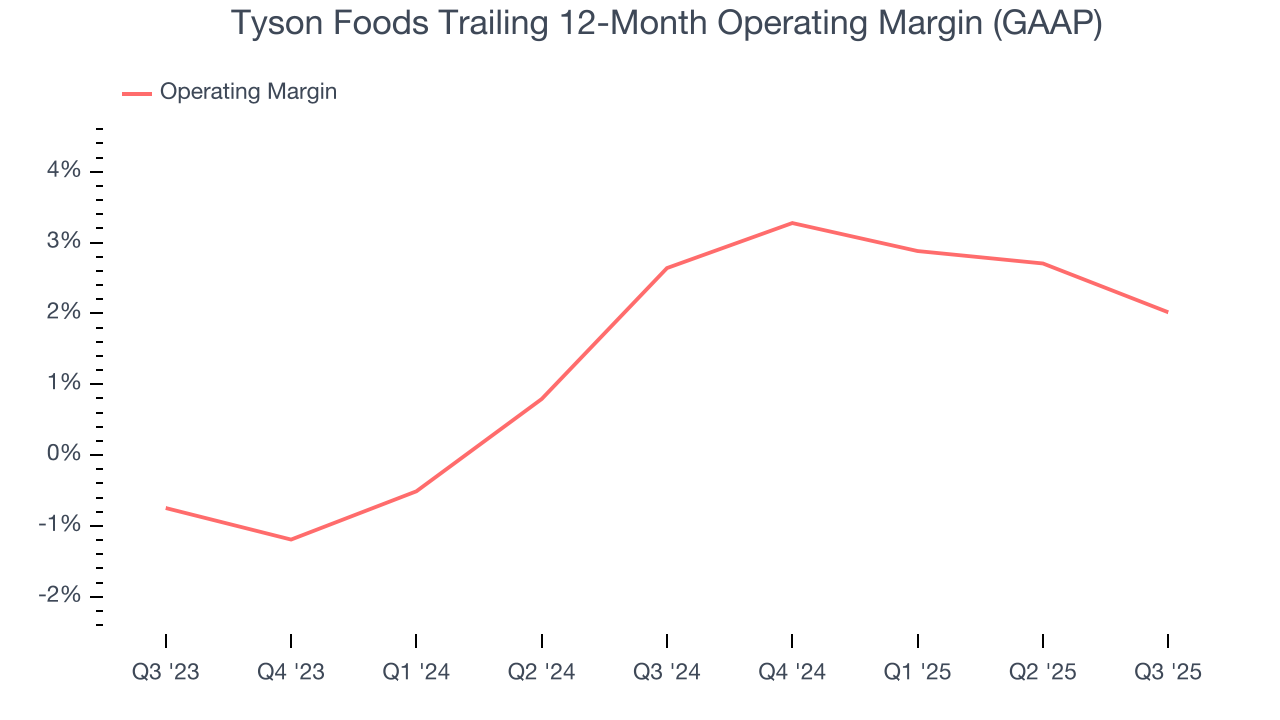
This quarter, Tyson Foods generated an operating margin profit margin of 1.1%, down 2.7 percentage points year on year. Since Tyson Foods’s operating margin decreased more than its gross margin, we can assume it was less efficient because expenses such as marketing, and administrative overhead increased.
9. Earnings Per Share
We track the change in earnings per share (EPS) for the same reason as long-term revenue growth. Compared to revenue, however, EPS highlights whether a company’s growth is profitable.
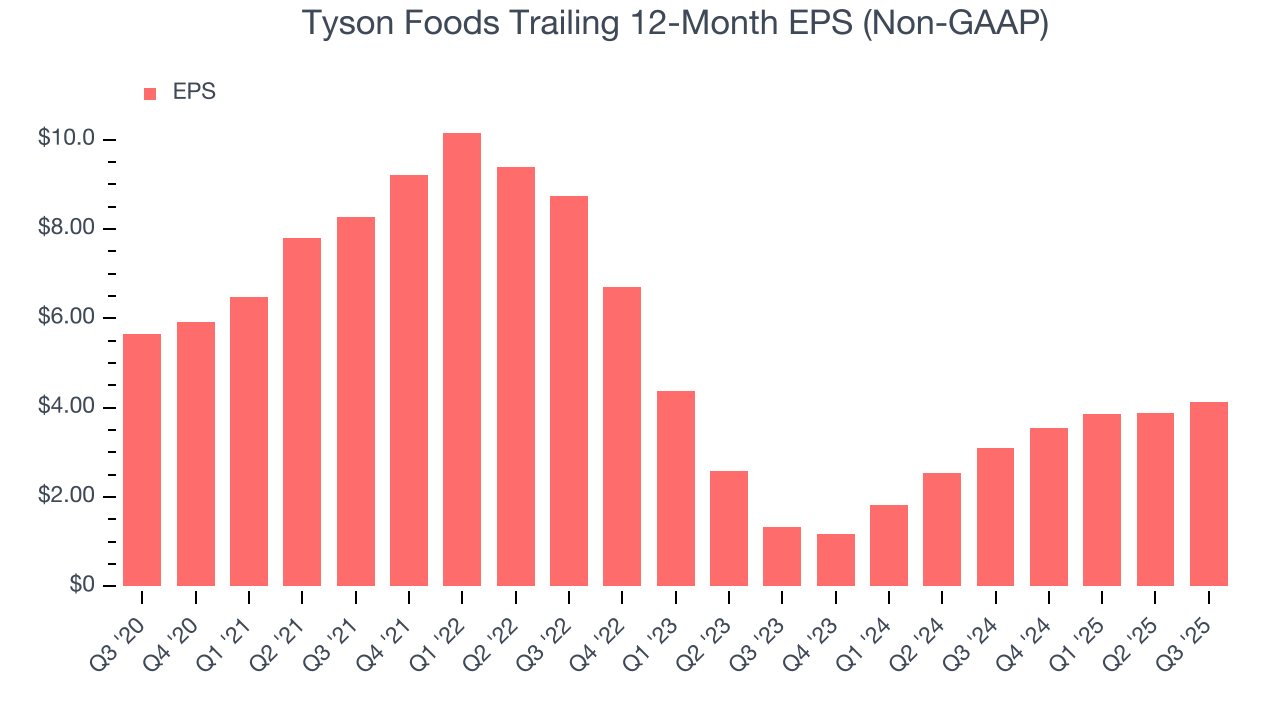
In Q3, Tyson Foods reported adjusted EPS of $1.15, up from $0.92 in the same quarter last year. This print easily cleared analysts’ estimates, and shareholders should be content with the results. Over the next 12 months, Wall Street expects Tyson Foods’s full-year EPS of $4.12 to shrink by 7.3%.
10. Cash Is King
Although earnings are undoubtedly valuable for assessing company performance, we believe cash is king because you can’t use accounting profits to pay the bills.
Tyson Foods has shown mediocre cash profitability over the last two years, giving the company limited opportunities to return capital to shareholders. Its free cash flow margin averaged 3.3%, subpar for a consumer staples business.
Taking a step back, an encouraging sign is that Tyson Foods’s margin expanded by 1.1 percentage points over the last year. The company’s improvement shows it’s heading in the right direction, and we can see it became a less capital-intensive business because its free cash flow profitability rose while its operating profitability was flat.
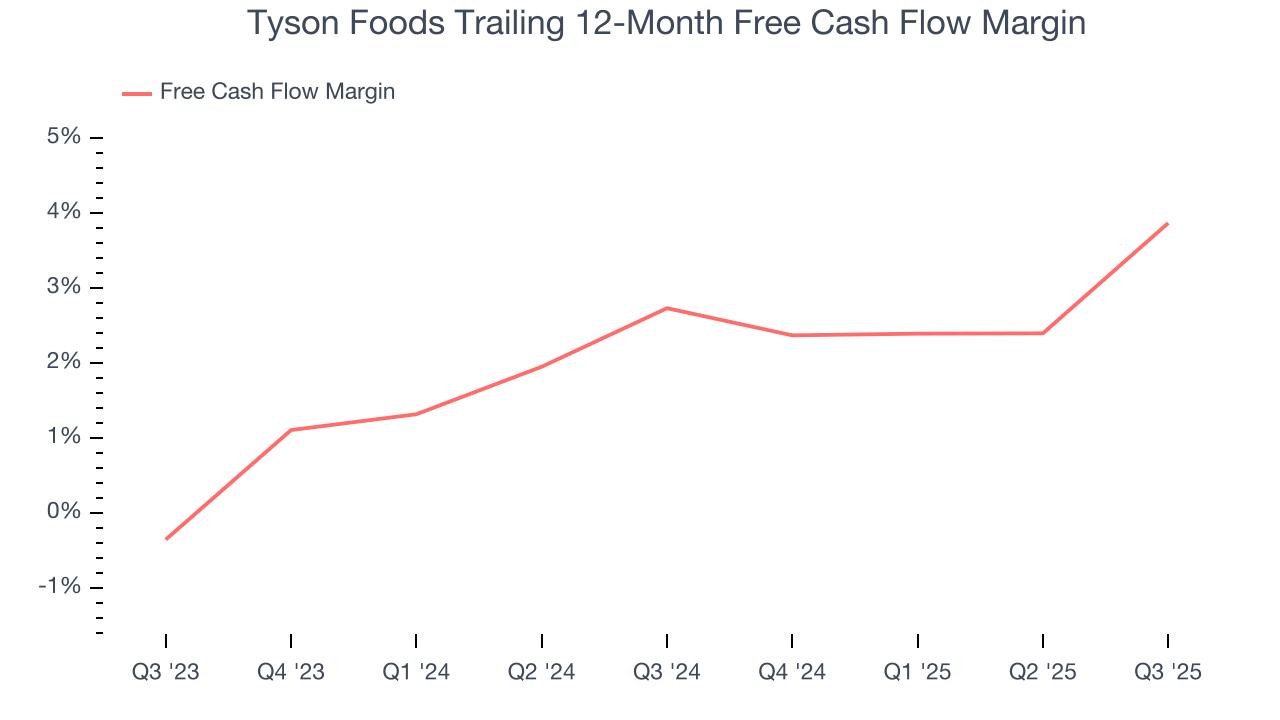
Tyson Foods’s free cash flow clocked in at $1.18 billion in Q3, equivalent to a 8.5% margin. This result was good as its margin was 5.8 percentage points higher than in the same quarter last year, building on its favorable historical trend.
11. Return on Invested Capital (ROIC)
EPS and free cash flow tell us whether a company was profitable while growing its revenue. But was it capital-efficient? Enter ROIC, a metric showing how much operating profit a company generates relative to the money it has raised (debt and equity).
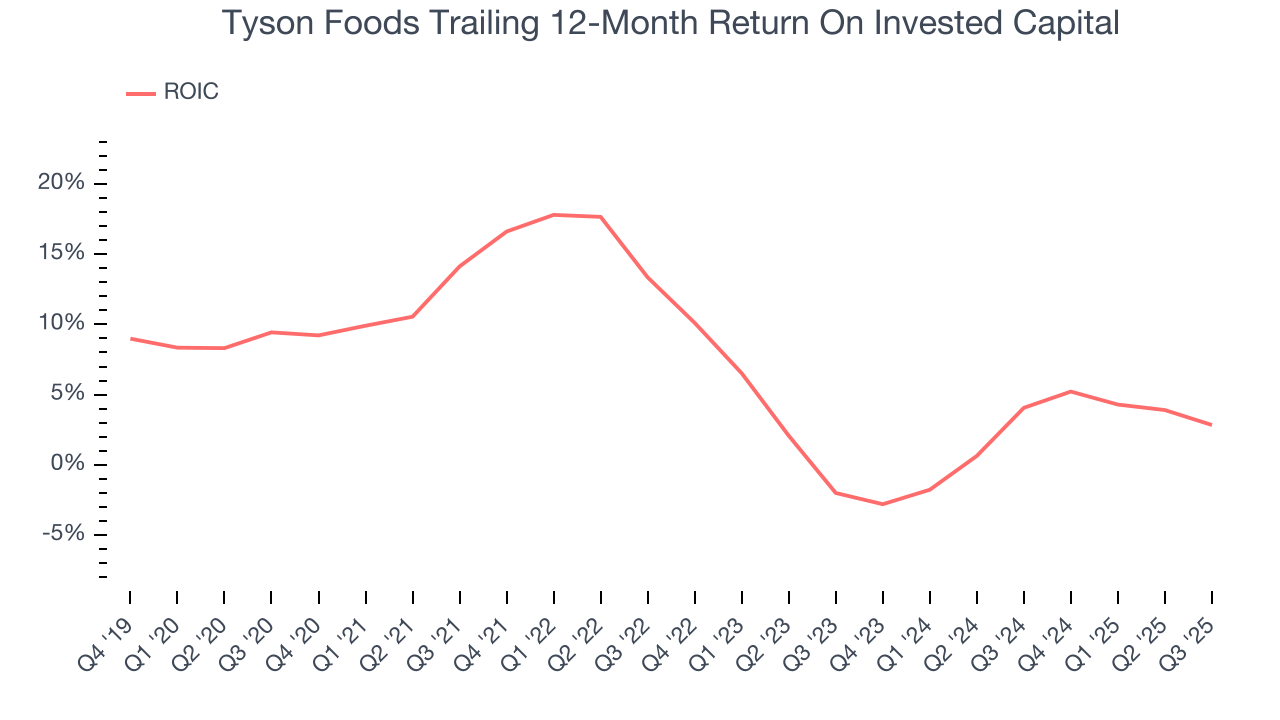
Tyson Foods historically did a mediocre job investing in profitable growth initiatives. Its five-year average ROIC was 6.5%, somewhat low compared to the best consumer staples companies that consistently pump out 20%+.
12. Balance Sheet Assessment
Tyson Foods reported $1.23 billion of cash and $8.83 billion of debt on its balance sheet in the most recent quarter. As investors in high-quality companies, we primarily focus on two things: 1) that a company’s debt level isn’t too high and 2) that its interest payments are not excessively burdening the business.
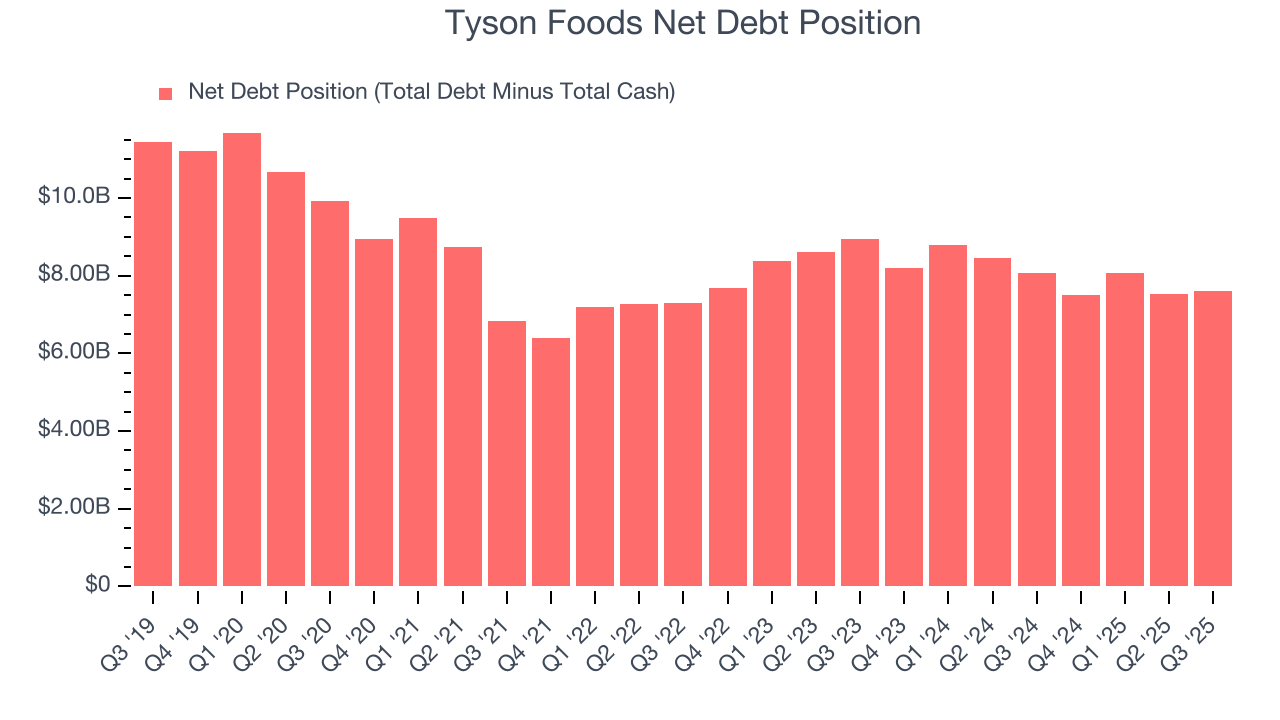
With $3.20 billion of EBITDA over the last 12 months, we view Tyson Foods’s 2.4× net-debt-to-EBITDA ratio as safe. We also see its $196 million of annual interest expenses as appropriate. The company’s profits give it plenty of breathing room, allowing it to continue investing in growth initiatives.
13. Key Takeaways from Tyson Foods’s Q3 Results
It was good to see Tyson Foods beat analysts’ EPS expectations this quarter. On the other hand, its revenue fell short of Wall Street’s estimates. Overall, this quarter was mixed. The stock traded up 3.7% to $54.62 immediately following the results.
14. Is Now The Time To Buy Tyson Foods?
Updated: January 28, 2026 at 9:57 PM EST
The latest quarterly earnings matters, sure, but we actually think longer-term fundamentals and valuation matter more. Investors should consider all these pieces before deciding whether or not to invest in Tyson Foods.
Tyson Foods doesn’t pass our quality test. To begin with, its revenue growth was weak over the last three years. And while its unparalleled brand awareness makes it a household name consumers consistently turn to, the downside is its declining EPS over the last three years makes it a less attractive asset to the public markets. On top of that, its gross margins make it more challenging to reach positive operating profits compared to other consumer staples businesses.
Tyson Foods’s P/E ratio based on the next 12 months is 16.8x. This valuation tells us a lot of optimism is priced in - we think there are better opportunities elsewhere.
Wall Street analysts have a consensus one-year price target of $65.17 on the company (compared to the current share price of $64.38).