
Elevance Health (ELV)
Elevance Health is a sound business. Its remarkable ROIC underscores its knack for targeting and investing in highly profitable growth initiatives.― StockStory Analyst Team


1. News




2. Summary
Why Elevance Health Is Interesting
Formerly known as Anthem until its 2022 rebranding, Elevance Health (NYSE:ELV) is one of America's largest health insurers, serving approximately 47 million medical members through its network-based managed care plans.
- Industry-leading 27.3% return on capital demonstrates management’s skill in finding high-return investments
- Unparalleled scale of $197.6 billion in revenue enables it to spread administrative costs across a larger membership base
- On the other hand, its forecasted revenue decline of 3% for the upcoming 12 months implies demand will fall off a cliff
Elevance Health has the potential to be a high-quality business. If you’ve been itching to buy the stock, the valuation looks fair.
Why Is Now The Time To Buy Elevance Health?







Elevance Health’s stock price of $293.50 implies a valuation ratio of 11.2x forward P/E. The current valuation is below that of most healthcare companies, but this isn’t a bargain. Instead, the price is appropriate for the quality you get.
If you think the market is not giving the company enough credit for its fundamentals, now could be a good time to invest.
3. Elevance Health (ELV) Research Report: Q4 CY2025 Update
Health insurance provider Elevance Health (NYSE:EVH) met Wall Streets revenue expectations in Q4 CY2025, with sales up 10.6% year on year to $49.75 billion. Its non-GAAP profit of $3.33 per share was 7.7% above analysts’ consensus estimates.
Elevance Health (ELV) Q4 CY2025 Highlights:
- Revenue: $49.75 billion vs analyst estimates of $49.92 billion (10.6% year-on-year growth, in line)
- Adjusted EPS: $3.33 vs analyst estimates of $3.09 (7.7% beat)
- Adjusted EPS guidance for the upcoming financial year 2026 is $25.50 at the midpoint, missing analyst estimates by 4.9%
- Operating Margin: 0.4%, down from 2.7% in the same quarter last year
- Free Cash Flow was -$209 million, down from $384 million in the same quarter last year
- Customers: 45.23 million, down from 45.37 million in the previous quarter
- Market Capitalization: $71.77 billion
Company Overview
Formerly known as Anthem until its 2022 rebranding, Elevance Health (NYSE:ELV) is one of America's largest health insurers, serving approximately 47 million medical members through its network-based managed care plans.
Elevance Health operates through a portfolio of brands including Anthem Blue Cross/Blue Shield in 14 states where it holds Blue Cross Blue Shield Association licenses, Wellpoint for its non-BCBS licensed plans, and Carelon for healthcare services. The company's business spans multiple market segments, offering health plans to individuals, employer groups, Medicare recipients, and Medicaid beneficiaries.
The company's health insurance products range from traditional PPO and HMO plans to consumer-driven health plans with health savings accounts. For Medicare-eligible individuals, Elevance offers Medicare Advantage plans, Medicare Supplement policies, and Medicare Part D prescription drug coverage. Its Medicaid business serves low-income populations across numerous states, including specialized programs for people with disabilities, foster children, and those needing long-term services.
Beyond insurance, Elevance provides an array of healthcare services through its Carelon division. These include pharmacy benefit management, behavioral health services, care management for complex conditions, and data analytics to improve healthcare outcomes. For example, a patient with multiple chronic conditions might receive coordinated care through Elevance's CareMore program (now Carelon Health), which provides personalized care plans and regular monitoring to prevent complications and reduce hospitalizations.
Elevance generates revenue primarily through insurance premiums paid by individuals, employers, and government programs. It also earns service fees from its pharmacy operations and healthcare services provided to external clients. The company leverages its scale to negotiate favorable rates with healthcare providers, helping to control costs for members while maintaining profitability.
The company employs sophisticated data analytics and digital tools to manage healthcare costs and improve outcomes. Its Sydney Health digital platform gives members access to their benefits information, telehealth services, and personalized health resources in one place. Elevance also offers care management programs for conditions like diabetes and heart disease, helping members navigate the healthcare system and adhere to treatment plans.
4. Health Insurance Providers
Upfront premiums collected by health insurers lead to reliable revenue, but profitability ultimately depends on accurate risk assessments and the ability to control medical costs. Health insurers are also highly sensitive to regulatory changes and economic conditions such as unemployment. Going forward, the industry faces tailwinds from an aging population, increasing demand for personalized healthcare services, and advancements in data analytics to improve cost management. However, continued regulatory scrutiny on pricing practices, the potential for government-led reforms such as expanded public healthcare options, and inflation in medical costs could add volatility to margins. One big debate among investors is the long-term impact of AI and whether it will help underwriting, fraud detection, and claims processing or whether it may wade into ethical grey areas like reinforcing biases and widening disparities in medical care.
Elevance Health's main competitors include other major health insurers such as UnitedHealth Group (NYSE:UNH), Cigna Group (NYSE:CI), CVS Health/Aetna (NYSE:CVS), Humana (NYSE:HUM), and Centene Corporation (NYSE:CNC).
5. Economies of Scale
Larger companies benefit from economies of scale, where fixed costs like infrastructure, technology, and administration are spread over a higher volume of goods or services, reducing the cost per unit. Scale can also lead to bargaining power with suppliers, greater brand recognition, and more investment firepower. A virtuous cycle can ensue if a scaled company plays its cards right.
With $198 billion in revenue over the past 12 months, Elevance Health is one of the most scaled enterprises in healthcare. This is particularly important because health insurance providers companies are volume-driven businesses due to their low margins.
6. Revenue Growth
Reviewing a company’s long-term sales performance reveals insights into its quality. Any business can experience short-term success, but top-performing ones enjoy sustained growth for years. Thankfully, Elevance Health’s 10.4% annualized revenue growth over the last five years was decent. Its growth was slightly above the average healthcare company and shows its offerings resonate with customers.
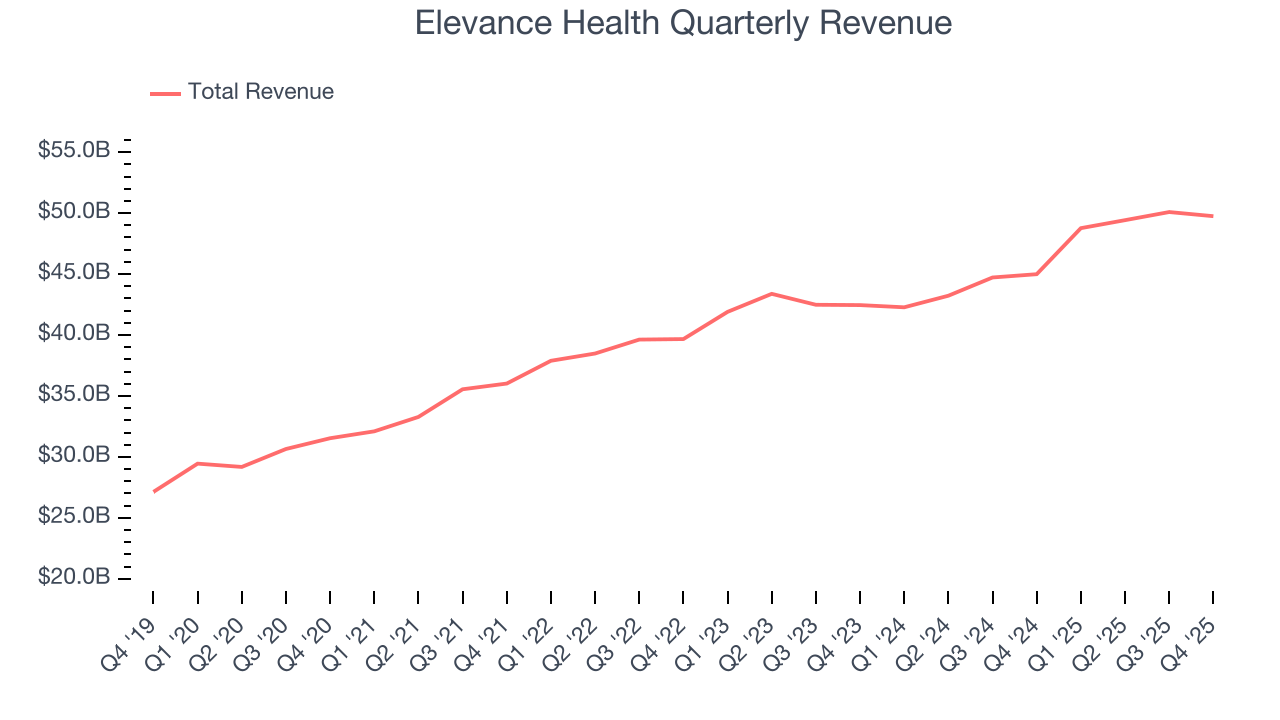
We at StockStory place the most emphasis on long-term growth, but within healthcare, a half-decade historical view may miss recent innovations or disruptive industry trends. Elevance Health’s annualized revenue growth of 7.9% over the last two years is below its five-year trend, but we still think the results were respectable. 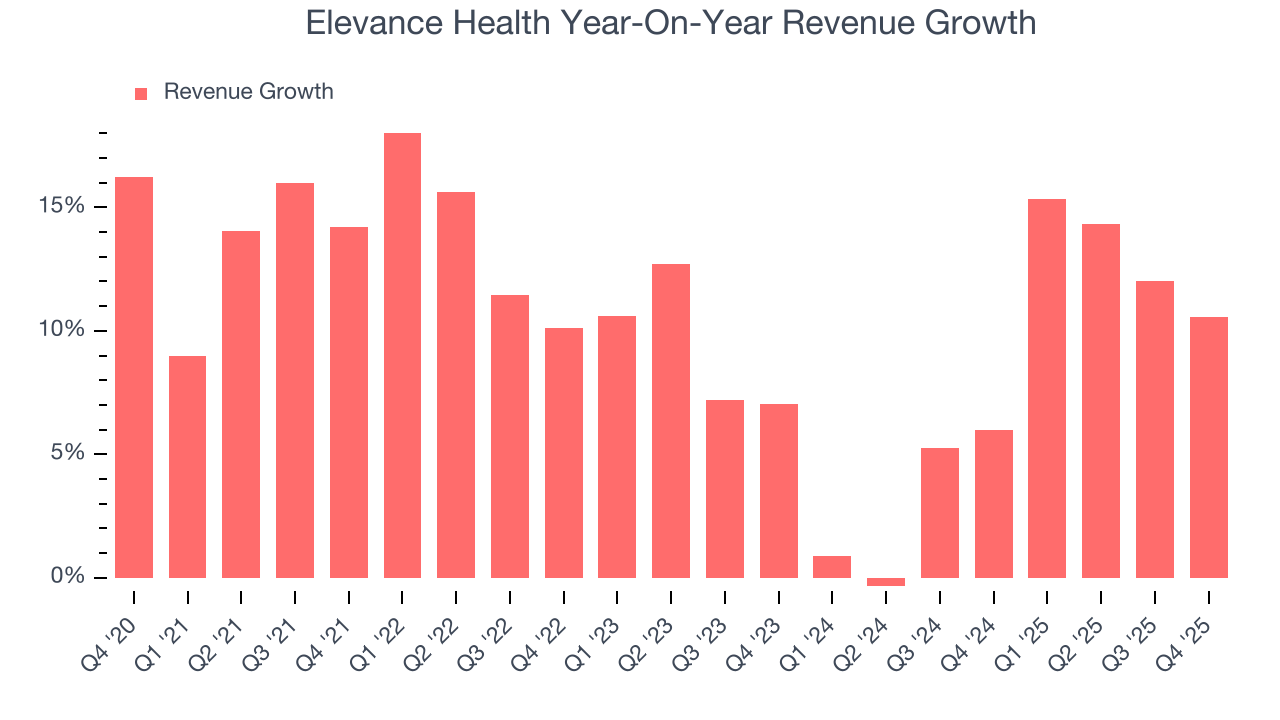
We can better understand the company’s revenue dynamics by analyzing its number of customers, which reached 45.23 million in the latest quarter. Over the last two years, Elevance Health’s customer base averaged 2.2% year-on-year declines. Because this number is lower than its revenue growth, we can see the average customer spent more money each year on the company’s products and services. 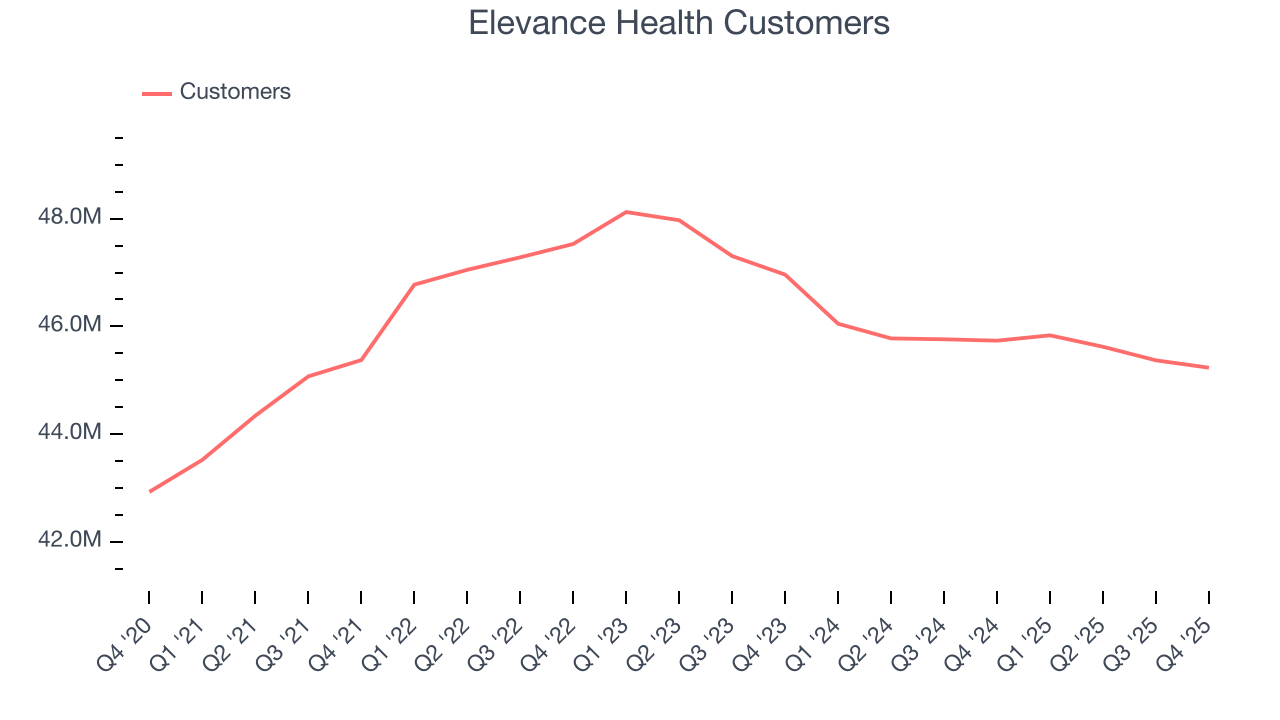
This quarter, Elevance Health’s year-on-year revenue growth was 10.6%, and its $49.75 billion of revenue was in line with Wall Street’s estimates.
Looking ahead, sell-side analysts expect revenue to grow 3.3% over the next 12 months, a deceleration versus the last two years. This projection is underwhelming and suggests its products and services will see some demand headwinds. At least the company is tracking well in other measures of financial health.
7. Operating Margin
Elevance Health was profitable over the last five years but held back by its large cost base. Its average operating margin of 5.6% was weak for a healthcare business.
Looking at the trend in its profitability, Elevance Health’s operating margin decreased by 2.6 percentage points over the last five years. The company’s two-year trajectory also shows it failed to get its profitability back to the peak as its margin fell by 2.2 percentage points. We still like Elevance Health but would like to see some improvement in the future.
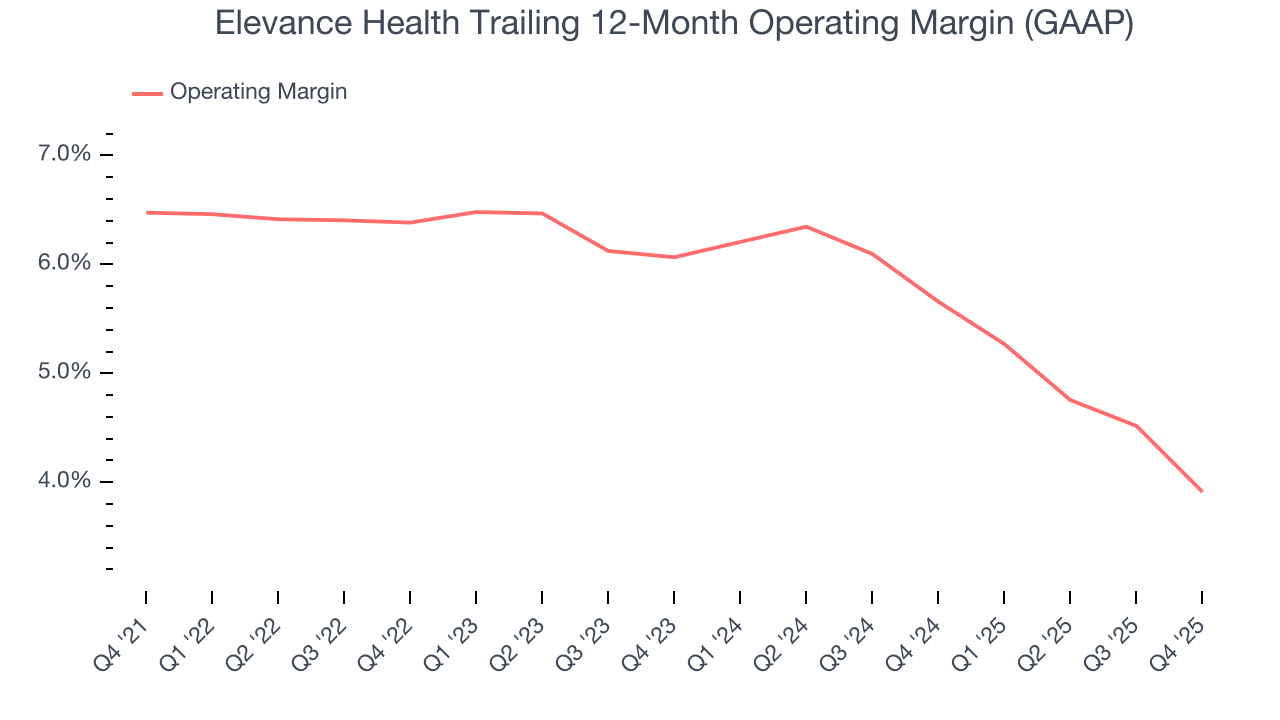
This quarter, Elevance Health’s breakeven margin was down 2.2 percentage points year on year. This contraction shows it was less efficient because its expenses grew faster than its revenue.
8. Earnings Per Share
We track the long-term change in earnings per share (EPS) for the same reason as long-term revenue growth. Compared to revenue, however, EPS highlights whether a company’s growth is profitable.
Elevance Health’s EPS grew at a decent 6.1% compounded annual growth rate over the last five years. However, this performance was lower than its 10.4% annualized revenue growth, telling us the company became less profitable on a per-share basis as it expanded due to non-fundamental factors such as interest expenses and taxes.
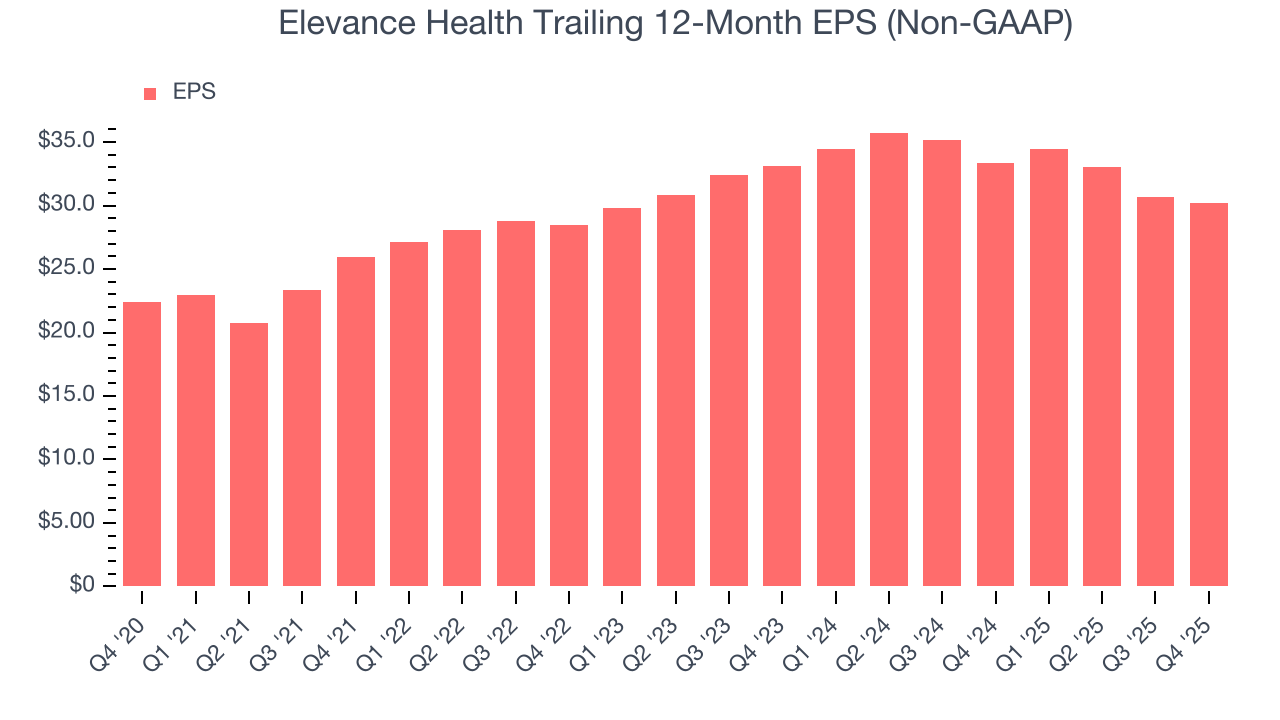
We can take a deeper look into Elevance Health’s earnings to better understand the drivers of its performance. As we mentioned earlier, Elevance Health’s operating margin declined by 2.6 percentage points over the last five years. This was the most relevant factor (aside from the revenue impact) behind its lower earnings; interest expenses and taxes can also affect EPS but don’t tell us as much about a company’s fundamentals.
In Q4, Elevance Health reported adjusted EPS of $3.33, down from $3.84 in the same quarter last year. Despite falling year on year, this print beat analysts’ estimates by 7.7%. Over the next 12 months, Wall Street expects Elevance Health’s full-year EPS of $30.17 to shrink by 11.4%.
9. Cash Is King
Free cash flow isn't a prominently featured metric in company financials and earnings releases, but we think it's telling because it accounts for all operating and capital expenses, making it tough to manipulate. Cash is king.
Elevance Health has shown mediocre cash profitability over the last five years, giving the company limited opportunities to return capital to shareholders. Its free cash flow margin averaged 3.5%, subpar for a healthcare business.
Taking a step back, we can see that Elevance Health’s margin dropped by 3.7 percentage points during that time. If the trend continues, it could signal it’s in the middle of an investment cycle.
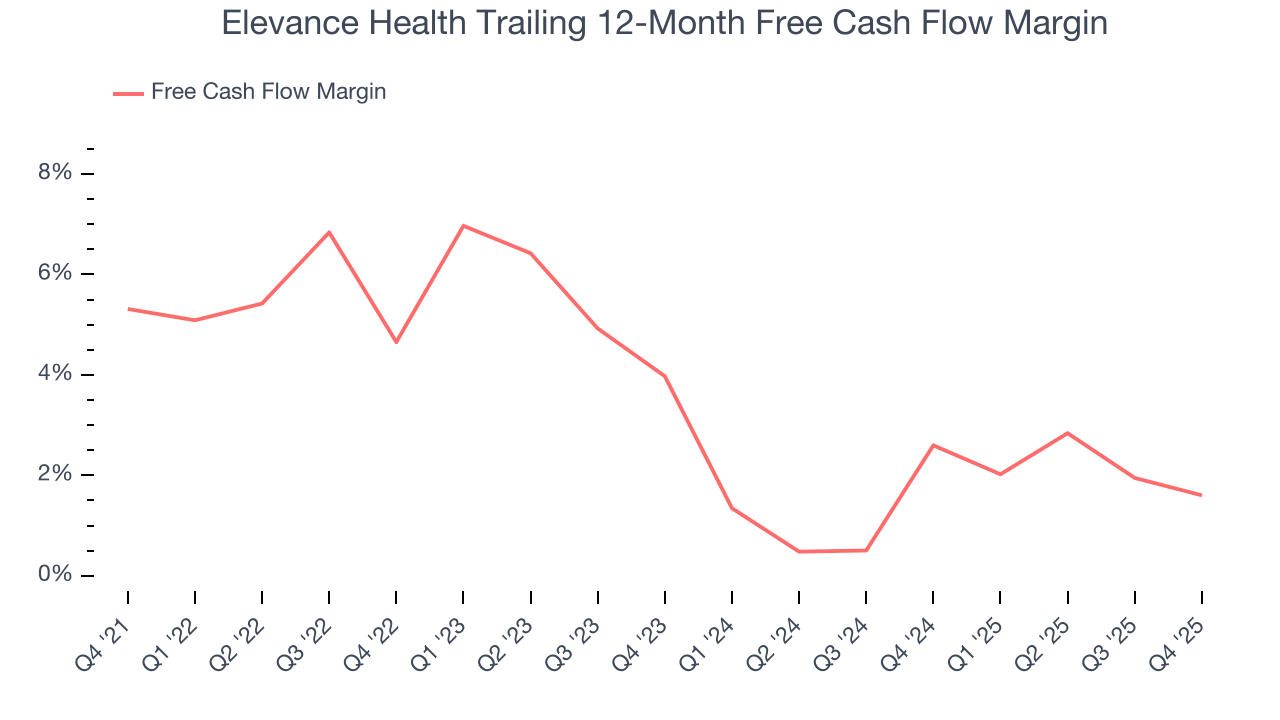
Elevance Health broke even from a free cash flow perspective in Q4. The company’s cash profitability regressed as it was 1.3 percentage points lower than in the same quarter last year, which isn’t ideal considering its longer-term trend.
10. Return on Invested Capital (ROIC)
EPS and free cash flow tell us whether a company was profitable while growing its revenue. But was it capital-efficient? Enter ROIC, a metric showing how much operating profit a company generates relative to the money it has raised (debt and equity).
Elevance Health’s five-year average ROIC was 26.5%, placing it among the best healthcare companies. This illustrates its management team’s ability to invest in highly profitable ventures and produce tangible results for shareholders.
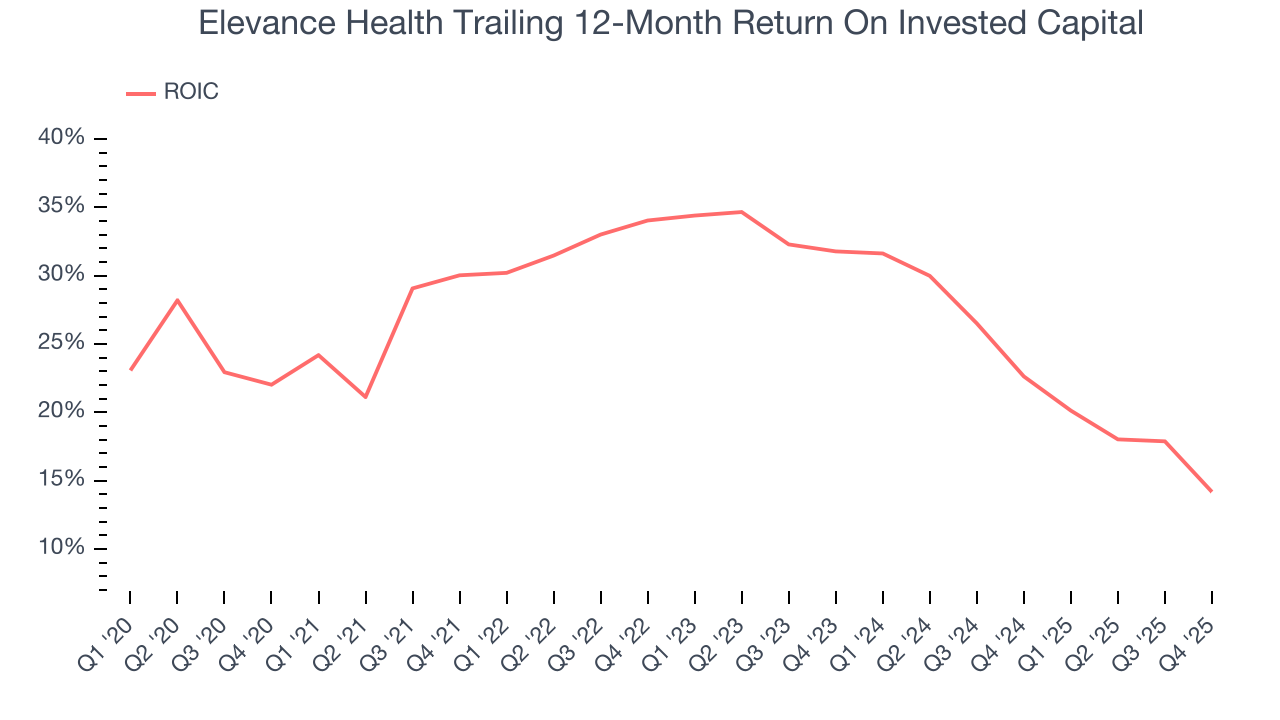
We like to invest in businesses with high returns, but the trend in a company’s ROIC is what often surprises the market and moves the stock price. Over the last few years, Elevance Health’s ROIC has unfortunately decreased significantly. Only time will tell if its new bets can bear fruit and potentially reverse the trend.
11. Balance Sheet Assessment
Elevance Health reported $9.49 billion of cash and $32.05 billion of debt on its balance sheet in the most recent quarter. As investors in high-quality companies, we primarily focus on two things: 1) that a company’s debt level isn’t too high and 2) that its interest payments are not excessively burdening the business.
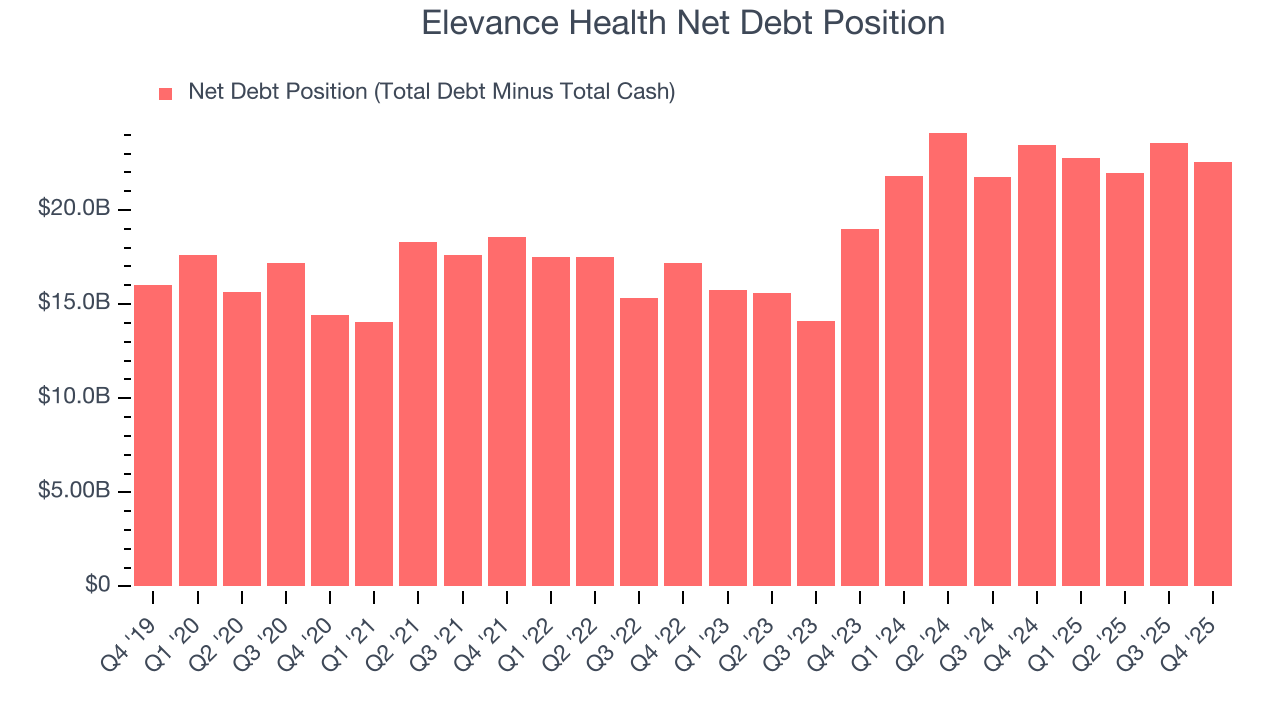
With $9.87 billion of EBITDA over the last 12 months, we view Elevance Health’s 2.3× net-debt-to-EBITDA ratio as safe. We also see its $670 million of annual interest expenses as appropriate. The company’s profits give it plenty of breathing room, allowing it to continue investing in growth initiatives.
12. Key Takeaways from Elevance Health’s Q4 Results
It was good to see Elevance Health beat analysts’ EPS expectations this quarter. On the other hand, its full-year EPS guidance missed and its revenue was only in line with Wall Street’s estimates. Overall, this was a weaker quarter. The stock traded down 6.7% to $302.06 immediately following the results.
13. Is Now The Time To Buy Elevance Health?
Updated: March 24, 2026 at 11:47 PM EDT
We think that the latest earnings result is only one piece of the bigger puzzle. If you’re deciding whether to own Elevance Health, you should also grasp the company’s longer-term business quality and valuation.
There are definitely a lot of things to like about Elevance Health. To kick things off, its revenue growth was good over the last five years. And while its diminishing returns show management's recent bets still have yet to bear fruit, its scale gives it meaningful leverage when negotiating reimbursement rates. On top of that, its stellar ROIC suggests it has been a well-run company historically.
Elevance Health’s P/E ratio based on the next 12 months is 11.1x. When scanning the healthcare space, Elevance Health trades at a fair valuation. If you’re a fan of the business and management team, now is a good time to scoop up some shares.
Wall Street analysts have a consensus one-year price target of $380.95 on the company (compared to the current share price of $290.40), implying they see 31.2% upside in buying Elevance Health in the short term.