Home Depot (HD)
We’re cautious of Home Depot. Its poor sales growth and falling returns on capital suggest its growth opportunities are shrinking.― StockStory Analyst Team


1. News


2. Summary
Why Home Depot Is Not Exciting
Founded and headquartered in Atlanta, Georgia, Home Depot (NYSE:HD) is a home improvement retailer that sells everything from tools to building materials to appliances.
- Annual sales growth of 1.5% over the last three years lagged behind its consumer retail peers as its large revenue base made it difficult to generate incremental demand
- Lagging same-store sales over the past two years suggest it might have to change its pricing and marketing strategy to stimulate demand
- The good news is that its industry-leading 36.2% return on capital demonstrates management’s skill in finding high-return investments
Home Depot doesn’t satisfy our quality benchmarks. We’d rather invest in businesses with stronger moats.
Why There Are Better Opportunities Than Home Depot






At $341.42 per share, Home Depot trades at 22.8x forward P/E. This multiple expensive for its subpar fundamentals.
Paying a premium for high-quality companies with strong long-term earnings potential is preferable to owning challenged businesses with questionable prospects. That helps the prudent investor sleep well at night.
3. Home Depot (HD) Research Report: Q4 CY2025 Update
Home improvement retail giant Home Depot (NYSE:HD) met Wall Street’s revenue expectations in Q4 CY2025, but sales fell by 3.8% year on year to $38.2 billion. Its non-GAAP profit of $2.72 per share was 7.8% above analysts’ consensus estimates.
Home Depot (HD) Q4 CY2025 Highlights:
- Revenue: $38.2 billion vs analyst estimates of $38.13 billion (3.8% year-on-year decline, in line)
- Adjusted EPS: $2.72 vs analyst estimates of $2.52 (7.8% beat)
- Operating Margin: 10.1%, down from 11.3% in the same quarter last year
- Free Cash Flow Margin: 6%, down from 9% in the same quarter last year
- Locations: 2,359 at quarter end, up from 2,347 in the same quarter last year
- Same-Store Sales were flat year on year, in line with the same quarter last year
- Market Capitalization: $375.3 billion
Company Overview
Founded and headquartered in Atlanta, Georgia, Home Depot (NYSE:HD) is a home improvement retailer that sells everything from tools to building materials to appliances.
The core customer is both the do-it-yourself (DIY) homeowner and the professional contractor. The broad range of high-quality products at competitive prices appeals to both types of customers. For the DIY shopper, Home Depot employs sales associates trained in specific areas such as tools, paint, and home appliances. Homeowners can also rent power tools or attend in-store workshops. For the professional contractor, Home Depot has loyalty programs and volume discounts. There is also a Pro Desk in most stores, where contractors can place large or custom orders and consult with specialists trained to specifically assist professionals.
The typical Home Depot store is between 100,000 and 200,000 square feet. Most stores are laid out in a similar way, with the entrance leading to the “action alley” where seasonal products (snow shovels during winter, potted flowers during spring) or promotions are placed. From there, the store is organized into departments such as lumber, plumbing, electrical, paint, and appliances. In addition to the main departments, Home Depot stores also feature service desks, which are staffed by store associates who assist with questions, purchases, returns, and exchanges.
4. Home Improvement Retailer
Home improvement retailers serve the maintenance and repair needs of do-it-yourself homeowners as well as professional contractors. Home is where the heart is, so any homeowner will want to keep that home in good shape by maintaining the yard, fixing leaks, or improving lighting fixtures, for example. Home improvement stores win with depth and breadth of product, in-store consultations for customers who need help, and services that cater to professionals. It is hard for non-focused retailers and e-commerce competitors to match these. However, the research, convenience, and prices of online platforms means they can’t be fully written off, either.
Home improvement retail competitors include Lowe’s (NYSE:LOW) and private company Ace Hardware. Amazon.com (NASDAQ:AMZN) and Wayfair (NYSE:W) also offer some home improvement products.
5. Revenue Growth
Examining a company’s long-term performance can provide clues about its quality. Any business can experience short-term success, but top-performing ones enjoy sustained growth for years.
With $164.7 billion in revenue over the past 12 months, Home Depot is a behemoth in the consumer retail sector and benefits from economies of scale, giving it an edge in distribution. This also enables it to gain more leverage on its fixed costs than smaller competitors and the flexibility to offer lower prices. However, its scale is a double-edged sword because there is only so much real estate to build new stores, placing a ceiling on its growth. To accelerate sales, Home Depot likely needs to optimize its pricing or lean into international expansion.
As you can see below, Home Depot’s sales grew at a sluggish 1.5% compounded annual growth rate over the last three years as it didn’t open many new stores.
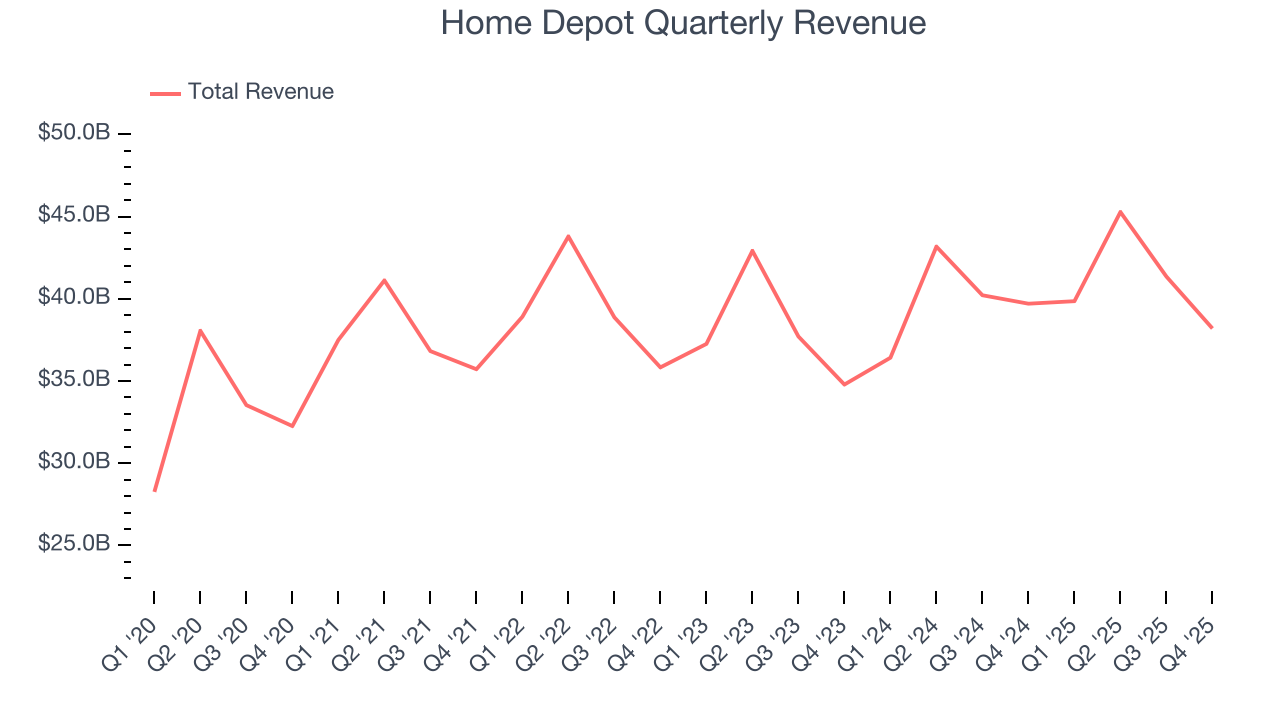
This quarter, Home Depot reported a rather uninspiring 3.8% year-on-year revenue decline to $38.2 billion of revenue, in line with Wall Street’s estimates.
Looking ahead, sell-side analysts expect revenue to grow 4.1% over the next 12 months, an acceleration versus the last three years. This projection is above the sector average and implies its newer products will catalyze better top-line performance.
6. Store Performance
Number of Stores
A retailer’s store count often determines how much revenue it can generate.
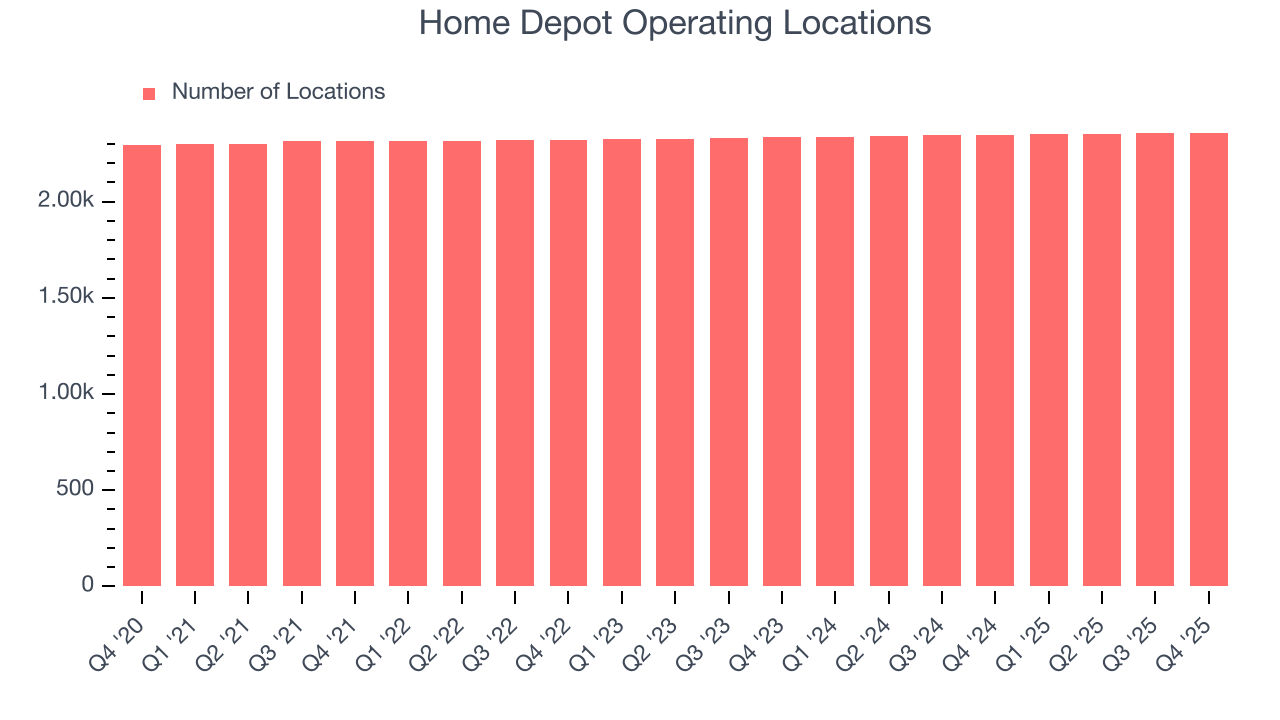
Home Depot operated 2,359 locations in the latest quarter, and over the last two years, has kept its store count flat while other consumer retail businesses have opted for growth.
When a retailer keeps its store footprint steady, it usually means demand is stable and it’s focusing on operational efficiency to increase profitability.
Same-Store Sales
The change in a company's store base only tells one side of the story. The other is the performance of its existing locations and e-commerce sales, which informs management teams whether they should expand or downsize their physical footprints. Same-store sales is an industry measure of whether revenue is growing at those existing stores and is driven by customer visits (often called traffic) and the average spending per customer (ticket).
Home Depot’s demand within its existing locations has barely increased over the last two years as its same-store sales were flat. This performance isn’t ideal, and we’d be skeptical if Home Depot starts opening new stores to artificially boost revenue growth.
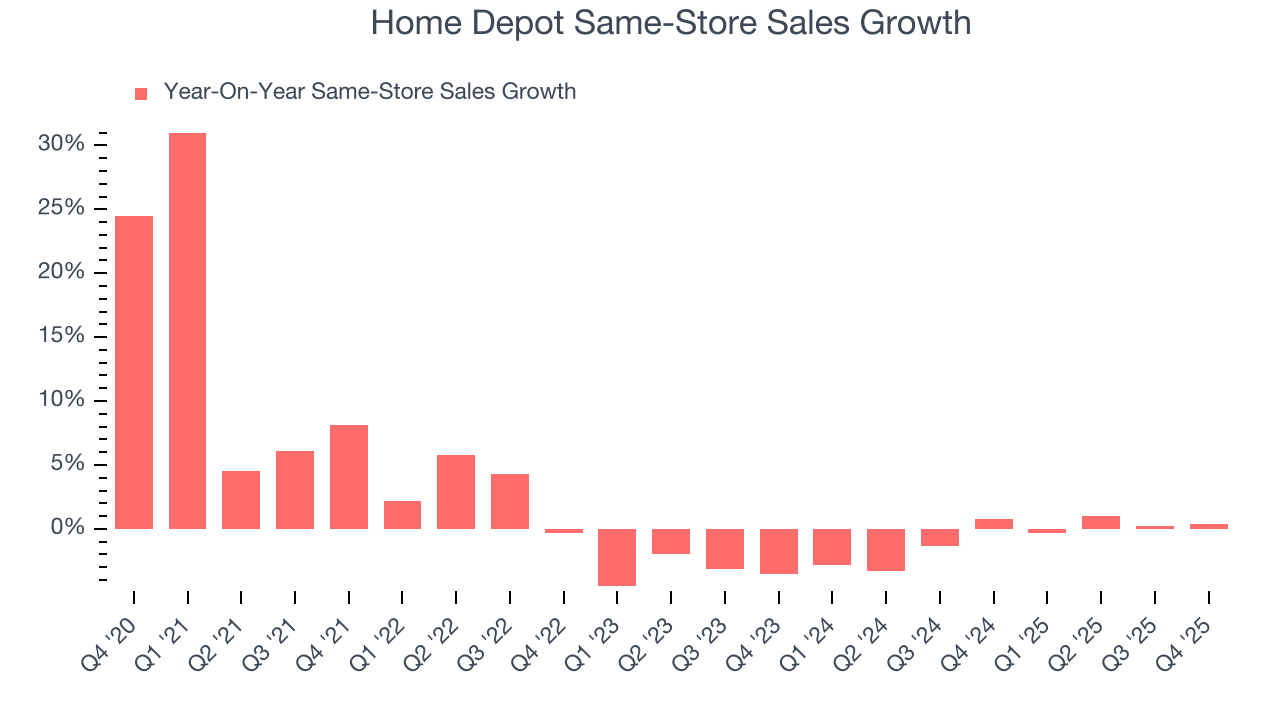
In the latest quarter, Home Depot’s year on year same-store sales were flat. This performance was more or less in line with its historical levels.
7. Gross Margin & Pricing Power
Home Depot has bad unit economics for a retailer, signaling it operates in a competitive market and lacks pricing power because its inventory is sold in many places. As you can see below, it averaged a 33.4% gross margin over the last two years. That means Home Depot paid its suppliers a lot of money ($66.63 for every $100 in revenue) to run its business. 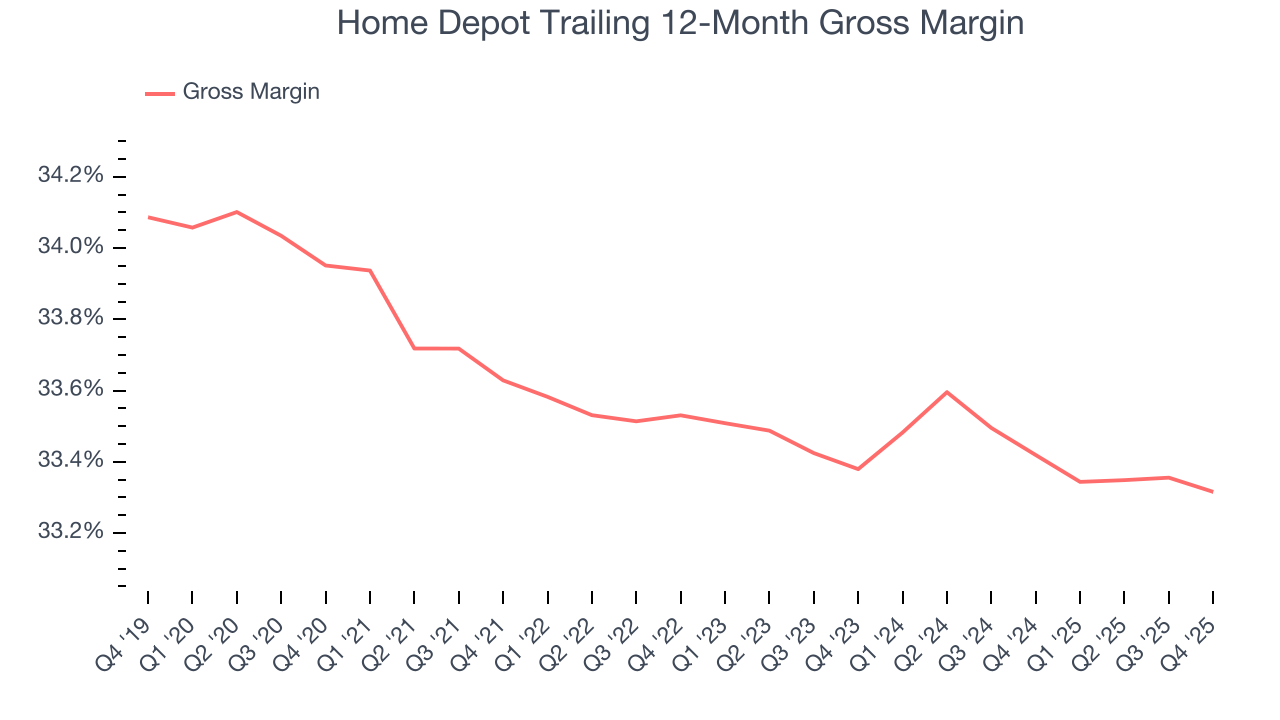
This quarter, Home Depot’s gross profit margin was 32.6%, in line with the same quarter last year. Zooming out, the company’s full-year margin has remained steady over the past 12 months, suggesting it strives to keep prices low for customers and has stable input costs (such as labor and freight expenses to transport goods).
8. Operating Margin
Home Depot’s operating margin might fluctuated slightly over the last 12 months but has generally stayed the same, averaging 13.1% over the last two years. This profitability was top-notch for a consumer retail business, showing it’s an well-run company with an efficient cost structure. This result was particularly impressive because of its low gross margin, which is mostly a factor of what it sells and takes huge shifts to move meaningfully. Companies have more control over their operating margins, and it’s a show of well-managed operations if they’re high when gross margins are low.
Analyzing the trend in its profitability, Home Depot’s operating margin might fluctuated slightly but has generally stayed the same over the last year. This raises questions about the company’s expense base because its revenue growth should have given it leverage on its fixed costs, resulting in better economies of scale and profitability.
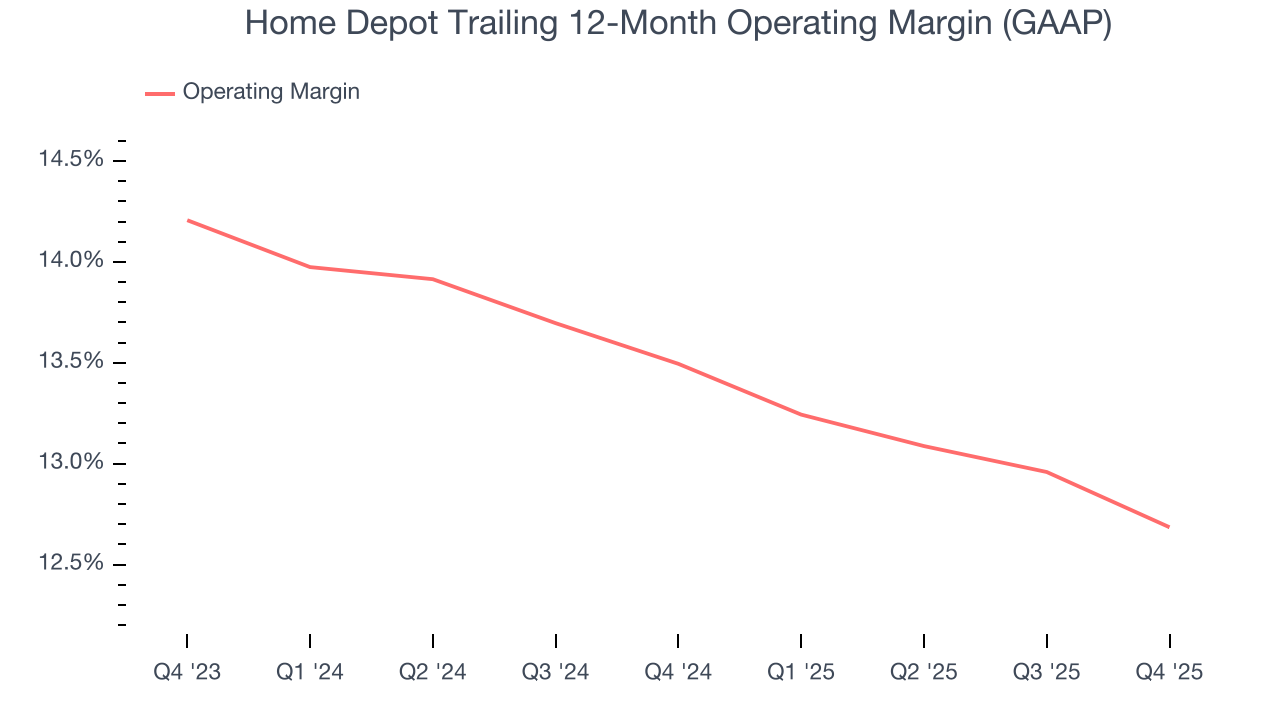
This quarter, Home Depot generated an operating margin profit margin of 10.1%, down 1.2 percentage points year on year. Since Home Depot’s operating margin decreased more than its gross margin, we can assume it was less efficient because expenses such as marketing, and administrative overhead increased.
9. Earnings Per Share
Revenue trends explain a company’s historical growth, but the long-term change in earnings per share (EPS) points to the profitability of that growth – for example, a company could inflate its sales through excessive spending on advertising and promotions.
Sadly for Home Depot, its EPS declined by 4.1% annually over the last three years while its revenue grew by 1.5%. This tells us the company became less profitable on a per-share basis as it expanded due to non-fundamental factors such as interest expenses and taxes.
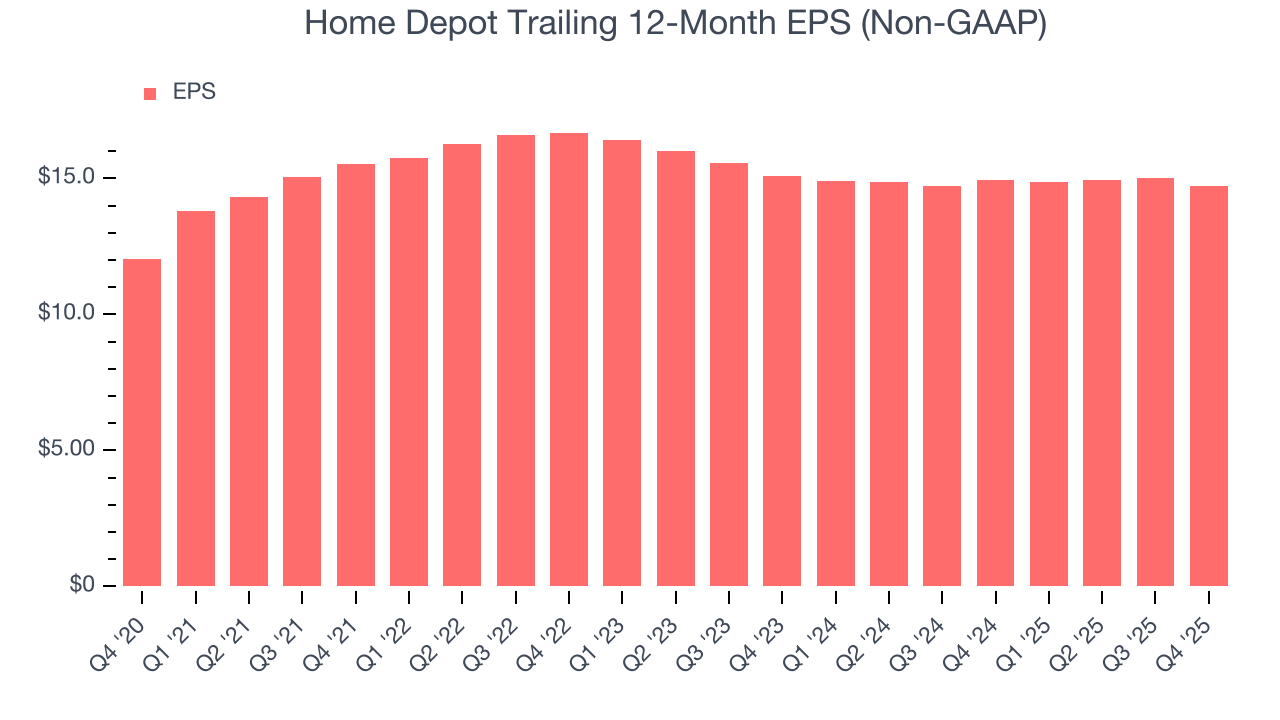
In Q4, Home Depot reported adjusted EPS of $2.72, down from $3.02 in the same quarter last year. Despite falling year on year, this print beat analysts’ estimates by 7.8%. Over the next 12 months, Wall Street expects Home Depot’s full-year EPS of $14.70 to grow 2.3%.
10. Cash Is King
Although earnings are undoubtedly valuable for assessing company performance, we believe cash is king because you can’t use accounting profits to pay the bills.
Home Depot has shown robust cash profitability, giving it an edge over its competitors and the ability to reinvest or return capital to investors. The company’s free cash flow margin averaged 8.9% over the last two years, quite impressive for a consumer retail business.
Taking a step back, we can see that Home Depot’s margin dropped by 2.6 percentage points over the last year. If its declines continue, it could signal increasing investment needs and capital intensity.
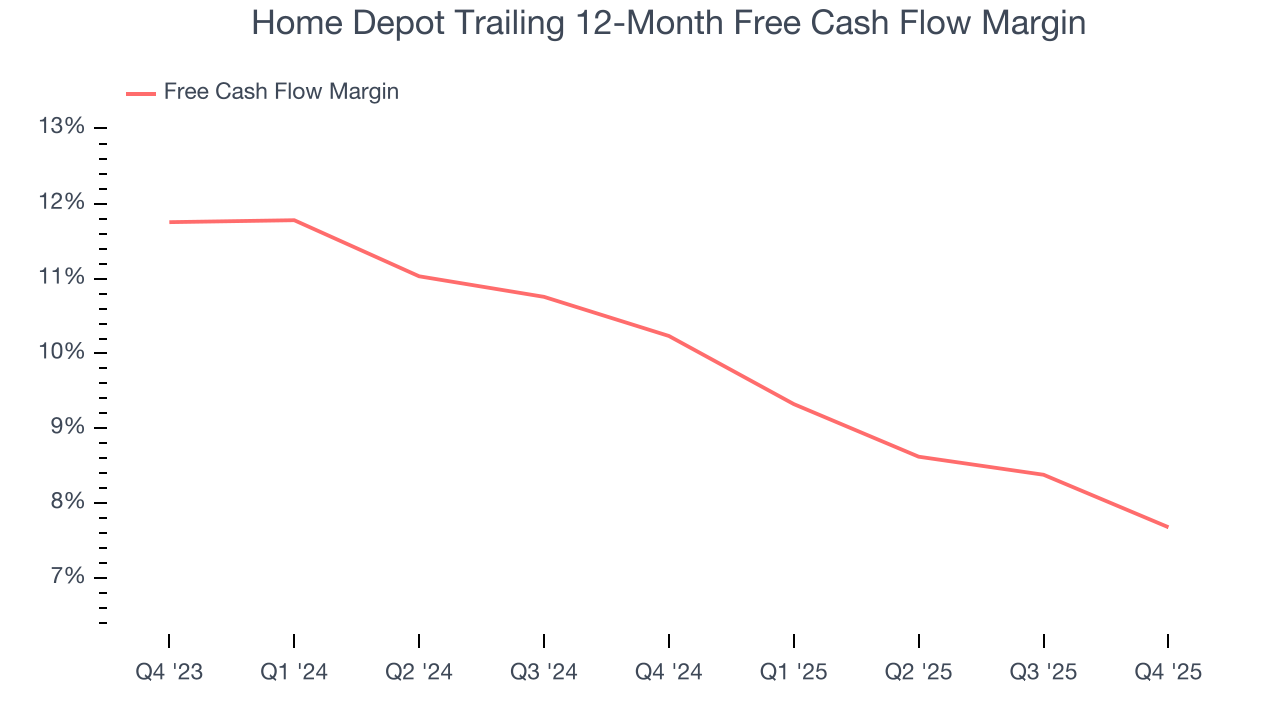
Home Depot’s free cash flow clocked in at $2.29 billion in Q4, equivalent to a 6% margin. The company’s cash profitability regressed as it was 3 percentage points lower than in the same quarter last year, suggesting its historical struggles have dragged on.
11. Return on Invested Capital (ROIC)
EPS and free cash flow tell us whether a company was profitable while growing its revenue. But was it capital-efficient? A company’s ROIC explains this by showing how much operating profit it makes compared to the money it has raised (debt and equity).
Although Home Depot hasn’t been the highest-quality company lately because of its poor revenue and EPS performance, it found a few growth initiatives in the past that worked out wonderfully. Its five-year average ROIC was 36.2%, splendid for a consumer retail business.
12. Balance Sheet Assessment
Home Depot reported $1.39 billion of cash and $60.38 billion of debt on its balance sheet in the most recent quarter. As investors in high-quality companies, we primarily focus on two things: 1) that a company’s debt level isn’t too high and 2) that its interest payments are not excessively burdening the business.
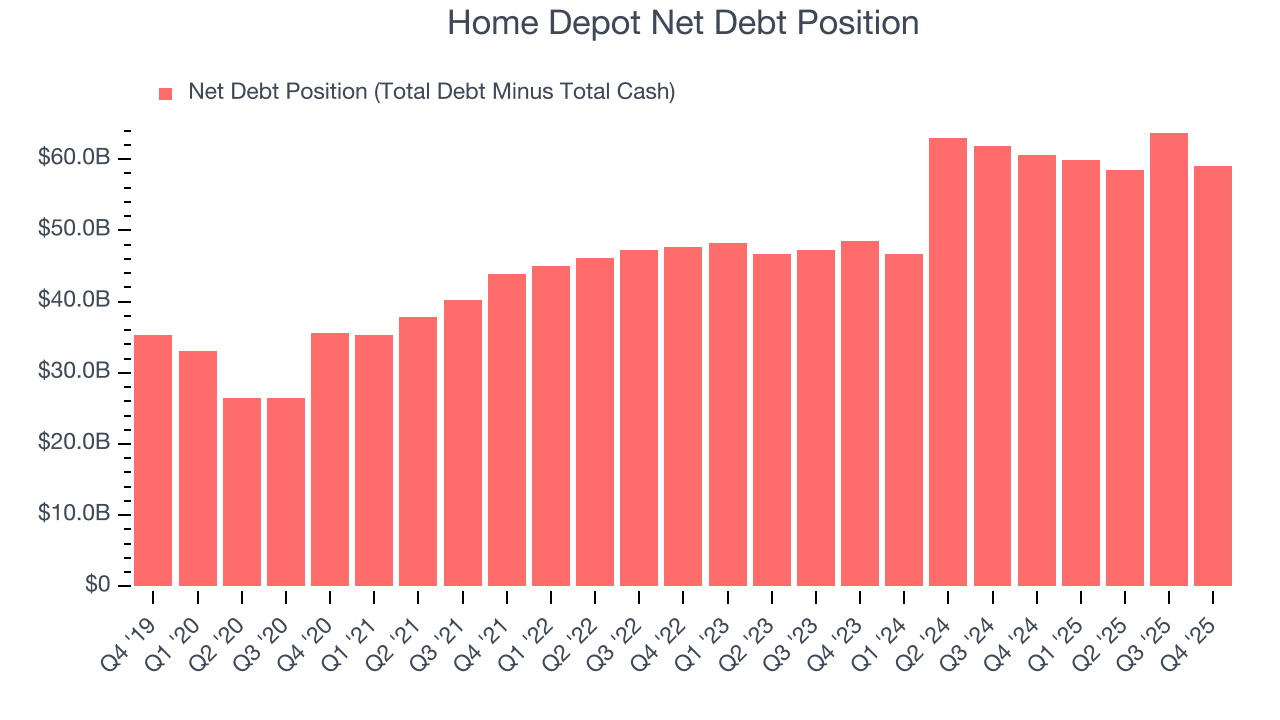
With $24.16 billion of EBITDA over the last 12 months, we view Home Depot’s 2.4× net-debt-to-EBITDA ratio as safe. We also see its $1.19 billion of annual interest expenses as appropriate. The company’s profits give it plenty of breathing room, allowing it to continue investing in growth initiatives.
13. Key Takeaways from Home Depot’s Q4 Results
It was good to see Home Depot narrowly top analysts’ gross margin expectations this quarter. We were also glad its EPS outperformed Wall Street’s estimates. Zooming out, we think this was a decent quarter despite just in-line revenue that declined year on year. The stock traded up 4.2% to $393 immediately following the results.
14. Is Now The Time To Buy Home Depot?
Updated: March 17, 2026 at 10:41 PM EDT
The latest quarterly earnings matters, sure, but we actually think longer-term fundamentals and valuation matter more. Investors should consider all these pieces before deciding whether or not to invest in Home Depot.
Home Depot’s business quality ultimately falls short of our standards. To begin with, its revenue growth was uninspiring over the last three years. While its stellar ROIC suggests it has been a well-run company historically, the downside is its poor same-store sales performance has been a headwind. On top of that, its gross margins make it more challenging to reach positive operating profits compared to other consumer retail businesses.
Home Depot’s P/E ratio based on the next 12 months is 22.8x. Beauty is in the eye of the beholder, but our analysis shows the upside isn’t great compared to the potential downside. We're fairly confident there are better stocks to buy right now.
Wall Street analysts have a consensus one-year price target of $410.27 on the company (compared to the current share price of $341.42).
Although the price target is bullish, readers should exercise caution because analysts tend to be overly optimistic. The firms they work for, often big banks, have relationships with companies that extend into fundraising, M&A advisory, and other rewarding business lines. As a result, they typically hesitate to say bad things for fear they will lose out. We at StockStory do not suffer from such conflicts of interest, so we’ll always tell it like it is.