
Zevia (ZVIA)
Zevia doesn’t excite us. Its flat sales suggest demand is weak and its cash burn makes us question the business’s long-term viability.― StockStory Analyst Team


1. News
2. Summary
Why Zevia Is Not Exciting
With a primary focus on soda but also a presence in energy drinks and teas, Zevia (NYSE:ZVIA) is a better-for-you beverage company.
- Sales were flat over the last three years, indicating it’s failed to expand its business
- Poor expense management has led to operating margin losses
- One positive is that its earnings per share grew by 47.9% annually over the last three years, outpacing its peers
Zevia’s quality isn’t up to par. We believe there are better businesses elsewhere.
Why There Are Better Opportunities Than Zevia





Zevia is trading at $1.24 per share, or 0.5x forward price-to-sales. The market typically values companies like Zevia based on their anticipated profits for the next 12 months, but it expects the business to lose money. We also think the upside isn’t great compared to the potential downside here - there are more exciting stocks to buy.
We’d rather pay up for companies with elite fundamentals than get a bargain on poor ones. Cheap stocks can be value traps, and as their performance deteriorates, they will stay cheap or get even cheaper.
3. Zevia (ZVIA) Research Report: Q4 CY2025 Update
Beverage company Zevia (NYSE:ZVIA) fell short of the market’s revenue expectations in Q4 CY2025, with sales falling 4% year on year to $37.87 million. On the other hand, next quarter’s outlook exceeded expectations with revenue guided to $41 million at the midpoint, or 1.2% above analysts’ estimates. Its GAAP loss of $0.02 per share was in line with analysts’ consensus estimates.
Zevia (ZVIA) Q4 CY2025 Highlights:
- Revenue: $37.87 million vs analyst estimates of $40.19 million (4% year-on-year decline, 5.8% miss)
- EPS (GAAP): -$0.02 vs analyst estimates of -$0.03 (in line)
- Adjusted EBITDA: $49,000 (0.1% margin, 101% year-on-year growth)
- Revenue Guidance for Q1 CY2026 is $41 million at the midpoint, above analyst estimates of $40.5 million
- EBITDA guidance for the upcoming financial year 2026 is -$250,000 at the midpoint, below analyst estimates of $2.04 million
- Operating Margin: -4%, up from -16.1% in the same quarter last year
- Free Cash Flow was -$588,000 compared to -$2.04 million in the same quarter last year
- Market Capitalization: $101.1 million
Company Overview
With a primary focus on soda but also a presence in energy drinks and teas, Zevia (NYSE:ZVIA) is a better-for-you beverage company.
The company was founded in 2007 and launched with three flavors of zero-calorie, naturally-sweetened sodas. Zevia believed that consumers deserved a soda that was both healthy and great-tasting. Since its founding, more flavors have been launched and range from familiar favorites such as cola to innovative flavors such as grapefruit citrus. In addition to expanding the soda portfolio, Zevia has launched products in the energy drink, alcoholic mixer, tea, and kids’ beverage categories.
The Zevia core customer enjoys the taste of soda but has also soured on traditional sodas due to their sugar content and negative health impacts. This individual is also likely wary of artificial sweeteners that have flooded the market. Lastly, Zevia’s loyalists are likely educated and have the willingness and means to pay a premium for products that tout health benefits.
Zevia products don’t enjoy the widespread distribution of traditional sodas, but the company has made major strides since its founding. Zevia beverages can be found in major supermarkets and convenience stores. Over time, the company is hoping to follow in the footsteps of storied soda brands where brand recognition leads to higher demand, which then increasingly incentivizes retailers to carry the brand to satisfy consumers.
4. Beverages, Alcohol, and Tobacco
These companies' performance is influenced by brand strength, marketing strategies, and shifts in consumer preferences. Changing consumption patterns are particularly relevant and can be seen in the rise of cannabis, craft beer, and vaping or the steady decline of soda and cigarettes. Companies that spend on innovation to meet consumers where they are with regards to trends can reap huge demand benefits while those who ignore trends can see stagnant volumes. Finally, with the advent of the social media, the cost of starting a brand from scratch is much lower, meaning that new entrants can chip away at the market shares of established players.
Competitors mainly include traditional soda companies such as Coca-Cola (NYSE:KO), PepsiCo (NASDAQ:PEP), Keurig Dr. Pepper (NASDAQ:KDP).
5. Revenue Growth
Examining a company’s long-term performance can provide clues about its quality. Any business can experience short-term success, but top-performing ones enjoy sustained growth for years.
With $161.3 million in revenue over the past 12 months, Zevia is a small consumer staples company, which sometimes brings disadvantages compared to larger competitors benefiting from economies of scale and negotiating leverage with retailers.
As you can see below, Zevia struggled to increase demand as its $161.3 million of sales for the trailing 12 months was close to its revenue three years ago. To its credit, however, consumers bought more of its products - we’ll explore what this means in the "Volume Growth" section.
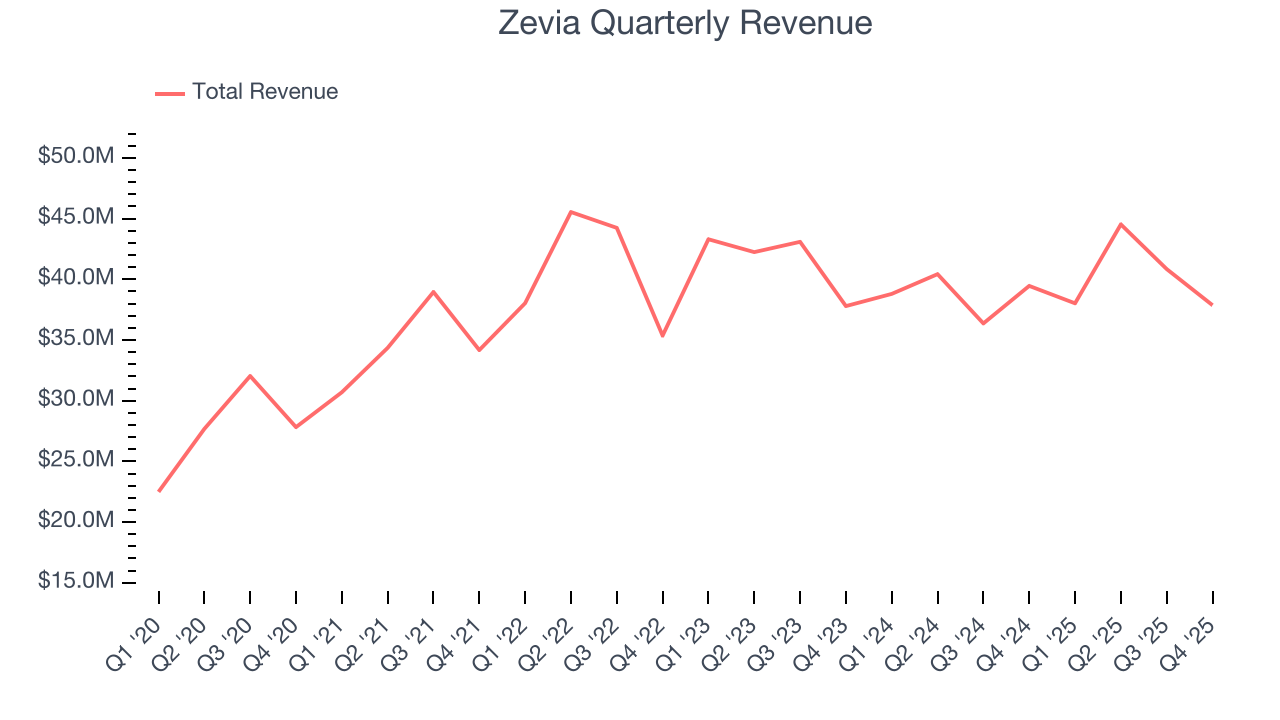
This quarter, Zevia missed Wall Street’s estimates and reported a rather uninspiring 4% year-on-year revenue decline, generating $37.87 million of revenue. Company management is currently guiding for a 7.8% year-on-year increase in sales next quarter.
Looking further ahead, sell-side analysts expect revenue to grow 8.2% over the next 12 months, an acceleration versus the last three years. This projection is commendable and suggests its newer products will fuel better top-line performance.
6. Gross Margin & Pricing Power
All else equal, we prefer higher gross margins because they make it easier to generate more operating profits and indicate that a company commands pricing power by offering more differentiated products.
Zevia has great unit economics for a consumer staples company, giving it ample room to invest in areas such as marketing and talent to grow its brand. As you can see below, it averaged an excellent 47.2% gross margin over the last two years. That means Zevia only paid its suppliers $52.78 for every $100 in revenue. 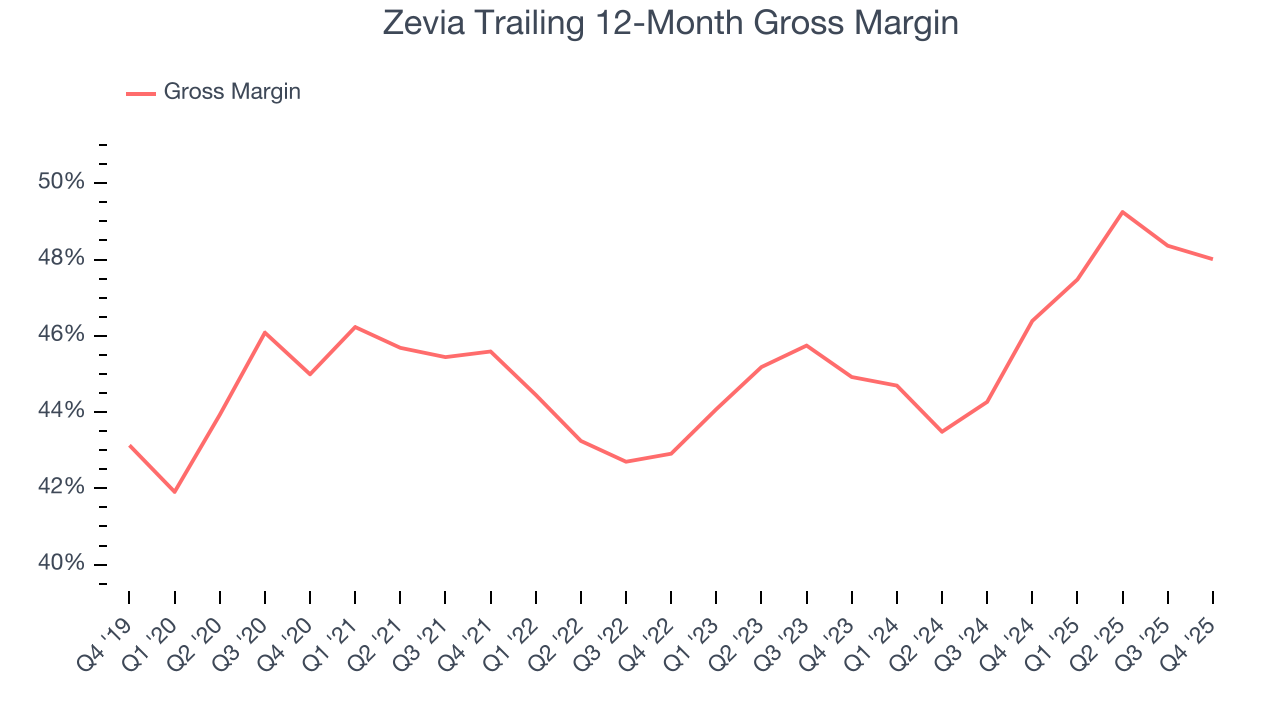
Zevia’s gross profit margin came in at 47.7% this quarter, down 1.5 percentage points year on year. Zooming out, however, Zevia’s full-year margin has been trending up over the past 12 months, increasing by 1.6 percentage points. If this move continues, it could suggest better unit economics due to some combination of stable to improving pricing power and input costs (such as raw materials).
7. Operating Margin
Operating margin is a key measure of profitability. Think of it as net income - the bottom line - excluding the impact of taxes and interest on debt, which are less connected to business fundamentals.
Unprofitable public companies are rare in the defensive consumer staples industry. Unfortunately, Zevia was one of them over the last two years as its high expenses contributed to an average operating margin of negative 11.2%.
On the plus side, Zevia’s operating margin rose by 7.9 percentage points over the last year. Still, it will take much more for the company to reach long-term profitability.
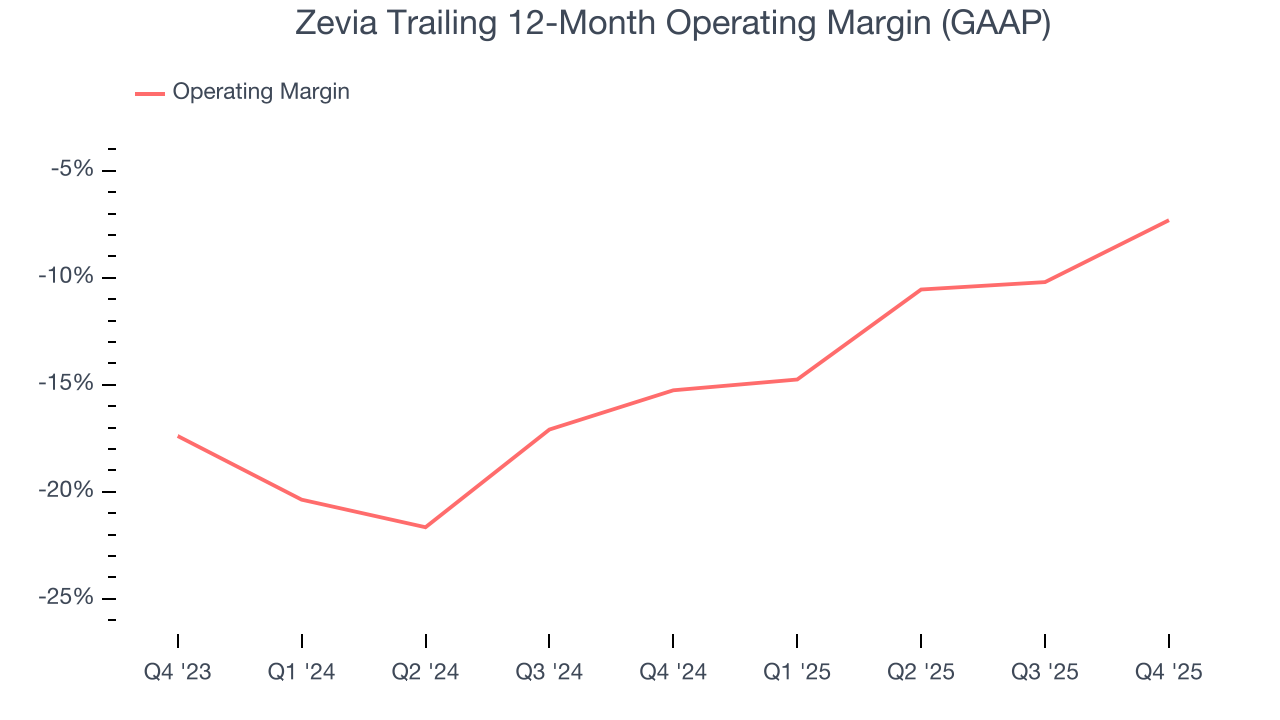
Zevia’s operating margin was negative 4% this quarter. The company's consistent lack of profits raise a flag.
8. Earnings Per Share
Revenue trends explain a company’s historical growth, but the long-term change in earnings per share (EPS) points to the profitability of that growth – for example, a company could inflate its sales through excessive spending on advertising and promotions.
Although Zevia’s full-year earnings are still negative, it reduced its losses and improved its EPS by 44.5% annually over the last three years. The next few quarters will be critical for assessing its long-term profitability.
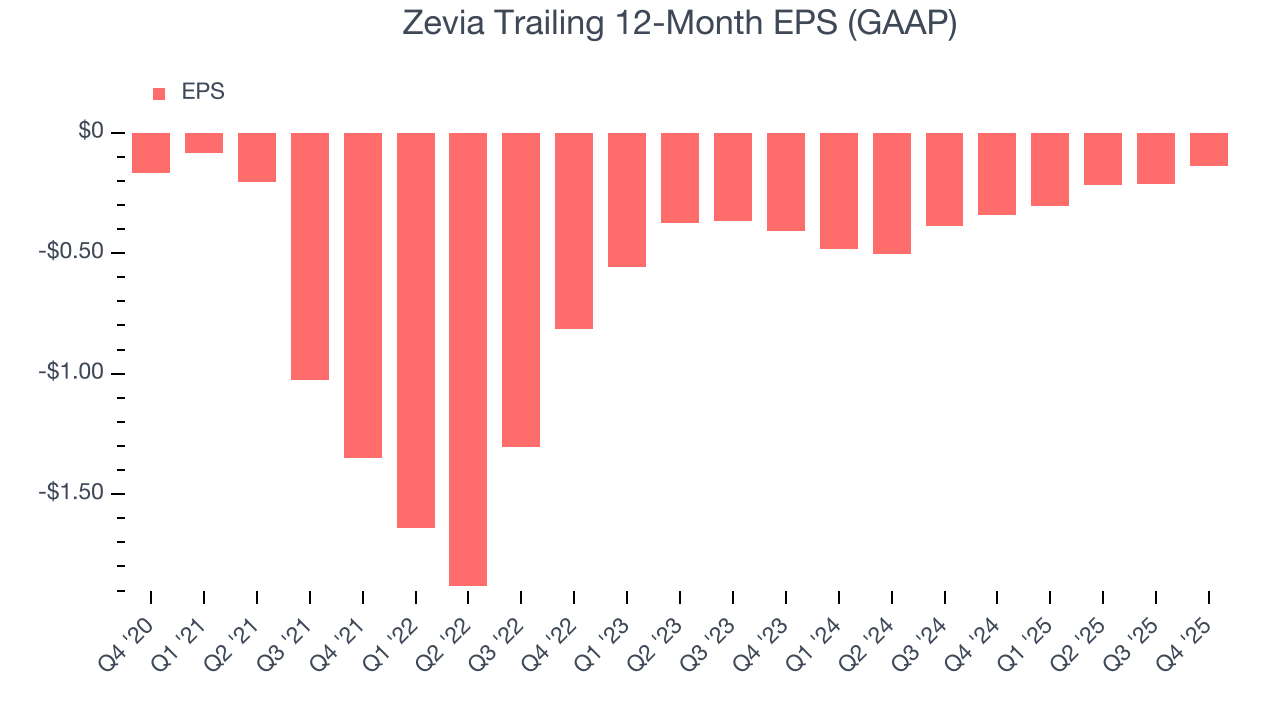
In Q4, Zevia reported EPS of negative $0.02, up from negative $0.10 in the same quarter last year. This print easily cleared analysts’ estimates, and shareholders should be content with the results. Over the next 12 months, Wall Street expects Zevia to improve its earnings losses. Analysts forecast its full-year EPS of negative $0.14 will advance to negative $0.07.
9. Cash Is King
Free cash flow isn't a prominently featured metric in company financials and earnings releases, but we think it's telling because it accounts for all operating and capital expenses, making it tough to manipulate. Cash is king.
Zevia’s demanding reinvestments have consumed many resources over the last two years, contributing to an average free cash flow margin of negative 2%. This means it lit $2.00 of cash on fire for every $100 in revenue.
Taking a step back, we can see that Zevia’s margin dropped by 2.3 percentage points over the last year. Almost any movement in the wrong direction is undesirable because it is already burning cash. If the trend continues, it could signal it’s becoming a more capital-intensive business.
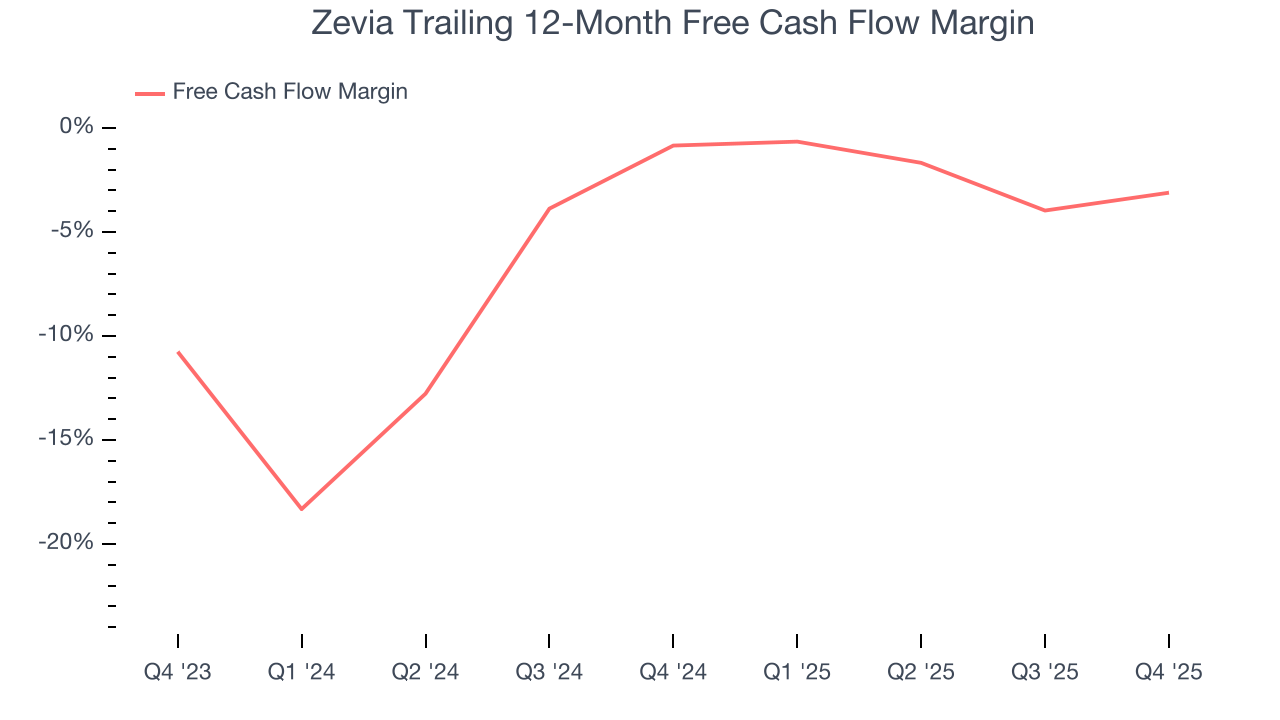
Zevia burned through $588,000 of cash in Q4, equivalent to a negative 1.6% margin. The company’s cash burn was similar to its $2.04 million of lost cash in the same quarter last year.
10. Balance Sheet Assessment
Businesses that maintain a cash surplus face reduced bankruptcy risk.
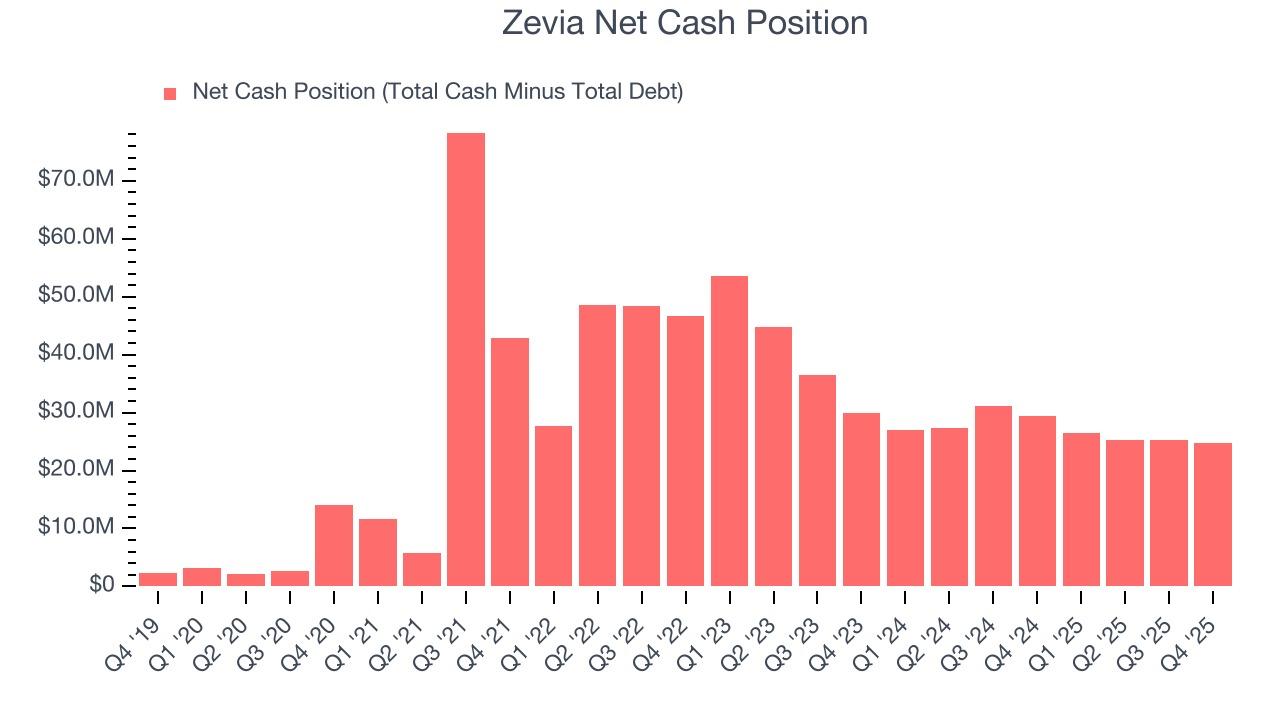
Zevia is a well-capitalized company with $25.35 million of cash and $668,000 of debt on its balance sheet. This $24.69 million net cash position is 24.4% of its market cap and gives it the freedom to borrow money, return capital to shareholders, or invest in growth initiatives. Leverage is not an issue here.
11. Key Takeaways from Zevia’s Q4 Results
We were impressed by how significantly Zevia blew past analysts’ EBITDA expectations this quarter. We were also glad its EPS was in line with Wall Street’s estimates. On the other hand, its full-year EBITDA guidance missed and its revenue fell short of Wall Street’s estimates. Overall, this quarter could have been better. The stock traded down 6.5% to $1.45 immediately following the results.
12. Is Now The Time To Buy Zevia?
Updated: March 19, 2026 at 11:04 PM EDT
A common mistake we notice when investors are deciding whether to buy a stock or not is that they simply look at the latest earnings results. Business quality and valuation matter more, so we urge you to understand these dynamics as well.
Zevia isn’t a bad business, but we have other favorites. Although its revenue has declined over the last three years, its growth over the next 12 months is expected to be higher. And while Zevia’s brand caters to a niche market, its EPS growth over the last three years has been fantastic.
Zevia’s forward price-to-sales ratio is 0.5x. The market typically values companies like Zevia based on their anticipated profits for the next 12 months, but it expects the business to lose money. We also think the upside isn’t great compared to the potential downside here - there are more exciting stocks to buy.
Wall Street analysts have a consensus one-year price target of $4.25 on the company (compared to the current share price of $1.24).