
Apogee (APOG)
Apogee faces an uphill battle. Its poor sales growth and falling returns on capital suggest its growth opportunities are shrinking.― StockStory Analyst Team


1. News




2. Summary
Why We Think Apogee Will Underperform
Involved in the design of the Apple Store on Fifth Avenue in New York City, Apogee (NASDAQ:APOG) sells architectural products and services such as high-performance glass for commercial buildings.
- Products and services are facing end-market challenges during this cycle, as seen in its flat sales over the last two years
- Earnings per share have dipped by 12.4% annually over the past two years, which is concerning because stock prices follow EPS over the long term
- Estimated sales decline of 1.8% for the next 12 months implies an even more challenging demand environment
Apogee doesn’t check our boxes. We see more attractive opportunities in the market.
Why There Are Better Opportunities Than Apogee





Apogee is trading at $39.93 per share, or 13.1x forward P/E. This multiple is cheaper than most industrials peers, but we think this is justified.
We’d rather pay up for companies with elite fundamentals than get a bargain on weak ones. Cheap stocks can be value traps, and as their performance deteriorates, they will stay cheap or get even cheaper.
3. Apogee (APOG) Research Report: Q4 CY2025 Update
Architectural products company Apogee (NASDAQ:APOG) missed Wall Street’s revenue expectations in Q4 CY2025 as sales rose 2.1% year on year to $348.6 million. The company’s full-year revenue guidance of $1.39 billion at the midpoint came in 1.4% below analysts’ estimates. Its non-GAAP profit of $1.02 per share was 1% above analysts’ consensus estimates.
Apogee (APOG) Q4 CY2025 Highlights:
- Revenue: $348.6 million vs analyst estimates of $355.3 million (2.1% year-on-year growth, 1.9% miss)
- Adjusted EPS: $1.02 vs analyst estimates of $1.01 (1% beat)
- Adjusted EBITDA: $46.13 million vs analyst estimates of $44.76 million (13.2% margin, 3.1% beat)
- Adjusted EPS guidance for the full year is $3.45 at the midpoint, missing analyst estimates by 6%
- Operating Margin: 7.1%, down from 10.3% in the same quarter last year
- Free Cash Flow Margin: 6.6%, similar to the same quarter last year
- Market Capitalization: $802.1 million
Company Overview
Involved in the design of the Apple Store on Fifth Avenue in New York City, Apogee (NASDAQ:APOG) sells architectural products and services such as high-performance glass for commercial buildings.
The company designs and manufactures the materials used in architectural designs that range from the mundane to the world-famous. Its building projects are usually found in commercial or industrial buildings rather than residential ones, and its key customers include builders and contractors.
Apogee’s offerings can be classified into several categories. Architectural products include architectural glass, aluminum windows, curtain walls, storefronts, and entrance systems. Architectural services include designs and installation of the aforementioned products. Lastly, the company offers custom framing and technical display applications like the glass used in Apple Stores or the frames used in renowned museums worldwide.
The company generates revenue through selling physical products; services are a much smaller portion of total revenue. As mentioned, Apogee sells its products and services to builders, contractors, architects, and developers involved in the construction of offices, stores, and institutional buildings.
4. Commercial Building Products
Commercial building products companies, which often serve more complicated projects, can supplement their core business with higher-margin installation and consulting services revenues. More recently, advances to address labor availability and job site productivity have spurred innovation. Additionally, companies in the space that can produce more energy-efficient materials have opportunities to take share. However, these companies are at the whim of commercial construction volumes, which tend to be cyclical and can be impacted heavily by economic factors such as interest rates. Additionally, the costs of raw materials can be driven by a myriad of worldwide factors and greatly influence the profitability of commercial building products companies.
Other companies in the architectural glass and building products industry include Tecnoglass (NYSE:TGLS) and private companies Oldcastle BuildingEvelope, Vitro Architectural Glass, and Guardian Glass.
5. Revenue Growth
Examining a company’s long-term performance can provide clues about its quality. Any business can have short-term success, but a top-tier one grows for years. Regrettably, Apogee’s sales grew at a sluggish 2.1% compounded annual growth rate over the last five years. This was below our standards and is a tough starting point for our analysis.
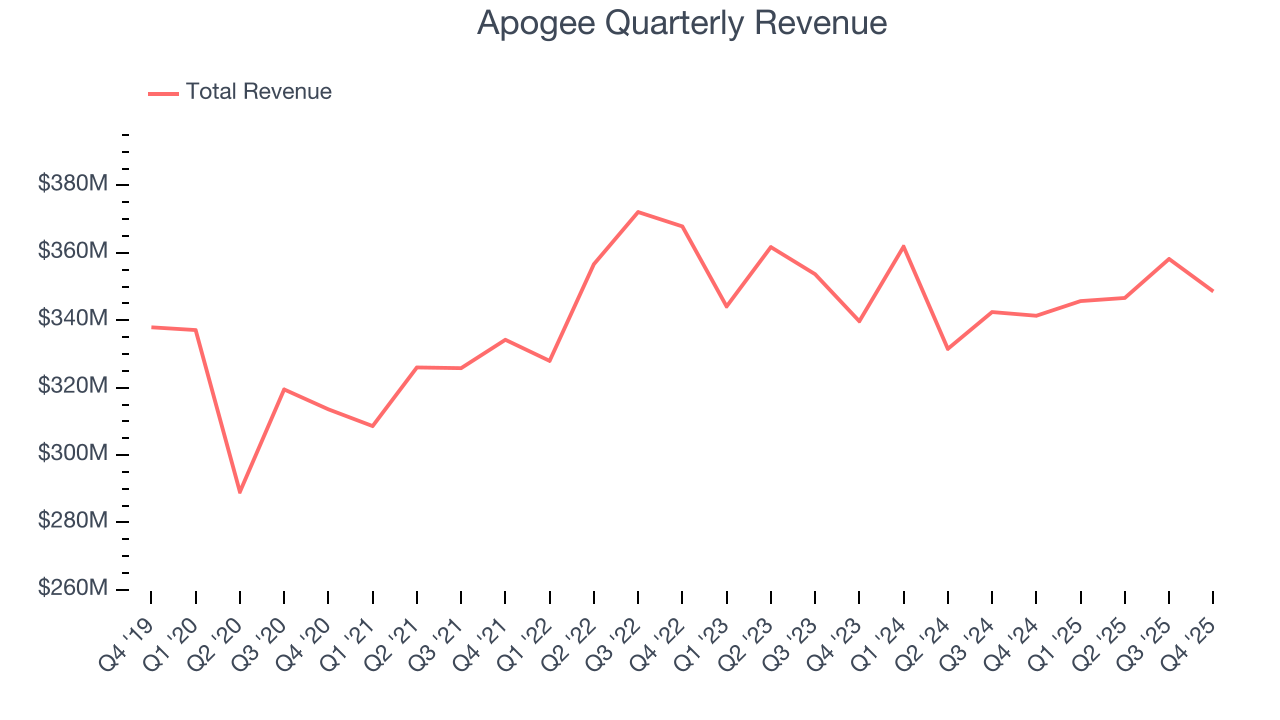
Long-term growth is the most important, but within industrials, a half-decade historical view may miss new industry trends or demand cycles. Apogee’s recent performance shows its demand has slowed as its revenue was flat over the last two years. 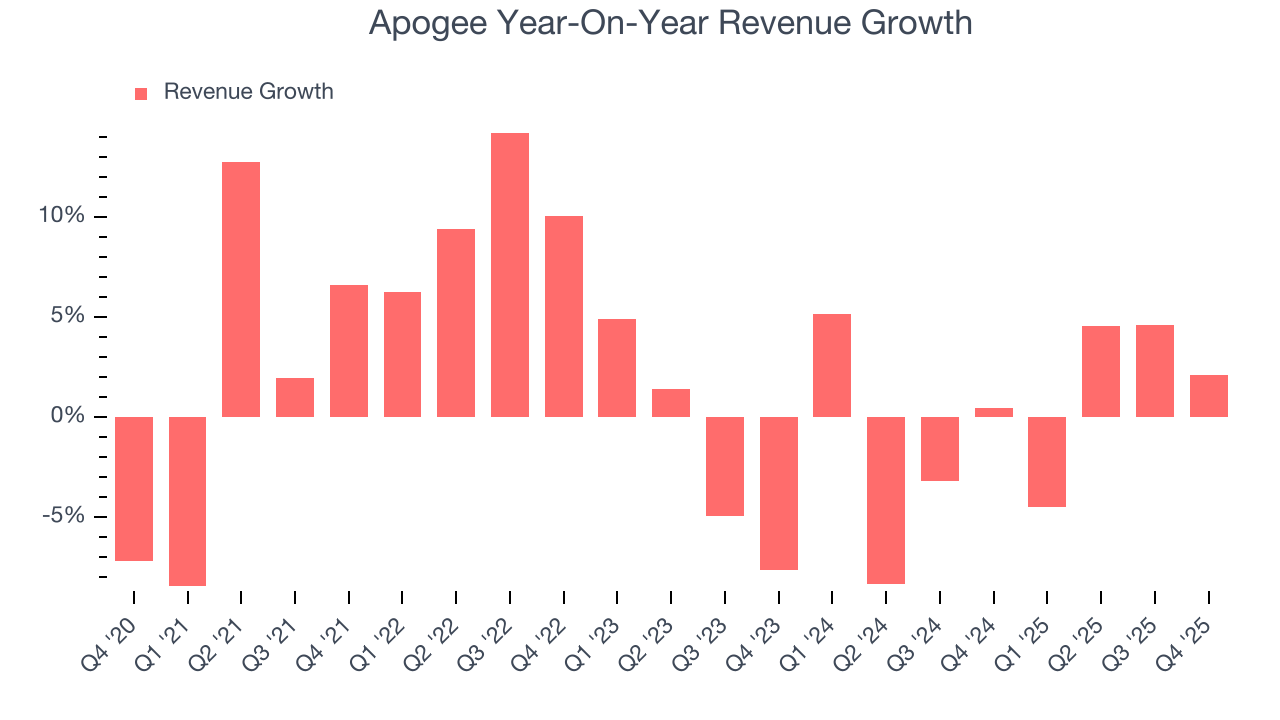
This quarter, Apogee’s revenue grew by 2.1% year on year to $348.6 million, falling short of Wall Street’s estimates.
Looking ahead, sell-side analysts expect revenue to remain flat over the next 12 months. This projection is underwhelming and indicates its newer products and services will not accelerate its top-line performance yet.
6. Gross Margin & Pricing Power
Cost of sales for an industrials business is usually comprised of the direct labor, raw materials, and supplies needed to offer a product or service. These costs can be impacted by inflation and supply chain dynamics.
Apogee has bad unit economics for an industrials company, giving it less room to reinvest and develop new offerings. As you can see below, it averaged a 24.7% gross margin over the last five years. That means Apogee paid its suppliers a lot of money ($75.34 for every $100 in revenue) to run its business. 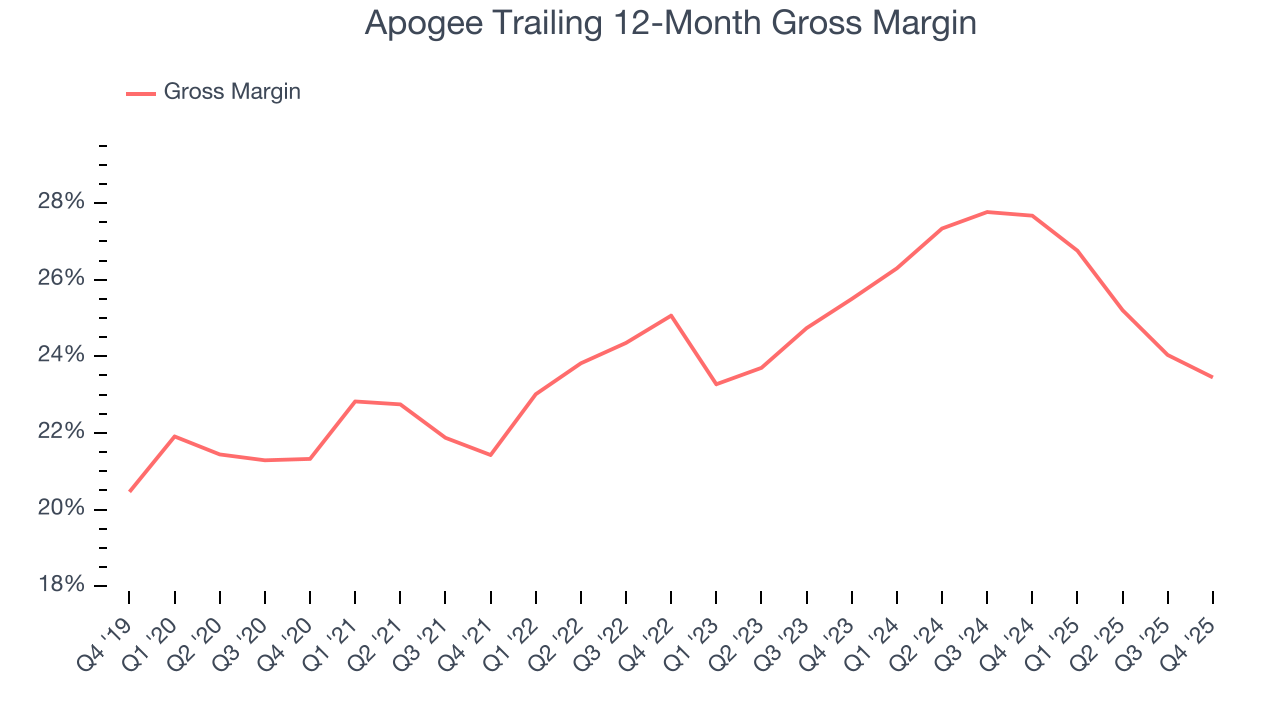
Apogee produced a 23.8% gross profit margin in Q4, down 2.4 percentage points year on year. Apogee’s full-year margin has also been trending down over the past 12 months, decreasing by 4.2 percentage points. If this move continues, it could suggest a more competitive environment with some pressure to lower prices and higher input costs (such as raw materials and manufacturing expenses).
7. Operating Margin
Operating margin is a key measure of profitability. Think of it as net income - the bottom line - excluding the impact of taxes and interest on debt, which are less connected to business fundamentals.
Apogee has done a decent job managing its cost base over the last five years. The company has produced an average operating margin of 8.5%, higher than the broader industrials sector.
Looking at the trend in its profitability, Apogee’s operating margin rose by 2.8 percentage points over the last five years, as its sales growth gave it operating leverage.
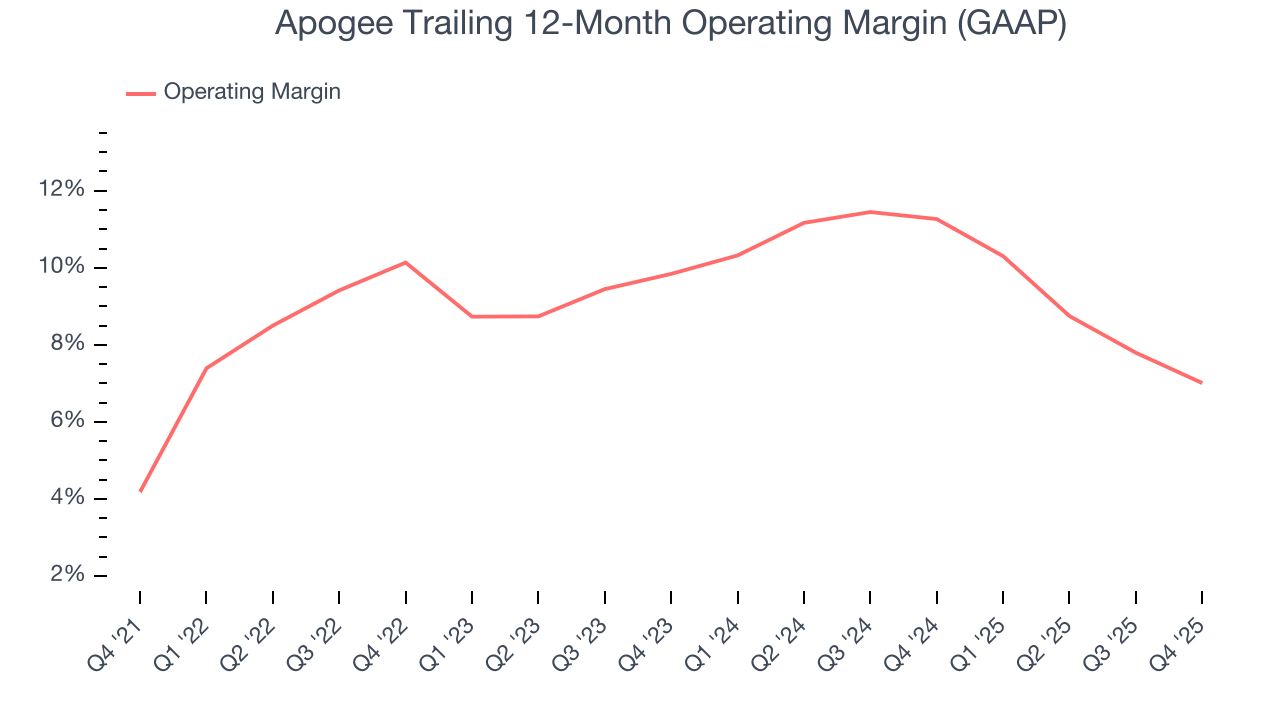
This quarter, Apogee generated an operating margin profit margin of 7.1%, down 3.2 percentage points year on year. Since Apogee’s operating margin decreased more than its gross margin, we can assume it was less efficient because expenses such as marketing, R&D, and administrative overhead increased.
8. Earnings Per Share
Revenue trends explain a company’s historical growth, but the long-term change in earnings per share (EPS) points to the profitability of that growth – for example, a company could inflate its sales through excessive spending on advertising and promotions.
Apogee’s EPS grew at a decent 8.5% compounded annual growth rate over the last five years, higher than its 2.1% annualized revenue growth. This tells us the company became more profitable on a per-share basis as it expanded.
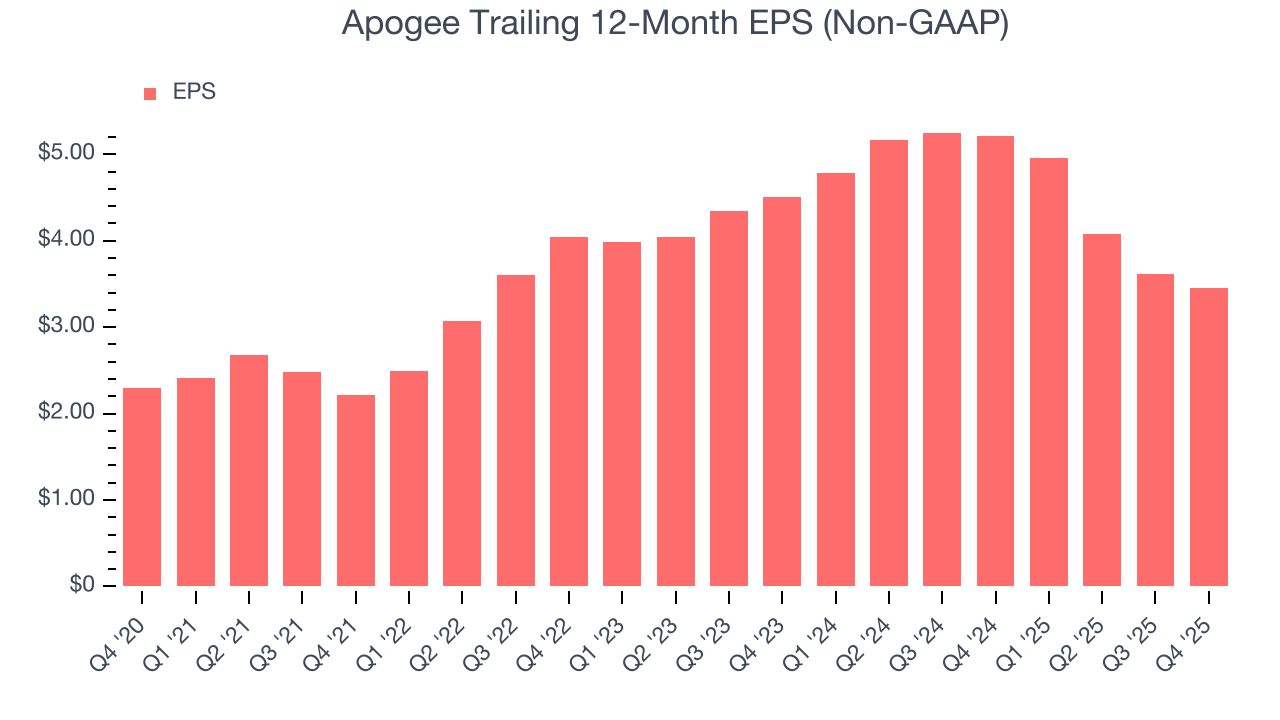
We can take a deeper look into Apogee’s earnings to better understand the drivers of its performance. As we mentioned earlier, Apogee’s operating margin declined this quarter but expanded by 2.8 percentage points over the last five years. Its share count also shrank by 17.7%, and these factors together are positive signs for shareholders because improving profitability and share buybacks turbocharge EPS growth relative to revenue growth. 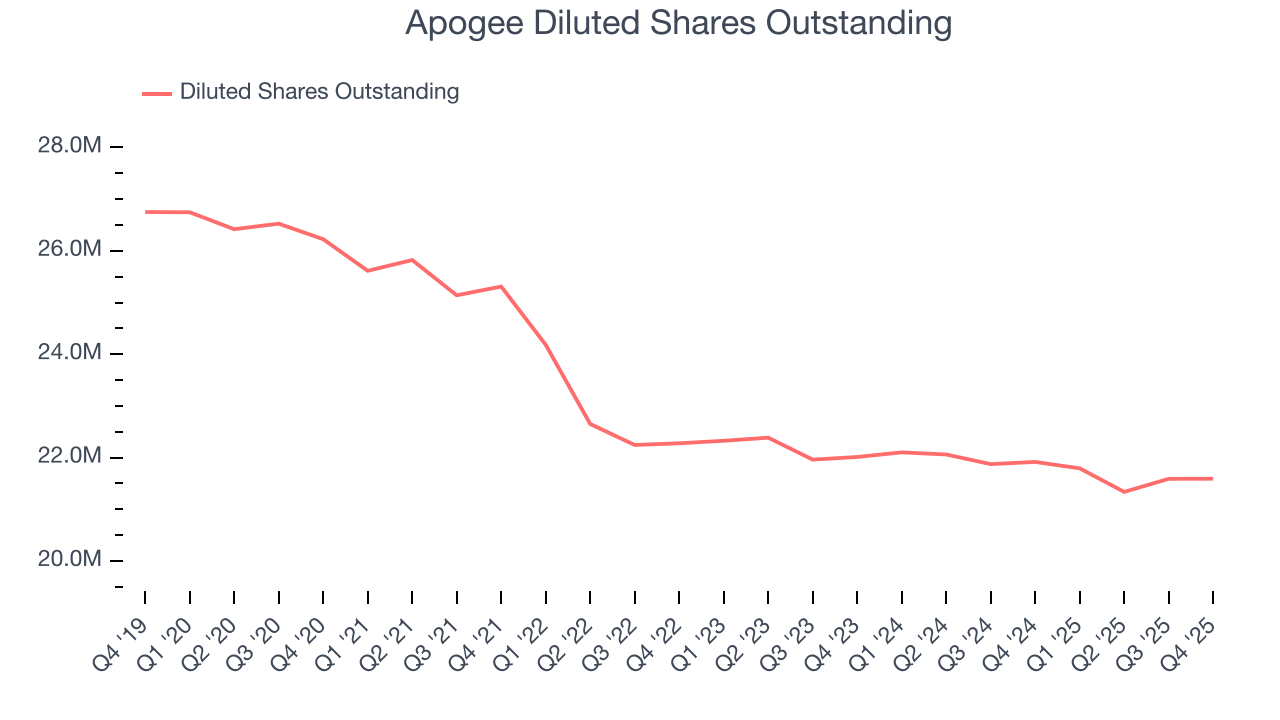
Like with revenue, we analyze EPS over a shorter period to see if we are missing a change in the business.
For Apogee, its two-year annual EPS declines of 12.4% mark a reversal from its five-year trend. We hope Apogee can return to earnings growth in the future.
In Q4, Apogee reported adjusted EPS of $1.02, down from $1.19 in the same quarter last year. This print was close to analysts’ estimates. Over the next 12 months, Wall Street expects Apogee’s full-year EPS of $3.45 to grow 17.4%.
9. Cash Is King
If you’ve followed StockStory for a while, you know we emphasize free cash flow. Why, you ask? We believe that in the end, cash is king, and you can’t use accounting profits to pay the bills.
Apogee has shown decent cash profitability, giving it some flexibility to reinvest or return capital to investors. The company’s free cash flow margin averaged 6.5% over the last five years, slightly better than the broader industrials sector.
Taking a step back, we can see that Apogee’s margin dropped by 1.8 percentage points during that time. If its declines continue, it could signal increasing investment needs and capital intensity.
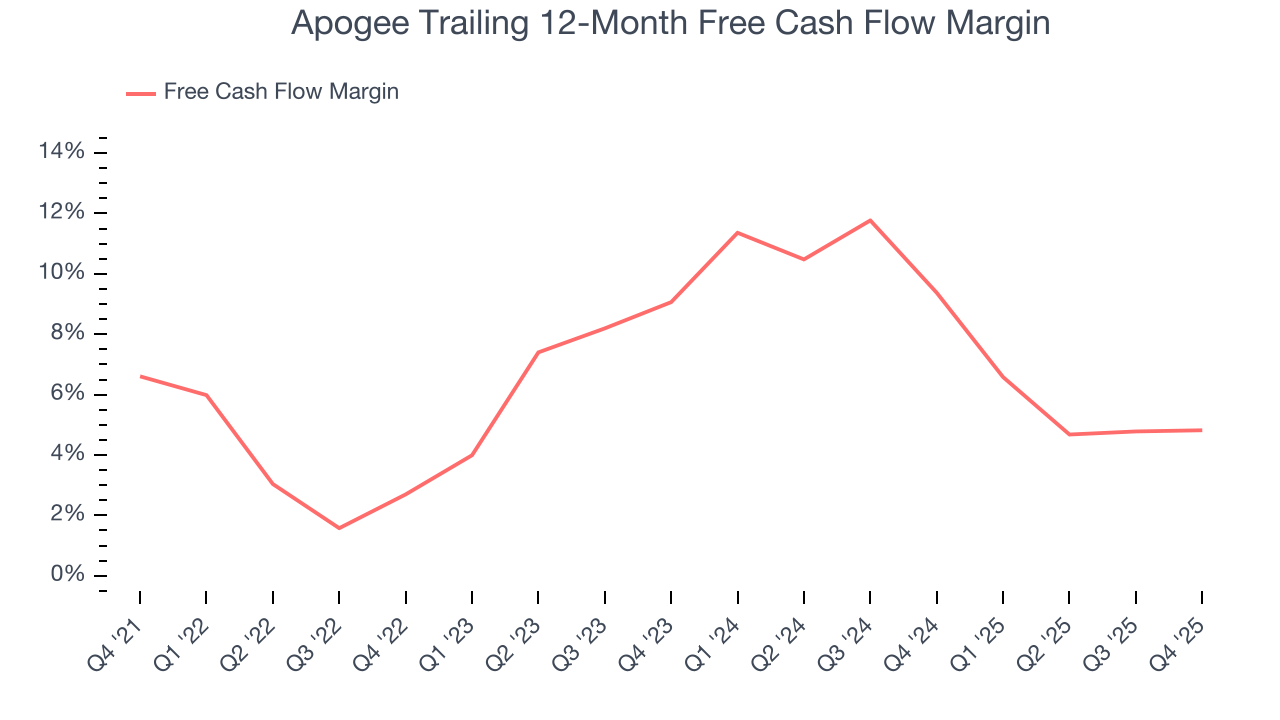
Apogee’s free cash flow clocked in at $22.85 million in Q4, equivalent to a 6.6% margin. This cash profitability was in line with the comparable period last year and its five-year average.
10. Return on Invested Capital (ROIC)
EPS and free cash flow tell us whether a company was profitable while growing its revenue. But was it capital-efficient? Enter ROIC, a metric showing how much operating profit a company generates relative to the money it has raised (debt and equity).
Although Apogee hasn’t been the highest-quality company lately because of its poor top-line performance, it historically found a few growth initiatives that worked out well. Its five-year average ROIC was 16.2%, impressive for an industrials business.
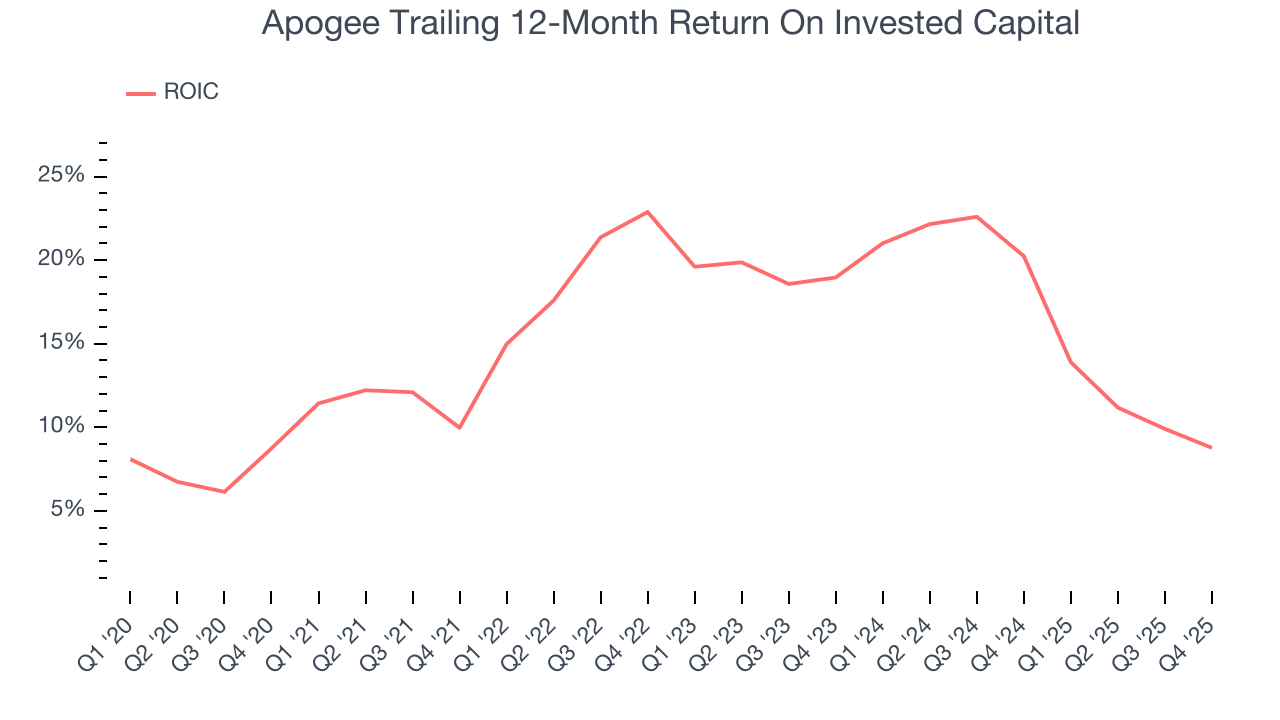
We like to invest in businesses with high returns, but the trend in a company’s ROIC is what often surprises the market and moves the stock price. Over the last few years, Apogee’s ROIC averaged 1.9 percentage point decreases each year. We like what management has done in the past, but its declining returns are perhaps a symptom of fewer profitable growth opportunities.
11. Balance Sheet Assessment
Apogee reported $41.32 million of cash and $311.5 million of debt on its balance sheet in the most recent quarter. As investors in high-quality companies, we primarily focus on two things: 1) that a company’s debt level isn’t too high and 2) that its interest payments are not excessively burdening the business.
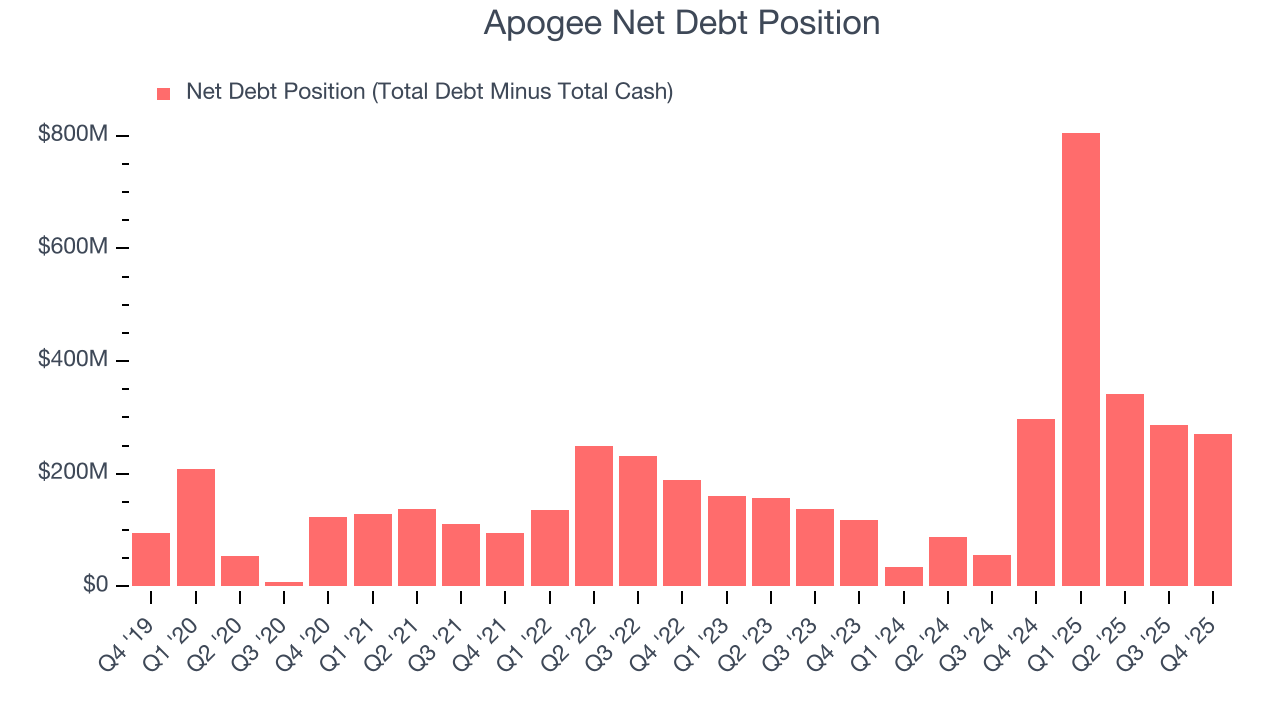
With $170.3 million of EBITDA over the last 12 months, we view Apogee’s 1.6× net-debt-to-EBITDA ratio as safe. We also see its $8.22 million of annual interest expenses as appropriate. The company’s profits give it plenty of breathing room, allowing it to continue investing in growth initiatives.
12. Key Takeaways from Apogee’s Q4 Results
It was encouraging to see Apogee beat analysts’ EBITDA expectations this quarter. On the other hand, its full-year EPS guidance missed and its revenue fell short of Wall Street’s estimates. Overall, this was a weaker quarter. The stock traded down 11.4% to $33.05 immediately after reporting.
13. Is Now The Time To Buy Apogee?
Updated: February 26, 2026 at 10:51 PM EST
The latest quarterly earnings matters, sure, but we actually think longer-term fundamentals and valuation matter more. Investors should consider all these pieces before deciding whether or not to invest in Apogee.
We see the value of companies helping their customers, but in the case of Apogee, we’re out. First off, its revenue growth was weak over the last five years, and analysts expect its demand to deteriorate over the next 12 months. While its market-beating ROIC suggests it has been a well-managed company historically, the downside is its projected EPS for the next year is lacking. On top of that, its gross margins are lower than its industrials peers.
Apogee’s P/E ratio based on the next 12 months is 13x. This valuation is reasonable, but the company’s shaky fundamentals present too much downside risk. There are better investments elsewhere.
Wall Street analysts have a consensus one-year price target of $43.33 on the company (compared to the current share price of $39.73).