
Blink Charging (BLNK)
Blink Charging is intriguing, but its cash burn shows it only has 6 months of runway left.― StockStory Analyst Team


1. News






2. Summary
Why Blink Charging Is Not Exciting
One of the first EV charging companies to go public, Blink Charging (NASDAQ:BLNK) is a manufacturer, owner, operator, and provider of electric vehicle charging equipment and networked EV charging services.
- Suboptimal cost structure is highlighted by its history of operating margin losses
- Cash-burning tendencies make us wonder if it can sustainably generate shareholder value
- Depletion of cash reserves could lead to a fundraising event that triggers shareholder dilution
Blink Charging has some respectable qualities, but we’d hold off on buying the stock until its EBITDA can comfortably service its debt.
Why There Are Better Opportunities Than Blink Charging






Blink Charging is trading at $0.64 per share, or 0.6x forward price-to-sales. The market typically values companies like Blink Charging based on their anticipated profits for the next 12 months, but it expects the business to lose money. We also think the upside isn’t great compared to the potential downside here - there are more exciting stocks to buy.
It’s better to pay up for high-quality businesses with strong long-term earnings potential rather than buy lower-quality stocks because they appear cheap. These challenged businesses often don’t re-rate, a phenomenon known as a “value trap”.
3. Blink Charging (BLNK) Research Report: Q3 CY2025 Update
EV charging infrastructure provider Blink Charging (NASDAQ:BLNK) fell short of the markets revenue expectations in Q3 CY2025, but sales rose 7.3% year on year to $27.03 million. Its non-GAAP loss of $0.10 per share was in line with analysts’ consensus estimates.
Blink Charging (BLNK) Q3 CY2025 Highlights:
- Revenue: $27.03 million vs analyst estimates of $29.88 million (7.3% year-on-year growth, 9.6% miss)
- Adjusted EPS: -$0.10 vs analyst estimates of -$0.11 (in line)
- Adjusted EBITDA: -$8.87 million vs analyst estimates of -$9.15 million (-32.8% margin, 3% beat)
- Operating Margin: -0.8%, up from -350% in the same quarter last year
- Free Cash Flow was -$3.70 million compared to -$10.09 million in the same quarter last year
- Market Capitalization: $171.7 million
Company Overview
One of the first EV charging companies to go public, Blink Charging (NASDAQ:BLNK) is a manufacturer, owner, operator, and provider of electric vehicle charging equipment and networked EV charging services.
The company operates in the U.S. and international markets for electric vehicles, offering solutions for residential and commercial EV charging needs. Blink's main products are its Blink EV charging networks and Blink EV charging equipment.
The Blink Networks are cloud-based systems that manage Blink charging stations, handling charging data, operations, and payment processing. This allows property owners and commercial customers to monitor and manage EV charging stations remotely. Aside from privately-owned stations (such as in a house), Blink charging stations are scattered throughout urban and suburban landscapes and can be accessed by anyone.
The company utilizes several business models, including Blink-owned turnkey, Blink-owned hybrid, host-owned, and Blink-as-a-Service models. The Blink-owned turnkey model gives stations to customers and sees Blink covering all costs and retaining most revenues, while the Blink-owned hybrid model shares costs and revenues with property partners. In the host-owned model, partners purchase and operate stations while Blink provides support services. The Blink-as-a-Service model offers a fixed-fee structure with partners covering installation costs.
Blink has historically expanded its operations via capital expenditures and acquisitions, including the purchase of SemaConnect in June 2022, Electric Blue Limited in April 2022, and Blue Corner in May 2021.
4. Renewable Energy
Renewable energy companies are buoyed by the secular trend of green energy that is upending traditional power generation. Those who innovate and evolve with this dynamic market can win share while those who continue to rely on legacy technologies can see diminishing demand, which includes headwinds from increasing regulation against “dirty” energy. Additionally, these companies are at the whim of economic cycles, as interest rates can impact the willingness to invest in renewable energy projects.
Competitors in the electric vehicle charging industry include ChargePoint (NYSE:CHPT), EVgo (NASDAQ:EVGO), and Wallbox (NYSE:WBX).
5. Revenue Growth
A company’s long-term sales performance is one signal of its overall quality. Any business can put up a good quarter or two, but the best consistently grow over the long haul. Thankfully, Blink Charging’s 88.5% annualized revenue growth over the last five years was incredible. Its growth beat the average industrials company and shows its offerings resonate with customers.
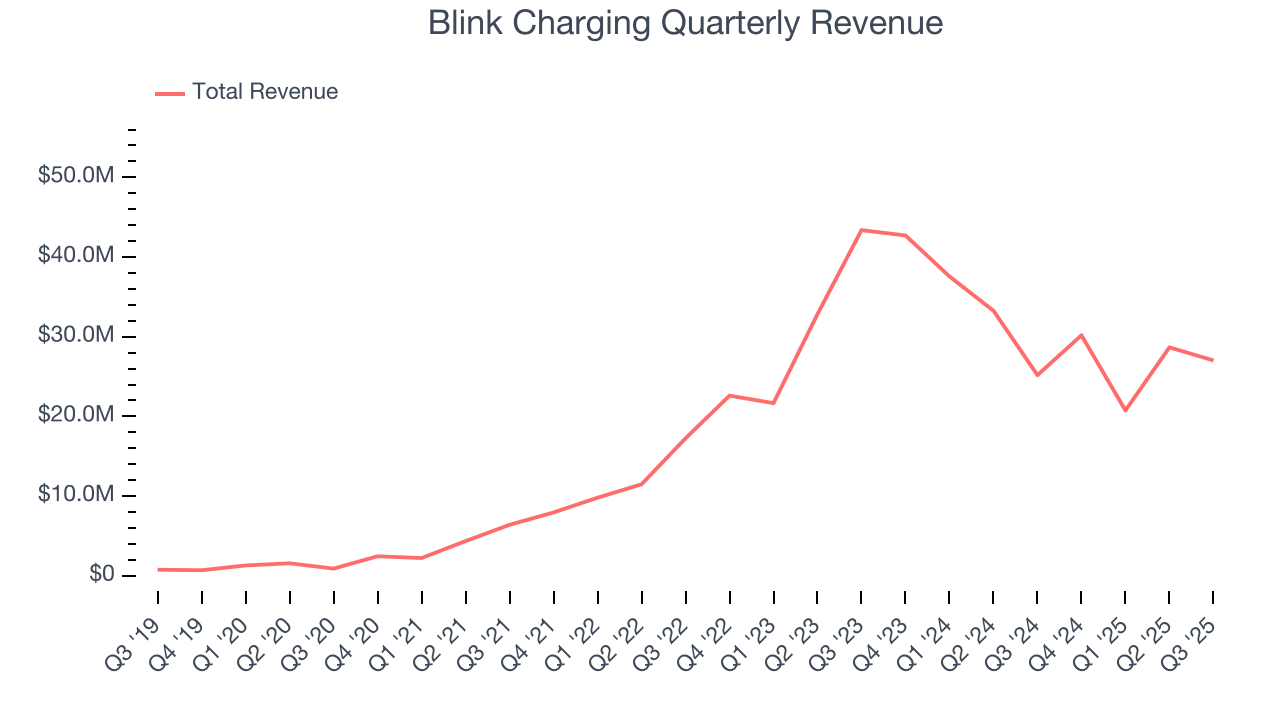
We at StockStory place the most emphasis on long-term growth, but within industrials, a half-decade historical view may miss cycles, industry trends, or a company capitalizing on catalysts such as a new contract win or a successful product line. Blink Charging’s recent performance marks a sharp pivot from its five-year trend as its revenue has shown annualized declines of 5.9% over the last two years. 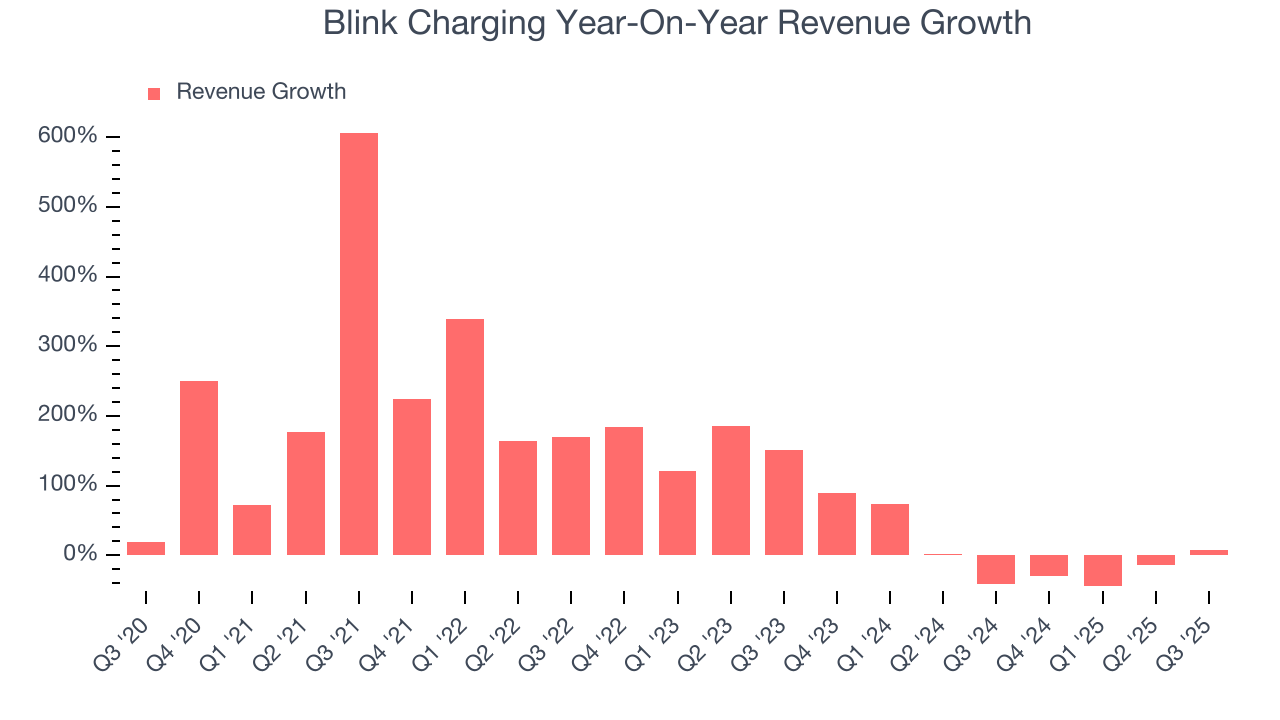
This quarter, Blink Charging’s revenue grew by 7.3% year on year to $27.03 million, missing Wall Street’s estimates.
Looking ahead, sell-side analysts expect revenue to grow 17.6% over the next 12 months, an improvement versus the last two years. This projection is eye-popping and indicates its newer products and services will fuel better top-line performance.
6. Gross Margin & Pricing Power
All else equal, we prefer higher gross margins because they usually indicate that a company sells more differentiated products and commands stronger pricing power.
Blink Charging’s unit economics are better than the typical industrials business, signaling its products are somewhat differentiated through quality or brand. As you can see below, it averaged a decent 31.8% gross margin over the last five years. Said differently, Blink Charging paid its suppliers $68.24 for every $100 in revenue. 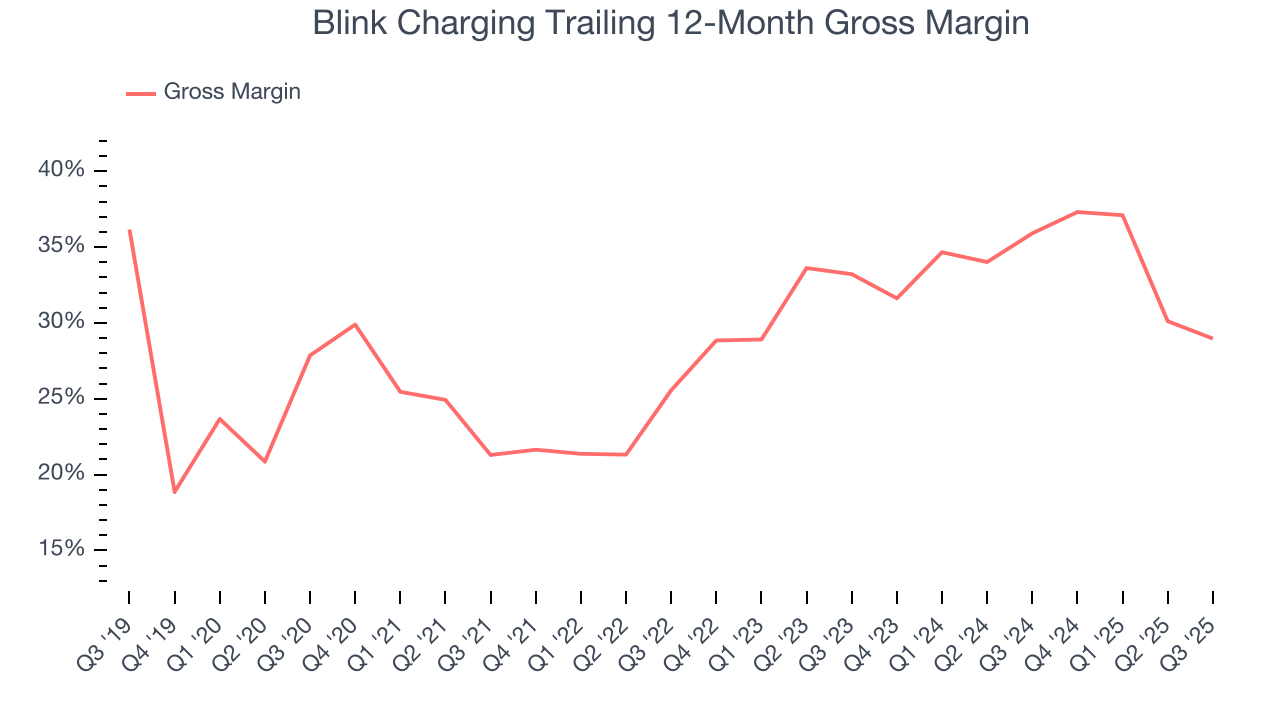
This quarter, Blink Charging’s gross profit margin was 35.8%, marking a 5.3 percentage point decrease from 41% in the same quarter last year. Blink Charging’s full-year margin has also been trending down over the past 12 months, decreasing by 6.9 percentage points. If this move continues, it could suggest deteriorating pricing power and higher input costs (such as raw materials and manufacturing expenses).
7. Operating Margin
Although Blink Charging broke even this quarter from an operational perspective, it’s generally struggled over a longer time period. Its expensive cost structure has contributed to an average operating margin of negative 142% over the last five years. Unprofitable industrials companies require extra attention because they could get caught swimming naked when the tide goes out. It’s hard to trust that the business can endure a full cycle.
On the plus side, Blink Charging’s operating margin rose over the last five years, as its sales growth gave it operating leverage. Still, it will take much more for the company to reach long-term profitability.
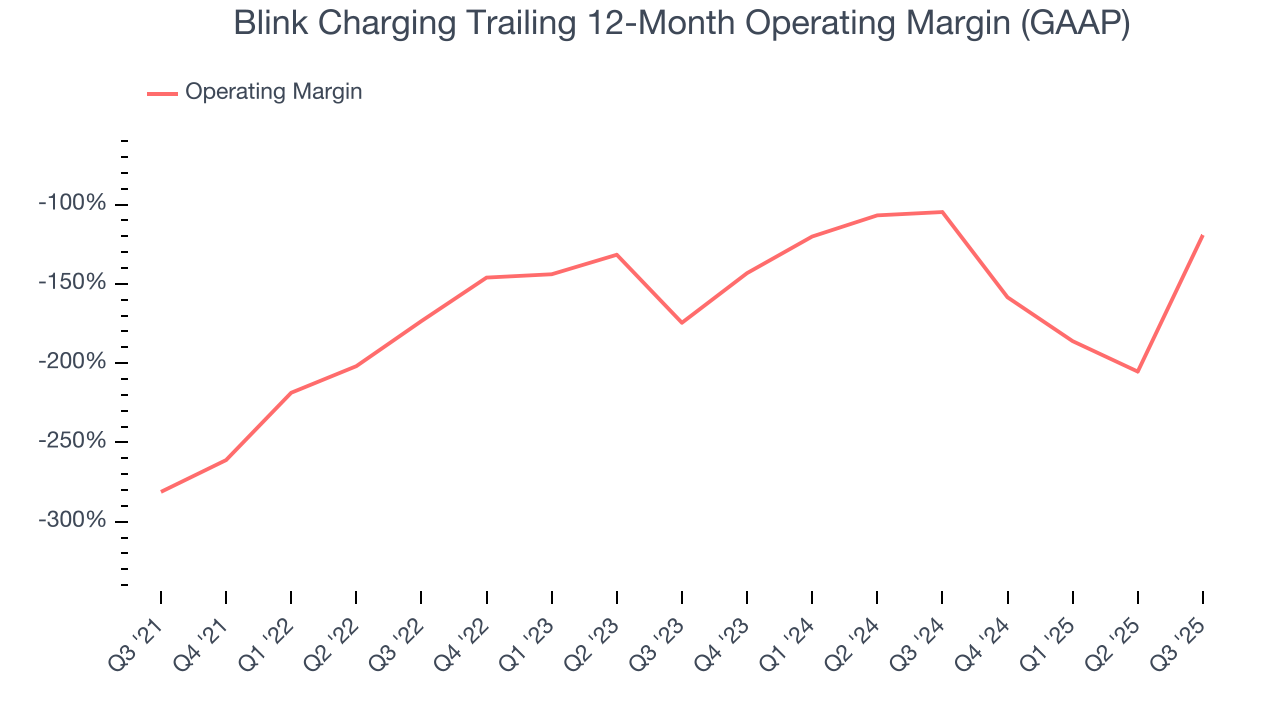
In Q3, Blink Charging generated a negative 0.8% operating margin.
8. Earnings Per Share
Revenue trends explain a company’s historical growth, but the long-term change in earnings per share (EPS) points to the profitability of that growth – for example, a company could inflate its sales through excessive spending on advertising and promotions.
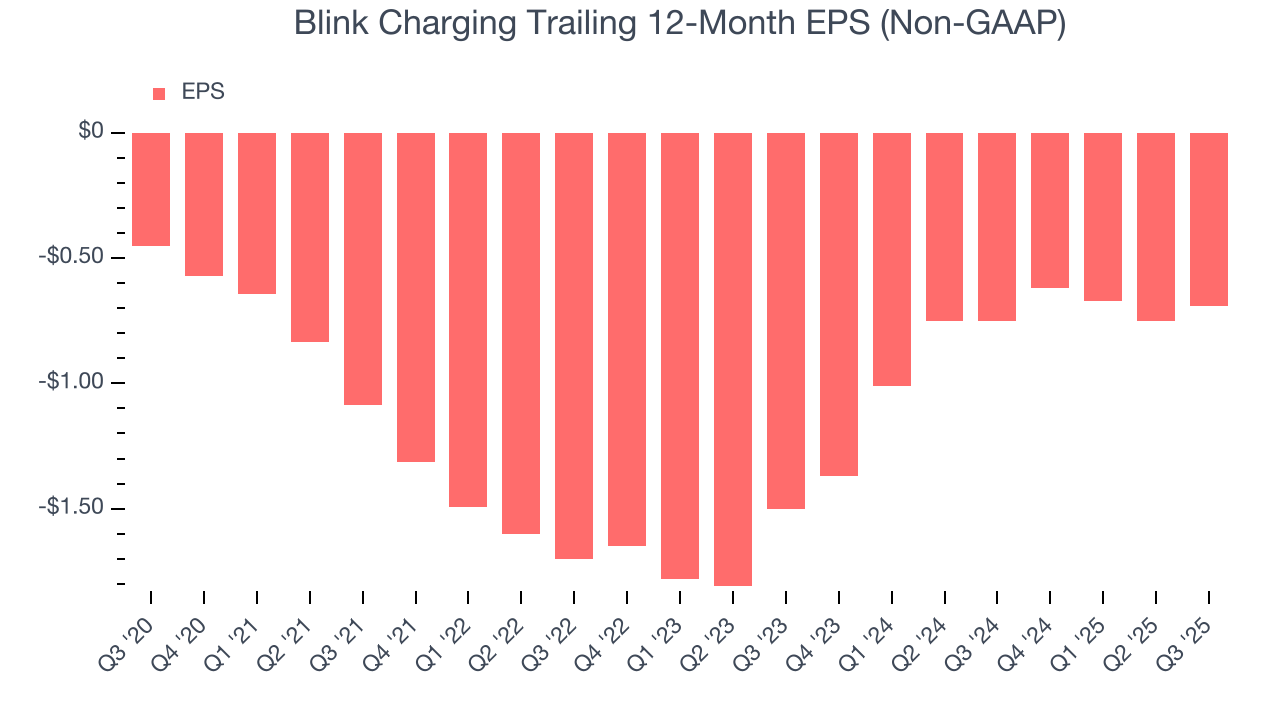
Blink Charging’s earnings losses deepened over the last five years as its EPS dropped 8.9% annually. We’ll keep a close eye on the company as diminishing earnings could imply changing secular trends and preferences.
Like with revenue, we analyze EPS over a shorter period to see if we are missing a change in the business.
For Blink Charging, its two-year annual EPS growth of 32.2% was higher than its five-year trend. Its improving earnings is an encouraging data point, but a caveat is that its EPS is still in the red.
In Q3, Blink Charging reported adjusted EPS of negative $0.10, up from negative $0.16 in the same quarter last year. This print beat analysts’ estimates by 9.1%. Over the next 12 months, Wall Street expects Blink Charging to improve its earnings losses. Analysts forecast its full-year EPS of negative $0.69 will advance to negative $0.47.
9. Cash Is King
If you’ve followed StockStory for a while, you know we emphasize free cash flow. Why, you ask? We believe that in the end, cash is king, and you can’t use accounting profits to pay the bills.
Blink Charging’s demanding reinvestments have drained its resources over the last five years, putting it in a pinch and limiting its ability to return capital to investors. Its free cash flow margin averaged negative 79.9%, meaning it lit $79.88 of cash on fire for every $100 in revenue.
Taking a step back, an encouraging sign is that Blink Charging’s margin expanded during that time. In light of its glaring cash burn, however, this improvement is a bucket of hot water in a cold ocean.
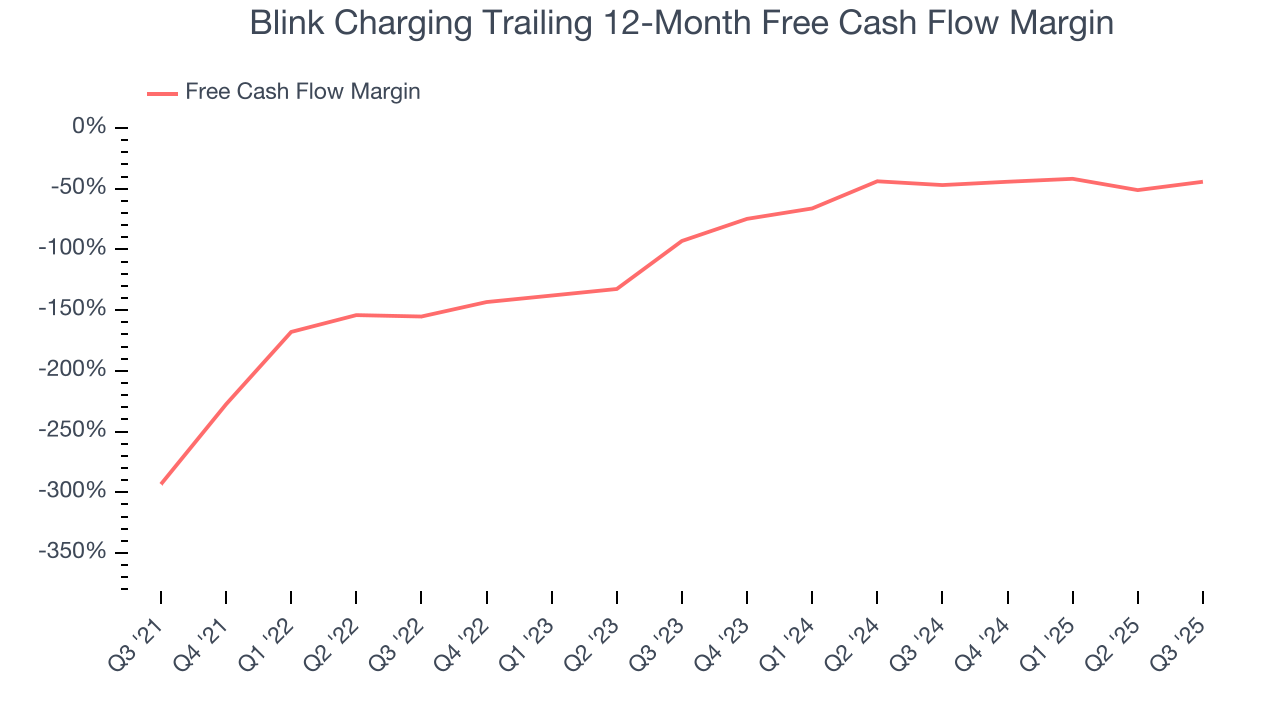
Blink Charging burned through $3.70 million of cash in Q3, equivalent to a negative 13.7% margin. The company’s cash burn was similar to its $10.09 million of lost cash in the same quarter last year.
10. Balance Sheet Risk
As long-term investors, the risk we care about most is the permanent loss of capital, which can happen when a company goes bankrupt or raises money from a disadvantaged position. This is separate from short-term stock price volatility, something we are much less bothered by.
Blink Charging burned through $47.14 million of cash over the last year. With $23.2 million of cash on its balance sheet, the company has around 6 months of runway left (assuming its $7.90 million of debt isn’t due right away).
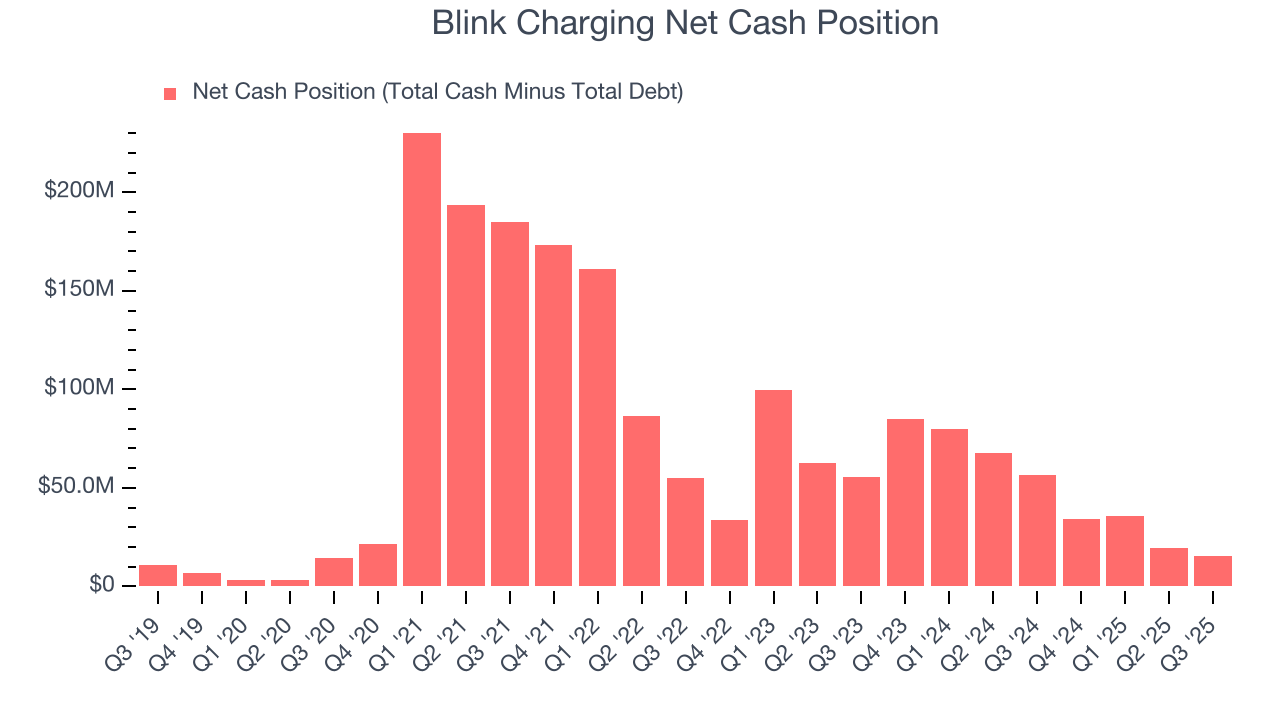
Unless the Blink Charging’s fundamentals change quickly, it might find itself in a position where it must raise capital from investors to continue operating. Whether that would be favorable is unclear because dilution is a headwind for shareholder returns.
We remain cautious of Blink Charging until it generates consistent free cash flow or any of its announced financing plans materialize on its balance sheet.
11. Key Takeaways from Blink Charging’s Q3 Results
It was encouraging to see Blink Charging beat analysts’ EBITDA expectations this quarter. We were also glad its EPS was in line with Wall Street’s estimates. On the other hand, its revenue missed. Overall, this was a weaker quarter. The stock remained flat at $1.52 immediately after reporting.
12. Is Now The Time To Buy Blink Charging?
Updated: March 14, 2026 at 11:40 PM EDT
Before deciding whether to buy Blink Charging or pass, we urge investors to consider business quality, valuation, and the latest quarterly results.
Blink Charging is a pretty decent company if you ignore its balance sheet. To kick things off, its revenue growth was exceptional over the last five years. And while its declining EPS over the last five years makes it a less attractive asset to the public markets, its rising cash profitability gives it more optionality. On top of that, its expanding operating margin shows the business has become more efficient.
Blink Charging’s forward price-to-sales ratio is 0.6x. Certain aspects of its fundamentals are attractive, but we aren’t investing at the moment because its balance sheet makes us uneasy. If you’re interested in buying the stock, wait until its debt falls or its profits increase.
Wall Street analysts have a consensus one-year price target of $2.50 on the company (compared to the current share price of $0.64).