Costco (COST)
Costco piques our interest. Its marvelous same-store sales and new store openings show there’s healthy demand for its products.― StockStory Analyst Team


1. News
2. Summary
Why Costco Is Interesting
Designed to be a one-stop shop for the suburban consumer, Costco (NASDAQ:COST) is a membership-only retail chain that sells groceries, apparel, toys, and household items, often in bulk quantities.
- Industry-leading 34.8% return on capital demonstrates management’s skill in finding high-return investments
- Unparalleled revenue scale of $275.2 billion offsets its poor gross margin and gives it advantageous pricing and terms with suppliers
- A blemish is its gross margin of 12.7% is an output of its commoditized inventory
Costco shows some potential. This company has a place on your watchlist.
Why Should You Watch Costco






Costco is trading at $875.62 per share, or 44.4x forward P/E. The market has high expectations, which are reflected in the premium multiple. This can result in short-term volatility if anything (e.g. a quarterly earnings miss) remotely dampens those hopes.
Costco could improve its business quality by stringing together a few solid quarters. We’d be more open to buying the stock when that time comes.
3. Costco (COST) Research Report: Q4 CY2025 Update
Membership-only discount retailer Costco (NASDAQ:COST) met Wall Streets revenue expectations in Q4 CY2025, with sales up 8.3% year on year to $67.31 billion. Its GAAP profit of $4.50 per share was 5.2% above analysts’ consensus estimates.
Costco (COST) Q4 CY2025 Highlights:
- Revenue: $67.31 billion vs analyst estimates of $67.03 billion (8.3% year-on-year growth, in line)
- EPS (GAAP): $4.50 vs analyst estimates of $4.28 (5.2% beat)
- Adjusted EBITDA: $3.06 billion vs analyst estimates of $3.07 billion (4.5% margin, in line)
- Operating Margin: 3.7%, in line with the same quarter last year
- Free Cash Flow Margin: 4.7%, up from 3.2% in the same quarter last year
- Locations: 923 at quarter end, up from 896 in the same quarter last year
- Same-Store Sales rose 6.4% year on year (5.2% in the same quarter last year)
- Market Capitalization: $388.2 billion
Company Overview
Designed to be a one-stop shop for the suburban consumer, Costco (NASDAQ:COST) is a membership-only retail chain that sells groceries, apparel, toys, and household items, often in bulk quantities.
The company is well known for offering these products at lower prices than most of its competitors. Costco is able to offer low prices due to its lean operating model that prioritizes low overhead costs and high inventory turnover. If you walk into a Costco store, the products are presented in a warehouse format, stacked high and with many products still sitting in their original boxes and palettes, rather than neatly presented as individual packages on shelves. This reduces store labor costs.
Costco's core customer is the value-conscious suburban shopper who is willing to buy in bulk to save money. These customers must pay for an annual membership, as non-members are not allowed to enter Costco locations. On the other hand, consumers living in cities often do not frequent Costco because their smaller homes or apartments cannot accommodate that 64-roll package of toilet paper.
In addition to groceries, electronics, and apparel, Costco also offers other consumer services so their customers don’t have to go elsewhere. Pharmacies, photo centers, and vision services/eyeglass retailers are common in their roughly 150,000 square foot stores. Outside the majority of Costco stores, there is also a gas station for quick and convenient fill ups.
4. Large-format Grocery & General Merchandise Retailer
Big-box retailers operate large stores that sell groceries and general merchandise at highly competitive prices. Because of their scale and resulting purchasing power, these big-box retailers–with annual sales in the tens to hundreds of billions of dollars–are able to get attractive volume discounts and sell at often the lowest prices. While e-commerce is a threat, these retailers have been able to weather the storm by either providing a unique in-store shopping experience or by reinvesting their hefty profits into omnichannel investments.
Competitors that offer groceries and/or other general merchandise in large-format stores include BJ’s Wholesale Club, Walmart (NYSE:WMT), and Kroger (NYSE:KR).
5. Revenue Growth
A company’s long-term sales performance is one signal of its overall quality. Any business can experience short-term success, but top-performing ones enjoy sustained growth for years.
With $280.4 billion in revenue over the past 12 months, Costco is a behemoth in the consumer retail sector and benefits from economies of scale, giving it an edge in distribution. This also enables it to gain more leverage on its fixed costs than smaller competitors and the flexibility to offer lower prices. However, its scale is a double-edged sword because there are only a finite number of places to build new stores, making it harder to find incremental growth. To expand meaningfully, Costco likely needs to tweak its prices or enter new markets.
As you can see below, Costco grew its sales at a tepid 6.7% compounded annual growth rate over the last three years (we compare to 2019 to normalize for COVID-19 impacts), but to its credit, it opened new stores and increased sales at existing, established locations.
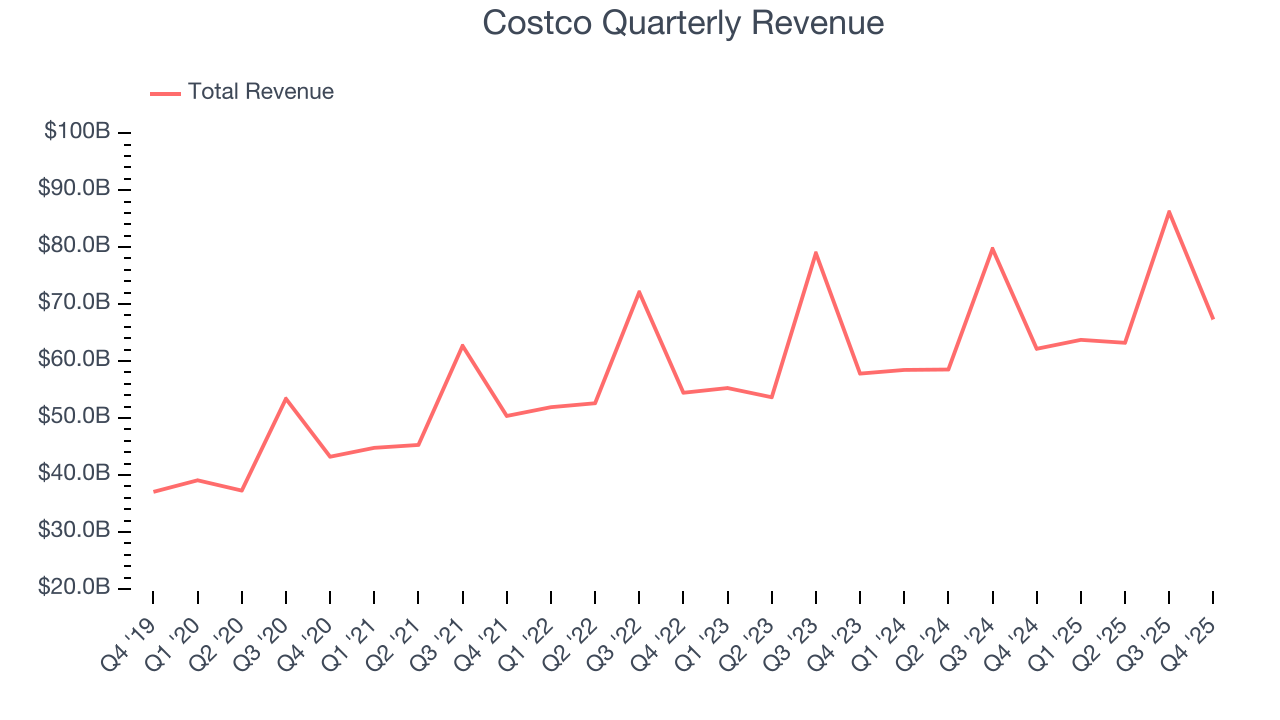
This quarter, Costco grew its revenue by 8.3% year on year, and its $67.31 billion of revenue was in line with Wall Street’s estimates.
Looking ahead, sell-side analysts expect revenue to grow 7.6% over the next 12 months, similar to its three-year rate. This projection is particularly healthy for a company of its scale and suggests the market sees success for its products.
6. Store Performance
Number of Stores
A retailer’s store count influences how much it can sell and how quickly revenue can grow.
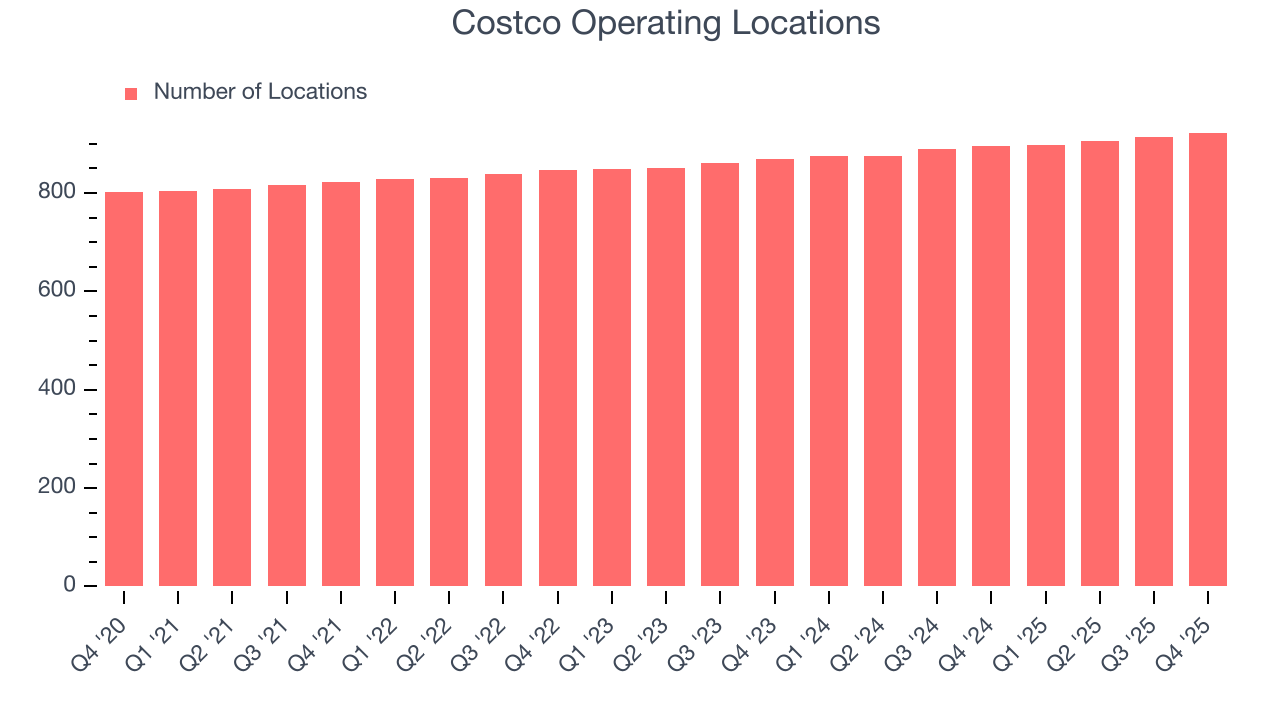
Costco sported 923 locations in the latest quarter. Over the last two years, it has opened new stores quickly, averaging 3% annual growth. This was faster than the broader consumer retail sector.
When a retailer opens new stores, it usually means it’s investing for growth because demand is greater than supply, especially in areas where consumers may not have a store within reasonable driving distance.
Same-Store Sales
The change in a company's store base only tells one side of the story. The other is the performance of its existing locations and e-commerce sales, which informs management teams whether they should expand or downsize their physical footprints. Same-store sales is an industry measure of whether revenue is growing at those existing stores and is driven by customer visits (often called traffic) and the average spending per customer (ticket).
Costco has been one of the most successful retailers over the last two years thanks to skyrocketing demand within its existing locations. On average, the company has posted exceptional year-on-year same-store sales growth of 5.9%. This performance suggests its rollout of new stores is beneficial for shareholders. We like this backdrop because it gives Costco multiple ways to win: revenue growth can come from new stores, e-commerce, or increased foot traffic and higher sales per customer at existing locations.
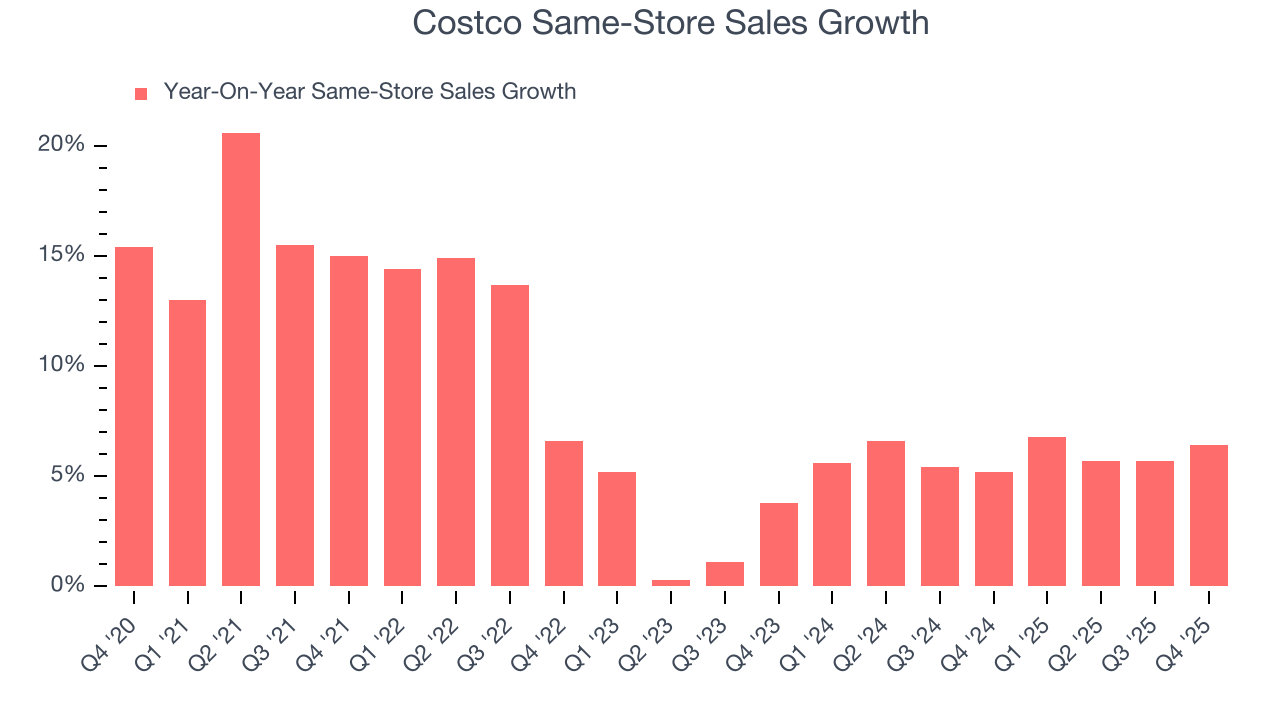
In the latest quarter, Costco’s same-store sales rose 6.4% year on year. This performance was more or less in line with its historical levels.
7. Gross Margin & Pricing Power
At StockStory, we prefer high gross margin businesses because they indicate pricing power or differentiated products, giving the company a chance to generate higher operating profits.
Costco has bad unit economics for a retailer, signaling it operates in a competitive market and lacks pricing power because its inventory is sold in many places. As you can see below, it averaged a 12.8% gross margin over the last two years.
Non-discretionary retailers, however, must be viewed through a different lens because they compete on the lowest price, sell products easily found elsewhere, and have high transportation costs to move goods. These dynamics lead to structurally lower gross margins, so the best metrics to assess them are free cash flow margin, operating leverage, and profit volatility, which account for their scale advantages and non-cyclical demand.
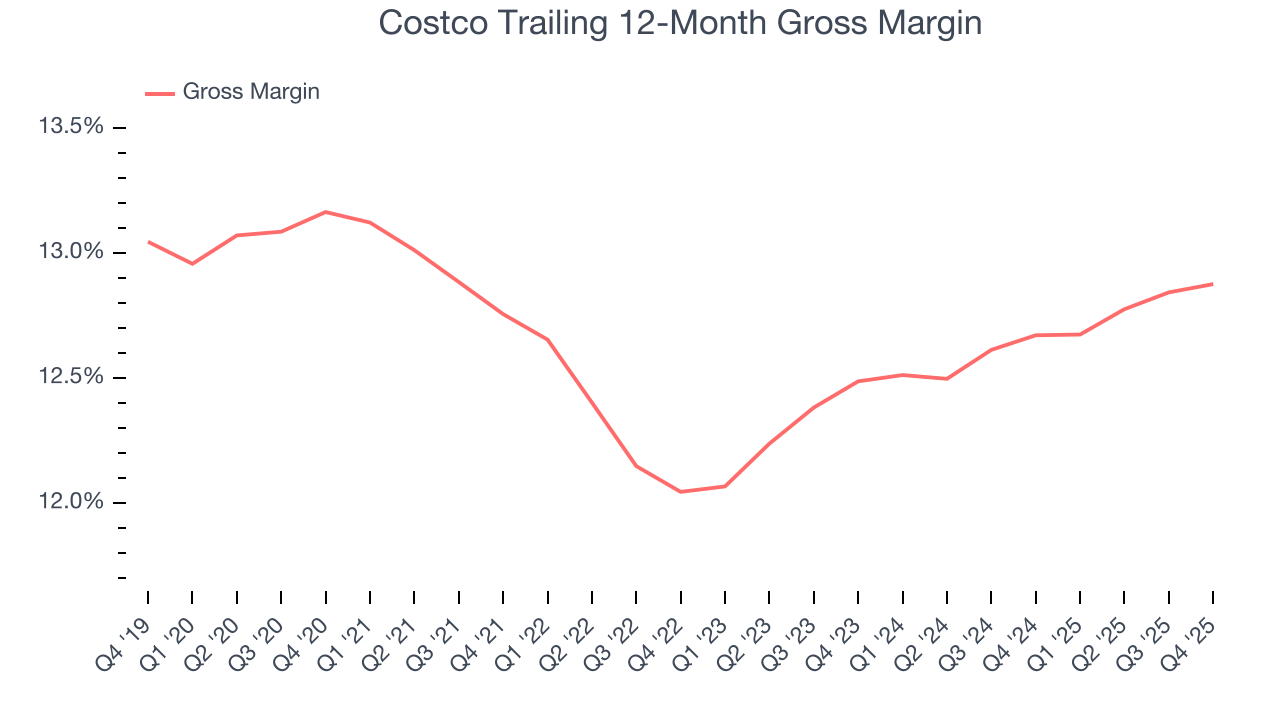
In Q4, Costco produced a 13.1% gross profit margin, in line with the same quarter last year. On a wider time horizon, the company’s full-year margin has remained steady over the past four quarters, suggesting it strives to keep prices low for customers and has stable input costs (such as labor and freight expenses to transport goods).
8. Operating Margin
Operating margin is an important measure of profitability as it shows the portion of revenue left after accounting for all core expenses – everything from the cost of goods sold to advertising and wages. It’s also useful for comparing profitability across companies with different levels of debt and tax rates because it excludes interest and taxes.
Costco’s operating margin might fluctuated slightly over the last 12 months but has remained more or less the same, averaging 3.7% over the last two years. This profitability was lousy for a consumer retail business and caused by its suboptimal cost structureand low gross margin.
Looking at the trend in its profitability, Costco’s operating margin might fluctuated slightly but has generally stayed the same over the last year. This raises questions about the company’s expense base because its revenue growth should have given it leverage on its fixed costs, resulting in better economies of scale and profitability.
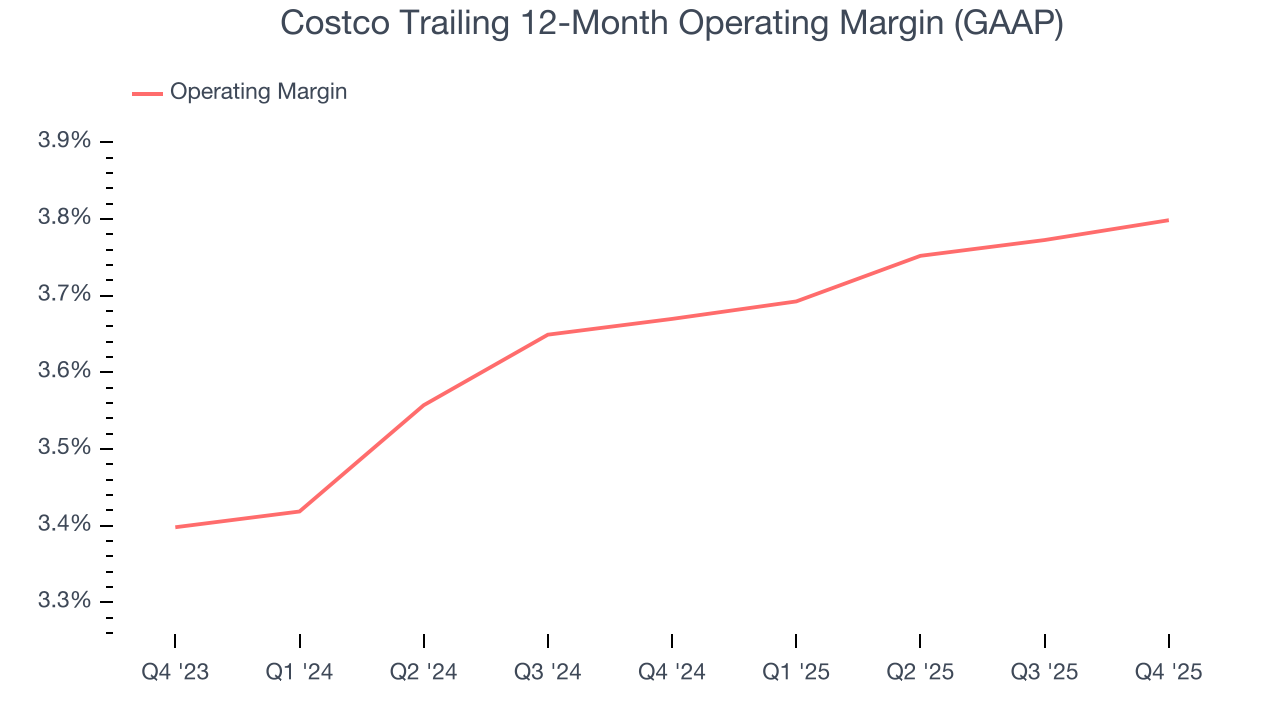
This quarter, Costco generated an operating margin profit margin of 3.7%, in line with the same quarter last year. This indicates the company’s cost structure has recently been stable.
9. Cash Is King
Although earnings are undoubtedly valuable for assessing company performance, we believe cash is king because you can’t use accounting profits to pay the bills.
Costco has shown decent cash profitability, giving it some flexibility to reinvest or return capital to investors. The company’s free cash flow margin averaged 2.6% over the last two years, slightly better than the broader consumer retail sector.
Taking a step back, we can see that Costco’s margin expanded by 1.3 percentage points over the last year. This shows the company is heading in the right direction, and we can see it became a less capital-intensive business because its free cash flow profitability rose while its operating profitability was flat.
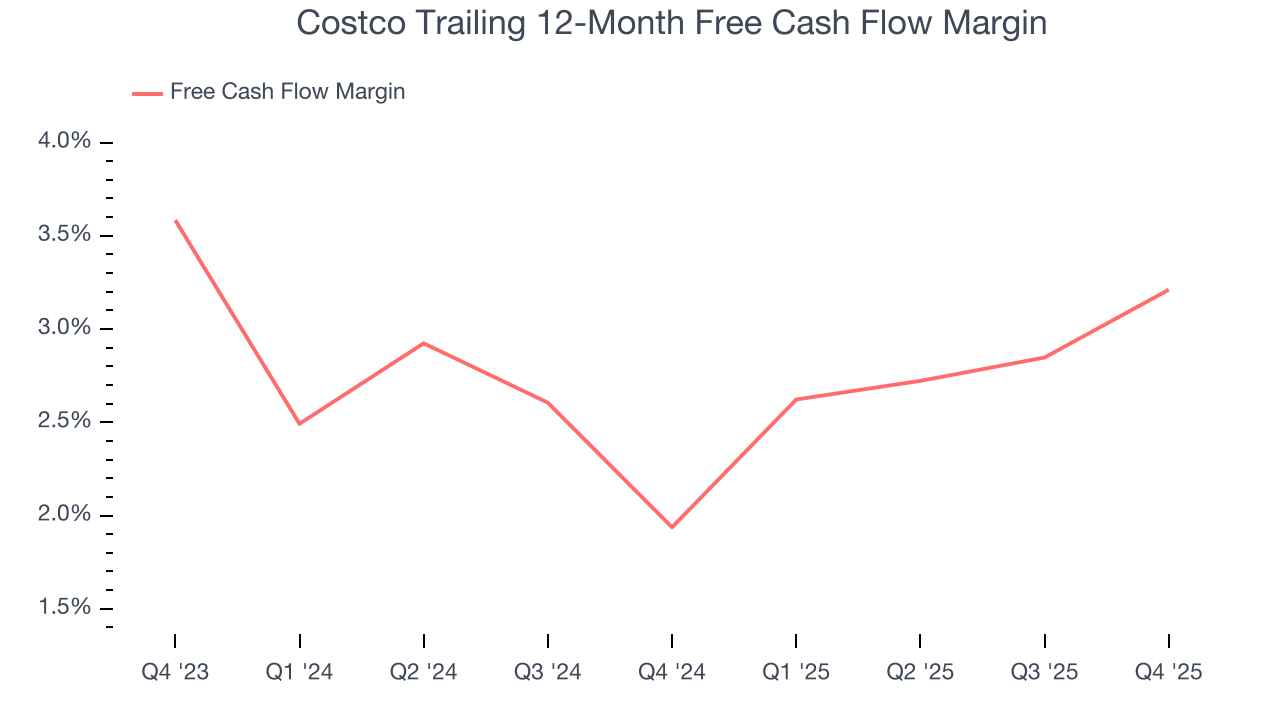
Costco’s free cash flow clocked in at $3.16 billion in Q4, equivalent to a 4.7% margin. This result was good as its margin was 1.5 percentage points higher than in the same quarter last year, building on its favorable historical trend.
10. Return on Invested Capital (ROIC)
EPS and free cash flow tell us whether a company was profitable while growing its revenue. But was it capital-efficient? Enter ROIC, a metric showing how much operating profit a company generates relative to the money it has raised (debt and equity).
Costco’s five-year average ROIC was 34.3%, placing it among the best consumer retail companies. This illustrates its management team’s ability to invest in highly profitable ventures and produce tangible results for shareholders.
11. Balance Sheet Assessment
Big corporations like Costco are attractive to many investors in times of instability thanks to their fortress balance sheets that buffer pockets of soft demand.
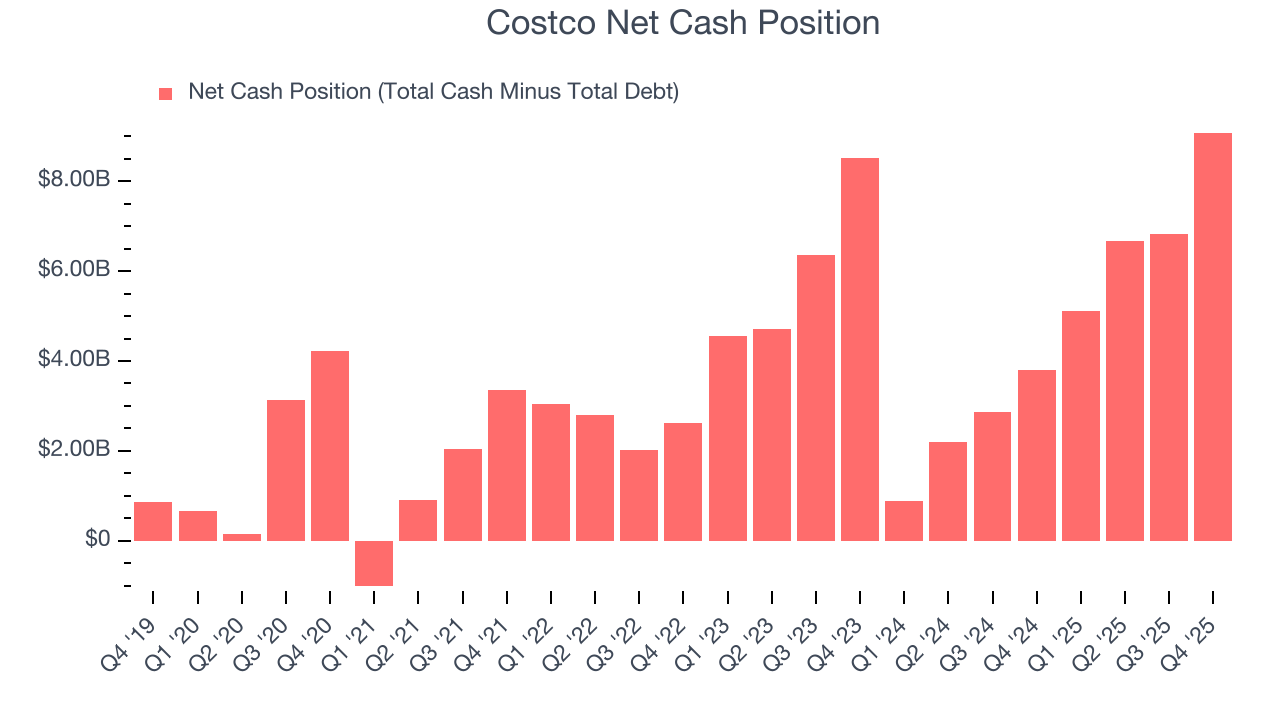
Costco is a profitable, well-capitalized company with $17.18 billion of cash and $8.1 billion of debt on its balance sheet. This $9.08 billion net cash position is 2.3% of its market cap and gives it the freedom to borrow money, return capital to shareholders, or invest in growth initiatives. Leverage is not an issue here.
12. Key Takeaways from Costco’s Q4 Results
We were impressed by how significantly Costco blew past analysts’ gross margin expectations this quarter. We were also glad its EPS outperformed Wall Street’s estimates. Overall, this print had some key positives. The stock remained flat at $883.54 immediately following the results.
13. Is Now The Time To Buy Costco?
When considering an investment in Costco, investors should account for its valuation and business qualities as well as what’s happened in the latest quarter.
Costco is a fine business. Although its revenue growth was a little slower over the last three years, its marvelous same-store sales growth is on another level. And while its gross margins make it more challenging to reach positive operating profits compared to other consumer retail businesses, its stellar ROIC suggests it has been a well-run company historically.
Costco’s P/E ratio based on the next 12 months is 43.2x. This valuation tells us that a lot of optimism is priced in. Add this one to your watchlist and come back to it later.
Wall Street analysts have a consensus one-year price target of $1,057 on the company (compared to the current share price of $883.54).