DocuSign (DOCU)
We’re wary of DocuSign. Its sluggish sales growth shows demand is soft, a worrisome sign for investors in high-quality stocks.― StockStory Analyst Team


1. News




2. Summary
Why We Think DocuSign Will Underperform
Creating the digital equivalent of "sign on the dotted line" for over a billion users worldwide, DocuSign (NASDAQ:DOCU) provides an agreement management platform that enables businesses to electronically prepare, sign, and manage documents and contracts.
- Operating profits and efficiency rose over the last year as it benefited from some fixed cost leverage
- Anticipated sales growth of 8.4% for the next year implies demand will be shaky
- On the plus side, its fast payback periods on sales and marketing expenses allow the company to invest heavily and onboard many customers concurrently
DocuSign falls short of our expectations. We’d search for superior opportunities elsewhere.
Why There Are Better Opportunities Than DocuSign






At $46.59 per share, DocuSign trades at 2.7x forward price-to-sales. This is a cheap valuation multiple, but for good reason. You get what you pay for.
It’s better to pay up for high-quality businesses with higher long-term earnings potential rather than to buy lower-quality stocks because they appear cheap. These challenged businesses often don’t re-rate, a phenomenon known as a “value trap”.
3. DocuSign (DOCU) Research Report: Q4 CY2025 Update
Electronic signature company DocuSign (NASDAQ:DOCU) beat Wall Street’s revenue expectations in Q4 CY2025, with sales up 7.8% year on year to $836.9 million. Guidance for next quarter’s revenue was better than expected at $824 million at the midpoint, 1.1% above analysts’ estimates. Its non-GAAP profit of $1.01 per share was 6.4% above analysts’ consensus estimates.
DocuSign (DOCU) Q4 CY2025 Highlights:
- Revenue: $836.9 million vs analyst estimates of $828.2 million (7.8% year-on-year growth, 1% beat)
- Adjusted EPS: $1.01 vs analyst estimates of $0.95 (6.4% beat)
- Adjusted Operating Income: $247.1 million vs analyst estimates of $237.3 million (29.5% margin, 4.2% beat)
- Revenue Guidance for Q1 CY2026 is $824 million at the midpoint, above analyst estimates of $815.2 million
- Operating Margin: 10.5%, up from 7.8% in the same quarter last year
- Free Cash Flow Margin: 41.8%, up from 32.1% in the previous quarter
- Billings: $1.02 billion at quarter end, up 10.4% year on year
- Market Capitalization: $9.38 billion
Company Overview
Creating the digital equivalent of "sign on the dotted line" for over a billion users worldwide, DocuSign (NASDAQ:DOCU) provides an agreement management platform that enables businesses to electronically prepare, sign, and manage documents and contracts.
The company's flagship product, eSignature, forms the foundation of its business, allowing organizations to securely execute agreements from virtually any device, anywhere in the world. Beyond simply capturing signatures, DocuSign offers a comprehensive suite of products that span the entire agreement lifecycle. These include contract lifecycle management (CLM) software for automating pre- and post-signature workflows, document generation tools, identity verification services, and industry-specific solutions for sectors like real estate and healthcare.
DocuSign's platform integrates with over 900 business applications including Salesforce, Microsoft, Google, and SAP, allowing companies to embed agreement processes into their existing workflows. This extensive integration ecosystem helps organizations streamline operations across departments from sales and marketing to legal, HR, and procurement.
The company employs a subscription-based business model with various pricing tiers based on functionality and usage volume. DocuSign measures usage through "Envelopes" – digital containers that hold documents sent for signature. Revenue grows as customers increase their envelope volume, upgrade plans, or adopt additional products. A Fortune 500 company might use DocuSign for everything from closing sales deals and processing vendor contracts to managing employment offers and executing internal compliance documents.
4. Document Management
The catch phrase "digital transformation" originally referred to the digitization of documents within enterprises. The growth of digital documents has spurred an explosion of collaboration within and between businesses, which in turn is driving the demand for e-signature and content management platforms.
DocuSign's primary global competitor is Adobe Acrobat Sign (formerly Adobe Sign), part of Adobe Inc. (NASDAQ:ADBE). Other competitors include HelloSign (owned by Dropbox), PandaDoc, SignNow, and various enterprise software providers that have incorporated electronic signature capabilities into their platforms.
5. Revenue Growth
A company’s long-term performance is an indicator of its overall quality. Any business can have short-term success, but a top-tier one grows for years. Over the last five years, DocuSign grew its sales at a 17.2% annual rate. Though this growth is acceptable on an absolute basis, we need to see more than just topline growth for the software sector, which can display significant earnings volatility. This means our bar for the sector is particularly high, reflecting the non-essential and hit-driven nature of the products and services offered. Additionally, five-year CAGR starts around Covid, when revenue was depressed then rebounded.
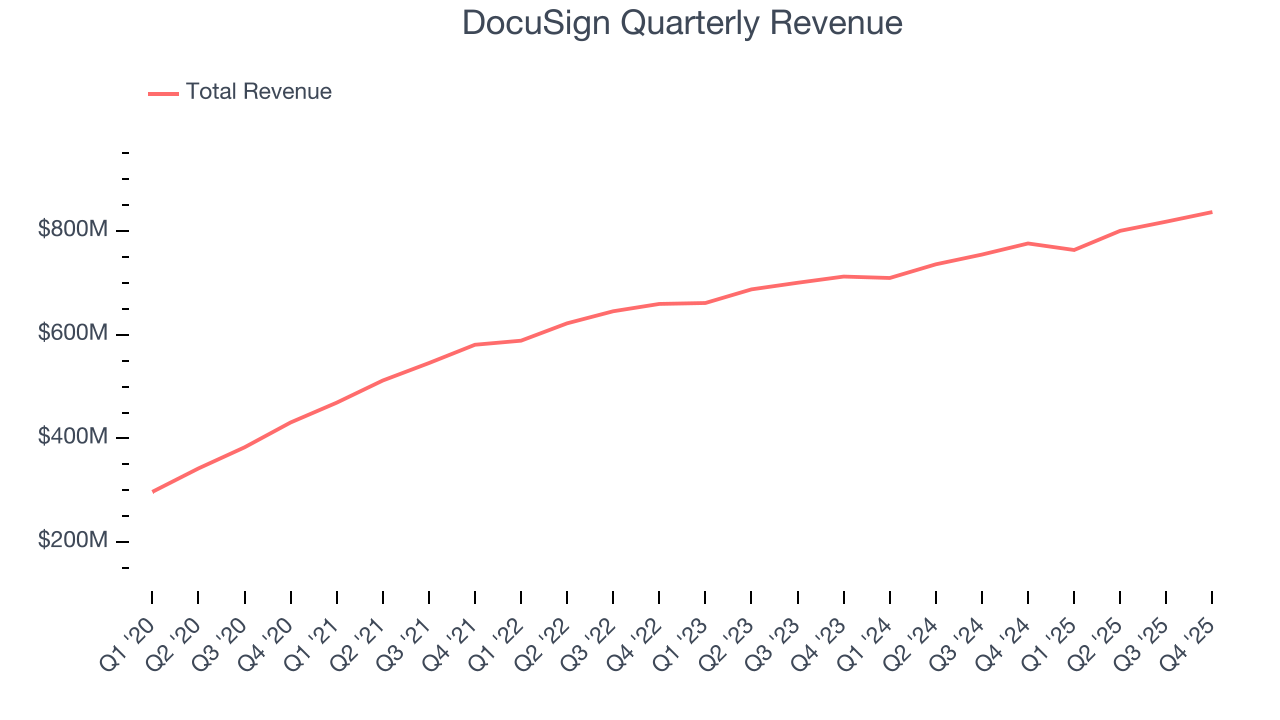
Long-term growth is the most important, but within software, a half-decade historical view may miss new innovations or demand cycles. DocuSign’s recent performance shows its demand has slowed as its annualized revenue growth of 8% over the last two years was below its five-year trend. We’re wary when companies in the sector see decelerations in revenue growth, as it could signal changing consumer tastes aided by low switching costs. 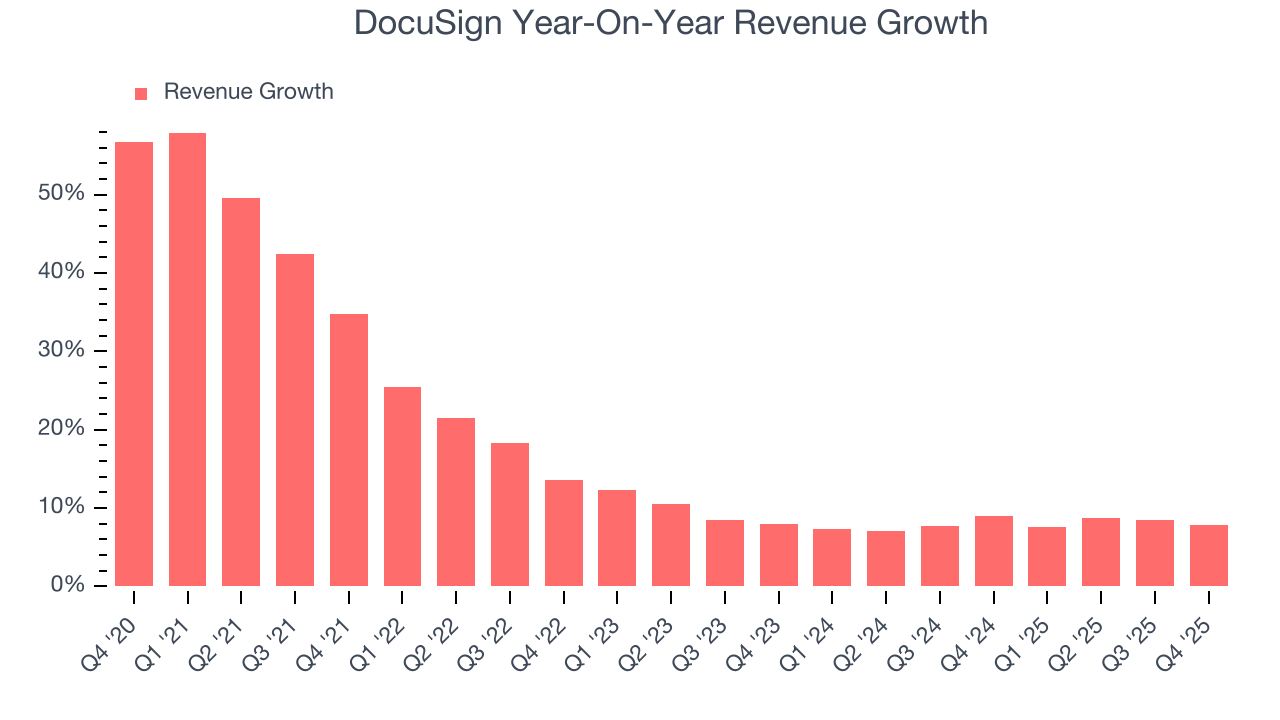
This quarter, DocuSign reported year-on-year revenue growth of 7.8%, and its $836.9 million of revenue exceeded Wall Street’s estimates by 1%. Company management is currently guiding for a 7.9% year-on-year increase in sales next quarter.
Looking further ahead, sell-side analysts expect revenue to grow 6.4% over the next 12 months, a slight deceleration versus the last two years. This projection doesn't excite us and suggests its products and services will see some demand headwinds.
6. Billings
Billings is a non-GAAP metric that is often called “cash revenue” because it shows how much money the company has collected from customers in a certain period. This is different from revenue, which must be recognized in pieces over the length of a contract.
DocuSign’s billings came in at $1.02 billion in Q4, and over the last four quarters, its growth was underwhelming as it averaged 9.4% year-on-year increases. This performance mirrored its total sales and suggests that increasing competition is causing challenges in acquiring/retaining customers. 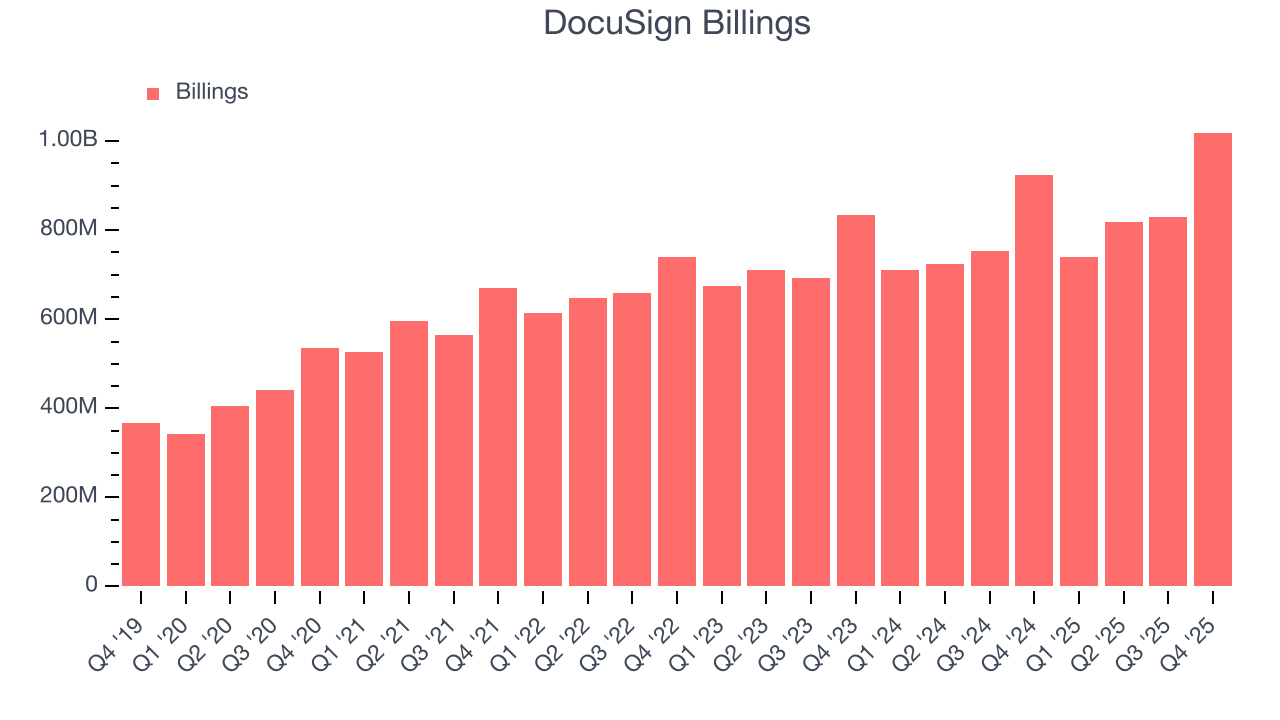
7. Customer Acquisition Efficiency
The customer acquisition cost (CAC) payback period measures the months a company needs to recoup the money spent on acquiring a new customer. This metric helps assess how quickly a business can break even on its sales and marketing investments.
DocuSign is extremely efficient at acquiring new customers, and its CAC payback period checked in at 16.4 months this quarter. The company’s rapid recovery of its customer acquisition costs means it can attempt to spur growth by increasing its sales and marketing investments.
8. Gross Margin & Pricing Power
For software companies like DocuSign, gross profit tells us how much money remains after paying for the base cost of products and services (typically servers, licenses, and certain personnel). These costs are usually low as a percentage of revenue, explaining why software is more lucrative than other sectors.
DocuSign’s robust unit economics are better than the broader software industry, an output of its asset-lite business model and pricing power. They also enable the company to fund large investments in new products and sales during periods of rapid growth to achieve higher profits in the future. As you can see below, it averaged an excellent 79.5% gross margin over the last year. That means DocuSign only paid its providers $20.45 for every $100 in revenue.
The market not only cares about gross margin levels but also how they change over time because expansion creates firepower for profitability and free cash generation. DocuSign has seen gross margins improve by 0.2 percentage points over the last 2 year, which is slightly better than average for software.
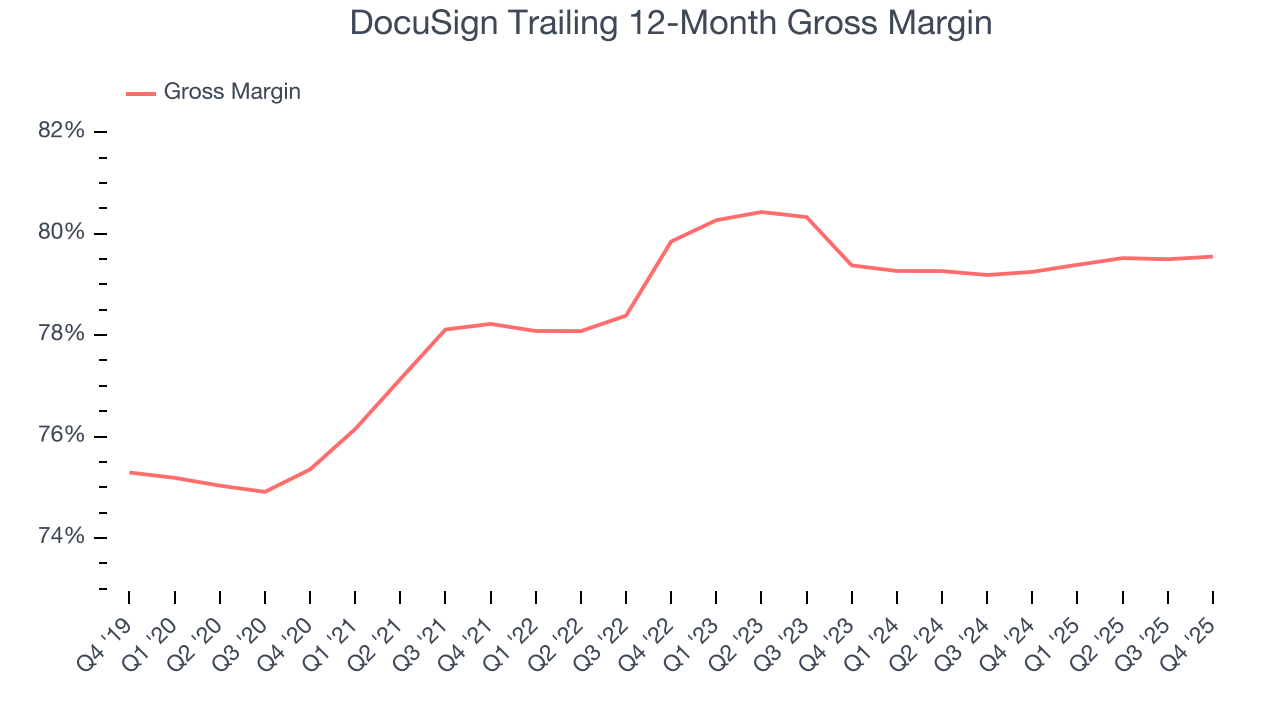
This quarter, DocuSign’s gross profit margin was 79.7%, in line with the same quarter last year. Zooming out, the company’s full-year margin has remained steady over the past 12 months, suggesting its input costs have been stable and it isn’t under pressure to lower prices.
9. Operating Margin
Many software businesses adjust their profits for stock-based compensation (SBC), but we prioritize GAAP operating margin because SBC is a real expense used to attract and retain engineering and sales talent. This is one of the best measures of profitability because it shows how much money a company takes home after developing, marketing, and selling its products.
DocuSign has been an efficient company over the last year. It was one of the more profitable businesses in the software sector, boasting an average operating margin of 9.3%. This result isn’t surprising as its high gross margin gives it a favorable starting point.
Looking at the trend in its profitability, DocuSign’s operating margin rose by 2.6 percentage points over the last two years, as its sales growth gave it operating leverage.
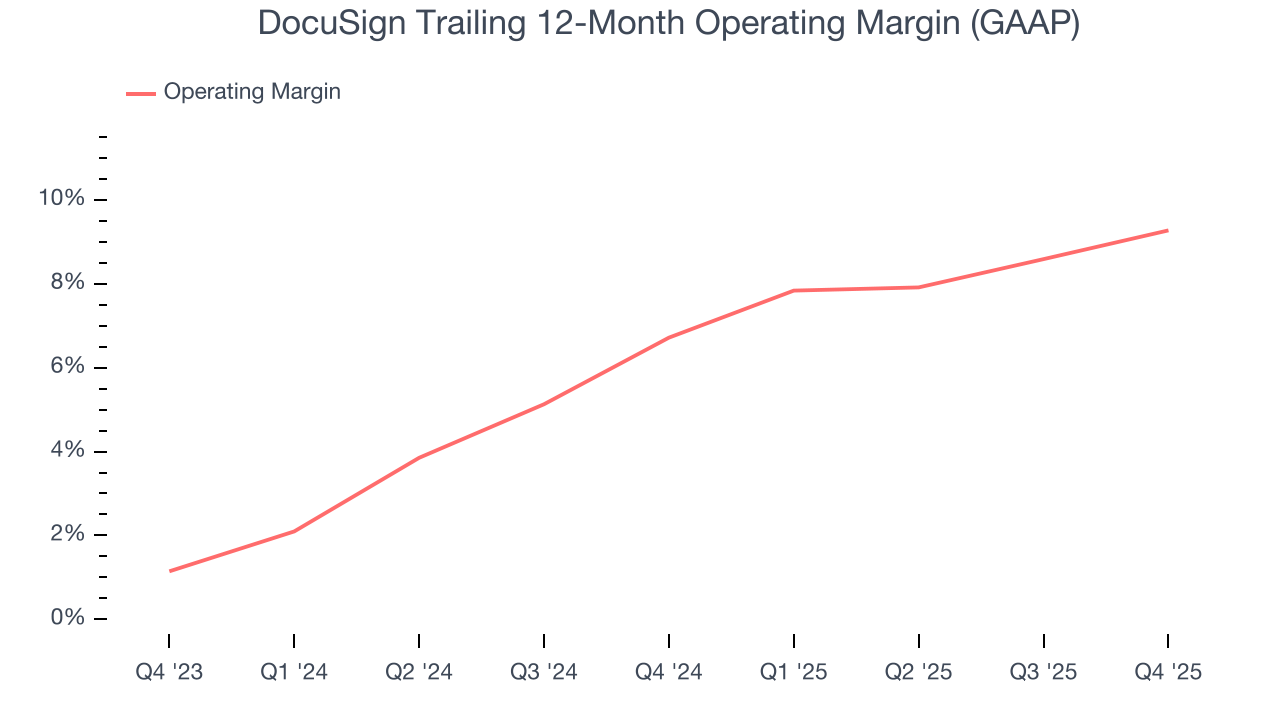
In Q4, DocuSign generated an operating margin profit margin of 10.5%, up 2.7 percentage points year on year. The increase was encouraging, and because its operating margin rose more than its gross margin, we can infer it was more efficient with expenses such as marketing, R&D, and administrative overhead.
10. Cash Is King
Free cash flow isn't a prominently featured metric in company financials and earnings releases, but we think it's telling because it accounts for all operating and capital expenses, making it tough to manipulate. Cash is king.
DocuSign has shown terrific cash profitability, driven by its lucrative business model and cost-effective customer acquisition strategy that enable it to stay ahead of the competition through investments in new products rather than sales and marketing. The company’s free cash flow margin was among the best in the software sector, averaging an eye-popping 32.9% over the last year.
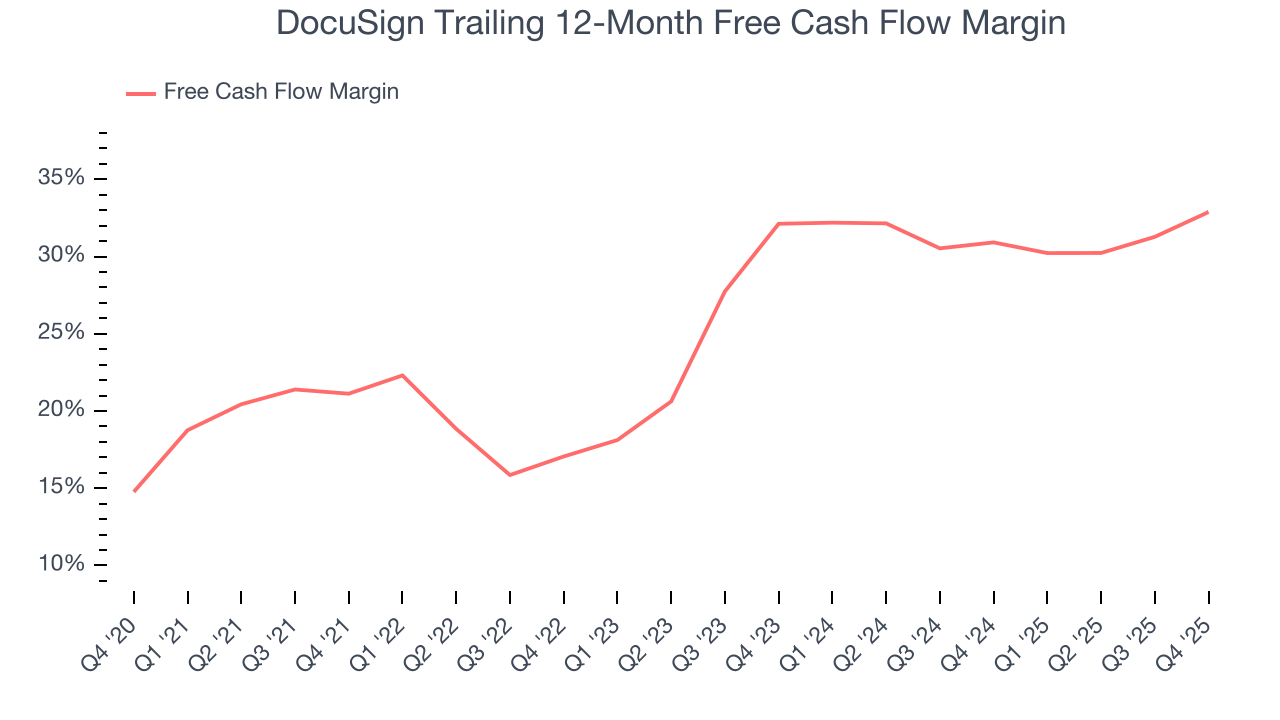
DocuSign’s free cash flow clocked in at $350.2 million in Q4, equivalent to a 41.8% margin. This result was good as its margin was 5.8 percentage points higher than in the same quarter last year, but we wouldn’t put too much weight on the short term because investment needs can be seasonal, causing temporary swings. Long-term trends trump fluctuations.
Over the next year, analysts’ consensus estimates show they’re expecting DocuSign’s free cash flow margin of 32.9% for the last 12 months to remain the same.
11. Balance Sheet Assessment
One of the best ways to mitigate bankruptcy risk is to hold more cash than debt.
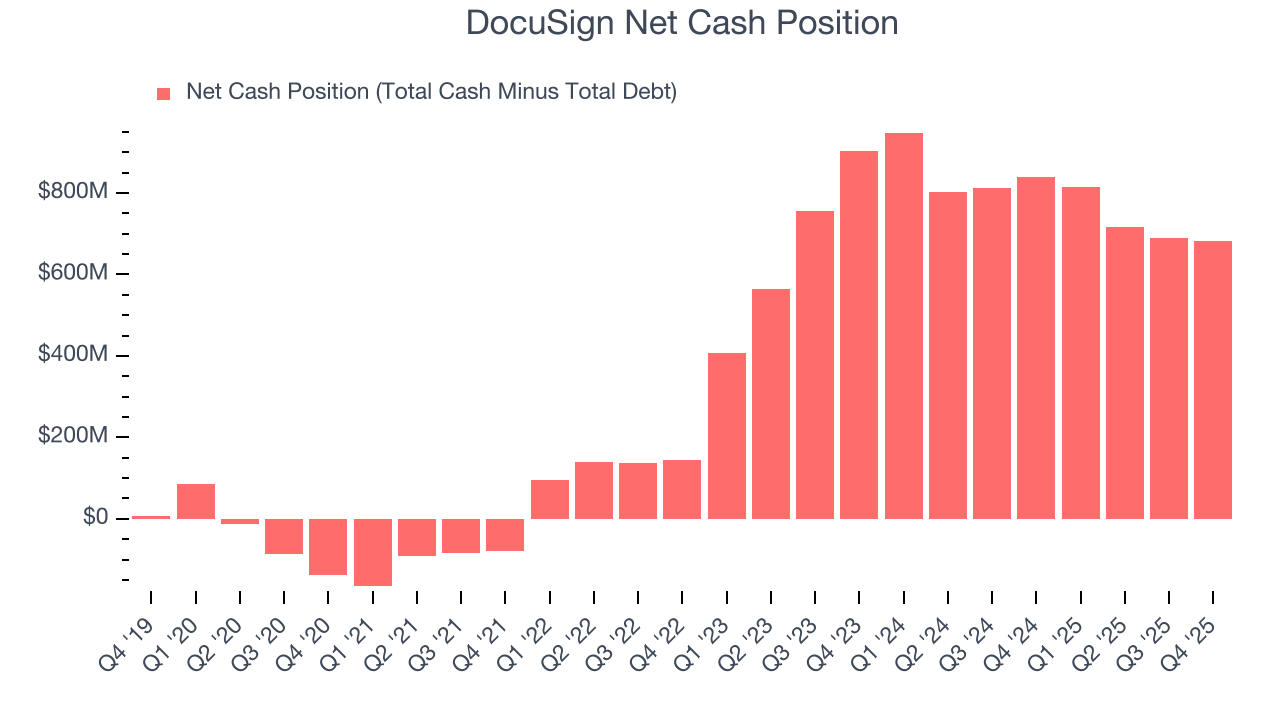
DocuSign is a profitable, well-capitalized company with $866.5 million of cash and $185.1 million of debt on its balance sheet. This $681.4 million net cash position is 7.2% of its market cap and gives it the freedom to borrow money, return capital to shareholders, or invest in growth initiatives. Leverage is not an issue here.
12. Key Takeaways from DocuSign’s Q4 Results
It was good to see DocuSign expecting revenue growth to continue next year. We were also happy its billings outperformed Wall Street’s estimates. Overall, this print had some key positives. The stock traded up 1.3% to $48.57 immediately following the results.
13. Is Now The Time To Buy DocuSign?
Updated: March 25, 2026 at 10:01 PM EDT
The latest quarterly earnings matters, sure, but we actually think longer-term fundamentals and valuation matter more. Investors should consider all these pieces before deciding whether or not to invest in DocuSign.
DocuSign isn’t a terrible business, but it doesn’t pass our quality test. To begin with, its revenue growth was mediocre over the last five years, and analysts expect its demand to deteriorate over the next 12 months. While its efficient sales strategy allows it to target and onboard new users at scale, the downside is its expanding operating margin shows it’s becoming more efficient at building and selling its software. On top of that, its ARR has disappointed and shows the company is having difficulty retaining customers and their spending.
DocuSign’s price-to-sales ratio based on the next 12 months is 2.7x. This valuation is reasonable, but the company’s shakier fundamentals present too much downside risk. We're fairly confident there are better stocks to buy right now.
Wall Street analysts have a consensus one-year price target of $64.55 on the company (compared to the current share price of $46.59).
Although the price target is bullish, readers should exercise caution because analysts tend to be overly optimistic. The firms they work for, often big banks, have relationships with companies that extend into fundraising, M&A advisory, and other rewarding business lines. As a result, they typically hesitate to say bad things for fear they will lose out. We at StockStory do not suffer from such conflicts of interest, so we’ll always tell it like it is.