
Northwest Bancshares (NWBI)
We wouldn’t buy Northwest Bancshares. Its weak sales growth and low returns on capital show it struggled to generate demand and profits.― StockStory Analyst Team


1. News


2. Summary
Why We Think Northwest Bancshares Will Underperform
Founded in 1896 and operating across Pennsylvania, New York, Ohio, and Indiana, Northwest Bancshares (NASDAQ:NWBI) is a bank holding company that operates Northwest Bank, providing personal and business banking, investment management, and trust services.
- 2.5% annual tangible book value per share growth over the last two years was slower than its banking peers
- Annual revenue growth of 4.4% over the last five years was below our standards for the banking sector
- Earnings per share lagged its peers over the last five years as they only grew by 5.9% annually
Northwest Bancshares doesn’t pass our quality test. There are more appealing investments to be made.
Why There Are Better Opportunities Than Northwest Bancshares








Northwest Bancshares is trading at $12.45 per share, or 0.9x forward P/B. Northwest Bancshares’s multiple may seem like a great deal among banking peers, but we think there are valid reasons why it’s this cheap.
We’d rather pay up for companies with elite fundamentals than get a bargain on weak ones. Cheap stocks can be value traps, and as their performance deteriorates, they will stay cheap or get even cheaper.
3. Northwest Bancshares (NWBI) Research Report: Q4 CY2025 Update
Regional banking company Northwest Bancshares (NASDAQ:NWBI) beat Wall Street’s revenue expectations in Q4 CY2025, with sales up 19.8% year on year to $179.9 million. Its non-GAAP profit of $0.33 per share was 7.8% above analysts’ consensus estimates.
Northwest Bancshares (NWBI) Q4 CY2025 Highlights:
- Net Interest Income: $142.2 million vs analyst estimates of $141.6 million (24.5% year-on-year growth, in line)
- Net Interest Margin: 3.7% vs analyst estimates of 3.7% (3.1 basis point beat)
- Revenue: $179.9 million vs analyst estimates of $173.5 million (19.8% year-on-year growth, 3.7% beat)
- Efficiency Ratio: 63.1% vs analyst estimates of 59.3% (377.4 basis point miss)
- Adjusted EPS: $0.33 vs analyst estimates of $0.31 (7.8% beat)
- Tangible Book Value per Share: $9.63 vs analyst estimates of $9.56 (1.2% year-on-year growth, 0.7% beat)
- Market Capitalization: $1.82 billion
Company Overview
Founded in 1896 and operating across Pennsylvania, New York, Ohio, and Indiana, Northwest Bancshares (NASDAQ:NWBI) is a bank holding company that operates Northwest Bank, providing personal and business banking, investment management, and trust services.
Northwest Bancshares operates primarily through its subsidiary, Northwest Bank, offering a comprehensive range of financial products and services. The bank's lending portfolio includes residential mortgages, home equity loans, commercial real estate financing, and business loans. For individual customers, Northwest provides everyday banking services like checking and savings accounts, along with personal loans and credit cards. Business clients can access commercial lending, deposit accounts, and cash management solutions.
A typical customer might be a family in western Pennsylvania securing a 30-year fixed-rate mortgage for their first home, or a small manufacturing business in Ohio obtaining financing to purchase new equipment. The bank also serves commercial real estate developers funding multi-family housing projects or retail establishments.
Northwest generates revenue primarily through interest income on loans and investments, as well as fees from various banking services. The company's business model follows traditional banking principles—collecting deposits from customers and using those funds to make loans at higher interest rates than what it pays depositors.
The bank maintains a significant physical presence with community banking offices throughout its four-state footprint, focusing on markets with diverse economies driven by healthcare, education, service businesses, and manufacturing. Northwest has expanded its geographic reach primarily through acquisitions, allowing it to serve customers across various economic regions while maintaining its community banking approach.
4. Thrifts & Mortgage Finance
Thrifts & Mortgage Finance institutions operate by accepting deposits and extending loans primarily for residential mortgages, earning revenue through interest rate spreads (difference between lending rates and borrowing costs) and origination fees. The industry benefits from demographic tailwinds as millennials enter prime homebuying age, technological advancements streamlining the loan approval process, and potential interest rate stabilization improving affordability. However, significant headwinds include net interest margin compression during rate volatility, increased competition from fintech disruptors offering digital-first experiences, mounting regulatory compliance costs, and potential housing market corrections that could impact loan portfolios and default rates.
Northwest Bancshares competes with other regional banks operating in its market areas, including PNC Financial Services (NYSE:PNC), KeyCorp (NYSE:KEY), and F.N.B. Corporation (NYSE:FNB), as well as national banks like JPMorgan Chase (NYSE:JPM) and Bank of America (NYSE:BAC).
5. Sales Growth
Two primary revenue streams drive bank earnings. While net interest income, which is earned by charging higher rates on loans than paid on deposits, forms the foundation, fee-based services across banking, credit, wealth management, and trading operations provide additional income. Unfortunately, Northwest Bancshares’s 4.6% annualized revenue growth over the last five years was sluggish. This fell short of our benchmark for the banking sector and is a tough starting point for our analysis.
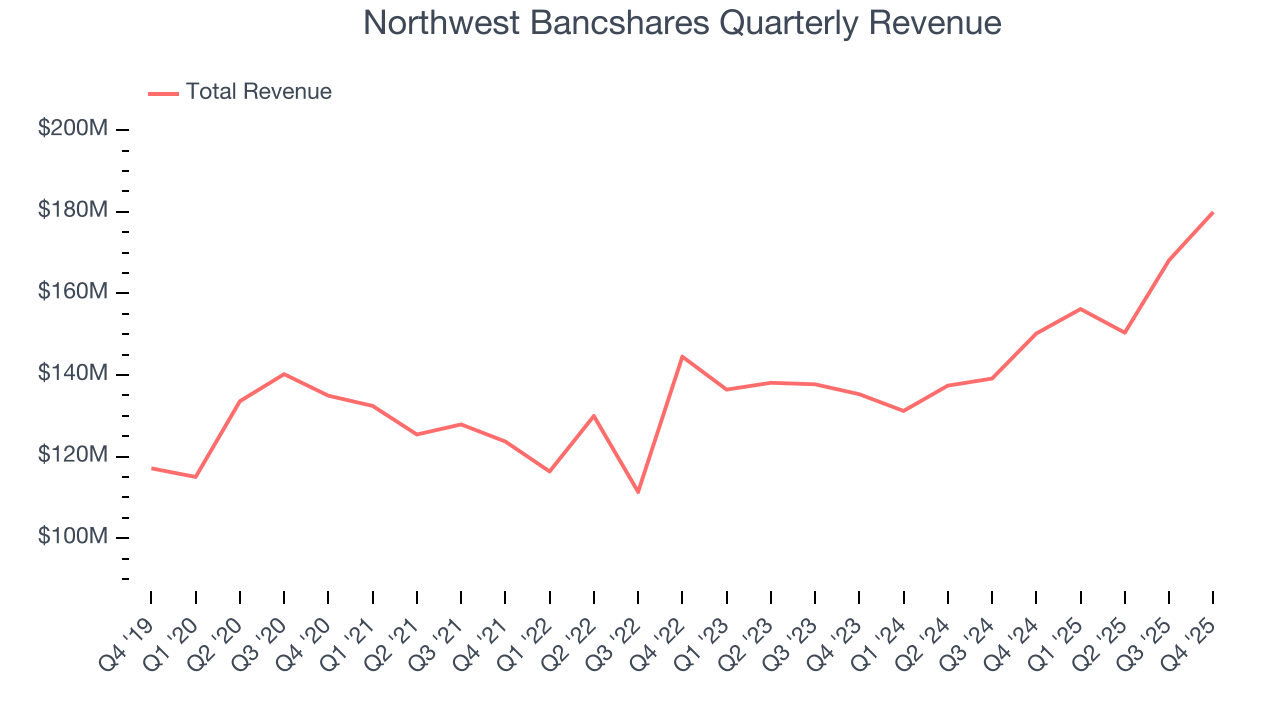
Long-term growth is the most important, but within financials, a half-decade historical view may miss recent interest rate changes and market returns. Northwest Bancshares’s annualized revenue growth of 9.3% over the last two years is above its five-year trend, but we were still disappointed by the results. 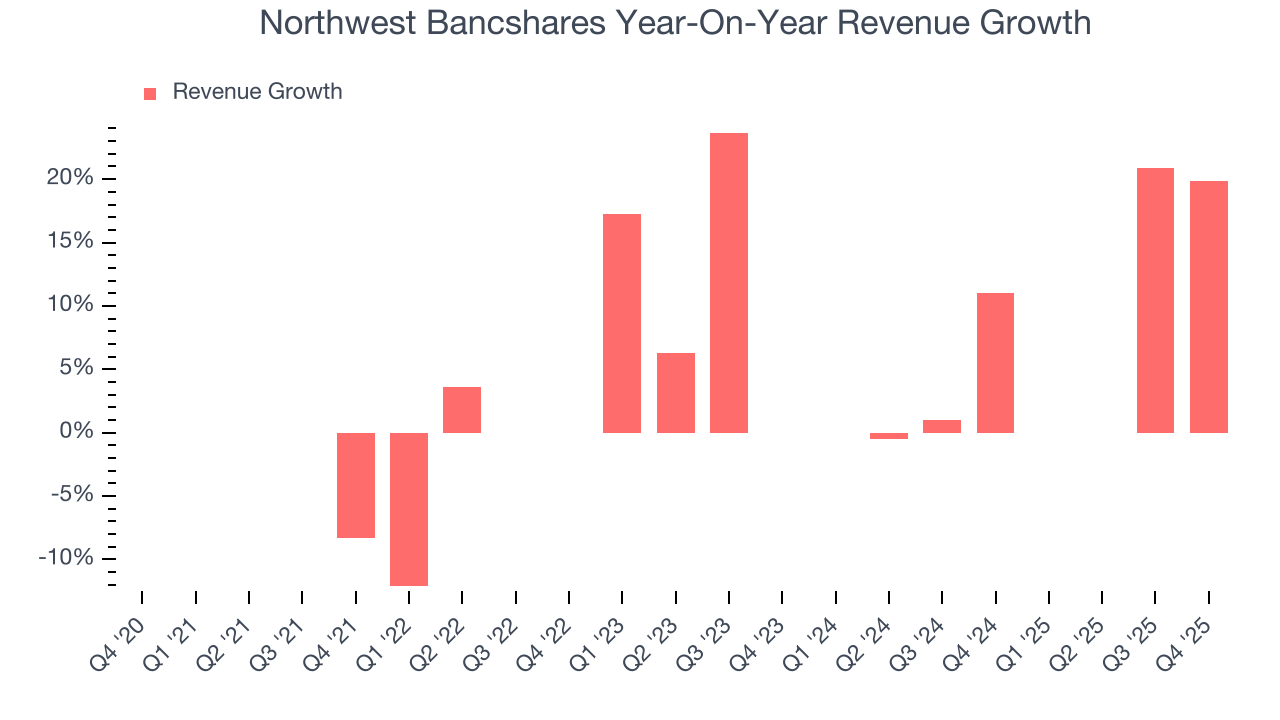 Note: Quarters not shown were determined to be outliers, impacted by outsized investment gains/losses that are not indicative of the recurring fundamentals of the business.
This quarter, Northwest Bancshares reported year-on-year revenue growth of 19.8%, and its $179.9 million of revenue exceeded Wall Street’s estimates by 3.7%.
Net interest income made up 79.8% of the company’s total revenue during the last five years, meaning lending operations are Northwest Bancshares’s largest source of revenue.
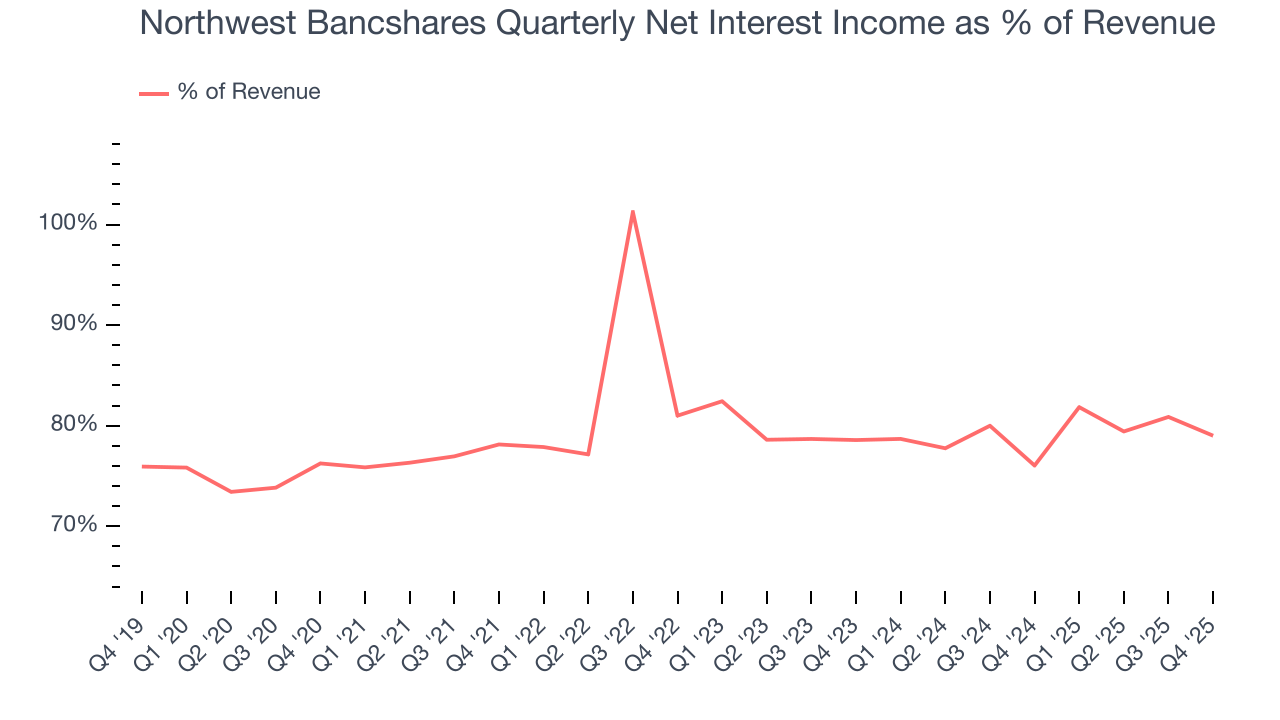
Net interest income commands greater market attention due to its reliability and consistency, whereas non-interest income is often seen as lower-quality revenue that lacks the same dependable characteristics.
6. Earnings Per Share
Revenue trends explain a company’s historical growth, but the long-term change in earnings per share (EPS) points to the profitability of that growth – for example, a company could inflate its sales through excessive spending on advertising and promotions.
Northwest Bancshares’s weak 5.9% annual EPS growth over the last five years aligns with its revenue performance. This tells us it maintained its per-share profitability as it expanded.
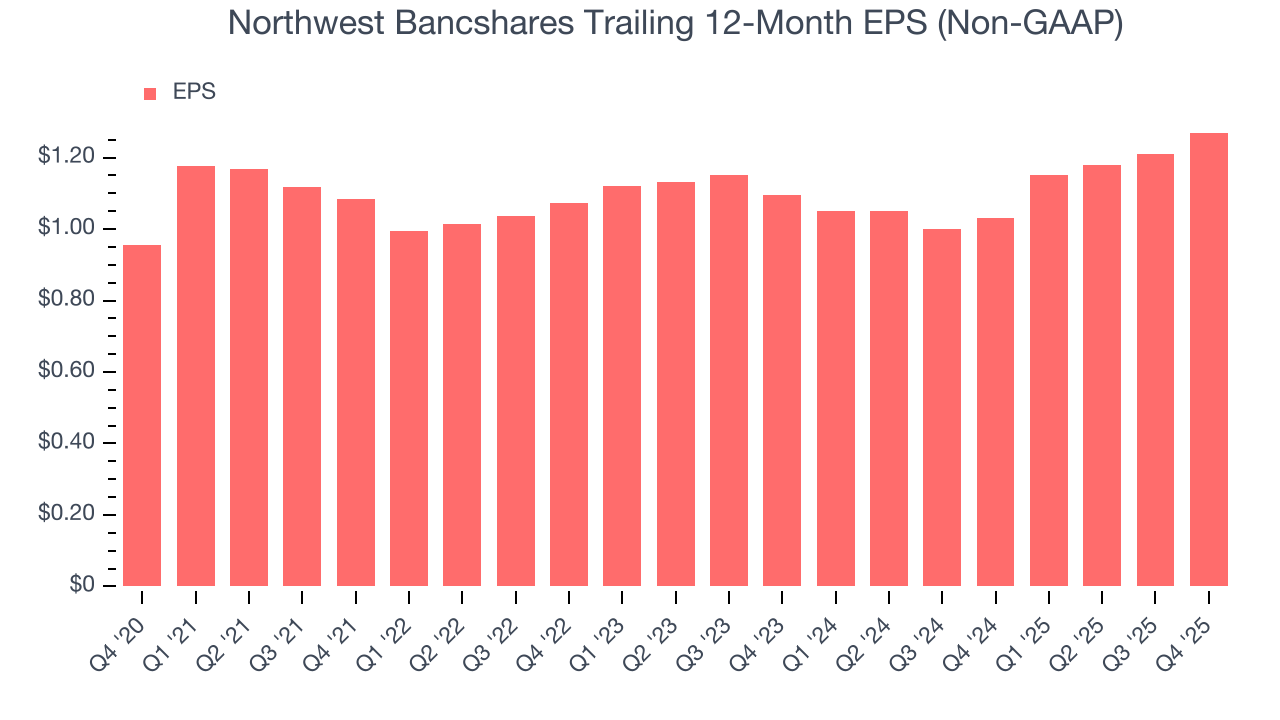
Like with revenue, we analyze EPS over a shorter period to see if we are missing a change in the business.
For Northwest Bancshares, its two-year annual EPS growth of 7.6% was higher than its five-year trend. Accelerating earnings growth is almost always an encouraging data point.
In Q4, Northwest Bancshares reported adjusted EPS of $0.33, up from $0.27 in the same quarter last year. This print beat analysts’ estimates by 7.8%. Over the next 12 months, Wall Street expects Northwest Bancshares’s full-year EPS of $1.27 to grow 3.2%.
7. Tangible Book Value Per Share (TBVPS)
Banks are balance sheet-driven businesses because they generate earnings primarily through borrowing and lending. They’re also valued based on their balance sheet strength and ability to compound book value (another name for shareholders’ equity) over time.
When analyzing banks, tangible book value per share (TBVPS) takes precedence over many other metrics. This measure isolates genuine per-share value by removing intangible assets of debatable liquidation worth. EPS can become murky due to acquisition impacts or accounting flexibility around loan provisions, and TBVPS resists financial engineering manipulation.
Northwest Bancshares’s TBVPS grew at a sluggish 1.5% annual clip over the last five years. However, TBVPS growth has accelerated recently, growing by 2.5% annually over the last two years from $9.17 to $9.63 per share.
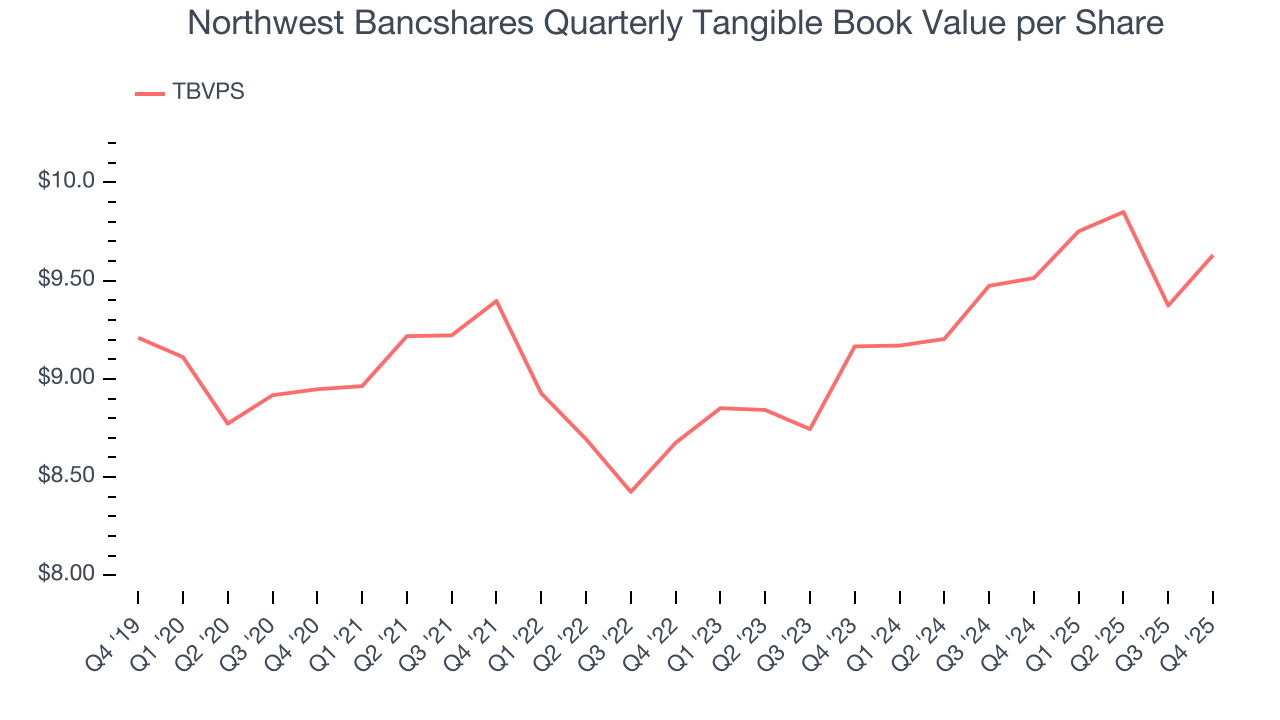
Over the next 12 months, Consensus estimates call for Northwest Bancshares’s TBVPS to grow by 5.5% to $10.16, lousy growth rate.
8. Balance Sheet Assessment
Leverage is core to a financial firm’s business model (loans funded by deposits). To ensure economic stability and avoid a repeat of the 2008 GFC, regulators require certain levels of capital and liquidity, focusing on the Tier 1 capital ratio.
Tier 1 capital is the highest-quality capital that a firm holds, consisting primarily of common stock and retained earnings, but also physical gold. It serves as the primary cushion against losses and is the first line of defense in times of financial distress.
This capital is divided by risk-weighted assets to derive the Tier 1 capital ratio. Risk-weighted means that cash and US treasury securities are assigned little risk while unsecured consumer loans and equity investments get much higher risk weights, for example.
New regulation after the 2008 financial crisis requires that all firms must maintain a Tier 1 capital ratio greater than 4.5%. On top of this, there are additional buffers based on scale, risk profile, and other regulatory classifications, so that at the end of the day, firms generally must maintain a 7-10% ratio at minimum.
Over the last two years, Northwest Bancshares has averaged a Tier 1 capital ratio of 12.7%, which is considered safe and well capitalized in the event that macro or market conditions suddenly deteriorate.
9. Return on Equity
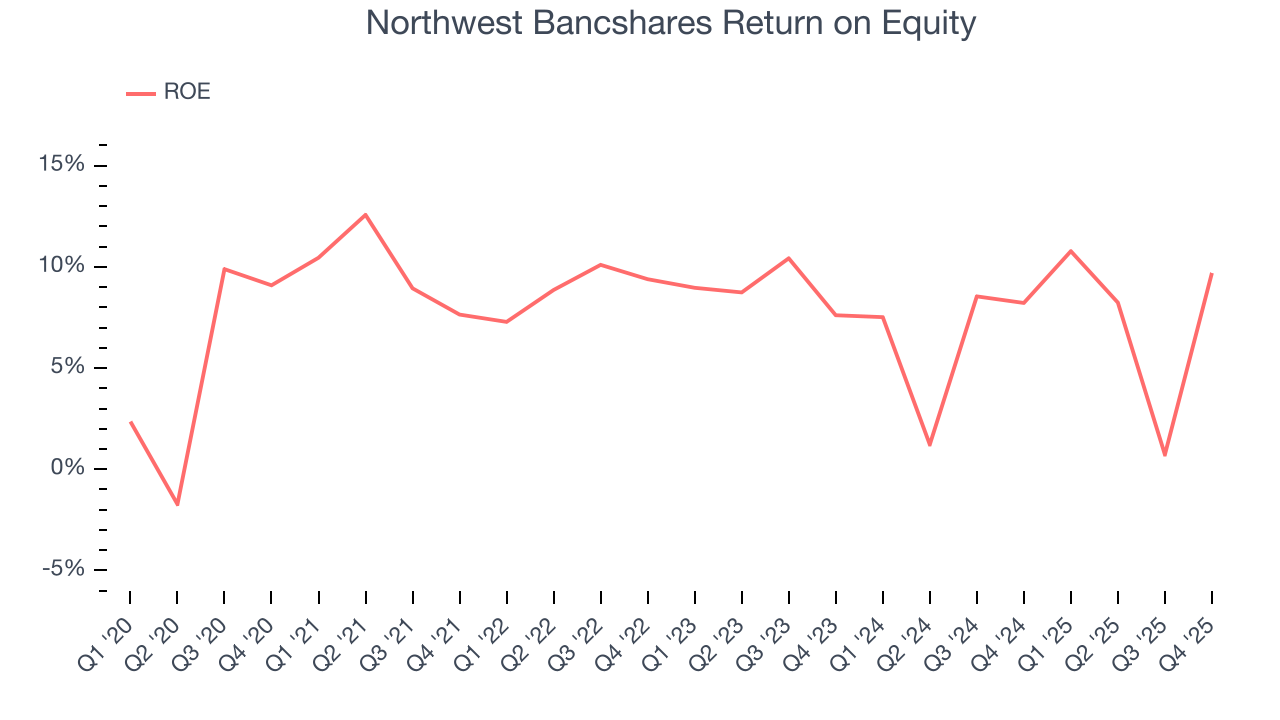
Return on equity (ROE) reveals the profit generated per dollar of shareholder equity, which represents a key source of bank funding. Banks maintaining elevated ROE levels tend to accelerate wealth creation for shareholders via earnings retention, buybacks, and distributions.
Over the last five years, Northwest Bancshares has averaged an ROE of 8.3%, uninspiring for a company operating in a sector where the average shakes out around 7.5%.
10. Key Takeaways from Northwest Bancshares’s Q4 Results
We enjoyed seeing Northwest Bancshares beat analysts’ revenue expectations this quarter. We were also glad its EPS outperformed Wall Street’s estimates. Overall, we think this was a decent quarter with some key metrics above expectations. The stock remained flat at $12.79 immediately after reporting.
11. Is Now The Time To Buy Northwest Bancshares?
Updated: March 24, 2026 at 12:50 AM EDT
The latest quarterly earnings matters, sure, but we actually think longer-term fundamentals and valuation matter more. Investors should consider all these pieces before deciding whether or not to invest in Northwest Bancshares.
Northwest Bancshares falls short of our quality standards. To begin with, its revenue growth was weak over the last five years. While its expanding net interest margin shows its loan book is becoming more profitable, the downside is its TBVPS growth was weak over the last five years. On top of that, its weak EPS growth over the last five years shows it’s failed to produce meaningful profits for shareholders.
Northwest Bancshares’s P/B ratio based on the next 12 months is 0.9x. This valuation multiple is fair, but we don’t have much confidence in the company. There are superior stocks to buy right now.
Wall Street analysts have a consensus one-year price target of $13.86 on the company (compared to the current share price of $12.45).