
Seagate (STX)
We see potential in Seagate. Its expanding operating margin shows it’s becoming a more efficient business.― StockStory Analyst Team


1. News


2. Summary
Why Seagate Is Interesting
One of two remaining major hard drive manufacturers after decades of industry consolidation, Seagate (NASDAQ:STX) manufactures hard disk drives and solid state drives that store data in data centers, cloud systems, and consumer devices.
- Estimated revenue growth of 28.2% for the next 12 months implies demand will accelerate from its two-year trend
- Industry-leading 30% return on capital demonstrates management’s skill in finding high-return investments, and its returns are climbing as it finds even more attractive growth opportunities
- On the flip side, its gross margin of 35.7% is below its competitors, leaving less money to invest in areas like marketing and R&D
Seagate shows some potential. If you like the story, the price seems fair.
Why Is Now The Time To Buy Seagate?

At $406.19 per share, Seagate trades at 24.6x forward P/E. Many semiconductor companies feature higher valuation multiples than Seagate. Regardless, we think Seagate’s current price is appropriate given the quality you get.
It could be a good time to invest if you see something the market doesn’t.
3. Seagate (STX) Research Report: Q4 CY2025 Update
Data storage manufacturer Seagate (NASDAQ:STX) reported Q4 CY2025 results exceeding the market’s revenue expectations, with sales up 21.5% year on year to $2.83 billion. On top of that, next quarter’s revenue guidance ($2.9 billion at the midpoint) was surprisingly good and 4% above what analysts were expecting. Its non-GAAP profit of $3.11 per share was 9.6% above analysts’ consensus estimates.
Seagate Technology (STX) Q4 CY2025 Highlights:
- Revenue: $2.83 billion vs analyst estimates of $2.75 billion (21.5% year-on-year growth, 2.6% beat)
- Adjusted EPS: $3.11 vs analyst estimates of $2.84 (9.6% beat)
- Adjusted EBITDA: $962 million vs analyst estimates of $893.5 million (34.1% margin, 7.7% beat)
- Revenue Guidance for Q1 CY2026 is $2.9 billion at the midpoint, above analyst estimates of $2.79 billion
- Adjusted EPS guidance for Q1 CY2026 is $3.40 at the midpoint, above analyst estimates of $3.01
- Operating Margin: 29.8%, up from 21% in the same quarter last year
- Free Cash Flow Margin: 21.5%, up from 6.5% in the same quarter last year
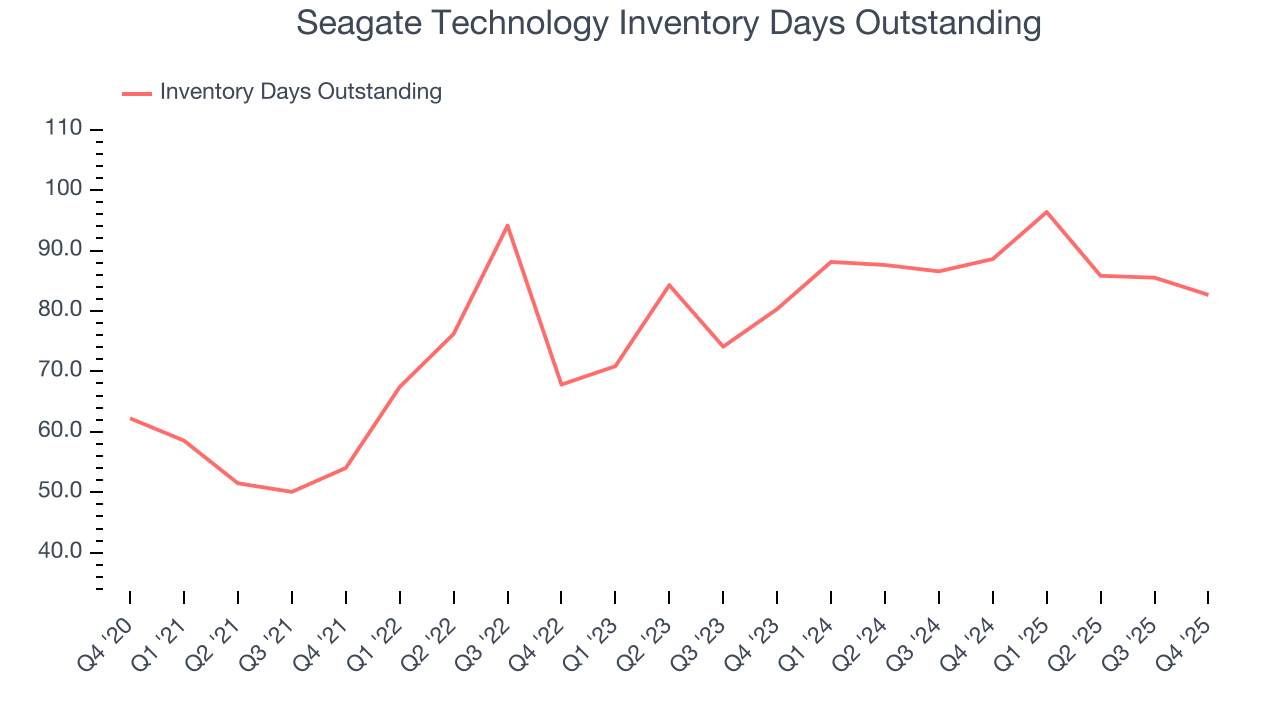
- Inventory Days Outstanding: 83, down from 86 in the previous quarter
- Market Capitalization: $78.06 billion
Company Overview
The developer of the original 5.25inch hard disk drive, Seagate (NASDAQ:STX) is a leading producer of data storage solutions, including hard drives and Solid State Drives (SSDs) used in PCs and data centers.
Seagate's core business revolves around hard disk drives (HDDs), which use spinning magnetic disks to store data, and solid state drives (SSDs), which store data on flash memory chips without moving parts. The company differentiates its products by capacity, performance, reliability, and interface type, serving applications ranging from massive cloud data centers to personal computers and gaming consoles.
The company's mass capacity storage products target hyperscale data centers, cloud service providers, and emerging applications like artificial intelligence and machine learning. Its enterprise nearline HDDs offer capacities up to 32 terabytes using heat-assisted magnetic recording (HAMR) technology, marketed under the Mozaic platform. These drives come with Serial Advanced Technology Attachment (SATA) or Serial Attached SCSI (SAS) interfaces. For example, a cloud service provider like Amazon or Microsoft might use thousands of Seagate's high-capacity drives to store customer data, videos, and backups across their data centers. Beyond individual drives, Seagate also sells complete storage systems—rack-mounted arrays that can hold multiple drives in configurations reaching over 2 petabytes per chassis.
Seagate's legacy markets include mission-critical enterprise applications and consumer products. The company offers external hard drives sold under brands like Seagate One Touch and LaCie, with capacities up to 24 terabytes for backing up personal files or expanding gaming console storage. Its video imaging drives support surveillance systems that record continuously, while network-attached storage (NAS) drives serve small and medium businesses requiring reliable file servers.
The company also operates Lyve, a platform for managing large-scale data movement and storage. Lyve Cloud provides object storage as a service compatible with Amazon's S3 standard, available on a consumption-based pricing model. Seagate designs and manufactures critical drive components in-house, including read/write heads and recording media, maintaining control over its core technology. Revenue comes primarily from selling drives to original equipment manufacturers (OEMs), distributors who resell to system builders and businesses, and retailers who stock consumer products.
Seagates peers and competitors include Western Digital (NASDAQ:WDC), SK Hynix (KOSI:000660), and Samsung (KOSI:005930).
4. Memory Semiconductors
The global memory chip market has become concentrated due to the highly commoditized nature of these semiconductors. Despite the market consolidation, DRAM and NAND are subject to wide pricing swings as supply and demand ebbs and flows. This plays itself out in the business models of memory producers, where the large, fixed cost bases required to produce memory chips in volume can become very profitable during times of rising prices due to high demand and tight supply but also can result in periods of low profitability when more supply is brought online or demand drops.
5. Revenue Growth
A company’s long-term sales performance can indicate its overall quality. Any business can experience short-term success, but top-performing ones enjoy sustained growth for years. Unfortunately, Seagate Technology struggled to consistently increase demand as its $10.06 billion of sales for the trailing 12 months was close to its revenue five years ago. This wasn’t a great result, but there are still things to like about Seagate Technology. Semiconductors are a cyclical industry, and long-term investors should be prepared for periods of high growth followed by periods of revenue contractions.
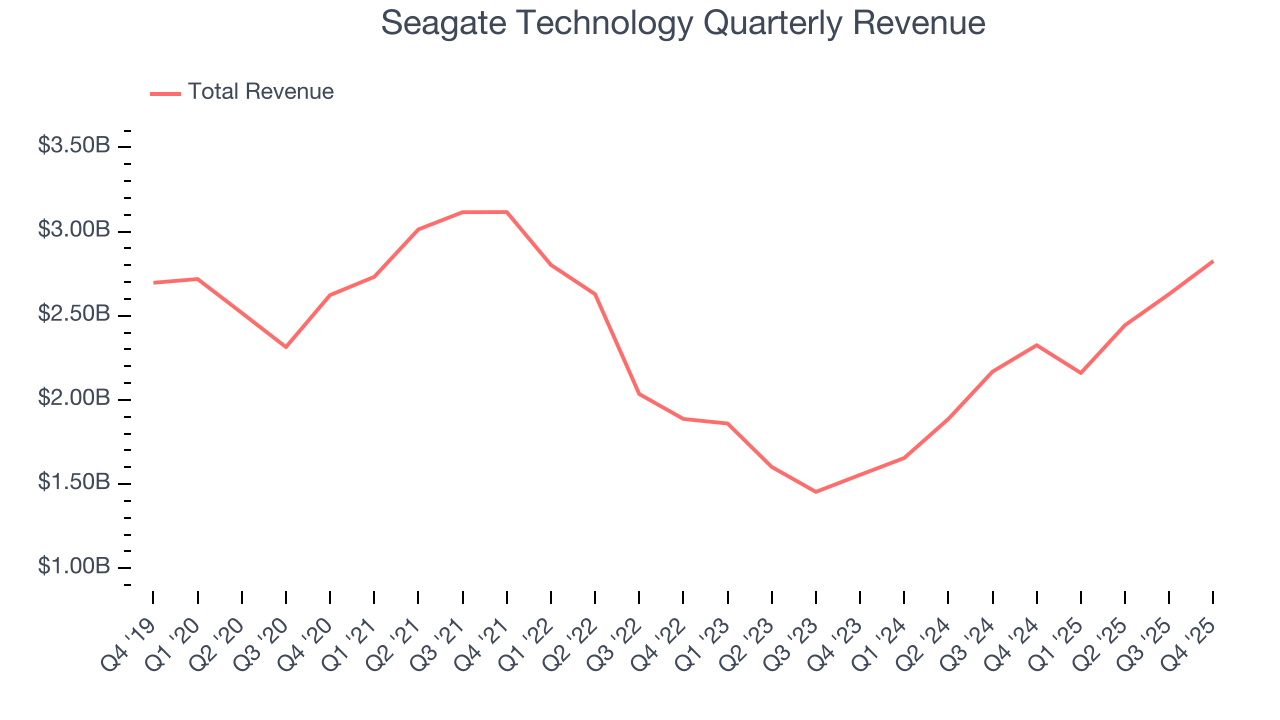
We at StockStory place the most emphasis on long-term growth, but within semiconductors, a half-decade historical view may miss new demand cycles or industry trends like AI. Seagate Technology’s annualized revenue growth of 24.7% over the last two years is above its five-year trend, suggesting its demand recently accelerated. 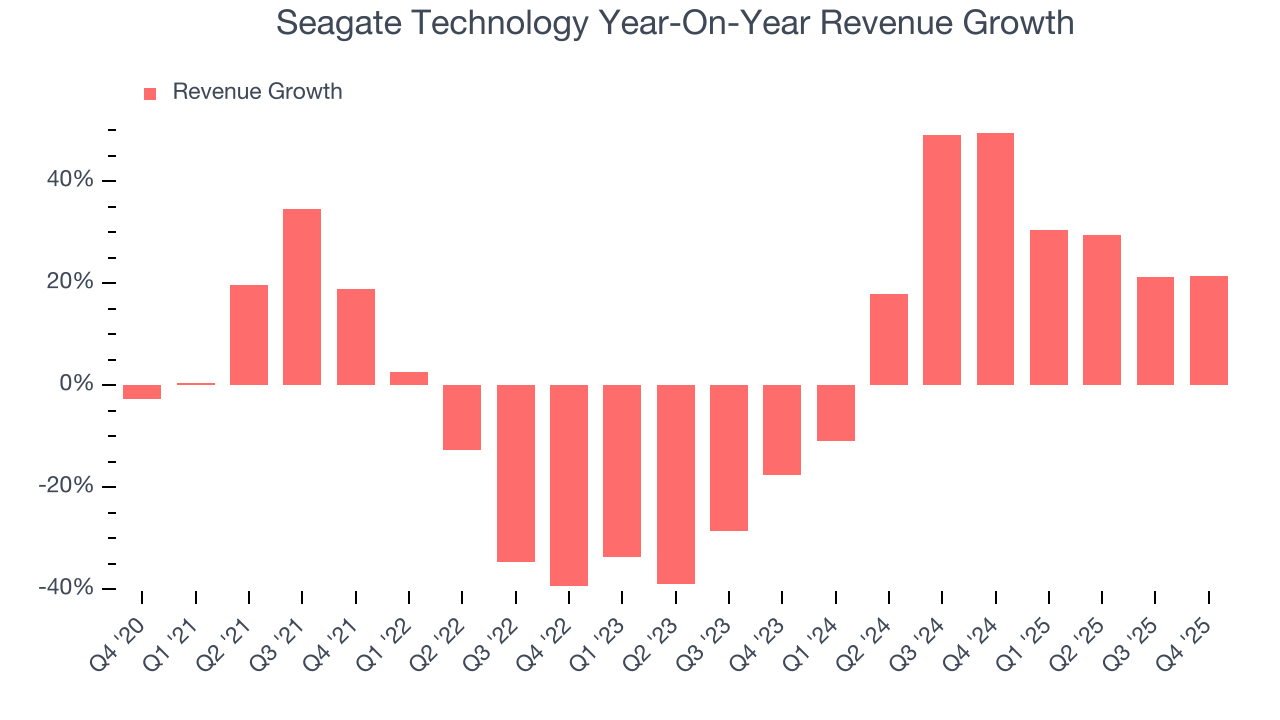
This quarter, Seagate Technology reported robust year-on-year revenue growth of 21.5%, and its $2.83 billion of revenue topped Wall Street estimates by 2.6%. Beyond the beat, this marks 7 straight quarters of growth, showing that the current upcycle has had a good run - a typical upcycle usually lasts 8-10 quarters. Company management is currently guiding for a 34.3% year-on-year increase in sales next quarter.
Looking further ahead, sell-side analysts expect revenue to grow 20.1% over the next 12 months, a deceleration versus the last two years. We still think its growth trajectory is attractive given its scale and suggests the market is forecasting success for its products and services.
6. Product Demand & Outstanding Inventory
Days Inventory Outstanding (DIO) is an important metric for chipmakers, as it reflects a business’ capital intensity and the cyclical nature of semiconductor supply and demand. In a tight supply environment, inventories tend to be stable, allowing chipmakers to exert pricing power. Steadily increasing DIO can be a warning sign that demand is weak, and if inventories continue to rise, the company may have to downsize production.
This quarter, Seagate Technology’s DIO came in at 83, which is 6 days above its five-year average. These numbers suggest that despite the recent decrease, the company’s inventory levels are higher than what we’ve seen in the past.
7. Gross Margin & Pricing Power
In the semiconductor industry, a company’s gross profit margin is a critical metric to track because it sheds light on its pricing power, complexity of products, and ability to procure raw materials, equipment, and labor.
Seagate Technology’s gross margin is one of the worst in the semiconductor industry, signaling it operates in a competitive market and lacks pricing power. As you can see below, it averaged a 35.7% gross margin over the last two years. That means Seagate Technology paid its suppliers a lot of money ($64.35 for every $100 in revenue) to run its business. 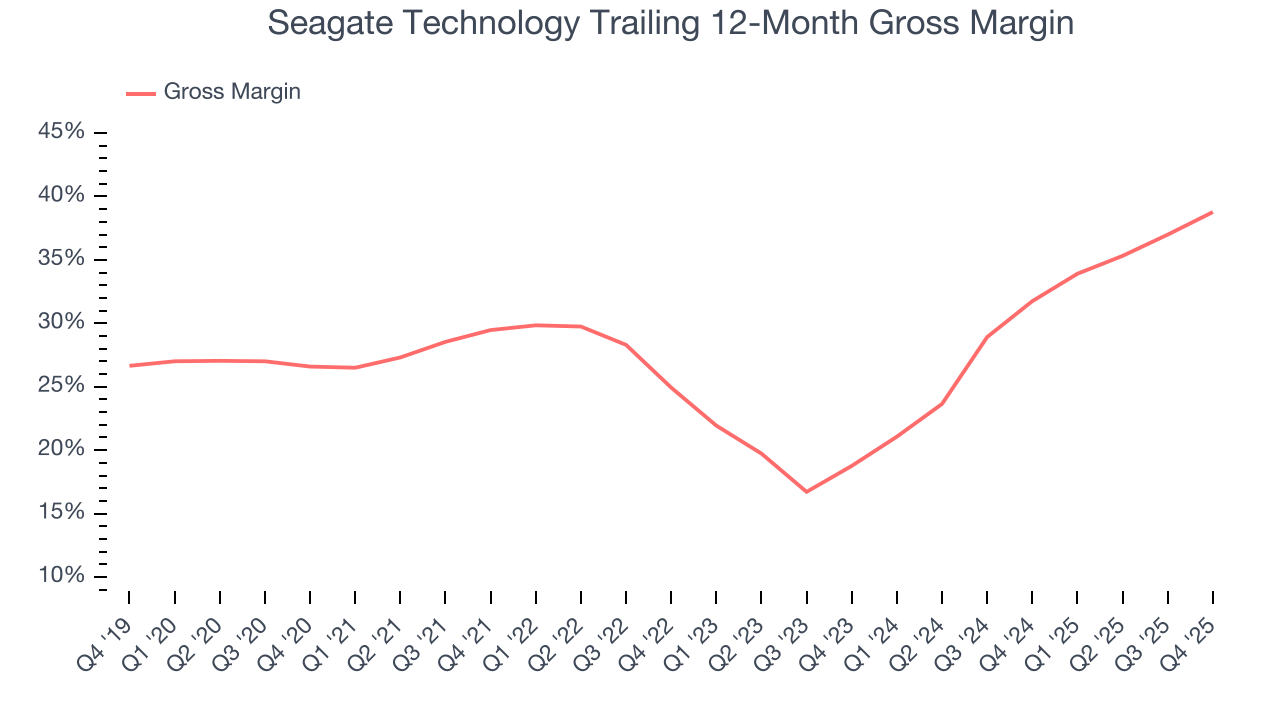
This quarter, Seagate Technology’s gross profit margin was 41.6%, marking a 6.7 percentage point increase from 34.9% in the same quarter last year. Seagate Technology’s full-year margin has also been trending up over the past 12 months, increasing by 7 percentage points. If this move continues, it could suggest a less competitive environment where the company has better pricing power and leverage from its growing sales on the fixed portion of its cost of goods sold (such as manufacturing expenses).
8. Operating Margin
Seagate Technology has managed its cost base well over the last two years. It demonstrated solid profitability for a semiconductor business, producing an average operating margin of 21.5%. This result was particularly impressive because of its low gross margin, which is mostly a factor of what it sells and takes huge shifts to move meaningfully. Companies have more control over their operating margins, and it’s a show of well-managed operations if they’re high when gross margins are low.
Analyzing the trend in its profitability, Seagate Technology’s operating margin rose by 8 percentage points over the last five years, showing its efficiency has improved.
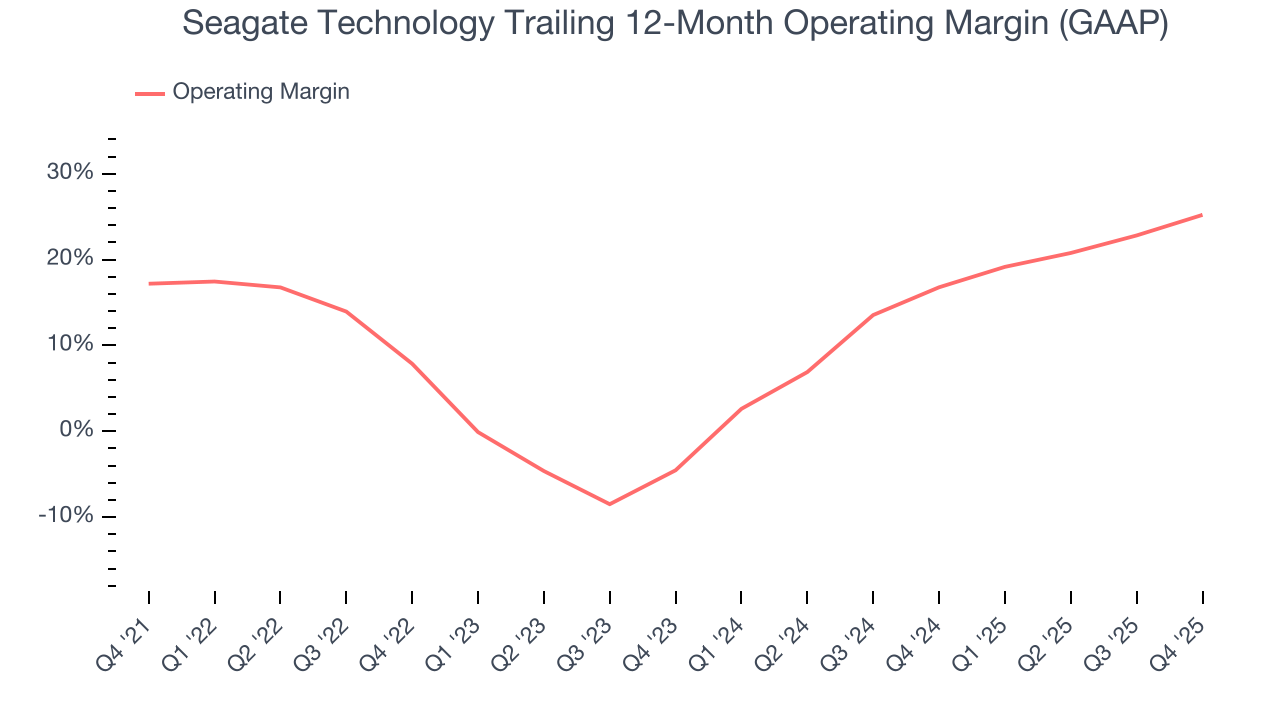
This quarter, Seagate Technology generated an operating margin profit margin of 29.8%, up 8.9 percentage points year on year. The increase was solid, and because its operating margin rose more than its gross margin, we can infer it was more efficient with expenses such as marketing, R&D, and administrative overhead.
9. Earnings Per Share
We track the long-term change in earnings per share (EPS) for the same reason as long-term revenue growth. Compared to revenue, however, EPS highlights whether a company’s growth is profitable.
Seagate Technology’s EPS grew at a decent 16.3% compounded annual growth rate over the last five years, higher than its flat revenue. This tells us management responded to softer demand by adapting its cost structure.
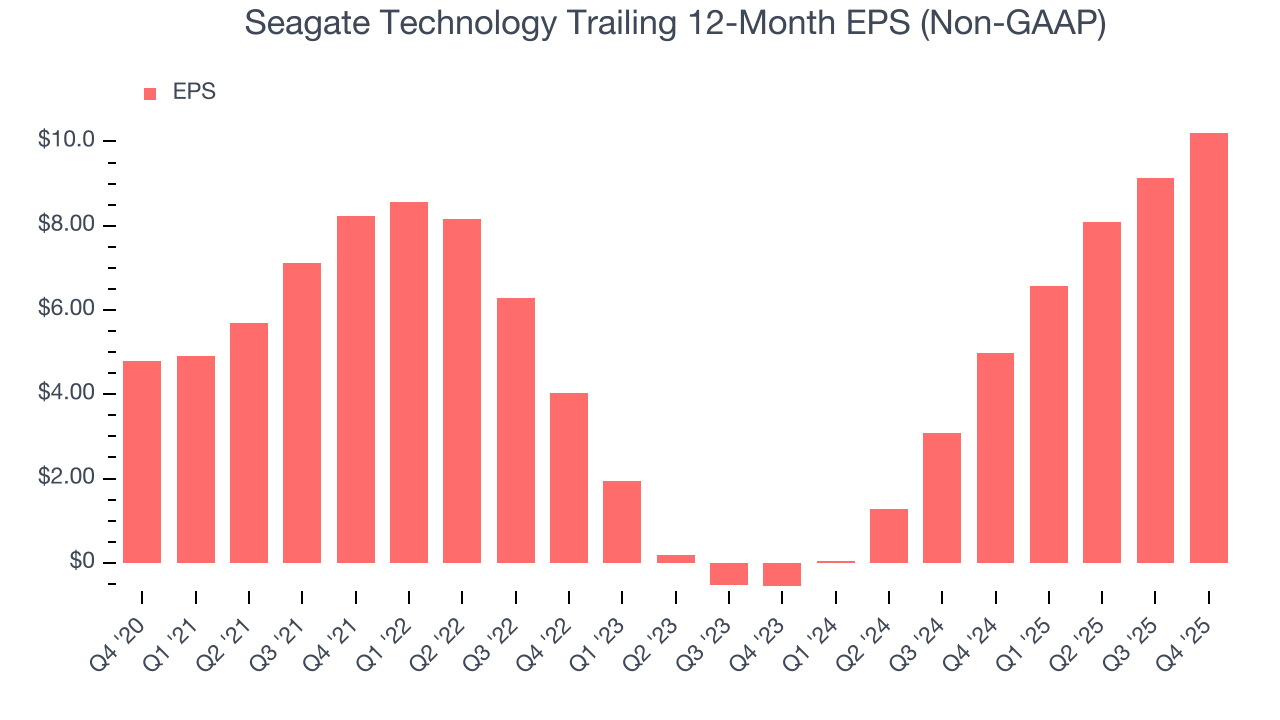
Diving into the nuances of Seagate Technology’s earnings can give us a better understanding of its performance. As we mentioned earlier, Seagate Technology’s operating margin expanded by 8 percentage points over the last five years. On top of that, its share count shrank by 9.2%. These are positive signs for shareholders because improving profitability and share buybacks turbocharge EPS growth relative to revenue growth. 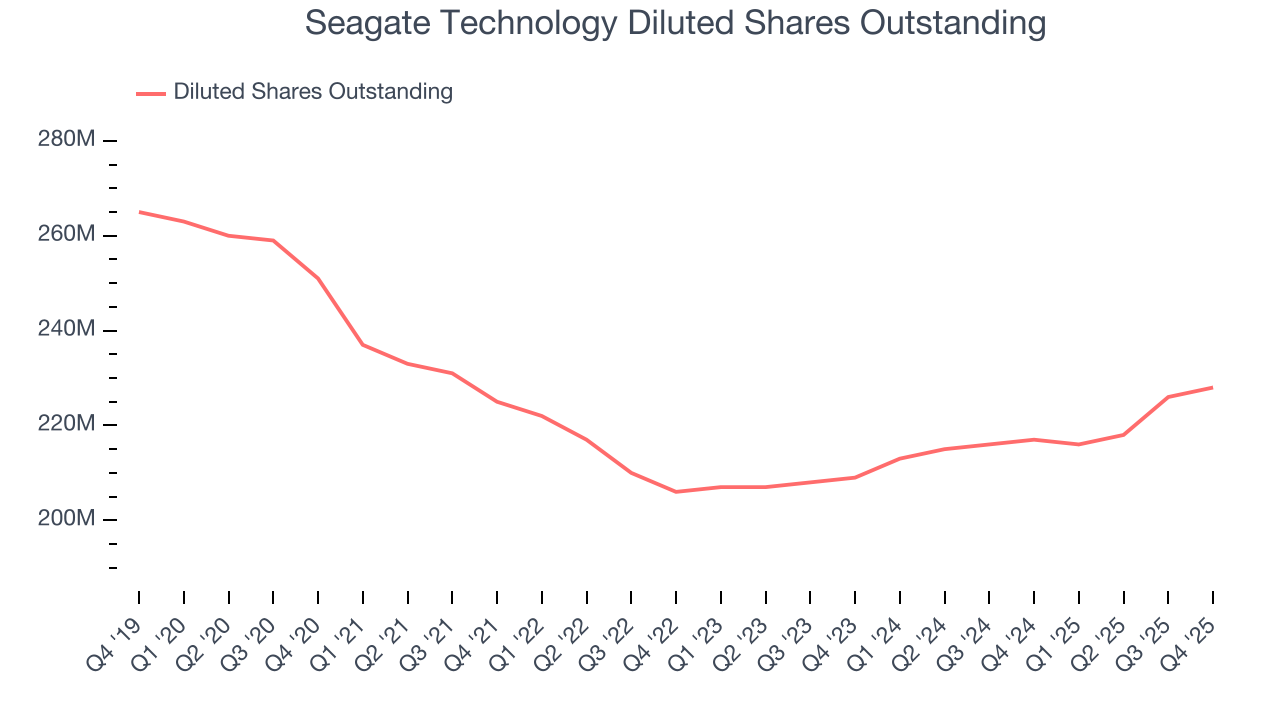
In Q4, Seagate Technology reported adjusted EPS of $3.11, up from $2.03 in the same quarter last year. This print beat analysts’ estimates by 9.6%. Over the next 12 months, Wall Street expects Seagate Technology’s full-year EPS of $10.21 to grow 40%.
10. Cash Is King
Free cash flow isn't a prominently featured metric in company financials and earnings releases, but we think it's telling because it accounts for all operating and capital expenses, making it tough to manipulate. Cash is king.
Seagate Technology has shown mediocre cash profitability over the last two years, giving the company limited opportunities to return capital to shareholders. Its free cash flow margin averaged 13%, subpar for a semiconductor business.
Taking a step back, an encouraging sign is that Seagate Technology’s margin expanded by 4.7 percentage points over the last five years. We have no doubt shareholders would like to continue seeing its cash conversion rise as it gives the company more optionality.
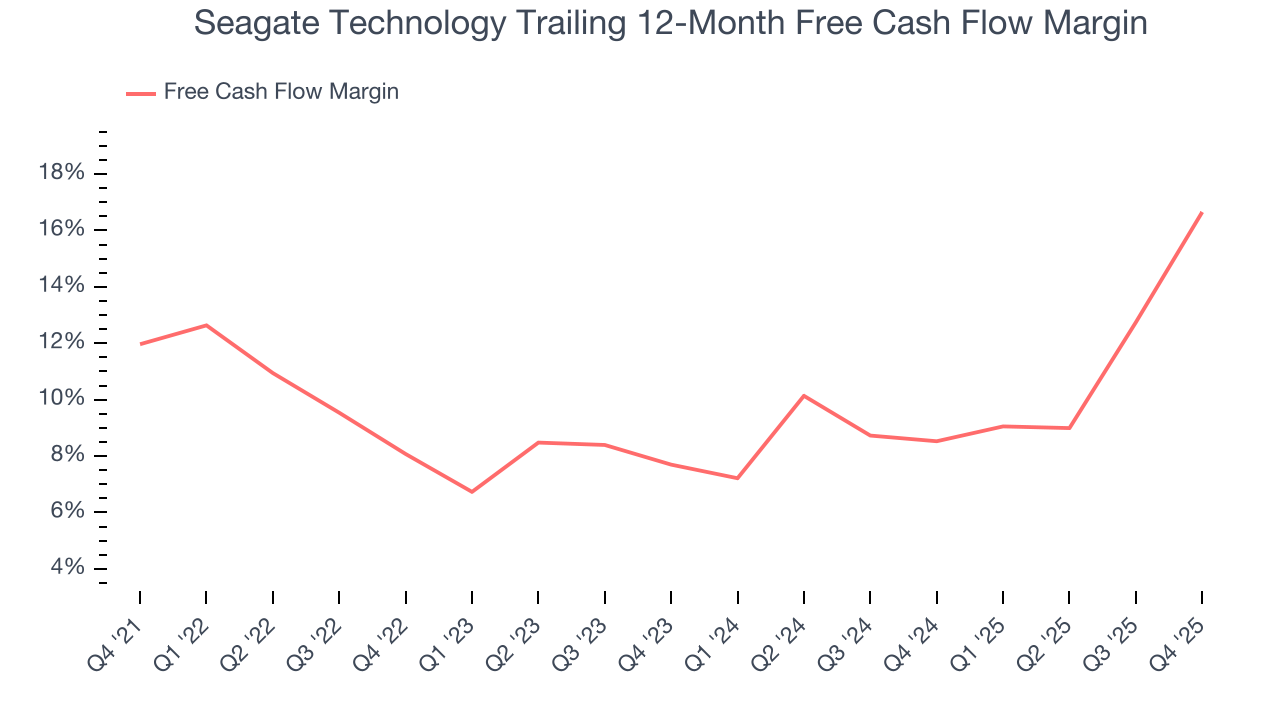
Seagate Technology’s free cash flow clocked in at $607 million in Q4, equivalent to a 21.5% margin. This result was good as its margin was 15 percentage points higher than in the same quarter last year, building on its favorable historical trend.
11. Return on Invested Capital (ROIC)
EPS and free cash flow tell us whether a company was profitable while growing its revenue. But was it capital-efficient? A company’s ROIC explains this by showing how much operating profit it makes compared to the money it has raised (debt and equity).
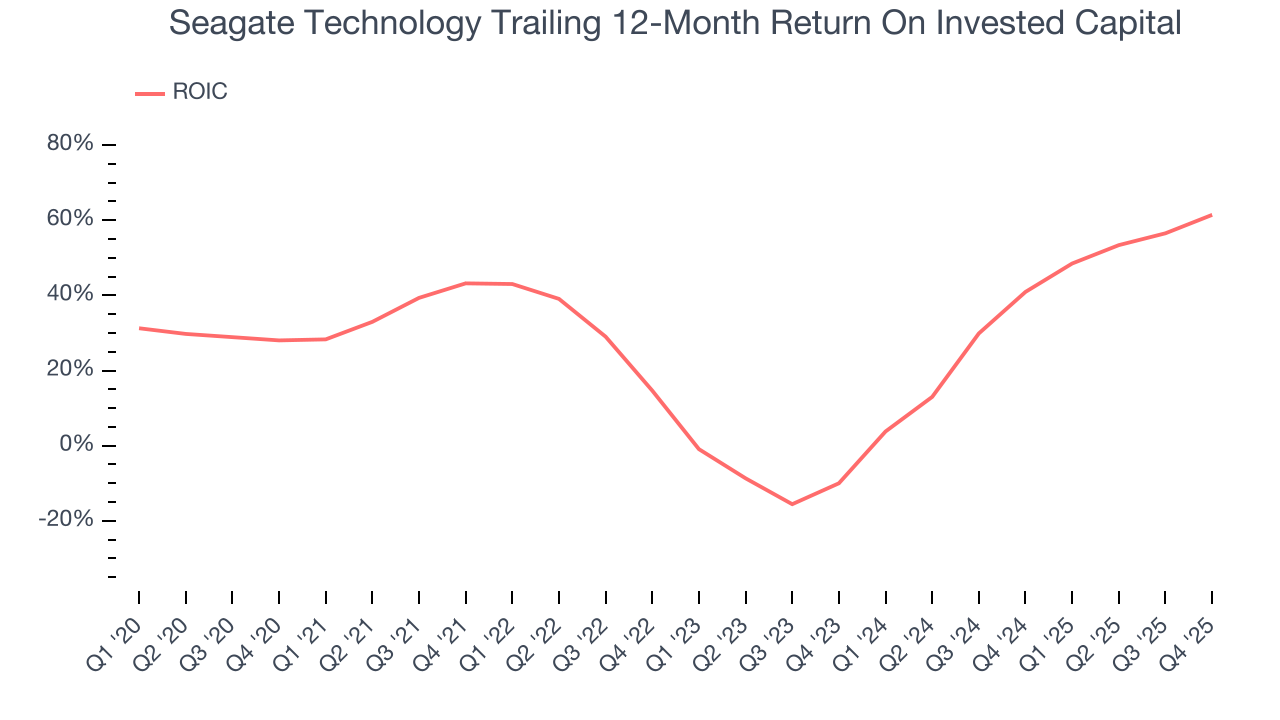
Seagate Technology’s five-year average ROIC was 30%, beating other semiconductor companies by a wide margin. This illustrates its management team’s ability to invest in attractive growth opportunities and produce tangible results for shareholders.
12. Balance Sheet Assessment
Seagate Technology reported $1.05 billion of cash and $4.50 billion of debt on its balance sheet in the most recent quarter. As investors in high-quality companies, we primarily focus on two things: 1) that a company’s debt level isn’t too high and 2) that its interest payments are not excessively burdening the business.
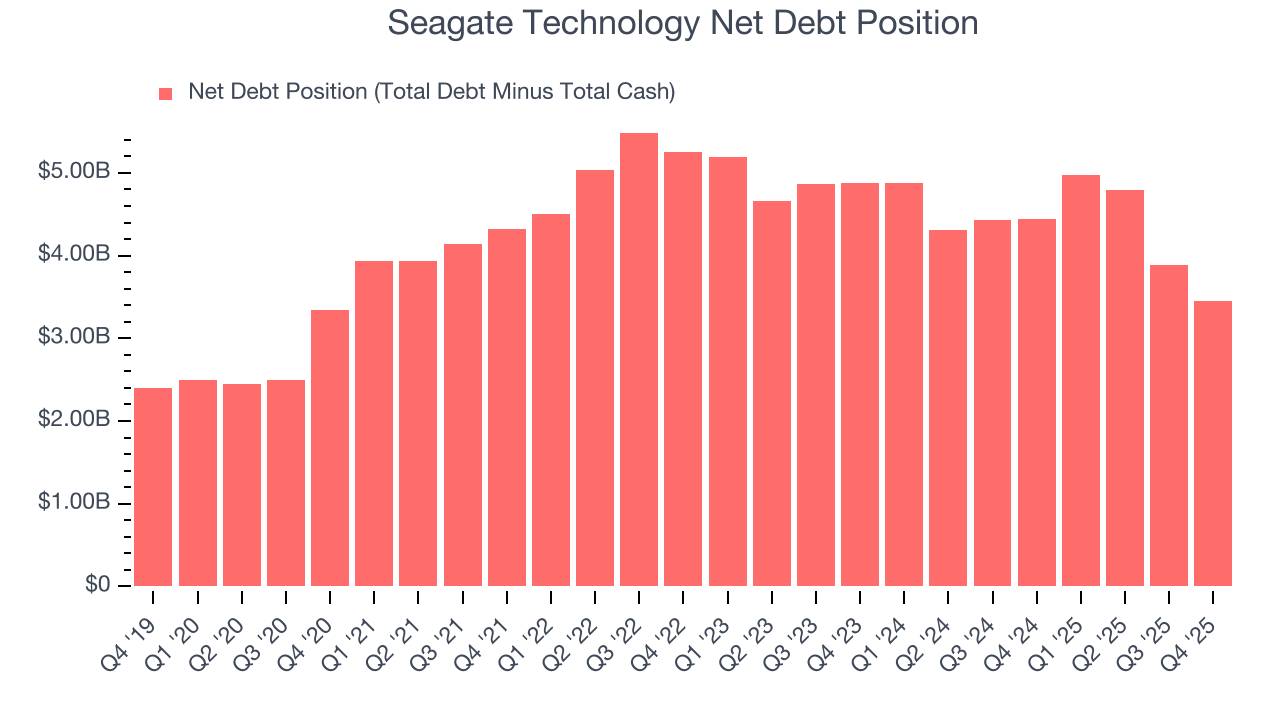
With $3.07 billion of EBITDA over the last 12 months, we view Seagate Technology’s 1.1× net-debt-to-EBITDA ratio as safe. We also see its $280 million of annual interest expenses as appropriate. The company’s profits give it plenty of breathing room, allowing it to continue investing in growth initiatives.
13. Key Takeaways from Seagate Technology’s Q4 Results
It was good to see Seagate Technology beat analysts’ EPS expectations this quarter. We were also excited its adjusted operating income outperformed Wall Street’s estimates by a wide margin. Zooming out, we think this was a good print with some key areas of upside. The market seemed to be hoping for more, and the stock traded down 2.5% to $364.18 immediately after reporting.
14. Is Now The Time To Buy Seagate?
Updated: March 23, 2026 at 10:22 PM EDT
Before deciding whether to buy Seagate or pass, we urge investors to consider business quality, valuation, and the latest quarterly results.
There’s plenty to admire about Seagate. Although its revenue growth was weak over the last five years, its growth over the next 12 months is expected to be higher. And while Seagate’s low gross margins indicate some combination of pricing pressures or rising production costs, its expanding operating margin shows the business has become more efficient. On top of that, its rising cash profitability gives it more optionality.
Seagate’s P/E ratio based on the next 12 months is 24.6x. Looking at the semiconductor space right now, Seagate trades at a compelling valuation. If you’re a fan of the business and management team, now is a good time to scoop up some shares.
Wall Street analysts have a consensus one-year price target of $475.35 on the company (compared to the current share price of $406.19), implying they see 17% upside in buying Seagate in the short term.