
Texas Roadhouse (TXRH)
Texas Roadhouse catches our eye. Its superior revenue growth and returns on capital show it can achieve fast and profitable expansion.― StockStory Analyst Team


1. News


2. Summary
Why Texas Roadhouse Is Interesting
With locations often featuring Western-inspired decor, Texas Roadhouse (NASDAQ:TXRH) is an American restaurant chain specializing in Southern-style cuisine and steaks.
- Stellar returns on capital showcase management’s ability to surface highly profitable business ventures
- Customers are lining up to eat at its restaurants as the company’s same-store sales growth averaged 6.7% over the past two years
- One risk is its gross margin of 16.7% reflects the bad unit economics inherent in most restaurant businesses
Texas Roadhouse is close to becoming a high-quality business. If you believe in the company, the valuation looks fair.
Why Is Now The Time To Buy Texas Roadhouse?







Texas Roadhouse’s stock price of $173.27 implies a valuation ratio of 27.4x forward P/E. Scanning the restaurant landscape, we think the price is reasonable for the revenue growth you get.
It could be a good time to invest if you see something the market doesn’t.
3. Texas Roadhouse (TXRH) Research Report: Q4 CY2025 Update
Restaurant company Texas Roadhouse (NASDAQ:TXRH) missed Wall Street’s revenue expectations in Q4 CY2025 as sales rose 3.1% year on year to $1.48 billion. Its GAAP profit of $1.28 per share was 13.8% below analysts’ consensus estimates.
Texas Roadhouse (TXRH) Q4 CY2025 Highlights:
- Revenue: $1.48 billion vs analyst estimates of $1.49 billion (3.1% year-on-year growth, 0.8% miss)
- EPS (GAAP): $1.28 vs analyst expectations of $1.49 (13.8% miss)
- Operating Margin: 6.5%, down from 9.6% in the same quarter last year
- Free Cash Flow Margin: 8.9%, similar to the same quarter last year
- Locations: 1,242 at quarter end, up from 784 in the same quarter last year
- Same-Store Sales rose 4.4% year on year (7.4% in the same quarter last year)
- Market Capitalization: $12.36 billion
Company Overview
With locations often featuring Western-inspired decor, Texas Roadhouse (NASDAQ:TXRH) is an American restaurant chain specializing in Southern-style cuisine and steaks.
The company operates under the Texas Roadhouse, Bubba's 33, and Jaggers banners. Across its different brands, Texas Roadhouse is known for its hand-cut steaks, fall-off-the-bone ribs, made-from-scratch sides, and fresh-baked bread. Portions tend to be hearty, giving customers a good bang for their buck.
Texas Roadhouse primarily targets suburban and rural families seeking high-quality comfort food. Given the sit-down nature of the dining experience, the target customer will certainly spend more at Texas Roadhouse than a typical fast-food joint. However, prices also are meaningfully cheaper than fine dining experiences at stuffier “white tablecloth” establishments.
Restaurants are typically 6,000 to 7,500 square feet and located in high-traffic areas of suburban and rural cities and towns. Locations feature a rustic ambiance and sometimes feature nostalgic Southern memorabilia and even line dancing performances. Open kitchens allow customers to witness the preparation of their meals.
4. Sit-Down Dining
Sit-down restaurants offer a complete dining experience with table service. These establishments span various cuisines and are renowned for their warm hospitality and welcoming ambiance, making them perfect for family gatherings, special occasions, or simply unwinding. Their extensive menus range from appetizers to indulgent desserts and wines and cocktails. This space is extremely fragmented and competition includes everything from publicly-traded companies owning multiple chains to single-location mom-and-pop restaurants.
Multi-brand full-service restaurant competitors include Bloomin’ Brands (NASDAQ:BLMN), Brinker International (NYSE:EAT), Darden Restaurants (NYSE:DRI), Dine Brands (NYSE:DIN), and The Cheesecake Factory (NASDAQ:CAKE).
5. Revenue Growth
A company’s long-term performance is an indicator of its overall quality. Any business can experience short-term success, but top-performing ones enjoy sustained growth for years.
With $5.88 billion in revenue over the past 12 months, Texas Roadhouse is one of the larger restaurant chains in the industry and benefits from a well-known brand that influences consumer purchasing decisions.
As you can see below, Texas Roadhouse’s sales grew at an impressive 13.5% compounded annual growth rate over the last six years as it opened new restaurants and increased sales at existing, established dining locations.
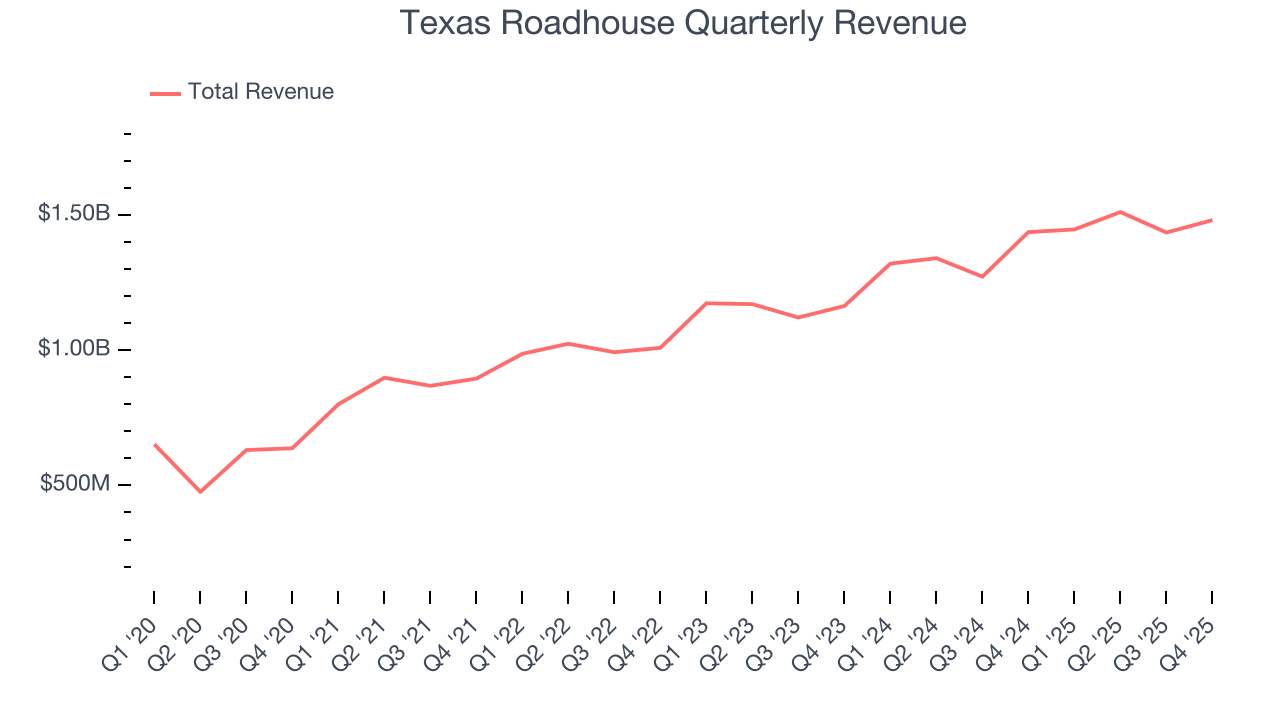
This quarter, Texas Roadhouse’s revenue grew by 3.1% year on year to $1.48 billion, falling short of Wall Street’s estimates.
Looking ahead, sell-side analysts expect revenue to grow 10.7% over the next 12 months, a slight deceleration versus the last six years. Still, this projection is healthy and suggests the market sees success for its menu offerings.
6. Restaurant Performance
Number of Restaurants
A restaurant chain’s total number of dining locations influences how much it can sell and how quickly revenue can grow.
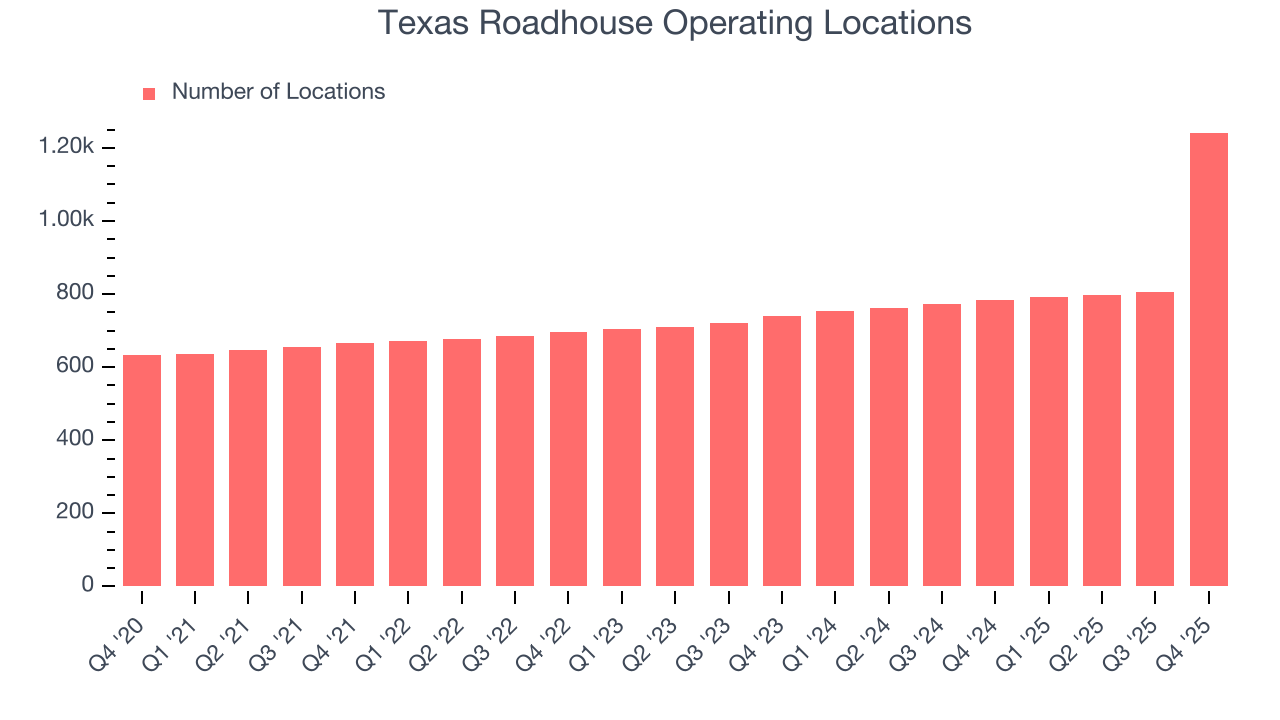
Texas Roadhouse operated 1,242 locations in the latest quarter. It has opened new restaurants at a rapid clip over the last two years, averaging 12.5% annual growth, much faster than the broader restaurant sector.
When a chain opens new restaurants, it usually means it’s investing for growth because there’s healthy demand for its meals and there are markets where its concepts have few or no locations.
Same-Store Sales
The change in a company's restaurant base only tells one side of the story. The other is the performance of its existing locations, which informs management teams whether they should expand or downsize their physical footprints. Same-store sales is an industry measure of whether revenue is growing at those existing restaurants and is driven by customer visits (often called traffic) and the average spending per customer (ticket).
Texas Roadhouse has been one of the most successful restaurant chains over the last two years thanks to skyrocketing demand within its existing dining locations. On average, the company has posted exceptional year-on-year same-store sales growth of 6.7%. This performance along with its meaningful buildout of new restaurants suggest it’s playing some aggressive offense.
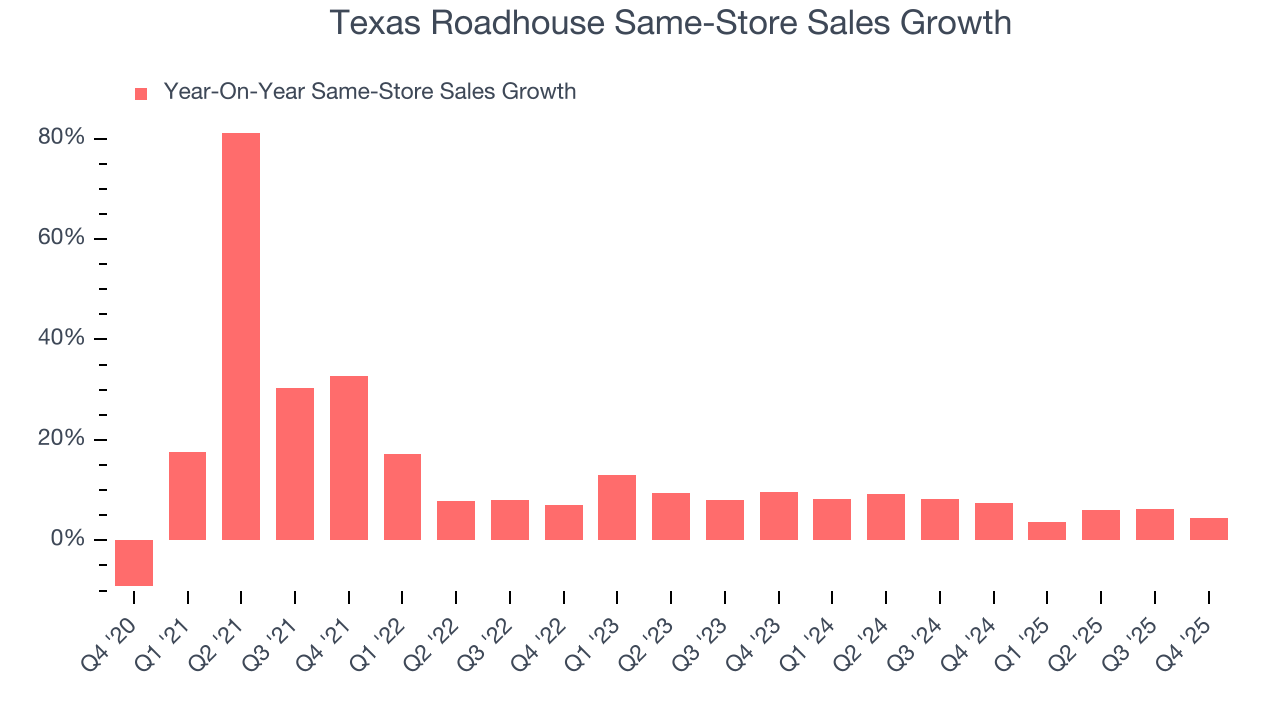
In the latest quarter, Texas Roadhouse’s same-store sales rose 4.4% year on year. This growth was a deceleration from its historical levels, showing the business is still performing well but losing a bit of steam.
7. Gross Margin & Pricing Power
Gross profit margins are an important measure of a restaurant’s pricing power and differentiation, whether it be the dining experience or quality and taste of food.
Texas Roadhouse has bad unit economics for a restaurant company, signaling it operates in a competitive market and has little room for error if demand unexpectedly falls. As you can see below, it averaged a 16.7% gross margin over the last two years. That means Texas Roadhouse paid its suppliers a lot of money ($83.26 for every $100 in revenue) to run its business. 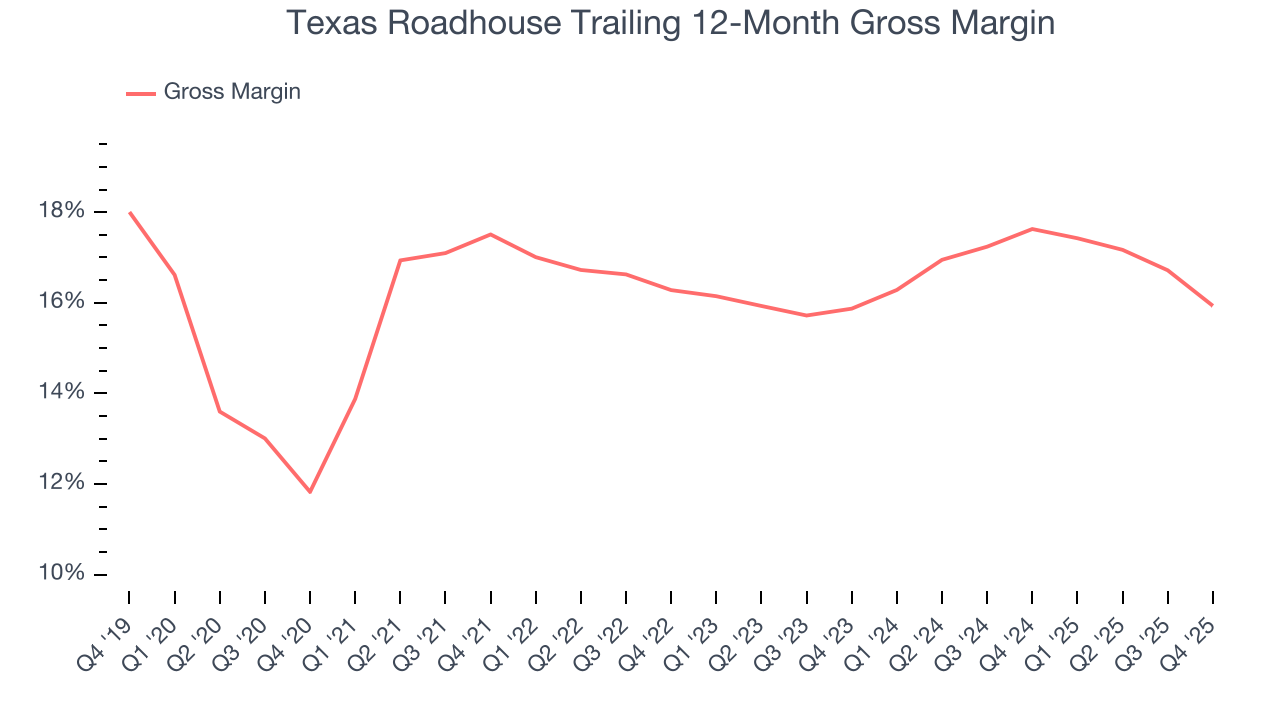
In Q4, Texas Roadhouse produced a 14.4% gross profit margin, marking a 3.1 percentage point decrease from 17.5% in the same quarter last year. Texas Roadhouse’s full-year margin has also been trending down over the past 12 months, decreasing by 1.7 percentage points. If this move continues, it could suggest a more competitive environment with some pressure to lower prices and higher input costs (such as ingredients and transportation expenses).
8. Operating Margin
Operating margin is an important measure of profitability as it shows the portion of revenue left after accounting for all core expenses – everything from the cost of goods sold to advertising and wages. It’s also useful for comparing profitability across companies with different levels of debt and tax rates because it excludes interest and taxes.
Texas Roadhouse has done a decent job managing its cost base over the last two years. The company has produced an average operating margin of 8.8%, higher than the broader restaurant sector.
Analyzing the trend in its profitability, Texas Roadhouse’s operating margin decreased by 1.5 percentage points over the last year. This raises questions about the company’s expense base because its revenue growth should have given it leverage on its fixed costs, resulting in better economies of scale and profitability.
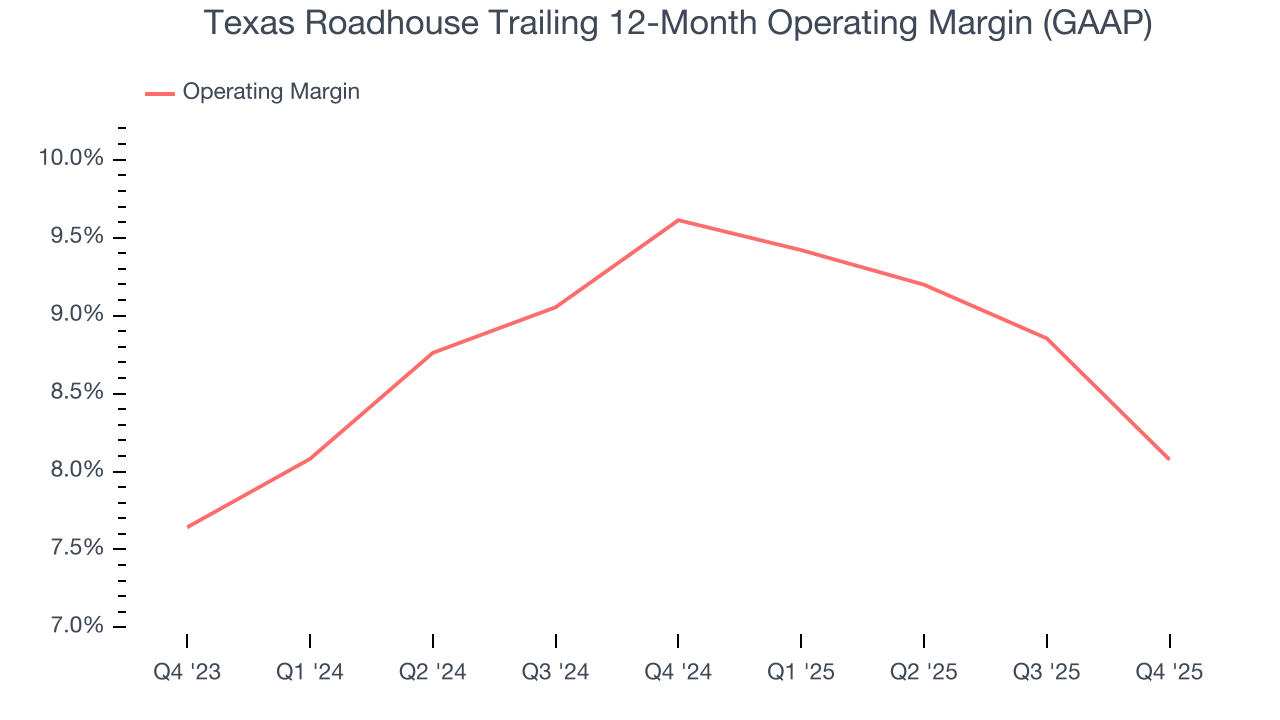
This quarter, Texas Roadhouse generated an operating margin profit margin of 6.5%, down 3.1 percentage points year on year. Since Texas Roadhouse’s gross margin decreased more than its operating margin, we can assume its recent inefficiencies were driven more by weaker leverage on its cost of sales rather than increased marketing, and administrative overhead expenses.
9. Earnings Per Share
We track the long-term change in earnings per share (EPS) for the same reason as long-term revenue growth. Compared to revenue, however, EPS highlights whether a company’s growth is profitable.
Texas Roadhouse’s EPS grew at a decent 16.4% compounded annual growth rate over the last six years, higher than its 13.5% annualized revenue growth. However, this alone doesn’t tell us much about its business quality because its operating margin didn’t improve.
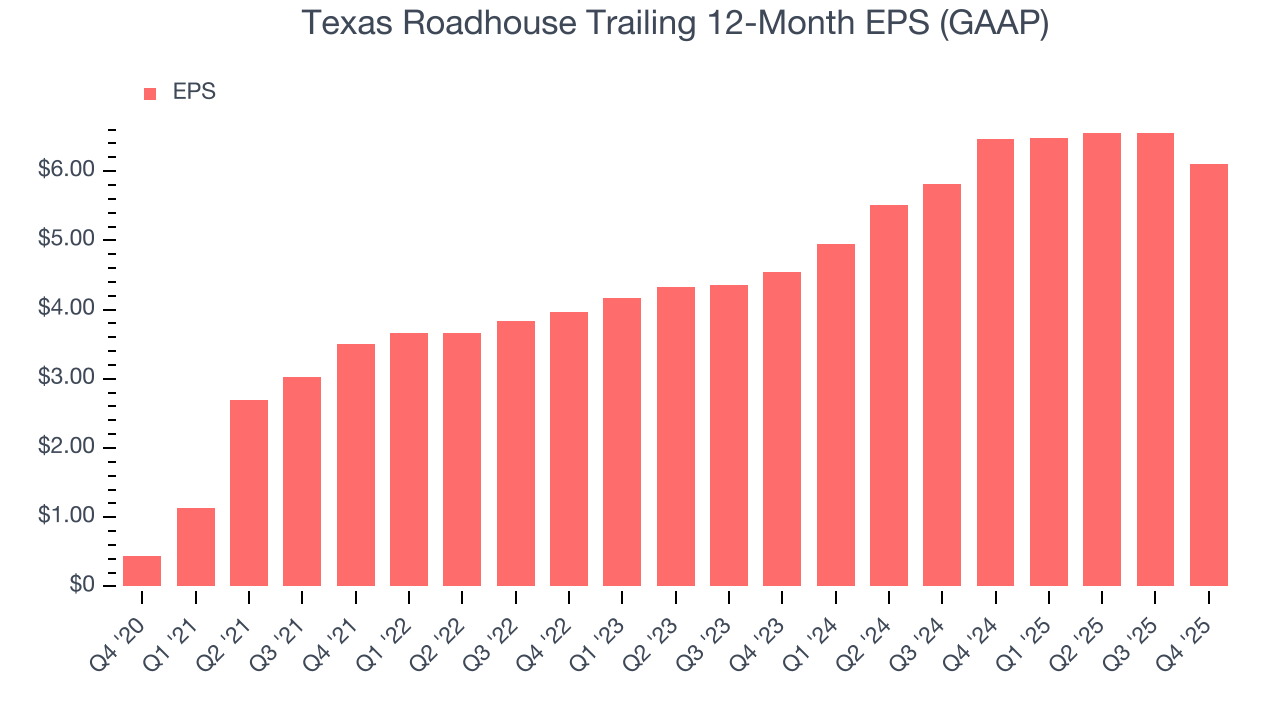
In Q4, Texas Roadhouse reported EPS of $1.28, down from $1.73 in the same quarter last year. This print missed analysts’ estimates, but we care more about long-term EPS growth than short-term movements. Over the next 12 months, Wall Street expects Texas Roadhouse’s full-year EPS of $6.10 to grow 8.1%.
10. Cash Is King
If you’ve followed StockStory for a while, you know we emphasize free cash flow. Why, you ask? We believe that in the end, cash is king, and you can’t use accounting profits to pay the bills.
Texas Roadhouse has shown impressive cash profitability, giving it the option to reinvest or return capital to investors. The company’s free cash flow margin averaged 6.6% over the last two years, better than the broader restaurant sector.
Taking a step back, we can see that Texas Roadhouse’s margin dropped by 1.6 percentage points over the last year. This decrease came from the higher costs associated with opening more restaurants.
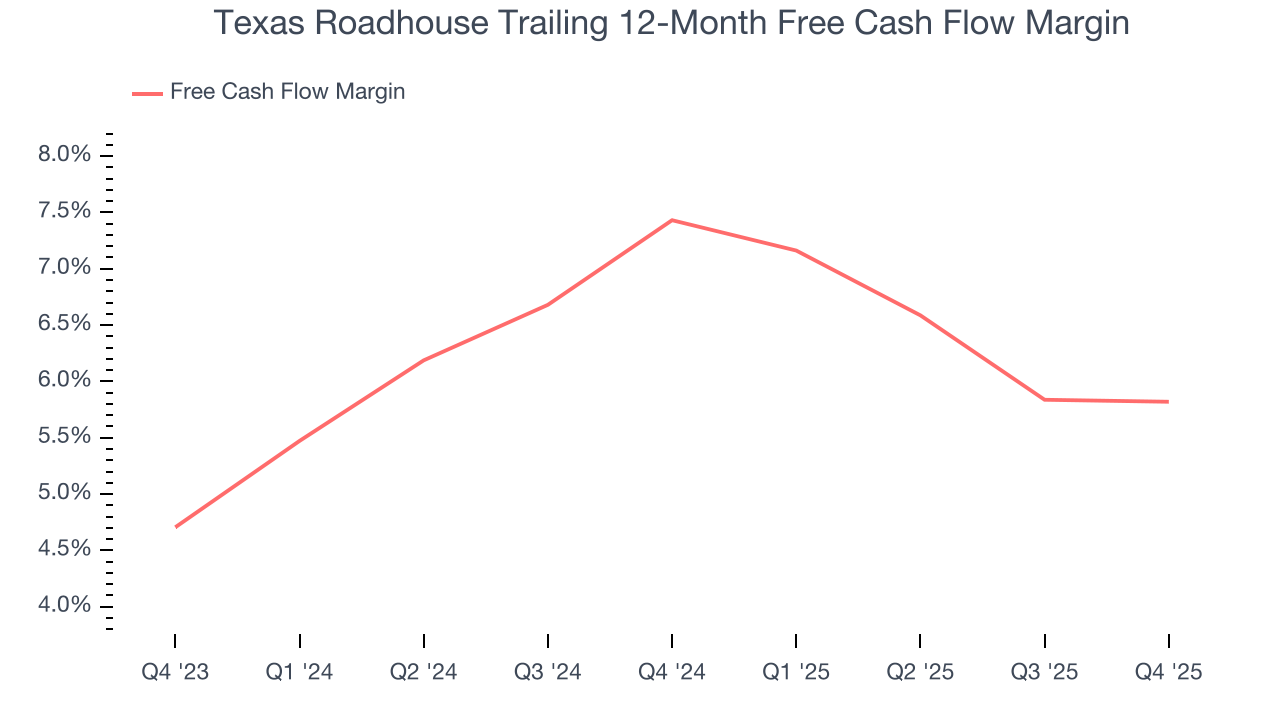
Texas Roadhouse’s free cash flow clocked in at $131.3 million in Q4, equivalent to a 8.9% margin. This cash profitability was in line with the comparable period last year and above its two-year average.
11. Return on Invested Capital (ROIC)
EPS and free cash flow tell us whether a company was profitable while growing its revenue. But was it capital-efficient? A company’s ROIC explains this by showing how much operating profit it makes compared to the money it has raised (debt and equity).
Texas Roadhouse’s five-year average ROIC was 21%, placing it among the best restaurant companies. This illustrates its management team’s ability to invest in highly profitable ventures and produce tangible results for shareholders.
12. Balance Sheet Assessment
Texas Roadhouse reported $113.5 million of cash and $952.1 million of debt on its balance sheet in the most recent quarter. As investors in high-quality companies, we primarily focus on two things: 1) that a company’s debt level isn’t too high and 2) that its interest payments are not excessively burdening the business.
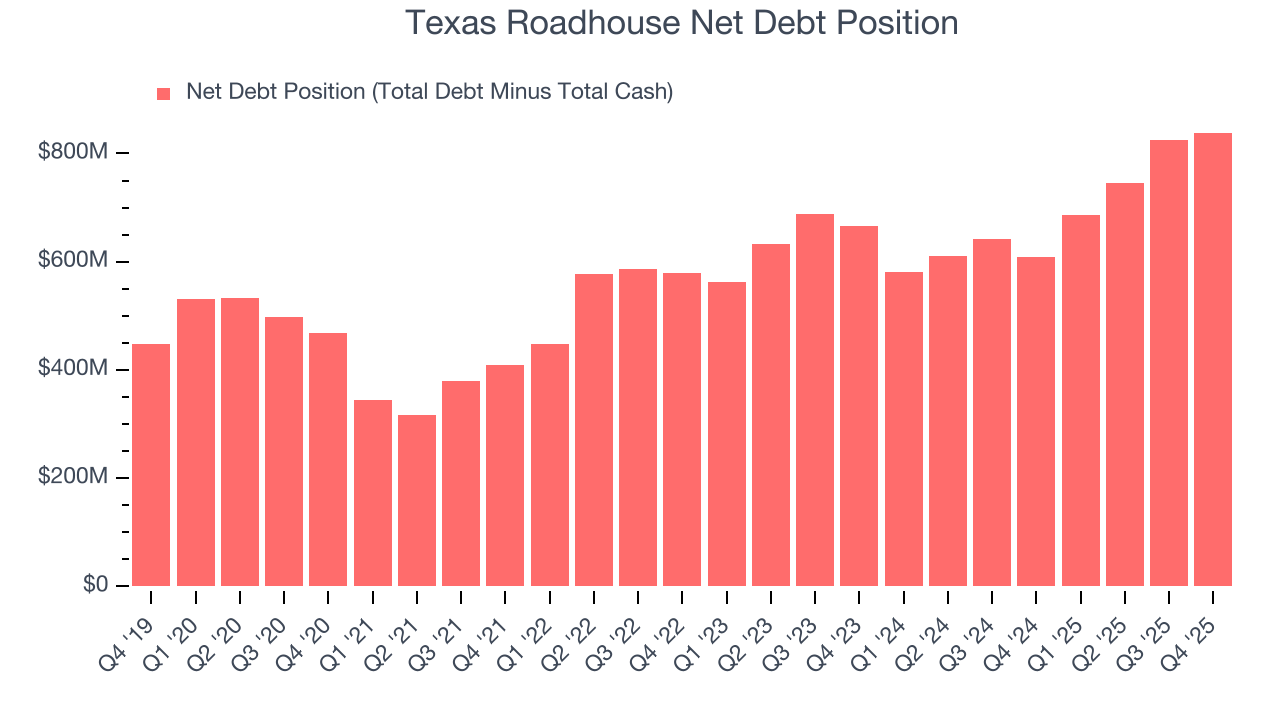
With $681.4 million of EBITDA over the last 12 months, we view Texas Roadhouse’s 1.2× net-debt-to-EBITDA ratio as safe. We also see its $2.84 million of annual interest expenses as appropriate. The company’s profits give it plenty of breathing room, allowing it to continue investing in growth initiatives.
13. Key Takeaways from Texas Roadhouse’s Q4 Results
We struggled to find many positives in these results. Its EPS missed and its same-store sales fell slightly short of Wall Street’s estimates. Overall, this was a softer quarter. The stock traded up 3.5% to $188.90 immediately after reporting.
14. Is Now The Time To Buy Texas Roadhouse?
Updated: March 21, 2026 at 10:48 PM EDT
We think that the latest earnings result is only one piece of the bigger puzzle. If you’re deciding whether to own Texas Roadhouse, you should also grasp the company’s longer-term business quality and valuation.
Texas Roadhouse possesses a number of positive attributes. To kick things off, its revenue growth was good over the last six years. And while its projected EPS for the next year is lacking, its marvelous same-store sales growth is on another level. On top of that, its new restaurant openings have increased its brand equity.
Texas Roadhouse’s P/E ratio based on the next 12 months is 27.4x. Looking at the restaurant landscape right now, Texas Roadhouse trades at a pretty interesting price. If you’re a fan of the business and management team, now is a good time to scoop up some shares.
Wall Street analysts have a consensus one-year price target of $197.88 on the company (compared to the current share price of $173.27), implying they see 14.2% upside in buying Texas Roadhouse in the short term.