
Universal Logistics (ULH)
We wouldn’t buy Universal Logistics. Its weak sales growth and declining returns on capital show its demand and profits are shrinking.― StockStory Analyst Team


1. News





2. Summary
Why We Think Universal Logistics Will Underperform
Founded in 1932, Universal Logistics (NASDAQ:ULH) is a provider of customized transportation and logistics solutions operating throughout the United States and in Mexico, Canada, and Colombia.
- Customers postponed purchases of its products and services this cycle as its revenue declined by 3.2% annually over the last two years
- Performance over the past five years shows its incremental sales were much less profitable, as its earnings per share fell by 19.5% annually
- Depletion of cash reserves could lead to a fundraising event that triggers shareholder dilution
Universal Logistics doesn’t satisfy our quality benchmarks. There are more appealing investments to be made.
Why There Are Better Opportunities Than Universal Logistics







Universal Logistics is trading at $17.67 per share, or 16.6x forward P/E. Universal Logistics’s valuation may seem like a bargain, especially when stacked up against other industrials companies. We remind you that you often get what you pay for, though.
Cheap stocks can look like great bargains at first glance, but you often get what you pay for. These mediocre businesses often have less earnings power, meaning there is more reliance on a re-rating to generate good returns - an unlikely scenario for low-quality companies.
3. Universal Logistics (ULH) Research Report: Q4 CY2025 Update
Transportation and logistics solutions provider Universal Logistics (NASDAQ:ULH) reported revenue ahead of Wall Street’s expectations in Q4 CY2025, but sales fell by 17.1% year on year to $385.4 million. Its non-GAAP profit of $0.14 per share was significantly above analysts’ consensus estimates.
Universal Logistics (ULH) Q4 CY2025 Highlights:
- Revenue: $385.4 million vs analyst estimates of $376.1 million (17.1% year-on-year decline, 2.5% beat)
- Adjusted EPS: $0.14 vs analyst estimates of -$0.05 (significant beat)
- Adjusted EBITDA: $52.99 million vs analyst estimates of $50.8 million (13.7% margin, 4.3% beat)
- Operating Margin: 4.5%, down from 7.1% in the same quarter last year
- Market Capitalization: $381.5 million
Company Overview
Founded in 1932, Universal Logistics (NASDAQ:ULH) is a provider of customized transportation and logistics solutions operating throughout the United States and in Mexico, Canada, and Colombia.
The company offers services including truckload, brokerage, intermodal, dedicated, and value-added services, catering to a diverse customer base across various industries. Its operations are structured into four distinct reportable segments: contract logistics, intermodal, trucking, and company-managed brokerage.
The contract logistics segment focuses on value-added and dedicated transportation services, primarily serving original equipment manufacturers and major retailers. The intermodal segment specializes in local and regional drayage moves, while the trucking segment handles individual freight shipments coordinated by agents. The company-managed brokerage segment deals with the pick-up and delivery of individual freight shipments using third-party carriers.
Truckload services, which include dry van, flatbed, heavy-haul, and refrigerated operations, make up the majority of sales. Brokerage services, including domestic and international freight forwarding and customs brokerage, form another important revenue stream. Intermodal operations, focusing on steamship-truck and rail-truck support services, represent a substantial portion of the company's earnings. Dedicated services, primarily supporting automotive customers, and value-added services, such as material handling, consolidation, and warehousing round out the company's revenue sources.
4. Ground Transportation
The growth of e-commerce and global trade continues to drive demand for shipping services, especially last-mile delivery, presenting opportunities for ground transportation companies. The industry continues to invest in data, analytics, and autonomous fleets to optimize efficiency and find the most cost-effective routes. Despite the essential services this industry provides, ground transportation companies are still at the whim of economic cycles. Consumer spending, for example, can greatly impact the demand for these companies’ offerings while fuel costs can influence profit margins.
Competitors in the transportation and logistics industry include J.B. Hunt (NASDAQ:JBHT), C.H. Robinson (NASDAQ:CHRW), and XPO Logistics (NYSE:XPO)
5. Revenue Growth
Reviewing a company’s long-term sales performance reveals insights into its quality. Any business can experience short-term success, but top-performing ones enjoy sustained growth for years. Regrettably, Universal Logistics’s sales grew at a sluggish 2.3% compounded annual growth rate over the last five years. This was below our standards and is a rough starting point for our analysis.
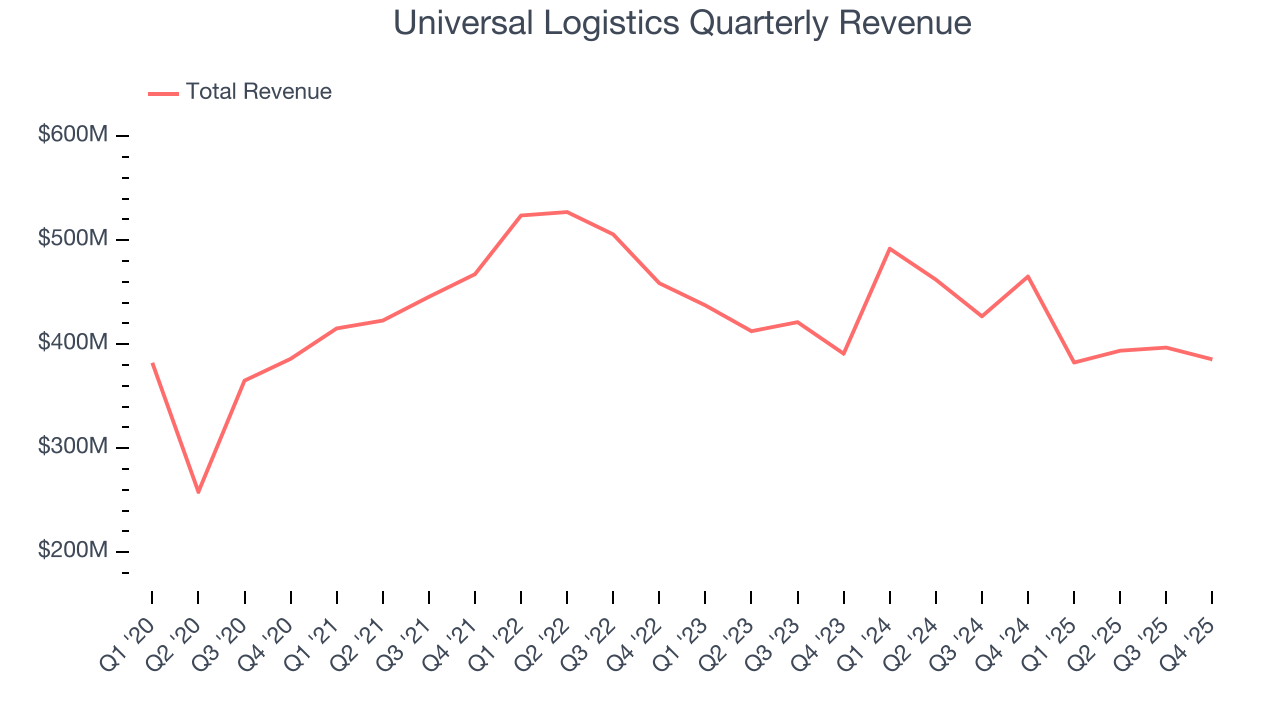
We at StockStory place the most emphasis on long-term growth, but within industrials, a half-decade historical view may miss cycles, industry trends, or a company capitalizing on catalysts such as a new contract win or a successful product line. Universal Logistics’s performance shows it grew in the past but relinquished its gains over the last two years, as its revenue fell by 3.2% annually. 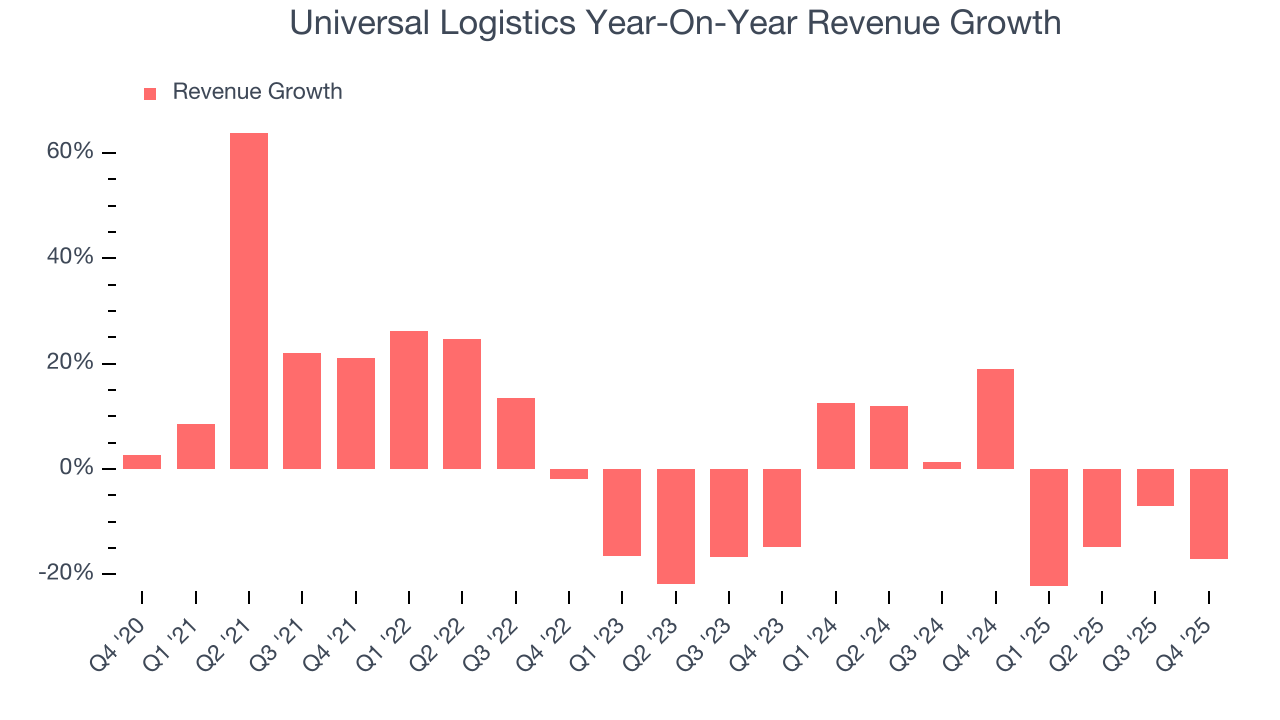
This quarter, Universal Logistics’s revenue fell by 17.1% year on year to $385.4 million but beat Wall Street’s estimates by 2.5%.
Looking ahead, sell-side analysts expect revenue to grow 2.5% over the next 12 months. While this projection implies its newer products and services will catalyze better top-line performance, it is still below average for the sector.
6. Gross Margin & Pricing Power
Cost of sales for an industrials business is usually comprised of the direct labor, raw materials, and supplies needed to offer a product or service. These costs can be impacted by inflation and supply chain dynamics.
Universal Logistics has bad unit economics for an industrials business, signaling it operates in a competitive market. As you can see below, it averaged a 20.3% gross margin over the last five years. Said differently, Universal Logistics had to pay a chunky $79.70 to its suppliers for every $100 in revenue. 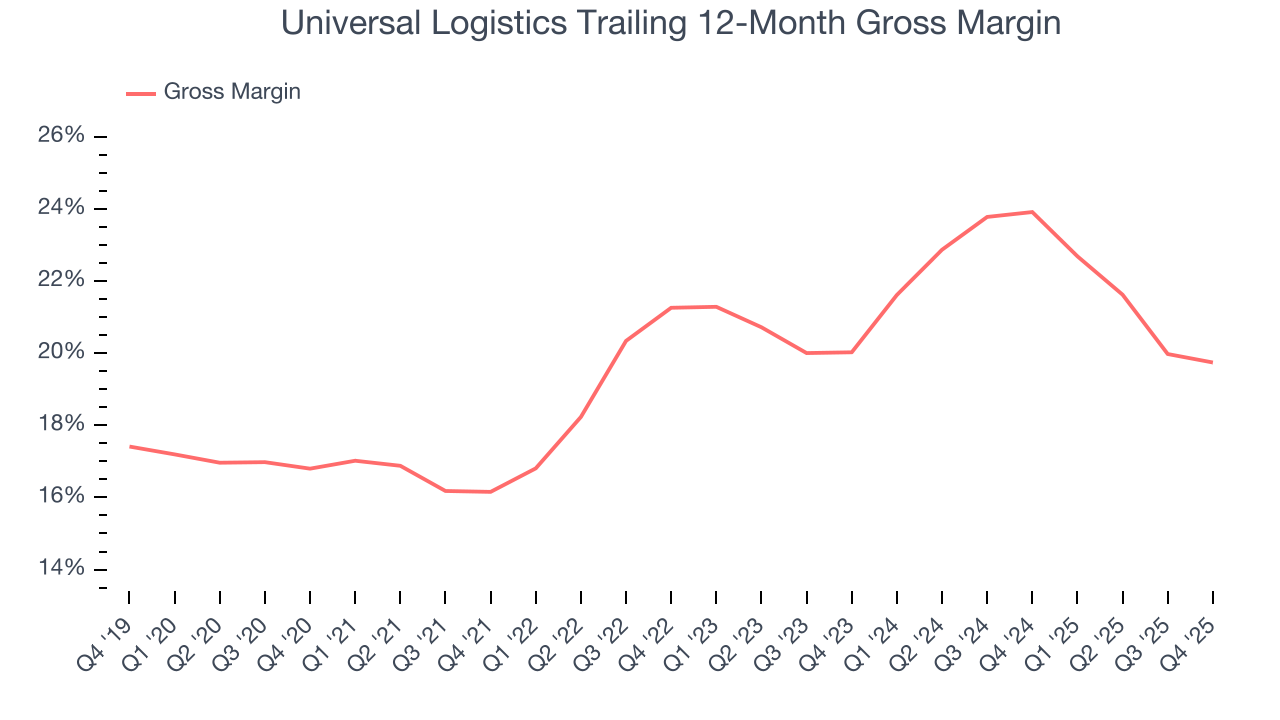
This quarter, Universal Logistics’s gross profit margin was 21%, in line with the same quarter last year. Zooming out, Universal Logistics’s full-year margin has been trending down over the past 12 months, decreasing by 4.2 percentage points. If this move continues, it could suggest a more competitive environment with some pressure to lower prices and higher input costs (such as raw materials and manufacturing expenses).
7. Operating Margin
Operating margin is one of the best measures of profitability because it tells us how much money a company takes home after procuring and manufacturing its products, marketing and selling those products, and most importantly, keeping them relevant through research and development.
Universal Logistics has done a decent job managing its cost base over the last five years. The company has produced an average operating margin of 8.7%, higher than the broader industrials sector.
Looking at the trend in its profitability, Universal Logistics’s operating margin decreased by 2 percentage points over the last five years. This raises questions about the company’s expense base because its revenue growth should have given it leverage on its fixed costs, resulting in better economies of scale and profitability.
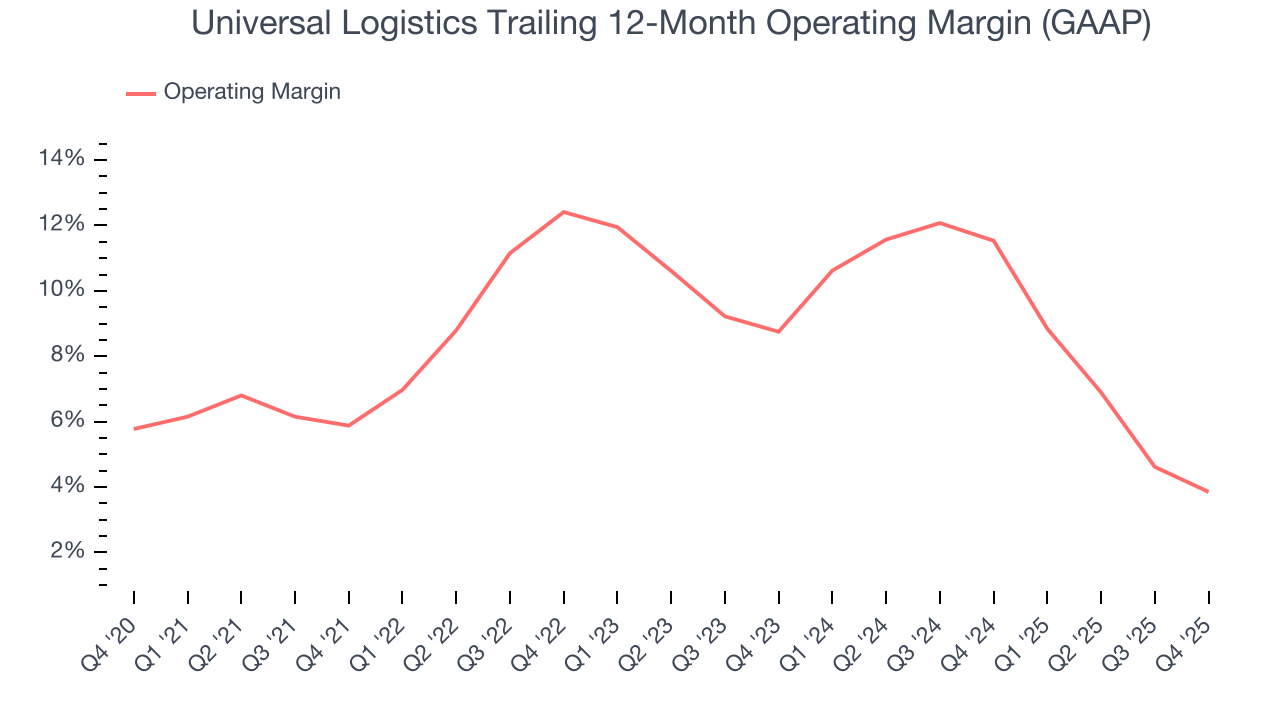
This quarter, Universal Logistics generated an operating margin profit margin of 4.5%, down 2.6 percentage points year on year. Since Universal Logistics’s operating margin decreased more than its gross margin, we can assume it was less efficient because expenses such as marketing, R&D, and administrative overhead increased.
8. Earnings Per Share
Revenue trends explain a company’s historical growth, but the long-term change in earnings per share (EPS) points to the profitability of that growth – for example, a company could inflate its sales through excessive spending on advertising and promotions.
Sadly for Universal Logistics, its EPS declined by 19.5% annually over the last five years while its revenue grew by 2.3%. This tells us the company became less profitable on a per-share basis as it expanded due to non-fundamental factors such as interest expenses and taxes.
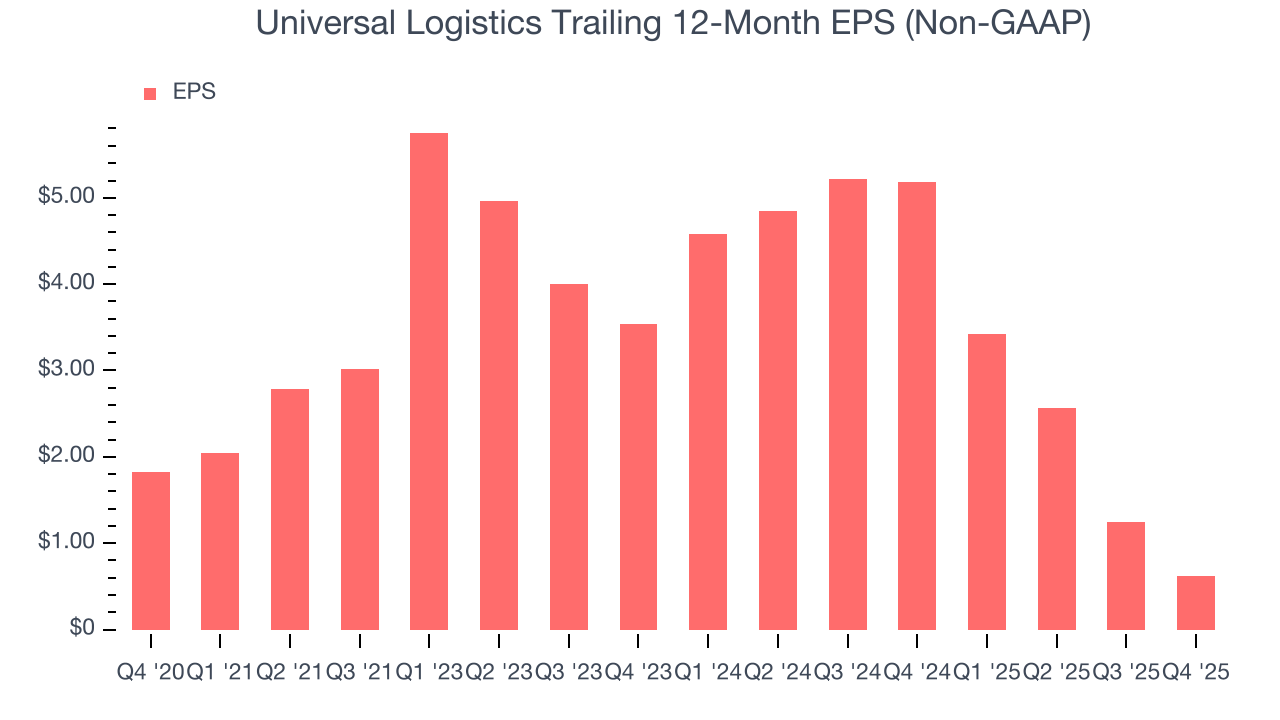
We can take a deeper look into Universal Logistics’s earnings to better understand the drivers of its performance. As we mentioned earlier, Universal Logistics’s operating margin declined by 2 percentage points over the last five years. This was the most relevant factor (aside from the revenue impact) behind its lower earnings; interest expenses and taxes can also affect EPS but don’t tell us as much about a company’s fundamentals.
Like with revenue, we analyze EPS over a more recent period because it can provide insight into an emerging theme or development for the business.
For Universal Logistics, its two-year annual EPS declines of 58.3% show it’s continued to underperform. These results were bad no matter how you slice the data.
In Q4, Universal Logistics reported adjusted EPS of $0.14, down from $0.77 in the same quarter last year. Despite falling year on year, this print easily cleared analysts’ estimates. Over the next 12 months, Wall Street expects Universal Logistics’s full-year EPS of $0.62 to grow 50.8%.
9. Cash Is King
If you’ve followed StockStory for a while, you know we emphasize free cash flow. Why, you ask? We believe that in the end, cash is king, and you can’t use accounting profits to pay the bills.
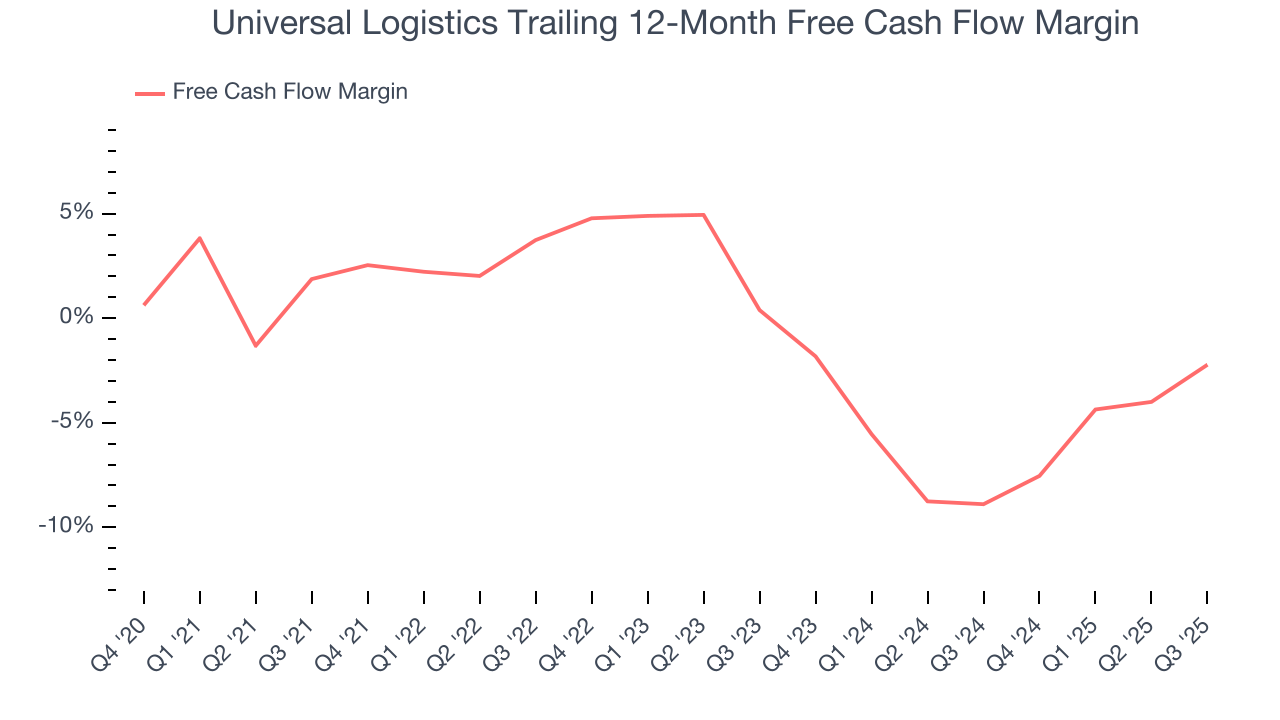
Universal Logistics broke even from a free cash flow perspective over the last five years, giving the company limited opportunities to return capital to shareholders.
Taking a step back, we can see that Universal Logistics’s margin dropped by 6.9 percentage points during that time. Almost any movement in the wrong direction is undesirable because of its already low cash conversion. If the trend continues, it could signal it’s becoming a more capital-intensive business.
10. Return on Invested Capital (ROIC)
EPS and free cash flow tell us whether a company was profitable while growing its revenue. But was it capital-efficient? A company’s ROIC explains this by showing how much operating profit it makes compared to the money it has raised (debt and equity).
Although Universal Logistics hasn’t been the highest-quality company lately because of its poor revenue and EPS performance, it historically found a few growth initiatives that worked out well. Its five-year average ROIC was 14.4%, impressive for an industrials business.
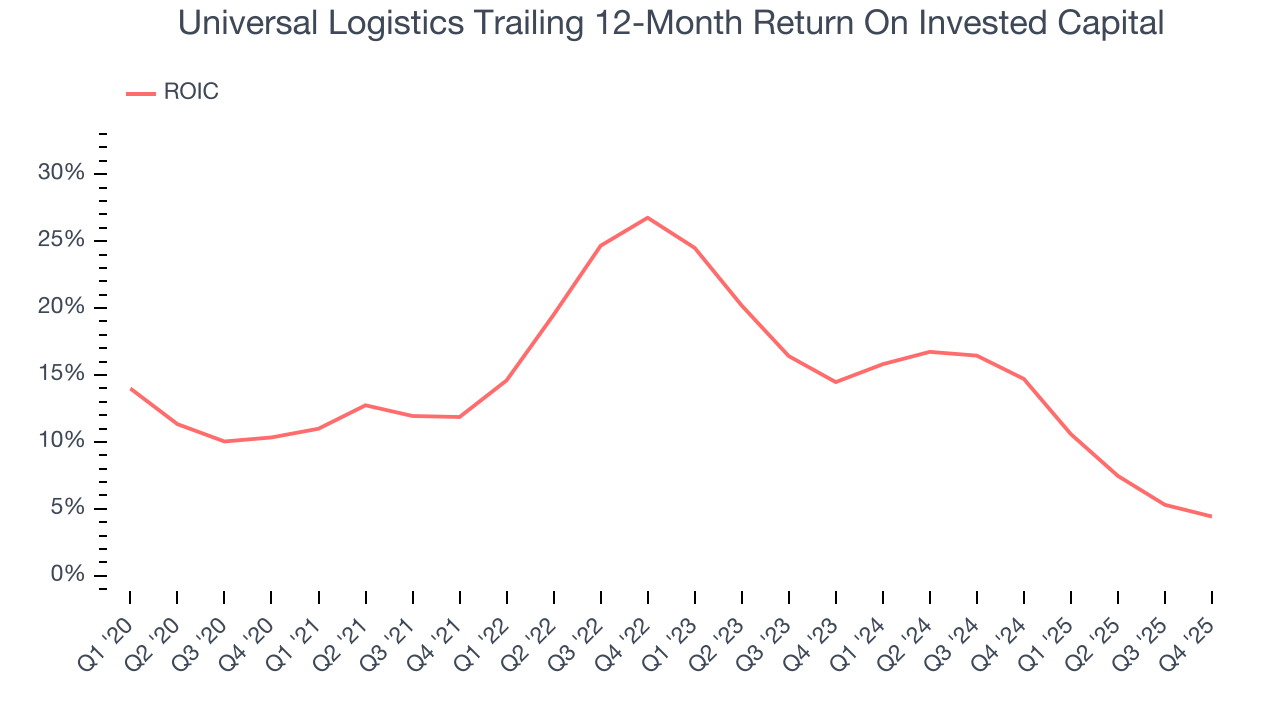
We like to invest in businesses with high returns, but the trend in a company’s ROIC is what often surprises the market and moves the stock price. Unfortunately, Universal Logistics’s ROIC has decreased over the last few years. We like what management has done in the past, but its declining returns are perhaps a symptom of fewer profitable growth opportunities.
11. Balance Sheet Assessment
Universal Logistics reported $37.2 million of cash and $797.6 million of debt on its balance sheet in the most recent quarter. As investors in high-quality companies, we primarily focus on two things: 1) that a company’s debt level isn’t too high and 2) that its interest payments are not excessively burdening the business.
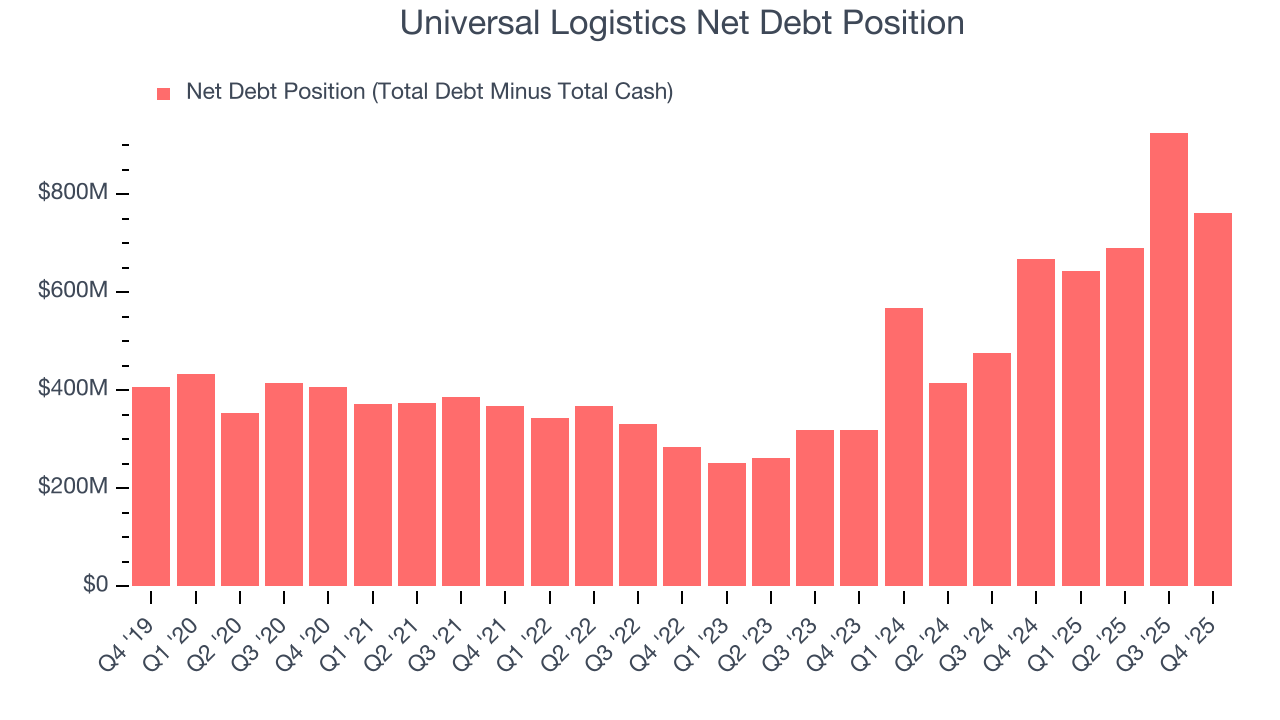
With $204.3 million of EBITDA over the last 12 months, we view Universal Logistics’s 3.7× net-debt-to-EBITDA ratio as safe. We also see its $37.81 million of annual interest expenses as appropriate. The company’s profits give it plenty of breathing room, allowing it to continue investing in growth initiatives.
12. Key Takeaways from Universal Logistics’s Q4 Results
It was good to see Universal Logistics beat analysts’ EPS expectations this quarter. We were also glad its revenue outperformed Wall Street’s estimates. Zooming out, we think this quarter featured some important positives. The stock remained flat at $14.54 immediately following the results.
13. Is Now The Time To Buy Universal Logistics?
Updated: March 21, 2026 at 11:49 PM EDT
Before investing in or passing on Universal Logistics, we urge you to understand the company’s business quality (or lack thereof), valuation, and the latest quarterly results - in that order.
We cheer for all companies making their customers lives easier, but in the case of Universal Logistics, we’ll be cheering from the sidelines. First off, its revenue growth was weak over the last five years, and analysts don’t see anything changing over the next 12 months. While its projected EPS for the next year implies the company’s fundamentals will improve, the downside is its diminishing returns show management's prior bets haven't worked out. On top of that, its declining EPS over the last five years makes it a less attractive asset to the public markets.
Universal Logistics’s P/E ratio based on the next 12 months is 16.6x. This valuation is reasonable, but the company’s shaky fundamentals present too much downside risk. There are better stocks to buy right now.
Wall Street analysts have a consensus one-year price target of $17 on the company (compared to the current share price of $17.67).