
Warner Music Group (WMG)
Warner Music Group faces an uphill battle. Its weak sales growth and low returns on capital show it struggled to generate demand and profits.― StockStory Analyst Team


1. News




2. Summary
Why We Think Warner Music Group Will Underperform
Launching the careers of legendary artists like Frank Sinatra, Warner Music Group (NASDAQ:WMG) is a music company managing a diverse portfolio of artists, recordings, and music publishing services worldwide.
- 8.7% annual revenue growth over the last five years was slower than its consumer discretionary peers
- Poor expense management has led to an operating margin that is below the industry average
- Low free cash flow margin gives it little breathing room, constraining its ability to self-fund growth or return capital to shareholders
Warner Music Group falls short of our expectations. There’s a wealth of better opportunities.
Why There Are Better Opportunities Than Warner Music Group








Warner Music Group’s stock price of $23.78 implies a valuation ratio of 15.8x forward P/E. Yes, this valuation multiple is lower than that of other consumer discretionary peers, but we’ll remind you that you often get what you pay for.
Our advice is to pay up for elite businesses whose advantages are tailwinds to earnings growth. Don’t get sucked into lower-quality businesses just because they seem like bargains. These mediocre businesses often never achieve a higher multiple as hoped, a phenomenon known as a “value trap”.
3. Warner Music Group (WMG) Research Report: Q4 CY2025 Update
Global music entertainment company Warner Music Group (NASDAQ:WMG) announced better-than-expected revenue in Q4 CY2025, with sales up 10.4% year on year to $1.84 billion. Its GAAP profit of $0.33 per share was 7% below analysts’ consensus estimates.
Warner Music Group (WMG) Q4 CY2025 Highlights:
- Revenue: $1.84 billion vs analyst estimates of $1.77 billion (10.4% year-on-year growth, 4.1% beat)
- EPS (GAAP): $0.33 vs analyst expectations of $0.35 (7% miss)
- Adjusted EBITDA: $463 million vs analyst estimates of $407.6 million (25.2% margin, 13.6% beat)
- Operating Margin: 15.7%, up from 12.8% in the same quarter last year
- Free Cash Flow Margin: 22.8%, up from 17.8% in the same quarter last year
- Market Capitalization: $14.73 billion
Company Overview
Launching the careers of legendary artists like Frank Sinatra, Warner Music Group (NASDAQ:WMG) is a music company managing a diverse portfolio of artists, recordings, and music publishing services worldwide.
Warner Music Group was founded to support artists and capitalize on the digital evolution of music distribution. The company strives to connect artists' creative work with audiences globally by providing a link between them and the market, giving artists the resources needed to broadcast to an international audience.
The company's revenue streams are diverse, encompassing sales of music in various formats, streaming services, and publishing rights. Warner Music Group's business model is anchored in content production, artist promotion, and expansive distribution networks with businesses such as Apple Music.
This approach not only extends the company's reach but also resonates with artists seeking a dynamic platform and professional marketing. In the absence of intermediaries like Warner Music Group, undiscovered artists would likely remain undiscovered as it’s extremely difficult to stand out in the music industry without big names backing you.
4. Media
The advent of the internet changed how shows, films, music, and overall information flow. As a result, many media companies now face secular headwinds as attention shifts online. Some have made concerted efforts to adapt by introducing digital subscriptions, podcasts, and streaming platforms. Time will tell if their strategies succeed and which companies will emerge as the long-term winners.
Competitors in the music industry include Universal Music Group (ENX:UMG), Sony Music Entertainment (owned by Sony, NYSE:SONY), and Spotify Technology (NYSE:SPOT).
5. Revenue Growth
Reviewing a company’s long-term sales performance reveals insights into its quality. Any business can experience short-term success, but top-performing ones enjoy sustained growth for years. Over the last five years, Warner Music Group grew its sales at a weak 8.7% compounded annual growth rate. This was below our standard for the consumer discretionary sector and is a tough starting point for our analysis.
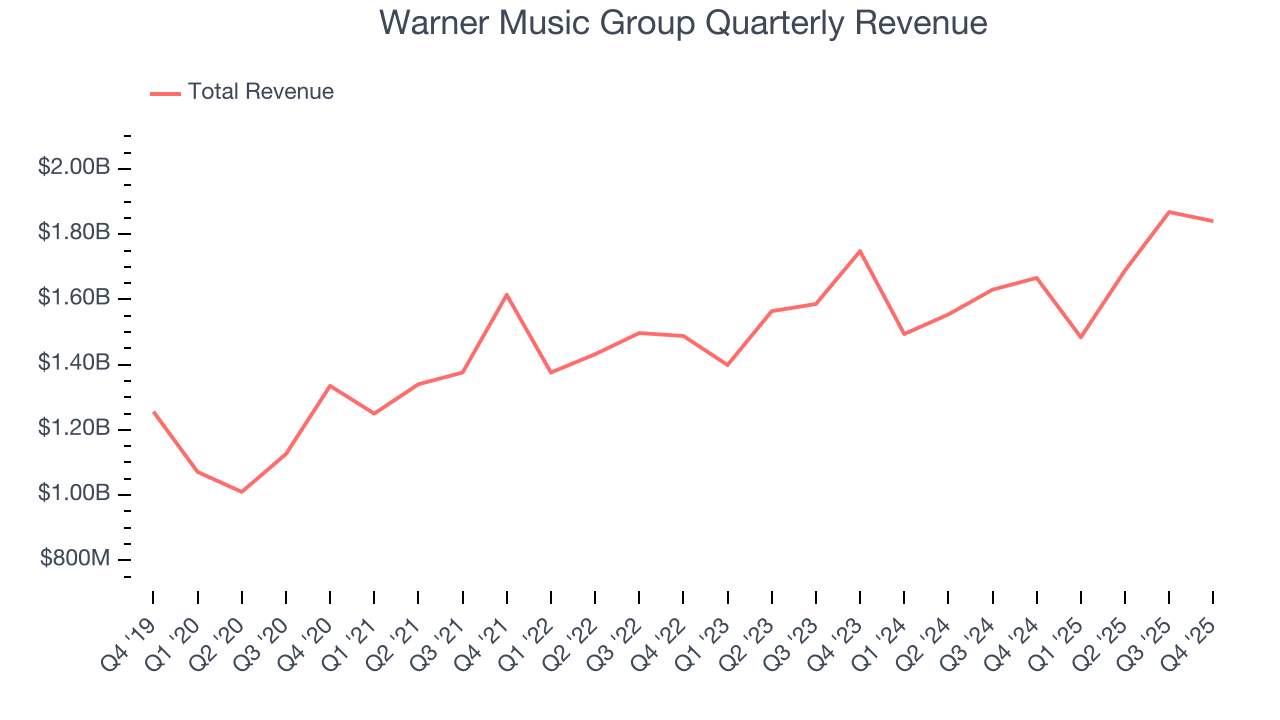
We at StockStory place the most emphasis on long-term growth, but within consumer discretionary, a stretched historical view may miss a company riding a successful new product or trend. Warner Music Group’s recent performance shows its demand has slowed as its annualized revenue growth of 4.5% over the last two years was below its five-year trend. 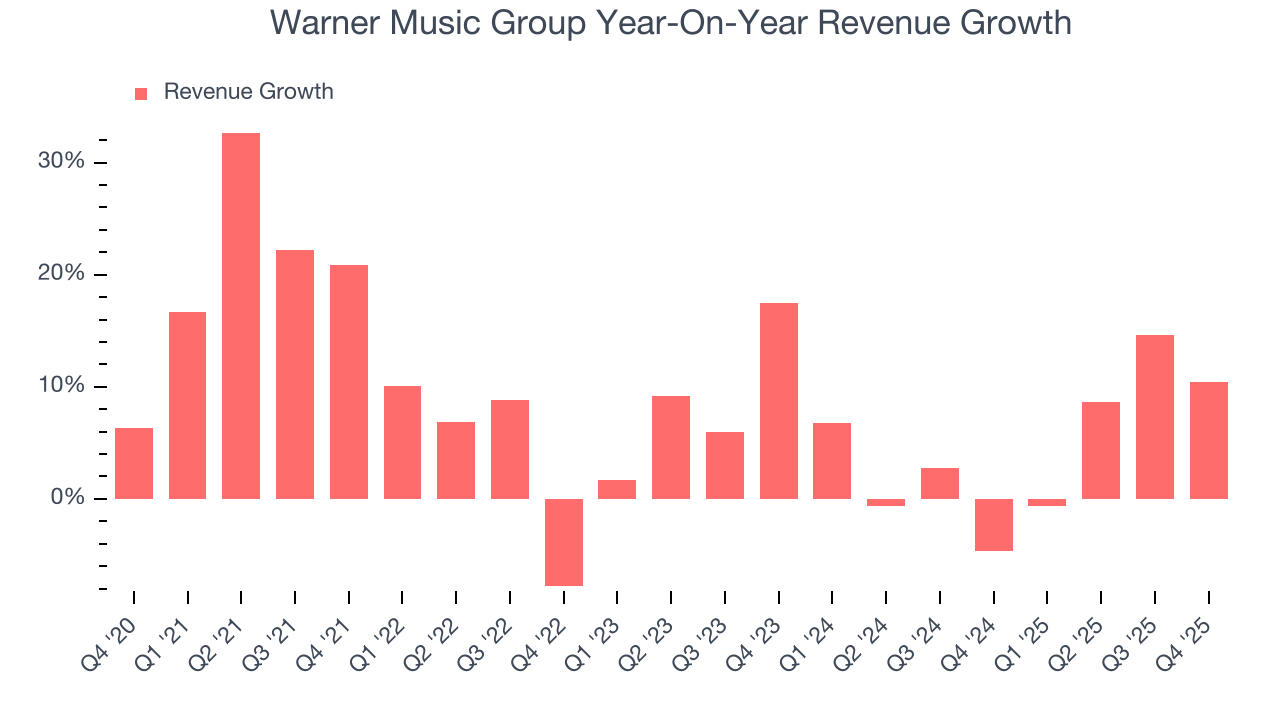
Warner Music Group also breaks out the revenue for its most important segments, Recorded Music and Music Publishing, which are 53% and 11.7% of revenue. Over the last two years, Warner Music Group’s Recorded Music revenue (new music production) averaged 1.5% year-on-year declines while its Music Publishing revenue (royalties from catalog music) was flat. 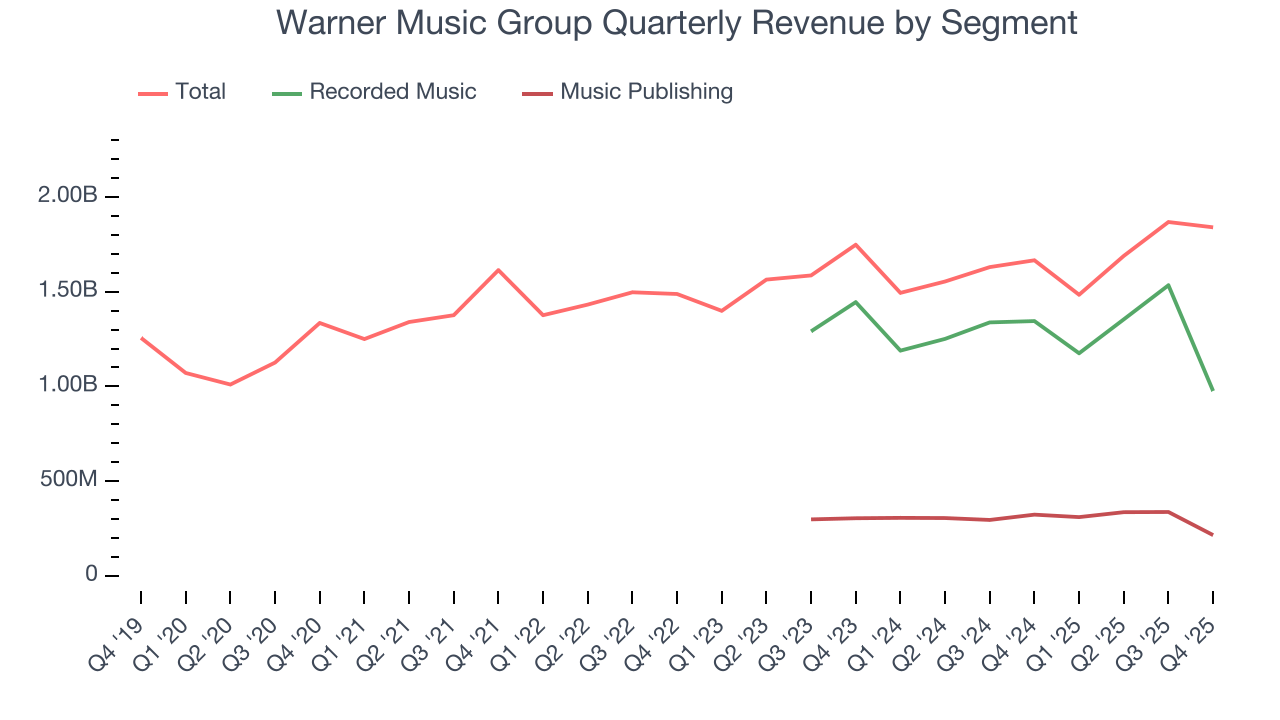
This quarter, Warner Music Group reported year-on-year revenue growth of 10.4%, and its $1.84 billion of revenue exceeded Wall Street’s estimates by 4.1%.
Looking ahead, sell-side analysts expect revenue to grow 3.6% over the next 12 months, similar to its two-year rate. This projection doesn't excite us and suggests its newer products and services will not accelerate its top-line performance yet.
6. Operating Margin
Warner Music Group’s operating margin might fluctuated slightly over the last 12 months but has remained more or less the same, averaging 11% over the last two years. This profitability was inadequate for a consumer discretionary business and caused by its suboptimal cost structure.
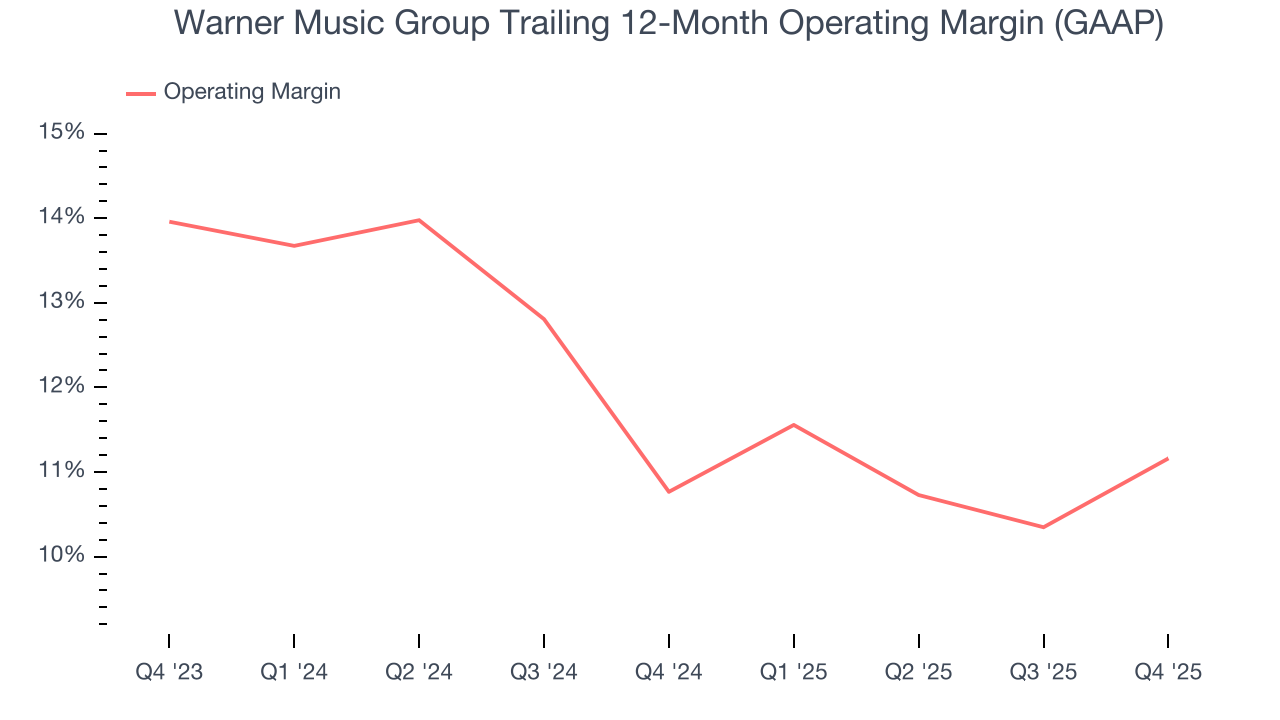
This quarter, Warner Music Group generated an operating margin profit margin of 15.7%, up 2.8 percentage points year on year. This increase was a welcome development and shows it was more efficient.
7. Earnings Per Share
Revenue trends explain a company’s historical growth, but the long-term change in earnings per share (EPS) points to the profitability of that growth – for example, a company could inflate its sales through excessive spending on advertising and promotions.
Warner Music Group’s full-year EPS flipped from negative to positive over the last five years. This is encouraging and shows it’s at a critical moment in its life.
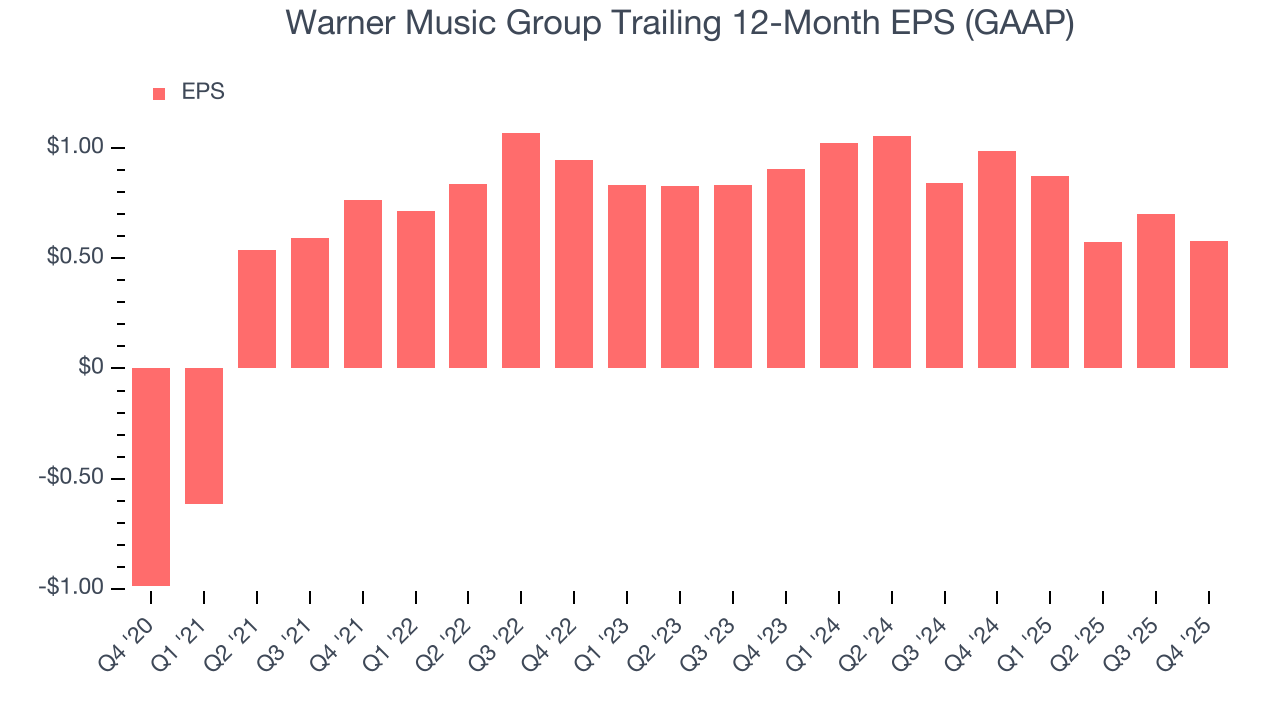
In Q4, Warner Music Group reported EPS of $0.33, down from $0.46 in the same quarter last year. This print missed analysts’ estimates. Over the next 12 months, Wall Street expects Warner Music Group’s full-year EPS of $0.58 to grow 152%.
8. Cash Is King
Free cash flow isn't a prominently featured metric in company financials and earnings releases, but we think it's telling because it accounts for all operating and capital expenses, making it tough to manipulate. Cash is king.
Warner Music Group has shown poor cash profitability over the last two years, giving the company limited opportunities to return capital to shareholders. Its free cash flow margin averaged 10.1%, lousy for a consumer discretionary business.
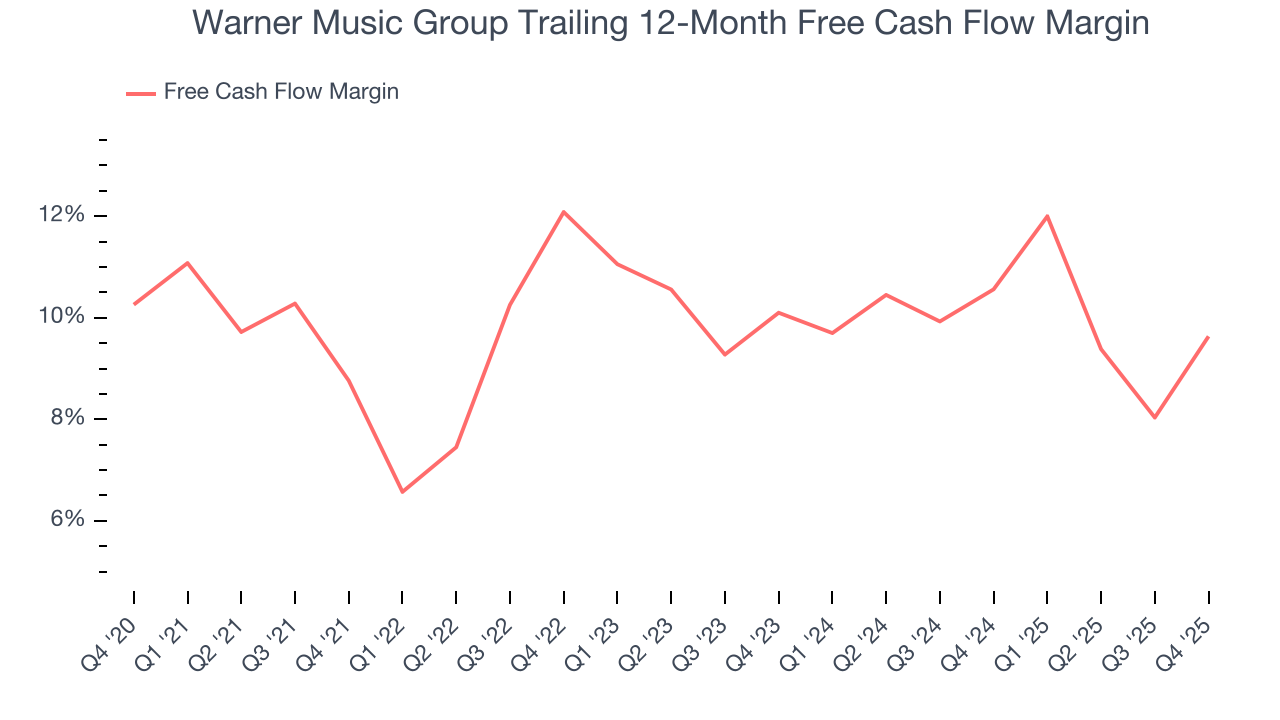
Warner Music Group’s free cash flow clocked in at $420 million in Q4, equivalent to a 22.8% margin. This result was good as its margin was 5.1 percentage points higher than in the same quarter last year, but we wouldn’t read too much into the short term because investment needs can be seasonal, leading to temporary swings. Long-term trends trump fluctuations.
9. Return on Invested Capital (ROIC)
EPS and free cash flow tell us whether a company was profitable while growing its revenue. But was it capital-efficient? Enter ROIC, a metric showing how much operating profit a company generates relative to the money it has raised (debt and equity).
Warner Music Group historically did a mediocre job investing in profitable growth initiatives. Its five-year average ROIC was 14.3%, somewhat low compared to the best consumer discretionary companies that consistently pump out 25%+.
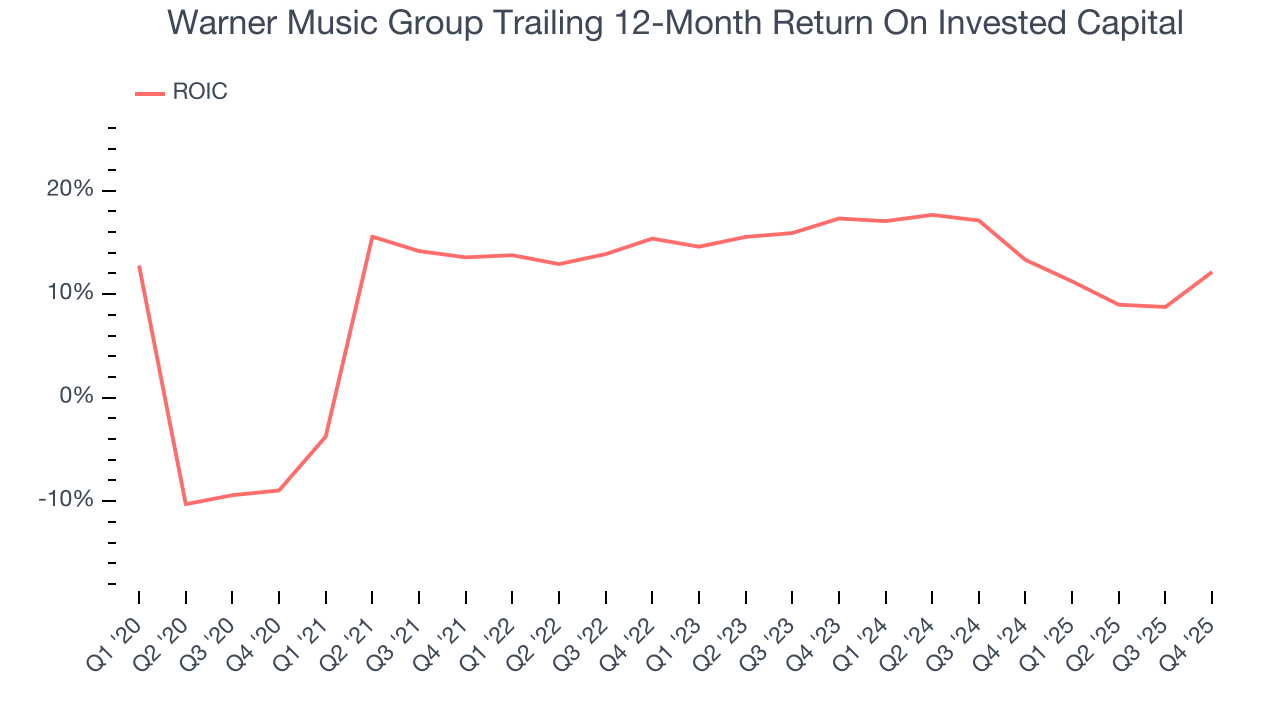
We like to invest in businesses with high returns, but the trend in a company’s ROIC is what often surprises the market and moves the stock price. Unfortunately, Warner Music Group’s ROIC averaged 1.7 percentage point decreases each year over the last few years. Paired with its already low returns, these declines suggest its profitable growth opportunities are few and far between.
10. Balance Sheet Assessment
Warner Music Group reported $751 million of cash and $4.30 billion of debt on its balance sheet in the most recent quarter. As investors in high-quality companies, we primarily focus on two things: 1) that a company’s debt level isn’t too high and 2) that its interest payments are not excessively burdening the business.
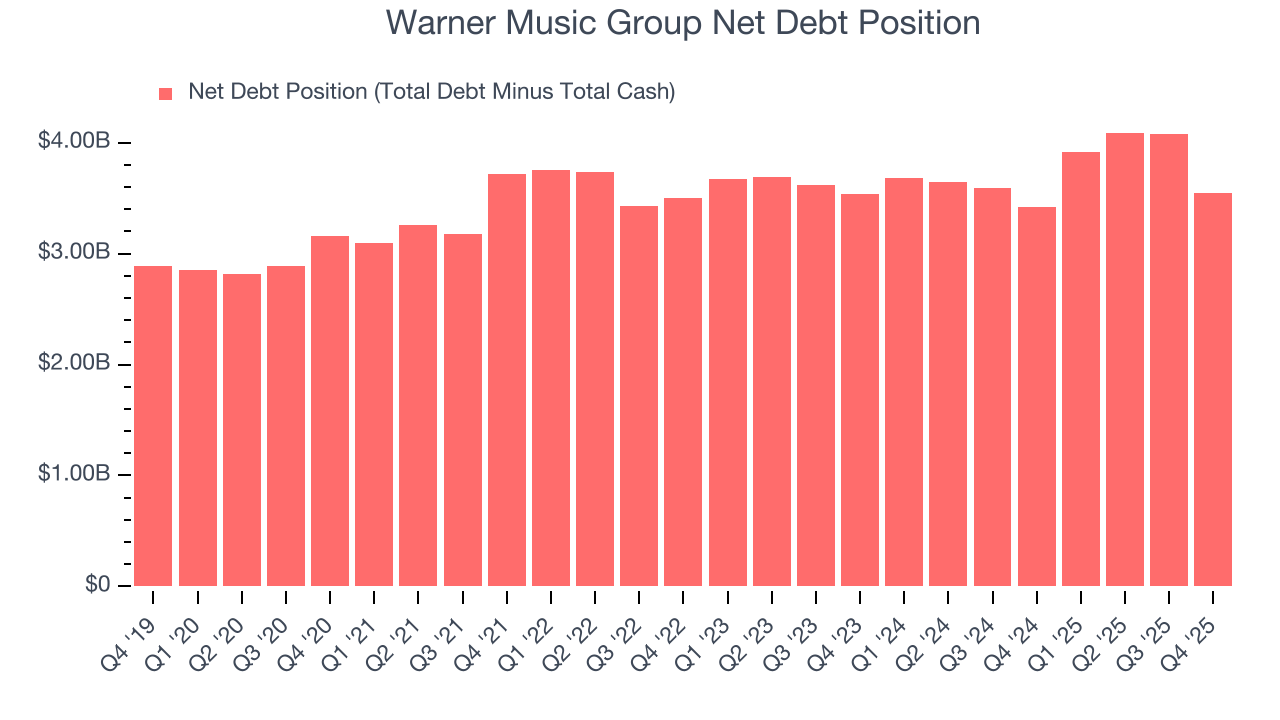
With $1.54 billion of EBITDA over the last 12 months, we view Warner Music Group’s 2.3× net-debt-to-EBITDA ratio as safe. We also see its $170 million of annual interest expenses as appropriate. The company’s profits give it plenty of breathing room, allowing it to continue investing in growth initiatives.
11. Key Takeaways from Warner Music Group’s Q4 Results
We enjoyed seeing Warner Music Group beat analysts’ EBITDA expectations this quarter. We were also glad its revenue outperformed Wall Street’s estimates. On the other hand, its EPS missed. Overall, this print had some key positives. The stock remained flat at $27.92 immediately after reporting.
12. Is Now The Time To Buy Warner Music Group?
Updated: March 27, 2026 at 11:01 PM EDT
We think that the latest earnings result is only one piece of the bigger puzzle. If you’re deciding whether to own Warner Music Group, you should also grasp the company’s longer-term business quality and valuation.
Warner Music Group doesn’t pass our quality test. On top of that, Warner Music Group’s Forecasted free cash flow margin suggests the company will have more capital to invest or return to shareholders next year, and its relatively low ROIC suggests management has struggled to find compelling investment opportunities.
Warner Music Group’s P/E ratio based on the next 12 months is 15.8x. This valuation is reasonable, but the company’s shaky fundamentals present too much downside risk. There are better investments elsewhere.
Wall Street analysts have a consensus one-year price target of $36.41 on the company (compared to the current share price of $23.78).
Although the price target is bullish, readers should exercise caution because analysts tend to be overly optimistic. The firms they work for, often big banks, have relationships with companies that extend into fundraising, M&A advisory, and other rewarding business lines. As a result, they typically hesitate to say bad things for fear they will lose out. We at StockStory do not suffer from such conflicts of interest, so we’ll always tell it like it is.