
Zebra (ZBRA)
We’re cautious of Zebra. Its weak sales growth and declining returns on capital show its demand and profits are shrinking.― StockStory Analyst Team


1. News


2. Summary
Why We Think Zebra Will Underperform
Taking its name from the black and white stripes of barcodes, Zebra Technologies (NASDAQ:ZBRA) provides barcode scanners, mobile computers, RFID systems, and other data capture technologies that help businesses track assets and optimize operations.
- Earnings growth underperformed the sector average over the last five years as its EPS grew by just 5.4% annually
- Sales trends were unexciting over the last five years as its 3.9% annual growth was below the typical business services company
- On the plus side, its healthy adjusted operating margin shows it’s a well-run company with efficient processes
Zebra doesn’t meet our quality criteria. We’re on the lookout for more interesting opportunities.
Why There Are Better Opportunities Than Zebra



At $240.52 per share, Zebra trades at 14.4x forward P/E. Yes, this valuation multiple is lower than that of other business services peers, but we’ll remind you that you often get what you pay for.
Cheap stocks can look like a great deal at first glance, but they can be value traps. They often have less earnings power, meaning there is more reliance on a re-rating to generate good returns - an unlikely scenario for low-quality companies.
3. Zebra (ZBRA) Research Report: Q3 CY2025 Update
Enterprise data capture company Zebra Technologies (NASDAQ:ZBRA) met Wall Street’s revenue expectations in Q3 CY2025, with sales up 5.2% year on year to $1.32 billion. The company expects next quarter’s revenue to be around $1.46 billion, coming in 2.4% above analysts’ estimates. Its non-GAAP profit of $3.88 per share was 3.4% above analysts’ consensus estimates.
Zebra (ZBRA) Q3 CY2025 Highlights:
- Revenue: $1.32 billion vs analyst estimates of $1.32 billion (5.2% year-on-year growth, in line)
- Adjusted EPS: $3.88 vs analyst estimates of $3.75 (3.4% beat)
- Adjusted EBITDA: $285 million vs analyst estimates of $275 million (21.6% margin, 3.7% beat)
- Revenue Guidance for Q4 CY2025 is $1.46 billion at the midpoint, above analyst estimates of $1.43 billion
- Adjusted EPS guidance for Q4 CY2025 is $4.30 at the midpoint, above analyst estimates of $4.26
- Operating Margin: 13.9%, down from 15.2% in the same quarter last year
- Free Cash Flow Margin: 16.4%, down from 22.1% in the same quarter last year
- Organic Revenue rose 4.8% year on year vs analyst estimates of 4.5% growth (28.3 basis point beat)
- Market Capitalization: $15.79 billion
Company Overview
Taking its name from the black and white stripes of barcodes, Zebra Technologies (NASDAQ:ZBRA) provides barcode scanners, mobile computers, RFID systems, and other data capture technologies that help businesses track assets and optimize operations.
Zebra's technology serves as the backbone of modern inventory management and logistics systems across retail, manufacturing, healthcare, and transportation industries. The company's hardware portfolio includes rugged mobile computers that withstand harsh environments, barcode printers that produce labels and identification cards, RFID readers that can track hundreds of items simultaneously without line-of-sight, and machine vision systems that automate quality inspection.
For example, when a retail associate scans inventory with a Zebra handheld device, the data flows instantly to inventory management systems, helping prevent stockouts and improving customer satisfaction. In healthcare settings, Zebra's wristband printers and mobile computers help ensure patients receive the correct medications and treatments by enabling accurate identification and data capture at the point of care.
Beyond hardware, Zebra offers software solutions that analyze operational data to optimize workflows and improve productivity. Its portfolio includes workforce management applications, task management systems, and analytics platforms that transform raw data into actionable insights. The company also provides a range of services including maintenance, technical support, and professional services to help customers implement and maintain their systems.
Zebra makes money by selling its hardware devices, software subscriptions, supplies (like labels and ribbons), and service contracts. It reaches customers primarily through a network of distributors, value-added resellers, and independent software vendors, though it also sells directly to select large customers. With operations in over 100 facilities worldwide and a partner network spanning approximately 176 countries, Zebra has established a global footprint serving enterprises of all sizes.
4. Specialized Technology
Companies in this sector, especially if they invest wisely, could see demand tailwinds as the world moves towards more IoT (Internet of Things), automation, and analytics. Enterprises across most industries will balk at taking these journeys solo and will enlist companies with expertise and scale in these areas. However, headwinds could include rising competition from larger technology firms, as digitization lowers barriers to entry in the space. Additionally, companies in the space will likely face evolving regulatory scrutiny over data privacy, particularly for surveillance and security technologies. This could make companies have to continually pivot and invest.
Zebra Technologies competes with Honeywell (NASDAQ:HON) and Datalogic in the barcode scanning and mobile computing markets, Avery Dennison (NYSE:AVY) and Sato in printing solutions, and Impinj (NASDAQ:PI) in RFID technology. In the machine vision space, it faces competition from Cognex (NASDAQ:CGNX) and Keyence.
5. Revenue Growth
A company’s long-term sales performance is one signal of its overall quality. Any business can experience short-term success, but top-performing ones enjoy sustained growth for years.
With $5.26 billion in revenue over the past 12 months, Zebra is one of the larger companies in the business services industry and benefits from a well-known brand that influences purchasing decisions. However, its scale is a double-edged sword because it’s harder to find incremental growth when you’ve penetrated most of the market. To expand meaningfully, Zebra likely needs to tweak its prices, innovate with new offerings, or enter new markets.
As you can see below, Zebra’s 3.9% annualized revenue growth over the last five years was tepid. This shows it failed to generate demand in any major way and is a rough starting point for our analysis.
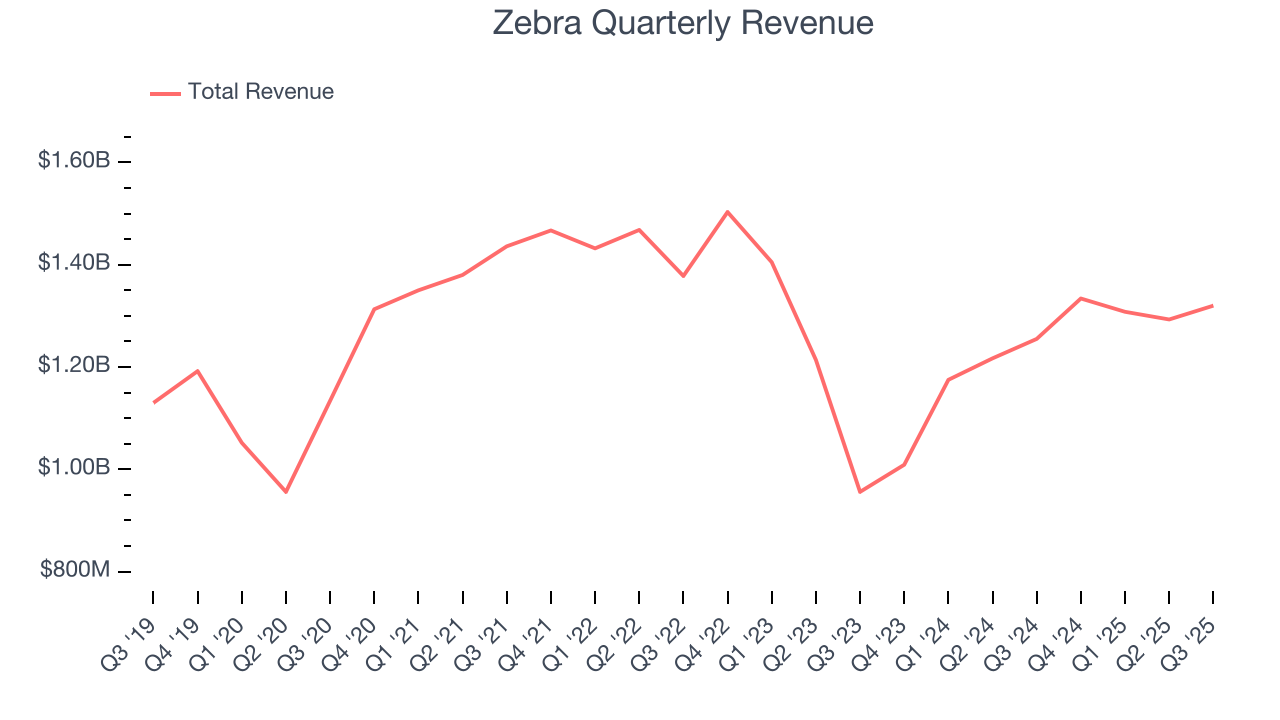
We at StockStory place the most emphasis on long-term growth, but within business services, a half-decade historical view may miss recent innovations or disruptive industry trends. Zebra’s recent performance shows its demand has slowed as its annualized revenue growth of 1.7% over the last two years was below its five-year trend. 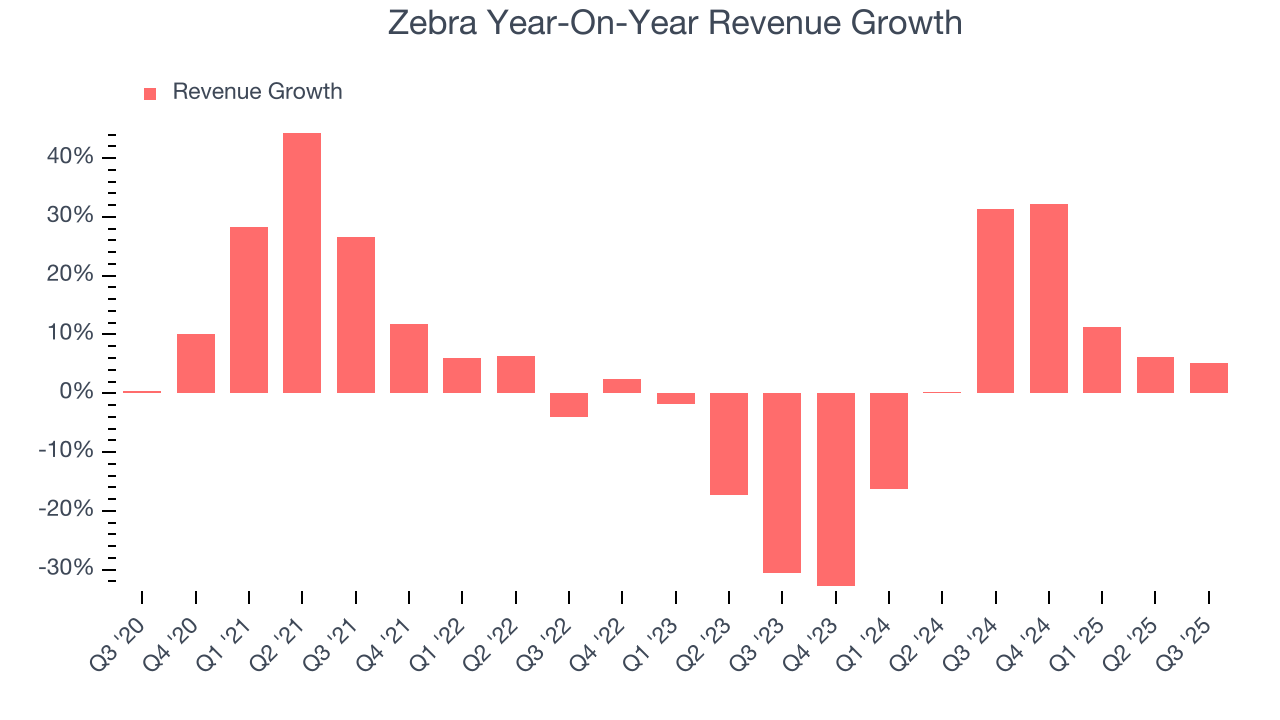
We can better understand the company’s sales dynamics by analyzing its organic revenue, which strips out one-time events like acquisitions and currency fluctuations that don’t accurately reflect its fundamentals. Over the last two years, Zebra’s organic revenue averaged 4.4% year-on-year growth. Because this number is better than its two-year revenue growth, we can see that some mixture of divestitures and foreign exchange rates dampened its headline results. 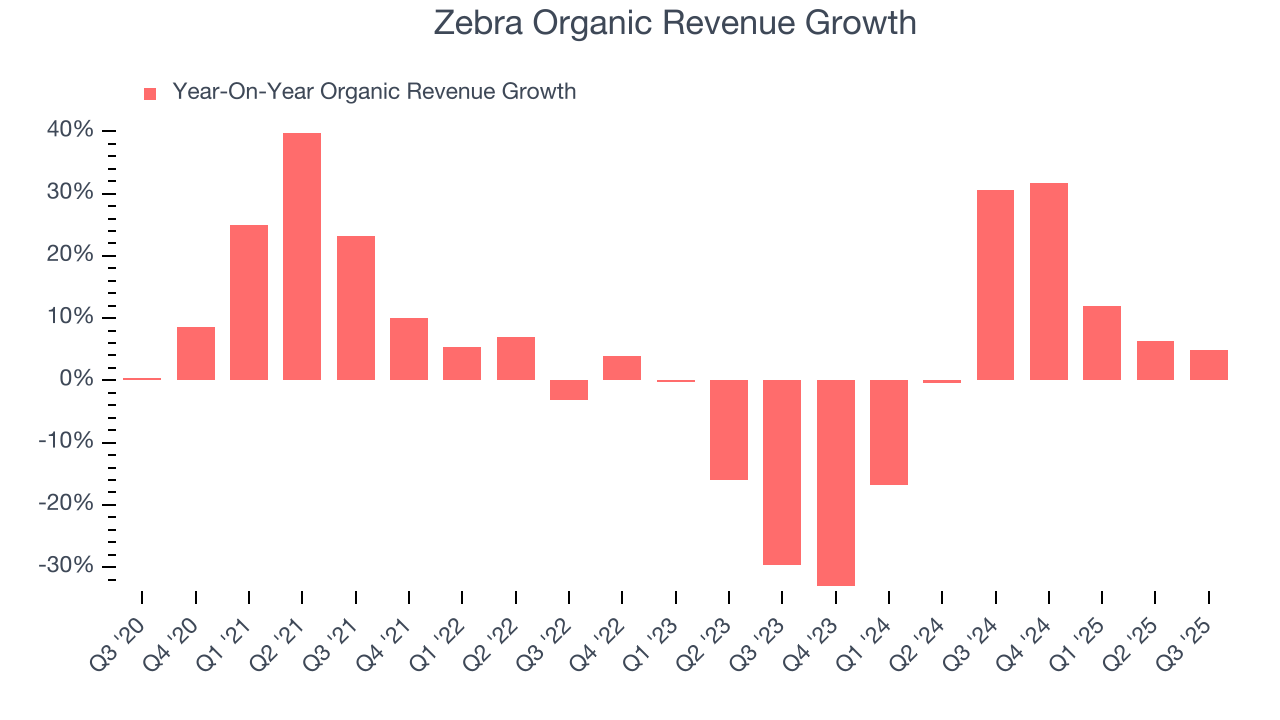
This quarter, Zebra grew its revenue by 5.2% year on year, and its $1.32 billion of revenue was in line with Wall Street’s estimates. Company management is currently guiding for a 9.5% year-on-year increase in sales next quarter.
Looking further ahead, sell-side analysts expect revenue to grow 10% over the next 12 months, an improvement versus the last two years. This projection is admirable and indicates its newer products and services will spur better top-line performance.
6. Operating Margin
Zebra has managed its cost base well over the last five years. It demonstrated solid profitability for a business services business, producing an average operating margin of 13.4%.
Looking at the trend in its profitability, Zebra’s operating margin decreased by 3.1 percentage points over the last five years. This raises questions about the company’s expense base because its revenue growth should have given it leverage on its fixed costs, resulting in better economies of scale and profitability.
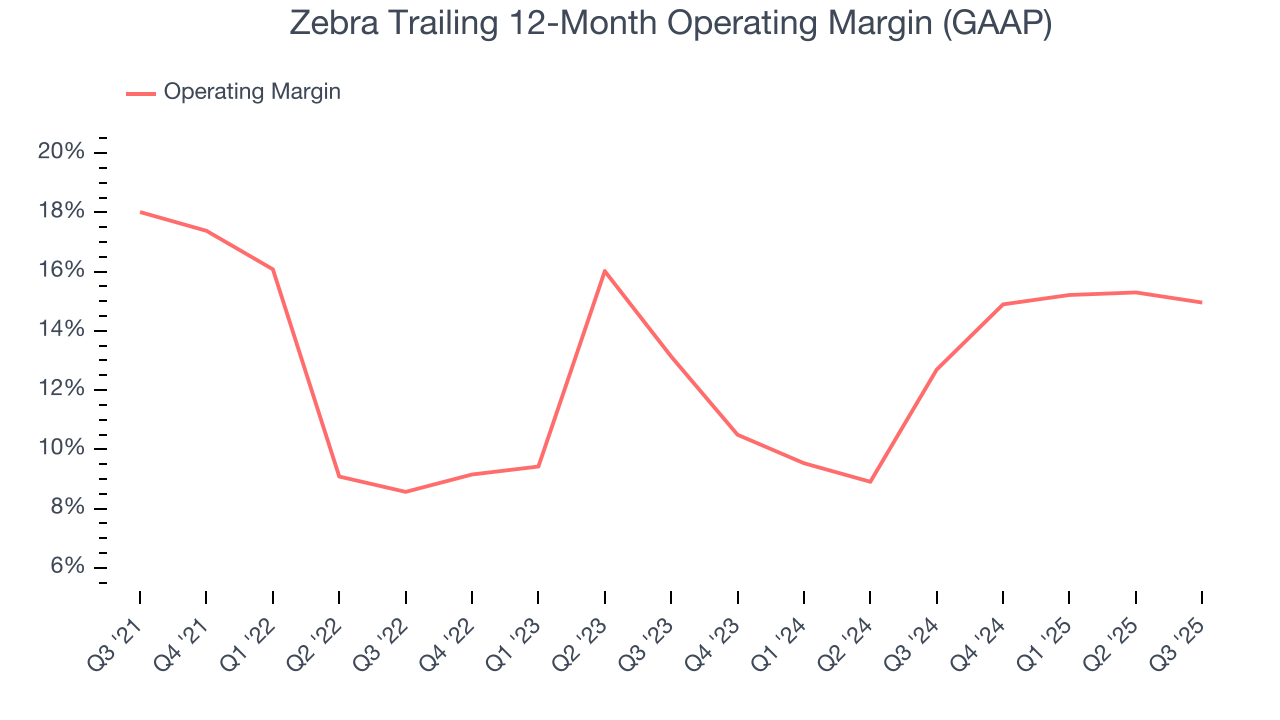
This quarter, Zebra generated an operating margin profit margin of 13.9%, down 1.4 percentage points year on year. This reduction is quite minuscule and indicates the company’s overall cost structure has been relatively stable.
7. Earnings Per Share
We track the long-term change in earnings per share (EPS) for the same reason as long-term revenue growth. Compared to revenue, however, EPS highlights whether a company’s growth is profitable.
Zebra’s unimpressive 5.4% annual EPS growth over the last five years aligns with its revenue performance. This tells us it maintained its per-share profitability as it expanded.
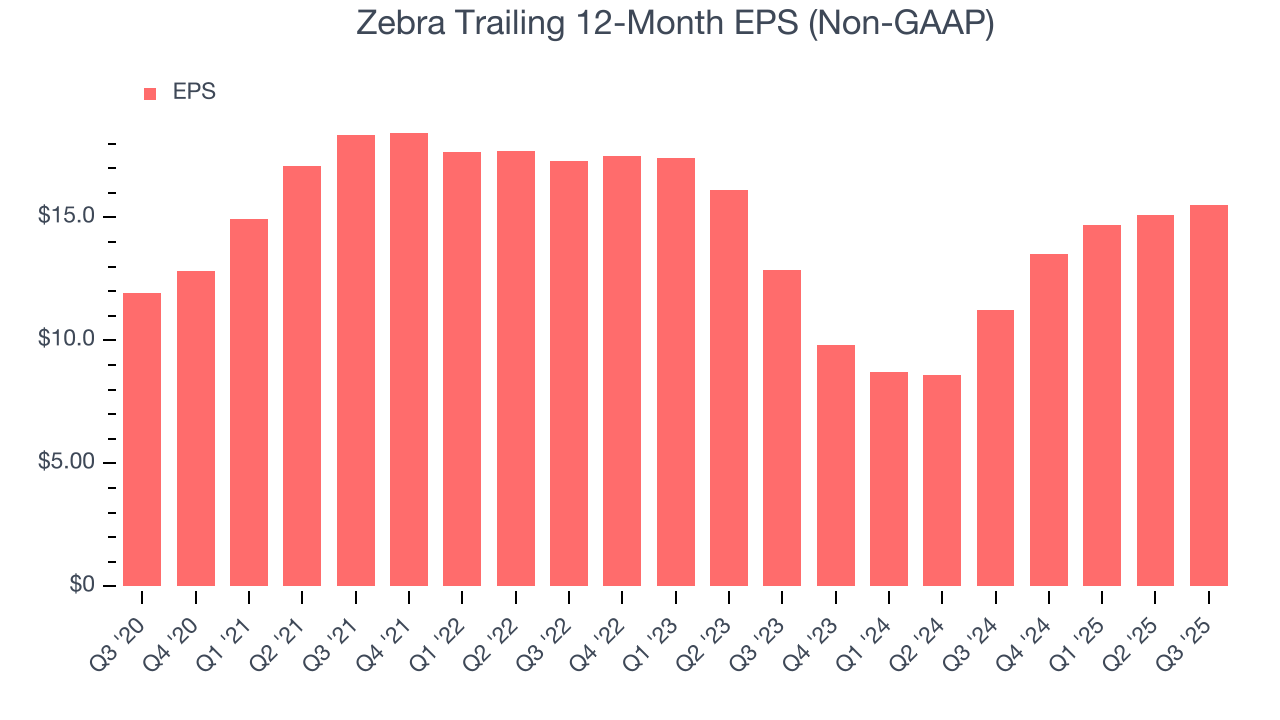
Like with revenue, we analyze EPS over a more recent period because it can provide insight into an emerging theme or development for the business.
Although it wasn’t great, Zebra’s two-year annual EPS growth of 9.9% topped its 1.7% two-year revenue growth.
We can take a deeper look into Zebra’s earnings to better understand the drivers of its performance. While we mentioned earlier that Zebra’s operating margin declined this quarter, a two-year view shows its margin has expanded. This was the most relevant factor (aside from the revenue impact) behind its higher earnings; interest expenses and taxes can also affect EPS but don’t tell us as much about a company’s fundamentals.
In Q3, Zebra reported adjusted EPS of $3.88, up from $3.49 in the same quarter last year. This print beat analysts’ estimates by 3.4%. Over the next 12 months, Wall Street expects Zebra’s full-year EPS of $15.51 to grow 8.1%.
8. Cash Is King
If you’ve followed StockStory for a while, you know we emphasize free cash flow. Why, you ask? We believe that in the end, cash is king, and you can’t use accounting profits to pay the bills.
Zebra has shown robust cash profitability, giving it an edge over its competitors and the ability to reinvest or return capital to investors. The company’s free cash flow margin averaged 12.2% over the last five years, quite impressive for a business services business.
Taking a step back, we can see that Zebra’s margin dropped by 7 percentage points during that time. If its declines continue, it could signal increasing investment needs and capital intensity.
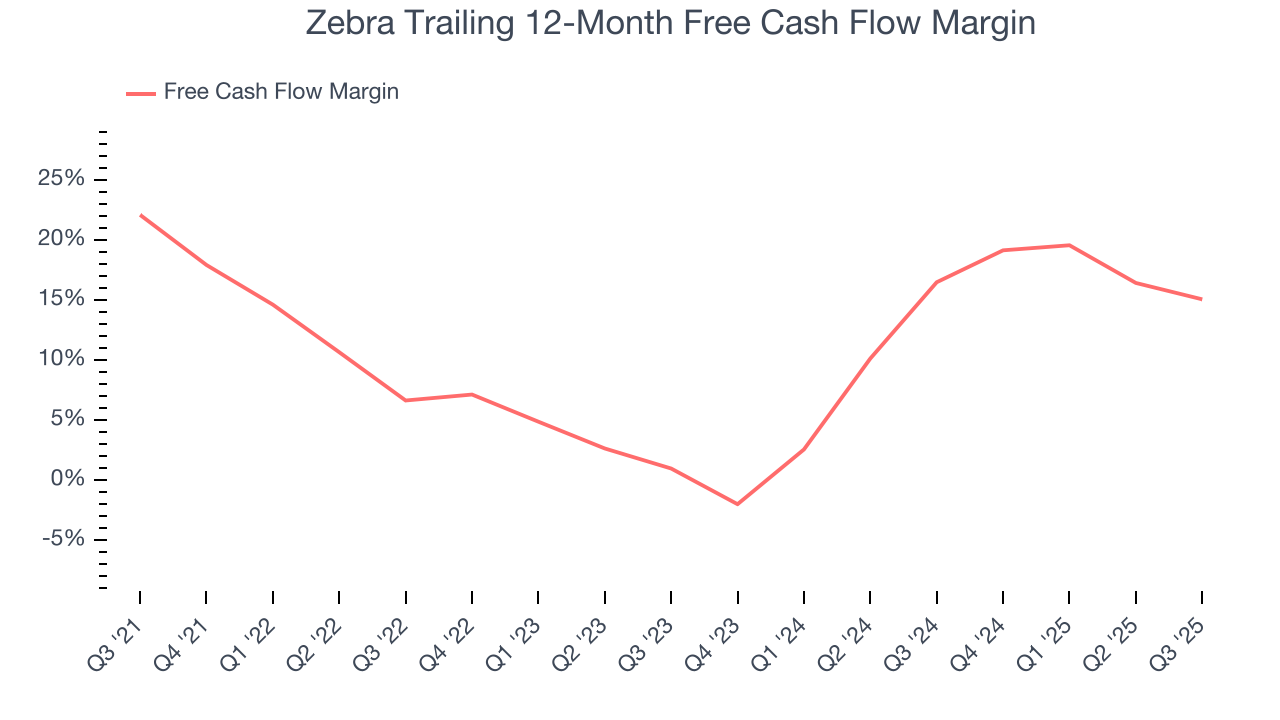
Zebra’s free cash flow clocked in at $216 million in Q3, equivalent to a 16.4% margin. The company’s cash profitability regressed as it was 5.7 percentage points lower than in the same quarter last year, but it’s still above its five-year average. We wouldn’t read too much into this quarter’s decline because investment needs can be seasonal, causing short-term swings. Long-term trends carry greater meaning.
9. Return on Invested Capital (ROIC)
EPS and free cash flow tell us whether a company was profitable while growing its revenue. But was it capital-efficient? Enter ROIC, a metric showing how much operating profit a company generates relative to the money it has raised (debt and equity).
Zebra historically did a mediocre job investing in profitable growth initiatives. Its five-year average ROIC was 12.9%, somewhat low compared to the best business services companies that consistently pump out 25%+.
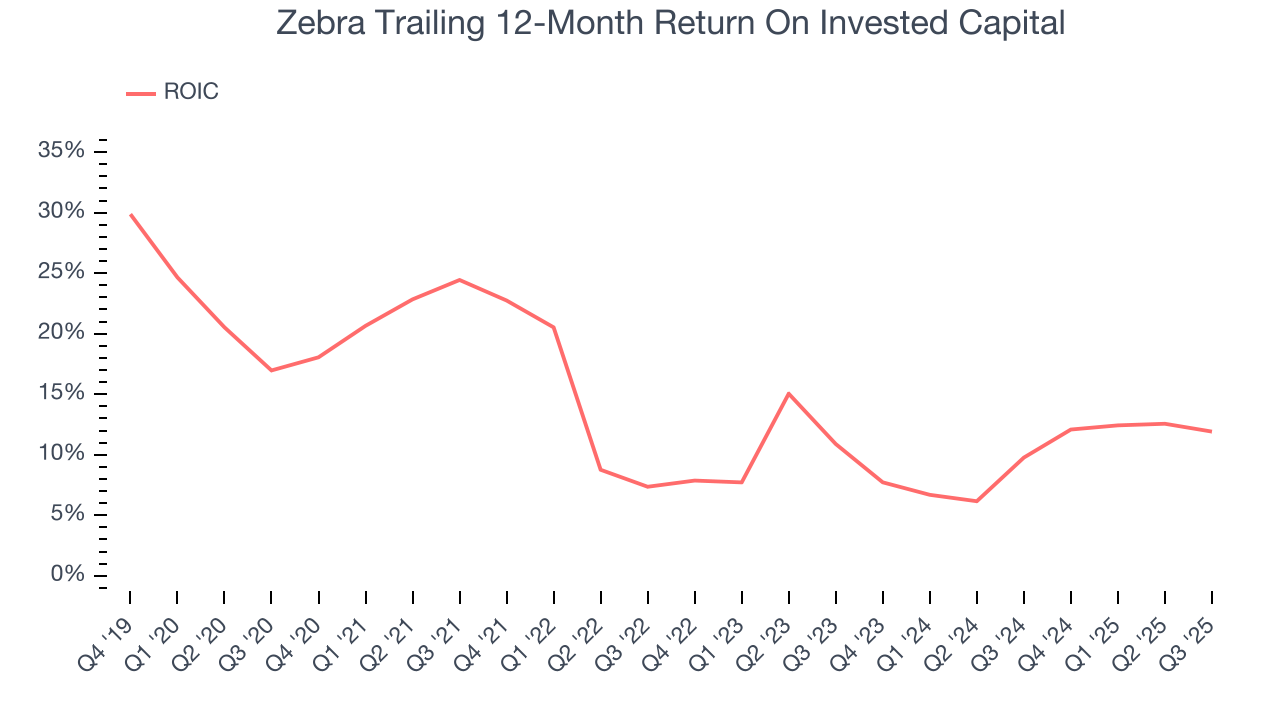
We like to invest in businesses with high returns, but the trend in a company’s ROIC is what often surprises the market and moves the stock price. Over the last few years, Zebra’s ROIC has unfortunately decreased. Paired with its already low returns, these declines suggest its profitable growth opportunities are few and far between.
10. Balance Sheet Assessment
Zebra reported $1.05 billion of cash and $2.32 billion of debt on its balance sheet in the most recent quarter. As investors in high-quality companies, we primarily focus on two things: 1) that a company’s debt level isn’t too high and 2) that its interest payments are not excessively burdening the business.
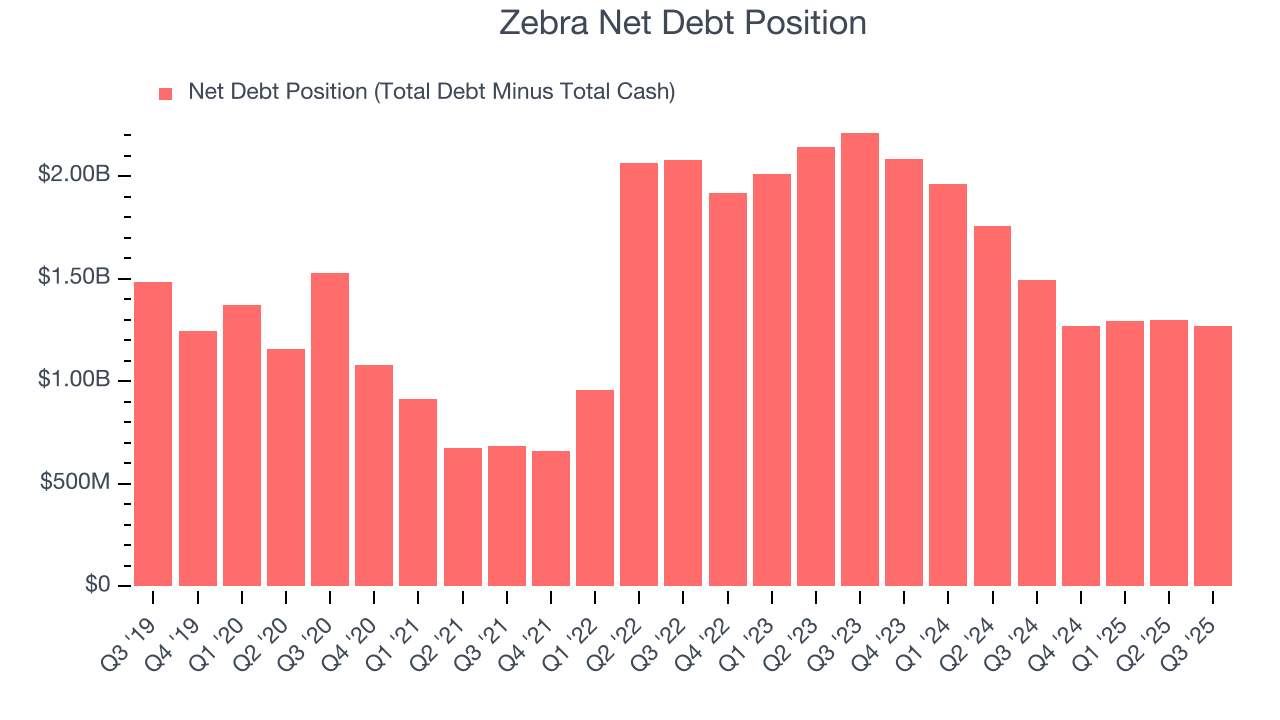
With $1.14 billion of EBITDA over the last 12 months, we view Zebra’s 1.1× net-debt-to-EBITDA ratio as safe. We also see its $98 million of annual interest expenses as appropriate. The company’s profits give it plenty of breathing room, allowing it to continue investing in growth initiatives.
11. Key Takeaways from Zebra’s Q3 Results
It was great to see Zebra’s revenue guidance for next quarter top analysts’ expectations. We were also glad its EPS outperformed Wall Street’s estimates. Overall, we think this was a decent quarter with some key metrics above expectations. The stock traded up 2.2% to $316.99 immediately after reporting.
12. Is Now The Time To Buy Zebra?
Updated: January 24, 2026 at 11:15 PM EST
Before investing in or passing on Zebra, we urge you to understand the company’s business quality (or lack thereof), valuation, and the latest quarterly results - in that order.
Zebra’s business quality ultimately falls short of our standards. To kick things off, its revenue growth was uninspiring over the last five years. And while its impressive operating margins show it has a highly efficient business model, the downside is its cash profitability fell over the last five years. On top of that, its diminishing returns show management's prior bets haven't worked out.
Zebra’s P/E ratio based on the next 12 months is 14.4x. Investors with a higher risk tolerance might like the company, but we think the potential downside is too great. We're pretty confident there are superior stocks to buy right now.
Wall Street analysts have a consensus one-year price target of $339.24 on the company (compared to the current share price of $240.52).
Although the price target is bullish, readers should exercise caution because analysts tend to be overly optimistic. The firms they work for, often big banks, have relationships with companies that extend into fundraising, M&A advisory, and other rewarding business lines. As a result, they typically hesitate to say bad things for fear they will lose out. We at StockStory do not suffer from such conflicts of interest, so we’ll always tell it like it is.