Salesforce (CRM)
We’re cautious of Salesforce. Its sluggish sales growth shows demand is soft, a worrisome sign for investors in high-quality stocks.― StockStory Analyst Team


1. News



2. Summary
Why We Think Salesforce Will Underperform
With its cloud-based platform named after its stock ticker symbol CRM (Customer Relationship Management), Salesforce (NYSE:CRM) provides customer relationship management software that helps businesses connect with their customers across sales, service, marketing, and commerce.
- Operating profits increased over the last year as the company gained some leverage on its fixed costs and became more efficient
- Underwhelming ARR growth of 10.3% over the last year suggests the company faced challenges in acquiring and retaining long-term customers
- The good news is that its excellent operating margin highlights the strength of its business model, and its profits increased over the last year as it scaled
Salesforce falls short of our quality standards. We’re hunting for superior stocks elsewhere.
Why There Are Better Opportunities Than Salesforce





Salesforce’s stock price of $183.97 implies a valuation ratio of 4x forward price-to-sales. Salesforce’s valuation may seem like a bargain, but we think there are valid reasons why it’s so cheap.
We’d rather pay up for companies with elite fundamentals than get a bargain on weak ones. Cheap stocks can be value traps, and as their performance deteriorates, they will stay cheap or get even cheaper.
3. Salesforce (CRM) Research Report: Q4 CY2025 Update
CRM software giant Salesforce (NYSE:CRM) met Wall Street’s revenue expectations in Q4 CY2025, with sales up 12.1% year on year to $11.2 billion. The company’s outlook for the full year was close to analysts’ estimates with revenue guided to $46 billion at the midpoint. Its non-GAAP profit of $3.81 per share was 24.9% above analysts’ consensus estimates.
Salesforce (CRM) Q4 CY2025 Highlights:
- Revenue: $11.2 billion vs analyst estimates of $11.18 billion (12.1% year-on-year growth, in line)
- Adjusted EPS: $3.81 vs analyst estimates of $3.05 (24.9% beat)
- Adjusted Operating Income: $3.84 billion vs analyst estimates of $3.82 billion (34.2% margin, in line)
- Revenue guidance for the upcoming financial year 2027 is $46.0 billion at the midpoint, missing analyst estimates
- Adjusted EPS guidance for the upcoming financial year 2027 is $13.15 at the midpoint, in line with analyst estimates
- Operating Margin: 16.7%, down from 18.2% in the same quarter last year
- Free Cash Flow Margin: 47.5%, up from 21.2% in the previous quarter
- Billings: $19.87 billion at quarter end, up 15.1% year on year
- Market Capitalization: $173.7 billion
Company Overview
With its cloud-based platform named after its stock ticker symbol CRM (Customer Relationship Management), Salesforce (NYSE:CRM) provides customer relationship management software that helps businesses connect with their customers across sales, service, marketing, and commerce.
Salesforce's Customer 360 platform serves as a digital command center for businesses, offering a unified view of customer data across multiple touchpoints. This single source of truth enables companies to deliver personalized experiences whether a customer is making a purchase, seeking support, or engaging with marketing campaigns. At its core, Salesforce allows companies to store customer information, track interactions, automate workflows, and gain insights through AI-powered analytics.
The company's portfolio includes specialized tools for different business functions. Sales Cloud helps sales teams manage leads and opportunities, while Service Cloud enables customer support agents to resolve issues efficiently across multiple channels. Marketing Cloud allows for personalized marketing campaigns, and Commerce Cloud powers digital storefronts. Additionally, Salesforce offers industry-specific solutions for sectors like healthcare, financial services, and manufacturing.
Salesforce operates on a subscription-based model, with customers paying regularly for access to its cloud-based software. This approach eliminates the need for businesses to maintain expensive on-premises systems. The company has built a robust ecosystem of third-party applications through its AppExchange marketplace, where developers can create and sell add-ons that extend the platform's functionality, similar to how smartphone app stores work.
4. Sales Software
Companies need to be able to interact with and sell to their customers as efficiently as possible. This reality coupled with the ongoing migration of enterprises to the cloud drives demand for cloud-based customer relationship management (CRM) software that integrates data analytics with sales and marketing functions.
Salesforce competes with Microsoft Dynamics 365 (NASDAQ: MSFT), Oracle CRM (NYSE: ORCL), SAP (NYSE: SAP), and HubSpot (NYSE: HUBS), along with numerous specialized CRM providers targeting specific industries or business functions.
5. Revenue Growth
Reviewing a company’s long-term sales performance reveals insights into its quality. Any business can put up a good quarter or two, but many enduring ones grow for years. Over the last five years, Salesforce grew its sales at a 14.3% compounded annual growth rate. Though this growth is acceptable on an absolute basis, we need to see more than just topline growth for the software sector, which can display significant earnings volatility. This means our bar for the sector is particularly high, reflecting the non-essential and hit-driven nature of the products and services offered. Additionally, five-year CAGR starts around Covid, when revenue was depressed then rebounded.
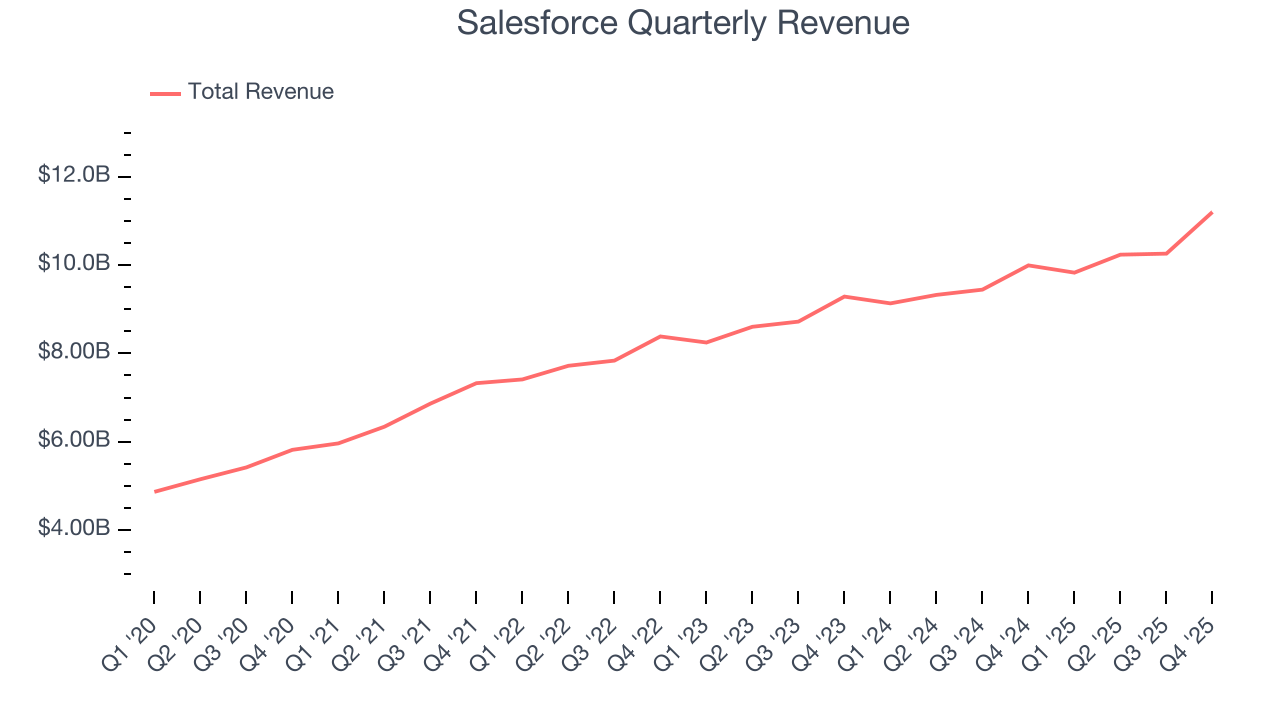
Long-term growth is the most important, but within software, a half-decade historical view may miss new innovations or demand cycles. Salesforce’s recent performance shows its demand has slowed as its annualized revenue growth of 9.1% over the last two years was below its five-year trend. We’re wary when companies in the sector see decelerations in revenue growth, as it could signal changing consumer tastes aided by low switching costs. 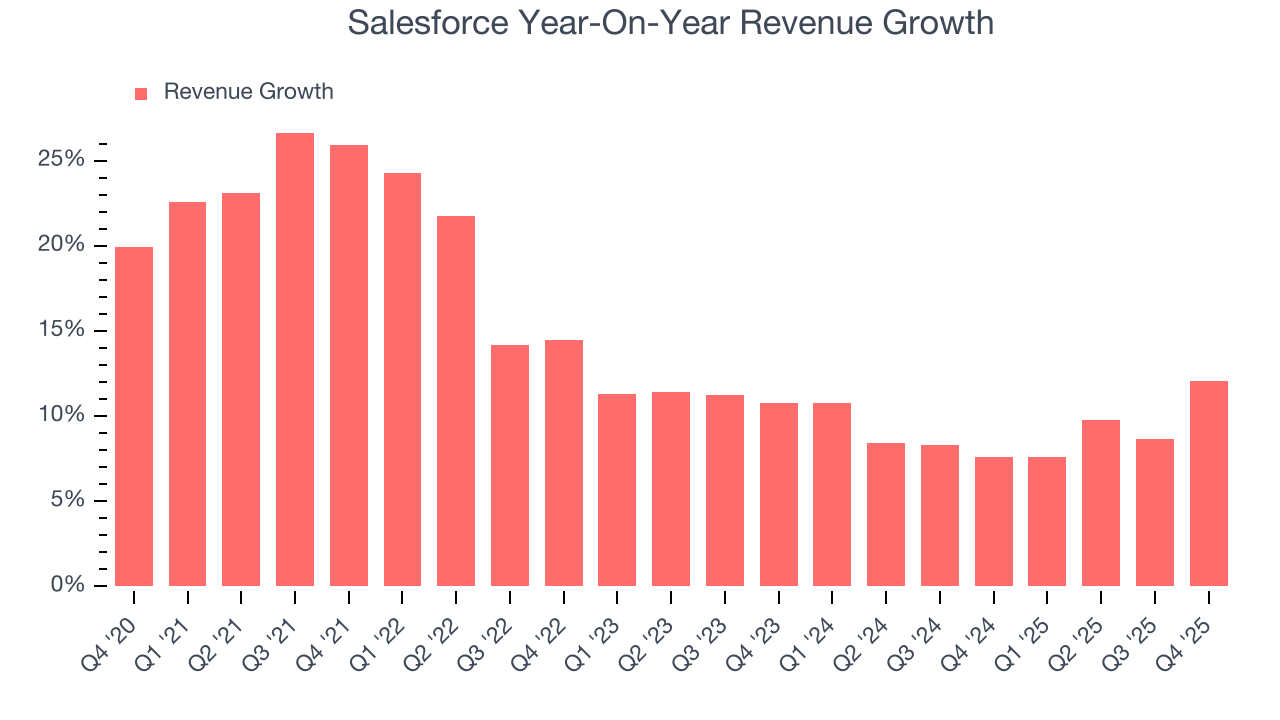
This quarter, Salesforce’s year-on-year revenue growth was 12.1%, and its $11.2 billion of revenue was in line with Wall Street’s estimates.
Looking ahead, sell-side analysts expect revenue to grow 11.1% over the next 12 months. While this projection suggests its newer products and services will catalyze better top-line performance, it is still below average for the sector.
6. Billings
Billings is a non-GAAP metric that is often called “cash revenue” because it shows how much money the company has collected from customers in a certain period. This is different from revenue, which must be recognized in pieces over the length of a contract.
Salesforce’s billings came in at $19.87 billion in Q4, and over the last four quarters, its growth was underwhelming as it averaged 11.3% year-on-year increases. This performance mirrored its total sales and suggests that increasing competition is causing challenges in acquiring/retaining customers. 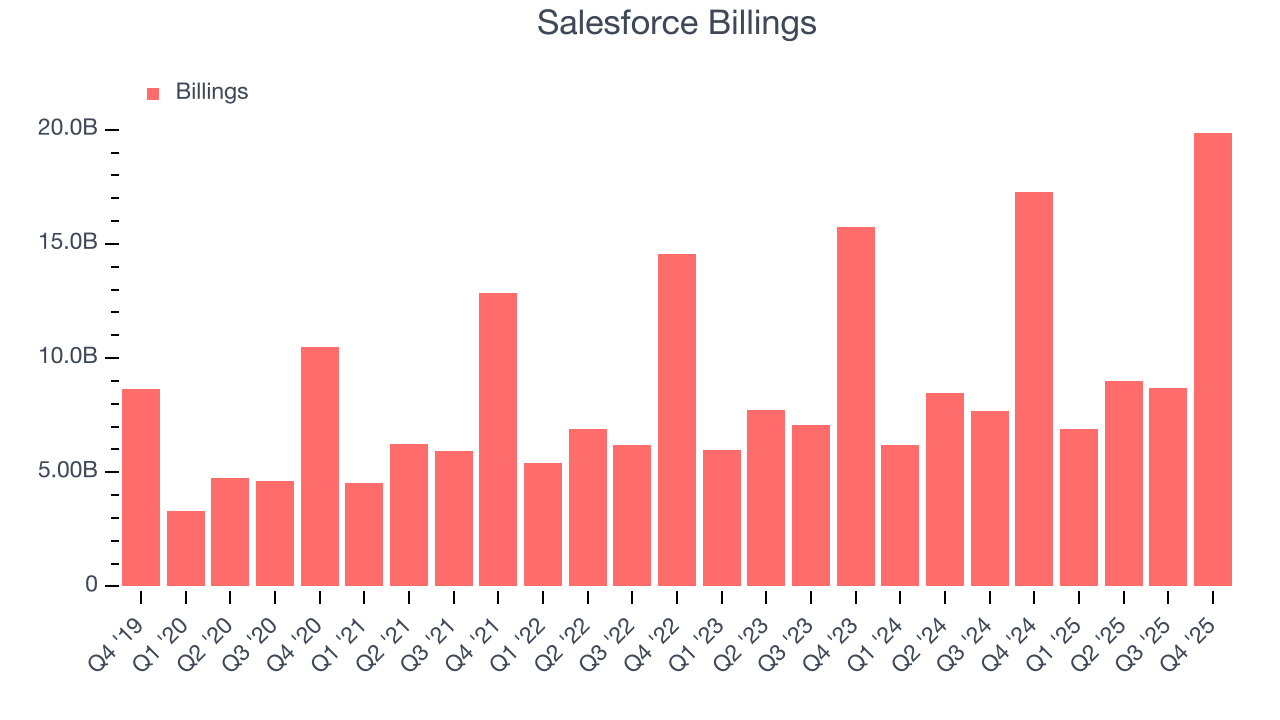
7. Customer Acquisition Efficiency
The customer acquisition cost (CAC) payback period represents the months required to recover the cost of acquiring a new customer. Essentially, it’s the break-even point for sales and marketing investments. A shorter CAC payback period is ideal, as it implies better returns on investment and business scalability.
It’s relatively expensive for Salesforce to acquire new customers as its CAC payback period checked in at 134.9 months this quarter. The company’s slow recovery of its sales and marketing expenses indicates it operates in a highly competitive market and must invest to stand out, even if the return on that investment is low.
8. Gross Margin & Pricing Power
For software companies like Salesforce, gross profit tells us how much money remains after paying for the base cost of products and services (typically servers, licenses, and certain personnel). These costs are usually low as a percentage of revenue, explaining why software is more lucrative than other sectors.
Salesforce’s robust unit economics are better than the broader software industry, an output of its asset-lite business model and pricing power. They also enable the company to fund large investments in new products and sales during periods of rapid growth to achieve higher profits in the future. As you can see below, it averaged an excellent 77.7% gross margin over the last year. Said differently, roughly $77.68 was left to spend on selling, marketing, and R&D for every $100 in revenue.
The market not only cares about gross margin levels but also how they change over time because expansion creates firepower for profitability and free cash generation. Salesforce has seen gross margins improve by 2.2 percentage points over the last 2 year, which is solid in the software space.
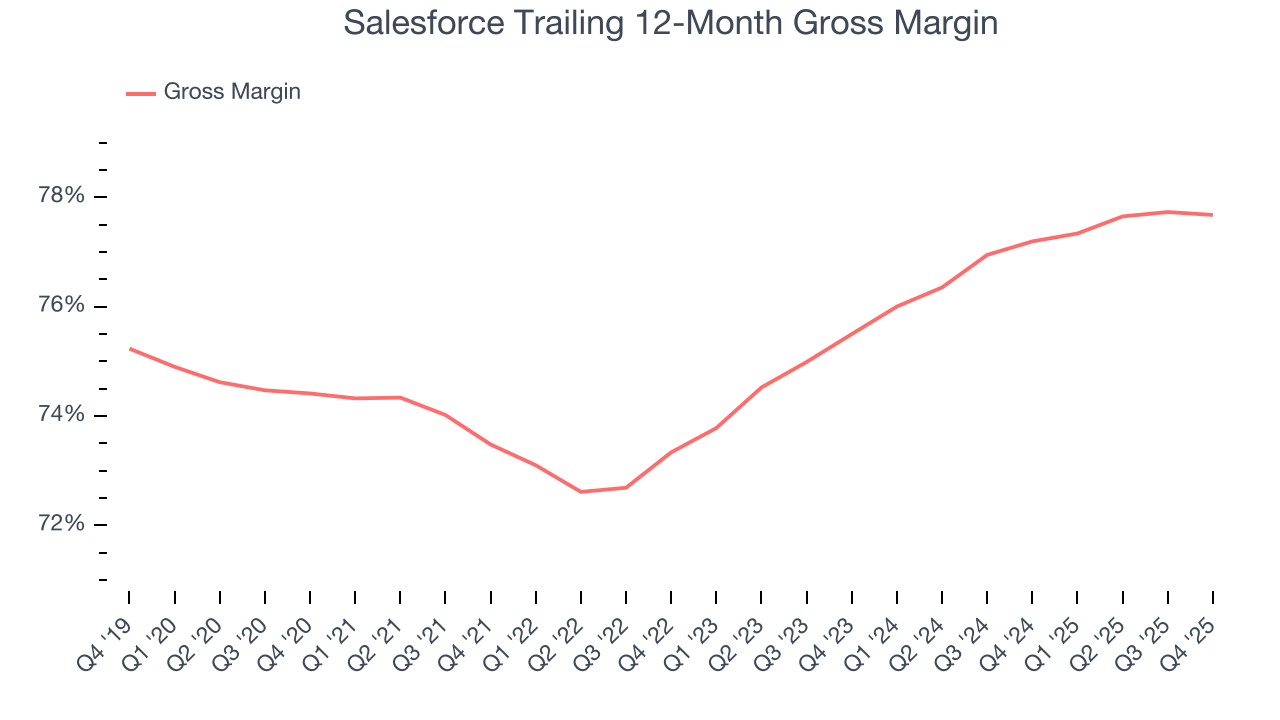
Salesforce produced a 77.6% gross profit margin in Q4, in line with the same quarter last year. On a wider time horizon, the company’s full-year margin has remained steady over the past four quarters, suggesting its input costs have been stable and it isn’t under pressure to lower prices.
9. Operating Margin
While many software businesses point investors to their adjusted profits, which exclude stock-based compensation (SBC), we prefer GAAP operating margin because SBC is a legitimate expense used to attract and retain talent. This is one of the best measures of profitability because it shows how much money a company takes home after developing, marketing, and selling its products.
Salesforce has been a well-oiled machine over the last year. It demonstrated elite profitability for a software business, boasting an average operating margin of 20.1%. This result isn’t surprising as its high gross margin gives it a favorable starting point.
Looking at the trend in its profitability, Salesforce’s operating margin rose by 1 percentage points over the last two years, as its sales growth gave it operating leverage.
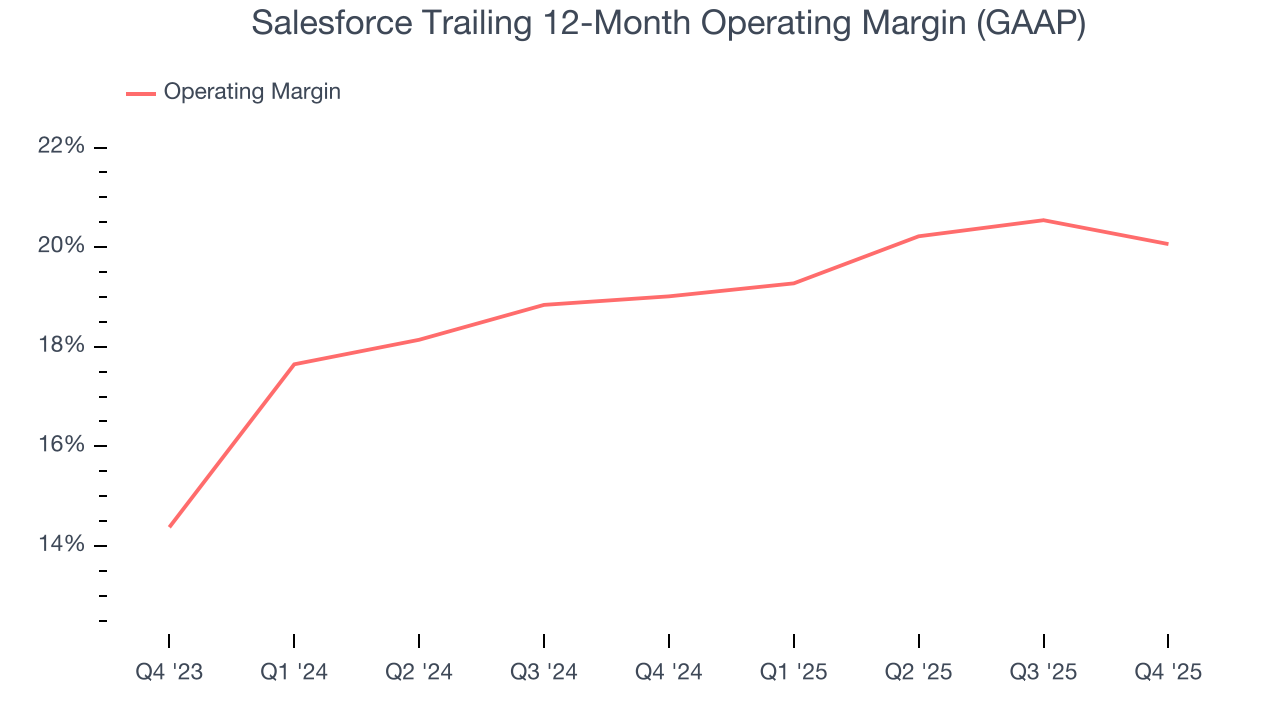
In Q4, Salesforce generated an operating margin profit margin of 16.7%, down 1.5 percentage points year on year. Since Salesforce’s operating margin decreased more than its gross margin, we can assume it was less efficient because expenses such as marketing, R&D, and administrative overhead increased.
10. Cash Is King
If you’ve followed StockStory for a while, you know we emphasize free cash flow. Why, you ask? We believe that in the end, cash is king, and you can’t use accounting profits to pay the bills.
Salesforce has shown terrific cash profitability, driven by its lucrative business model that enables it to reinvest, return capital to investors, and stay ahead of the competition while maintaining an ample cushion. The company’s free cash flow margin was among the best in the software sector, averaging an eye-popping 34.7% over the last year.
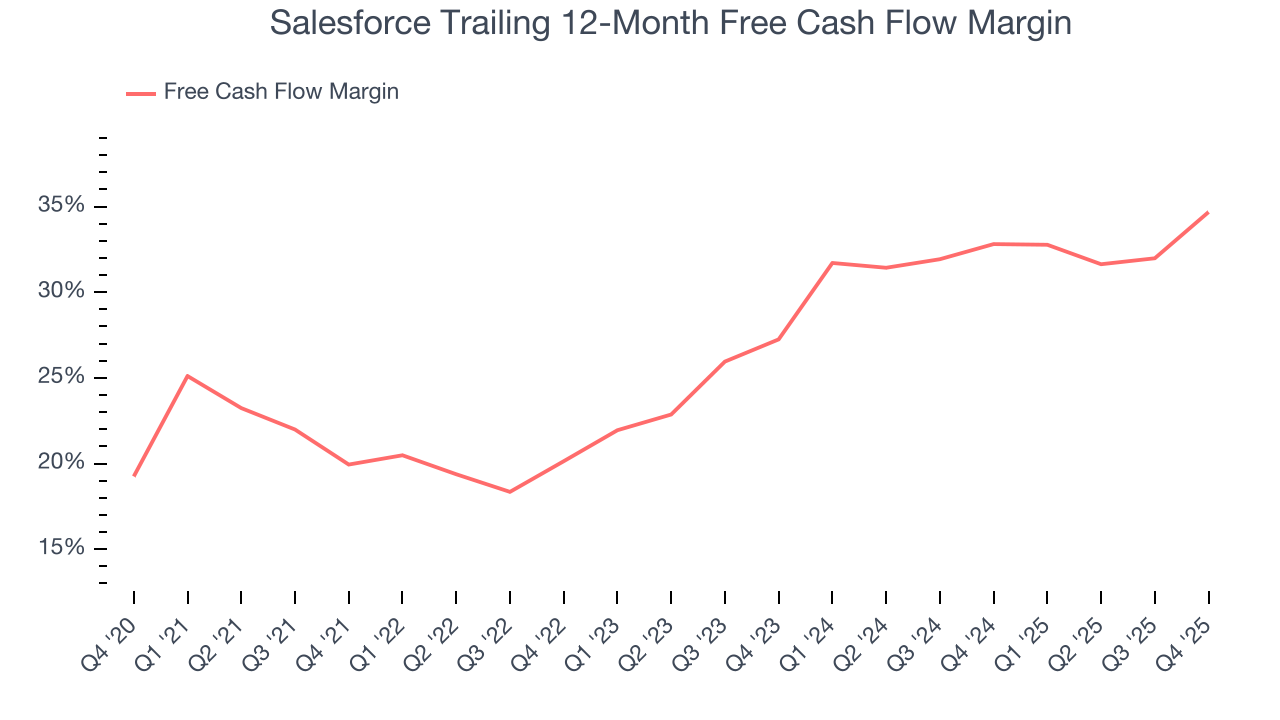
Salesforce’s free cash flow clocked in at $5.32 billion in Q4, equivalent to a 47.5% margin. This result was good as its margin was 9.3 percentage points higher than in the same quarter last year, but we wouldn’t read too much into the short term because investment needs can be seasonal, leading to temporary swings. Long-term trends carry greater meaning.
Over the next year, analysts’ consensus estimates show they’re expecting Salesforce’s free cash flow margin of 34.7% for the last 12 months to remain the same.
11. Balance Sheet Assessment
Salesforce reported $9.57 billion of cash and $17.18 billion of debt on its balance sheet in the most recent quarter. As investors in high-quality companies, we primarily focus on two things: 1) that a company’s debt level isn’t too high and 2) that its interest payments are not excessively burdening the business.
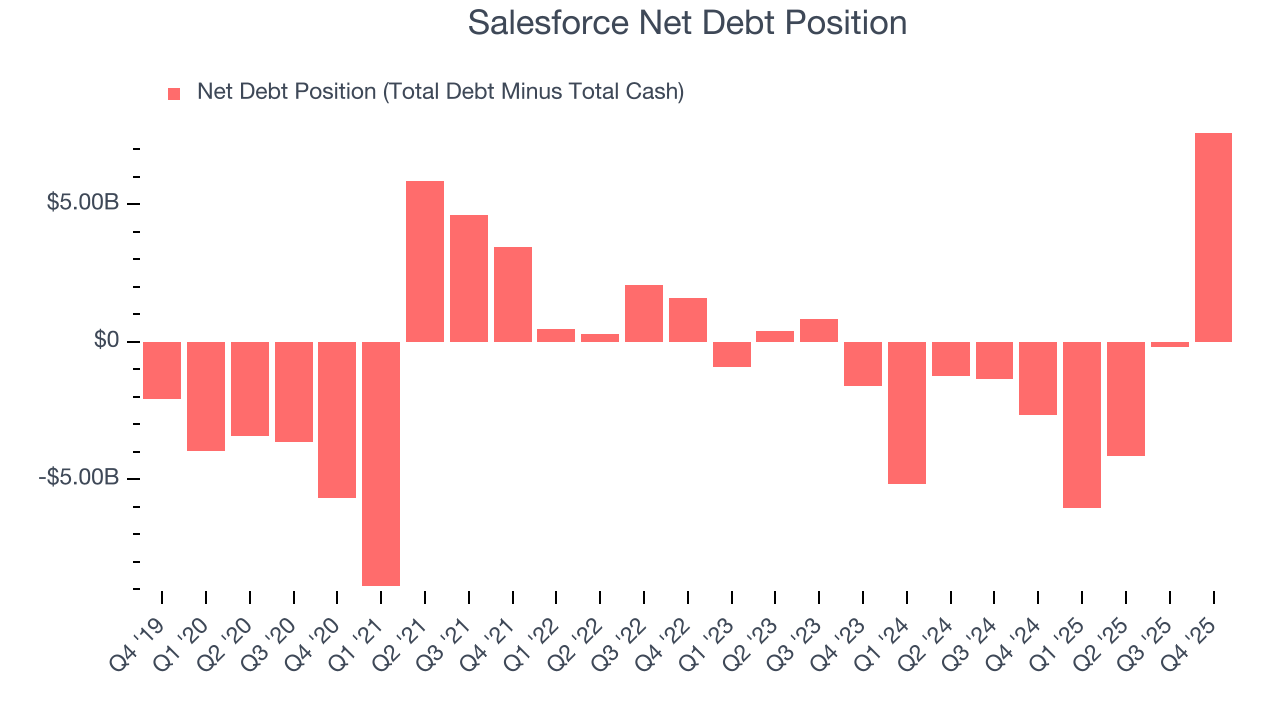
With $17.79 billion of EBITDA over the last 12 months, we view Salesforce’s 0.4× net-debt-to-EBITDA ratio as safe. We also see its $324 million of annual interest expenses as appropriate. The company’s profits give it plenty of breathing room, allowing it to continue investing in growth initiatives.
12. Key Takeaways from Salesforce’s Q4 Results
It was great to see Salesforce expecting revenue growth to accelerate next year. We were also glad its EPS guidance for next quarter exceeded Wall Street’s estimates. On the other hand, full-year revenue guidance missed expectations. Overall, we think this was a mixed quarter. Investors were hoping for more, and shares traded down 3.7% to $184.70 immediately after reporting.
13. Is Now The Time To Buy Salesforce?
Updated: March 24, 2026 at 10:01 PM EDT
We think that the latest earnings result is only one piece of the bigger puzzle. If you’re deciding whether to own Salesforce, you should also grasp the company’s longer-term business quality and valuation.
Salesforce’s business quality ultimately falls short of our standards. To begin with, its revenue growth was a little slower over the last five years, and analysts expect its demand to deteriorate over the next 12 months. While its impressive operating margins show it has a highly efficient business model, the downside is its expanding operating margin shows it’s becoming more efficient at building and selling its software. On top of that, its ARR has disappointed and shows the company is having difficulty retaining customers and their spending.
Salesforce’s price-to-sales ratio based on the next 12 months is 4x. This valuation multiple is fair, but we don’t have much faith in the company. We're fairly confident there are better investments elsewhere.
Wall Street analysts have a consensus one-year price target of $273.66 on the company (compared to the current share price of $183.97).
Although the price target is bullish, readers should exercise caution because analysts tend to be overly optimistic. The firms they work for, often big banks, have relationships with companies that extend into fundraising, M&A advisory, and other rewarding business lines. As a result, they typically hesitate to say bad things for fear they will lose out. We at StockStory do not suffer from such conflicts of interest, so we’ll always tell it like it is.