
EMCOR (EME)
Not many stocks excite us like EMCOR. Its superior revenue growth and returns on capital show it can achieve fast and profitable expansion.― StockStory Analyst Team


1. News




2. Summary
Why We Like EMCOR
Through its network of over 70 subsidiaries, EMCOR (NYSE:EME) provides electrical, mechanical, and building construction and services
- Annual revenue growth of 16.2% over the past two years was outstanding, reflecting market share gains this cycle
- Additional sales over the last five years increased its profitability as the 64% annual growth in its earnings per share outpaced its revenue
- Industry-leading 32.8% return on capital demonstrates management’s skill in finding high-return investments, and its returns are growing as it capitalizes on even better market opportunities
EMCOR is a remarkable business. The valuation seems fair when considering its quality, and we think now is a favorable time to invest.
Why Is Now The Time To Buy EMCOR?




EMCOR’s stock price of $760.01 implies a valuation ratio of 26x forward P/E. Most companies in the industrials sector may feature a cheaper multiple, but we think EMCOR is priced fairly given its fundamentals.
Entry price may seem important in the moment, but our work shows that time and again, long-term market outperformance is determined by business quality rather than getting an absolute bargain on a stock.
3. EMCOR (EME) Research Report: Q4 CY2025 Update
Specialty construction contractor company EMCOR (NYSE:EME) beat Wall Street’s revenue expectations in Q4 CY2025, with sales up 19.7% year on year to $4.51 billion. The company’s full-year revenue guidance of $18.13 billion at the midpoint came in 1.7% above analysts’ estimates. Its GAAP profit of $9.68 per share was 45% above analysts’ consensus estimates.
EMCOR (EME) Q4 CY2025 Highlights:
- Revenue: $4.51 billion vs analyst estimates of $4.29 billion (19.7% year-on-year growth, 5.3% beat)
- EPS (GAAP): $9.68 vs analyst estimates of $6.68 (45% beat, included gain on sale of $144.9 million for EMCOR’s United Kingdom operations)
- Adjusted EBITDA: $591.7 million vs analyst estimates of $456.8 million (13.1% margin, 29.5% beat)
- EPS (GAAP) guidance for the upcoming financial year 2026 is $28.25 at the midpoint, beating analyst estimates by 1.1%
- Operating Margin: 12.7%, up from 10.3% in the same quarter last year
- Free Cash Flow Margin: 10.9%, down from 12% in the same quarter last year
- Market Capitalization: $35.89 billion
Company Overview
Through its network of over 70 subsidiaries, EMCOR (NYSE:EME) provides electrical, mechanical, and building construction and services
The company provides the design, installation, operation, and maintenance of complex mechanical and electrical systems, like electrical power transmission systems. Its services ensure the safe and sustainable operation of these mechanical and electrical systems in buildings and industrial sites.
Specifically, it services power cables, power supply systems, electric vehicle charging stations, roadway transit lighting, ventilation systems in buildings, and fire protection and suppression systems. It also offers more hands-on services like crane and rigging services and steel fabrication and welding services on-site.
EMCOR's main sources of revenue come from the contracts it receives for its mechanical and electrical construction projects. Its business is modeled around project-based work, and its wide clientele means it has a diversified revenue stream, ranging from commercial buildings and healthcare facilities to government entities and industrial sites. Due to the service and maintenance nature of this company, a significant portion of its revenue comes in a recurring form.
4. Engineering and Design Services
Companies providing engineering and design services boast ever-evolving technical expertise. Compared to their counterparts who manufacture and sell physical products, these companies can also pivot faster to more trending areas due to their smaller physical asset bases. Green energy and water conservation, for example, are current themes driving incremental demand in this space. On the other hand, those providing engineering and design services are at the whim of construction and infrastructure project volumes, which tend to be cyclical and can be impacted heavily by economic factors such as interest rates.
EMCOR’s competitors include Quanta Services (NYSE:PWR), Comfort Systems (NYSE:FIX), and Dycom Industries (NYSE:DY).
5. Revenue Growth
A company’s long-term performance is an indicator of its overall quality. Even a bad business can shine for one or two quarters, but a top-tier one grows for years. Thankfully, EMCOR’s 14.1% annualized revenue growth over the last five years was exceptional. Its growth surpassed the average industrials company and shows its offerings resonate with customers, a great starting point for our analysis.
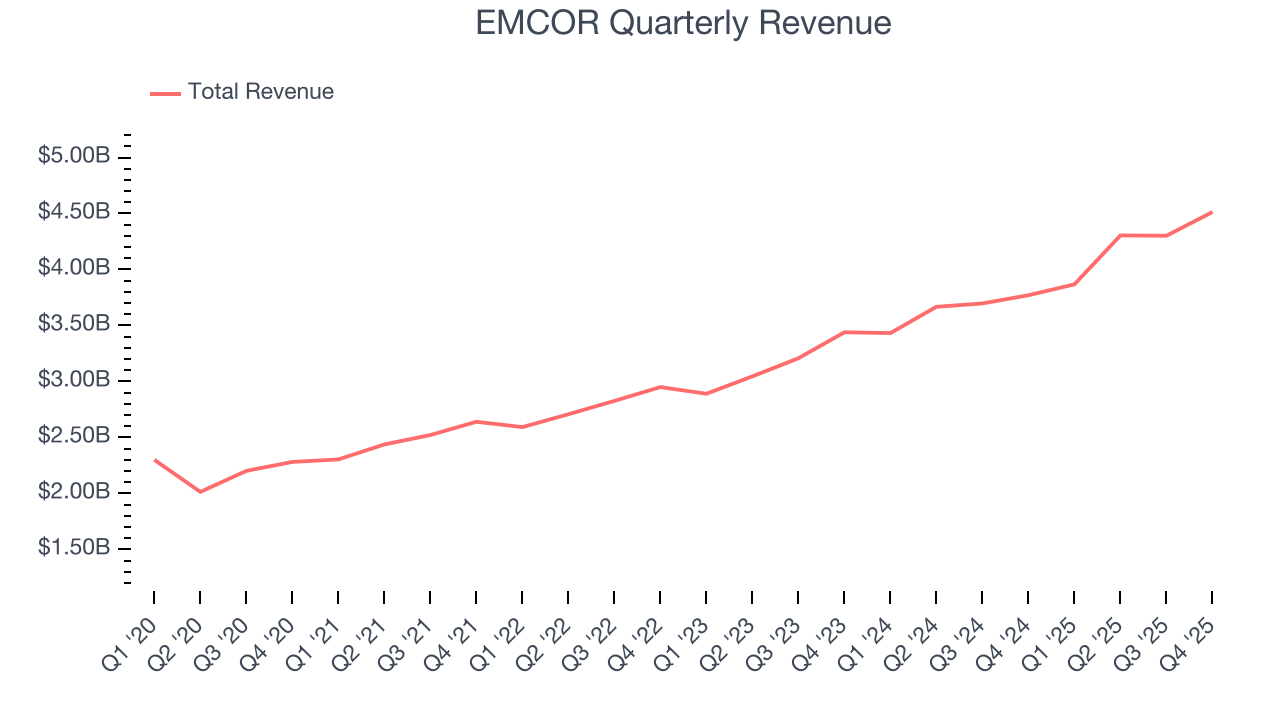
Long-term growth is the most important, but within industrials, a half-decade historical view may miss new industry trends or demand cycles. EMCOR’s annualized revenue growth of 16.2% over the last two years is above its five-year trend, suggesting its demand was strong and recently accelerated.
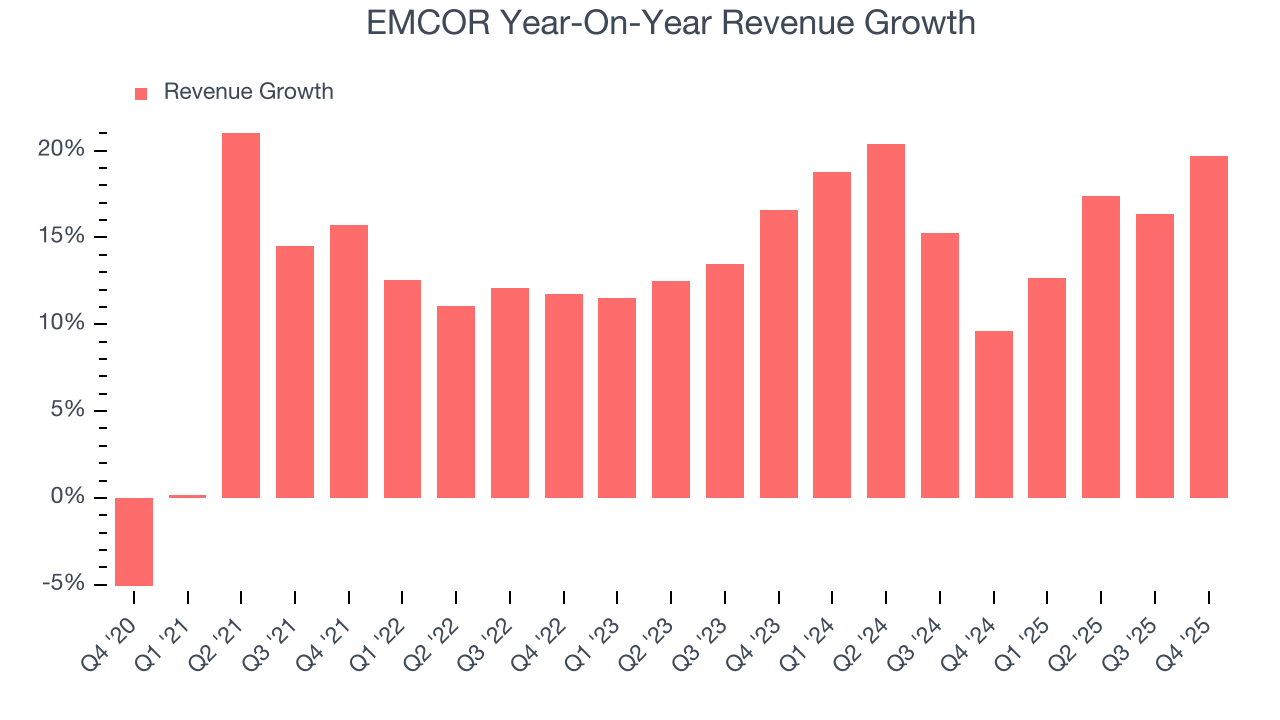
This quarter, EMCOR reported year-on-year revenue growth of 19.7%, and its $4.51 billion of revenue exceeded Wall Street’s estimates by 5.3%.
Looking ahead, sell-side analysts expect revenue to grow 4.9% over the next 12 months, a deceleration versus the last two years. This projection doesn't excite us and suggests its products and services will see some demand headwinds. At least the company is tracking well in other measures of financial health.
6. Gross Margin & Pricing Power
At StockStory, we prefer high gross margin businesses because they indicate the company has pricing power or differentiated products, giving it a chance to generate higher operating profits.
EMCOR has bad unit economics for an industrials business, signaling it operates in a competitive market. As you can see below, it averaged a 17.3% gross margin over the last five years. Said differently, EMCOR had to pay a chunky $82.73 to its suppliers for every $100 in revenue. 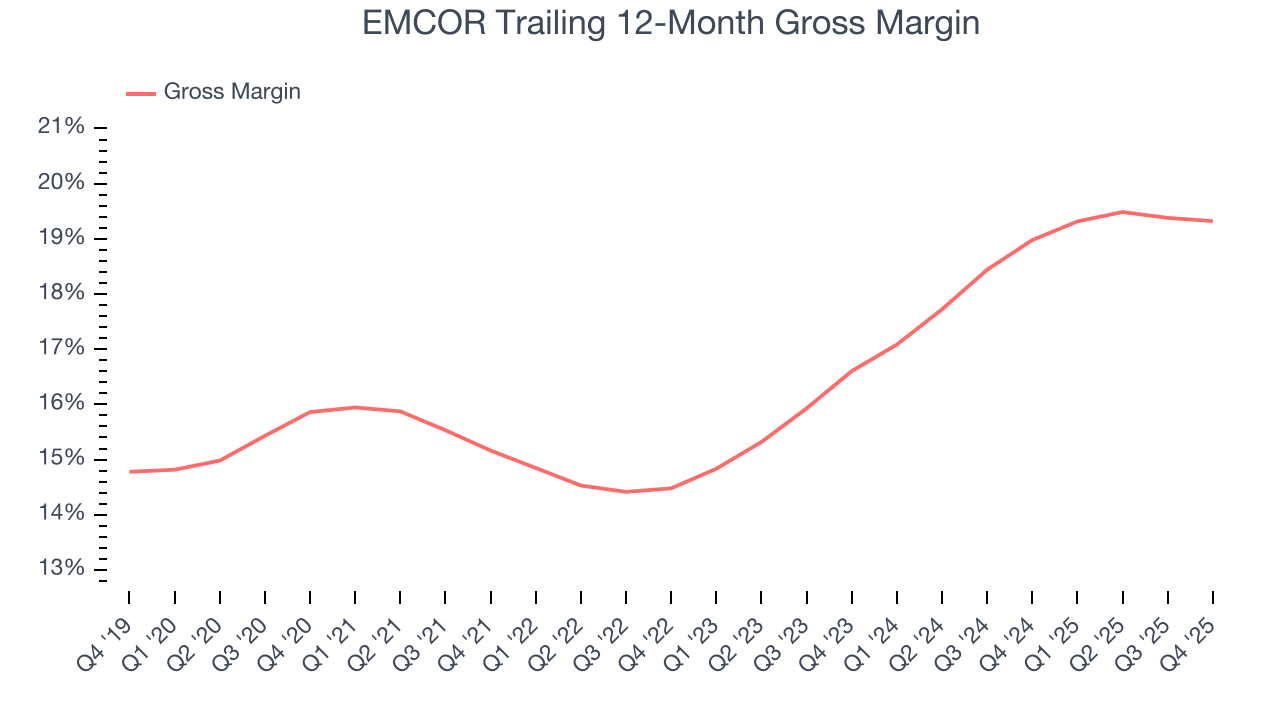
EMCOR produced a 19.7% gross profit margin in Q4, in line with the same quarter last year. Zooming out, the company’s full-year margin has remained steady over the past 12 months, suggesting its input costs (such as raw materials and manufacturing expenses) have been stable and it isn’t under pressure to lower prices.
7. Operating Margin
Operating margin is one of the best measures of profitability because it tells us how much money a company takes home after procuring and manufacturing its products, marketing and selling those products, and most importantly, keeping them relevant through research and development.
EMCOR was profitable over the last five years but held back by its large cost base. Its average operating margin of 7.7% was weak for an industrials business. This result isn’t too surprising given its low gross margin as a starting point.
On the plus side, EMCOR’s operating margin rose by 4.7 percentage points over the last five years, as its sales growth gave it operating leverage.
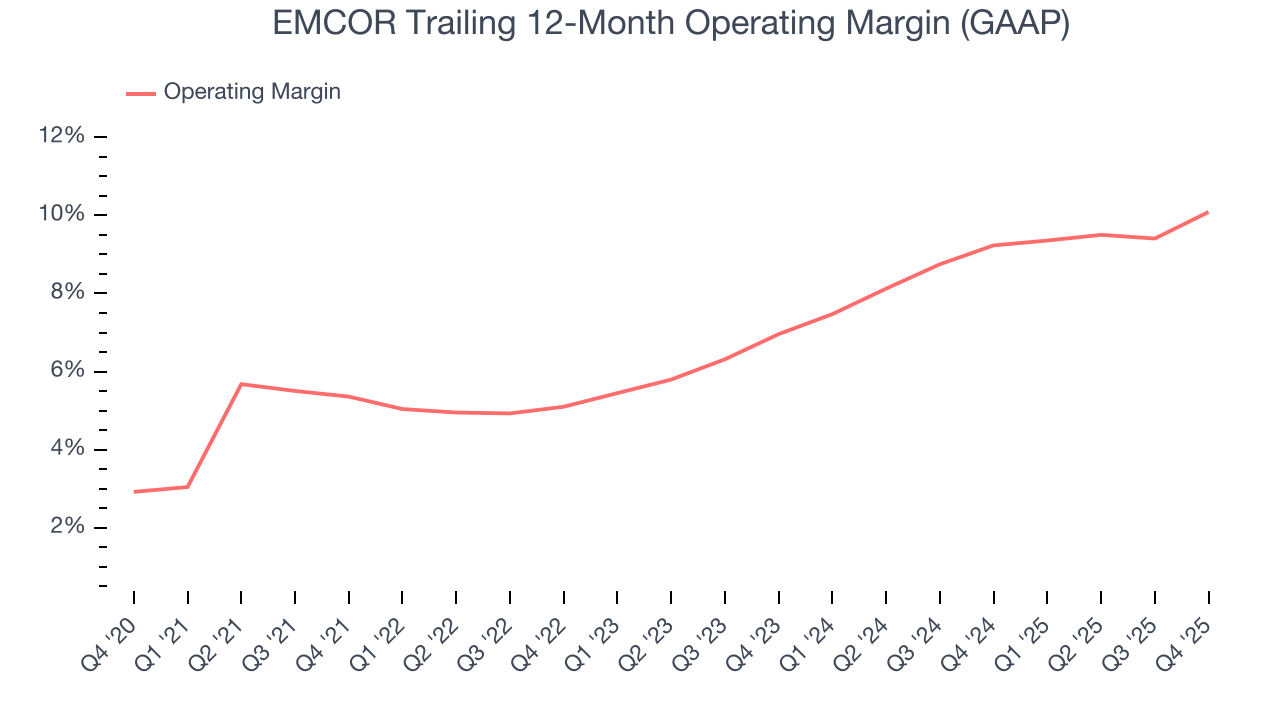
This quarter, EMCOR generated an operating margin profit margin of 12.7%, up 2.4 percentage points year on year. The increase was encouraging, and because its operating margin rose more than its gross margin, we can infer it was more efficient with expenses such as marketing, R&D, and administrative overhead.
8. Earnings Per Share
Revenue trends explain a company’s historical growth, but the long-term change in earnings per share (EPS) points to the profitability of that growth – for example, a company could inflate its sales through excessive spending on advertising and promotions.
EMCOR’s EPS grew at an astounding 64% compounded annual growth rate over the last five years, higher than its 14.1% annualized revenue growth. This tells us the company became more profitable on a per-share basis as it expanded.
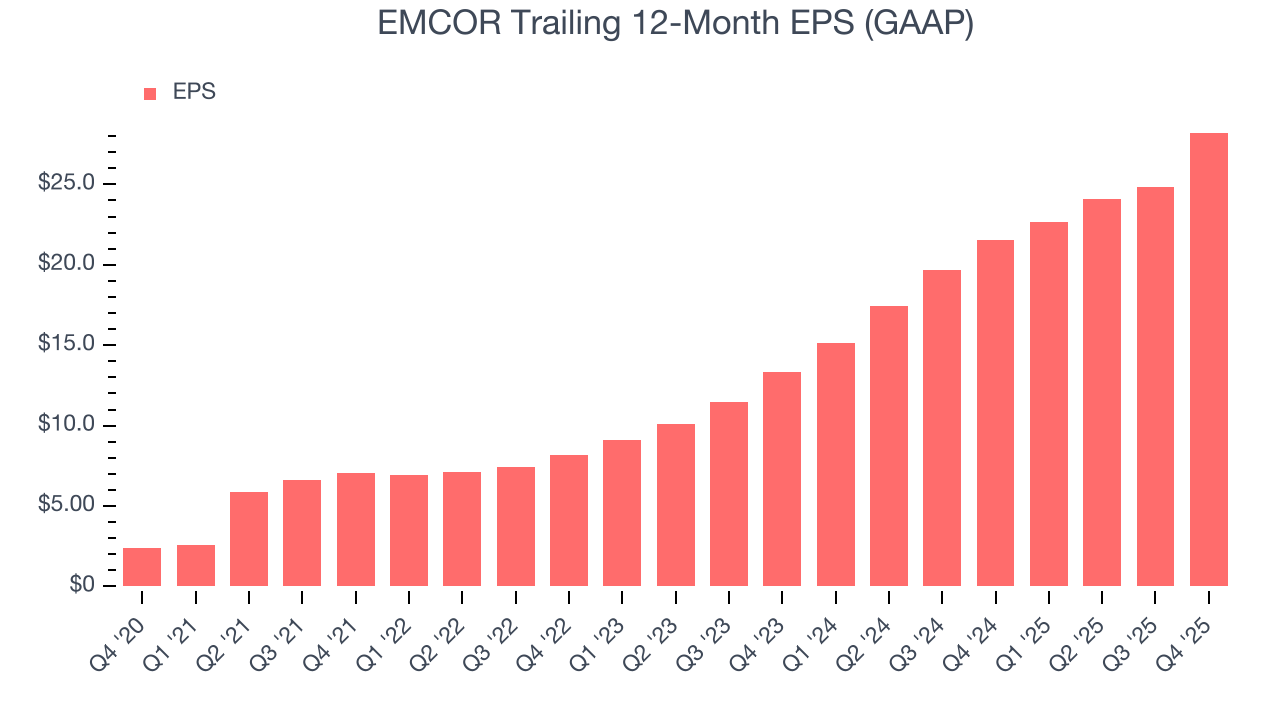
Diving into EMCOR’s quality of earnings can give us a better understanding of its performance. As we mentioned earlier, EMCOR’s operating margin expanded by 4.7 percentage points over the last five years. On top of that, its share count shrank by 18.6%. These are positive signs for shareholders because improving profitability and share buybacks turbocharge EPS growth relative to revenue growth. 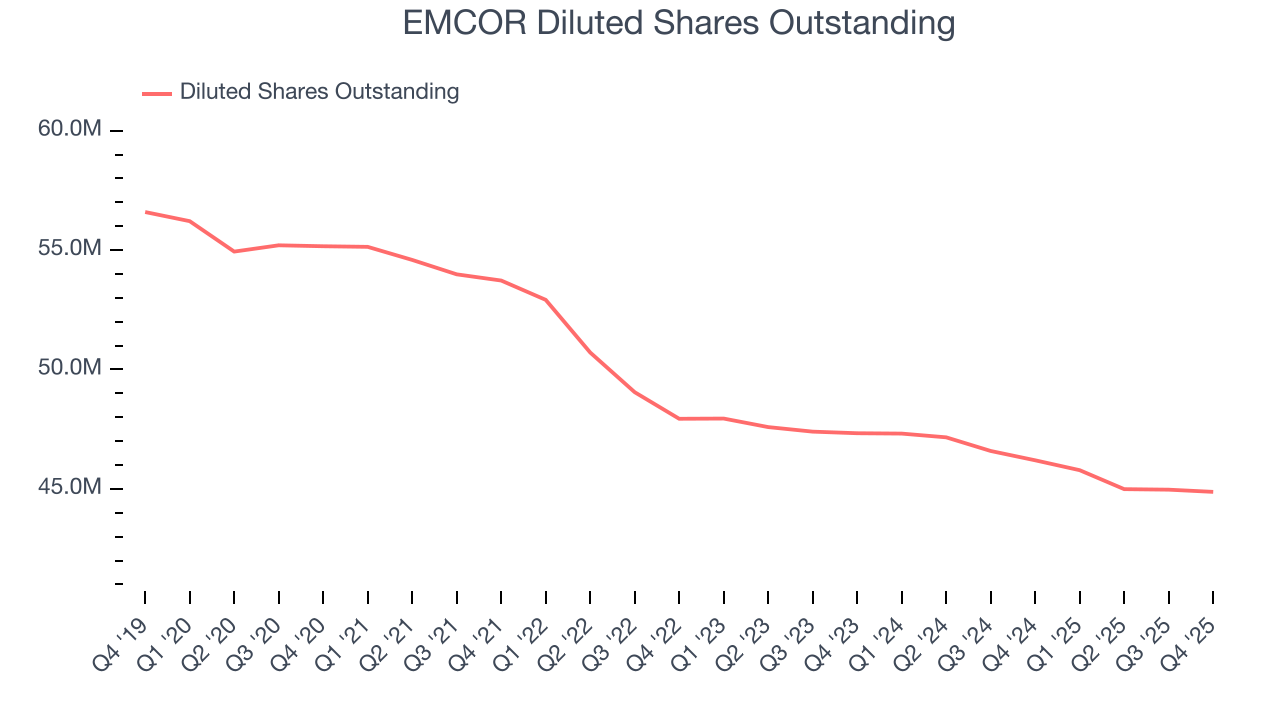
Like with revenue, we analyze EPS over a shorter period to see if we are missing a change in the business.
For EMCOR, its two-year annual EPS growth of 45.5% was lower than its five-year trend. We still think its growth was good and hope it can accelerate in the future.
In Q4, EMCOR reported EPS of $9.68, up from $6.32 in the same quarter last year. This print easily cleared analysts’ estimates, and shareholders should be content with the results. Over the next 12 months, Wall Street expects EMCOR’s full-year EPS of $28.22 to stay about the same.
9. Cash Is King
If you’ve followed StockStory for a while, you know we emphasize free cash flow. Why, you ask? We believe that in the end, cash is king, and you can’t use accounting profits to pay the bills.
EMCOR has shown decent cash profitability, giving it some flexibility to reinvest or return capital to investors. The company’s free cash flow margin averaged 6.3% over the last five years, slightly better than the broader industrials sector.
Taking a step back, we can see that EMCOR’s margin expanded by 4.1 percentage points during that time. This is encouraging because it gives the company more optionality.
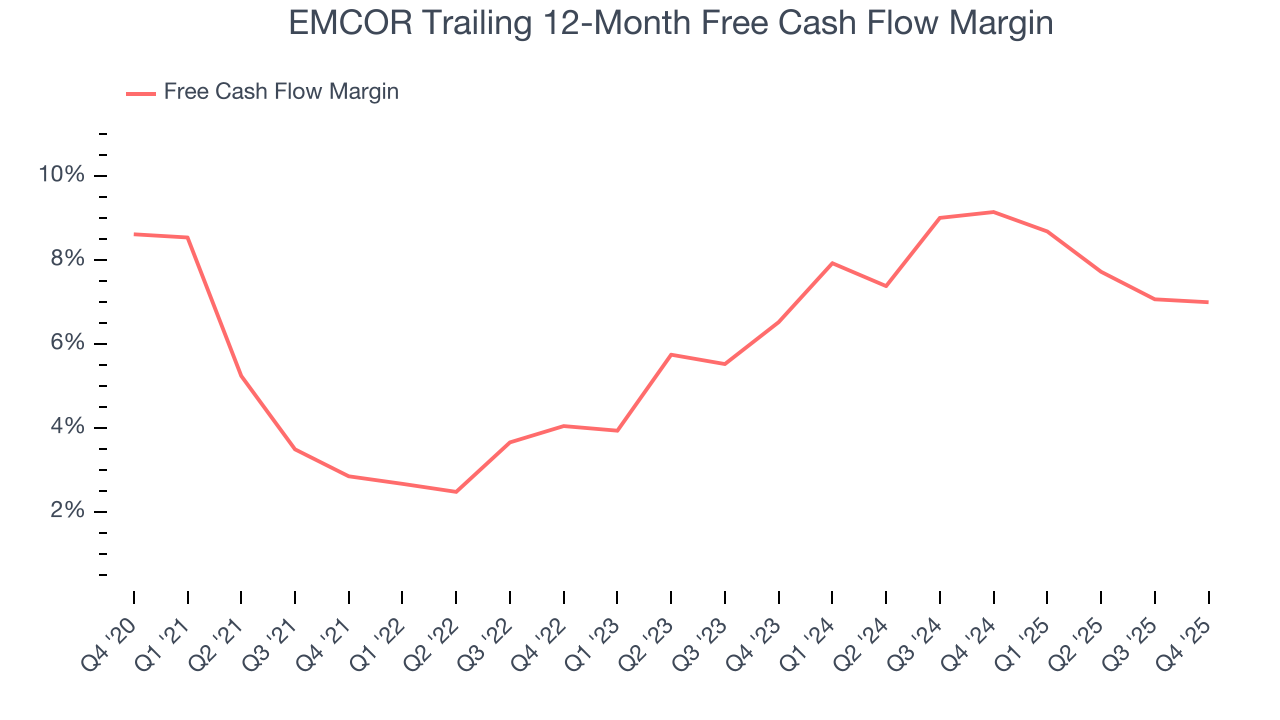
EMCOR’s free cash flow clocked in at $492.5 million in Q4, equivalent to a 10.9% margin. The company’s cash profitability regressed as it was 1.1 percentage points lower than in the same quarter last year, but it’s still above its five-year average. We wouldn’t read too much into this quarter’s decline because investment needs can be seasonal, causing short-term swings. Long-term trends are more important.
10. Return on Invested Capital (ROIC)
EPS and free cash flow tell us whether a company was profitable while growing its revenue. But was it capital-efficient? A company’s ROIC explains this by showing how much operating profit it makes compared to the money it has raised (debt and equity).
EMCOR’s five-year average ROIC was 32.6%, placing it among the best industrials companies. This illustrates its management team’s ability to invest in highly profitable ventures and produce tangible results for shareholders.
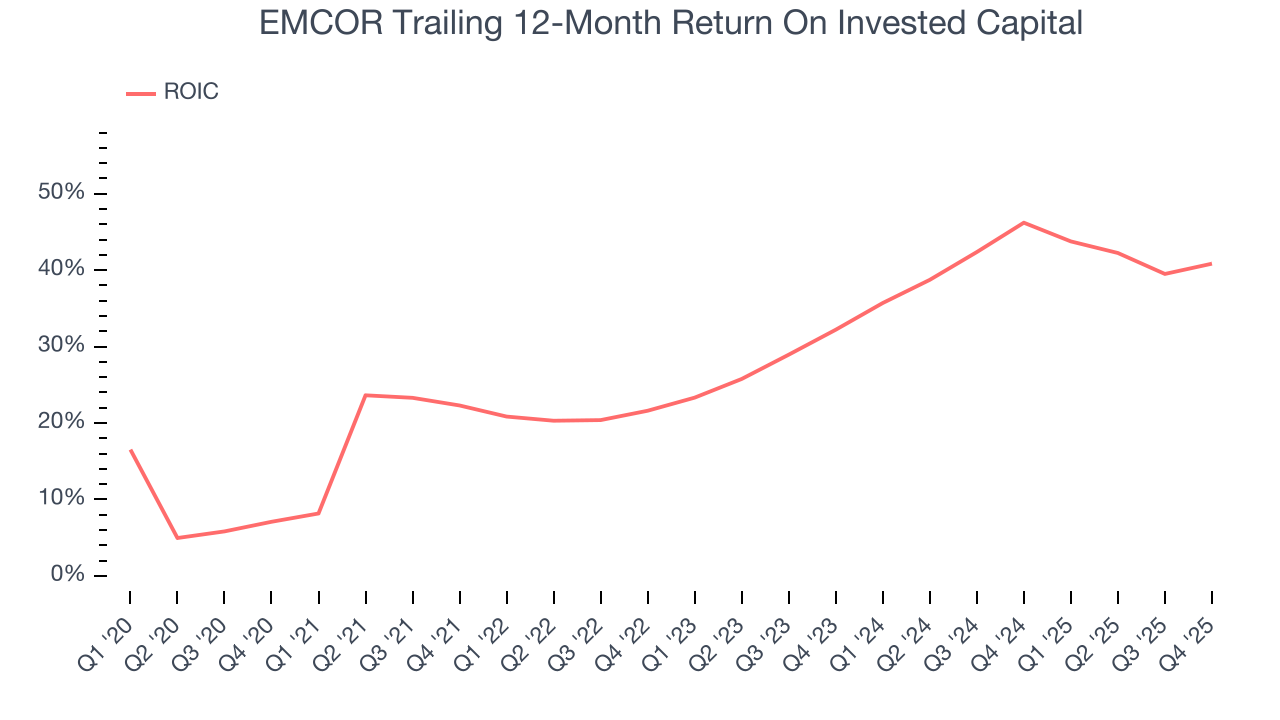
We like to invest in businesses with high returns, but the trend in a company’s ROIC is what often surprises the market and moves the stock price. Fortunately, EMCOR’s ROIC has increased significantly over the last few years. This is a great sign when paired with its already strong returns. It could suggest its competitive advantage or profitable growth opportunities are expanding.
11. Balance Sheet Assessment
Companies with more cash than debt have lower bankruptcy risk.
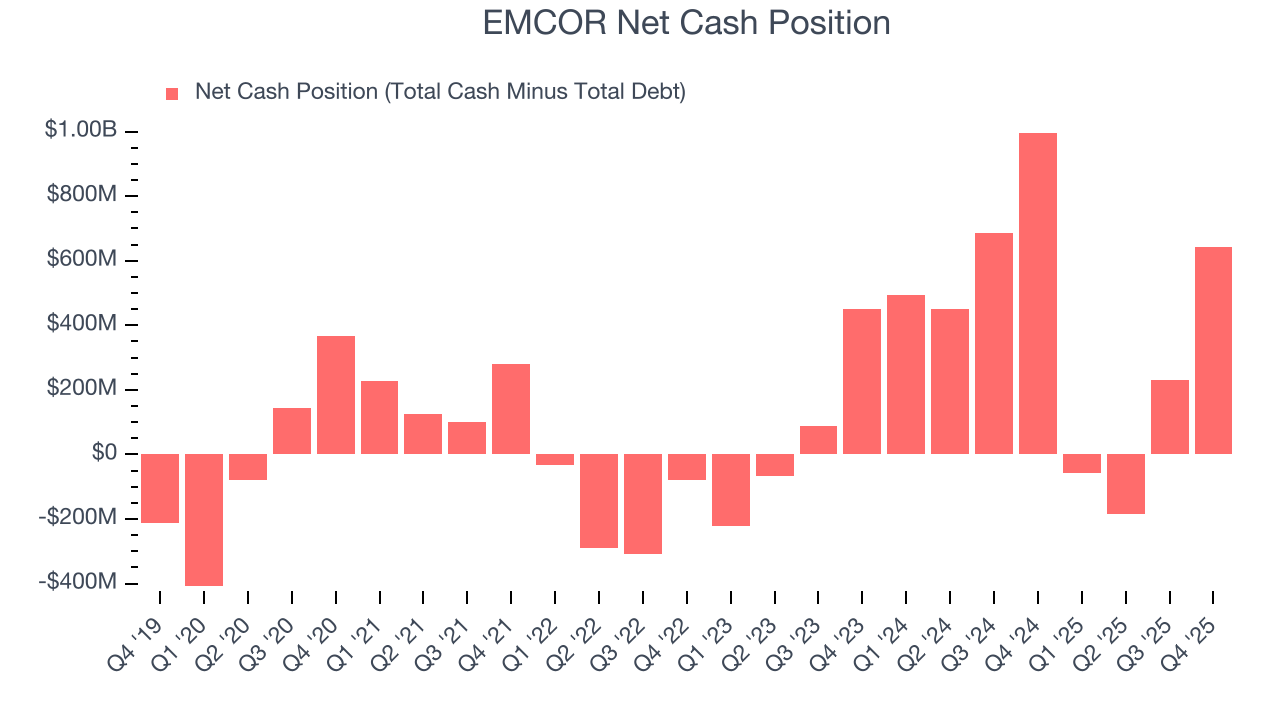
EMCOR is a profitable, well-capitalized company with $1.11 billion of cash and $468.2 million of debt on its balance sheet. This $643.8 million net cash position gives it the freedom to borrow money, return capital to shareholders, or invest in growth initiatives. Leverage is not an issue here.
12. Key Takeaways from EMCOR’s Q4 Results
It was good to see EMCOR beat analysts’ EBITDA and EPS expectations this quarter, even after removing the non-recurring gain on sale from its UK operations transaction. Looking ahead, EPS guidance for the coming year also came in head. Zooming out, we think this quarter featured some important positives. The stock traded up 2% to $818.06 immediately following the results.
13. Is Now The Time To Buy EMCOR?
Updated: March 19, 2026 at 11:10 PM EDT
Before investing in or passing on EMCOR, we urge you to understand the company’s business quality (or lack thereof), valuation, and the latest quarterly results - in that order.
EMCOR is truly a cream-of-the-crop industrials company. First of all, the company’s revenue growth was exceptional over the last five years. And while its projected EPS for the next year is lacking, its astounding EPS growth over the last five years shows its profits are trickling down to shareholders. On top of that, EMCOR’s stellar ROIC suggests it has been a well-run company historically.
EMCOR’s P/E ratio based on the next 12 months is 26x. Scanning the industrials landscape today, EMCOR’s fundamentals clearly illustrate that it’s an elite business, and we like it at this price.
Wall Street analysts have a consensus one-year price target of $869.29 on the company (compared to the current share price of $760.01), implying they see 14.4% upside in buying EMCOR in the short term.