
Federal Signal (FSS)
Federal Signal is in a league of its own. Its elite revenue growth and returns on capital demonstrate it can grow rapidly and profitably.― StockStory Analyst Team


1. News




2. Summary
Why We Like Federal Signal
Developing sirens that warned of air raid attacks or fallout during the Cold War, Federal Signal (NYSE:FSS) provides safety and emergency equipment for government agencies, municipalities, and industrial companies.
- Incremental sales over the last five years have been highly profitable as its earnings per share increased by 20.4% annually, topping its revenue gains
- Exciting sales outlook for the upcoming 12 months calls for 20.3% growth, an acceleration from its two-year trend
- Annual revenue growth of 14% over the last five years was superb and indicates its market share increased during this cycle
Federal Signal is at the top of our list. The price seems reasonable relative to its quality, and we think now is a favorable time to buy.
Why Is Now The Time To Buy Federal Signal?








At $105.43 per share, Federal Signal trades at 22.7x forward P/E. Scanning the industrials landscape, we think this multiple is reasonable - arguably even attractive - for the quality you get.
By definition, where you buy a stock impacts returns. Compared to entry price, business quality matters much more for long-term market outperformance. Buying in at a great price helps, nevertheless.
3. Federal Signal (FSS) Research Report: Q4 CY2025 Update
Safety and security company Federal Signal (NYSE:FSS) announced better-than-expected revenue in Q4 CY2025, with sales up 26.5% year on year to $597.1 million. The company’s full-year revenue guidance of $2.6 billion at the midpoint came in 5.3% above analysts’ estimates. Its non-GAAP profit of $1.16 per share was 7.4% above analysts’ consensus estimates.
Federal Signal (FSS) Q4 CY2025 Highlights:
- Revenue: $597.1 million vs analyst estimates of $545.2 million (26.5% year-on-year growth, 9.5% beat)
- Adjusted EPS: $1.16 vs analyst estimates of $1.08 (7.4% beat)
- Adjusted EBITDA: $119.4 million vs analyst estimates of $110.7 million (20% margin, 7.9% beat)
- Adjusted EPS guidance for the upcoming financial year 2026 is $4.65 at the midpoint, beating analyst estimates by 0.6%
- Operating Margin: 14%, in line with the same quarter last year
- Free Cash Flow Margin: 15%, down from 17.4% in the same quarter last year
- Backlog: $1.04 billion at quarter end, up 4% year on year
- Market Capitalization: $7.11 billion
Company Overview
Developing sirens that warned of air raid attacks or fallout during the Cold War, Federal Signal (NYSE:FSS) provides safety and emergency equipment for government agencies, municipalities, and industrial companies.
Federal Signal Corporation was founded in 1901 manufacturing and selling store signs lit by incandescent lamps and soon produced electric sirens. Over the decades, the company evolved its product offerings to include a wide range of safety and emergency equipment. Specifically, key acquisitions such as Joe Johnson Equipment in 2016 and Truck Bodies and Equipment in 2017 opened doors for its current selection of outdoor warning systems and emergency vehicle equipment.
Its emergency vehicle lighting systems are used for police cars and ambulances to ensure visibility during emergencies. In manufacturing settings, Federal Signal industrial signaling products facilitate communication among workers. These devices ensure that operators can coordinate machinery operations, alerting them to start or stop processes, and warning of any potential hazards. The company also offers environmental and safety products such as air quality monitors and detectors for hazardous materials. These tools are particularly important for utility companies and transportation sectors to comply with environmental regulations and maintain safe working conditions.
Federal Signal frequently secures contracts with government agencies, municipalities, and industrial companies through bids for large-scale projects and ongoing service agreements. These contracts vary in length, ranging from short-term agreements for specific projects to longer-term arrangements spanning several years. In terms of pricing, it is determined through these bids where proposals outline costs based on factors like materials, labor, installation, and ongoing maintenance.
4. Heavy Transportation Equipment
Heavy transportation equipment companies are investing in automated vehicles that increase efficiencies and connected machinery that collects actionable data. Some are also developing electric vehicles and mobility solutions to address customers’ concerns about carbon emissions, creating new sales opportunities. Additionally, they are increasingly offering automated equipment that increases efficiencies and connected machinery that collects actionable data. On the other hand, heavy transportation equipment companies are at the whim of economic cycles. Interest rates, for example, can greatly impact the construction and transport volumes that drive demand for these companies’ offerings.
Competitors of Federal Signal Corporation include Oshkosh (NYSE:OSK), Dover NYSE:DOV), and 3M ((NYSE:MMM).
5. Revenue Growth
A company’s long-term sales performance is one signal of its overall quality. Any business can put up a good quarter or two, but many enduring ones grow for years. Thankfully, Federal Signal’s 14% annualized revenue growth over the last five years was exceptional. Its growth surpassed the average industrials company and shows its offerings resonate with customers, a great starting point for our analysis.
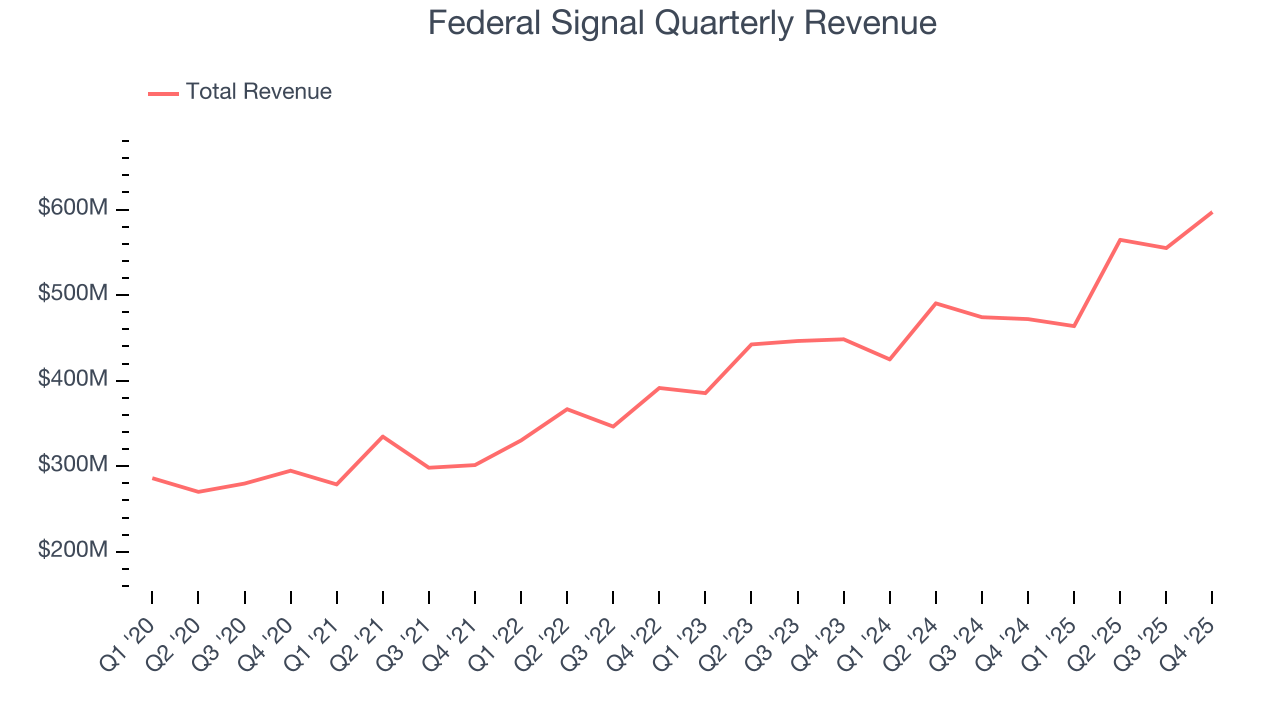
Long-term growth is the most important, but within industrials, a half-decade historical view may miss new industry trends or demand cycles. Federal Signal’s annualized revenue growth of 12.5% over the last two years is below its five-year trend, but we still think the results suggest healthy demand. Federal Signal’s recent performance shows it’s one of the better Heavy Transportation Equipment businesses as many of its peers faced declining sales because of cyclical headwinds. 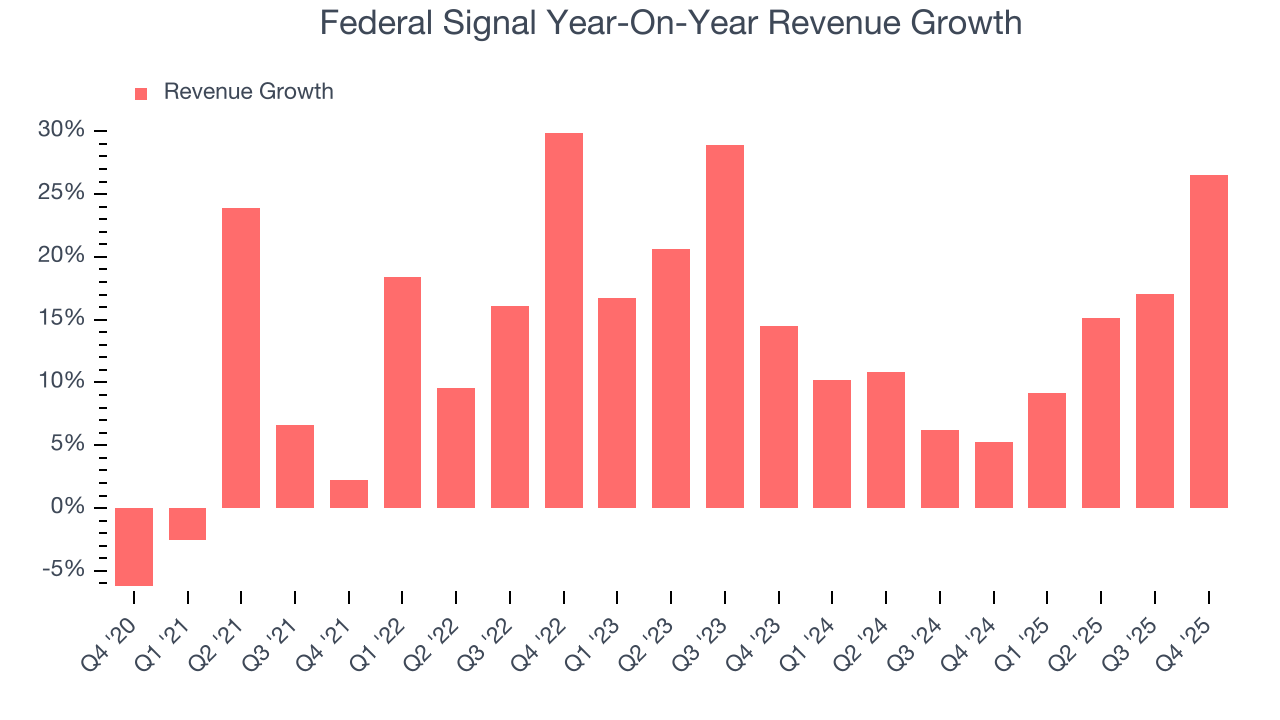
We can better understand the company’s revenue dynamics by analyzing its backlog, or the value of its outstanding orders that have not yet been executed or delivered. Federal Signal’s backlog reached $1.04 billion in the latest quarter and was flat over the last two years. Because this number is lower than its revenue growth, we can see the company fulfilled orders at a faster rate than it added new orders to the backlog. This implies Federal Signal was operating efficiently but raises questions about the health of its sales pipeline. 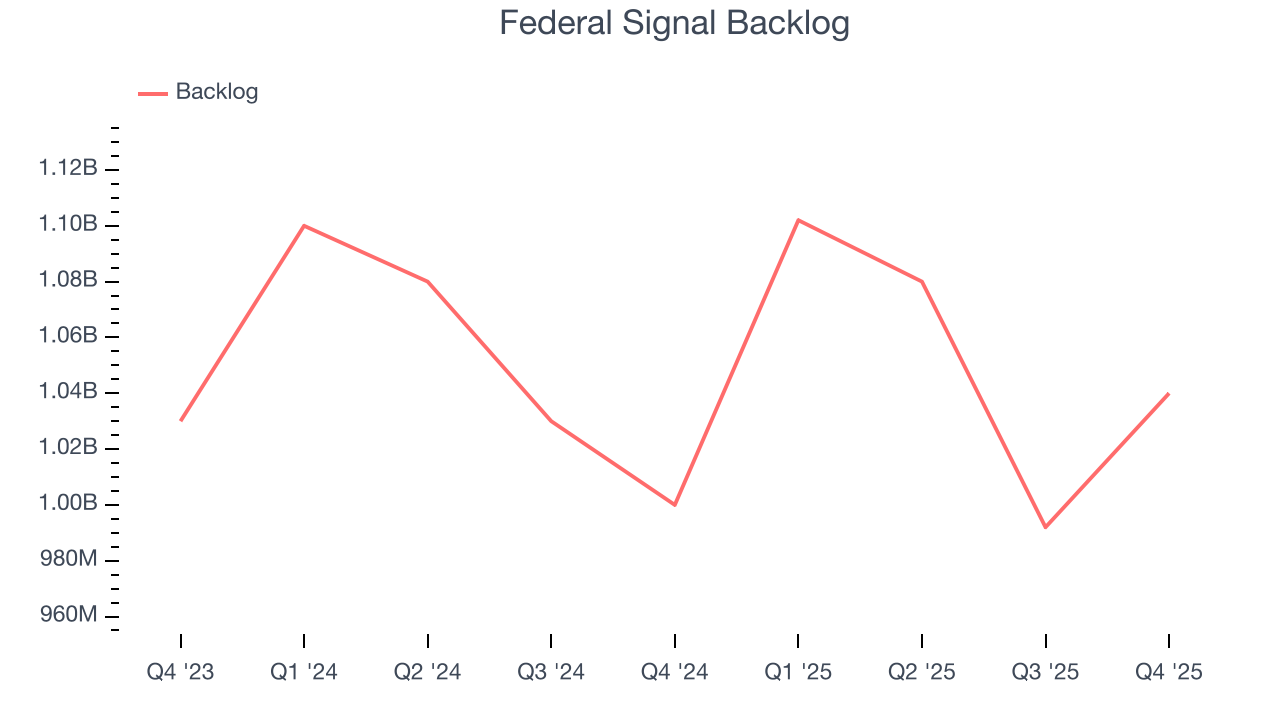
This quarter, Federal Signal reported robust year-on-year revenue growth of 26.5%, and its $597.1 million of revenue topped Wall Street estimates by 9.5%.
Looking ahead, sell-side analysts expect revenue to grow 12.3% over the next 12 months, similar to its two-year rate. This projection is commendable and implies the market is forecasting success for its products and services.
6. Gross Margin & Pricing Power
Federal Signal has bad unit economics for an industrials company, giving it less room to reinvest and develop new offerings. As you can see below, it averaged a 26.7% gross margin over the last five years. Said differently, Federal Signal had to pay a chunky $73.27 to its suppliers for every $100 in revenue. 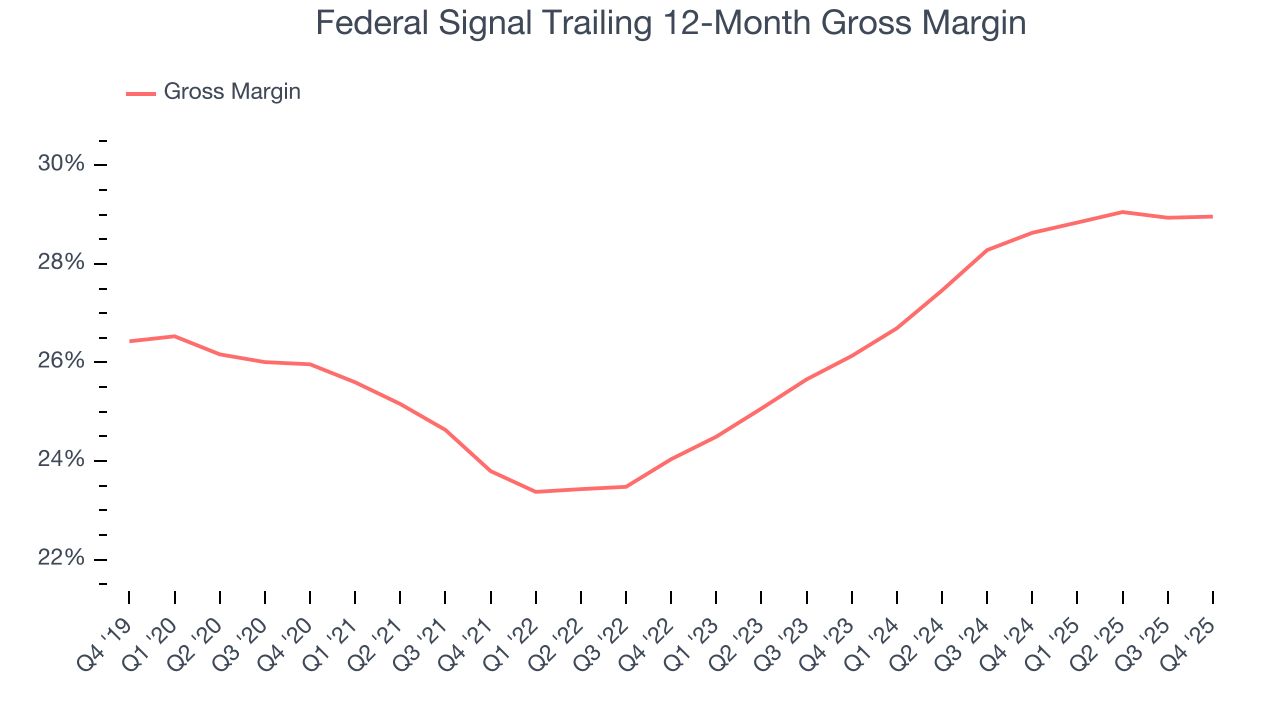
Federal Signal’s gross profit margin came in at 28.4% this quarter, in line with the same quarter last year. On a wider time horizon, the company’s full-year margin has remained steady over the past four quarters, suggesting its input costs (such as raw materials and manufacturing expenses) have been stable and it isn’t under pressure to lower prices.
7. Operating Margin
Federal Signal has been an efficient company over the last five years. It was one of the more profitable businesses in the industrials sector, boasting an average operating margin of 13.5%. This result was particularly impressive because of its low gross margin, which is mostly a factor of what it sells and takes huge shifts to move meaningfully. Companies have more control over their operating margins, and it’s a show of well-managed operations if they’re high when gross margins are low.
Analyzing the trend in its profitability, Federal Signal’s operating margin rose by 4.9 percentage points over the last five years, as its sales growth gave it operating leverage.
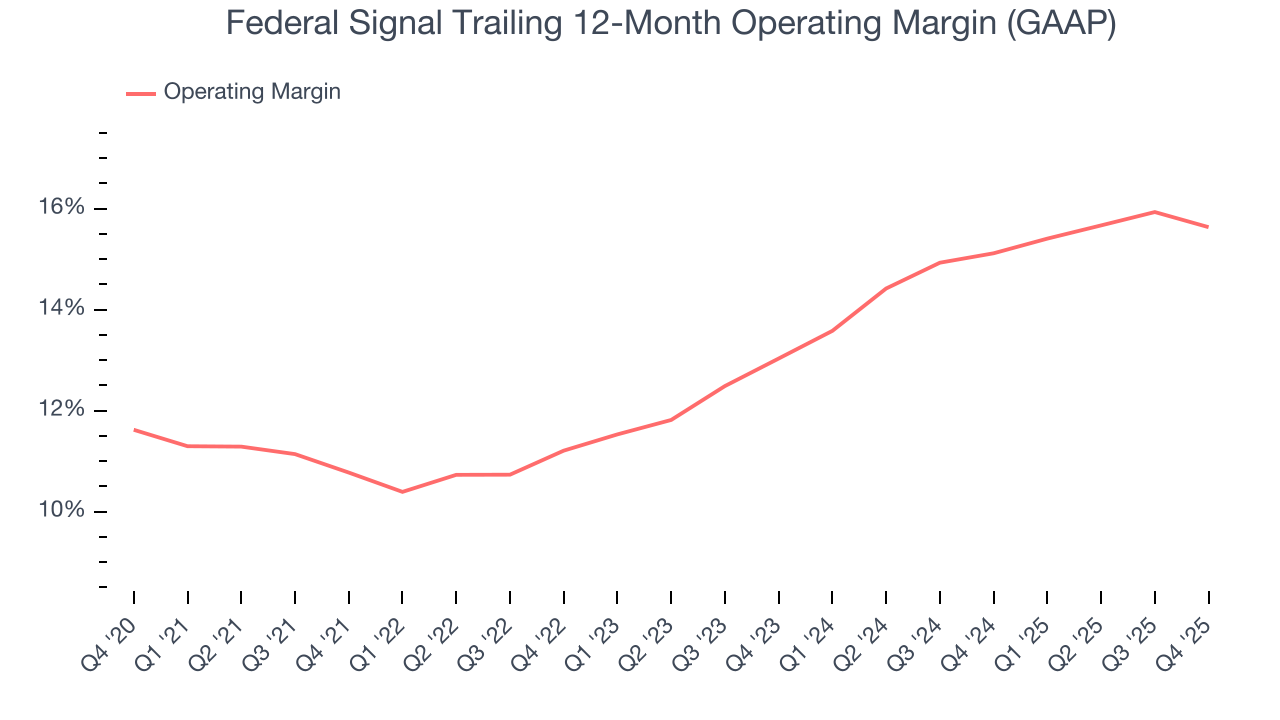
This quarter, Federal Signal generated an operating margin profit margin of 14%, in line with the same quarter last year. This indicates the company’s cost structure has recently been stable.
8. Earnings Per Share
Revenue trends explain a company’s historical growth, but the long-term change in earnings per share (EPS) points to the profitability of that growth – for example, a company could inflate its sales through excessive spending on advertising and promotions.
Federal Signal’s EPS grew at an astounding 20.4% compounded annual growth rate over the last five years, higher than its 14% annualized revenue growth. This tells us the company became more profitable on a per-share basis as it expanded.
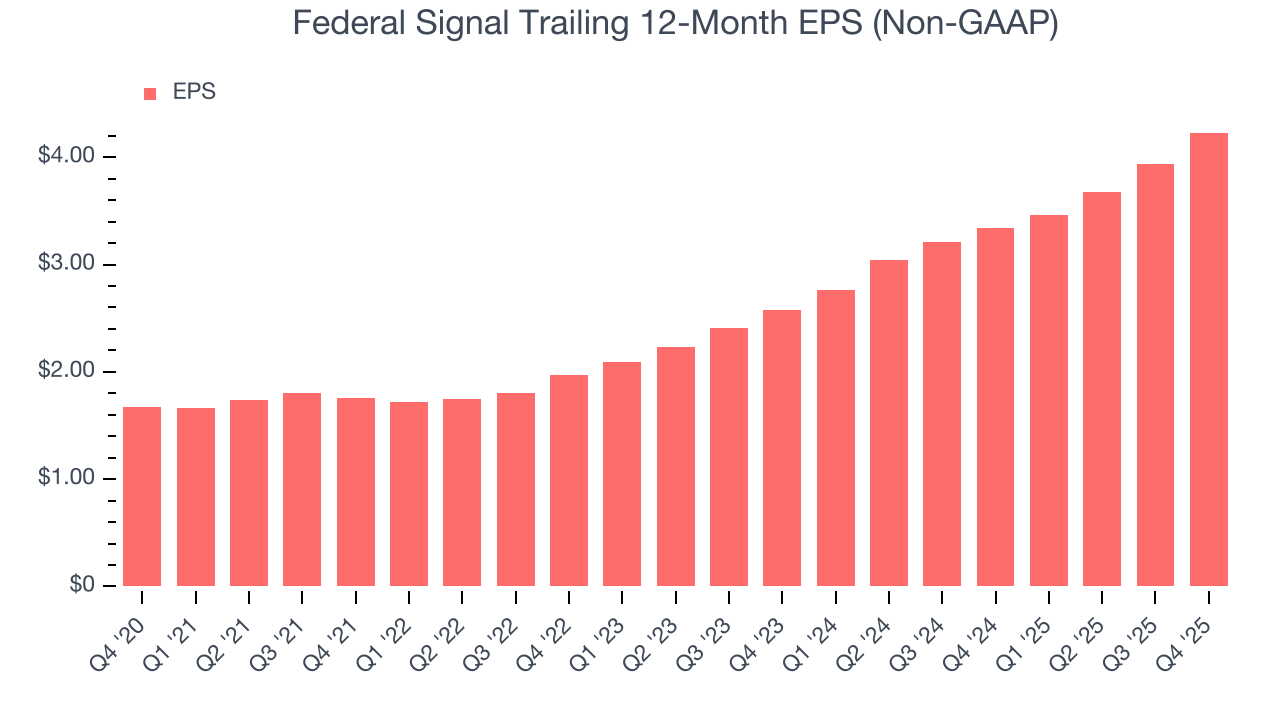
We can take a deeper look into Federal Signal’s earnings to better understand the drivers of its performance. As we mentioned earlier, Federal Signal’s operating margin was flat this quarter but expanded by 4.9 percentage points over the last five years. This was the most relevant factor (aside from the revenue impact) behind its higher earnings; interest expenses and taxes can also affect EPS but don’t tell us as much about a company’s fundamentals.
Like with revenue, we analyze EPS over a more recent period because it can provide insight into an emerging theme or development for the business.
For Federal Signal, its two-year annual EPS growth of 28% was higher than its five-year trend. We love it when earnings growth accelerates, especially when it accelerates off an already high base.
In Q4, Federal Signal reported adjusted EPS of $1.16, up from $0.87 in the same quarter last year. This print beat analysts’ estimates by 7.4%. Over the next 12 months, Wall Street expects Federal Signal’s full-year EPS of $4.23 to grow 9.9%.
9. Cash Is King
Although earnings are undoubtedly valuable for assessing company performance, we believe cash is king because you can’t use accounting profits to pay the bills.
Federal Signal has shown impressive cash profitability, enabling it to ride out cyclical downturns more easily while maintaining its investments in new and existing offerings. The company’s free cash flow margin averaged 7.9% over the last five years, better than the broader industrials sector.
Taking a step back, we can see that Federal Signal’s margin expanded by 5.1 percentage points during that time. This is encouraging because it gives the company more optionality.
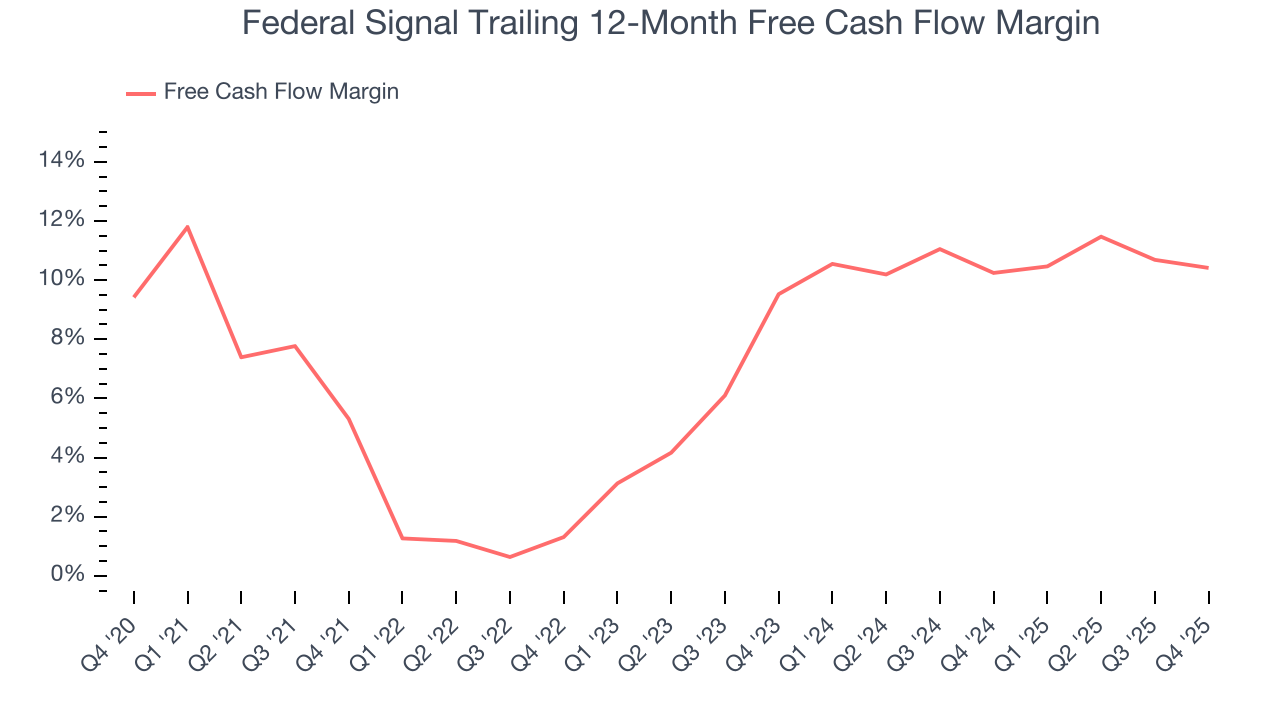
Federal Signal’s free cash flow clocked in at $89.5 million in Q4, equivalent to a 15% margin. The company’s cash profitability regressed as it was 2.4 percentage points lower than in the same quarter last year, but it’s still above its five-year average. We wouldn’t read too much into this quarter’s decline because capital expenditures can be seasonal and companies often stockpile inventory in anticipation of higher demand, causing short-term swings. Long-term trends trump temporary fluctuations.
10. Return on Invested Capital (ROIC)
EPS and free cash flow tell us whether a company was profitable while growing its revenue. But was it capital-efficient? A company’s ROIC explains this by showing how much operating profit it makes compared to the money it has raised (debt and equity).
Federal Signal’s five-year average ROIC was 14.1%, beating other industrials companies by a wide margin. This illustrates its management team’s ability to invest in attractive growth opportunities and produce tangible results for shareholders.
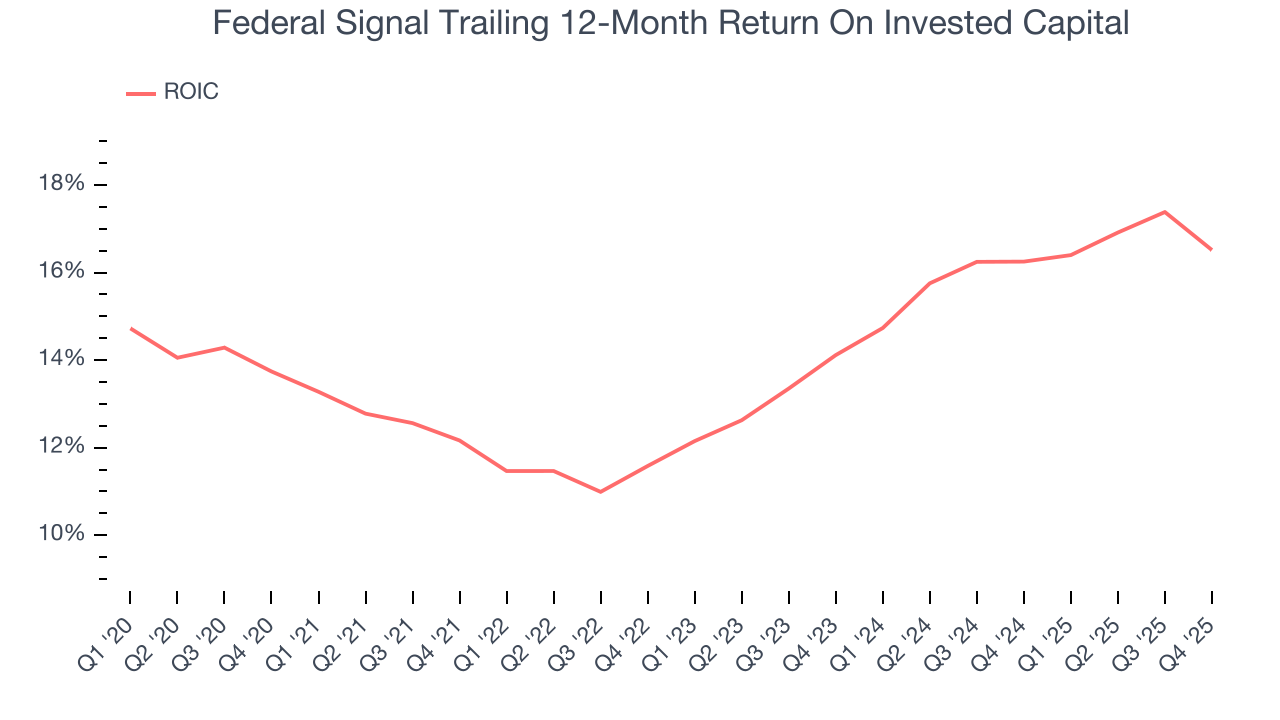
We like to invest in businesses with high returns, but the trend in a company’s ROIC is what often surprises the market and moves the stock price. Over the last few years, Federal Signal’s ROIC averaged 4.5 percentage point increases each year. This is a great sign when paired with its already strong returns. It could suggest its competitive advantage or profitable growth opportunities are expanding.
11. Balance Sheet Assessment
Federal Signal reported $63.7 million of cash and $565.1 million of debt on its balance sheet in the most recent quarter. As investors in high-quality companies, we primarily focus on two things: 1) that a company’s debt level isn’t too high and 2) that its interest payments are not excessively burdening the business.
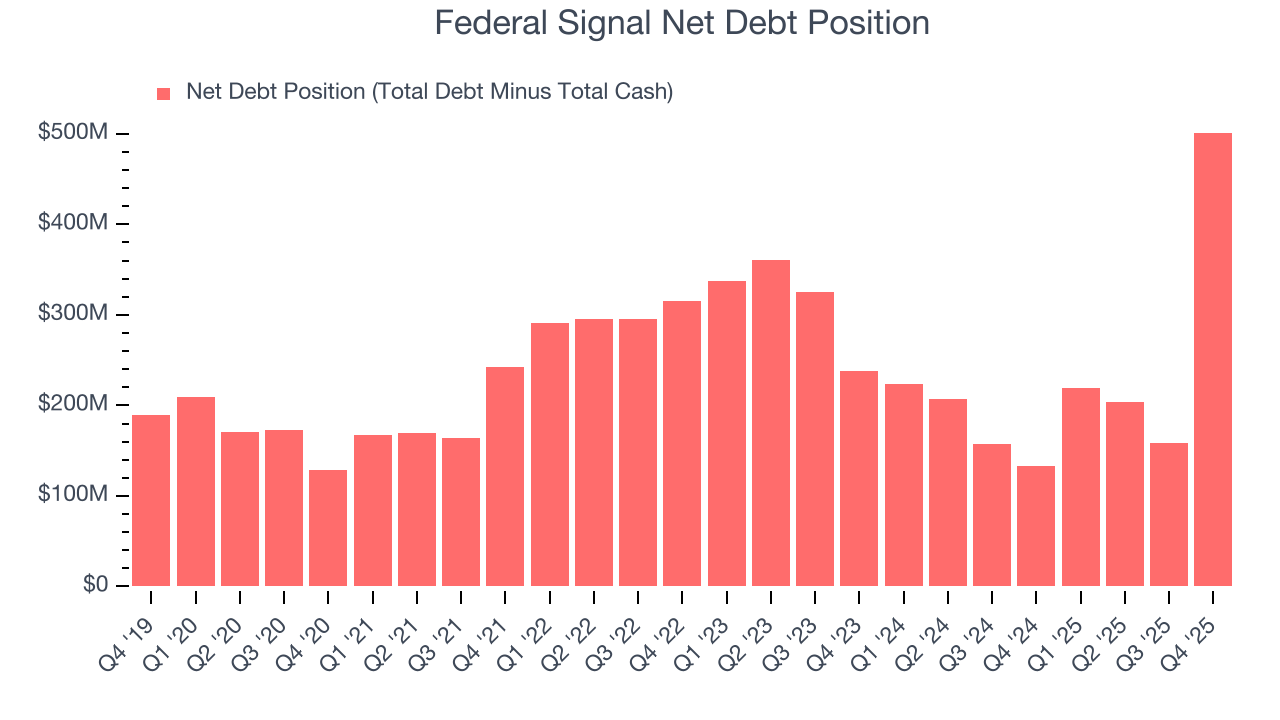
With $438.9 million of EBITDA over the last 12 months, we view Federal Signal’s 1.1× net-debt-to-EBITDA ratio as safe. We also see its $14.1 million of annual interest expenses as appropriate. The company’s profits give it plenty of breathing room, allowing it to continue investing in growth initiatives.
12. Key Takeaways from Federal Signal’s Q4 Results
We were impressed by how significantly Federal Signal blew past analysts’ EBITDA expectations this quarter. We were also excited its revenue outperformed Wall Street’s estimates by a wide margin. Zooming out, we think this was a good print with some key areas of upside. The stock traded up 8.2% to $126.57 immediately after reporting.
13. Is Now The Time To Buy Federal Signal?
Updated: March 15, 2026 at 11:08 PM EDT
Before deciding whether to buy Federal Signal or pass, we urge investors to consider business quality, valuation, and the latest quarterly results.
There is a lot to like about Federal Signal. To begin with, its revenue growth was exceptional over the last five years, and its growth over the next 12 months is expected to accelerate. And while its flat backlog disappointed, its rising cash profitability gives it more optionality. On top of that, Federal Signal’s astounding EPS growth over the last five years shows its profits are trickling down to shareholders.
Federal Signal’s P/E ratio based on the next 12 months is 22.7x. Analyzing the industrials landscape today, Federal Signal’s positive attributes shine bright. We think it’s one of the best businesses in our coverage and like the stock at this price.
Wall Street analysts have a consensus one-year price target of $138 on the company (compared to the current share price of $105.43), implying they see 30.9% upside in buying Federal Signal in the short term.